REVIEW 2 major objections 5 minor 30 references
The one-loop H±→W±Z amplitude in the two-Higgs-doublet model carries a CP-violating charge asymmetry that decomposes into bosonic, fermionic, and interference parts, and in the alignment limit only the fermionic part survives when the addit
Reviewed by Pith at T0; open to challenge. T0 means a machine referee read the full paper against a public rubric. the ladder, T0–T4 →
T0 review · deepseek-v4-flash
2026-08-03 05:41 UTC pith:I72XEAVE
load-bearing objection Competent, genuinely additive one-loop 2HDM calculation; the alignment-limit vanishing claim has an addressable but real analyticity gap. the 2 major comments →
CP violation in H^pm to W^pm Z: A physical approach for the 2HDM
The pith
A machine-rendered reading of the paper's core claim, the machinery that carries it, and where it could break.
Core claim
The central claim is that the charge asymmetry δ = (Γ(H+→W+Z) − Γ(H−→W−Z)) / (Γ(H+→W+Z) + Γ(H−→W−Z)) arises at one loop from three distinct interference families. In addition to the previously identified interference between bosonic and fermionic amplitudes, the paper identifies CP violation generated entirely within the bosonic loops (through the complex phases of the couplings fi that link each neutral Higgs to the charged Higgs and W) and entirely within the fermionic loops (through relative phases among the Yukawa couplings ρ~). All amplitudes are written directly in terms of the physical couplings ei, fi, qi and ρ, with loop integrals identical for both charge states. In the exact align
What carries the argument
The argument is carried by a reparametrisation of the 2HDM in terms of physical couplings rather than potential parameters: the neutral-scalar couplings to vector boson pairs (ei, with e1²+e2²+e3² = v²), the charged-Higgs–neutral-scalar–W couplings (fi, with phases fixed by the ei), the neutral-scalar–charged-pair couplings (qi), and the generic Yukawa matrices ρ~ that carry independent phases for up-type, down-type and lepton sectors. The charge asymmetry is organised by writing the one-loop amplitude as a sum over diagrams with a common prefactor fi or ρ~, so that complex conjugation of the external charge reverses only these coupling phases while leaving the Passarino–Veltman integrals un
Load-bearing premise
The vanishing of the purely bosonic asymmetry in the alignment limit rests on the premise, stated in section 4.4, that for m2+m3>mZ the only potentially complex loop integral among the surviving bosonic diagrams is C00 of diagram C-1, with all others real; if any other diagram or subleading term acquires an imaginary part, the asymmetry need not vanish.
What would settle it
Compute the full one-loop bosonic amplitude numerically in the exact alignment limit for a scalar spectrum with m2+m3>mZ, without imposing the 'only C-1 is complex' premise; if the imaginary parts of any other triangle or bubble integrals are non-zero, the claim that the asymmetry vanishes is refuted. A more direct experimental falsifier would be a measured non-zero charge asymmetry in a parameter region where fermionic contributions are kinematically or parametrically suppressed (e.g., mH± < mt+mb and |ρ| → 0).
If this is right
- If the decomposition is correct, a measured charge asymmetry in H±→W±Z directly constrains combinations of physical phases (phases of fi, phases of ρ, and the relative boson–fermion phase), not just the parameters of the scalar potential.
- In the alignment limit with m2+m3>mZ, any observed asymmetry is evidence of CP violation in the fermionic couplings or in the fermion-tadpole sector, since the purely bosonic contribution is predicted to vanish.
- The three sources of asymmetry can in principle be separated by scanning the charged-Higgs mass: fermionic amplitudes become complex immediately above the tb threshold, while bosonic amplitudes require the heavier mHi + mW threshold.
- The construction extends trivially to any multi-Higgs-doublet model, suggesting the charge asymmetry is a generic signature of extended scalar sectors, not a special feature of the 2HDM.
Where Pith is reading between the lines
- A dedicated numerical scan that drops the analyticity premise of section 4.4 could test whether subleading bosonic diagrams develop imaginary parts below the m2+m3>mZ threshold; if they do, the vanishing of the bosonic asymmetry in the alignment limit would be an artifact of the assumption.
- The same charge-asymmetry variable could be adapted to H±→W±γ, where the photon coupling forbids the scalar-mediated diagrams but shares the WZ gauge structure; a combined measurement of both asymmetries would help isolate the fermionic contribution.
- One could use the relation between the asymmetry and the CP-odd invariants ImJi to design sum rules linking the asymmetry size to known collider constraints on e2, e3 and qi, turning a future observation into a measurement of the invariants themselves.
Editorial analysis
A structured set of objections, weighed in public.
Referee Report
Summary. The paper computes the one-loop amplitude and charge asymmetry δ for H^± → W^± Z in the general 2HDM, expressing all amplitudes in terms of physical couplings (e_i, f_i, q_i, and the Yukawa matrices ρ̃). The amplitude is split into bosonic and fermionic loop contributions, including fermion tadpoles in the bosonic category. The central claims are: (i) there are CP-violating charge asymmetries from pure-bosonic interference, pure-fermionic interference, and boson–fermion interference; (ii) this qualitatively confirms the Kanemura–Mura result for boson–fermion interference, while also providing new sources; (iii) in the exact alignment limit with no fermionic loops and with m2 + m3 > mZ, the purely bosonic asymmetry vanishes; and (iv) away from alignment, or with fermionic loops, a charge asymmetry can survive. Extensive one-loop amplitudes are tabulated, cross-checked with FormCalc and by hand, and code is made available on GitHub.
Significance. If the claims are correct, this work is a valuable addition to 2HDM phenomenology: it isolates contributions to CP violation in H^± → W^± Z in terms of physical couplings rather than potential parameters, and it identifies new sources of the charge asymmetry beyond those studied by Kanemura and Mura. The paper has notable strengths: the analytic tabulation of loop amplitudes is detailed and machine-checked, the physical-coupling parametrization makes the phase structure transparent, the CPT/Cutkosky discussion gives a useful consistency check, and the GitHub repository provides reproducible analytic results. However, the alignment-limit vanishing claim — which is highlighted in the abstract — rests on an analyticity assertion that is not proven, and one of the analyticity statements in the fermionic section is incorrect as written. These issues are local and fixable, but they directly affect the paper's central claims.
major comments (2)
- [Section 4.4, Eq. (4.13)] The alignment-limit vanishing claim is load-bearing for the abstract, but it rests on the unproved assertion that 'it turns out that only diagram C-1 can possibly contain loop integrals with an imaginary part' and that its C00 is real for m2+m3>mZ. The surviving amplitudes in Table 4.1 also involve the combinations C1, C11, C12, C22 for C-1 and C-2, as well as B0 and B1 for the bubbles. No analyticity argument is given for these coefficients, and the numerical illustrations in Fig. 8 include fermionic tadpoles; they do not plot the no-fermion asymmetry in the exact alignment limit. Please provide a complete proof, or a numerical scan of the imaginary parts of all surviving Passarino–Veltman coefficients, together with a no-fermion asymmetry plot in the alignment limit. Without this, Eq. (4.13) and the abstract conclusion remain conditional.
- [Section 5.1, just before Eqs. (5.3)] The statement 'Since the loop integrals involved in the H amplitudes are all real' is not correct. For the tb triangles in Table 5.4, the coefficients C0 and C1 become complex when m_H± > m_t + m_b, which is precisely the region where the fermionic F and G amplitudes develop their imaginary parts. The conclusion that the H amplitude does not contribute to the charge asymmetry can instead be justified by the fact that the H+ and H- amplitudes are proportional to ρ^* Z and ρ Z with a common loop factor Z for diagonal ρ, so |H+|^2 = |H-|^2. The erroneous analyticity claim should be removed and replaced by this argument.
minor comments (5)
- [Notation, Eq. (4.10) and Section 2.3] The symbol ρ is used both for the kinematic tadpole factor in Eq. (4.10) and (in the form ρ̃) for the Yukawa matrices. This is confusing in Tables 4.3 and 4.4. Please rename one of them.
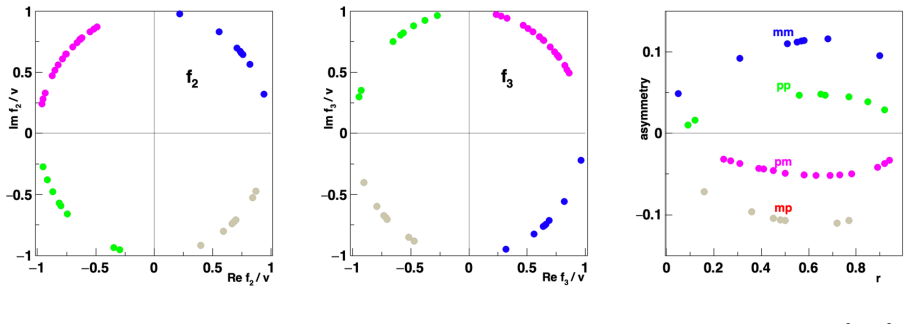
- [Figure 8 caption] The phrase 'the thin curves below do not' is ambiguous. Please specify exactly which contributions are omitted in the thin curves.
- [Section 4.5] There is a typo: 'threshol' should be 'threshold'.
- [Abstract / Comparison with Ref. [4]] The paper says it 'qualitatively confirms' Kanemura and Mura, but no quantitative comparison or parameter-overlap plot with Ref. [4] is provided. Please add one, so that the confirmation claim can be checked and the differences identified in Sections 4.6 and 5.3 are put in context.
- [Table 4.1] The remark that 'i' in the K_d column denotes the imaginary unit should be made in the table caption, not only in a footnote in the text.
Circularity Check
No significant circularity: the one-loop H±→W±Z asymmetry is derived from explicit loop integrals; self-citations are notational, and the alignment-limit claim rests on an unproved analyticity assertion, which is a correctness gap, not circularity.
full rationale
The paper's central quantity, the charge asymmetry δ, is computed from one-loop amplitudes whose dependence on the couplings e_i, f_i, q_i and ρ~ is set by Feynman rules and evaluated with Passarino–Veltman integrals (Tables 4.1–5.8). No parameter appearing in the final asymmetry is fitted to the asymmetry itself: the physical couplings are either algebraic definitions from prior work (Refs. [12,13]) or illustrative benchmark values (e.g., |ρ~|=0.1, imported from Ref. [4] and used only for numerical examples). The claimed new results—bosonic self-interference and fermionic self-interference contributions—follow from the structure of Eqs. (4.7), (5.4) and (3.7), not from any input equivalent to the output. The self-citations to Refs. [12,13,31] provide notation, Feynman rules, and independent CP-conditions; they do not supply the asymmetry result, and the custodial-symmetry equivalence is credited to Ref. [5] and Haber–O'Neil [14], which are not the present authors. The only notable weakness is in Section 4.4, where the vanishing of the purely bosonic asymmetry in the alignment limit for m2+m3>mZ rests on the asserted statement that 'only diagram C-1 can possibly contain loop integrals with an imaginary part' and that the surviving C00, B0, B1 are then real. This is an analyticity claim that is not fully demonstrated, but it is an unproved premise about loop-integral reality, not an input that has been renamed as a prediction. A failure of that premise would weaken the claim, but would not make the derivation circular. The paper is self-contained against the independent Kanemura–Mura result [4] and explicitly identifies differences, so no fitted-input-called-prediction or self-definitional circularity is present.
Axiom & Free-Parameter Ledger
free parameters (4)
- Neutral scalar masses m_i =
125, 200, 250 GeV; 125, 200, 400 GeV
- Gauge/Higgs couplings e_i =
e1 = 0.95v or 0.99v; e2,e3 split with r=0.5 or scanned
- Trilinear couplings q_i =
{100,150,10} GeV and {100,150,175} GeV
- Yukawa magnitudes and phases =
|ρ̃|=0.1 or 0.01; ζ_t=0,π/4,π/2; ζ_b=ζ_τ=0; θ_BF=0,π/4
axioms (6)
- domain assumption The 2HDM is the correct effective framework, with three neutral scalars, one charged pair, and the most general Yukawa couplings.
- domain assumption The one-loop amplitude is the leading contribution, since H±W∓Z vanishes at tree level in SU(2)×U(1) with doublets.
- standard math Passarino–Veltman reduction and dimensional reduction provide a consistent finite one-loop result.
- domain assumption For on-shell W/Z decaying to light fermions, terms proportional to p2^α or p3^β can be dropped.
- domain assumption A loop integral develops an imaginary part only when √s_i > m_i + m_{i+1}; and for m2+m3>mZ the relevant C00/B0/B1 integrals in the alignment limit are real.
- standard math CPT requires total widths to be equal, so the asymmetry in H±→W±Z is balanced by other channels listed in Eq. (1.7).
read the original abstract
We investigate CP violation in the process H^\pm \to W^\pm Z within the framework of the two-Higgs-Doublet model (2HDM). Amplitudes are expressed transparently in terms of physical couplings. Our analysis qualitatively confirms recent results by Kanemura and Mura, for the interference between one-loop bosonic and fermionic amplitudes. Furthermore, we identify additional sources of CP violation arising from internal interference among the bosonic and also among the fermionic loop amplitudes. In the alignment limit, the asymmetry would vanish in the absence of fermionic loop contributions when the sum of the masses of the additional neutral scalars is higher than the mass of the Z. Our results allow for generic Yukawa couplings, and cover both explicit and spontaneous CP violation. For inclusive W^\pm and Z decays, the CP violation will only manifest itself as a charge asymmetry.
Figures






Reference graph
Works this paper leans on
-
[1]
J. A. Grifols and A. Mendez,TheW ZH ± Coupling inSU(2)×U(1)Gauge Models,Phys. Rev. D22(1980) 1725
1980
-
[2]
Mendez and A
A. Mendez and A. Pomarol,One loop inducedH +W +Zvertex in the minimal supersymmetry model,Nucl. Phys. B349(1991) 369–380
1991
-
[3]
Mendez and A
A. Mendez and A. Pomarol,Signals of CP violation in the Higgs sector,Phys. Lett. B272(1991) 313–318
1991
-
[4]
S. Kanemura and Y. Mura,Loop induced H ±W∓Z vertices in the general two Higgs doublet model with CP violation,JHEP10(2024) 041, [2408.06863]
Pith/arXiv arXiv 2024
-
[5]
B. Grzadkowski, M. Maniatis and J. Wudka,The bilinear formalism and the custodial symmetry in the two-Higgs-doublet model,JHEP11(2011) 030, [1011.5228]
Pith/arXiv arXiv 2011
-
[6]
J. F. Gunion and H. E. Haber,Conditions for CP-violation in the general two-Higgs-doublet model,Phys. Rev. D72(2005) 095002, [hep-ph/0506227]
Pith/arXiv arXiv 2005
-
[7]
G. C. Branco, M. N. Rebelo and J. I. Silva-Marcos,CP-odd invariants in models with several Higgs doublets,Phys. Lett. B614(2005) 187–194, [hep-ph/0502118]
Pith/arXiv arXiv 2005
-
[8]
L. Lavoura and J. P. Silva,Fundamental CP violating quantities in a SU(2)×U(1) model with many Higgs doublets,Phys. Rev. D50(1994) 4619–4624, [hep-ph/9404276]
Pith/arXiv arXiv 1994
-
[9]
F. J. Botella and J. P. Silva,Jarlskog - like invariants for theories with scalars and fermions,Phys. Rev. D51(1995) 3870–3875, [hep-ph/9411288]
Pith/arXiv arXiv 1995
-
[10]
R. F. Streater and A. S. Wightman,PCT, spin and statistics, and all that. Benjamin/Cummings, Reading, Mass., 1964
1964
-
[11]
R. E. Cutkosky,Singularities and discontinuities of Feynman amplitudes,J. Math. Phys.1(1960) 429–433
1960
-
[12]
B. Grzadkowski, O. M. Ogreid and P. Osland,Measuring CP violation in Two-Higgs-Doublet models in light of the LHC Higgs data,JHEP11(2014) 084, [1409.7265]
Pith/arXiv arXiv 2014
-
[13]
B. Grzadkowski, H. E. Haber, O. M. Ogreid and P. Osland,Heavy Higgs boson decays in the alignment limit of the 2HDM,JHEP12(2018) 056, [1808.01472]
Pith/arXiv arXiv 2018
-
[14]
H. E. Haber and D. O’Neil,Basis-independent methods for the two-Higgs-doublet model III: The CP-conserving limit, custodial symmetry, and the oblique parameters S, T, U,Phys. Rev. D83(2011) 055017, [1011.6188]
Pith/arXiv arXiv 2011
-
[15]
M. Aoki, S. Kanemura, K. Tsumura and K. Yagyu,Models of Yukawa interaction in the two Higgs doublet model, and their collider phenomenology,Phys. Rev. D80 (2009) 015017, [0902.4665]. 37
Pith/arXiv arXiv 2009
-
[16]
G. C. Branco, P. M. Ferreira, L. Lavoura, M. N. Rebelo, M. Sher and J. P. Silva, Theory and phenomenology of two-Higgs-doublet models,Phys. Rept.516(2012) 1–102, [1106.0034]
Pith/arXiv arXiv 2012
-
[17]
T. Hahn and M. Perez-Victoria,Automatized one loop calculations in four-dimensions and D-dimensions,Comput.Phys.Commun.118(1999) 153–165, [hep-ph/9807565]
Pith/arXiv arXiv 1999
-
[18]
F. J. Botella, G. C. Branco, M. Nebot and M. N. Rebelo,New physics and evidence for a complex CKM,Nucl. Phys. B725(2005) 155–172, [hep-ph/0502133]. [19]CKMfitter Groupcollaboration, J. Charles, A. Hocker, H. Lacker, S. Laplace, F. R. Le Diberder, J. Malcles et al.,CP violation and the CKM matrix: Assessing the impact of the asymmetricBfactories,Eur. Phys....
Pith/arXiv arXiv 2005
-
[20]
Tree-level metastability bounds of the 2HDM in terms of physical parameters
O. M. Ogreid, “Tree-level metastability bounds of the 2HDM in terms of physical parameters.” Talk at MultiHiggs workshop, Lisboa September 2024, http://cftp.tecnico.ulisboa.pt/~2hdmwork/index.php?n=Main.HomePage, 2024
2024
-
[21]
I. P. Ivanov and J. P. Silva,Tree-level metastability bounds for the most general two Higgs doublet model,Phys. Rev. D92(2015) 055017, [1507.05100]
Pith/arXiv arXiv 2015
-
[22]
Passarino and M
G. Passarino and M. J. G. Veltman,One Loop Corrections for e+ e- Annihilation Into mu+ mu- in the Weinberg Model,Nucl. Phys. B160(1979) 151–207
1979
-
[23]
G. J. van Oldenborgh and J. A. M. Vermaseren,New Algorithms for One Loop Integrals,Z. Phys. C46(1990) 425–438
1990
-
[24]
Hahn,Generating Feynman diagrams and amplitudes with FeynArts 3,Comput
T. Hahn,Generating Feynman diagrams and amplitudes with FeynArts 3,Comput. Phys. Commun.140(2001) 418–431, [hep-ph/0012260]
Pith/arXiv arXiv 2001
-
[25]
Kublbeck, M
J. Kublbeck, M. Bohm and A. Denner,Feyn Arts: Computer Algebraic Generation of Feynman Graphs and Amplitudes,Comput. Phys. Commun.60(1990) 165–180. [26]Particle Data Groupcollaboration, S. Navas et al.,Review of particle physics, Phys. Rev. D110(2024) 030001
1990
-
[27]
P. Athron, A. Crivellin, T. E. Gonzalo, S. Iguro and C. Sierra,Global fit to the 2HDM with generic sources of flavour violation using GAMBIT,JHEP11(2024) 133, [2410.10493]
Pith/arXiv arXiv 2024
-
[28]
A. Crivellin, A. Kokulu and C. Greub,Flavor-phenomenology of two-Higgs-doublet models with generic Yukawa structure,Phys. Rev. D87(2013) 094031, [1303.5877]
Pith/arXiv arXiv 2013
-
[29]
A. Pomarol and R. Vega,Constraints on CP violation in the Higgs sector from the rho parameter,Nucl. Phys. B413(1994) 3–15, [hep-ph/9305272]
Pith/arXiv arXiv 1994
-
[30]
A. Pilaftsis,On the Classification of Accidental Symmetries of the Two Higgs Doublet Model Potential,Phys. Lett. B706(2012) 465–469, [1109.3787]. 38
Pith/arXiv arXiv 2012
-
[31]
B. Grzadkowski, O. M. Ogreid and P. Osland,Spontaneous CP violation in the 2HDM: physical conditions and the alignment limit,Phys. Rev. D94(2016) 115002, [1609.04764]
Pith/arXiv arXiv 2016
-
[32]
P. M. Ferreira, B. Grzadkowski, O. M. Ogreid and P. Osland,Symmetries of the 2HDM: an invariant formulation and consequences,JHEP02(2021) 196, [2010.13698]. 39
Pith/arXiv arXiv 2021
discussion (0)
Sign in with ORCID, Apple, or X to comment. Anyone can read and Pith papers without signing in.