REVIEW 6 minor 108 references
Spin Relaxometry with Solid-State Defects: Theory, Platforms, and Applications
T0 review · 0 major / 6 minor · reviewed 2026-08-03 · deepseek-v4-flash
Pith's one-line read Spin relaxometry turns solid-state defects into local, frequency-selective noise spectrometers.
desk verdict A solid, carefully scoped review of defect spin relaxometry; no new physics but a genuinely useful consolidation, worth refereeing if the journal wants a review. read the letter →
The pith
A machine-rendered reading of the paper's core claim, the machinery that carries it, and where it could break.
The reading
What carries the argument
The load-bearing object is the Bloch-Redfield / Fermi-golden-rule expression for longitudinal relaxation, Eq. (10), which connects the macroscopic decay rate Gamma1 to the microscopic PSD S_B_perp(omega_NV). Around it sit the filter-function formalism that places T1 in a family with T2*, T2, and T1_rho; the fluctuation-dissipation theorem linking spin/current correlations to noise; and the magnetostatic Green's function / near-field propagator that relates sample degrees of freedom to the field at the sensor. Cross-relaxometry adds a Lorentzian resonance formula Gamma1,CR(B) ~ J^2 tau_c / (1 + Delta^2 tau_c^2) that turns field sweeps into spectra.
What would settle it
Measure T1 as a function of height h and temperature T above a metal film of independently known conductivity sigma, and test the predicted Johnson-noise scaling Gamma1 proportional to T sigma / d. A quantitative disagreement larger than the uncertainty in NV depth, or a measured T1 that cannot be reconciled with any S_B_perp(omega_NV) consistent with transport data, would falsify the central mapping.
Extended reading notes
Core claim
The central claim is Eq. (10): Gamma1 is approximately (gamma_e^2/2) S_B_perp(omega_NV), with angular factors and matrix elements folded into the prefactor. The longitudinal spin relaxation rate is set by the transverse component of the magnetic-noise power spectral density at the transition frequency of the sensor spin. Because omega_NV is field-tunable, a single defect can scan environmental noise; when omega_NV matches a target transition, cross-relaxation produces Lorentzian features in Gamma1(B) that act as ESR or NMR spectra. The review's thesis is that measured T1 data, combined with propagator models for how sample currents or spins create fields at the sensor, can be inverted to inf
Load-bearing premise
The entire quantitative interpretation rests on weak coupling to a classical, Markovian noise bath, so that Gamma1 really is proportional to S_B_perp(omega_NV) with frequency-symmetric PSD; near level anticrossings, for strongly coupled targets, or at low temperature this simple proportionality can fail.
Editorial extensions
If this is right
- A single T1 measurement at known field and depth constrains the transverse magnetic-noise PSD at that frequency, making the defect a calibrated noise spectrometer.
- Field sweeps of T1 reveal ESR fingerprints of dark spins and NMR spectra of nearby nuclear spins without applying microwaves, as demonstrated in cross-relaxometry and GSLAC-based nano-NMR.
- Combining T1 with T1_rho, T2, and T2* data maps S_B(omega) over roughly DC to GHz, letting distinct noise sources be separated by their frequency bands.
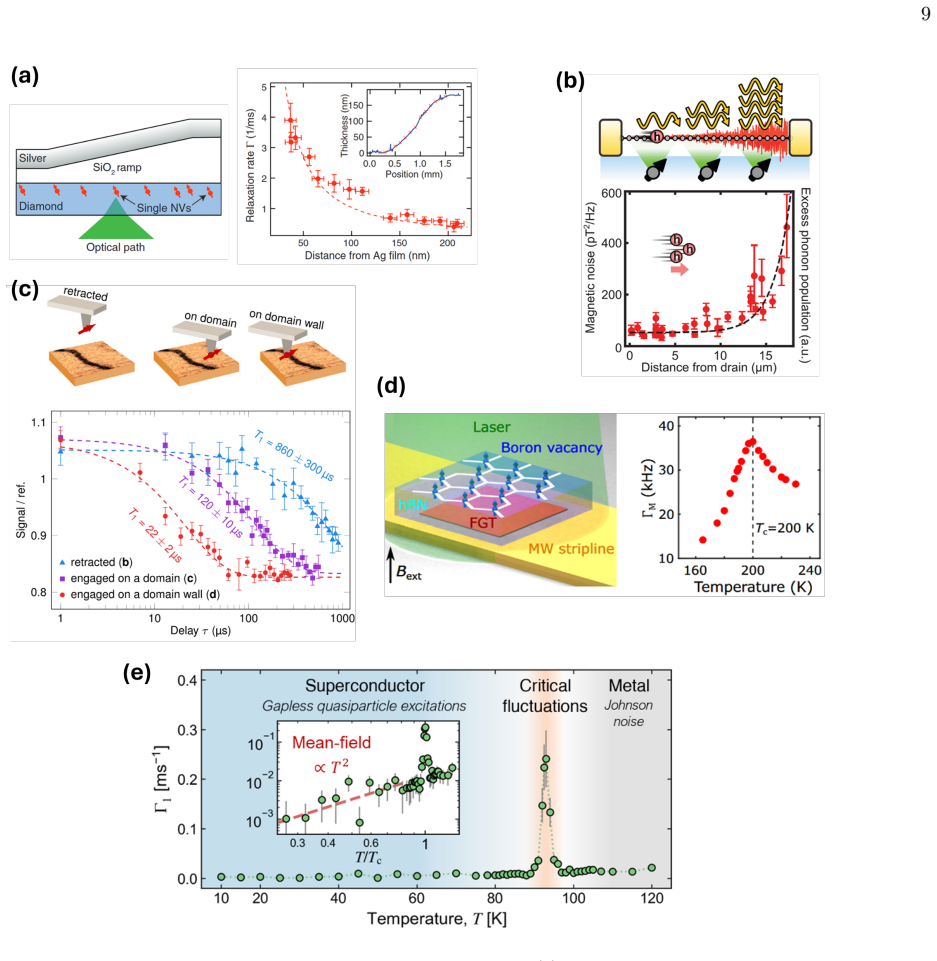
- Because the sensor-sample distance acts as a near-field spatial filter, relaxometry can image antiferromagnetic domain walls, vortex motion, and critical fluctuations that produce no static stray field.
- At bias fields above about 1 T, where resonant microwave control is impractical, all-optical relaxometry remains functional, extending noise spectroscopy to high-frequency magnon modes if the sensor frequency is tuned into resonance.
Reading between the lines
- If the linear mapping is quantitatively reliable, then T1(h, B, T) datasets acquired at multiple depths and fields should allow a 'noise tomography' that separates surface-spin noise from sample noise; the review notes the inversion is ill-posed, so this would require physically constrained multi-contrast fitting.
- The same mapping should apply to other optically addressable defects (hBN boron vacancies, SiC divacancies), so the quantitative machinery of NV relaxometry could be carried to 2D and chip-integrated platforms with closer standoff.
- At cryogenic temperatures or strong coupling, the classical high-temperature PSD symmetry breaks down; a testable extension is to use the ratio of up/down transition rates to measure the effective temperature of the noise source through detailed balance.
- A concrete experimental proposal: compare T1-derived noise PSD with independently calculated Johnson-Nyquist noise from a metal film of known conductivity; agreement at all distances would validate the geometry-sensitive propagator, and any systematic excess would point to uncontrolled surface noise.
Editorial analysis
A structured set of objections, weighed in public.
Referee Report
Summary. This review presents a comprehensive overview of spin relaxometry with solid-state spin defects, primarily NV centers, hBN boron vacancies, and SiC defects. It introduces the central weak-coupling result that the longitudinal relaxation rate Γ1 is proportional to the transverse magnetic-noise power spectral density at the NV transition frequency (Eq. 10), and discusses how field tuning and near-field geometry turn T1 measurements into local noise spectroscopy. The review then surveys experimental platforms, theory (including cross-relaxation and filter-function concepts), and applications in condensed matter (conductors, magnets, superconductors), biology, and nanoscale NMR. It closes with an outlook emphasizing quantitative inversion, standardization, and integration with extreme environments.
Significance. As a review, the paper's value lies in its uniform theoretical framing and broad application survey. It correctly presents the standard Bloch–Redfield/Fermi–Golden-Rule result with explicit caveats for strong coupling, GSLAC, and cryogenic regimes. The review is balanced in acknowledging measurement artifacts (charge conversion, surface noise) and the ill-posed nature of the inverse problem. If the manuscript is intended for practitioners, it provides a useful entry point and a coherent notation across platforms. The inclusion of recent preprints makes it timely, though some citations should be updated.
minor comments (6)
- [§4.2, Eq. (10)] The coefficient in Eq. (10) is stated “up to angular factors and matrix elements.” Please specify the exact prefactor or at least define B⊥ and the transition chosen; otherwise the “quantitative roadmap” promise is not fully met.
- [§4.3, Eq. (13)] The filter function F(ω,τ) is not defined. Please give a definition and normalization (or provide a reference to a standard formula) so readers can compare with the literature.
- [§3.2] Typo: “in a a magnetic layer” should read “in a magnetic layer.”
- [§5.1.1] Grammar: “dominated by fluctuations arises from” should be “dominated by fluctuations arising from.”
- [§5.1.3, §5.3.1] Several key applications rely on arXiv preprints (e.g., Refs. [19], [89], and others). Please update to published versions where available, or note the preprint status in the citation.
- [References] Minor inconsistencies in author initials: Ref. [9] vs [10] use different initials for the same first author (J. D. A. Wood vs J. D. Wood), and Ref. [83] lists “L. Hall” instead of “L. T. Hall.” Please standardize.
Circularity Check
No significant circularity: the central weak-coupling mapping is standard textbook physics, benchmarked against external literature, and the review explicitly scopes its own breakdown regimes.
full rationale
The paper's load-bearing relation, Γ1 = (γ_e^2/2) S_B⊥(ω_NV) (Eq. 10), is derived explicitly from Bloch–Redfield / Fermi's Golden Rule (Eqs. 7–10) under stated assumptions of weak coupling, Markovian noise, and classical high-temperature PSD symmetry. No quantity in this derivation is defined by a fit performed in the paper, and no fitted parameter is renamed as a prediction. The inverse problem—extracting a unique S(ω) from Γ1(h,B,T)—is openly acknowledged in the Outlook as 'often ill-posed,' which is a practical identifiability concern, not a circular reduction. The review does cite several of the authors' own experiments (e.g., Refs. 19, 37–40, 84, 89, 95–96) as application exemplars, but these are externally falsifiable experimental measurements and are not used to justify or force the central theoretical mapping. Breakdown regimes—GSLAC strong coupling, cryogenic detailed balance, and surface charge conversion mimicking fast T1—are explicitly flagged in §§4.1, 4.2, and 5.3.2, so the central claim is appropriately scoped rather than overclaimed. The derivation chain is therefore self-contained and not circular.
Assumptions & free parameters
assumptions (6)
- domain assumption Weak-coupling, Markovian Bloch–Redfield / Fermi Golden Rule applies to NV–environment dynamics (V small, memoryless).
- domain assumption High-temperature classical noise with symmetric PSD, S_B⊥(ω)≈S_B⊥(−ω).
- domain assumption NV can be truncated to an effective two-level system {|0>,|−1>} or {|0>,|+1>}.
- domain assumption Rotating-wave approximation and Lorentzian spectral density for target spins in cross-relaxometry.
- standard math Fluctuation-dissipation relations (Eqs. 14-15) and magnetostatic/Biot-Savart propagators connect sample fluctuations to NV-field noise.
- domain assumption Statistical polarization √N for nanoscale NMR and no back-action on target nuclei.
Cite this review
Pith. "Pith review of Spin Relaxometry with Solid-State Defects: Theory, Platforms, and Applications." pith.science (2026). https://pith.science/paper/IDCKU2PH
@misc{pith2026260201521,
  author       = {Pith},
  title        = {Pith review of: Spin Relaxometry with Solid-State Defects: Theory, Platforms, and Applications},
  year         = {2026},
  howpublished = {\url{https://pith.science/paper/IDCKU2PH}},
  note         = {Machine review of arXiv:2602.01521}
}
read the original abstract
Spin relaxometry using solid-state spin defects, such as the diamond nitrogen-vacancy (NV) center, probes dynamical processes by measuring how environmental fluctuations enhance the spin relaxation rate. In the weak-coupling limit, relaxation rates sample the transverse magnetic-noise power spectral density through a sensor-specific filter function, turning the defect into a local, frequency-selective noise spectrometer. This review bridges theory and experiment, clarifying how measured relaxation rates map onto noise spectra and how near-field geometry shapes the response. We highlight representative applications across condensed-matter physics, chemical and biological sensing, and relaxometry-based magnetic-resonance spectroscopy. We conclude with emerging opportunities and key challenges.
Figures


Figures from the paper (2 more)


Reference graph
Works this paper leans on
-
[1]
a material response, described by current or spin correlation functions (or equivalently, by dynamical susceptibilities)
-
[2]
is most sensitive to quasi-static and low-frequency noise, since the corresponding filter function is peaked nearω≈0 and slow fluctuations and inhomogeneous fields domi- nate. Hahn echo and dynamical decoupling (T2) suppress quasi-static contributions and become sensitive to noise near frequencies set by the inverse evolution time; multi- pulse sequences ...
-
[3]
Tetienne, T
J. Tetienne, T. Hingant, and L. Rondin, Physical Re- view B87, 235436 (2013)
2013
-
[4]
relaxometric
THEOR Y OF SPIN RELAXOMETR Y The goal of this section is to make explicit how mea- sured relaxation rates (e.g.,T 1,T 1ρ) connect to the en- vironmental magnetic-noise spectral densitySB(ω). We first write down a minimal Hamiltonian for the NV, then use a Bloch–Redfield / Fermi–Golden-Rule picture to re- lateΓ 1 toS B⊥ (ωNV), and finally placeT 1 within t...
-
[5]
For spin systems (e.g., magnets, paramagnets), one of- ten starts from the spin–spin correlation function or the imaginary part of the dynamical susceptibilityχ′′(q, ω)
ageometricalpropagator, describinghow thesecur- rents or spins generate magnetic fields at the NV location. For spin systems (e.g., magnets, paramagnets), one of- ten starts from the spin–spin correlation function or the imaginary part of the dynamical susceptibilityχ′′(q, ω). The fluctuation–dissipation theorem relates the Fourier transform of magnetizat...
-
[6]
rad- ical dialogues
EXPERIMENT AL APPLICA TIONS OF SPIN RELAXOMETR Y 5.1 Condensed matter systems 5.1.1 Conductors Inregularconductors, themagneticnoiseinthesystem is dominated by fluctuations arises from the thermal ex- cited current, commonly described as Johnson-Nyquist noise. The stochastic thermal currents produce broad- band magnetic fields that encompass the transitio...
2019
-
[7]
where noise is
CONCLUSION AND OUTLOOK NV spin relaxometry has evolved from a niche technique into a general-purpose nanoscale noise- spectroscopy platform. Its strength lies in turn- ing complex dynamics into an experimentally acces- sible decay rate while retaining a quantitative link to the underlying magnetic-noise power spectral den- sity. The method is now establis...
-
[8]
A. Mzyk, A. Sigaeva, and R. Schirhagl, Accounts of chemical research55, 3572 (2022)
2022
Show all 108 references
-
[9]
C. L. Degen, F. Reinhard, and P. Cappellaro, Reviews of modern physics89, 035002 (2017)
2017
-
[10]
J. F. Barry, J. M. Schloss, E. Bauch, M. J. Turner, C. A. Hart, L. M. Pham, and R. L. Walsworth, Reviews of Modern Physics92, 015004 (2020)
2020
-
[11]
Rosskopf, A
T. Rosskopf, A. Dussaux, K. Ohashi, M. Loretz, R. Schirhagl, H. Watanabe, S. Shikata, K. M. Itoh, and C. Degen, Physical review letters112, 147602 (2014)
2014
-
[12]
Y.Romach, C.Müller, T.Unden, L.J.Rogers, T.Isoda, K. M. Itoh, M. Markham, A. Stacey, J. Meijer, S. Pezza- gna, B. Naydenov, L. P. McGuinness, N. Bar-Gill, and F. Jelezko, Phys. Rev. Lett.114, 017601 (2015)
2015
-
[13]
Sangtawesin, B
S. Sangtawesin, B. L. Dwyer, S. Srinivasan, J. J. Allred, L. V. H. Rodgers, K. De Greve, A. Stacey, N. Dontschuk, K. M. O’Donnell, D. Hu, D. A. Evans, C. Jaye, D. A. Fischer, M. L. Markham, D. J. Twitchen, H. Park, M. D. Lukin, and N. P. de Leon, Phys. Rev. X 9, 031052 (2019)
2019
-
[14]
Cardoso Barbosa, J
I. Cardoso Barbosa, J. Gutsche, and A. Widera, Physi- cal Review B108, 075411 (2023)
2023
-
[15]
J. D. A. Wood, D. A. Broadway, L. T. Hall, A. Stacey, D. A. Simpson, J.-P. Tetienne, and L. C. L. Hollenberg, Phys. Rev. B94, 155402 (2016)
2016
-
[16]
J. D. Wood, J.-P. Tetienne, D. A. Broadway, L. T. Hall, D. A. Simpson, A. Stacey, and L. C. Hollenberg, Nature communications8, 15950 (2017)
2017
-
[17]
D. A. Broadway, J.-P. Tetienne, A. Stacey, J. D. Wood, D. A. Simpson, L. T. Hall, and L. C. Hollenberg, Nature communications9, 1246 (2018)
2018
-
[18]
Mignon, A
C. Mignon, A. R. Ortiz Moreno, H. Shirzad, S. K. Padamati, V. G. Damle, Y. Ong, R. Schirhagl, and M. Chipaux, ACS sensors8, 1667 (2023)
2023
-
[19]
Kolkowitz, A
S. Kolkowitz, A. Safira, A. High, R. Devlin, S. Choi, Q. Unterreithmeier, D. Patterson, A. Zibrov, V. Manucharyan, H. Park,et al., Science347, 1129 (2015)
2015
-
[20]
B. A. McCullian, A. M. Thabt, B. A. Gray, A. L. Melen- dez, M. S. Wolf, V. L. Safonov, D. V. Pelekhov, V. P. Bhallamudi, M. R. Page, and P. C. Hammel, Nature communications11, 5229 (2020)
2020
-
[21]
Takei and Y
S. Takei and Y. Tserkovnyak, Physical Review Research 6, 013043 (2024)
2024
-
[22]
Ariyaratne, D
A. Ariyaratne, D. Bluvstein, B. A. Myers, and A. C. B. Jayich, Nature communications9, 2406 (2018)
2018
-
[23]
Finco, A
A. Finco, A. Haykal, R. Tanos, F. Fabre, S. Chouaieb, W. Akhtar, I. Robert-Philip, W. Legrand, F. Ajejas, K. Bouzehouane,et al., Nature communications12, 767 (2021)
2021
-
[24]
B. G. Simon, S. Kurdi, H. La, I. Bertelli, J. J. Carmiggelt, M. Ruf, N. De Jong, H. Van Den Berg, A. J. Katan, and T. Van Der Sar, Nano Letters21, 8213 (2021)
2021
-
[25]
Z. Liu, R. Gong, J. Kim, O. K. Diessel, Q. Xu, Z. Re- hfuss, X. Du, G. He, A. Singh, Y. S. Eo,et al., arXiv preprint arXiv:2502.04439 (2025)
2025 arXiv
-
[26]
M. W. Doherty, N. B. Manson, P. Delaney, F. Jelezko, J. Wrachtrup, and L. C. Hollenberg, Physics Reports 528, 1 (2013)
2013
-
[27]
Rondin, J.-P
L. Rondin, J.-P. Tetienne, T. Hingant, J.-F. Roch, P. Maletinsky, and V. Jacques, Reports on progress in physics77, 056503 (2014)
2014
-
[28]
Schirhagl, K
R. Schirhagl, K. Chang, M. Loretz, and C. L. Degen, Annual review of physical chemistry65, 83 (2014)
2014
-
[29]
R. D. Allert, K. D. Briegel, and D. B. Bucher, Chemical Communications58, 8165 (2022)
2022
-
[30]
J. Du, F. Shi, X. Kong, F. Jelezko, and J. Wrachtrup, Reviews of Modern Physics96, 025001 (2024)
2024
-
[31]
Steinert, F
S. Steinert, F. Ziem, L. Hall, A. Zappe, M. Schweik- ert, N. Götz, A. Aird, G. Balasubramanian, L. Hollen- berg,andJ.Wrachtrup,Naturecommunications4,1607 (2013)
2013
-
[32]
Maletinsky, S
P. Maletinsky, S. Hong, M. S. Grinolds, B. Hausmann, M. D. Lukin, R. L. Walsworth, M. Loncar, and A. Ya- coby, Nature nanotechnology7, 320 (2012)
2012
-
[33]
E. V. Levine, M. J. Turner, P. Kehayias, C. A. Hart, N. Langellier, R. Trubko, D. R. Glenn, R. R. Fu, and R. L. Walsworth, Nanophotonics8, 1945 (2019)
1945
-
[34]
J. J. Hamlin and B. B. Zhou, Science366, 1312 (2019)
2019
-
[35]
Hsieh, P
S. Hsieh, P. Bhattacharyya, C. Zu, T. Mittiga, T. Smart, F. Machado, B. Kobrin, T. Höhn, N. Rui, M. Kamrani,et al., Science366, 1349 (2019)
2019
-
[36]
Bhattacharyya, W
P. Bhattacharyya, W. Chen, X. Huang, S. Chatterjee, B. Huang, B. Kobrin, Y. Lyu, T. Smart, M. Block, E. Wang,et al., Nature627, 73 (2024)
2024
-
[37]
Lesik, T
M. Lesik, T. Plisson, L. Toraille, J. Renaud, F. Occelli, M. Schmidt, O. Salord, A. Delobbe, T. Debuisschert, L. Rondin,et al., Science366, 1359 (2019)
2019
-
[38]
K. Y. Yip, K. O. Ho, K. Y. Yu, Y. Chen, W. Zhang, S. Kasahara, Y. Mizukami, T. Shibauchi, Y. Matsuda, S. K. Goh,et al., Science366, 1355 (2019)
2019
-
[39]
Perona Martínez, A
F. Perona Martínez, A. C. Nusantara, M. Chipaux, S. K. Padamati, and R. Schirhagl, ACS sensors5, 3862 (2020). 18
2020
-
[40]
S.Vaidya, X.Gao, S.Dikshit, I.Aharonovich,andT.Li, Advances in Physics: X8, 2206049 (2023)
2023
-
[41]
Gottscholl, M
A. Gottscholl, M. Kianinia, V. Soltamov, S. Orlin- skii, G. Mamin, C. Bradac, C. Kasper, K. Krambrock, A. Sperlich, M. Toth,et al., Nature materials19, 540 (2020)
2020
-
[42]
Gottscholl, M
A. Gottscholl, M. Diez, V. Soltamov, C. Kasper, A. Sperlich, M. Kianinia, C. Bradac, I. Aharonovich, and V. Dyakonov, Science Advances7, eabf3630 (2021)
2021
-
[43]
R. Gong, G. He, X. Gao, P. Ju, Z. Liu, B. Ye, E. A. Henriksen, T. Li, and C. Zu, Nature Communications 14, 3299 (2023)
2023
-
[44]
R. Gong, X. Du, E. Janzen, V. Liu, Z. Liu, G. He, B. Ye, T. Li, N. Y. Yao, J. H. Edgar,et al., Nature communications15, 104 (2024)
2024
-
[45]
Z. Liu, R. Gong, B. Huang, Y. Jin, X. Du, G. He, E. Janzen, L. Yang, E. A. Henriksen, J. H. Edgar,et al., Physical Review B111, 024108 (2025)
2025
-
[46]
Biswas, G
S. Biswas, G. Scuri, N. Huffman, E. I. Rosenthal, R. Gong, T. Poirier, X. Gao, S. Vaidya, A. J. Stein, T. Weissman,et al., arXiv preprint arXiv:2509.08984 (2025)
2025 arXiv
-
[47]
H. L. Stern, Q. Gu, J. Jarman, S. Eizagirre Barker, N. Mendelson, D. Chugh, S. Schott, H. H. Tan, H. Sir- ringhaus, I.Aharonovich,et al.,Naturecommunications 13, 618 (2022)
2022
-
[48]
H.L.Stern, C.M.Gilardoni, Q.Gu, S.EizagirreBarker, O. F. Powell, X. Deng, S. A. Fraser, L. Follet, C. Li, A. J. Ramsay,et al., Nature Materials23, 1379 (2024)
2024
-
[49]
Chejanovsky, A
N. Chejanovsky, A. Mukherjee, J. Geng, Y.-C. Chen, Y. Kim, A. Denisenko, A. Finkler, T. Taniguchi, K. Watanabe, D. B. R. Dasari,et al., Nature materi- als20, 1079 (2021)
2021
-
[50]
Mendelson, D
N. Mendelson, D. Chugh, J. R. Reimers, T. S. Cheng, A. Gottscholl, H. Long, C. J. Mellor, A. Zettl, V. Dyakonov, P. H. Beton,et al., Nature materials20, 321 (2021)
2021
-
[51]
X. Gao, S. Vaidya, P. Ju, S. Dikshit, K. Shen, Y. P. Chen, and T. Li, ACS Photonics10, 2894 (2023)
2023
-
[52]
Huang, J
M. Huang, J. Zhou, D. Chen, H. Lu, N. J. McLaughlin, S. Li, M. Alghamdi, D. Djugba, J. Shi, H. Wang,et al., Nature communications13, 5369 (2022)
2022
-
[53]
J. Zhou, H. Lu, D. Chen, M. Huang, G. Q. Yan, F. Al- Matouq, J. Chang, D. Djugba, Z. Jiang, H. Wang,et al., Science Advances10, eadk8495 (2024)
2024
-
[54]
Widmann, S.-Y
M. Widmann, S.-Y. Lee, T. Rendler, N. T. Son, H. Fed- der, S. Paik, L.-P. Yang, N. Zhao, S. Yang, I. Booker, et al., Nature materials14, 164 (2015)
2015
-
[55]
Wolfowicz, C
G. Wolfowicz, C. P. Anderson, A. L. Yeats, S. J. Whiteley, J. Niklas, O. G. Poluektov, F. J. Heremans, and D. D. Awschalom, Nature communications8, 1876 (2017)
2017
-
[56]
R. Nagy, M. Niethammer, M. Widmann, Y.-C. Chen, P. Udvarhelyi, C. Bonato, J. U. Hassan, R. Karhu, I. G. Ivanov, N. T. Son,et al., Nature communications10, 1954 (2019)
1954
-
[57]
D. J. Christle, P. V. Klimov, C. F. de las Casas, K. Szász, V. Ivády, V. Jokubavicius, J. Ul Hassan, M. Syväjärvi, W. F. Koehl, T. Ohshima,et al., Physical Review X7, 021046 (2017)
2017
-
[58]
H. Seo, A. L. Falk, P. V. Klimov, K. C. Miao, G. Galli, and D. D. Awschalom, Nature communications7, 12935 (2016)
2016
-
[59]
Li, J.-Y
P. Li, J.-Y. Zhou, S. Li, P. Udvarhelyi, J.-S. Xu, C.-F. Li, B. Huang, G.-C. Guo, and A. Gali, Nature Materials , 1 (2025)
2025
-
[60]
C. W. Thiel, T. Böttger, and R. Cone, Journal of lumi- nescence131, 353 (2011)
2011
-
[61]
Bertaina, S
S. Bertaina, S. Gambarelli, A. Tkachuk, I. Kurkin, B. Malkin, A. Stepanov, and B. Barbara, Nature nan- otechnology2, 39 (2007)
2007
-
[62]
Siyushev, K
P. Siyushev, K. Xia, R. Reuter, M. Jamali, N. Zhao, N. Yang, C. Duan, N. Kukharchyk, A. Wieck, R. Kolesov,et al., Nature communications5, 3895 (2014)
2014
-
[63]
H. Zhao, S. M. Hus, J. Chen, X. Yan, B. J. Lawrie, S. Jesse, A.-P. Li, L. Liang, and H. Htoon, ACS nano 19, 6911 (2025)
2025
-
[64]
H. Zhao, M. T. Pettes, Y. Zheng, and H. Htoon, Nature communications12, 6753 (2021)
2021
-
[65]
J. Chen, C. Cui, B. Lawrie, Y. Xue, S. Guha, M. Eichen- field, H. Zhao, and X. Yan, Nanophotonics14, 1687 (2025)
2025
-
[66]
J.-Y.Tsai, J.Pan, H.Lin, A.Bansil,andQ.Yan,Nature communications13, 492 (2022)
2022
-
[67]
Shang, Q
L. Shang, Q. Chen, W. Jing, C.-G. Ma, C.-K. Duan, and J. Du, Physical Review Materials6, 086201 (2022)
2022
-
[68]
Y. Lee, Y. Hu, X. Lang, D. Kim, K. Li, Y. Ping, K.- M.C.Fu,andK.Cho,NatureCommunications13,7501 (2022)
2022
-
[69]
S. P. Kelly and Y. Tserkovnyak, arXiv preprint arXiv:2412.05465 (2024)
2024 arXiv
-
[70]
T. I. Andersen, B. L. Dwyer, J. D. Sanchez-Yamagishi, J. F. Rodriguez-Nieva, K. Agarwal, K. Watanabe, T. Taniguchi, E. A. Demler, P. Kim, H. Park,et al., Science364, 154 (2019)
2019
-
[71]
Y. Li, Z. Ding, C. Wang, H. Sun, Z. Chen, P. Wang, Y. Wang, M. Gong, H. Zeng, F. Shi, and J. Du, Nature Communications16, 8585 (2025)
2025
-
[72]
M. E. Ziffer, F. Machado, B. Ursprung, A. Lozovoi, A. B. Tazi, Z. Yuan, M. E. Ziebel, T. Delord, N. Zeng, E. Telford,et al., arXiv preprint arXiv:2407.05614 (2024)
2024 arXiv
-
[73]
Y.-C. Wu, G. B. Halász, J. T. Damron, Z. Gai, H. Zhao, Y. Sun, K. A. Dahmen, C. Sohn, E. W. Carlson, C. Hua, et al., Nano letters25, 1473 (2025)
2025
-
[74]
P. Wang, S. Chen, M. Guo, S. Peng, M. Wang, M. Chen, W. Ma, R. Zhang, J. Su, X. Rong,et al., Science ad- vances5, eaau8038 (2019)
2019
-
[75]
Aslam, H
N. Aslam, H. Zhou, E. K. Urbach, M. J. Turner, R. L. Walsworth, M. D. Lukin, and H. Park, Nature Reviews Physics5, 157 (2023)
2023
-
[76]
Zhang, G
T. Zhang, G. Pramanik, K. Zhang, M. Gulka, L. Wang, J. Jing, F. Xu, Z. Li, Q. Wei, P. Cigler,et al., ACS sensors6, 2077 (2021)
-
[77]
Wu and T
Y. Wu and T. Weil, Advanced Science9, 2200059 (2022)
2022
-
[78]
K. Wu, L. Nie, A. C. Nusantara, W. Woudstra, T. Vede- laar, A. Sigaeva, and R. Schirhagl, ACS nano17, 1100 (2023)
2023
-
[79]
K. Wu, Q. Lu, M. Sow, P. Balasubramanian, F. Jelezko, T. Weil, and Y. Wu, Functional Diamond4, 2336524 (2024)
2024
-
[80]
S. Fan, L. Lopez Llorens, F. P. Perona Martinez, and R. Schirhagl, ACS sensors9, 2440 (2024)
2024
-
[81]
Q. Lu, B. Vosberg, Z. Wang, P. Balasubramanian, M. Sow, C. Volkert, R. Gonzalez Brouwer, I. Lieber- 19 wirth, R. Graf, F. Jelezko,et al., Journal of the Ameri- can Chemical Society146, 7222 (2024)
2024
-
[82]
F. A. Freire-Moschovitis, R. Rizzato, A. Pershin, M. R. Schepp, R. D. Allert, L. M. Todenhagen, M. S. Brandt, A. Gali, and D. B. Bucher, ACS nano17, 10474 (2023)
2023
-
[83]
E. S. Grant, L. T. Hall, L. C. Hollenberg, G. McColl, and D. A. Simpson, ACS nano17, 372 (2022)
2022
-
[84]
Lamichhane, E
S. Lamichhane, E. C. Guevara, I. Fescenko, S.-H. Liou, R. Y. Lai, and A. Laraoui, Applied Physics Letters125 (2024)
2024
-
[85]
Sarkar, Z
A. Sarkar, Z. R. Jones, M. Parashar, E. Druga, A. Akki- raju, S. Conti, P. Krishnamoorthi, S. Nachuri, P. Aman, M. Hashemi,et al., Science Advances10, eadp4033 (2024)
2024
-
[86]
Cheng, Y
H. Cheng, Y. Luo, X. Luo, C. Xue, Y. Li, G. Liu, L. Chen, Z. Chen, and Y. Chen, Optics Express32, 29265 (2024)
2024
-
[87]
S. Fan, Y. Zhang, A. P. Ainslie, R. Seinstra, T. Zhang, E. Nollen, and R. Schirhagl, Advanced Science12, 2412300 (2025)
2025
-
[88]
I. O. Robertson, S. C. Scholten, P. Singh, A. J. Healey, F. Meneses, P. Reineck, H. Abe, T. Ohshima, M. Kian- inia, I. Aharonovich,et al., ACS nano17, 13408 (2023)
2023
-
[89]
Budker, and L
L.Hall, P.Kehayias, D.Simpson, A.Jarmola, A.Stacey, D. Budker, and L. Hollenberg, Nature communications 7, 10211 (2016)
2016
-
[90]
C. Zu, F. Machado, B. Ye, S. Choi, B. Kobrin, T. Mittiga, S. Hsieh, P. Bhattacharyya, M. Markham, D. Twitchen,et al., Nature597, 45 (2021)
2021
-
[91]
Jarmola, V
A. Jarmola, V. Acosta, K. Jensen, S. Chemerisov, and D. Budker, Physical review letters108, 197601 (2012)
2012
-
[92]
Mrózek, D
M. Mrózek, D. Rudnicki, P. Kehayias, A. Jarmola, D. Budker, and W. Gawlik, EPJ Quantum Technology 2, 22 (2015)
2015
-
[93]
Lazda, L
R. Lazda, L. Busaite, A. Berzins, J. Smits, F. Gahbauer, M. Auzinsh, D. Budker, and R. Ferber, Physical Review B103, 134104 (2021)
2021
-
[94]
D. A. Broadway, J. D. Wood, L. T. Hall, A. Stacey, M. Markham, D. A. Simpson, J.-P. Tetienne, and L. C. Hollenberg, Physical Review Applied6, 064001 (2016)
2016
-
[95]
A. L. Melendez, R. Gong, G. He, Y. Wang, Y.-C. Wu, T. Poirier, S. Randolph, S. Ghosh, L. Liang, S. Jesse, A.-P. Li, J. T. Damron, B. J. Lawrie, J. H. Edgar, I. V. Vlassiouk, C. Zu, and H. Zhao, Nanoscale quantum imaging of spin dynamics using a hybrid 2d/3d system (2025), arXi...
2025
-
[96]
B. A. Myers, A. Das, M. C. Dartiailh, K. Ohno, D. D. Awschalom, and A. C. Bleszynski Jayich, Phys. Rev. Lett.113, 027602 (2014)
2014
-
[97]
Stacey, N
A. Stacey, N. Dontschuk, J.-P. Chou, D. A. Broadway, A. K. Schenk, M. J. Sear, J.-P. Tetienne, A. Hoffman, S.Prawer, C.I.Pakes, A.Tadich, N.P.deLeon, A.Gali, and L. C. L. Hollenberg, Advanced Materials Interfaces 6, 1801449 (2019)
2019
-
[98]
Bluvstein, Z
D. Bluvstein, Z. Zhang, and A. C. Bleszynski Jayich, Phys. Rev. Lett.122, 076101 (2019)
2019
-
[99]
Cardoso Barbosa, J
I. Cardoso Barbosa, J. Gutsche, and A. Widera, Phys. Rev. B108, 075411 (2023)
2023
-
[100]
J. Choi, S. Choi, G. Kucsko, P. C. Maurer, B. J. Shields, H. Sumiya, S. Onoda, J. Isoya, E. Demler, F. Jelezko, et al., Physical review letters118, 093601 (2017)
2017
-
[101]
G. He, B. Ye, R. Gong, Z. Liu, K. W. Murch, N. Y. Yao, and C. Zu, Physical Review Letters131, 130401 (2023)
2023
-
[102]
G. He, B. Ye, R. Gong, C. Yao, Z. Liu, K. W. Murch, N. Y. Yao, and C. Zu, Physical Review X15, 011055 (2025)
2025
-
[103]
H. J. Maminet al., Science339, 557 (2013)
2013
-
[104]
Staudacheret al., Science339, 561 (2013)
T. Staudacheret al., Science339, 561 (2013)
2013
-
[105]
C. A. Merileset al., The Journal of Chemical Physics 133, 124105 (2010)
2010
-
[106]
Herzog, D
B. Herzog, D. Cadeddu, F. Xue, P. Peddibhotia, and M. Poggio, Applied Physics Letters105, 043112 (2014)
2014
-
[107]
Staudacher, N
T. Staudacher, N. Raatz, S. Pezzagna, J. Meijer, F. Reinhard, C. A. Meriles, and J. Wrachtrup, Nature Communications6, 8527 (2015)
2015
-
[108]
Bruschini and E
C. Bruschini and E. Charbon, Reporters, Markers, Dyes, Nanoparticles, and Molecular Probes for Biomed- ical Applications XV12862, 22 (2024)
2024
Reviewed August 3, 2026 · model on record in the stance chip above.
Discussion (0). Continue with ORCID to comment.