REVIEW 2 major objections 8 minor 60 references
Extended Haloscope Search and Exclusion of a Candidate Signal near 1.036 GHz
T0 review · 2 major / 8 minor · reviewed 2026-08-04 · deepseek-v4-flash
Pith's one-line read Candidate axion signal near 1.036 GHz does not survive follow-up searches
desk verdict Solid limits paper with a candidate-exclusion chain that needs one missing number: the expected sensitivity of the follow-up runs. read the letter →
The pith
A machine-rendered reading of the paper's core claim, the machinery that carries it, and where it could break.
The reading
What carries the argument
The key machinery is the resonant microwave haloscope: a high-Q cylindrical copper cavity in a 12-T superconducting solenoid, tuned by a piezoelectric rod, with a Josephson parametric amplifier (a near-quantum-limited microwave amplifier) readout. The expected signal power scales as g_aγγ² ρ_a B² V C Q β/(β+1), and the validation protocol—independent apparatus cross-check, original-apparatus rescan, and magnet-off persistence testing—is what carries the central claim that the candidate is not a real axion signal.
What would settle it
A future, more sensitive search at 1.036315 GHz that observes a persistent signal with the expected virialized lineshape, scaling with the cavity mode and disappearing when the magnetic field is off, would overturn the paper's conclusion; conversely, the reported magnet-off and independent-apparatus null results already speak against the axion interpretation.
Extended reading notes
Core claim
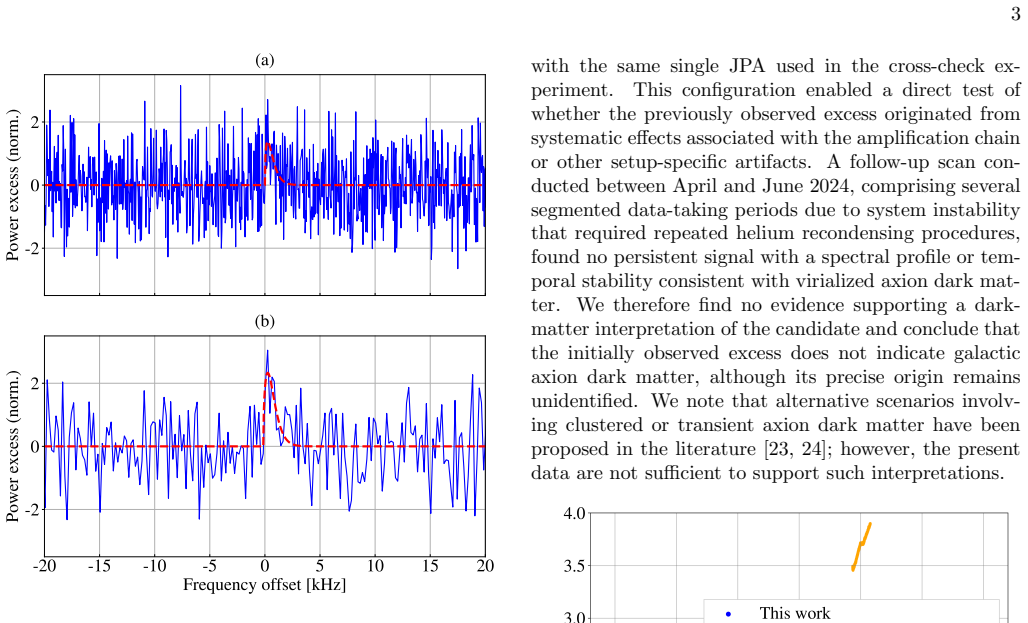
The central result is a null finding with a detailed validation narrative: the recovered dataset produced an excess at 1.036315 GHz with a local significance of 5.1σ (3.5σ global), a spectral shape consistent with virialized axion dark matter, and a signal strength matching the cavity resonance profile. However, the excess vanished under independent cross-checks and when re-scanning with the original apparatus, including a test with the magnetic field turned off. The paper therefore establishes that this excess does not indicate axion dark matter, and it reports new 90% confidence-level exclusion limits on the axion–photon coupling over 1.026–1.045 GHz, reaching near the DFSZ benchmark at th
Load-bearing premise
The follow-up rescans, taken in several interrupted segments because of system instability that required repeated helium recondensing, had enough integrated exposure and sensitivity that a genuine axion signal at the candidate's inferred strength would have been detected and recognized.
Editorial extensions
If this is right
- The previously unanalyzed gap at 1.033–1.037 GHz is now covered, making the exclusion limits continuous across the full 1.026–1.045 GHz range.
- The upper limits set here are among the most stringent haloscope constraints reported in this frequency window, approaching the DFSZ benchmark.
- One persistent frequency feature that survived follow-up but remained with the magnetic field off is inconsistent with axions; the paper notes it could merit further study in the context of magnetic-field-independent dark matter candidates such as dark photons.
- The step-by-step candidate-validation strategy provides a working template for distinguishing genuine axion signals from instrumental artifacts as haloscope sensitivity approaches benchmark-model levels.
Reading between the lines
- The paper leaves the physical origin of the original 1.036 GHz excess unidentified; an editorial inference is that it likely arose from an instrumental or environmental effect, possibly tied to the interpolation used to restore the missing antenna-coupling data.
- Because a separate haloscope also saw a transient excess at the same frequency that did not persist, a shared environmental or procedural trigger is a plausible explanation worth investigating in future campaigns.
- If these limits are robust, the 1.026–1.045 GHz band is effectively closed to KSVZ-scale axions; the next searches in this band will need to push below the DFSZ benchmark to further constrain the axion parameter space.
Editorial analysis
A structured set of objections, weighed in public.
Referee Report
Summary. The paper reports recovery of previously unanalyzable HEMT data in the 1.033–1.037 GHz band from the experiment described in Ref. [16]. In this recovered dataset the authors identify an excess at 1.036315 GHz with a local significance of 5.1σ (global 3.5σ), whose spectral profile and cavity response are consistent with a virialized axion signal. They then describe three follow-up tests: an independent 8-T haloscope cross-check, a re-scan with the original apparatus, and a 20-MHz JPA-based rescan. The excess does not persist, and the authors conclude that the candidate is not galactic axion dark matter. The 20-MHz rescan is used to set improved 90% confidence-level upper limits on the axion–photon coupling over 1.026–1.045 GHz, reaching near-DFSZ sensitivity at the upper end and KSVZ-level sensitivity at the lower end.
Significance. If the reported limits are correct, they improve axion–photon coupling constraints in the 4.24–4.32 μeV mass range, reaching near benchmark-model sensitivity. The candidate-validation strategy—software injection efficiency tests (92.7 ± 0.9%), residual-based noise uncertainty (6.4%), an independent-detector cross-check, and re-examination with the original hardware—is a valuable demonstration for the haloscope community as experiments approach discovery-level sensitivity. The limit-setting analysis is carefully documented, while the candidate-exclusion argument would be more compelling with explicit quantification of the follow-up sensitivities.
major comments (2)
- [Paragraph 'A cross-check was performed...' and 'Following the independent cross-check...'] The null results of the 8-T cross-check and the April–June 2024 re-scan are not accompanied by any quantitative sensitivity statement. The cross-check uses a reduced form factor (C≈0.12) and elevated system noise (Tsys≈500 mK initially, ~200 mK later), making it substantially less sensitive than the main 12-T apparatus. No expected SNR, minimum detectable g_aγγ, integration time, or noise temperature at the candidate frequency is reported. Without these, the non-persistence of the excess cannot exclude a 1.3×KSVZ axion signal; the null result may simply reflect insufficient exposure. The paper should either provide the expected sensitivity of these runs or explicitly state that the quantitative exclusion is provided by the 20-MHz JPA rescan and justify the role of the earlier runs.
- [Paragraph 'To further strengthen this conclusion...' (20-MHz JPA rescan)] The central claim that the candidate is not axion dark matter ultimately rests on the 20-MHz rescan, but the paper never quotes the 90% confidence-level upper limit at the candidate frequency (1.036315 GHz) nor compares it with the inferred candidate coupling of ~1.3×KSVZ. The text says the upper portion of the range approaches DFSZ sensitivity, which would exclude the candidate, but the explicit number and ratio are absent. Adding a sentence such as 'The 90% CL upper limit at 1.036315 GHz is gaγγ < X, a factor Y below the inferred candidate coupling' would make the exclusion quantitative and directly support the abstract's claim.
minor comments (8)
- [Title and metadata] The arXiv title reads 'Extended Haloscope Search and Exclusion of a Candidate Signal near 1.036 GHz' while the manuscript title is 'Extended Haloscope Search and Candidate Validation near 1.036 GHz'. Please ensure consistency between metadata and the text.
- [Affiliations] Line 6 of the first page: 'Advancd' should be 'Advanced'.
- [Reference [10]] The journal name is misprinted as 'Astron. Astto- phys.'; should be 'Astron. Astrophys.'.
- [Reference [16] and author list] Several references contain 'i. m. c. b. u.' in the author list, apparently a formatting artifact. This should be corrected to the proper author names (e.g., Çağlar Kutlu).
- [Cross-check transient] The transient SNR of ~3.7 in the December 2023 cross-check is reported without an uncertainty or a quantitative statement of how many independent trials were examined. Please provide the statistical significance and the expected background fluctuation rate.
- [Cross-check integration] The sentence 'the excess did not reappear with increased exposure' should be accompanied by the total integration time of the cross-check runs, to allow the reader to assess the exposure increase.
- [Definition of SNR] The abbreviation SNR is used in the cross-check paragraph before being defined. Please define it at first use.
- [Private communication] The statement about ADMX probing this region with adequate sensitivity relies on a private communication (G. Rybka). If possible, replace this with a public reference; otherwise, the remark is not independently verifiable and may be better placed in a footnote or removed.
Circularity Check
No significant circularity: the limits and candidate rejection are independent of fitted inputs.
full rationale
The paper's central quantitative output is the 90% CL upper limit on the axion-photon coupling over 1.026-1.045 GHz. This limit is computed from Eq. (1) using measured cavity parameters, system noise temperatures, and a signal-power prediction; no fitted parameter is recycled as the final prediction. The analysis efficiency is calibrated by injecting software-synthesized axion signals (92.7±0.9%), which is an independent validation rather than a fit to the final limit. The candidate excess at 1.036315 GHz is an observed feature in the recovered dataset; its inferred coupling (~1.3×KSVZ) depends on the antenna coupling β, but β is recovered by quadratic interpolation from adjacent measured values and is checked for interpolation-order insensitivity (~0.37% deviation), not fitted to the candidate. The validation chain—independent 8-T haloscope cross-check, re-scan with the original apparatus, and extended JPA rescan—is experimental, and the conclusion that the excess is not galactic axion dark matter is not definitionally tied to the candidate. The paper explicitly notes that alternative clustered/transient axion interpretations cannot be supported by the present data, which is a stated limitation, not a circular move. Self-citations to Ref. [16] provide apparatus and analysis context, but the present exclusion and limits do not logically reduce to an unverified self-citation; an external ADMX check is also cited. The lack of quantified sensitivity for the April-June re-scan is a potential experimental weakness, but it is not an instance of circular reasoning because the non-persistence conclusion is not defined in terms of the candidate.
Assumptions & free parameters
free parameters (3)
- Quadratic interpolation order for antenna coupling beta =
order 2 (quadratic)
- Savitzky-Golay smoothing window for T_sys =
not stated
- Signal search thresholds (5-sigma cluster cut, 3.718-sigma rescan) =
5 sigma / 3.718 sigma
assumptions (4)
- standard math Axion-to-photon conversion power formula (Eq. 1) with cavity parameters (B0, V, C, Q, beta).
- domain assumption Standard halo model (virialized) axion line shape for signal extraction.
- domain assumption Local axion dark-matter density rho_a = 0.45 GeV/cm^3.
- domain assumption KSVZ and DFSZ benchmark models define target couplings.
Cite this review
Pith. "Pith review of Extended Haloscope Search and Exclusion of a Candidate Signal near 1.036 GHz." pith.science (2026). https://pith.science/paper/MLEOVZZJ
@misc{pith2026260205388,
  author       = {Pith},
  title        = {Pith review of: Extended Haloscope Search and Exclusion of a Candidate Signal near 1.036 GHz},
  year         = {2026},
  howpublished = {\url{https://pith.science/paper/MLEOVZZJ}},
  note         = {Machine review of arXiv:2602.05388}
}
read the original abstract
We report a follow-up axion haloscope search near 1.036 GHz that completes and extends our previous work [Phys. Rev. X 14, 031023 (2024)], in which a portion of the HEMT-based data could not be analyzed due to unrecorded experimental information. While recovering this dataset, we identified an excess near 1.036 GHz that satisfied our candidate-selection criteria, motivating dedicated validation studies, including independent cross-checks and re-examination with the original apparatus. The excess did not persist under these investigations and was not confirmed as an axion dark-matter signal. We subsequently extended the search over a 20-MHz band surrounding the candidate using a quantum-noise-limited amplifier, achieving sensitivity close to the Dine-Fischler-Srednicki-Zhitnitsky benchmark. In the absence of a confirmed signal, we set improved 90% confidence-level upper limits on the axion-photon coupling over the frequency range 1.026-1.045 GHz. This work highlights the importance of robust candidate-validation strategies as haloscope searches approach discovery-level sensitivity.
Figures


Figures from the paper (1 more)

Reference graph
Works this paper leans on
-
[16]
S. Ahn, J. Kim, B. I. Ivanov, O. Kwon, H. Byun, A. F. van Loo, S. Park, J. Jeong, S. Lee, J. Kim, i. m. c. b. u. Kutlu, A. K. Yi, Y. Nakamura, S. Oh, D. Ahn, S. Bae, H. Choi, J. Choi, Y. Chong, W. Chung, V. Gkika, J. E. Kim, Y. Kim, B. R. Ko, L. Miceli, D. Lee, J. Lee, K. W. Lee, M. Lee, A. Matlashov, P. Parashar, T. Seong, Y. C. Shin, S. V. Uchaikin, S. ...
2024
-
[1]
’t Hooft, Symmetry Breaking through Bell-Jackiw Anomalies, Phys
G. ’t Hooft, Symmetry Breaking through Bell-Jackiw Anomalies, Phys. Rev. Lett.37, 8 (1976)
1976
-
[2]
’t Hooft, Computation of the quantum effects due to a four-dimensional pseudoparticle, Phys
G. ’t Hooft, Computation of the quantum effects due to a four-dimensional pseudoparticle, Phys. Rev. D14, 3432 (1976)
1976
-
[3]
G. t. Hooft, Erratum: Computation of the quantum effects due to a four-dimensional pseudoparticle, Phys. Rev. D18, 2199 (1978)
1978
-
[4]
J. H. Smith, E. M. Purcell, and N. F. Ramsey, Experi- mental Limit to the Electric Dipole Moment of the Neu- 5 FIG. 5. Experimental limits on the axion–photon couplingg aγγ as a function of axion massm a (frequencyν a). The upper panel shows the 90% confidence-level limits set by this work, assuming a local axion density ofρ a = 0.45 GeV/cm3; the black da...
1957
-
[5]
W. B. Dress, P. D. Miller, J. M. Pendlebury, P. Perrin, and N. F. Ramsey, Search for an electric dipole moment of the neutron, Phys. Rev. D15, 9 (1977)
1977
-
[6]
Altarev, Y
I. Altarev, Y. Borisov, A. Brandin, A. Egorov, V. Ezhov, S. Ivanov, V. Lobashov, V. Nazarenko, G. Porsev, V. Ryabov, A. Serebrov, and R. Taldaev, A search for the electric dipole moment of the neutron using ultra- cold neutrons, Nuclear Physics A341, 269 (1980)
1980
-
[7]
R. D. Peccei and H. R. Quinn, CP Conservation in the Presence of Pseudoparticles, Phys. Rev. Lett.38, 1440 (1977)
1977
Show all 60 references
-
[8]
Weinberg, A New Light Boson?, Phys
S. Weinberg, A New Light Boson?, Phys. Rev. Lett.40, 223 (1978)
1978
-
[9]
Wilczek, Problem of StrongPandTInvariance in the Presence of Instantons, Phys
F. Wilczek, Problem of StrongPandTInvariance in the Presence of Instantons, Phys. Rev. Lett.40, 279 (1978)
1978
-
[10]
P. A. R. Adeet al.(Planck Collaboration), Planck2015 results: XIII. Cosmological parameters, Astron. Astto- phys.594, A13 (2016), arXiv:1502.01589
2016 arXiv
-
[11]
D. Kim, J. Jeong, S. Youn, Y. Kim, and Y. K. Se- mertzidis, Revisiting the detection rate for axion halo- scopes, Journal of Cosmology and Astroparticle Physics 2020(03), 066
2020
-
[12]
J. E. Kim, Weak-Interaction Singlet and Strong CP In- variance, Phys. Rev. Lett.43, 103 (1979)
1979
-
[13]
Shifman, A
M. Shifman, A. Vainshtein, and V. Zakharov, Can con- finement ensure natural CP invariance of strong interac- tions?, Nuclear Physics B166, 493 (1980)
1980
-
[14]
A. R. Zhitnitskii, On Possible Suppression of the Axion Hadron Interactions, Yad. Fiz.31, 497 (1980), in Rus- sian
1980
-
[15]
M. Dine, W. Fischler, and M. Srednicki, A simple solution to the strong CP problem with a harmless axion, Physics Letters B104, 199 (1981)
1981
-
[17]
S. V. Uchaikin, J. Kim, C ¸ . Kutlu, B. I. Ivanov, J. Kim, A. F. van Loo, Y. Nakamura, S. Ahn, S. Oh, M. Ko, and Y. K. Semertzidis, Josephson parametric amplifier based quantum noise limited amplifier development for 6 axion search experiments in capp, Frontiers in Physics V o...
2024
-
[18]
Kutlu, A
C ¸ . Kutlu, A. F. van Loo, S. V. Uchaikin, A. N. Mat- lashov, D. Lee, S. Oh, J. Kim, W. Chung, Y. Nakamura, and Y. K. Semertzidis, Characterization of a flux-driven Josephson parametric amplifier with near quantum- limited added noise for axion search experiments, Super- cond...
2021
-
[19]
M. S. Turner, Periodic signatures for the detection of cosmic axions, Phys. Rev. D42, 3572 (1990)
1990
-
[20]
Ou, A.-C
X. Ou, A.-C. Eilers, L. Necib, and A. Frebel, The dark matter profile of the Milky Way in- ferred from its circular velocity curve, Monthly Notices of the Royal Astronomical Society528, 693 (2024), https://academic.oup.com/mnras/article- pdf/528/1/693/56254192/stae034.pdf
2024
-
[21]
S. H. Lim, E. Putney, M. R. Buckley, and D. Shih, Map- ping dark matter in the Milky Way using normalizing flows and Gaia DR3, Journal of Cosmology and Astropar- ticle Physics2025(01), 021
-
[22]
S. Lee, S. Ahn, J. Choi, B. R. Ko, and Y. K. Semertzidis, Axion Dark Matter Search around 6.7µeV, Phys. Rev. Lett.124, 101802 (2020)
2020
-
[23]
Tinyakov, I
P. Tinyakov, I. Tkachev, and K. Zioutas, Tidal streams from axion miniclusters and direct axion searches, Jour- nal of Cosmology and Astroparticle Physics2016(01), 035
-
[24]
Visinelli and J
L. Visinelli and J. Redondo, Axion miniclusters in mod- ified cosmological histories, Phys. Rev. D101, 023008 (2020)
2020
-
[25]
Savitzky and M
A. Savitzky and M. J. E. Golay, Smoothing and Differentiation of Data by Simplified Least Squares Procedures., Analytical Chemistry36, 1627 (1964), https://doi.org/10.1021/ac60214a047
1964 doi
-
[26]
S. J. Asztalos, G. Carosi, C. Hagmann, D. Kinion, K. van Bibber, M. Hotz, L. J. Rosenberg, G. Ry- bka, J. Hoskins, J. Hwang, P. Sikivie, D. B. Tanner, R. Bradley, and J. Clarke, SQUID-Based Microwave Cav- ity Search for Dark-Matter Axions, Phys. Rev. Lett.104, 041301 (2010)
2010
-
[27]
N. Du, N. Force, R. Khatiwada, E. Lentz, R. Ottens, L. J. Rosenberg, G. Rybka, G. Carosi, N. Woollett, D. Bowring, A. S. Chou, A. Sonnenschein, W. Wester, C. Boutan, N. S. Oblath, R. Bradley, E. J. Daw, A. V. Dixit, J. Clarke, S. R. O’Kelley, N. Crisosto, J. R. Glea- son, S. J...
2018
-
[28]
Braine, R
T. Braine, R. Cervantes, N. Crisosto, N. Du, S. Kimes, L. J. Rosenberg, G. Rybka, J. Yang, D. Bowring, A. S. Chou, R. Khatiwada, A. Sonnenschein, W. Wester, G. Carosi, N. Woollett, L. D. Duffy, R. Bradley, C. Boutan, M. Jones, B. H. LaRoque, N. S. Oblath, M. S. Taubman, J. Cla...
2020
-
[29]
Bartram, T
C. Bartram, T. Braine, E. Burns, R. Cervantes, N. Crisosto, N. Du, H. Korandla, G. Leum, P. Moha- patra, T. Nitta, L. J. Rosenberg, G. Rybka, J. Yang, J. Clarke, I. Siddiqi, A. Agrawal, A. V. Dixit, M. H. Aw- ida, A. S. Chou, M. Hollister, S. Knirck, A. Sonnenschein, W. Wester...
2021
-
[30]
Goodman, M
C. Goodman, M. Guzzetti, C. Hanretty, L. J. Rosenberg, G. Rybka, J. Sinnis, D. Zhang, J. Clarke, I. Siddiqi, A. S. Chou, M. Hollister, S. Knirck, A. Sonnenschein, T. J. Caligiure, J. R. Gleason, A. T. Hipp, P. Sikivie, M. E. Solano, N. S. Sullivan, D. B. Tanner, R. Khatiwada, ...
2025
-
[31]
Collaboration, G
A. Collaboration, G. Carosi, C. Cisneros, N. Du, S. Durham, N. Robertson, C. Goodman, M. Guzzetti, C. Hanretty, K. Enzian, L. J. Rosenberg, G. Rybka, J. Sinnis, D. Zhang, J. Clarke, I. Siddiqi, A. S. Chou, M. Hollister, A. Sonnenschein, S. Knirck, T. J. Caligiure, J. R. Gleaso...
2025
-
[32]
Boutan, M
C. Boutan, M. Jones, B. H. LaRoque, N. S. Oblath, R. Cervantes, N. Du, N. Force, S. Kimes, R. Ottens, L. J. Rosenberg, G. Rybka, J. Yang, G. Carosi, N. Woollett, D. Bowring, A. S. Chou, R. Khatiwada, A. Sonnenschein, W. Wester, R. Bradley, E. J. Daw, A. Agrawal, A. V. Dixit, J...
2018
-
[33]
Bartram, T
C. Bartram, T. Braine, R. Cervantes, N. Crisosto, N. Du, G. Leum, P. Mohapatra, T. Nitta, L. J. Rosenberg, G. Rybka, J. Yang, J. Clarke, I. Siddiqi, A. Agrawal, A. V. Dixit, M. H. Awida, A. S. Chou, M. Hollister, S. Knirck, A. Sonnenschein, W. Wester, J. R. Gleason, A. T. Hipp...
2023
-
[34]
Jeong, S
J. Jeong, S. Youn, S. Bae, J. Kim, T. Seong, J. E. Kim, and Y. K. Semertzidis, Search for Invisible Axion Dark Matter with a Multiple-Cell Haloscope, Phys. Rev. Lett. 125, 221302 (2020)
2020
-
[35]
O. Kwon, D. Lee, W. Chung, D. Ahn, H. Byun, F. Caspers, H. Choi, J. Choi, Y. Chong, H. Jeong, J. Jeong, J. E. Kim, J. Kim, i. m. c. b. u. Kutlu, J. Lee, M. Lee, S. Lee, A. Matlashov, S. Oh, S. Park, S. Uchaikin, S. Youn, and Y. K. Semertzidis, First Results from an Axion Halos...
2021
-
[36]
Y. Lee, B. Yang, H. Yoon, M. Ahn, H. Park, B. Min, D. Kim, and J. Yoo, Searching for Invisible Axion Dark Matter with an 18 T Magnet Haloscope, Phys. Rev. Lett. 128, 241805 (2022)
2022
-
[37]
J. Kim, O. Kwon, i. m. c. b. u. Kutlu, W. Chung, A. Matlashov, S. Uchaikin, A. F. van Loo, Y. Nakamura, S. Oh, H. Byun, D. Ahn, and Y. K. Semertzidis, Near- Quantum-Noise Axion Dark Matter Search at CAPP around 9.5µeV, Phys. Rev. Lett.130, 091602 (2023)
2023
-
[38]
A. K. Yi, S. Ahn, i. m. c. b. u. Kutlu, J. Kim, B. R. Ko, B. I. Ivanov, H. Byun, A. F. van Loo, S. Park, J. Jeong, O. Kwon, Y. Nakamura, S. V. Uchaikin, J. Choi, S. Lee, M. Lee, Y. C. Shin, J. Kim, D. Lee, D. Ahn, S. Bae, J. Lee, Y. Kim, V. Gkika, K. W. Lee, S. Oh, T. Seong, D...
2023
-
[39]
B. Yang, H. Yoon, M. Ahn, Y. Lee, and J. Yoo, Ex- tended Axion Dark Matter Search Using the CAPP18T Haloscope, Phys. Rev. Lett.131, 081801 (2023)
2023
-
[40]
Y. Kim, J. Jeong, S. Youn, S. Bae, K. Lee, A. F. van Loo, Y. Nakamura, S. Oh, T. Seong, S. Uchaikin, J. E. Kim, and Y. K. Semertzidis, Experimental Search for Invisible Dark Matter Axions around 22µeV, Phys. Rev. Lett. 133, 051802 (2024)
2024
-
[41]
S. Bae, J. Jeong, Y. Kim, S. Youn, H. Park, T. Seong, S. Oh, and Y. K. Semertzidis, Search for Dark Matter Axions with Tunable TM020 Mode, Phys. Rev. Lett.133, 211803 (2024)
2024
-
[42]
S. Ahn, i. m. c. b. u. Kutlu, S. Lee, S. Youn, S. V. Uchaikin, S. Bae, J. Jeong, A. F. van Loo, Y. Nakamura, S. Oh, J. E. Kim, and Y. K. Semertzidis, Probing Kim- Shifman-Vainshtein-Zakharov Axion Dark Matter near 5.9 GHz Using an 8-Cell Cavity Haloscope, Phys. Rev. Lett.135, ...
2025
-
[43]
S. Bae, J. Jeong, Y. Kim, S. Youn, J. Kim, A. F. van Loo, Y. Nakamura, S. Oh, T. Seong, S. Uchaikin, J. E. Kim, and Y. K. Semertzidis, Axion Dark Matter Search with Sensitivity near the Kim-Shifman-Vainshtein-Zakharov Benchmark Using the TM 020 Mode, Phys. Rev. Lett. 135, 0918...
2025
-
[44]
C. M. Adair, K. Altenm¨ uller, V. Anastassopoulos, S. Ar- guedas Cuendis, J. Baier, K. Barth, A. Belov, D. Bozice- vic, H. Br¨ auninger, G. Cantatore, F. Caspers, J. F. Cas- tel, S. A. C ¸ etin, W. Chung, H. Choi, J. Choi, T. Dafni, M. Davenport, A. Dermenev, K. Desch, B. D¨ o...
2022
-
[45]
Grenet, R
T. Grenet, R. Ballou, Q. Basto, K. Martineau, P. Per- rier, P. Pugnat, J. Quevillon, N. Roch, and C. Smith, The Grenoble Axion Haloscope platform (GrAHal): de- velopment plan and first results (2021), arXiv:2110.14406 [hep-ex]
2021 arXiv
-
[46]
K. M. Backes, D. A. Palken, S. A. Kenany, B. M. Brubaker, S. B. Cahn, A. Droster, G. C. Hilton, S. Ghosh, H. Jackson, S. K. Lamoreaux, A. F. Leder, K. W. Lehnert, S. M. Lewis, M. Malnou, R. H. Maruyama, N. M. Rapidis, M. Simanovskaia, S. Singh, D. H. Speller, I. Urdinaran, L. ...
2021
-
[47]
M. J. Jewell, A. F. Leder, K. M. Backes, X. Bai, K. van Bibber, B. M. Brubaker, S. B. Cahn, A. Droster, M. H. Esmat, S. Ghosh, E. Graham, G. C. Hilton, H. Jackson, C. Laffan, S. K. Lamoreaux, K. W. Lehnert, S. M. Lewis, M. Malnou, R. H. Maruyama, D. A. Palken, N. M. Ra- pidis,...
2023
-
[48]
X. Bai, M. J. Jewell, J. Echevers, K. van Bibber, A. Droster, M. H. Esmat, S. Ghosh, E. Graham, H. Jackson, C. Laffan, S. K. Lamoreaux, A. F. Leder, K. W. Lehnert, S. M. Lewis, R. H. Maruyama, R. D. Nath, N. M. Rapidis, E. P. Ruddy, M. Silva-Feaver, M. Simanovskaia, S. Singh, ...
2025
-
[49]
A. P. Quiskamp, G. R. Flower, S. Samuels, B. T. McAl- lister, P. Altin, E. N. Ivanov, M. Goryachev, and M. E. Tobar, Near-quantum-limited axion dark matter search with the ORGAN experiment around 26µeV, Phys. Rev. D111, 095007 (2025)
2025
-
[50]
Alesini, C
D. Alesini, C. Braggio, G. Carugno, N. Crescini, D. D’Agostino, D. Di Gioacchino, R. Di Vora, P. Falferi, S. Gallo, U. Gambardella, C. Gatti, G. Iannone, G. Lamanna, C. Ligi, A. Lombardi, R. Mezzena, A. Or- tolan, R. Pengo, N. Pompeo, A. Rettaroli, G. Ruoso, E. Silva, C. C. Sp...
2019
-
[51]
Alesini, C
D. Alesini, C. Braggio, G. Carugno, N. Crescini, D. D’Agostino, D. Di Gioacchino, R. Di Vora, P. Falferi, U. Gambardella, C. Gatti, G. Iannone, C. Ligi, A. Lom- bardi, G. Maccarrone, A. Ortolan, R. Pengo, A. Ret- taroli, G. Ruoso, L. Taffarello, and S. Tocci, Search for 8 invi...
2021
-
[52]
Alesini, D
D. Alesini, D. Babusci, C. Braggio, G. Carugno, N. Crescini, D. D’Agostino, A. D’Elia, D. Di Gioacchino, R. Di Vora, P. Falferi, U. Gambardella, C. Gatti, G. Ian- none, C. Ligi, A. Lombardi, G. Maccarrone, A. Ortolan, R. Pengo, A. Rettaroli, G. Ruoso, L. Taffarello, and S. Toc...
2022
-
[53]
Di Vora, A
R. Di Vora, A. Lombardi, A. Ortolan, R. Pengo, G. Ruoso, C. Braggio, G. Carugno, L. Taffarello, G. Cappelli, N. Crescini, M. Esposito, L. Planat, A. Ranadive, N. Roch, D. Alesini, D. Babusci, A. D’Elia, D. Di Gioacchino, C. Gatti, C. Ligi, G. Maccarrone, A. Rettaroli, S. Tocci...
2023
-
[54]
Rettaroli, D
A. Rettaroli, D. Alesini, D. Babusci, C. Braggio, G. Carugno, D. D’Agostino, A. D’Elia, D. Di Gioacchino, R. Di Vora, P. Falferi, U. Gambardella, A. Gardikiotis, C. Gatti, C. Ligi, A. Lombardi, G. Maccarrone, A. Or- tolan, G. Ruoso, S. Tocci, and G. Vidali (QUAX Collab- oratio...
2024
-
[55]
´Alvarez Melc´ on, S
A. ´Alvarez Melc´ on, S. Arguedas Cuendis, J. Baier, K. Barth, H. Br¨ auninger, S. Calatroni, G. Canta- tore, F. Caspers, J. F. Castel, S. A. Cetin, C. Co- gollos, T. Dafni, M. Davenport, A. Dermenev, K. De- sch, A. D ´ ıaz-Morcillo, B. D¨ obrich, H. Fischer, W. Funk, J. D. Ga...
2021
-
[56]
Ahyoune, A
S. Ahyoune, A. ´A. Melc´ on, S. A. Cuendis, S. Cala- troni, C. Cogollos, A. D ´ ıaz-Morcillo, B. D¨ obrich, J. D. Gallego, J. M. Garc ´ ıa-Barcel´ o, B. Gimeno, J. Golm, X. Granados, J. Gutierrez, L. Herwig, I. G. Irastorza, N. Lamas, A. Lozano-Guerrero, W. L. Millar, C. Mal- ...
2024
-
[57]
W. U. Wuensch, S. De Panfilis-Wuensch, Y. K. Se- mertzidis, J. T. Rogers, A. C. Melissinos, H. J. Halama, B. E. Moskowitz, A. G. Prodell, W. B. Fowler, and F. A. Nezrick, Results of a laboratory search for cosmic axions and other weakly coupled light particles, Phys. Rev. D 40...
1989
-
[58]
Hagmann, P
C. Hagmann, P. Sikivie, N. S. Sullivan, and D. B. Tanner, Results from a search for cosmic axions, Phys. Rev. D42, 1297 (1990)
1990
-
[59]
Chang, J.-Y
H. Chang, J.-Y. Chang, Y.-C. Chang, Y.-H. Chang, Y.- H. Chang, C.-H. Chen, C.-F. Chen, K.-Y. Chen, Y.-F. Chen, W.-Y. Chiang, W.-C. Chien, H. T. Doan, W.-C. Hung, W. Kuo, S.-B. Lai, H.-W. Liu, M.-W. OuYang, P.-I. Wu, and S.-S. Yu (TASEH Collaboration), First Re- sults from the ...
2022
-
[60]
O’Hare, cajohare/AxionLimits: AxionLimits,https: //cajohare.github.io/AxionLimits/(2020)
C. O’Hare, cajohare/AxionLimits: AxionLimits,https: //cajohare.github.io/AxionLimits/(2020)
2020
Reviewed August 4, 2026 · model on record in the stance chip above.
Discussion (0). Sign in to comment.