REVIEW 4 major objections 6 minor 1 cited by
Imaginary rotation can induce chromomagnetic condensation and perturbative confinement in SU(2) Yang-Mills.
Reviewed by Pith at T0; open to challenge. T0 means a machine referee read the full paper against a public rubric. the ladder, T0–T4 →
T0 review · deepseek-v4-flash
2026-08-03 04:11 UTC pith:JI5SULMI
load-bearing objection Worth refereeing: coherent one-loop extension of Chen-Fukushima-Shimada to a Savvidy background, but the induced condensate and first-order boundary lean on the real-part LLL prescription; sensitivity checks are needed. the 4 major comments →
Chromomagnetic condensation and perturbative confinement induced by imaginary rotation in SU(2) Yang-Mills Theory
The pith
A machine-rendered reading of the paper's core claim, the machinery that carries it, and where it could break.
Core claim
On its own terms, the paper establishes that with a nonzero imaginary angular velocity Ω̃, the physical minimum of the one-loop Polyakov-loop potential moves from the deconfined vacuum (Polyakov loop unbroken, chromomagnetic field near zero) to a state with nonzero chromomagnetic condensate and a Polyakov-loop phase near the confining value, via a first-order jump. Symmetry of the potential creates a second first-order jump into the confined phase at the center-symmetric point. The critical Ω̃ decreases with temperature and approaches π/√3 at high T. Under real rotation, the condensate decreases with Ω̃, and the minimum develops a cusp because the spin–chromomagnetic coupling yields a comple
What carries the argument
The central object is the one-loop effective potential V(H,φ) for the Polyakov loop in a constant chromomagnetic background H (a Savvidy-type field). The authors decompose it into a chromomagnetic-favoring part (vacuum log plus the lowest Landau level) and a chromomagnetic-suppressing part (higher Landau levels). Imaginary rotation enters as a shift φ+(l−s)Ω̃ in the Matsubara frequencies; at the rotation center only the lowest Landau level contributes, so the rotational shift directly biases the confining minimum. For real rotation, a boundary condition enforces causality, and the spin-dependent spectrum makes the effective chemical potential complex, producing the cusp.
Load-bearing premise
The result relies on taking the real part of the unstable lowest Landau level contribution as the true effective potential, trusting that higher-order terms restore reality without moving the minimum; if that fails, both the induced condensate and the first-order boundary change.
What would settle it
A lattice simulation of SU(2) gauge theory with imaginary angular velocity could measure the Polyakov loop and local chromomagnetic condensate at the rotation center; observing a second-order rather than first-order transition, or a critical boundary that does not approach Ω̃=π/√3, would falsify the central prediction.
If this is right
- SU(2) Yang-Mills can exhibit a first-order confinement transition within perturbation theory when subject to an imaginary angular velocity.
- The critical imaginary rotation Ω̃_c is temperature-dependent and approaches π/√3 from above at high temperatures.
- The phase diagram gains a larger deconfined region than the no-condensate calculation, and the transition order changes from second to first.
- For real rotation, the chromomagnetic condensate decreases with Ω̃, and the Polyakov-loop potential has a cusp at its minimum, so a conventional Debye screening mass cannot be defined.
Where Pith is reading between the lines
- Editorial inference: The same mechanism might extend to chiral symmetry breaking once dynamical quarks are included, but the paper does not show this.
- Editorial inference: The boundary condition that ensures causality under real rotation is a modeling choice; a full treatment of the unstable-mode stabilization could alter the dependence of the condensate on Ω̃.
- Editorial inference: If the first-order perturbative boundary continues into the non-perturbative region, it could meet the second-order deconfinement transition at a critical end point, as the paper suggests but does not establish.
Editorial analysis
A structured set of objections, weighed in public.
Referee Report
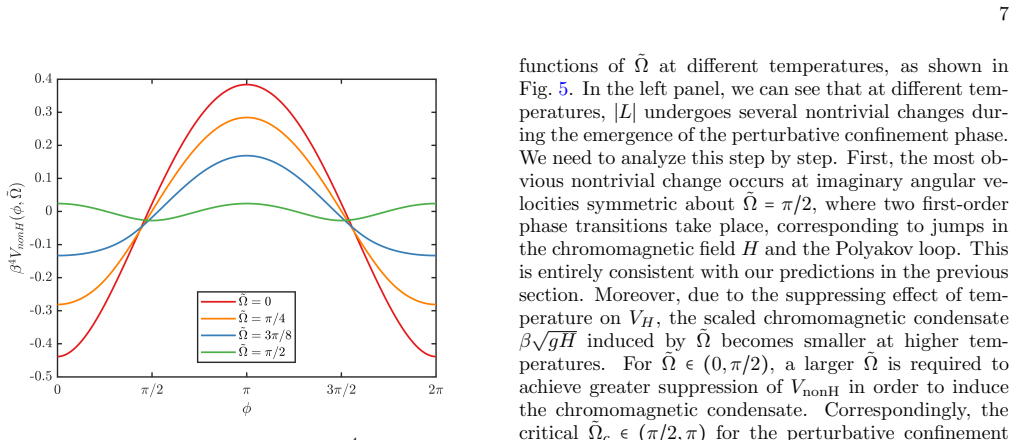
Summary. The paper computes the one-loop effective potential of SU(2) Yang-Mills theory in a constant chromomagnetic background H and a Polyakov-loop background φ, under both imaginary and real rotation. It decomposes the potential into a chromomagnetic-favoring part V_H (vacuum energy plus the two lowest s=-1 Landau-type modes) and a chromomagnetic-suppressing part V_nonH (higher Landau levels). At Ω̃=0 the suppressing part dominates and H≈0 in the perturbative regime. As the imaginary angular velocity Ω̃ grows, V_H shifts in φ and V_nonH loses its suppressing power, producing a first-order transition into a state with H≠0 and φ=π. The critical boundary is claimed to be temperature dependent and to approach Ω̃_c=π/√3 at high T. For real rotation, a causality-preserving boundary condition at radius R is imposed; the resulting real part of the potential shows a cusp at the Polyakov-loop minimum, and the chromomagnetic condensate decreases with ω. The paper argues that imaginary rotation provides a perturbative window into chromomagnetic condensation and confinement, with concrete predictions for the Ω̃-T phase diagram.
Significance. If the main claims hold, this is a significant result: it suggests that imaginary rotation can turn a purely perturbative one-loop calculation into a source of non-perturbative-looking physics, including chromomagnetic condensation and a first-order deconfinement-type transition, with falsifiable predictions for imaginary-rotation lattice simulations. The paper is also valuable for its clean derivation of the rotation-modified equations of motion (Appendix A), its explicit series/integral representations, and its careful reduction to the known no-H limit of Ref. [54]. The decomposition into V_H and V_nonH is a useful organizing principle. However, the central quantitative claims rest on a few fragile choices — the real-part treatment of the tachyonic lowest Landau level, the numerical representation of H=0 by β√gH=0.01 and 0.075, and the boundary-condition parameter TR=1.5 — and the manuscript does not yet supply sensitivity tests that would make those choices convincing.
major comments (4)
- [Sec. III, Eq. (20) and Eq. (26); Figs. 5-6] The central H≠0 minimum and the first-order transition are controlled by the tachyonic lowest Landau level u(-,0). For k_z^2<gH the integrand is complex, and the paper defines the contribution by taking the real part (ln|...| and the Y_1 representation). The justification via Refs. [64,65] concerns the Savvidy instability without the present Polyakov-loop and rotation-dependent Matsubara shift φ+Ω̃. That shift changes the analytic structure, and for real rotation it becomes a complex chemical potential. Because the depth and location of the V_H minimum determine the critical Ω̃_c and the order of the transition, the paper needs a direct check that the higher-order stabilization of [64,65] survives in the presence of φ and Ω̃, or at least a quantitative estimate of the possible shift of Ω̃_c. As written, the induced-condensate claim is not fully established.
- [Sec. II after Eq. (22) and Sec. V after Eq. (38)] The numerical representation of H=0 is load-bearing. The paper sets β√gH=0.01 for imaginary rotation and 0.075 for real rotation, and identifies the resulting V_nonH with the exact H→0 limit. The first-order jump in Figs. 5-6 is precisely the competition between V_H at its H≠0 minimum and V_nonH at this H≈0 proxy. No sensitivity test is shown: the critical Ω̃_c, the jump size, and the claimed asymptotic π/√3 could all shift if the cutoff were changed. Appendix C proves the H→0 limit in the strict sense but does not control the rate of approach. Please provide a convergence study in the lower cutoff and, ideally, an analytic estimate of the error in the phase boundary.
- [Sec. V, Eq. (38) and Figs. 9-10] For real rotation the total potential is complex; the paper takes its real part and then interprets a cusp in Re V at φ=0 as a physical singularity. Since the imaginary part is responsible for the non-analytic behavior in the usual complex-chemical-potential case, the plotted cusp could be an artifact of projecting onto the real part. The manuscript states that the imaginary part is non-vanishing near the minimum but does not report its magnitude or show that it is negligible in the plotted region. The result also depends on the arbitrarily chosen TR=1.5; no variation with TR is shown. Please report the imaginary part and test the robustness of the cusp under changes of the boundary condition and TR.
- [Sec. IV, Fig. 6 and abstract] The claim that the phase boundary asymptotically approaches Ω̃_c=π/√3 is imported from Ref. [54] as an external benchmark, but no quantitative convergence criterion is given. At T=10^8Λ the induced condensate is represented by very small but nonzero β√⟨gH⟩; the remaining finite-H correction to the critical Ω̃ is not estimated. Since this asymptotic behavior is one of the headline results, the manuscript should state the numerical difference between its critical Ω̃_c at the largest T and π/√3, and show that it decreases systematically with T.
minor comments (6)
- [Eqs. (29) and (33)] The summation label 's=±' is used in two senses: as spin and as the sign of gH inside the square root. In Eq. (33) the two terms are u(-,0) with k^2-gH and u(-,1) with k^2+gH, not the two spin projections. This notation is confusing and should be changed or explicitly explained.
- [Fig. 2 caption] 'V_nonH is independent of temperature' is true only for the dimensionless combination β^4 V_nonH; the dimensional expression in Eq. (22) is proportional to T (gH)^{3/2}. Please clarify.
- [Eq. (20)] For the tachyonic region k_z^2<gH, the expression inside ln|...| is complex. The manuscript should explicitly define the branch of the logarithm and state precisely which real part is taken, since 'real part' and 'absolute value' are not interchangeable for the series representation in Eq. (26).
- [Abstract] Typo: 'gauge theroy' should be 'gauge theory'.
- [Acknowledgments, Ref. [73]] Ref. [73] is acknowledged as addressing a similar topic on the same day. Given the strong overlap, the authors should discuss the relation to that work explicitly, including any differences in the treatment of the LLL instability and in the resulting phase boundary.
- [Fig. 10] The figure shows β√⟨gH⟩ as a function of ω for T=10Λ, but the text does not give the numerical values of TR or the cutoff used for the sums in this panel. Please include these parameters in the caption or text.
Circularity Check
No significant circularity: the one-loop potential is derived from the stated action and checked against an external benchmark; the LLL real-part prescription is an independent modeling assumption, not a fitted input.
full rationale
I walked the claimed derivation chain. The central object is the one-loop effective potential Eq. (29), obtained by a standard functional determinant in the stated chromomagnetic background with rotation. This is self-contained algebra. The 'induced chromomagnetic condensate' and 'perturbative confinement' follow from minimizing this potential, not from any parameter fitted to the target phase boundary. The asymptotic Omega_c = pi/sqrt(3) is not fitted; it is the known result of Ref. [54], and the paper explicitly verifies in Appendix C that V_nonH reduces to the Ref. [54] potential in the H -> 0 limit, so the asymptotic matching is a consistency check. The LLL tachyonic contribution is regularized by taking the real part, justified by Refs. [64,65], which are independent earlier calculations; whether this stabilization is quantitatively reliable is a correctness/robustness issue, not circularity. The numerical H=0 proxies (beta sqrt(gH)=0.01 and 0.075) are numerical representations of the H -> 0 limit, with the physical minima located far from these proxies; they are not fitted inputs. Self-citations by the present authors appear only in peripheral literature lists, not in load-bearing derivations. No equation or fitted parameter is equivalent, by construction, to the claimed prediction.
Axiom & Free-Parameter Ledger
free parameters (4)
- β√(gH) lower cutoff (imaginary rotation) =
0.01
- β√(gH) lower cutoff (real rotation) =
0.075
- R T (rotation boundary radius times temperature) =
1.5
- Landau level summation cutoff =
O(H^{-1}) levels
axioms (7)
- domain assumption The one-loop background-field effective potential captures the relevant physics; higher-order fluctuations only restore reality of the LLL without changing minima.
- domain assumption The chromomagnetic background tensor B_μν is invariant under the rotation generator R_0, so only kinetic terms are modified.
- domain assumption The lowest Landau level contribution is evaluated by taking its real part in the quadratic approximation.
- ad hoc to paper Boundary quantization via F(-λ, |l|+1, X)=0 enforces causality for real rotation and is the correct way to treat the rotating finite-size system.
- domain assumption T ≥ 10Λ defines the perturbative regime, and T < 10Λ is treated as a strong-coupling transition region.
- ad hoc to paper H=0 can be represented numerically by β√(gH)=0.01 (imaginary) or 0.075 (real).
- standard math The Polyakov loop is the order parameter for Z(2) center symmetry, and |L| vanishes in the confined phase.
read the original abstract
We perturbatively investigate the rotation effect on the Polyakov loop potential in SU(2) gauge theroy within a chromomagnetic background. It is observed that the imaginary rotation spontaneously induces both confinement and chromomagnetic condensation at high temperatures, thereby provides a perturbative window to explore non-perturbative dynamics. Compared to the case without including the induced chromomagnetic field, the perturbative confinement transition becomes first-order, with a temperature-dependent phase boundary that asymptotically approaches $\tilde{\Omega}_c = \pi/\sqrt{3}$ at high temperatures. This leads to a significantly enriched $\tilde{\Omega}$-$T$ phase diagram characterized by an expanded deconfined region. For real angular velocities, we find that the chromomagnetic condensate decreases with increasing rotation, and that the coupling between rotation, spin, and the chromomagnetic background leads to a cusp in the Polyakov loop potential, suggesting that the underlying dynamics could be more intricate.
Figures




Forward citations
Cited by 1 Pith paper
-
A Chromomagnetic Mechanism for the Rotational Phase Transition of Gluonic Matter
Using a rotation–magnetic holographic dictionary calibrated to lattice QCD, the paper predicts real rotation raises T_c and induces a negative total moment of inertia in pure gluonic matter near deconfinement.
Reference graph
Works this paper leans on
-
[1]
Gluino condensate and magnetic monopoles in supersymmetric gluodynam- 16 ics,
N. Michael Davies, Timothy J. Hollowood, Valentin V. Khoze, and Michael P. Mattis, “Gluino condensate and magnetic monopoles in supersymmetric gluodynam- 16 ics,” Nucl. Phys. B559, 123–142 (1999), arXiv:hep- th/9905015
arXiv 1999
-
[2]
Continuity, Deconfinement, and (Super) Yang-Mills Theory,
Erich Poppitz, Thomas Sch¨ afer, and Mithat Unsal, “Continuity, Deconfinement, and (Super) Yang-Mills Theory,” JHEP10, 115 (2012), arXiv:1205.0290 [hep-th]
Pith/arXiv arXiv 2012
-
[3]
Moreover, within theT- ˜Ω region where the phase boundary curve is calculated, the critical temperatureT c decreases with increasing ˜Ω. Furthermore, for a fixed ˜Ω, looking from either side of any point on the phase boundary, increas- ing temperature causes the system to transition from the deconfined phase to the perturbatively confined phase. This cont...
-
[4]
Kyle Aitken, Aleksey Cherman, Erich Poppitz, and Lau- rence G. Yaffe, “QCD on a small circle,” Phys. Rev. D 96, 096022 (2017), arXiv:1707.08971 [hep-th]
Pith/arXiv arXiv 2017
-
[5]
Quark Confinement and Topol- ogy of Gauge Groups,
Alexander M. Polyakov, “Quark Confinement and Topol- ogy of Gauge Groups,” Nucl. Phys. B120, 429–458 (1977)
1977
-
[6]
Confinement of Quarks,
Kenneth G. Wilson, “Confinement of Quarks,” Phys. Rev. D10, 2445–2459 (1974)
1974
-
[7]
Thermal Properties of Gauge Fields and Quark Liberation,
Alexander M. Polyakov, “Thermal Properties of Gauge Fields and Quark Liberation,” Phys. Lett. B72, 477–480 (1978)
1978
-
[8]
Thermody- namics of SU(3) lattice gauge theory,
G. Boyd, J. Engels, F. Karsch, E. Laermann, C. Leg- eland, M. Lutgemeier, and B. Petersson, “Thermody- namics of SU(3) lattice gauge theory,” Nucl. Phys. B469, 419–444 (1996), arXiv:hep-lat/9602007
Pith/arXiv arXiv 1996
-
[9]
The Phase Dia- gram of Strongly-Interacting Matter,
P. Braun-Munzinger and J. Wambach, “The Phase Dia- gram of Strongly-Interacting Matter,” Rev. Mod. Phys. 81, 1031–1050 (2009), arXiv:0801.4256 [hep-ph]
Pith/arXiv arXiv 2009
-
[10]
What the Infrared Be- haviour of QCD Vertex Functions in Landau gauge can tell us about Confinement,
Reinhard Alkofer, Christian S. Fischer, Felipe J. Llanes- Estrada, and Kai Schwenzer, “What the Infrared Be- haviour of QCD Vertex Functions in Landau gauge can tell us about Confinement,” Int. J. Mod. Phys. E16, 2720–2732 (2007), arXiv:0705.4402 [hep-ph]
Pith/arXiv arXiv 2007
-
[11]
Chiral effective model with the Polyakov loop,
Kenji Fukushima, “Chiral effective model with the Polyakov loop,” Phys. Lett. B591, 277–284 (2004), arXiv:hep-ph/0310121
Pith/arXiv arXiv 2004
-
[12]
The QCD phase diagram for external magnetic fields,
G. S. Bali, F. Bruckmann, G. Endrodi, Z. Fodor, S. D. Katz, S. Krieg, A. Schafer, and K. K. Szabo, “The QCD phase diagram for external magnetic fields,” JHEP02, 044 (2012), arXiv:1111.4956 [hep-lat]
Pith/arXiv arXiv 2012
-
[13]
Critical point in the QCD phase dia- gram for extremely strong background magnetic fields,
Gergely Endrodi, “Critical point in the QCD phase dia- gram for extremely strong background magnetic fields,” JHEP07, 173 (2015), arXiv:1504.08280 [hep-lat]
Pith/arXiv arXiv 2015
-
[14]
Deconfinement and Chiral Symmetry Restoration in a Strong Mag- netic Background,
Raoul Gatto and Marco Ruggieri, “Deconfinement and Chiral Symmetry Restoration in a Strong Mag- netic Background,” Phys. Rev. D83, 034016 (2011), arXiv:1012.1291 [hep-ph]
Pith/arXiv arXiv 2011
-
[15]
Christian S. Fischer, Jan Luecker, and Jens A. Mueller, “Chiral and deconfinement phase transitions of two- flavour QCD at finite temperature and chemical poten- tial,” Phys. Lett. B702, 438–441 (2011), arXiv:1104.1564 [hep-ph]
Pith/arXiv arXiv 2011
-
[16]
QCD phase structure at finite temperature and den- sity,
Wei-jie Fu, Jan M. Pawlowski, and Fabian Rennecke, “QCD phase structure at finite temperature and den- sity,” Phys. Rev. D101, 054032 (2020), arXiv:1909.02991 [hep-ph]
Pith/arXiv arXiv 2020
-
[17]
Phase diagrams in the three-flavor Nambu-Jona-Lasinio model with the Polyakov loop,
Kenji Fukushima, “Phase diagrams in the three-flavor Nambu-Jona-Lasinio model with the Polyakov loop,” Phys. Rev. D77, 114028 (2008), [Erratum: Phys.Rev.D 78, 039902 (2008)], arXiv:0803.3318 [hep-ph]
Pith/arXiv arXiv 2008
-
[18]
Global Λ hyperon polar- ization in nuclear collisions: evidence for the most vor- tical fluid,
L. Adamczyk et al. (STAR), “Global Λ hyperon polar- ization in nuclear collisions: evidence for the most vor- tical fluid,” Nature548, 62–65 (2017), arXiv:1701.06657 [nucl-ex]
Pith/arXiv arXiv 2017
-
[19]
Extreme matter in electromagnetic fields and rotation,
Kenji Fukushima, “Extreme matter in electromagnetic fields and rotation,” Prog. Part. Nucl. Phys.107, 167– 199 (2019), arXiv:1812.08886 [hep-ph]
Pith/arXiv arXiv 2019
-
[20]
Polarization and Vorticity in the Quark–Gluon Plasma,
Francesco Becattini and Michael A. Lisa, “Polarization and Vorticity in the Quark–Gluon Plasma,” Ann. Rev. Nucl. Part. Sci.70, 395–423 (2020), arXiv:2003.03640 [nucl-ex]
Pith/arXiv arXiv 2020
-
[21]
Vorticity and Spin Polarization in Heavy Ion Collisions: Transport Models,
Xu-Guang Huang, Jinfeng Liao, Qun Wang, and Xiao- Liang Xia, “Vorticity and Spin Polarization in Heavy Ion Collisions: Transport Models,” Lect. Notes Phys.987, 281–308 (2021), arXiv:2010.08937 [nucl-th]
Pith/arXiv arXiv 2021
-
[22]
Absence of charged pion condensation in a magnetic field with parallel rotation,
Puyuan Bai and Lianyi He, “Absence of charged pion condensation in a magnetic field with parallel rotation,” (2025), arXiv:2512.07473 [nucl-th]
Pith/arXiv arXiv 2025
-
[23]
Tao Guo, Jianing Li, Chengfu Mu, and Lianyi He, “For- mation of a supergiant quantum vortex in a relativistic Bose-Einstein condensate driven by rotation and a par- allel magnetic field,” Phys. Rev. D106, 094010 (2022), arXiv:2111.13159 [nucl-th]
Pith/arXiv arXiv 2022
-
[24]
Thermodynamic properties of a relativistic Bose gas under rigid rotation,
E. Siri and N. Sadooghi, “Thermodynamic properties of a relativistic Bose gas under rigid rotation,” Phys. Rev. D110, 036016 (2024), arXiv:2405.09481 [hep-ph]
Pith/arXiv arXiv 2024
-
[25]
Fermion propagator in a rotating environ- ment,
Alejandro Ayala, L. A. Hern´ andez, K. Raya, and R. Zamora, “Fermion propagator in a rotating environ- ment,” Phys. Rev. D103, 076021 (2021), [Erratum: Phys.Rev.D 104, 039901 (2021)], arXiv:2102.03476 [hep- ph]
Pith/arXiv arXiv 2021
-
[26]
Analogy between rotation and density for Dirac fermions in a magnetic field,
Hao-Lei Chen, Kenji Fukushima, Xu-Guang Huang, and Kazuya Mameda, “Analogy between rotation and density for Dirac fermions in a magnetic field,” Phys. Rev. D93, 104052 (2016), arXiv:1512.08974 [hep-ph]
Pith/arXiv arXiv 2016
-
[27]
Pairing Phase Transitions of Matter under Rotation,
Yin Jiang and Jinfeng Liao, “Pairing Phase Transitions of Matter under Rotation,” Phys. Rev. Lett.117, 192302 (2016), arXiv:1606.03808 [hep-ph]
Pith/arXiv arXiv 2016
-
[28]
Chiral symmetry restoration in a ro- tating medium,
Irving I. Gaspar, Luis A. Hern´ andez, and Re- nato Zamora, “Chiral symmetry restoration in a ro- tating medium,” Phys. Rev. D108, 094020 (2023), arXiv:2305.00101 [hep-ph]
Pith/arXiv arXiv 2023
-
[29]
Proca equation and vector field quantization in a rotating system,
Tian Xu and Yin Jiang, “Proca equation and vector field quantization in a rotating system,” Chin. Phys. C45, 114102 (2021), arXiv:2106.04851 [hep-th]
Pith/arXiv arXiv 2021
-
[30]
Spin alignment of vector mesons from quark dynamics in a rotating medium*,
Minghua Wei and Mei Huang, “Spin alignment of vector mesons from quark dynamics in a rotating medium*,” Chin. Phys. C47, 104105 (2023), arXiv:2303.01897 [hep- ph]
Pith/arXiv arXiv 2023
-
[31]
Rotational motion in nuclei,
Aage Bohr, “Rotational motion in nuclei,” Rev. Mod. Phys.48, 365–374 (1976)
1976
-
[32]
Underlying struc- ture of collective bands and self-organization in quan- tum systems,
Takaharu Otsuka, Yusuke Tsunoda, Takashi Abe, Nori- taka Shimizu, and Piet Van Duppen, “Underlying struc- ture of collective bands and self-organization in quan- tum systems,” Phys. Rev. Lett.123, 222502 (2019), arXiv:1907.10759 [nucl-th]
Pith/arXiv arXiv 2019
-
[33]
Parity Violating Currents in Thermal Ra- diation,
A. Vilenkin, “Parity Violating Currents in Thermal Ra- diation,” Phys. Lett. B80, 150–152 (1978)
1978
-
[34]
MACROSCOPIC PARITY VIOLATING EFFECTS: NEUTRINO FLUXES FROM ROTATING BLACK HOLES AND IN ROTATING THERMAL RA- DIATION,
A. Vilenkin, “MACROSCOPIC PARITY VIOLATING EFFECTS: NEUTRINO FLUXES FROM ROTATING BLACK HOLES AND IN ROTATING THERMAL RA- DIATION,” Phys. Rev. D20, 1807–1812 (1979)
1979
-
[35]
QUANTUM FIELD THEORY AT FINITE TEMPERATURE IN A ROTATING SYSTEM,
A. Vilenkin, “QUANTUM FIELD THEORY AT FINITE TEMPERATURE IN A ROTATING SYSTEM,” Phys. Rev. D21, 2260–2269 (1980)
1980
-
[36]
Hydrodynamics with Triangle Anomalies,
Dam T. Son and Piotr Surowka, “Hydrodynamics with Triangle Anomalies,” Phys. Rev. Lett.103, 191601 (2009), arXiv:0906.5044 [hep-th]
Pith/arXiv arXiv 2009
-
[37]
Boundary effects and gapped dispersion in rotating fermionic matter,
Shu Ebihara, Kenji Fukushima, and Kazuya Mameda, “Boundary effects and gapped dispersion in rotating fermionic matter,” Phys. Lett. B764, 94–99 (2017), arXiv:1608.00336 [hep-ph]
Pith/arXiv arXiv 2017
-
[38]
M. N. Chernodub and Shinya Gongyo, “Interacting 17 fermions in rotation: chiral symmetry restoration, mo- ment of inertia and thermodynamics,” JHEP01, 136 (2017), arXiv:1611.02598 [hep-th]
Pith/arXiv arXiv 2017
-
[39]
Effects of ro- tation and boundaries on chiral symmetry breaking of relativistic fermions,
M. N. Chernodub and Shinya Gongyo, “Effects of ro- tation and boundaries on chiral symmetry breaking of relativistic fermions,” Phys. Rev. D95, 096006 (2017), arXiv:1702.08266 [hep-th]
Pith/arXiv arXiv 2017
-
[40]
Quark matter under rotation in the NJL model with vector interaction,
Xinyang Wang, Minghua Wei, Zhibin Li, and Mei Huang, “Quark matter under rotation in the NJL model with vector interaction,” Phys. Rev. D99, 016018 (2019), arXiv:1808.01931 [hep-ph]
Pith/arXiv arXiv 2019
-
[41]
Inho- mogeneous chiral condensation under rotation in the holographic QCD,
Yidian Chen, Danning Li, and Mei Huang, “Inho- mogeneous chiral condensation under rotation in the holographic QCD,” Phys. Rev. D106, 106002 (2022), arXiv:2208.05668 [hep-ph]
Pith/arXiv arXiv 2022
-
[42]
Yuki Fujimoto, Kenji Fukushima, and Yoshimasa Hi- daka, “Deconfining Phase Boundary of Rapidly Rotating Hot and Dense Matter and Analysis of Moment of Iner- tia,” Phys. Lett. B816, 136184 (2021), arXiv:2101.09173 [hep-ph]
Pith/arXiv arXiv 2021
-
[43]
Study of the Confine- ment/Deconfinement Phase Transition in Rotating Lattice SU(3) Gluodynamics,
V. V. Braguta, A. Yu. Kotov, D. D. Kuznedelev, and A. A. Roenko, “Study of the Confine- ment/Deconfinement Phase Transition in Rotating Lattice SU(3) Gluodynamics,” Pisma Zh. Eksp. Teor. Fiz.112, 9–16 (2020)
2020
-
[44]
Influence of relativistic rotation on the confinement-deconfinement transition in gluodynamics,
V. V. Braguta, A. Yu. Kotov, D. D. Kuznedelev, and A. A. Roenko, “Influence of relativistic rotation on the confinement-deconfinement transition in gluodynamics,” Phys. Rev. D103, 094515 (2021), arXiv:2102.05084 [hep- lat]
Pith/arXiv arXiv 2021
-
[45]
Gluodynamics and deconfinement phase tran- sition under rotation from holography,
Xun Chen, Lin Zhang, Danning Li, Defu Hou, and Mei Huang, “Gluodynamics and deconfinement phase tran- sition under rotation from holography,” JHEP07, 132 (2021), arXiv:2010.14478 [hep-ph]
Pith/arXiv arXiv 2021
-
[46]
Inhomogeneous confining- deconfining phases in rotating plasmas,
M. N. Chernodub, “Inhomogeneous confining- deconfining phases in rotating plasmas,” Phys. Rev. D 103, 054027 (2021), arXiv:2012.04924 [hep-ph]
Pith/arXiv arXiv 2021
-
[47]
Rotating SU(2) gluon matter and deconfine- ment at finite temperature,
Yin Jiang, “Rotating SU(2) gluon matter and deconfine- ment at finite temperature,” Phys. Lett. B853, 138655 (2024), arXiv:2312.06166 [hep-th]
Pith/arXiv arXiv 2024
-
[48]
Inhomogeneous SU(2) gluon matter un- der rotation,
Yin Jiang, “Inhomogeneous SU(2) gluon matter un- der rotation,” Phys. Rev. D110, 054047 (2024), arXiv:2406.03311 [nucl-th]
Pith/arXiv arXiv 2024
-
[49]
Fei Sun, Jingdong Shao, Rui Wen, Kun Xu, and Mei Huang, “Chiral phase transition and spin align- ment of vector mesons in the polarized-Polyakov-loop Nambu–Jona-Lasinio model under rotation,” Phys. Rev. D109, 116017 (2024), arXiv:2402.16595 [hep-ph]
Pith/arXiv arXiv 2024
-
[50]
Yidian Chen, Xun Chen, Danning Li, and Mei Huang, “Deconfinement and chiral restoration phase transition under rotation from holography in an anisotropic gravi- tational background,” Phys. Rev. D111, 046006 (2025), arXiv:2405.06386 [hep-ph]
Pith/arXiv arXiv 2025
-
[51]
Strong Coupling Expansion of Gluodynamics on a Lattice under Rotation,
Sheng Wang, Jun-Xia Chen, Defu Hou, and Hai-Cang Ren, “Strong Coupling Expansion of Gluodynamics on a Lattice under Rotation,” (2025), arXiv:2505.15487 [hep- ph]
Pith/arXiv arXiv 2025
-
[52]
Imaginary ro- tating gluonic matter at strong coupling,
Kenji Fukushima and Yusuke Shimada, “Imaginary ro- tating gluonic matter at strong coupling,” Phys. Lett. B 868, 139716 (2025), arXiv:2506.03560 [hep-ph]
Pith/arXiv arXiv 2025
-
[53]
QCD and Instantons at Finite Temperature,
David J. Gross, Robert D. Pisarski, and Laurence G. Yaffe, “QCD and Instantons at Finite Temperature,” Rev. Mod. Phys.53, 43 (1981)
1981
-
[54]
The Effective Potential for the Order Pa- rameter of Gauge Theories at Finite Temperature,
Nathan Weiss, “The Effective Potential for the Order Pa- rameter of Gauge Theories at Finite Temperature,” Phys. Rev. D24, 475 (1981)
1981
-
[55]
Per- turbative Confinement in Thermal Yang-Mills Theories Induced by Imaginary Angular Velocity,
Shi Chen, Kenji Fukushima, and Yusuke Shimada, “Per- turbative Confinement in Thermal Yang-Mills Theories Induced by Imaginary Angular Velocity,” Phys. Rev. Lett.129, 242002 (2022), arXiv:2207.12665 [hep-ph]
Pith/arXiv arXiv 2022
-
[56]
Vacuum Polar- ization Induced by the Intense Gauge Field,
Sergei G. Matinyan and G. K. Savvidy, “Vacuum Polar- ization Induced by the Intense Gauge Field,” Nucl. Phys. B134, 539–545 (1978)
1978
-
[57]
Infrared Instability of the Vacuum State of Gauge Theories and Asymptotic Freedom,
G. K. Savvidy, “Infrared Instability of the Vacuum State of Gauge Theories and Asymptotic Freedom,” Phys. Lett. B71, 133–134 (1977)
1977
-
[58]
An Unstable Yang-Mills Field Mode,
N. K. Nielsen and P. Olesen, “An Unstable Yang-Mills Field Mode,” Nucl. Phys. B144, 376–396 (1978)
1978
-
[59]
Finite tem- perature quark confinement,
Peter N. Meisinger and Michael C. Ogilvie, “Finite tem- perature quark confinement,” Phys. Lett. B407, 297–302 (1997), arXiv:hep-lat/9703009
Pith/arXiv arXiv 1997
-
[60]
On the Rela- tivistic Bose-einstein Integrals,
Howard E. Haber and H. Arthur Weldon, “On the Rela- tivistic Bose-einstein Integrals,” J. Math. Phys.23, 1852 (1982)
1982
-
[61]
Finite Tem- perature Symmetry Breaking as Bose-Einstein Conden- sation,
Howard E. Haber and H. Arthur Weldon, “Finite Tem- perature Symmetry Breaking as Bose-Einstein Conden- sation,” Phys. Rev. D25, 502 (1982)
1982
-
[62]
Zeta Function Regularization of High Temper- ature Expansions in Field Theory,
A. Actor, “Zeta Function Regularization of High Temper- ature Expansions in Field Theory,” Nucl. Phys. B265, 689–719 (1986)
1986
-
[63]
More on Zeta Function Regularization of High Temperature Expansions,
A. Actor, “More on Zeta Function Regularization of High Temperature Expansions,” Fortsch. Phys.35, 793–829 (1987)
1987
-
[64]
The Fi- nite temperature SU(2) Savvidy model with a nontriv- ial Polyakov loop,
Peter N. Meisinger and Michael C. Ogilvie, “The Fi- nite temperature SU(2) Savvidy model with a nontriv- ial Polyakov loop,” Phys. Rev. D66, 105006 (2002), arXiv:hep-ph/0206181
Pith/arXiv arXiv 2002
-
[65]
Savvidy vacuum in SU(2) Yang-Mills theory,
D. Kay, A. Kumar, and Ragavachariar Parthasarathy, “Savvidy vacuum in SU(2) Yang-Mills theory,” Mod. Phys. Lett. A20, 1655–1662 (2005)
2005
-
[66]
SU(2) Yang-Mills theory in Savvidy background at finite temperature and chemical potential,
R. Parthasarathy and Alok Kumar, “SU(2) Yang-Mills theory in Savvidy background at finite temperature and chemical potential,” Phys. Rev. D75, 085007 (2007), arXiv:hep-th/0609090
Pith/arXiv arXiv 2007
-
[67]
Scaling prop- erties of the energy density in SU(2) lattice gauge the- ory,
J. Engels, F. Karsch, and K. Redlich, “Scaling prop- erties of the energy density in SU(2) lattice gauge the- ory,” Nucl. Phys. B435, 295–310 (1995), arXiv:hep- lat/9408009
arXiv 1995
-
[68]
Quark Confinement from Color Confinement,
Jens Braun, Holger Gies, and Jan M. Pawlowski, “Quark Confinement from Color Confinement,” Phys. Lett. B 684, 262–267 (2010), arXiv:0708.2413 [hep-th]
Pith/arXiv arXiv 2010
-
[69]
Quantization of Nonabelian Gauge The- ories,
V. N. Gribov, “Quantization of Nonabelian Gauge The- ories,” Nucl. Phys. B139, 1 (1978)
1978
-
[70]
Local Covariant Oper- ator Formalism of Nonabelian Gauge Theories and Quark Confinement Problem,
Taichiro Kugo and Izumi Ojima, “Local Covariant Oper- ator Formalism of Nonabelian Gauge Theories and Quark Confinement Problem,” Prog. Theor. Phys. Suppl.66, 1– 130 (1979)
1979
-
[71]
Fundamental modular region, Boltz- mann factor and area law in lattice gauge theory,
Daniel Zwanziger, “Fundamental modular region, Boltz- mann factor and area law in lattice gauge theory,” Nucl. Phys. B412, 657–730 (1994)
1994
-
[72]
M. N. Chernodub, V. A. Goy, and A. V. Molochkov, “In- homogeneity of a rotating gluon plasma and the Tolman- Ehrenfest law in imaginary time: Lattice results for fast imaginary rotation,” Phys. Rev. D107, 114502 (2023), arXiv:2209.15534 [hep-lat]
Pith/arXiv arXiv 2023
-
[73]
QCD dynamics in a constant chromomagnetic field,
Paolo Cea, Leonardo Cosmai, and Massimo D’Elia, “QCD dynamics in a constant chromomagnetic field,” JHEP12, 097 (2007), arXiv:0707.1149 [hep-lat]. 18
Pith/arXiv arXiv 2007
-
[74]
Chromomagnetic Condensate in Finite-Temperature SU(2) Yang-Mills Theory under Imaginary Rotation,
Haolei Chen and Xuguang Huang, “Chromomagnetic Condensate in Finite-Temperature SU(2) Yang-Mills Theory under Imaginary Rotation,” arXiv on the same day (2026)
2026
-
[75]
Hao-Lei Chen, Kenji Fukushima, Xu-Guang Huang, and Kazuya Mameda, “Surface Magnetic Catalysis,” Phys. Rev. D96, 054032 (2017), arXiv:1707.09130 [hep-ph]
Pith/arXiv arXiv 2017
discussion (0)
Sign in with ORCID, Apple, or X to comment. Anyone can read and Pith papers without signing in.