REVIEW 3 major objections 3 minor 1 cited by
For SU(2) Yang-Mills at finite temperature, an imaginary angular velocity induces a nonzero Polyakov-loop phase, enhances the chromomagnetic condensate, partially suppresses the Nielsen-Olesen instability, and creates a negative condensate
Reviewed by Pith at T0; open to challenge. T0 means a machine referee read the full paper against a public rubric. the ladder, T0–T4 →
T0 review · deepseek-v4-flash
2026-08-03 04:13 UTC pith:Z3PWIUX6
load-bearing objection Imaginary rotation in the SU(2) Savvidy model: a clean one-loop derivation, but the gφ=0 truncation in Sec. V spoils the quantitative coefficients. the 3 major comments →
Chromomagnetic Condensate in Finite-Temperature SU(2) Yang-Mills Theory under Imaginary Rotation
The pith
A machine-rendered reading of the paper's core claim, the machinery that carries it, and where it could break.
Core claim
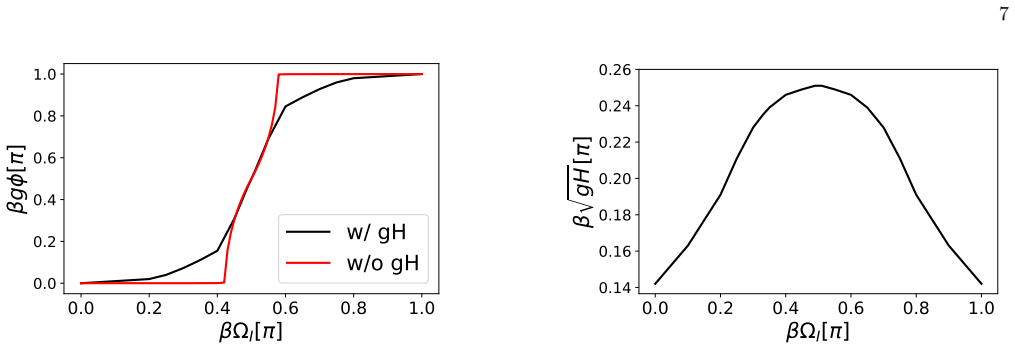
The central claim is that in the one-loop Savvidy model at high temperature, an imaginary angular velocity acts as a spin-dependent chemical potential that explicitly breaks the Z2 center symmetry, so the Polyakov-loop phase becomes nonzero and the equilibrium chromomagnetic field grows with the imaginary rotation, peaking at half the Matsubara period. The tachyonic lowest-Landau-level mode becomes less tachyonic: the imaginary part of the effective potential vanishes in a finite interval of imaginary angular velocity, giving a locally stable chromomagnetic configuration. In a small-rotation, small-field expansion, the coefficient of the squared field in the effective potential is interprete
What carries the argument
The load-bearing object is the one-loop effective potential evaluated at the rotation axis in the background of a constant chromomagnetic field and a Polyakov-loop phase, with the imaginary angular velocity entering the Matsubara frequencies as a spin-dependent chemical potential. The tachyonic mode — the lowest Landau level with negative spin projection — controls the imaginary part; the finite-temperature potential is assembled from non-tachyonic modes via a Schwinger proper-time theta-function representation and from the tachyonic sector by splitting the momentum integration and using the principal branch. Minimizing the real part over the two background fields yields the equilibrium curv
Load-bearing premise
The high-temperature expansion that produces the effective coupling and the negative moment of inertia assumes the Polyakov-loop phase can be neglected in the quadratic-in-rotation sector, yet the paper's own numerical results show that phase growing linearly with imaginary rotation; if that neglect is not justified, the quoted coefficients and the size of the negative moment-of-inertia term could receive comparable corrections.
What would settle it
Numerically minimize the full one-loop effective potential over both the chromomagnetic field and the Polyakov-loop phase without the zero-phase approximation at high temperature, and check whether the coefficient of the quadratic-in-rotation times field term — and hence the negative moment-of-inertia contribution — survives. Alternatively, a lattice simulation of SU(2) with imaginary rotation and a chromomagnetic background could measure the imaginary part of the effective potential and see whether it vanishes in the predicted window around half the Matsubara period.
If this is right
- If the effective coupling indeed grows with imaginary angular velocity, the confinement/deconfinement critical temperature under imaginary rotation is expected to rise, matching the trend seen in lattice gluodynamics.
- The finite window where the imaginary part of the effective potential vanishes means a constant chromomagnetic background plus a nonzero Polyakov phase can be locally stable at high temperature under imaginary rotation, not only in the zero-rotation case.
- Under analytic continuation to real rotation, the negative contribution of the chromomagnetic condensate to the moment of inertia persists, while the effective coupling then decreases with rotation — so real rotation would favor deconfinement, consistent with traditional model studies.
- The induced Polyakov-loop phase is nonzero even infinitesimally away from zero imaginary rotation, so imaginary rotation explicitly breaks the Z2 center symmetry and selects one of the two minima, a direct rather than spontaneous symmetry-breaking mechanism.
- Because the chromomagnetic condensate couples to the Polyakov loop through the lowest Landau levels, measurements of the Polyakov phase in rotating systems carry information about the magnetic component of the gluon plasma.
Where Pith is reading between the lines
- The paper's high-temperature expansion neglects the Polyakov-loop phase in the quadratic-in-rotation sector even though its own numerical results show that phase growing linearly with imaginary rotation; a self-consistent minimization retaining that response could change the size, and possibly the sign, of the negative moment-of-inertia term, so the quantitative coefficients should be treated as p
- The same one-loop machinery could be extended to SU(3) or to two loops; whether the stable window and the sign of the condensate contribution to the moment of inertia survive would test whether this 'negative Barnett effect' is a general property of chromomagnetic condensates or a peculiarity of SU(2).
- Since the imaginary part of the effective potential vanishes only in a finite interval of imaginary angular velocity, the system may undergo stabilization-de-stabilization transitions as the rotation speed increases, which could appear as nonmonotonic thermodynamic behavior in rotating-lattice simulations.
- The enhanced effective coupling under imaginary rotation suggests that the magnetic component of the gluon plasma carries extra infrared enhancement; this could be probed by comparing Polyakov-loop susceptibility between systems with and without a chromomagnetic background.
Editorial analysis
A structured set of objections, weighed in public.
Referee Report
Summary. The paper studies the one-loop effective potential of SU(2) Yang-Mills theory in a constant chromomagnetic background together with a Polyakov-loop background at finite temperature and imaginary angular velocity. Starting from the background-field method, the authors derive separate expressions for the real and imaginary parts of the effective potential, then minimize the real part numerically. They report that a finite imaginary angular velocity induces a nonzero Polyakov-loop phase and increases the chromomagnetic condensate, and that the imaginary part of the potential vanishes in a finite interval of βΩ_I, partially suppressing the Nielsen-Olesen instability. In the final section they perform a small-Ω, high-temperature expansion to extract an Ω_I-dependent effective coupling and a chromomagnetic contribution to the moment of inertia. The central quantitative claims are Eqs. (45) and (46).
Significance. If the results are correct, this is a useful continuum calculation connecting imaginary rotation, the Savvidy vacuum, and recent lattice observations of a negative moment of inertia in rotating gluonic matter. The one-loop derivation is largely self-contained, the numerical minimization is consistent with the derived imaginary part, and the stability window in Fig. 4 is a concrete falsifiable prediction. The paper also presents a new coefficient C3, Eqs. (43). The main weakness is the uncontrolled high-temperature expansion in Sec. V, which sets the Polyakov-loop phase to zero despite the numerical evidence that it is of order Ω_I; this affects the quantitative content of Eqs. (45) and (46).
major comments (3)
- [Sec. V, Eq. (39) and following] The expansion leading to the new quantitative results sets gφ=0 while justifying this by saying βgφ remains very small. The relevant comparison is not smallness relative to π, but relative to Ω_I itself. Fig. 2 shows βgφ growing roughly linearly with βΩ_I over 0≲βΩ_I≲0.4, so gφ is O(Ω_I). In Eq. (17), gφ and Ω_I appear additively, and a nonzero φ_min therefore contributes to the effective potential at the same order O(Ω_I^2) as the terms retained in Eq. (41). Dropping φ is not a controlled truncation. Consequently, the coefficient C3 in Eq. (43), the Ω_I dependence of g_eff in Eq. (45), and the moment of inertia in Eq. (46) could receive corrections of comparable size. The authors should either include the φ_min response by minimizing in both φ and H before expanding, or show numerically at the Ω_I values used that the omitted φ-dependent terms are subleading.
- [Fig. 4 and Eq. (44)] The high-temperature expansion is the foundation of the central claims in Eqs. (45) and (46), yet Eq. (39) is not actually derived in the manuscript. The text says it follows by replacing the Polyakov-loop phase in Ref. [42] with βΩ_I and that the detailed derivation is not repeated. Since the new coefficient C3 and the moment-of-inertia term are extracted from this expression, the reader cannot verify the sums, branch choices, or the contribution of the neutral-gluon sector. A full derivation, or at least an appendix with the essential steps, is needed to make the quantitative results checkable.
- [Fig. 4 and Eq. (44)] The stable window 0.2≲βΩ_I≲0.4 is presented as a central result, but the paper does not demonstrate explicitly how the exact stability condition (18) is satisfied at the minima of V_R in that window. The small-Ω expression Eq. (44) gives V_I≠0 there, so the vanishing must come from the full branch-cut integral Eq. (31). Please provide the values of βgφ and β√gH at the minima inside the stable window and verify that Eq. (18) holds for all Matsubara frequencies, or state explicitly that the stability claim relies only on the numerical evaluation of Eq. (31).
minor comments (3)
- [Eq. (14)] The summation over l is written as N−λ above the sum, but the meaning of this upper limit is not defined. Later, in Eq. (17), only l=0 is kept at r=0. Please define the range of l clearly and state how Landau-level degeneracy and angular momentum are related.
- [Eq. (39)] The notation P′_l is introduced, but the summation range over l is not specified. It is also not clear whether the exclusion implied by the prime applies to all terms or only to the 1/|l| piece. Please define the sums and their ranges explicitly.
- [Figs. 2 and 3] The vertical axis of Fig. 3 is labelled gH with empty square brackets, and the caption of Fig. 2 does not state the units of gH. Since T=10μ is used, please specify whether the plotted quantity is gH/μ^2, β√gH, or something else.
Circularity Check
No circularity: the central results are a self-contained one-loop derivation with externally sourced constants and a newly computed coefficient.
full rationale
The paper's main claims—nonzero Polyakov-loop phase, enhanced chromomagnetic condensate, partial suppression of the Nielsen–Olesen instability, stronger effective coupling, and negative chromomagnetic contribution to the moment of inertia—all follow from the explicit one-loop effective potential in Eq. (17) and its subsequent evaluation. The only imported numerical inputs, C1 and C2, are taken from external references [42,46,47], not from work by the present authors, and the new coefficient C3 is computed from the same expansion. No parameter is fitted to any target result: the Ω_I dependence of the effective coupling and the moment of inertia is read off from the coefficient structure of the high-temperature expansion, which is a definitional identification rather than a fit. The self-citations that do appear (e.g., [29]) are not load-bearing. The main caveat is that Sec. V sets gφ≈0 when extracting the O(Ω_I^2) terms, while Fig. 2 shows gφ~O(Ω_I); this is an uncontrolled truncation and a quantitative-consistency concern, but it is not a circular reduction of the result to its own inputs. The derivation is therefore self-contained enough that no circular step can be exhibited.
Axiom & Free-Parameter Ledger
axioms (5)
- domain assumption Local density approximation: spatial gradients of the background fields gH and φ are neglected; the effective potential is evaluated at the system center r=0 where only l=0 Landau modes contribute.
- domain assumption Chromomagnetic background is Abelian and aligned with the rotation axis: âa_μ = δ^{a3}(φ, Hy/2, -Hx/2, 0).
- domain assumption Imaginary angular velocity framework: the Euclidean theory with metric (1) and spin connection ω = Ω_I is a valid regularization, with real rotation recovered by analytic continuation.
- ad hoc to paper gφ≃0 in the small-Ω high-T expansion used to derive g_eff(Ω) and the moment of inertia.
- domain assumption One-loop truncation of the effective potential; two-loop contributions are neglected.
read the original abstract
We investigate the finite-temperature SU(2) Savvidy model under an imaginary angular velocity. Employing the background-field method, we derive the one-loop effective potential and analyze both its real and imaginary parts. We demonstrate that imaginary rotation modifies the chromomagnetic condensate and the Polyakov loop, and can partially suppress the Nielsen-Olesen instability of the chromomagnetic background. Moreover, a high-temperature expansion shows that imaginary rotation strengthens the effective coupling and that the chromomagnetic field induces a negative contribution to the moment of inertia.
Figures


Forward citations
Cited by 1 Pith paper
-
A Chromomagnetic Mechanism for the Rotational Phase Transition of Gluonic Matter
Using a rotation–magnetic holographic dictionary calibrated to lattice QCD, the paper predicts real rotation raises T_c and induces a negative total moment of inertia in pure gluonic matter near deconfinement.
Reference graph
Works this paper leans on
-
[1]
B. Betz, M. Gyulassy, and G. Torrieri, Polarization probes of vorticity in heavy ion collisions, Phys. Rev. C76, 044901 (2007), arXiv:0708.0035 [nucl-th]
Pith/arXiv arXiv 2007
-
[2]
Y. Jiang, Z.-W. Lin, and J. Liao, Rotating quark-gluon plasma in relativistic heavy ion collisions, Phys. Rev. C94, 044910 (2016), [Erratum: Phys.Rev.C 95, 049904 (2017)], arXiv:1602.06580 [hep-ph]
Pith/arXiv arXiv 2016
-
[3]
W.-T. Deng and X.-G. Huang, Vorticity in Heavy-Ion Collisions, Phys. Rev. C93, 064907 (2016), arXiv:1603.06117 [nucl- th]
Pith/arXiv arXiv 2016
-
[4]
X.-G. Deng, X.-G. Huang, Y.-G. Ma, and S. Zhang, Vorticity in low-energy heavy-ion collisions, Phys. Rev. C101, 064908 (2020), arXiv:2001.01371 [nucl-th]
Pith/arXiv arXiv 2020
-
[5]
L. Adamczyk EMet al. (STAR), Global Λ hyperon polarization in nuclear collisions: evidence for the most vortical fluid, Nature548, 62 (2017), arXiv:1701.06657 [nucl-ex]
Pith/arXiv arXiv 2017
-
[6]
Z.-T. Liang, M. A. Lisa, and X.-N. Wang, Global Polarization Effect in the Extremely Rapidly Rotating QGP in HIC, Nucl. Phys. News30, 10 (2020), arXiv:1912.07822 [nucl-th]
Pith/arXiv arXiv 2020
-
[7]
J.-H. Gao, Z.-T. Liang, Q. Wang, and X.-N. Wang, Global Polarization Effect and Spin-Orbit Coupling in Strong Interac- tion, Lect. Notes Phys.987, 195 (2021), arXiv:2009.04803 [nucl-th]
Pith/arXiv arXiv 2021
-
[8]
X.-G. Huang, J. Liao, Q. Wang, and X.-L. Xia, Vorticity and Spin Polarization in Heavy Ion Collisions: Transport Models, Lect. Notes Phys.987, 281 (2021), arXiv:2010.08937 [nucl-th]
Pith/arXiv arXiv 2021
-
[9]
Y.-C. Liu and X.-G. Huang, Anomalous chiral transports and spin polarization in heavy-ion collisions, Nucl. Sci. Tech.31, 56 (2020), arXiv:2003.12482 [nucl-th]
Pith/arXiv arXiv 2020
-
[10]
Becattini, Spin and polarization: a new direction in relativistic heavy ion physics, Rept
F. Becattini, Spin and polarization: a new direction in relativistic heavy ion physics, Rept. Prog. Phys.85, 122301 (2022), arXiv:2204.01144 [nucl-th]
Pith/arXiv arXiv 2022
-
[11]
F. Becattini, M. Buzzegoli, T. Niida, S. Pu, A.-H. Tang, and Q. Wang, Spin polarization in relativistic heavy-ion collisions, Int. J. Mod. Phys. E33, 2430006 (2024), arXiv:2402.04540 [nucl-th]
Pith/arXiv arXiv 2024
-
[12]
T. Niida and S. A. Voloshin, Polarization phenomenon in heavy-ion collisions, Int. J. Mod. Phys. E33, 2430010 (2024), arXiv:2404.11042 [nucl-ex]
Pith/arXiv arXiv 2024
-
[13]
J.-H. Chen, Z.-T. Liang, Y.-G. Ma, X.-L. Sheng, and Q. Wang, Vector meson’s spin alignments in high energy reactions, Sci. China Phys. Mech. Astron.68, 211001 (2025), arXiv:2407.06480 [hep-ph]
Pith/arXiv arXiv 2025
-
[14]
H.-L. Chen, K. Fukushima, X.-G. Huang, and K. Mameda, Analogy between rotation and density for Dirac fermions in a magnetic field, Phys. Rev. D93, 104052 (2016), arXiv:1512.08974 [hep-ph]
Pith/arXiv arXiv 2016
-
[15]
Y. Jiang and J. Liao, Pairing Phase Transitions of Matter under Rotation, Phys. Rev. Lett.117, 192302 (2016), arXiv:1606.03808 [hep-ph]
Pith/arXiv arXiv 2016
-
[16]
M. N. Chernodub and S. Gongyo, Interacting fermions in rotation: chiral symmetry restoration, moment of inertia and thermodynamics, JHEP01, 136, arXiv:1611.02598 [hep-th]
-
[17]
H.-L. Chen, X.-G. Huang, and J. Liao, QCD Phase Structure Under Rotation, Lect. Notes Phys.987, 349 (2021), arXiv:2108.00586 [hep-ph]
Pith/arXiv arXiv 2021
-
[18]
Y. Fujimoto, K. Fukushima, and Y. Hidaka, Deconfining Phase Boundary of Rapidly Rotating Hot and Dense Matter and Analysis of Moment of Inertia, Phys. Lett. B816, 136184 (2021), arXiv:2101.09173 [hep-ph]
Pith/arXiv arXiv 2021
-
[19]
H.-L. Chen, Z.-B. Zhu, and X.-G. Huang, Quark-meson model under rotation: A functional renormalization group study, Phys. Rev. D108, 054006 (2023), arXiv:2306.08362 [hep-ph]
Pith/arXiv arXiv 2023
-
[20]
Y.-Q. Zhao, S. He, D. Hou, L. Li, and Z. Li, Phase diagram of holographic thermal dense QCD matter with rotation, JHEP04, 115, arXiv:2212.14662 [hep-ph]
-
[21]
K. Mameda and K. Takizawa, Deconfinement transition in the revolving bag model, Phys. Lett. B847, 138317 (2023), arXiv:2308.07310 [hep-ph]
Pith/arXiv arXiv 2023
-
[22]
Y. Chen, X. Chen, D. Li, and M. Huang, Deconfinement and chiral restoration phase transition under rotation from holography in an anisotropic gravitational background, Phys. Rev. D111, 046006 (2025), arXiv:2405.06386 [hep-ph]
Pith/arXiv arXiv 2025
- [23]
-
[24]
F. Sun, J. Shao, R. Wen, K. Xu, and M. Huang, Chiral phase transition and spin alignment of vector mesons in the polarized-Polyakov-loop Nambu–Jona-Lasinio model under rotation, Phys. Rev. D109, 116017 (2024), arXiv:2402.16595 [hep-ph]
Pith/arXiv arXiv 2024
-
[25]
K. Xu, F. Lin, A. Huang, and M. Huang, Λ/ ¯Λ polarization and splitting induced by rotation and magnetic field, Phys. Rev. D106, L071502 (2022), arXiv:2205.02420 [hep-ph]. 12
Pith/arXiv arXiv 2022
-
[26]
M. Wei and M. Huang, Spin alignment of vector mesons from quark dynamics in a rotating medium*, Chin. Phys. C47, 104105 (2023), arXiv:2303.01897 [hep-ph]
Pith/arXiv arXiv 2023
-
[27]
H.-L. Chen, W.-j. Fu, X.-G. Huang, and G.-L. Ma, Fluctuations and Correlations of Quark Spin in Hot and Dense QCD Matter, Phys. Rev. Lett.135, 032302 (2025), arXiv:2410.20704 [hep-ph]
arXiv 2025
-
[28]
V. V. Braguta, A. Y. Kotov, D. D. Kuznedelev, and A. A. Roenko, Influence of relativistic rotation on the confinement- deconfinement transition in gluodynamics, Phys. Rev. D103, 094515 (2021), arXiv:2102.05084 [hep-lat]
Pith/arXiv arXiv 2021
-
[29]
J.-C. Yang and X.-G. Huang, QCD on Rotating Lattice with Staggered Fermions, arXiv:2307.05755 [hep-lat] (2023)
Pith/arXiv arXiv 2023
-
[30]
V. V. Braguta, M. N. Chernodub, I. E. Kudrov, A. A. Roenko, and D. A. Sychev, Negative Barnett effect, negative moment of inertia of the gluon plasma, and thermal evaporation of the chromomagnetic condensate, Phys. Rev. D110, 014511 (2024), arXiv:2310.16036 [hep-ph]
Pith/arXiv arXiv 2024
-
[31]
S. Chen, K. Fukushima, and Y. Shimada, Perturbative Confinement in Thermal Yang-Mills Theories Induced by Imaginary Angular Velocity, Phys. Rev. Lett.129, 242002 (2022), arXiv:2207.12665 [hep-ph]
Pith/arXiv arXiv 2022
-
[32]
S. Chen, K. Fukushima, and Y. Shimada, Inhomogeneous confinement and chiral symmetry breaking induced by imaginary angular velocity, Phys. Lett. B859, 139107 (2024), arXiv:2404.00965 [hep-ph]
Pith/arXiv arXiv 2024
-
[33]
Jiang, Rotating SU(2) gluon matter and deconfinement at finite temperature, Phys
Y. Jiang, Rotating SU(2) gluon matter and deconfinement at finite temperature, Phys. Lett. B853, 138655 (2024), arXiv:2312.06166 [hep-th]
Pith/arXiv arXiv 2024
-
[34]
Jiang, Inhomogeneous SU(2) gluon matter under rotation, Phys
Y. Jiang, Inhomogeneous SU(2) gluon matter under rotation, Phys. Rev. D110, 054047 (2024), arXiv:2406.03311 [nucl-th]
Pith/arXiv arXiv 2024
-
[35]
S. Wang, J.-X. Chen, D. Hou, and H.-C. Ren, Strong Coupling Expansion of Gluodynamics on a Lattice under Rotation, arXiv:2505.15487 [hep-ph] (2025)
Pith/arXiv arXiv 2025
-
[36]
K. Fukushima and Y. Shimada, Imaginary rotating gluonic matter at strong coupling, Phys. Lett. B868, 139716 (2025), arXiv:2506.03560 [hep-ph]
Pith/arXiv arXiv 2025
-
[37]
D. V. Fursaev, Statistical mechanics, gravity, and Euclidean theory, Nucl. Phys. B Proc. Suppl.104, 33 (2002), arXiv:hep- th/0107089
arXiv 2002
-
[38]
G. K. Savvidy, Infrared Instability of the Vacuum State of Gauge Theories and Asymptotic Freedom, Phys. Lett. B71, 133 (1977)
1977
-
[39]
N. K. Nielsen and P. Olesen, An Unstable Yang-Mills Field Mode, Nucl. Phys. B144, 376 (1978)
1978
-
[40]
A. O. Starinets, A. S. Vshivtsev, and V. C. Zhukovsky, Color ferromagnetic state in SU(2) gauge theory at finite temper- ature, Phys. Lett. B322, 403 (1994)
1994
-
[41]
Ebert, V
D. Ebert, V. C. Zhukovsky, and A. S. Vshivtsev, Thermodynamic potential with condensate fields in an SU(2) model of QCD, Int. J. Mod. Phys. A13, 1723 (1998)
1998
-
[42]
P. N. Meisinger and M. C. Ogilvie, The Finite temperature SU(2) Savvidy model with a nontrivial Polyakov loop, Phys. Rev. D66, 105006 (2002), arXiv:hep-ph/0206181
Pith/arXiv arXiv 2002
-
[43]
M. Bordag and V. Skalozub, The effective potential of gluodynamics in the background of Polyakov loop and colormagnetic field, Eur. Phys. J. C82, 390 (2022), arXiv:2112.01043 [hep-th]
Pith/arXiv arXiv 2022
-
[44]
N. K. Nielsen, ASYMPTOTIC FREEDOM AS A SPIN EFFECT, Am. J. Phys.49, 1171 (1981)
1981
-
[45]
Greiner, S
W. Greiner, S. Schramm, and E. Stein, EMQuantum Chromodynamics, Physics and astronomy online library (Springer, 2002)
2002
-
[46]
Ninomiya and N
M. Ninomiya and N. Sakai, Finite Temperature Behavior of Color Ferromagnetic State in QCD, Nucl. Phys. B190, 316 (1981)
1981
-
[47]
D. Persson, Asymptotic freedom from thermal and vacuum magnetization, Annals Phys.252, 33 (1996), arXiv:hep- ph/9601259
arXiv 1996
-
[48]
Weiss, The Effective Potential for the Order Parameter of Gauge Theories at Finite Temperature, Phys
N. Weiss, The Effective Potential for the Order Parameter of Gauge Theories at Finite Temperature, Phys. Rev. D24, 475 (1981)
1981
-
[49]
Weiss, The Wilson Line in Finite Temperature Gauge Theories, Phys
N. Weiss, The Wilson Line in Finite Temperature Gauge Theories, Phys. Rev. D25, 2667 (1982)
1982
-
[50]
D. J. Gross, R. D. Pisarski, and L. G. Yaffe, QCD and Instantons at Finite Temperature, Rev. Mod. Phys.53, 43 (1981)
1981
-
[51]
K. Fukushima and V. Skokov, Polyakov loop modeling for hot QCD, Prog. Part. Nucl. Phys.96, 154 (2017), arXiv:1705.00718 [hep-ph]
Pith/arXiv arXiv 2017
-
[52]
Chodos, D
A. Chodos, D. A. Owen, and C. M. Sommerfield, Strong Field Dependence of the Fine Structure Constant, Phys. Lett. B 212, 491 (1988)
1988
-
[53]
V. V. Braguta, M. N. Chernodub, A. A. Roenko, and D. A. Sychev, Negative moment of inertia and rotational instability of gluon plasma, Phys. Lett. B852, 138604 (2024), arXiv:2303.03147 [hep-lat]
Pith/arXiv arXiv 2024
-
[54]
Bordag, Tachyon condensation in a chromomagnetic background field and the groundstate of QCD, Eur
M. Bordag, Tachyon condensation in a chromomagnetic background field and the groundstate of QCD, Eur. Phys. J. A 59, 55 (2023), arXiv:2207.08711 [hep-th]
Pith/arXiv arXiv 2023
-
[55]
Kondo, Gauge-invariant gluon mass, infrared Abelian dominance and stability of magnetic vacuum, Phys
K.-I. Kondo, Gauge-invariant gluon mass, infrared Abelian dominance and stability of magnetic vacuum, Phys. Rev. D 74, 125003 (2006), arXiv:hep-th/0609166
Pith/arXiv arXiv 2006
-
[56]
R. Parthasarathy and A. Kumar, SU(2) Yang-Mills theory in Savvidy background at finite temperature and chemical potential, Phys. Rev. D75, 085007 (2007), arXiv:hep-th/0609090
Pith/arXiv arXiv 2007
-
[57]
D. Vercauteren and H. Verschelde, Resolving the instability of the Savvidy vacuum by dynamical gluon mass, Phys. Lett. B660, 432 (2008), arXiv:0712.0570 [hep-th]
Pith/arXiv arXiv 2008
-
[58]
Cao, Charged rho superconductor in the presence of magnetic field and rotation, Eur
G. Cao, Charged rho superconductor in the presence of magnetic field and rotation, Eur. Phys. J. C81, 148 (2021), arXiv:2008.08321 [nucl-th]
Pith/arXiv arXiv 2021
-
[59]
S. Ebihara, K. Fukushima, and K. Mameda, Boundary effects and gapped dispersion in rotating fermionic matter, Phys. Lett. B764, 94 (2017), arXiv:1608.00336 [hep-ph]
Pith/arXiv arXiv 2017
-
[60]
Jiang, Chiral vortical catalysis, Eur
Y. Jiang, Chiral vortical catalysis, Eur. Phys. J. C82, 949 (2022), arXiv:2108.09622 [hep-ph]. 13
Pith/arXiv arXiv 2022
-
[61]
M. Bordag and V. Skalozub,A 0-condensation in quark-gluon plasma with finite baryon density, Eur. Phys. J. C81, 998 (2021), arXiv:2009.11734 [hep-th]
Pith/arXiv arXiv 2021
-
[62]
Zhang, K
L. Zhang, K. Xu, and M. Huang, Imaginary rotation and chromomagnetic condensation in su(2) yang-mills theory
discussion (0)
Sign in with ORCID, Apple, or X to comment. Anyone can read and Pith papers without signing in.