REVIEW 2 major objections 3 minor 2 cited by
The paper proves that pure quantum states that look thermal on every additive observable cannot be used to extract extensive work, and have an entropy density that never decreases—two forms of the second law.
Reviewed by Pith at T0; open to challenge. T0 means a machine referee read the full paper against a public rubric. the ladder, T0–T4 →
2026-08-03 03:49 UTC pith:X76QBI7G
load-bearing objection A serious paper that proves the second law for a macroscopic-equivalence equilibrium notion, with one unproven uniqueness assumption (2.B) carrying the entropy-law theorem. the 2 major comments →
Second law of thermodynamics in closed quantum many-body systems
The pith
A machine-rendered reading of the paper's core claim, the machinery that carries it, and where it could break.
Core claim
The central claim is that thermodynamic irreversibility survives the transition to pure quantum states as long as equilibrium and operations are both characterized macroscopically. A state is an iMATE if, in the thermodynamic limit, the density of every additive observable matches the canonical Gibbs state at some inverse temperature; a macroscopic operation is unitary evolution generated by an additive Hamiltonian plus a finite number of time-dependent fields coupled to additive observables, with operation time O(L^0). Under these definitions, macroscopic passivity holds: the initial Hamiltonian's expectation value cannot decrease extensively (Corollary 3). The paper then defines the quantu
What carries the argument
Three objects carry the argument. iMATE is the notion of thermal equilibrium used: two states are macroscopically equivalent when all additive-observable densities agree in the thermodynamic limit, and an iMATE is any state equivalent to a canonical Gibbs state. Macroscopic operations are the allowed adiabatic operations: unitaries generated by time-dependent additive Hamiltonians; the Lieb-Robinson bound ensures their light cone is system-size independent, so macroscopic equivalence is preserved for O(L^0) operations (Theorem 1). The quantum macroscopic entropy density is built from spatially averaged ℓ-local reduced density matrices; because it is a functional of the macroscopic state alon
Load-bearing premise
Assumption 2.B—that macroscopically equivalent states must have macroscopically equivalent long-time averages under the final Hamiltonian—is the load-bearing premise; without it the proof of entropy non-decrease collapses.
What would settle it
Take a small spin chain with a local Hamiltonian and prepare two microscopically different states from the same iMATE class (identical densities for all additive observables). Apply the same macroscopic operation for an O(L^0) time, then compute the long-time-averaged expectation values of additive observables under the final Hamiltonian. If any such density differs between the two runs, Assumption 2.B is violated and Theorem 4's monotonicity is not guaranteed for that Hamiltonian. A direct numerical experiment of this kind can settle whether the condition holds.
If this is right
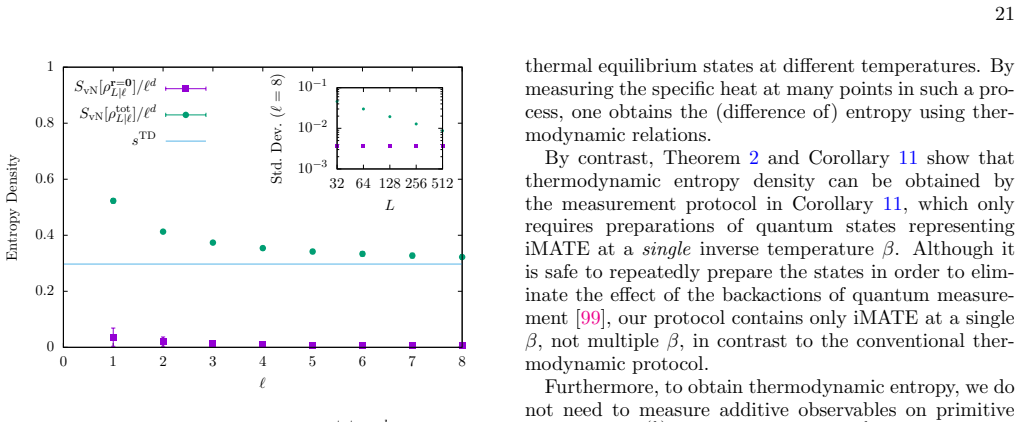
- Thermodynamic entropy density can be read off from measurements of additive observables at a single temperature, without traversing a thermodynamic process.
- Pure states such as energy eigenstates of nonintegrable systems, which represent iMATE, acquire a well-defined thermodynamic entropy even though their von Neumann or half-chain entropies do not match it.
- No nonequilibrium state that is not iMATE can relax to iMATE in any system-size-independent time; thermalization in this sense requires a diverging timescale.
- The system-size-independent operation time is optimal: at longer timescales the paper constructs explicit local models in which both macroscopic passivity and entropy increase fail, with the entropy density dropping from its maximum value to zero.
- With thermalization, the result reduces to the standard adiabatic inequality between thermodynamic entropies of the initial and final Hamiltonians; with only the weaker uniqueness assumption, entropy still increases even without final equilibrium.
Where Pith is reading between the lines
- A natural extension is to read the framework as assigning a thermodynamic entropy to every macroscopic state, equilibrium or not; if such a state later relaxes to an iMATE, the measured quantum macroscopic entropy density would have to settle at the Gibbs value, which is checkable on simulators.
- The dependence on Assumption 2.B suggests that integrable systems with multiple conserved quantities form a natural test bed: two macroscopically equivalent states carrying different quasiparticle arrangements should be driven by an O(L^0) pulse and their long-time averages compared; any mismatch would show where the theorem's condition fails.
- The longer-timescale counterexamples are concrete enough to attempt in a quantum simulator: preparing Bell-pair product states, implementing swap-based macroscopic operations for times much larger than O(L^0), and recording the quantum macroscopic entropy density would exhibit a Loschmidt-type second-law violation without any measurement-and-feedback.
- One might also test the β=0 stability prediction: an iMATE at infinite temperature should keep every additive-observable density fixed under any O(L^0) macroscopic operation; a deviation would falsify Corollary 4.
Editorial analysis
A structured set of objections, weighed in public.
Referee Report
Summary. The paper introduces iMATE (macroscopic equivalence to the canonical Gibbs state for all additive observables) and macroscopic operations generated by time-dependent additive Hamiltonians. It proves preservation of macroscopic equivalence for O(L^0) times using a Lieb-Robinson bound (Theorem 1), macroscopic passivity of iMATE (Corollary 3), an entropy formula smac that equals thermodynamic entropy on iMATE (Theorem 2), and a law of increasing entropy (Theorems 3 and 4) under either thermalization (Assumption 2.A) or a weaker uniqueness-of-final-macroscopic-state condition (Assumption 2.B). It also provides explicit counterexamples showing that both laws fail for longer operation times t* = ω(L^0).
Significance. If the main results hold as stated, the paper is a serious step toward reconciling pure-state thermal equilibrium with the second law. The framework is well defined, the Lieb-Robinson-based preservation theorem is a substantial technical contribution, the entropy formula is explicit and measurable, and the numerical METTS demonstration supports Theorem 2. The counterexamples in Sec. XIII also usefully delimit the regime of validity. However, the central law of increasing entropy for arbitrary pure iMATE states is conditional on Assumption 2.B, which is neither derived nor independently supported; without it the proof only yields the inequality for the canonical Gibbs representative. The significance is therefore real but partial, and the paper's advertised claim needs qualification.
major comments (2)
- [Sec. XI C, Eq. (82); proof of Theorem 4 (Appendix E5)] The central result for arbitrary pure iMATE states relies on Assumption 2.B. Proposition 12 gives a lower bound for the unital CPTP relaxation map applied to the canonical Gibbs state, namely smac[U(ρcan)] ≥ s_TD(β0|H0). To replace ρcan by an arbitrary representation ρL of the same iMATE, the proof must identify the final macroscopic states U(ρL) and U(ρcan). This is exactly Assumption 2.B, which is stated without proof or supporting evidence. Since Proposition 6 shows that such uniqueness can fail at t* = ω(L^0), the O(L^0) restriction does not by itself make the assumption evident. Unless Assumption 2.B is derived or a concrete physical condition implying it is supplied, Theorem 4 only establishes the inequality for Gibbs initial states, not for general pure iMATE states.
- [Abstract and Sec. II C (Main Result 4)] The abstract states that the entropy density 'cannot be decreased by any macroscopic operations' for 'any initial state in iMATE' without mentioning the assumption. Main Result 4 only refers to 'some mild assumption about the existence of a unique thermodynamic limit', which is vague and understates Assumption 2.B. The conditional nature of the law of increasing entropy should be clearly stated in the abstract and in the main-result summary, with a precise reference to Assumption 2.B (or to Assumption 2.A for Theorem 3).
minor comments (3)
- [Sec. VII A / Corollary 3] Corollary 3 assumes β ≥ 0, but the abstract says 'any quantum state in iMATE' without this restriction. Please state the β ≥ 0 condition explicitly in the abstract and in Main Result 2.
- [Sec. VII C, Example 4] The statement that local conserved quantities are restricted to HL itself is asserted without proof or citation. If this is not central, add a reference; if it is used, provide a derivation or a more careful statement.
- [General presentation] There are several typographical and formatting issues, including stray 'S' characters, broken spacing in Table II, and inconsistent use of ∥•∥ versus ∥•∥∞. A careful proofreading pass is needed.
Circularity Check
No significant circularity: results are conditional on explicit assumptions and nontrivial lemmas, not circular definitions or self-citations.
full rationale
I walked the paper's derivation chain. The notion of iMATE is defined by macroscopic equivalence to a Gibbs state for all additive observables, and macroscopic operations are generated by additive Hamiltonians; however, the key transfer step—that macroscopic equivalence is preserved under such operations—is not assumed by definition but proved via the Lieb-Robinson bound (Theorem 1, Sec. VI B, App. D). Macroscopic passivity (Corollary 3) then follows by combining that preservation theorem with the independent passivity of Gibbs states, so it is not merely an echo of the definitions. The entropy formula (Theorem 2) is also nontrivial: the quantum macroscopic entropy density is defined from spatially averaged local reduced states, whereas thermodynamic entropy density is defined from the full Gibbs state; their equality is proved using a maximum-entropy upper bound (Lemma 2) and a unital-CPTP lower bound (Proposition 12), rather than being built into the definition. The law of increasing entropy (Theorems 3 and 4) explicitly relies on Assumption 2.A or the weaker Assumption 2.B about the uniqueness of the final macroscopic state. This assumption is not derived, and it is load-bearing; but it is a stated dynamical assumption, not a hidden re-statement of the conclusion, and it is not equivalent to entropy non-decrease. Its unproven status is a correctness/limitation concern, not a circularity. No fitted parameters are renamed as predictions, no load-bearing self-citations are used, and no known result is merely relabeled. The counterexamples at longer timescales (Propositions 5 and 6) further confirm that the O(L^0) restriction is substantive rather than definitionally forced.
Axiom & Free-Parameter Ledger
axioms (10)
- domain assumption Assumption 1.A: canonical Gibbs state ρ_can(β|H) represents a macroscopic state (expectation values of all additive observables converge in L→∞).
- domain assumption Assumption 1.B: canonical Gibbs state represents a normal macroscopic state (variances of additive observables are macroscopically negligible).
- domain assumption Assumption 1.C: variance of additive observables composed of ℓmax_L-local observables is o(L^0) for a diverging ℓmax_L = o(L).
- domain assumption Assumption 1.D: Gaussian concentration bound for additive observables in the Gibbs state, with χ_L = O(N^{2-ν}).
- domain assumption Assumption 2.A: thermalization — if the post-operation state has macroscopically negligible energy fluctuation, its long-time average represents iMATE.
- domain assumption Assumption 2.B: unique final macroscopic state — macroscopic equivalence at t* implies macroscopic equivalence of long-time averages under H1.
- domain assumption System class: translation-invariant short-range Hamiltonian, no first-order phase coexistence, no additive conserved quantities other than energy.
- standard math Lieb-Robinson bound for locally interacting time-dependent Hamiltonians.
- standard math Passivity of canonical Gibbs states at β ≥ 0 under arbitrary unitaries.
- standard math Monotonicity of quantum relative entropy, concavity of von Neumann entropy, and existence of the thermodynamic limit of free energy.
Cite this review
Pith. "Pith review of Second law of thermodynamics in closed quantum many-body systems." pith.science (2026). https://pith.science/paper/X76QBI7G
@misc{pith2026260206657,
  author       = {Pith},
  title        = {Pith review of: Second law of thermodynamics in closed quantum many-body systems},
  year         = {2026},
  howpublished = {\url{https://pith.science/paper/X76QBI7G}},
  note         = {Machine review of arXiv:2602.06657}
}
read the original abstract
The second law of thermodynamics for adiabatic operations -- constraints on state transitions in closed systems under external control -- is one of the fundamental principles of thermodynamics. On the other hand, it is recently established that even pure quantum states can represent thermal equilibrium. However, pure quantum states do not satisfy the second law in that they are not passive, i.e., work can be extracted from them if arbitrary unitary operations are allowed. It therefore remains unresolved how quantum mechanics can be reconciled with thermodynamics. Here, based on our key quantum-mechanical notions of thermal equilibrium and adiabatic operations, we address the emergence of the second law for adiabatic operations in the thermodynamics limit. We first introduce infinite-observable macroscopic thermal equilibrium (iMATE); a quantum state, including pure states, is in iMATE if the expectation values of all additive observables agree with their equilibrium values. We also introduce a macroscopic operation as unitary evolution generated by a time-dependent additive Hamiltonian, which is regarded as corresponding to adiabatic operations. Employing these concepts, we show that no extensive work can be extracted from any quantum state in iMATE through any macroscopic operations. Furthermore, we introduce a quantum-mechanical form of entropy density such that it agrees with thermodynamic entropy density for any quantum state in iMATE. We then prove that for any initial state in iMATE, this entropy density cannot be decreased by any macroscopic operations, followed by a time-independent relaxation process. Our theory thus proves two different forms of the second law, by adopting macroscopically reasonable classes of observables, equilibrium states, and operations. We also discuss the time scales of macroscopic operations in these results.
Figures

Forward citations
Cited by 2 Pith papers
-
Clifford Ergotropy
Clifford ergotropy is upper-bounded by a magic measure, exhibits a control transition in two qubits, and implies a second law under Clifford operations for typical many-body states.
-
Clifford Ergotropy
Defines Clifford ergotropy with universal upper bounds that decrease with magic (via infinite-order filtered stabilizer Rényi entropy), shows results for 1-2 qubit systems including a control landscape transition, and...
Reference graph
Works this paper leans on
-
[1]
We divide the proof of this proposition into two parts: proof for the necessity and sufficiency of Eq
Proof of Proposition 3 Here, we prove Proposition 3. We divide the proof of this proposition into two parts: proof for the necessity and sufficiency of Eq. (51). Proof for the necessity of Eq. (51). Take arbitrary k ∈ {1, ..., K} and ℓ ∈ N. As explained above, Eq. (50) holds for any observable α on C ℓ. If {ρL}L and {σL}L are macroscopically equivalent, w...
-
[2]
Proposition 10 (Infinite temperature iMATE without random variables)
Infinite temperature iMA TE without random variables (details of Example 2) In this subsection, we provide a simple example of representations of iMATE at β = 0 that contains no random variables in contrast to the typical sequence of METTS. Proposition 10 (Infinite temperature iMATE without random variables) . For simplicity, we consider a one- dimensiona...
-
[3]
Importantly, it contains no random variables in contrast to METTS
Finite temperature iMA TE without random variables (details of Example 3) In this subsection, we explicitly construct a representation of iMATE at finite temperature. Importantly, it contains no random variables in contrast to METTS. Proposition 11 (Finite temperature iMATE without random variables) . For simplicity, we consider a one- dimensional spin- 1...
-
[4]
Let (ρL)L∈N represent a macroscopic state
Upper bound on the quantum macroscopic entropy density Lemma 2 (Principle of maximum entropy). Let (ρL)L∈N represent a macroscopic state. If its energy density coincides with that of an equilibrium state described by a Hamiltonian H at some inverse temperature β∗, lim L→∞ Tr[ρLH]/N = lim L→∞ Tr[ρcan L (β∗|H)H]/N, (E4) then the quantum macroscopic entropy ...
-
[5]
A CPTP map U (•) on the total Hilbert space is said to be unital when it satisfies U (IΛL ) = IΛL , (E16) where IΛL is the identity operator on the total Hilbert space
Lower bound on the quantum macroscopic entropy density after a unital CPTP map Next we investigate how smac[•] can be decreased by a completely positive trace preserving (CPTP) map. A CPTP map U (•) on the total Hilbert space is said to be unital when it satisfies U (IΛL ) = IΛL , (E16) where IΛL is the identity operator on the total Hilbert space. For in...
-
[6]
(72) which is used in the proof of Theorem 2 Proof
Proof of Eq. (72) which is used in the proof of Theorem 2 Proof. Inserting ρL = ρcan L (β|H) into Lemma 2, we have lim sup ℓ→∞ smac ℓ ρcan L (β|H) L∈N ≤ sTD(β|H). (E36) On the other hand, inserting ρL = ρcan L (β|H) into Proposition 12 and taking UL in Proposition 12 as the identity map, we have smac ℓ ρcan L (β|H) L∈N ≥ lim sup L→∞ SvN[ρcan L (β|H)] N = ...
-
[7]
We introduce UL(•) := lim T →∞ 1 T Z T 0 dt e−iH1tU (t∗, 0) • U †(t∗, 0)eiH1t, (E39) which is a unital CPTP map
Proof of Theorem 4 Proof. We introduce UL(•) := lim T →∞ 1 T Z T 0 dt e−iH1tU (t∗, 0) • U †(t∗, 0)eiH1t, (E39) which is a unital CPTP map. The existence of the limit lim T →∞can be shown from the fact that the Hilbert space is finite dimensional. Inserting ρL = ρcan L (β|H) into Proposition 12 and taking UL(•) in Proposition 12 as the above one, we have s...
-
[8]
Proof of Theorem 3 using Theorem 4 Equation (78) of Theorem 3 readily follows from Theorem 4 as follows. Proof. Suppose that the assumptions of Theorem 3 are satisfied. First, we will show that Assumption 2.B is also satisfied. Consider two representations of the same iMATE, i.e., ( ρL)L∈N and ( σL)L∈N satisfying Eq. (80). From Corollary 1, the expectatio...
-
[9]
Direct proof of Theorem 3 We here give a more direct proof of Theorem 3. Proof. First, we will show that ρL(t > t∗) L∈N represents iMATE. Since ρL(0) L∈N represents normal iMATE, Proposition 2 implies that ρL(t∗) L∈N represents a normal macroscopic state. This means that Eq. (75) is satisfied. This fact combined with Assumption 2.A implies that ρL(t > t∗)...
-
[10]
iMATE + macroscopic operations
Passivity to local controls In this Appendix, we extend our results for the setup “iMATE + macroscopic operations” to the setup “MITE + local control”. Precisely, MITE considered here corresponds to O(L0)-local MITE defined by Definition 16 and local control considered here is given as follows: Definition 17 (Local control). Let rH be a positive integer i...
-
[11]
MITE + local control
Proof of Eq. (46) in Example 5 Thus, the passivity holds true for the “MITE + local control” setup, in addition to the “iMATE + macroscopic operation” setup (Corollary 3). One might expect that they could be extended to a broader setup of “iMATE + local control.” However, Example 5 shows that such an extension is impossible. Below, we prove Eq. (46) in Ex...
-
[12]
Since we can obtain a d-dimensional system by bundling Ld−1 copies of a one-dimensional system, it suffices to provide an example for the case of d = 1
Proof of Proposition 5 We prove Proposition 5 by an explicit construction. Since we can obtain a d-dimensional system by bundling Ld−1 copies of a one-dimensional system, it suffices to provide an example for the case of d = 1. Moreover, since the timescale can be freely rescaled by a factor independent of L through multiplying the Hamiltonian by a consta...
-
[13]
The basic strategy is almost the same as that of Proposition 5
Proof of Proposition 6 In this subsection, we prove Proposition 6 by an explicit construction. The basic strategy is almost the same as that of Proposition 5. a. Setup We choose the initial Hamiltonian H0 as H0 = π 4 LX j=1 ⃗ σj · ⃗ σj+1 (H15) 58 and the final Hamiltonian H1 as H1 = π 4 LX j=1 ⃗ σj · ⃗ σj+1 + π 8 LX j=1 ⃗ σj · ⃗ σj+2. (H16) The latter is ...
-
[14]
Kittel and H
C. Kittel and H. Kroemer, Thermal Physics , 2nd ed. (W. H. Freeman and Company, San Francisco, 1980)
1980
-
[15]
L. D. Landau and E. M. Lifshitz, Statistical Physics, 3rd ed. (Butterworth-Heinemann, Oxford, 1980) p. 544
1980
-
[16]
H. B. Callen, Thermodynamics and an Introduction to Thermostatistics, 2nd ed. (John Wiley and Sons, New York, 1985)
1985
-
[17]
E. H. Lieb and J. Yngvason, The physics and mathe- matics of the second law of thermodynamics, Phys. Rep. 310, 1 (1999)
1999
-
[18]
Pusz and S
W. Pusz and S. L. Woronowicz, Passive states and KMS states for general quantum systems, Commun. Math. Phys. 58, 273 (1978)
1978
-
[19]
Lenard, Thermodynamical proof of the Gibbs for- mula for elementary quantum systems, J
A. Lenard, Thermodynamical proof of the Gibbs for- mula for elementary quantum systems, J. Stat. Phys. 19, 575 (1978)
1978
-
[20]
Gorecki and W
J. Gorecki and W. Pusz, Passive states for finite classical systems, Lett. Math. Phys. 4, 433 (1980)
1980
-
[21]
H. A. M. Dani¨ els, Passivity and equilibrium for classical Hamiltonian systems, J. Math. Phys. 22, 843 (1981)
1981
-
[22]
Tasaki, The second law of Thermodynamics as a the- orem in quantum mechanics (2000)
H. Tasaki, The second law of Thermodynamics as a the- orem in quantum mechanics (2000)
2000
-
[23]
S. Z. Baba, N. Yoshioka, and T. Sagawa, Work ex- tractability from energy eigenstates under optimized lo- cal operations (2023), arXiv:2308.03537
Pith/arXiv arXiv 2023
-
[24]
Brand˜ aoa, M
F. Brand˜ aoa, M. Horodecki, N. Ng, J. Oppenheim, and S. Wehner, The second laws of quantum thermodynam- ics, Proc. Natl. Acad. Sci. U.S.A. 112, 3275 (2015)
2015
-
[25]
H. Tasaki, Statistical mechanical derivation of the second law of thermodynamics (2000), arXiv:cond- mat/0009206 [cond-mat.stat-mech]
arXiv 2000
-
[26]
L. F. Santos, A. Polkovnikov, and M. Rigol, Entropy of Isolated Quantum Systems after a Quench, Phys. Rev. Lett. 107, 040601 (2011)
2011
-
[27]
T. N. Ikeda, N. Sakumichi, A. Polkovnikov, and M. Ueda, The second law of thermodynamics under uni- tary evolution and external operations, Ann. Phys. 354, 338 (2015)
2015
-
[28]
Tasaki, Quantum Statistical Mechanical Derivation of the Second Law of Thermodynamics: A Hybrid Set- ting Approach, Phys
H. Tasaki, Quantum Statistical Mechanical Derivation of the Second Law of Thermodynamics: A Hybrid Set- ting Approach, Phys. Rev. Lett. 116, 170402 (2016)
2016
-
[29]
Kaneko, E
K. Kaneko, E. Iyoda, and T. Sagawa, Work extraction from a single energy eigenstate, Phys. Rev. E99, 032128 (2019)
2019
-
[30]
Hokkyo and M
A. Hokkyo and M. Ueda, Universal Upper Bound on Ergotropy and No-Go Theorem by the Eigenstate Ther- malization Hypothesis, Phys. Rev. Lett. 134, 010406 (2025)
2025
-
[31]
Meier, T
F. Meier, T. Rivlin, T. Debarba, J. Xuereb, M. Huber, and M. P. Lock, Emergence of a Second Law of Thermo- dynamics in Isolated Quantum Systems, PRX Quantum 6, 010309 (2025)
2025
-
[32]
von Neumann, Beweis des ergodensatzes und des H- theorems in der neuen mechanik, Z
J. von Neumann, Beweis des ergodensatzes und des H- theorems in der neuen mechanik, Z. Phys.57, 30 (1929)
1929
-
[33]
J. M. Deutsch, Quantum statistical mechanics in a closed system, Phys. Rev. A 43, 2046 (1991)
2046
-
[34]
Srednicki, Chaos and quantum thermalization, Phys
M. Srednicki, Chaos and quantum thermalization, Phys. Rev. E 50, 888 (1994)
1994
-
[35]
Rigol, V
M. Rigol, V. Dunjko, and M. Olshanii, Thermalization and its mechanism for generic isolated quantum sys- tems., Nature (London) 452, 854 (2008)
2008
-
[36]
H. Kim, T. N. Ikeda, and D. A. Huse, Testing whether all eigenstates obey the eigenstate thermalization hy- pothesis, Phys. Rev. E 90, 052105 (2014)
2014
-
[37]
Beugeling, R
W. Beugeling, R. Moessner, and M. Haque, Finite-size scaling of eigenstate thermalization, Phys. Rev. E 89, 042112 (2014)
2014
-
[38]
Biroli, C
G. Biroli, C. Kollath, and A. M. L¨ auchli, Effect of Rare Fluctuations on the Thermalization of Isolated Quan- tum Systems, Phys. Rev. Lett. 105, 250401 (2010)
2010
-
[39]
Mori, Weak eigenstate thermalization with large de- viation bound (2016), arXiv:1609.09776
T. Mori, Weak eigenstate thermalization with large de- viation bound (2016), arXiv:1609.09776
Pith/arXiv arXiv 2016
-
[40]
Iyoda, K
E. Iyoda, K. Kaneko, and T. Sagawa, Fluctuation The- orem for Many-Body Pure Quantum States, Phys. Rev. Lett. 119, 100601 (2017)
2017
-
[41]
Srednicki, Thermal fluctuations in quantized chaotic systems, J
M. Srednicki, Thermal fluctuations in quantized chaotic systems, J. Phys. A 29, L75 (1996)
1996
-
[42]
I. Arad, T. Kuwahara, and Z. Landau, Connecting global and local energy distributions in quantum spin models on a lattice, J. Stat. Mech. 2016, 10.1088/1742- 5468/2016/03/033301 (2016)
doi:10.1088/1742- 2016
-
[43]
F. G. S. L. Brand˜ ao, E. Crosson, M. B. S ¸ahino˘ glu, and J. Bowen, Quantum Error Correcting Codes in Eigen- states of Translation-Invariant Spin Chains, Phys. Rev. Lett. 123, 110502 (2019)
2019
-
[44]
F. H. Essler and A. J. De Klerk, Statistics of Matrix El- ements of Local Operators in Integrable Models, Phys. Rev. X 14, 31048 (2024)
2024
-
[45]
Tasaki, From Quantum Dynamics to the Canonical Distribution: General Picture and a Rigorous Example, Phys
H. Tasaki, From Quantum Dynamics to the Canonical Distribution: General Picture and a Rigorous Example, Phys. Rev. Lett. 80, 1373 (1998)
1998
-
[46]
Reimann, Foundation of Statistical Mechanics under Experimentally Realistic Conditions, Phys
P. Reimann, Foundation of Statistical Mechanics under Experimentally Realistic Conditions, Phys. Rev. Lett. 101, 190403 (2008)
2008
-
[47]
Linden, S
N. Linden, S. Popescu, A. J. Short, and A. Winter, Quantum mechanical evolution towards thermal equi- librium, Phys. Rev. E 79, 061103 (2009)
2009
-
[48]
A. J. Short and T. C. Farrelly, Quantum equilibration in finite time, New J. Phys. 14, 013063 (2012)
2012
-
[49]
P. Reimann and M. Kastner, Equilibration of iso- lated macroscopic quantum systems, New J. Phys. 14, 10.1088/1367-2630/14/4/043020 (2012)
-
[50]
Farrelly, F
T. Farrelly, F. G. Brand˜ ao, and M. Cramer, Thermal- ization and Return to Equilibrium on Finite Quantum Lattice Systems, Phys. Rev. Lett. 118, 140601 (2017)
2017
-
[51]
Eisert, M
J. Eisert, M. Friesdorf, and C. Gogolin, Quantum many- body systems out of equilibrium, Nat. Phys. 11, 124 (2015)
2015
-
[52]
D’Alessio, Y
L. D’Alessio, Y. Kafri, A. Polkovnikov, and M. Rigol, From quantum chaos and eigenstate thermalization to statistical mechanics and thermodynamics, Advances in Physics 65, 239 (2016)
2016
-
[53]
Gogolin and J
C. Gogolin and J. Eisert, Equilibration, thermalisation, and the emergence of statistical mechanics in closed quantum systems, Rep. Prog. Phys. 79, 056001 (2016)
2016
-
[54]
T. Mori, T. N. Ikeda, E. Kaminishi, and M. Ueda, Ther- malization and prethermalization in isolated quantum systems: A theoretical overview, J. Phys. B 51, 112001 (2018)
2018
-
[55]
Kinoshita, T
T. Kinoshita, T. Wenger, and D. S. Weiss, A quantum Newton’s cradle, Nature (London) 440, 900 (2006). 61
2006
-
[56]
Gring, M
M. Gring, M. Kuhnert, T. Langen, T. Kitagawa, B. Rauer, M. Schreitl, I. Mazets, D. A. Adu Smith, E. Demler, and J. Schmiedmayer, Relaxation and prethermalization in an isolated quantum system, Sci- ence 337, 1318 (2012)
2012
-
[57]
Trotzky, Y
S. Trotzky, Y. A. Chen, A. Flesch, I. P. McCulloch, U. Schollw¨ ock, J. Eisert, and I. Bloch, Probing the re- laxation towards equilibrium in an isolated strongly cor- related one-dimensional Bose gas, Nat. Phys. 8, 325 (2012)
2012
-
[58]
A. M. Kaufman, M. E. Tai, A. Lukin, M. Rispoli, R. Schittko, P. M. Preiss, and M. Greiner, Quan- tum thermalization through entanglement in an isolated many-body system, Science 353, 794 (2016)
2016
-
[59]
Goldstein, D
S. Goldstein, D. A. Huse, J. L. Lebowitz, and R. Tu- mulka, Thermal Equilibrium of a Macroscopic Quantum System in a Pure State, Phys. Rev. Lett. 115, 100402 (2015)
2015
-
[60]
Tasaki, Typicality of Thermal Equilibrium and Ther- malization in Isolated Macroscopic Quantum Systems, J
H. Tasaki, Typicality of Thermal Equilibrium and Ther- malization in Isolated Macroscopic Quantum Systems, J. Stat. Phys. 163, 937 (2016)
2016
-
[61]
Goldstein, D
S. Goldstein, D. A. Huse, J. L. Lebowitz, and R. Tu- mulka, Macroscopic and microscopic thermal equilib- rium, Ann. Phys. (Leipzig) 529, 1600301 (2017)
2017
-
[62]
Goldstein, J
S. Goldstein, J. L. Lebowitz, R. Tumulka, and N. Zangh ` ı, Canonical Typicality, Phys. Rev. Lett.96, 050403 (2006)
2006
-
[63]
Popescu, A
S. Popescu, A. J. Short, and A. Winter, Entanglement and the foundations of statistical mechanics, Nat. Phys. 2, 754 (2006)
2006
-
[64]
Sugita, On the foundation of quantum statistical mechanics (in Japanese), RIMS Kokyuroku 1507, 147 (2006)
A. Sugita, On the foundation of quantum statistical mechanics (in Japanese), RIMS Kokyuroku 1507, 147 (2006)
2006
-
[65]
Reimann, Typicality for generalized microcanonical ensemble, Phys
P. Reimann, Typicality for generalized microcanonical ensemble, Phys. Rev. Lett. 99, 160404 (2007)
2007
-
[66]
Sugiura and A
S. Sugiura and A. Shimizu, Thermal Pure Quantum States at Finite Temperature, Phys. Rev. Lett. 108, 240401 (2012)
2012
-
[67]
Sugiura and A
S. Sugiura and A. Shimizu, Canonical Thermal Pure Quantum State, Phys. Rev. Lett. 111, 010401 (2013)
2013
-
[68]
Rigol, V
M. Rigol, V. Dunjko, V. Yurovsky, and M. Olshanii, Re- laxation in a Completely Integrable Many-Body Quan- tum System: An Ab initioStudy of the Dynamics of the Highly Excited States of 1D Lattice Hard-Core Bosons, Phys. Rev. Lett. 98, 050405 (2007)
2007
-
[69]
Sotiriadis and P
S. Sotiriadis and P. Calabrese, Validity of the GGE for quantum quenches from interacting to noninteracting models, J. Stat. Mech. 2014, P07024 (2014)
2014
-
[70]
Wouters, J
B. Wouters, J. De Nardis, M. Brockmann, D. Fioretto, M. Rigol, and J. S. Caux, Quenching the Anisotropic Heisenberg Chain: Exact Solution and Generalized Gibbs Ensemble Predictions, Phys. Rev. Lett. 113, 117202 (2014)
2014
-
[71]
Pozsgay, M
B. Pozsgay, M. Mesty´ an, M. A. Werner, M. Kormos, G. Zar´ and, and G. Tak´ acs, Correlations after Quantum Quenches in the XXZ Spin Chain: Failure of the Gen- eralized Gibbs Ensemble, Phys. Rev. Lett. 113, 117203 (2014)
2014
-
[72]
Ilievski, M
E. Ilievski, M. Medenjak, and T. Prosen, Quasilocal Conserved Operators in the Isotropic Heisenberg Spin- 1/2 Chain, Phys. Rev. Lett. 115, 120601 (2015)
2015
-
[73]
Mierzejewski, P
M. Mierzejewski, P. Prelovˇ sek, and T. Prosen, Identify- ing Local and Quasilocal Conserved Quantities in Inte- grable Systems, Phys. Rev. Lett. 114, 140601 (2015)
2015
-
[74]
Ilievski, J
E. Ilievski, J. De Nardis, B. Wouters, J. S. Caux, F. H. L. Essler, and T. Prosen, Complete Generalized Gibbs Ensembles in an Interacting Theory, Phys. Rev. Lett. 115, 157201 (2015)
2015
-
[75]
Ilievski, M
E. Ilievski, M. Medenjak, T. Prosen, and L. Zadnik, Quasilocal charges in integrable lattice systems, J. Stat. Mech. 2016, 064008 (2016)
2016
-
[76]
Doyon, Thermalization and pseudolocality in ex- tended quantum systems, Commun
B. Doyon, Thermalization and pseudolocality in ex- tended quantum systems, Commun. Math. Phys. 351, 155 (2017)
2017
-
[77]
Kuwahara and K
T. Kuwahara and K. Saito, Eigenstate Thermalization from the Clustering Property of Correlation, Phys. Rev. Lett. 124, 200604 (2020)
2020
-
[78]
Reimann, Generalization of von Neumann’s Ap- proach to Thermalization, Phys
P. Reimann, Generalization of von Neumann’s Ap- proach to Thermalization, Phys. Rev. Lett. 115, 010403 (2015)
2015
-
[79]
Sugimoto, R
S. Sugimoto, R. Hamazaki, and M. Ueda, Test of the Eigenstate Thermalization Hypothesis Based on Local Random Matrix Theory, Phys. Rev. Lett. 126, 120602 (2021)
2021
-
[80]
Sugimoto, R
S. Sugimoto, R. Hamazaki, and M. Ueda, Eigenstate Thermalization in Long-Range Interacting Systems, Phys. Rev. Lett. 129, 030602 (2022)
2022
This paper was first reviewed by deepseek-v4-flash on August 3, 2026.
discussion (0)
Sign in with ORCID, Apple, or X to comment. Anyone can read and Pith papers without signing in.