REVIEW 4 major objections 4 minor 1 cited by
AFDM: Evolving OFDM Towards 6G+
T0 review · 4 major / 4 minor · reviewed 2026-08-03 · deepseek-v4-flash
Pith's one-line read AFDM delivers 6G-level mobility and sensing without replacing the OFDM hardware chain.
desk verdict The compatibility story is clean, but the paper drops the prefix-wrap term in its own channel model, so the performance results rest on a channel that is linear, not circular, convolution. read the letter →
The pith
A machine-rendered reading of the paper's core claim, the machinery that carries it, and where it could break.
The reading
What carries the argument
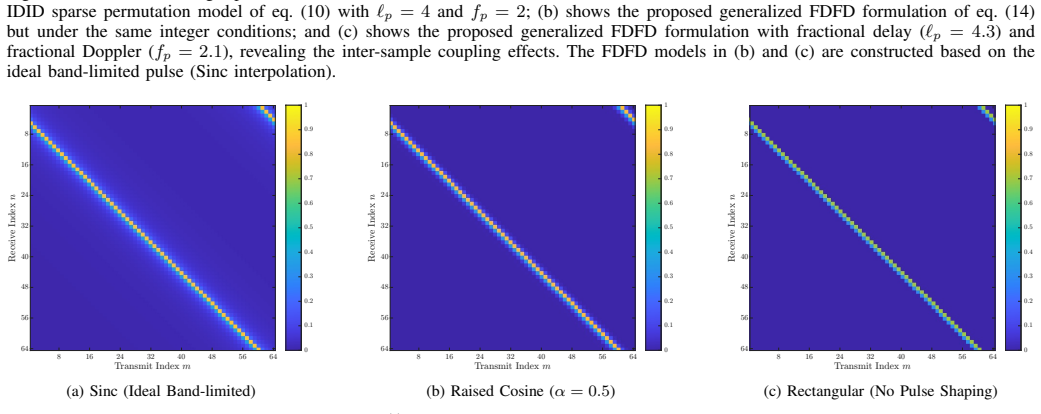
The central object is the discrete affine Fourier transform (DAFT), a unitary matrix A = Λλ2 F_N Λλ1 — a standard DFT preceded and followed by diagonal chirp phase rotations parameterized by λ1 and λ2. This identity makes AFDM a wrapper around the OFDM FFT/IFFT, which carries the entire compatibility argument: all OFDM blocks remain in place, and the two chirp rotations plus a chirp-periodic prefix (CPP) are the only additions. A second load-bearing piece is the generalized fractional-delay-fractional-Doppler (FDFD) channel matrix H_p = V^{f_p} Ψ(ℓ_p), where Ψ captures the inter-sample coupling from the pulse shape and fractional delay; it shows AFDM's effective channel stays structured wher
What would settle it
A controlled over-the-air or hardware-in-the-loop comparison of OFDM and AFDM using the same RF front-end, oscillators, and power amplifier under high Doppler and phase noise: if OFDM with standard compensation matches or beats AFDM's bit error rate, the central robustness-and-reusability claim collapses. Alternatively, modifying an existing OFDM modem chip by adding only the two chirp multiplications and measuring the actual overhead would test the 'no hardware change' premise.
Extended reading notes
Core claim
On its own terms, the central claim is that AFDM is not a new physical layer but a re-parameterization of the existing OFDM one. Because the discrete affine Fourier transform (DAFT) is a DFT sandwiched between two diagonal chirp phase-rotation matrices, the AFDM modulator and demodulator are the OFDM IFFT/FFT with one element-wise chirp multiplication before and one after. The paper shows this preserves the one-dimensional resource-grid framing, allows the cyclic prefix to be kept (with optional chirp-periodic phase adjustments), and yields an effective channel matrix that remains structured even under fractional delay and fractional Doppler. From that structural identity flows the rest of t
Load-bearing premise
The claim that AFDM provides 6G-level resilience relies on the assumption that the Doppler, phase-noise, and CFO advantages seen in simulations survive in real hardware with only the two chirp-rotation blocks added.
Editorial extensions
If this is right
- 6G+ terminals could keep existing OFDM RF chains, FFT engines, prefix insertion, and resource mapping; only baseband chirp rotations and CPP phase adjustments are added.
- The computational overhead over OFDM is fixed at 12N FLOPs per block, shrinking relative to FFT cost as N grows (about 30% at N=256, 20% at N=4096).
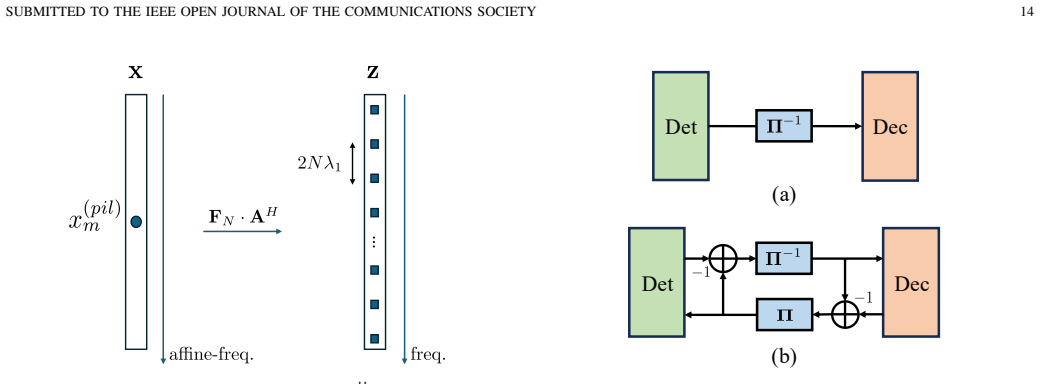
- Standard OFDM channel estimation and detection algorithms transfer to AFDM; in low-Doppler conditions AFDM can even be demodulated with a plain DFT, preserving backward compatibility with legacy OFDM receivers.
- AFDM's tunable chirp parameters create new degrees of freedom for index modulation, physical-layer security, and PAPR control without changing the transceiver architecture.
- Under phase noise and CFO, the paper's BER results show AFDM near-ideal while OFDM loses several dB, strengthening the case for high-mobility and high-frequency operation.
Reading between the lines
- A testable extension: exercise the claimed reusability on an actual OFDM modem chip by adding only the two chirp multiplications; measured throughput, energy, and BER would settle whether the 12N overhead and resilience claims hold in hardware.
- The FDFD channel model with pulse-shape-dependent inter-sample coupling is reusable beyond AFDM — the same virtual-path reformulation could let established integer-delay/Doppler estimation algorithms handle fractional channels in any chirp-based waveform.
- If real oscillators and power amplifiers erase AFDM's phase-noise/CFO advantage in hardware, the backward-compatibility claim would still stand but the 'high-fidelity 6G+' conclusion would shrink; this boundary is worth probing directly.
- The chirp-parameter domain suggests an adaptive-waveform control plane where λ1 and λ2 are negotiated per link, a capability OFDM cannot offer and a possible new feature for 6G+ standards.
Signed reviews
Editorial analysis
A structured set of objections, weighed in public.
Referee Report
Summary. The paper presents AFDM as an evolutionary 6G+ waveform. It develops a generalized fractional-delay-fractional-Doppler (FDFD) channel model that includes pulse-shaping inter-sample coupling, then argues that the AFDM transceiver is an OFDM chain with two diagonal chirp multiplications (Eq. (31)). On this structural basis it claims reuse of OFDM RF and PHY hardware, a modest 12N FLOP per-block complexity overhead (Eq. (38)), adaptability of channel estimation, detection, MIMO and multiple-access schemes, robustness to phase noise and CFO, and additional capabilities such as index modulation and physical-layer security. The overall conclusion is that AFDM offers OFDM backward compatibility while overcoming OFDM's Doppler fragility, unlike OTFS.
Significance. The algebraic identity A=Λ_λ2 F Λ_λ1 is a genuine, transparent strength: the hardware-reuse and complexity claims are verifiable directly from the equations. The generalized FDFD pulse-kernel formulation is also a useful framework for capturing fractional-delay effects. However, the paper's load-bearing performance claims rest on effective channel models that omit the circular-prefix wrap term, and the only new PHN/CFO BER figure lacks essential statistical and parameter detail. If the model inconsistency is corrected and the simulations are redone, the paper would be a valuable systems-level argument for AFDM in 6G+. In its current form, the quantitative robustness and performance conclusions are not yet established, although the structural compatibility argument is independent of the disputed model.
major comments (4)
- [Section III-A/B, Eqs. (27), (33), (15)-(17)] The effective-channel models used for the numerical and estimation analysis are not the FDFD channel defined in Section II-C. Eq. (15) defines Ψ(ℓ_p)=G(ℓ_p)+Φ(ℓ_p), with Φ(ℓ_p) the wrap contribution (Eq. (17)). For OFDM, setting φ_cp=0 does not imply Φ(ℓ_p)=0; for integer delays the term is the upper-right part of the cyclic shift matrix, so Eq. (27) is a linear, not circular, convolution. Eq. (33) likewise replaces the wrap matrix by the diagonal phase-offset matrix Φ_p of Eq. (11), which cannot restore the missing entries. Concretely, for N=4, ℓ_p=1, G(ℓ_p) lacks the (0,3) entry, so the model does not correspond to the CP/CPP system of Eq. (10). Because Fig. 3, the BER curves of Fig. 12, and the estimation/detection formulas in Section IV-B use this channel, the robustness and performance conclusions are currently computed for a different system. The authors should either use Ψ(ℓ_p) th
- [Section IV-A, Eq. (39)] The complexity overhead expression is internally inconsistent. With C_AFDM,N = 5Nlog2N+12N and, as stated and tabulated in Table I, C_OFDM,N = 5Nlog2N+2N, the difference is 10N, not 12N, and the denominator should include the +2N term. The stated percentages (30%, 24%, 20%) are therefore overestimates. The qualitative conclusion of logarithmic overhead remains, but the quantitative values should be corrected.
- [Section IV-F, Fig. 12] The figure is the only direct evidence for the headline PHN/CFO robustness of AFDM over OFDM. It reports N=128, QPSK, θ_CFO=0.1, P=3, and LMMSE detection, but no PHN variance σ_Δ^2 (or ξ, f_c), no channel realization/delay-Doppler parameters, no channel-estimation assumption, no number of Monte-Carlo runs, and no error bars. The claimed 2 dB, 8 dB, and 10.5 dB losses/gains are not verifiable from the information provided. Please provide the full simulation setting and statistical significance, or temper the claims.
- [Section IV-B2c, Eqs. (54)-(56)] The fractional-delay estimation section replaces the Toeplitz G(ℓ_p) by a banded circulant matrix and rewrites the channel as P(2B+1) virtual IDID paths. The text notes the circulant approximation is exact only with a cyclic suffix or a negative-delay pre-processing, but the subsequent general claims (e.g., estimation beyond the Nyquist rate) assume it without an error analysis. Please state the approximation error or verify its impact for the parameter ranges used.
minor comments (4)
- [Section III-E] The statement that OTFS 'absolutely requires dedicated pulse-shaping' is stronger than the cited literature supports; rectangular-pulse OTFS with appropriate equalizers is common. Since the comparative argument is otherwise based on structural reuse, softening this to 'often beneficial' would improve accuracy.
- [Sections II-C and III-B] The diagonal prefix-phase matrix Φ_p (Eq. (11)) and the wrap matrix Φ(ℓ_p) (Eq. (17)) share a symbol, which invites the confusion identified in Major Comment 1. Rename one of them (e.g., use D_p for the diagonal prefix phase).
- [Throughout] The chirp parameter notation is inconsistent: λ_1, λ_2 in Eqs. (31)-(32) become c_1, c_2 in Fig. 3 and later text. Please unify.
- [Throughout] Typographical and grammatical issues include 'reusibility' in the Section V heading, 'critival' in Section III-E, and several instances of awkward phrasing. A careful proofread is needed.
Circularity Check
No significant circularity: the AFDM/OFDM compatibility claim is a direct algebraic identity (Eq. 31), and the main complexity and structural results are self-contained; the paper's reliance on several self-citations is a survey-level feature rather than a load-bearing circular derivation.
full rationale
The central claim — that AFDM reuses the OFDM transceiver chain with only two additional chirp-rotation blocks — is not circular. Equation (31) explicitly factors the DAFT as A = Λλ2 F Λλ1, so the modulator/demodulator structure is an algebraic identity, and the 12N FLOP overhead in Eq. (38) follows arithmetically from two N-point element-wise complex multiplications. The generalized FDFD channel model in Eqs. (14)–(17) is a new modeling contribution, and the PHN/CFO robustness discussion is supported by an in-paper BER simulation (Fig. 12) rather than solely by the authors' prior work. The manuscript does lean on self-references ([28], [30], [35], [38], [60], [89], [110], [126]) for diversity, ISAC, PLS, and hardware-impairment claims, but these are mostly survey-level support and are not the load-bearing derivation of the OFDM-reuse conclusion. A separate, non-circularity technical concern: the transceiver models in Eqs. (27) and (33) drop the wrap term Φ(ℓp) from the generalized per-path channel in Eq. (15) (setting Ψ = G after assuming φ_cp = 0), so the effective-channel and BER analyses may not correspond to a true circular-convolution CP/CPP system; this is a correctness/consistency risk, not an equivalence-to-inputs circularity.
Assumptions & free parameters
free parameters (2)
- AFDM chirp parameter λ1 and guard width ξ =
Example: c1 = (2(fmax+1)+1)/(2N) with fmax=3; condition λ1 ≥ (2(fmax+ξ)+1)/(2N)
- AFDM chirp parameter λ2 =
Example: 1/(2N); otherwise ≪1 or irrational
assumptions (5)
- domain assumption Sparse P-path doubly dispersive channel with constant per-path gain h_p, delay τ_p, and Doppler ν_p (Eq. 1)
- domain assumption Fractional delay equals pulse-shaping interpolation: s[n−ℓp]=Σ_m s[m] g(n−m−ℓp), with g(m)=p(mTs) (Eqs. 6-7)
- ad hoc to paper G(ℓp) is approximated as banded with width 2B+1 and then circulant (Eq. 54)
- standard math DAFT basis A=Λ_λ2 F Λ_λ1 is unitary and the AFDM CPP phase φcp(n)=λ1(N^2+2Nn) restores circular convolution
- domain assumption Wiener PHN model (Eq. 90) and diagonal CFO matrix (Eq. 92) govern the impairment analysis
Cite this review
Pith. "Pith review of AFDM: Evolving OFDM Towards 6G+." pith.science (2026). https://pith.science/paper/J2KS7CH3
@misc{pith2026260208163,
  author       = {Pith},
  title        = {Pith review of: AFDM: Evolving OFDM Towards 6G+},
  year         = {2026},
  howpublished = {\url{https://pith.science/paper/J2KS7CH3}},
  note         = {Machine review of arXiv:2602.08163}
}
read the original abstract
As sixth generation (6G) standardization accelerates, there is growing consensus in favor of evolutionary waveforms that add new capabilities while preserving compatibility with the orthogonal frequency division multiplexing (OFDM) core of 4G and 5G. This article positions affine frequency division multiplexing (AFDM) as such a candidate, providing structural robustness for high-mobility communications and integrated sensing and communication (ISAC) over doubly dispersive channels while remaining backward-compatible with the legacy OFDM air interface. We first develop a generalized fractional-delay-fractional-Doppler (FDFD) channel model that accounts for practical pulse-shaping filters and the resulting inter-sample coupling. Building on this model, we show that the AFDM transceiver reuses nearly the entire OFDM chain, adding only lightweight digital pre- and post-processing. We then analyze the impact of hardware impairments such as phase noise and carrier frequency offset, and examine the advanced functionalities enabled by the chirp-parameter domain, including index modulation and physical-layer security. Assessing reusability across the radio-frequency, physical, and higher layers, we conclude that AFDM offers an efficient path toward high-fidelity later versions of 6G and beyond (6G+) communications.
Figures


Figures from the paper (8 more)




Forward citations
Cited by 1 Pith paper
-
Artificial Intelligence for Spatially Reconfigurable Antennas: Movable, Fluid, and Pinching Antenna Systems
A cross-architecture survey that organizes AI methods for movable, fluid, and pinching antennas by the joint optimization problem they solve.
Reference graph
Works this paper leans on
-
[1]
What should 6G be?
S. Danget al., “What should 6G be?”Nature Electronics, vol. 3, no. 1, pp. 20–29, 2020
2020
-
[2]
The road towards 6G: A comprehensive survey,
W. Jianget al., “The road towards 6G: A comprehensive survey,”IEEE Open Journal of the Communications Society, vol. 2, pp. 334–366, 2021
2021
-
[3]
On the road to 6G: Visions, requirements, key technologies, and testbeds,
C. X. Wanget al., “On the road to 6G: Visions, requirements, key technologies, and testbeds,”IEEE Communications Surveys & Tutorials, vol. 25, no. 2, pp. 905–974, 2023
2023
-
[4]
R1-2508043: Feature Lead summary #3 on 6G waveform (Source: Nokia), RAN1 Meeting #122bis,
3GPP TSG RAN, “R1-2508043: Feature Lead summary #3 on 6G waveform (Source: Nokia), RAN1 Meeting #122bis,” Oct. 2025
2025
-
[5]
TR 22.870: Study on 6G Use Cases and Service Requirements,
3GPP, Group Services and System Aspects, “TR 22.870: Study on 6G Use Cases and Service Requirements,” Jun. 2025, Release 20, v0.3.1
2025
-
[6]
RP-251881: New SID: Study on 6G Radio,
3GPP TSG RAN, “RP-251881: New SID: Study on 6G Radio,” Jun. 2025, RAN Meeting #108
2025
-
[7]
5G New Radio: Unveiling the Essentials of the Next Generation Wireless Access Technology,
X. Linet al., “5G New Radio: Unveiling the Essentials of the Next Generation Wireless Access Technology,”IEEE Communications Standards Magazine, vol. 3, no. 3, pp. 30–37, 2019
2019
-
[8]
Dahlman, S
E. Dahlman, S. Parkvall, and J. Skold,5G NR: The next generation wireless access technology. Academic Press, 2020
2020
Show all 132 references
-
[9]
Evolved universal terrestrial radio access (E-UTRA); physical channels and modulation,
3GPP, “Evolved universal terrestrial radio access (E-UTRA); physical channels and modulation,” 3rd Generation Partnership Project (3GPP), Technical Specification (TS) TS 36.211, 2008
2008
-
[10]
NR; physical channels and modulation,
3GPP, “NR; physical channels and modulation,” 3rd Generation Partnership Project (3GPP), Technical Specification (TS) TS 38.211, 2018
2018
-
[11]
Synchronization techniques for orthogonal frequency division multiple access (OFDMA): A tutorial review,
M. Morelli, C.-C. J. Kuo, and M.-O. Pun, “Synchronization techniques for orthogonal frequency division multiple access (OFDMA): A tutorial review,”Proceedings of the IEEE, vol. 95, no. 7, pp. 1394–1427, 2007
2007
-
[12]
An overview of peak-to-average power ratio (PAPR) reduction techniques for multicarrier transmission,
S. H. Han and J. H. Lee, “An overview of peak-to-average power ratio (PAPR) reduction techniques for multicarrier transmission,”IEEE wireless communications, vol. 12, no. 2, pp. 56–65, 2005
2005
-
[13]
Channel estimation for wireless OFDM systems,
M. Ozdemir and H. Arslan, “Channel estimation for wireless OFDM systems,”IEEE Communications Surveys & Tutorials, vol. 9, no. 2, 2007
2007
-
[14]
Channel estimation for OFDM,
Y . Liuet al., “Channel estimation for OFDM,”IEEE Communications Surveys & Tutorials, vol. 16, no. 4, pp. 1891–1908, 2014
1908
-
[15]
A Vision of 6G Wireless Systems: Applications, Trends, Technologies, and Open Research Problems,
W. Saad, M. Bennis, and M. Chen, “A Vision of 6G Wireless Systems: Applications, Trends, Technologies, and Open Research Problems,” IEEE Network, vol. 34, no. 3, pp. 134–142, 2020
2020
-
[16]
Bliss and S
D. Bliss and S. Govindasamy,Dispersive and doubly dispersive channels. Cambridge University Press, 2013
2013
-
[17]
Multicarrier ISAC: Advances in waveform design, signal processing, and learning under nonidealities,
V . Koivunenet al., “Multicarrier ISAC: Advances in waveform design, signal processing, and learning under nonidealities,”IEEE Signal Processing Magazine, vol. 41, no. 5, pp. 17–30, 2024
2024
-
[18]
Toward integration of 6G-NTN to terrestrial mobile networks: Research and standardization aspects,
M. Harounabadi and T. Heyn, “Toward integration of 6G-NTN to terrestrial mobile networks: Research and standardization aspects,” IEEE Wireless Communications, vol. 30, no. 6, pp. 20–26, 2023
2023
-
[19]
Toward 6G non-terrestrial networks,
G. Aranitiet al., “Toward 6G non-terrestrial networks,”IEEE Network, vol. 36, no. 1, pp. 113–120, 2021
2021
-
[20]
Survey on device to device (D2D) communication for 5GB/6G networks: Concept, applications, challenges, and future directions,
M. Gismallaet al., “Survey on device to device (D2D) communication for 5GB/6G networks: Concept, applications, challenges, and future directions,”IEEE Access, vol. 10, pp. 30 792–30 821, 2022
2022
-
[21]
6G for vehicle-to-everything (V2X) communications: Enabling technologies, challenges, and opportunities,
M. Noor-A-Rahimet al., “6G for vehicle-to-everything (V2X) communications: Enabling technologies, challenges, and opportunities,”Proceedings of the IEEE, vol. 110, no. 6, pp. 712–734, 2022
2022
-
[22]
Drone networking in the 6G era: A technology overview,
D. Mishraet al., “Drone networking in the 6G era: A technology overview,”IEEE Communications Standards Magazine, vol. 5, no. 4, pp. 88–95, 2022
2022
-
[23]
Performance degradation of OFDM systems due to doppler spreading,
T. Wanget al., “Performance degradation of OFDM systems due to doppler spreading,”IEEE Trans. Wireless Commun., vol. 5, no. 6, pp. 1422–1432, 2006
2006
-
[24]
Integrated Sensing and Communications: Toward Dual-Functional Wireless Networks for 6G and Beyond,
F. Liuet al., “Integrated Sensing and Communications: Toward Dual-Functional Wireless Networks for 6G and Beyond,”IEEE J. Sel. Area. Comm., vol. 40, no. 6, pp. 1728–1767, 2022
2022
-
[25]
Integrated sensing and communication signals toward 5G-A and 6G: A survey,
Z. Weiet al., “Integrated sensing and communication signals toward 5G-A and 6G: A survey,”IEEE Internet Things J., vol. 10, no. 13, pp. 11 068–11 092, 2023
2023
-
[26]
Joint design of communication and sensing for beyond 5G and 6G systems,
T. Wild, V . Braun, and H. Viswanathan, “Joint design of communication and sensing for beyond 5G and 6G systems,”IEEE Access, vol. 9, pp. 30 845–30 857, 2021
2021
-
[27]
Optimized waveforms for 5G-6G communication with sensing: Theory, simulations and experiments,
S. D. Liyanaarachchiet al., “Optimized waveforms for 5G-6G communication with sensing: Theory, simulations and experiments,” IEEE Trans. Wireless Commun., vol. 20, no. 12, pp. 8301–8315, 2021
2021
-
[28]
H. S. Rouet al., “From Orthogonal Time-Frequency Space to Affine Frequency-Division Multiplexing: A comparative study of next-generation waveforms for integrated sensing and communications in doubly dispersive channels,”IEEE Signal Processing Magazine, vol. 41, no. 5, pp. 71–86, 2024
2024
-
[29]
Affine Frequency Division Multiplexing for Next Generation Wireless Communications,
A. Bemani, N. Ksairi, and M. Kountouris, “Affine Frequency Division Multiplexing for Next Generation Wireless Communications,”IEEE Trans. Wireless Commun., vol. 22, no. 11, pp. 8214–8229, 2023
2023
-
[30]
Affine frequency division multiplexing (AFDM) for 6G: Properties, features, and challenges,
H. S. Rouet al., “Affine frequency division multiplexing (AFDM) for 6G: Properties, features, and challenges,”IEEE Communications Standards Magazine, pp. 1–10, 2025
2025
-
[31]
Affine frequency division multiplexing: Extending OFDM for scenario-flexibility and resilience,
H. Yinet al., “Affine frequency division multiplexing: Extending OFDM for scenario-flexibility and resilience,”arXiv preprint arXiv:2502.04735, 2025
2025 arXiv
-
[32]
Affine frequency division multiplexing for 6G networks: Fundamentals, opportunities, and challenges,
Q. Liet al., “Affine frequency division multiplexing for 6G networks: Fundamentals, opportunities, and challenges,”IEEE Network, 2025
2025
-
[33]
Affine Frequency Division Multiplexing With Index Modulation: Full Diversity Condition, Performance Analysis, and Low-Complexity Detection,
Y . Taoet al., “Affine Frequency Division Multiplexing With Index Modulation: Full Diversity Condition, Performance Analysis, and Low-Complexity Detection,”IEEE J. Sel. Area. Comm., vol. 43, no. 4, pp. 1041–1055, April 2025
2025
-
[34]
Pre-chirp-domain index modulation for full-diversity affine frequency division multiplexing toward 6G,
G. Liuet al., “Pre-chirp-domain index modulation for full-diversity affine frequency division multiplexing toward 6G,”IEEE Trans. Wireless Commun., vol. 24, no. 9, pp. 7331–7345, September 2025
2025
-
[35]
AFDM chirp-permutation-index modulation with quantum-accelerated codebook design,
H. S. Rouet al., “AFDM chirp-permutation-index modulation with quantum-accelerated codebook design,” in2024 58th Asilomar Conference on Signals, Systems, and Computers, 2024, pp. 817–821
2024
-
[36]
On the Robustness of AFDM and OTFS Against Passive Eavesdroppers,
V . Savauxet al., “On the Robustness of AFDM and OTFS Against Passive Eavesdroppers,”IEEE Wireless Commun. Lett., pp. 1–1, 2026
2026
-
[37]
A Secure Affine Frequency Division Multiplexing for Wireless Communication Systems,
P. Wanget al., “A Secure Affine Frequency Division Multiplexing for Wireless Communication Systems,” inProc. IEEE ICC, 2025, pp. 2701–2706
2025
-
[38]
Chirp-permuted AFDM for quantum-resilient physical-layer secure communications,
H. S. Rou and G. T. F. de Abreu, “Chirp-permuted AFDM for quantum-resilient physical-layer secure communications,”IEEE Wireless Commun. Lett., pp. 1–1, 2025
2025
-
[39]
DFT-s-OFDM with chirp modulation,
Y . Liuet al., “DFT-s-OFDM with chirp modulation,” in2025 IEEE 36th International Symposium on Personal, Indoor and Mobile Radio Communications (PIMRC), 2025, pp. 1–6
2025
-
[40]
Radar-centric AFDM waveform with chirp-domain index modulation for ISAC,
M. Ahmadet al., “Radar-centric AFDM waveform with chirp-domain index modulation for ISAC,”IEEE Open Journal of the Communications Society, vol. 7, pp. 844–857, 2026
2026
-
[41]
Multi-functional chirp signalling for next-generation multi-carrier wireless networks: Communications, sensing and ISAC perspectives,
Z. Suiet al., “Multi-functional chirp signalling for next-generation multi-carrier wireless networks: Communications, sensing and ISAC perspectives,”arXiv preprint arXiv:2508.06022, 2025
2025 arXiv
-
[42]
A complex wavelet AFDM scheme for integrated sensing and communication in LEO satellite,
S. Sabuj, S.-H. Lee, and H.-S. Jo, “A complex wavelet AFDM scheme for integrated sensing and communication in LEO satellite,”Authorea Preprints, 2025
2025
-
[43]
Affine filter bank modulation (AFBM): A novel 6G ISAC waveform with low PAPR and OOBE,
K. R. R.et al., “Affine filter bank modulation (AFBM): A novel 6G ISAC waveform with low PAPR and OOBE,”arXiv preprint arXiv:2509.05683, 2025
2025 arXiv
-
[44]
Non-orthogonal affine frequency division multiplexing for spectrally efficient high-mobility communications,
Q. Yiet al., “Non-orthogonal affine frequency division multiplexing for spectrally efficient high-mobility communications,”arXiv preprint arXiv:2508.09782, 2025
2025
-
[45]
Affine filter bank modulation: A new waveform for high mobility communications,
H. L. Sengeret al., “Affine filter bank modulation: A new waveform for high mobility communications,”arXiv preprint arXiv:2505.03589, 2025
2025 arXiv
-
[46]
Orthogonal Time-Frequency Space Modulation: A Promising Next-Generation Waveform,
Z. Weiet al., “Orthogonal Time-Frequency Space Modulation: A Promising Next-Generation Waveform,”IEEE Wireless Communications, vol. 28, no. 4, pp. 136–144, 2021
2021
-
[47]
Orthogonal time sequency multiplexing modulation,
T. Thaj and E. Viterbo, “Orthogonal time sequency multiplexing modulation,” in2021 IEEE Wireless Communications and Networking Conference (WCNC), 2021, pp. 1–7
2021
-
[48]
Performance analysis and approximate message passing detection of orthogonal time sequency multiplexing modulation,
Z. Suiet al., “Performance analysis and approximate message passing detection of orthogonal time sequency multiplexing modulation,”IEEE Trans. Wireless Commun., vol. 23, no. 3, pp. 1913–1928, 2024. SUBMITTED TO THE IEEE OPEN JOURNAL OF THE COMMUNICATIONS SOCIETY 23
1913
-
[49]
Orthogonal delay-doppler division multiplexing modulation,
H. Lin and J. Yuan, “Orthogonal delay-doppler division multiplexing modulation,”IEEE Trans. Wireless Commun., vol. 21, no. 12, pp. 11 024–11 037, 2022
2022
-
[50]
On OTFS using the discrete zak transform,
F. Lampel, A. Avarado, and F. M. Willems, “On OTFS using the discrete zak transform,” in2022 IEEE International Conference on Communications Workshops (ICC Workshops). IEEE, 2022, pp. 729–734
2022
-
[51]
Y . Hong, T. Thaj, and E. Viterbo,Delay-Doppler Communications: Principles and Applications. Academic Press, 2022
2022
-
[52]
Performance analysis of coded OTFS systems over high-mobility channels,
S. Liet al., “Performance analysis of coded OTFS systems over high-mobility channels,”IEEE Trans. Wireless Commun., vol. 20, no. 9, pp. 6033–6048, 2021
2021
-
[53]
On the diversity of uncoded OTFS modulation in doubly-dispersive channels,
G. D. Surabhi, R. M. Augustine, and A. Chockalingam, “On the diversity of uncoded OTFS modulation in doubly-dispersive channels,” IEEE Trans. Wireless Commun., vol. 18, no. 6, pp. 3049–3063, 2019
2019
-
[54]
Affine Frequency Division Multiplexing for Next-Generation Wireless Networks,
A. Bemani, G. Cuozzo, N. Ksairi, and M. Kountouris, “Affine Frequency Division Multiplexing for Next-Generation Wireless Networks,” in2021 17th International Symposium on Wireless Communication Systems (ISWCS), October 2021, pp. 1–6
2021
-
[55]
Integrated sensing and communications with affine frequency division multiplexing (AFDM),
A. Bemani, N. Ksairi, and M. Kountouris, “Integrated sensing and communications with affine frequency division multiplexing (AFDM),” IEEE Wireless Commun. Lett., vol. 13, no. 5, pp. 1255–1259, 2024
2024
-
[56]
An AFDM-based integrated sensing and communications,
Y . Ni, Z. Wang, P. Yuan, and Q. Huang, “An AFDM-based integrated sensing and communications,” in2022 International Symposium on Wireless Communication Systems (ISWCS). IEEE, 2022, pp. 1–6
2022
-
[57]
Target sensing with off-grid sparse bayesian learning for AFDM-ISAC system,
Y . Luo, Y . L. Guan, Y . Ge, and C. Yuen, “Target sensing with off-grid sparse bayesian learning for AFDM-ISAC system,”arXiv preprint arXiv:2503.10011, 2025
2025 arXiv
-
[58]
An integrated sensing and communications system based on affine frequency division multiplexing,
Y . Niet al., “An integrated sensing and communications system based on affine frequency division multiplexing,”IEEE Trans. Wireless Commun., 2025
2025
-
[59]
A novel angle-delay-doppler estimation scheme for AFDM-ISAC system in mixed near-field and far-field scenarios,
Y . Luoet al., “A novel angle-delay-doppler estimation scheme for AFDM-ISAC system in mixed near-field and far-field scenarios,”IEEE Internet Things J., 2025
2025
-
[60]
Normalized ambiguity function characteristics of OFDM, OTFS, AFDM, and CP-AFDM for ISAC,
H. S. Rou and G. T. F. de Abreu, “Normalized ambiguity function characteristics of OFDM, OTFS, AFDM, and CP-AFDM for ISAC,” Accepted at the IEEE ICC 2026, preprint available arXiv:2510.11216, 2025
2026
-
[61]
Ambiguity function analysis of AFDM under pulse-shaped random ISAC signaling,
Y . Niet al., “Ambiguity function analysis of AFDM under pulse-shaped random ISAC signaling,”arXiv preprint arXiv:2511.04200, 2025
2025
-
[62]
AFDM-based bistatic integrated sensing and communication in static scatterer environments,
J. Zhuet al., “AFDM-based bistatic integrated sensing and communication in static scatterer environments,”IEEE Wireless Commun. Lett., vol. 13, no. 8, pp. 2245–2249, 2024
2024
-
[63]
ISAC with affine frequency division multiplexing: An FMCW-based signal processing perspective,
J. Zhuet al., “ISAC with affine frequency division multiplexing: An FMCW-based signal processing perspective,”arXiv preprint arXiv:2511.12308, 2025
2025 arXiv
-
[64]
AFDM-enabled integrated sensing and communication: Theoretical framework and pilot design,
F. Zhanget al., “AFDM-enabled integrated sensing and communication: Theoretical framework and pilot design,”arXiv preprint arXiv:2502.14203, 2025
2025 arXiv
-
[65]
AFDM-enabled integrated sensing and communication for 4D reconstruction,
Y . Luoet al., “AFDM-enabled integrated sensing and communication for 4D reconstruction,” in2025 5th International Conference on Intelligent Communications and Computing (ICICC). IEEE, 2025, pp. 211–216
2025
-
[66]
Performance evaluation of AFDM for integrated sensing and communications in doubly dispersive channels,
K. Ramadan, A. A. Alharbi, and E. S. Hassan, “Performance evaluation of AFDM for integrated sensing and communications in doubly dispersive channels,”Defence Technology, 2026
2026
-
[67]
Orthogonal Chirp Division Multiplexing,
X. Ouyang and J. Zhao, “Orthogonal Chirp Division Multiplexing,” IEEE Trans. Commun., vol. 64, no. 9, pp. 3946–3957, 2016
2016
-
[68]
Channel estimation, interpolation and extrapolation in doubly-dispersive channels,
Z. Gonget al., “Channel estimation, interpolation and extrapolation in doubly-dispersive channels,”arXiv preprint arXiv:2408.09381, 2024
2024 arXiv
-
[69]
Doubly-dispersive continuous MIMO systems: Channel modeling and beamforming design,
K. R. R. Ranasingheet al., “Doubly-dispersive continuous MIMO systems: Channel modeling and beamforming design,”arXiv preprint arXiv:2509.00964, 2025
2025 arXiv
-
[70]
Doubly-dispersive MIMO channels with stacked intelligent metasurfaces: Modeling, parametrization, and receiver design,
K. R. R. Ranasingheet al., “Doubly-dispersive MIMO channels with stacked intelligent metasurfaces: Modeling, parametrization, and receiver design,”IEEE Transactions on Wireless Communications, vol. 25, pp. 3801–3817, 2026
2026
-
[71]
Flexible intelligent metasurfaces in high-mobility MIMO integrated sensing and communications,
K. R. R. Ranasingheet al., “Flexible intelligent metasurfaces in high-mobility MIMO integrated sensing and communications,”arXiv preprint arXiv:2507.18793, 2025
2025 arXiv
-
[72]
Reducing the peak-to-average power ratio of multicarrier modulation by selected mapping,
R. W. B ¨auml, R. F. H. Fischer, and J. B. Huber, “Reducing the peak-to-average power ratio of multicarrier modulation by selected mapping,”Electronics Letters, vol. 32, no. 22, pp. 2056–2057, 1996. [73]3GPP TS 36.211 V17.2.0: Evolved Universal Terrestrial Radio Access (E-UTRA...
-
[76]
Evaluation and design criterion for pulse-shaped AFDM,
H. Yin, Y . Tang, S. Li, Y . Zhou, and C. Yi, “Evaluation and design criterion for pulse-shaped AFDM,” inGLOBECOM 2024 - 2024 IEEE Global Communications Conference, 2024, pp. 4944–4949
2024
-
[77]
On the use of a two-dimensional cyclic prefix in OTFS modulation and its implications,
M. Mirabella, P. D. Viesti, and G. M. Vitetta, “On the use of a two-dimensional cyclic prefix in OTFS modulation and its implications,”IEEE Open Journal of the Communications Society, vol. 5, pp. 3340–3367, 2024
2024
-
[78]
Implementation of an OTFS-DCP-based communication system on software-defined radios,
M. Mirabella, P. Di Viesti, and G. M. Vitetta, “Implementation of an OTFS-DCP-based communication system on software-defined radios,” in2025 IEEE Wireless Communications and Networking Conference (WCNC), 2025, pp. 1–7
2025
-
[79]
Pilot Aided Channel Estimation for AFDM in Doubly Dispersive Channels,
H. Yin and Y . Tang, “Pilot Aided Channel Estimation for AFDM in Doubly Dispersive Channels,” in2022 IEEE/CIC International Conference on Communications in China (ICCC), August 2022, pp. 308–313
2022
-
[80]
GI-Free Pilot-Aided Channel Estimation for Affine Frequency Division Multiplexing Systems,
Y . Zhouet al., “GI-Free Pilot-Aided Channel Estimation for Affine Frequency Division Multiplexing Systems,” 2024. [Online]. Available: https://arxiv.org/abs/2404.01088
2024 arXiv
-
[81]
Channel Estimation for AFDM With Superimposed Pilots,
K. Zhenget al., “Channel Estimation for AFDM With Superimposed Pilots,”IEEE Trans. Veh. Technol., vol. 74, no. 2, pp. 3389–3394, February 2025
2025
-
[82]
Pilot design for multiple domains channel estimation in special cases of affine frequency division multiplexing,
V . Savaux, “Pilot design for multiple domains channel estimation in special cases of affine frequency division multiplexing,” Physical Communication, vol. 73, p. 102863, December 2025. [Online]. Available: https://www.sciencedirect.com/science/article/pii/ S1874490725002666
2025
-
[83]
Special Cases of DFT-Based Modulation and Demodulation for Affine Frequency Division Multiplexing,
V . Savaux, “Special Cases of DFT-Based Modulation and Demodulation for Affine Frequency Division Multiplexing,”IEEE Trans. Commun., vol. 72, no. 12, pp. 7627–7638, 2024
2024
-
[84]
Physical channels and modulation,
3GPP, “Physical channels and modulation,” 3GPP, Tech. Rep. TS 38.211 v16.2.0, July 2020
2020
-
[85]
A Study of Channel Estimation in OFDM Systems,
S. Coleri, M. Ergen, A. Puri, and A. Bahai, “A Study of Channel Estimation in OFDM Systems,” inVehicular Technology Conference, vol. 2, september 2002, pp. 894–898
2002
-
[86]
LMMSE channel estimation in OFDM context: a review,
V . Savaux and Y . Lou ¨et, “LMMSE channel estimation in OFDM context: a review,”IET Signal Processing, vol. 11, no. 2, pp. 123 – 134, April 2017
2017
-
[87]
Time-domain zero-padding (TZP) AFDM with two-stage iterative MMSE detection,
C. Shen, J. Yuan, and J. Tong, “Time-domain zero-padding (TZP) AFDM with two-stage iterative MMSE detection,”IEEE Trans. Wireless Commun., pp. 1–1, 2025
2025
-
[88]
Iterative soft-MMSE detection aided AFDM and OTFS,
H. Hawkins, C. Xu, L.-L. Yang, and L. Hanzo, “Iterative soft-MMSE detection aided AFDM and OTFS,”IEEE Open J. Veh. Technol., vol. 6, pp. 2944–2959, 2025
2025
-
[89]
Generalized spatial modulation aided affine frequency division multiplexing,
Z. Suiet al., “Generalized spatial modulation aided affine frequency division multiplexing,”IEEE Trans. Wireless Commun., pp. 1–16, 2025
2025
-
[90]
Chirp parameter selection for affine frequency division multiplexing with MMSE equalization,
Z. Liet al., “Chirp parameter selection for affine frequency division multiplexing with MMSE equalization,”IEEE Trans. Commun., vol. 73, no. 7, pp. 5079–5093, 2025
2025
-
[91]
Low complexity LMMSE receiver for OTFS,
S. Tiwari, S. S. Das, and V . Rangamgari, “Low complexity LMMSE receiver for OTFS,”IEEE Commun. Lett., vol. 23, no. 12, pp. 2205–2209, 2019
2019
-
[92]
Error rate analysis and low-complexity receiver design for zero-padded AFDM,
Q. Yi, Z. Sui, and Z. Liu, “Error rate analysis and low-complexity receiver design for zero-padded AFDM,”arXiv preprint arXiv:2510.14507, 2025
2025 arXiv
-
[93]
Simple equalization of time-varying channels for OFDM,
L. Rugini, P. Banelli, and G. Leus, “Simple equalization of time-varying channels for OFDM,”IEEE Commun. Lett., vol. 9, no. 7, pp. 619–621, 2005
2005
-
[94]
Low complexity equalization for AFDM in doubly dispersive channels,
A. Bemani, N. Ksairi, and M. Kountouris, “Low complexity equalization for AFDM in doubly dispersive channels,” inProc. IEEE ICASSP, 2022, pp. 5273–5277
2022
-
[95]
AFDM-SCMA: A promising waveform for massive connectivity over high mobility channels,
Q. Luoet al., “AFDM-SCMA: A promising waveform for massive connectivity over high mobility channels,”IEEE Trans. Wireless Commun., vol. 23, no. 10, pp. 14 421–14 436, 2024
2024
-
[96]
Affine frequency division multiplexing over wideband doubly-dispersive channels with time-scaling effects,
X. Liet al., “Affine frequency division multiplexing over wideband doubly-dispersive channels with time-scaling effects,”IEEE Trans. Wireless Commun., pp. 1–1, 2025. SUBMITTED TO THE IEEE OPEN JOURNAL OF THE COMMUNICATIONS SOCIETY 24
2025
-
[97]
AFDM signal detection based on message passing scheme,
L. Wuet al., “AFDM signal detection based on message passing scheme,”Digital Signal Processing, vol. 153, p. 104633, 2024
2024
-
[98]
Joint channel, data, and radar parameter estimation for AFDM systems in doubly-dispersive channels,
K. R. R. Ranasingheet al., “Joint channel, data, and radar parameter estimation for AFDM systems in doubly-dispersive channels,”IEEE Trans. Wireless Commun., vol. 24, no. 2, pp. 1602–1619, 2025
2025
-
[99]
AFDM-aided grant-free random access for LEO SIoT: Performance analysis and near-optimal joint detection,
Y . Xuet al., “AFDM-aided grant-free random access for LEO SIoT: Performance analysis and near-optimal joint detection,”IEEE Trans. Commun., pp. 1–1, 2025
2025
-
[100]
Joint sparse graph for enhanced MIMO-AFDM receiver design,
Q. Luoet al., “Joint sparse graph for enhanced MIMO-AFDM receiver design,”IEEE Trans. Wireless Commun., pp. 1–1, 2025
2025
-
[101]
Minimum mean squared error equalization usinga prioriinformation,
M. Tuchler, A. C. Singer, and R. Koetter, “Minimum mean squared error equalization usinga prioriinformation,”IEEE Trans. Signal Process., vol. 50, no. 3, pp. 673–683, 2002
2002
-
[102]
Diagonally Reconstructed Channel Estimation for MIMO-AFDM With Inter-Doppler Interference in Doubly Selective Channels,
H. Yin, X. Wei, Y . Tang, and K. Yang, “Diagonally Reconstructed Channel Estimation for MIMO-AFDM With Inter-Doppler Interference in Doubly Selective Channels,”IEEE Trans. Wireless Commun., vol. 23, no. 10, pp. 14 066–14 079, October 2024
2024
-
[103]
Spatial Precoding in Frequency Domain for Multi-User MIMO Affine Frequency Division Multiplexing,
V . Savaux and X. Chen, “Spatial Precoding in Frequency Domain for Multi-User MIMO Affine Frequency Division Multiplexing,” inProc. IEEE EUSIPCO, August 2024, pp. 2112–2116
2024
-
[104]
On the orthogonal coexistence of AFDM and OFDM for joint sensing and communication,
R. Y . Bir, A. A. Boudjelal, and H. Arslan, “On the orthogonal coexistence of AFDM and OFDM for joint sensing and communication,”IEEE Open J. Commun. Soc., vol. 6, pp. 10 010–10 022, November 2025
2025
-
[105]
Waveform coexistence-driven RSMA: A pioneeering stragegy for future 6G networks,
K. Abela, S. Abidrabbu, A. A. Boudjelal, and H. Arslan, “Waveform coexistence-driven RSMA: A pioneeering stragegy for future 6G networks,”arXiv preprint https://arxiv.org/abs/2505.18739, 2025
2025 arXiv
-
[106]
Downlink AFDM-RSMA scheme based on orthogonal chirps and sum-rate maximization,
Y . Yinet al., “Downlink AFDM-RSMA scheme based on orthogonal chirps and sum-rate maximization,” in2025 IEEE/CIC International Conference on Communications in China (ICCC). IEEE, 2025, pp. 1–6
2025
-
[107]
BER analysis of SCMA-OFDM systems in the presence of carrier frequency offset,
H. Liuet al., “BER analysis of SCMA-OFDM systems in the presence of carrier frequency offset,”IEEE Commun. Lett., vol. 28, no. 1, pp. 213–217, Jan. 2024
2024
-
[108]
Analysis of phase noise effects in OFDM modems,
L. Piazzo and P. Mandarini, “Analysis of phase noise effects in OFDM modems,”IEEE Trans. Commun., vol. 50, no. 10, pp. 1696–1705, Oct. 2002
2002
-
[109]
Joint estimation of channel and oscillator phase noise in MIMO systems,
H. Mehrpouyanet al., “Joint estimation of channel and oscillator phase noise in MIMO systems,”IEEE Trans. Signal Process., vol. 60, no. 9, pp. 4790–4807, Sep. 2012
2012
-
[110]
MIMO-AFDM outperforms MIMO-OFDM in the face of hardware impairments,
Z. Suiet al., “MIMO-AFDM outperforms MIMO-OFDM in the face of hardware impairments,”arXiv preprint arXiv:2601.00502, 2026
2026 arXiv
-
[111]
The variational inference approach to joint data detection and phase noise estimation in OFDM,
D. D. Lin and T. J. Lim, “The variational inference approach to joint data detection and phase noise estimation in OFDM,”IEEE Trans. Signal Process., vol. 55, no. 5, pp. 1862–1874, May 2007
2007
-
[112]
Channel estimation, carrier recovery, and data detection in the presence of phase noise in OFDM relay systems,
R. Wang, H. Mehrpouyan, M. Tao, and Y . Hua, “Channel estimation, carrier recovery, and data detection in the presence of phase noise in OFDM relay systems,”IEEE Trans. Wireless Commun., vol. 15, no. 2, pp. 1186–1205, 2016
2016
-
[113]
Performance analysis and optimization of STAR-RIS-aided cell-free massive MIMO systems relying on imperfect hardware,
Z. Sui, H. Q. Ngo, M. Matthaiou, and L. Hanzo, “Performance analysis and optimization of STAR-RIS-aided cell-free massive MIMO systems relying on imperfect hardware,”IEEE Trans. Wireless Commun., vol. 24, no. 4, pp. 2925–2939, Apr. 2025
2025
-
[114]
Massive MIMO with non-ideal arbitrary arrays: Hardware scaling laws and circuit-aware design,
E. Bj ¨ornson, M. Matthaiou, and M. Debbah, “Massive MIMO with non-ideal arbitrary arrays: Hardware scaling laws and circuit-aware design,”IEEE Trans. Wireless Commun., vol. 14, no. 8, pp. 4353–4368, Apr. 2015
2015
-
[115]
Orthogonal frequency division multiplexing with index modulation,
E. Bas ¸aret al., “Orthogonal frequency division multiplexing with index modulation,”IEEE Trans. Signal Process., vol. 61, no. 22, pp. 5536–5549, 2013
2013
-
[116]
Approximate message passing algorithms for low complexity OFDM-IM detection,
Z. Suiet al.,“Approximate message passing algorithms for low complexity OFDM-IM detection,”IEEE Trans. Veh. Technol., vol. 70, no. 9, pp. 9607–9612, 2021
2021
-
[117]
Affine Frequency Division Multiplexing With Index Modulation,
Y . Tao, M. Wen, Y . Ge, and J. Li, “Affine Frequency Division Multiplexing With Index Modulation,” inProc. IEEE WCNC, April 2024, pp. 1–6
2024
-
[118]
Spatial modulation,
R. Y . Meslehet al., “Spatial modulation,”IEEE Trans. Veh. Technol., vol. 57, no. 4, pp. 2228–2241, 2008
2008
-
[119]
Scalable Quadrature Spatial Modulation,
H. S. Rouet al., “Scalable Quadrature Spatial Modulation,”IEEE Transactions on Wireless Communications, vol. 21, no. 11, pp. 9293–9311, Nov. 2022
2022
-
[120]
Low complexity detection of spatial modulation aided OTFS in doubly-selective channels,
Z. Suiet al., “Low complexity detection of spatial modulation aided OTFS in doubly-selective channels,”IEEE Trans. Veh. Technol., vol. 72, no. 10, pp. 13 746–13 751, 2023
2023
-
[121]
Space-time shift keying aided OTFS modulation for orthogonal multiple access,
Z. Suiet al., “Space-time shift keying aided OTFS modulation for orthogonal multiple access,”IEEE Trans. Commun., vol. 71, no. 12, pp. 7393–7408, 2023
2023
-
[122]
Design and performance analysis of index modulation empowered AFDM system,
J. Zhuet al.,“Design and performance analysis of index modulation empowered AFDM system,”IEEE Wireless Commun. Lett., vol. 13, no. 3, pp. 686–690, 2024
2024
-
[123]
Affine Frequency Division Multiplexing with Subcarrier Power-Level Index Modulation for Integrated Sensing and Communications,
M. Temiz and C. Masouros, “Affine Frequency Division Multiplexing with Subcarrier Power-Level Index Modulation for Integrated Sensing and Communications,” June 2025
2025
-
[124]
Dual-mode Index Modulation based on Affine Frequency Division Multiplexing,
A. A., C. K. Thomas, K. S., J. B. Benifa, and W. Saad, “Dual-mode Index Modulation based on Affine Frequency Division Multiplexing,” Physical Communication, vol. 70, p. 102628, 2025
2025
-
[125]
Multiple-Mode Affine Frequency Division Multiplexing with Index Modulation,
G. Liu, T. Mao, Y . Tang, J. Zhao, and Z. Xiao, “Multiple-Mode Affine Frequency Division Multiplexing with Index Modulation,” 2025
2025
-
[126]
Chirp-permuted AFDM: A versatile waveform design for ISAC in 6G,
H. S. Rou and G. T. F. de Abreu, “Chirp-permuted AFDM: A versatile waveform design for ISAC in 6G,” 2025
2025
-
[127]
A Novel and Secure AFDM System for High Mobility Environments,
Y . I. Tek and E. Basar, “A Novel and Secure AFDM System for High Mobility Environments,”IEEE Trans. Veh. Technol., pp. 1–6, 2025
2025
-
[128]
Chirp Parameters Hopping over Time for Affine Frequency Division Multiplexing with Physical Layer Security,
H. Chenet al., “Chirp Parameters Hopping over Time for Affine Frequency Division Multiplexing with Physical Layer Security,” in Proc. IEEE ICC, 2025, pp. 2120–2125
2025
-
[129]
Parameter Design for Secure Affine Frequency Division Multiplexing Waveform,
D. Zhanget al., “Parameter Design for Secure Affine Frequency Division Multiplexing Waveform,” 2025
2025
-
[130]
On the Noise Robustness of Affine Frequency Division Multiplexing: Analysis and Applications,
V . Savauxet al., “On the Noise Robustness of Affine Frequency Division Multiplexing: Analysis and Applications,” inProc. of 6GNet, December 2025, pp. 1–8
2025
-
[131]
PAPR in AFDM: Upper Bound and Reduction With Normalizedµ-Law Companding,
V . M. Reddy and H. Bitra, “PAPR in AFDM: Upper Bound and Reduction With Normalizedµ-Law Companding,”IEEE Access, vol. 13, pp. 86 553–86 561, 2025
2025
-
[132]
Spreading the Wave: Low-Complexity PAPR Reduction for AFDM and OCDM in 6G Networks,
A. Ali, A. Arous, and H. Arslan, “Spreading the Wave: Low-Complexity PAPR Reduction for AFDM and OCDM in 6G Networks,”IEEE Transactions on Green Communications and Networking, vol. 10, pp. 1565–1577, 2026
2026
-
[133]
PAPR Reduction With Pre-Chirp Selection for Affine Frequency Division Multiplexing,
H. Yuanet al.,“PAPR Reduction With Pre-Chirp Selection for Affine Frequency Division Multiplexing,”IEEE Wireless Commun. Lett., vol. 14, no. 3, pp. 736–740, March 2025
2025
-
[134]
Augmented Affine Frequency Division Multiplexing for Both Low PAPR Signaling and Diversity Gain Protection,
Z. Lu, M. El-Hajjar, and L. liang Yang, “Augmented Affine Frequency Division Multiplexing for Both Low PAPR Signaling and Diversity Gain Protection,” 2025
2025
-
[135]
PAPR reduction scheme in AFDM by optimal chirp selection using unimodular quadratic program,
M. Karthiga and D. Deepa “PAPR reduction scheme in AFDM by optimal chirp selection using unimodular quadratic program,”Physical Communication, vol. 72, pp. 102731, 2025
2025
Reviewed August 3, 2026 · model on record in the stance chip above.
Discussion (0). Continue with ORCID to comment.