REVIEW 3 major objections 3 minor 36 references
A two-component dark matter model with Z2×Z4 symmetry produces the observed relic density via freeze-in for both particles, with the scalar coupling λ_ds reaching values as low as 10^-25, roughly fifteen orders below conventional FIMP coupl
Reviewed by Pith at T0; open to challenge. T0 means a machine referee read the full paper against a public rubric. the ladder, T0–T4 →
T0 review · deepseek-v4-flash
2026-08-03 03:18 UTC pith:6FD6CBW5
load-bearing objection Plausible incremental FIMP scan for the authors' own Z2×Z4 model, but the abstract's headline λds≈10^-25 is not supported by the paper's own figures or scan resolution. the 3 major comments →
FIMPs in a two-component dark matter model with Z₂ times Z₄ symmetry
The pith
A machine-rendered reading of the paper's core claim, the machinery that carries it, and where it could break.
Core claim
The paper establishes that, in the decoupling limit with sinθ = 10^-4, the freeze-in production of the two dark matter candidates can be treated independently, and the relic density of each is controlled by a small set of parameters: mχ, y_sf, m2 for χ, and mS, λ_ds, λ_dh, plus the ratio mχ/y_sf = v0 for S. Depending on whether mχ and mS lie below or above m2/2, four distinct production regimes arise. By numerically solving the Boltzmann equations, the authors find that the allowed parameter space covers DM masses from 1 GeV to 3 TeV, with y_sf constrained between about 10^-14 and 2.5×10^-6 and λ_ds ranging from about 10^-24 up to 10^-10 depending on the regime. The central new result is tha
What carries the argument
The central object is the singlet vacuum expectation value v0, defined by the ratio mχ/y_sf. It generates the fermion mass after spontaneous symmetry breaking and simultaneously controls the strength of h2-mediated S production: the decay width Γ(h2→SS) scales as λ_ds² v0²/m2 and the annihilation h2h2→SS also grows with v0. Because freeze-in requires y_sf to be tiny, v0 becomes very large, which boosts S production and forces λ_ds to be correspondingly small. This ratio-symmetric mechanism explains both the ultra-feeble coupling and the persistent dominance of h2 channels.
Load-bearing premise
The paper assumes that SM-Higgs-mediated production of χ is negligible by fixing sinθ = 10^-4, and states that it 'fine-tunes' the value to make this contribution negligible, but it never quantitatively demonstrates that the h1→χχ and SM-annihilation channels are subdominant over the entire scanned parameter space.
What would settle it
For a representative point such as mχ = 100 GeV, y_sf = 10^-9, and sinθ = 10^-4, compute the χ yield from h1 decay and SM annihilation using the same Boltzmann equations; if the resulting Ωχ exceeds about 1% of the observed density, the decoupling limit assumption fails, and the claimed viable regions for λ_ds and y_sf would need to be revised.
If this is right
- The observed relic density can be matched for both DM components across a wide mass range, from 1 GeV to 3 TeV, with no need for a thermal WIMP-like interaction.
- For mχ < m2/2, the Yukawa coupling y_sf is bounded to roughly 3×10^-13 to 10^-11 when h2→χχ dominates χ production; for mχ > m2/2, y_sf can be as large as 2.5×10^-6 via h2h2→χχ.
- The scalar coupling λ_ds can be as small as 2×10^-24 for light S while remaining the dominant source of S production through h2 decay, contradicting the usual expectation that such tiny couplings would make the channel irrelevant.
- The two DM components do not convert into each other appreciably, so their relic densities add independently and each can be tuned separately to achieve the total observed abundance.
- The heavy Higgs h2 can play the dominant role in S production even when λ_ds is fifteen orders below conventional FIMP values, which sharpens predictions for hidden-sector searches at colliders.
Where Pith is reading between the lines
- The same v0-enhancement mechanism should generalize to any freeze-in model where a fermion dark matter mass is generated by a large vacuum expectation value: the effective couplings of scalars to that vev get amplified, driving quartic couplings to ultra-tiny values, and this hierarchy may be a generic feature rather than a special conspiracy.
- Because h2→SS with such a tiny λ_ds produces a very narrow decay width, the h2 state could be long-lived on collider timescales; searches for displaced vertices or missing-energy signatures from h2 decay may offer a testable consequence of this parameter region.
- A concrete check of the paper's decoupling assumption is to recompute the χ yield keeping h1-mediated processes (proportional to (y_sf sinθ)^2) for representative points; if those become non-negligible at the highest scanned y_sf values, the allowed parameter space may shrink.
- The authors fix λ_dh in the range 10^-14 to 10^-11; extending this range to larger values could alter the lower bound on λ_ds, so the reported 10^-24 bound should be understood as conditioned on that choice.
Editorial analysis
A structured set of objections, weighed in public.
Referee Report
Summary. This paper studies freeze-in production of two-component dark matter in a model with Z2×Z4 symmetry, where a singlet scalar S and a Majorana fermion χ are the DM candidates and a singlet S0 with vev v0 generates mχ. The authors fix sinθ=10^-4, identify four mass hierarchies with respect to m2/2, give approximate analytic estimates (Eqs. (20)–(23)), and solve the Boltzmann equations with Micromegas to map parameter space consistent with Ωh2=0.12. They report viable masses in [1 GeV, 3 TeV] and claim λds can be extremely small: the abstract quotes O(10^-25), while Section V quotes O(10^-20) and Fig. 6(c) gives a lower bound of 2×10^-24. The paper concludes that h2-mediated processes still dominate S production even for such tiny λds.
Significance. If the results hold, the model extends the two-component FIMP framework into a regime of ultra-small scalar portal couplings and shows that the new Higgs can still govern DM production. The separation of the parameter space into four mass cases is useful, and the analytic estimates provide a valuable cross-check on the numerics. The main strengths are the systematic treatment of the four hierarchies and the explicit analytic expressions for the yields. However, the abstract's headline value for λds is not supported by the body, and the neglect of SM-mediated χ production is not quantitatively justified. These issues affect the central quantitative claims but appear fixable within a revision.
major comments (3)
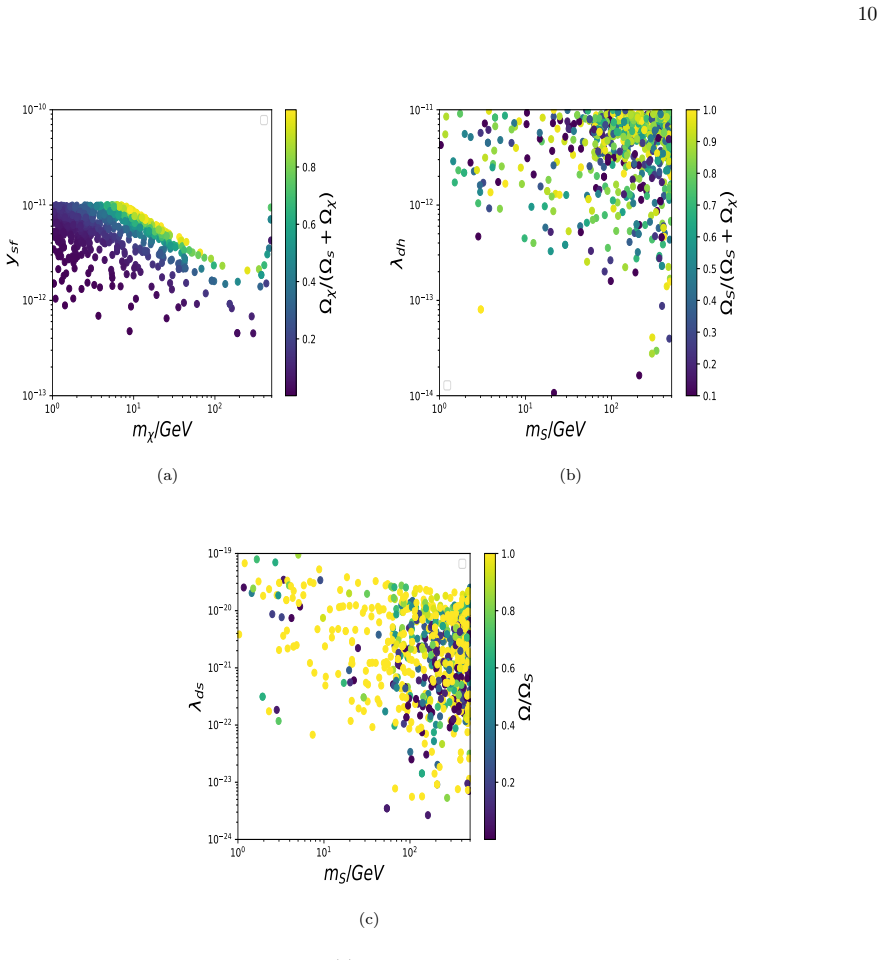
- [Abstract / Sec. V / Eq. (24) / Fig. 6(c)] The abstract states that λds can reach O(10^-25), 'roughly fifteen orders of magnitude below conventional FIMP values'. The body does not support this value: Sec. V says λds can be as tiny as O(10^-20) level, Eq. (24) scans λds from 10^-24 to 10^-10, and Fig. 6(c) reports an allowed lower bound of 2×10^-24 for case i. Since the abstract's number is the paper's headline novelty and is not reproducible from the plotted data, it must be corrected or demonstrated with a dedicated scan. The random scan cannot establish a true minimum; the lower bound appears set by the scan range, not by physics.
- [Sec. IV.A, Eq. (13)] The Boltzmann equation for χ (Eq. 13) includes only h2-mediated terms. The paper states in Sec. II that SM-mediated production is negligible because sinθ is fine-tuned, but no calculation is shown. Production via h1→χχ and XX→χχ scales as (y_sf sinθ)^2; with y_sf up to 2.5×10^-6 (cases iii/iv) and sinθ=10^-4, y_sf sinθ ≈ 2.5×10^-10, which is not obviously negligible compared with the h2 processes considered, particularly where h2→χχ is phase-space suppressed. Please compute the SM-mediated yield (or a rigorous upper bound) over the scanned parameter space and show it is subdominant, or include it in Eq. (13).
- [Sec. IV.C, Eq. (24)] The quoted viable parameter spaces are obtained from a random scan over the ranges in Eq. (24). The bounds of these ranges are not derived: in particular, the upper bound y_sf ≈ 2.5×10^-6 is estimated from Fig. 3, and the text says the exact value is not needed. Because the paper's quantitative conclusions (e.g., the allowed λds intervals in Figs. 6–9) depend on the completeness of the scan, the authors should either derive the scan boundaries or state how sampling density affects the reported lower/upper bounds. Without this, the reported intervals are not demonstrated to be complete.
minor comments (3)
- [Sec. IV.C] The sentence 'In the case of mχ < m2/2, χ production is obtained via the decay process χ→h2h2' appears to have the initial and final states reversed; it should be h2→χχ.
- [Eq. (12)] Eq. (12) uses ar{Y}_X for the SM bath, but ar{Y}_X is not defined in Eq. (14) and X is not a single species. Please define it or specify the sum over SM species.
- [General] No Micromegas model files or input parameters are provided, so the numerical results cannot be reproduced. Adding the model implementation or a table of key scan settings would improve reproducibility.
Circularity Check
No circular derivation: the relic-density scan is a filter, not a prediction; the only self-reference is to the authors' earlier model papers, which is not load-bearing. The abstract's O(10^-25) lambda_ds claim conflicts with the paper's own scan range and figures, but that is a reproducibility error, not circularity.
full rationale
The paper does not derive a prediction from fitted inputs. It states six free parameters (Eq. (16)), fixes sin(theta)=10^-4, and numerically solves the Boltzmann equations (Eqs. (12)-(15)) with Micromegas, then retains points satisfying Omega h^2 = 0.12 (Figs. 6-9). The allowed lambda_ds values are scan outputs, not inputs renamed as predictions. The model Lagrangian, mass matrix, and decay/annihilation rates are given explicitly (Eqs. (1)-(8), (15), (A1)), so the calculation is self-contained. The citations to the authors' own Refs. [20,22] only identify the Z2 x Z4 framework; the present paper re-derives the scalar potential and Boltzmann equations, so these self-citations are not load-bearing. The weakest quantitative point is not circular: the abstract's headline 'lambda_ds can reach O(10^-25)' is five orders of magnitude below the scan lower bound of Eq. (24) (lambda_ds in [10^-24, 10^-10]) and below the plotted lower limit (2x10^-24) of Fig. 6(c), while Section V states O(10^-20). This means the headline minimum is not reproducible from the paper's own scan, and the 'fifteen orders' number is unsupported; however, this is an internal consistency/support failure, not a reduction of an equation to itself. The assumption that SM-mediated chi production is negligible at sin(theta)=10^-4 is asserted without a quantitative check ('we fine-tune the value so that such a contribution can be negligible'), but again is an unquantified approximation rather than circular reasoning. No step in the derivation chain equates a fitted parameter to its prediction by construction.
Axiom & Free-Parameter Ledger
free parameters (6)
- sinθ =
10^-4 (fixed by hand)
- m2 =
1 TeV (fixed for scans; some plots also show 2 TeV)
- λds =
Case-dependent allowed ranges, e.g. (2×10^-24, 10^-19] for mχ<m2/2, mS<m2/2
- ysf =
Case-dependent ranges, e.g. (3×10^-13, 10^-11] for mχ<m2/2; [2×10^-8, 2.5×10^-6] for mχ>m2/2
- λdh =
Scanned in [10^-14, 10^-11]
- v0 = mχ/ysf =
Derived, up to ~10^14 GeV
axioms (6)
- domain assumption Standard freeze-in Boltzmann equations are valid for S and χ.
- domain assumption The new Higgs h2 is in thermal equilibrium with the SM bath, so its equilibrium abundance \bar Y_h2 sources DM production.
- domain assumption Initial DM abundances are negligible and S–χ conversion processes are negligible.
- domain assumption Narrow-width decay approximation for h1,h2 → DM processes.
- domain assumption h1 is the SM Higgs with m1=125 GeV and v=246 GeV.
- standard math Vacuum stability and perturbative unitarity constraints in Sec. III are sufficient.
invented entities (3)
-
Singlet scalar S (DM candidate)
no independent evidence
-
Majorana fermion χ (DM candidate)
no independent evidence
-
Singlet scalar S0 with vev v0
no independent evidence
read the original abstract
We study the freeze-in production of a two-component dark matter model with $Z_2\times Z_4$ symmetry where a singlet scalar $S$ and a Majorana fermion $\chi$ are the DM candidates. A singlet scalar $S_0$ with a non-zero vev $v_0$ generates $\chi$'s mass after spontaneous symmetry breaking. We choose six free parameters with the Higgs mixing angle fixed at $\sin\theta=10^{-4}$ in this work. Depending on whether $m_\chi$ and $m_S$ lie above or below $m_2/2$, with $m_2$ being the new Higgs $h_2$ mass, we have four phenomenological cases with distinct production channels. For $m_2=1$~TeV, we determine the viable parameter space consistent with the observed DM relic density by numerically solving the Boltzmann equations. Both DM masses are viable in the range $[1~\mathrm{GeV},\,3~\mathrm{TeV}]$. The coupling $\lambda_{ds}$ can reach $\mathcal{O}(10^{-25})$, roughly fifteen orders of magnitude below conventional FIMP values---a suppression that originates from the large hierarchy $v_0$, which enhances $h_2$-mediated $S$ production and forces $\lambda_{ds}$ to be correspondingly tiny. Remarkably, $h_2$ can still play a dominant role in determining $S$ production even for such a tiny $\lambda_{ds}$ when $m_S<m_2/2$.
Figures




Reference graph
Works this paper leans on
-
[1]
F ormulas The expression of the cross section ofh 2h2 →SSis given as follows: σh2h2→SS = λ2 ds 8πs(s−4m 2
-
[2]
Freeze-in
+ cos 2θ(m2 2 −m 2 1) 4v2 0 ,(8) λsh = sin 2θ(m2 2 −m 2 1) 2vv0 According to the current results, the mixing angle of the SM Higgs with other scalars is limited stringently arising from W boson mass correction [28] at NLO, the requirement of perturbativity and unitarity of the theory [29] as well as the LHC and LEP direct search [30, 31]. In this work, we...
-
[3]
A1, for the processh 2h2 →SS, the cross section will increase with the increase ofλ ds but decrease with the increase ofm 2
( p (s−4m 2 2)(s−4m 2 S)( 8λ2 dsm4 χ m4 2−4m2 2m2 S +m2 S s + y4 sf ((s−m2 2)+3m2 2)2 (m2 2−s)2 ) y4 sf + 8λdsm2 χ log( − √ (s−4m2 2)(s−4m2 S )−2m2 2+s√ (s−4m2 2)(s−4m2 S )−2m2 2+s )( m2 χ( 3m2 2 y2 sf m2χ (s−m2 2 ) − 2λds s−2m2 2 ) y2 sf + 1) y2 sf ) (A1) According to Eq. A1, for the processh 2h2 →SS, the cross section will increase with the increase ofλ...
-
[4]
10, we show the evolution of dark matter abundanceY S (left) andY χ(right) with the temperatureT, We have fixedy sf = 10 −9, λds = 10 −14 ,λdh = 10 −11 andm 2 = 1 TeV
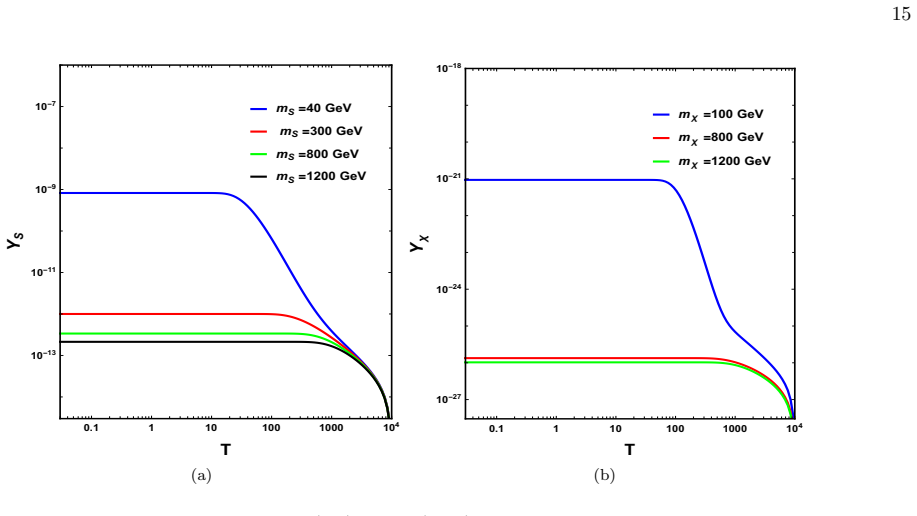
Evolution of Boltzmann equations In Fig. 10, we show the evolution of dark matter abundanceY S (left) andY χ(right) with the temperatureT, We have fixedy sf = 10 −9, λds = 10 −14 ,λdh = 10 −11 andm 2 = 1 TeV. In Fig. 10(a), we fixm χ = 100 GeV, and the colored lines correspond to the results ofm S = 40 GeV,m S = 300 GeV,m S = 800 GeV, andm S = 1200 GeV, r...
-
[5]
N. Aghanim et al. (Planck), Astron. Astrophys.641, A6 (2020), 1807.06209
Pith/arXiv arXiv 2020
-
[6]
N. Bernal, M. Heikinheimo, T. Tenkanen, K. Tuominen, and V. Vaskonen, Int. J. Mod. Phys. A32, 1730023 (2017), 1706.07442
Pith/arXiv arXiv 2017
-
[7]
L. J. Hall, K. Jedamzik, J. March-Russell, and S. M. West, JHEP03, 080 (2010), 0911.1120
Pith/arXiv arXiv 2010
-
[8]
C. Boehm, P. Fayet, and J. Silk, Phys. Rev. D69, 101302 (2004), hep-ph/0311143
Pith/arXiv arXiv 2004
-
[9]
V. Barger, P. Langacker, M. McCaskey, M. Ramsey-Musolf, and G. Shaughnessy, Phys. Rev. D79, 015018 (2009), 0811.0393
Pith/arXiv arXiv 2009
-
[10]
K. M. Zurek, Phys. Rev. D79, 115002 (2009), 0811.4429
Pith/arXiv arXiv 2009
-
[11]
S. Profumo, K. Sigurdson, and L. Ubaldi, JCAP12, 016 (2009), 0907.4374
Pith/arXiv arXiv 2009
-
[12]
Z.-P. Liu, Y.-L. Wu, and Y.-F. Zhou, Eur. Phys. J. C71, 1749 (2011), 1101.4148
Pith/arXiv arXiv 2011
- [13]
-
[14]
M. Pandey, D. Majumdar, and K. P. Modak, JCAP06, 023 (2018), 1709.05955
Pith/arXiv arXiv 2018
-
[15]
S. Bhattacharya, P. Poulose, and P. Ghosh, JCAP04, 043 (2017), 1607.08461
Pith/arXiv arXiv 2017
-
[16]
S. Bhattacharya, P. Ghosh, T. N. Maity, and T. S. Ray, JHEP10, 088 (2017), 1706.04699
Pith/arXiv arXiv 2017
-
[17]
S. Bhattacharya, P. Ghosh, J. Lahiri, and B. Mukhopadhyaya, Phys. Rev. D108, L111703 (2023), 2211.10749
Pith/arXiv arXiv 2023
-
[18]
A. S. Sakharov and M. Y. Khlopov, Phys. Atom. Nucl.57, 651 (1994)
1994
-
[19]
Khlopov, Prog
M. Khlopov, Prog. Part. Nucl. Phys.116, 103824 (2021)
2021
-
[20]
B. D ´ ıaz S´ aez, P. Escalona, S. Norero, and A. R. Zerwekh, JHEP10, 233 (2021), 2105.04255
Pith/arXiv arXiv 2021
-
[21]
B. D ´ ıaz S´ aez and P. E. Contreras, JCAP03, 010 (2024), 2307.07760
Pith/arXiv arXiv 2024
-
[22]
G. B´ elanger, A. Pukhov, C. E. Yaguna, and O. Zapata, JHEP09, 030 (2020), 2006.14922. 16
Pith/arXiv arXiv 2020
-
[23]
G. B´ elanger, A. Pukhov, C. E. Yaguna, and O. Zapata, JHEP03, 100 (2023), 2212.07488
Pith/arXiv arXiv 2023
- [24]
- [25]
- [26]
-
[27]
S. Esch, M. Klasen, and C. E. Yaguna, JHEP09, 108 (2014), 1406.0617
Pith/arXiv arXiv 2014
-
[28]
C. E. Yaguna and O. Zapata, Phys. Rev. D105, 095026 (2022), 2112.07020
Pith/arXiv arXiv 2022
-
[29]
C. E. Yaguna and O. Zapata, Phys. Rev. D109, 015002 (2024), 2308.05249
Pith/arXiv arXiv 2024
-
[30]
S. Bhattacharya, P. Ghosh, and N. Sahu, JHEP02, 059 (2019), 1809.07474
Pith/arXiv arXiv 2019
-
[31]
T. Blazek, P. Matak, J. Ramaj, and M. Sabova, Eur. Phys. J. C85, 801 (2025), 2504.15164
Pith/arXiv arXiv 2025
-
[32]
D. L´ opez-Val and T. Robens, Phys. Rev. D90, 114018 (2014), 1406.1043
Pith/arXiv arXiv 2014
-
[33]
Robens, in 55th Rencontres de Moriond on QCD and High Energy Interactions (2021), 2105.07719
T. Robens, in 55th Rencontres de Moriond on QCD and High Energy Interactions (2021), 2105.07719
Pith/arXiv arXiv 2021
- [34]
-
[35]
M. J. Strassler and K. M. Zurek, Phys. Lett. B661, 263 (2008), hep-ph/0605193
Pith/arXiv arXiv 2008
-
[36]
J.-J. Zhang, Z.-L. Han, A. Liu, and F.-L. Shao, Nucl. Phys. B1014, 116864 (2025), 2411.06744
Pith/arXiv arXiv 2025
discussion (0)
Sign in with ORCID, Apple, or X to comment. Anyone can read and Pith papers without signing in.