REVIEW 3 major objections 4 minor 1 cited by
Forward-mode automatic differentiation can compute derivatives of the tensor renormalization group partition function at a modest, fixed extra cost, and the impurity method is its limiting case where SVD derivatives are dropped.
Reviewed by Pith at T0; open to challenge. T0 means a machine referee read the full paper against a public rubric. the ladder, T0–T4 →
T0 review · deepseek-v4-flash
2026-08-03 03:03 UTC pith:HKJGRTGF
load-bearing objection A solid forward-mode AD/TRG methods paper: the 2D accuracy claim largely holds and the impurity-limit identification is neat; the 3D section is a placeholder and the eta regulator needs principled treatment. the 3 major comments →
Forward-mode automatic differentiation for the tensor renormalization group and its relation to the impurity method
The pith
A machine-rendered reading of the paper's core claim, the machinery that carries it, and where it could break.
Core claim
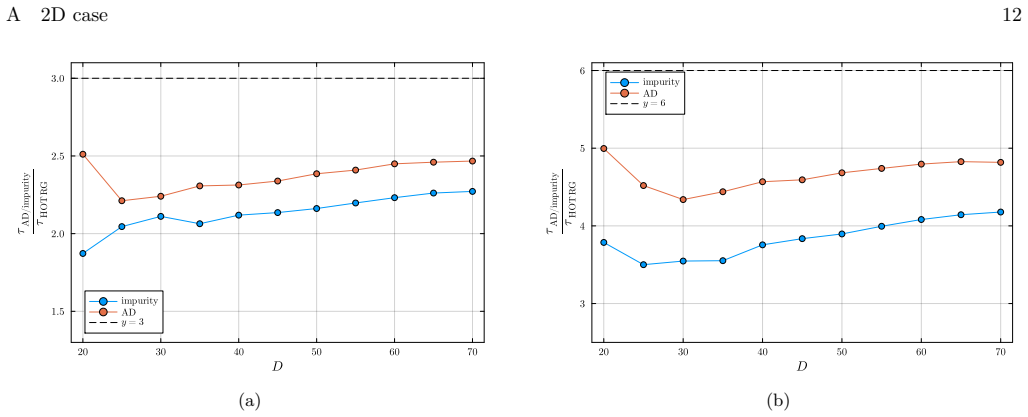
By propagating derivative tensors alongside the renormalized tensor and differentiating the SVD at each coarse-graining step, derivatives of the partition function up to order k can be computed with matrix-multiplication cost multiplied by (k+1)(k+2)/2 and memory multiplied by k+1, independent of RG depth. The impurity method is exactly the limit where SVD derivatives are discarded. On the 2D Ising model at D=80 this yields specific-heat relative errors below 1e-5, versus about 1e-1 for the impurity method, and the slope of log|dX/dT| gives 1/nu=1.000053(8).
What carries the argument
The central objects are the derivative tensors \dot T, \ddot T, ... propagated by the chain rule through each coarse-graining map, together with the differentiated SVD rule that supplies the projectors' derivatives. The paper regularizes near-degenerate singular values with a Lorentzian broadening eta in 1/(sigma_j^2 - sigma_i^2), and uses a contraction-tree formulation so that the repeated contractions for different derivative orders share intermediate tensors rather than being evaluated independently.
Load-bearing premise
The accuracy advantage rests on differentiating the truncated SVD at each step; this derivative is ill-defined when singular values are (nearly) degenerate, the paper regularizes it with an ad hoc Lorentzian width eta, and no principled criterion or error bound for eta is given.
What would settle it
Compute the specific heat of the 3D Ising model at larger bond dimensions (or with several eta values) and check whether the reported discontinuity persists and whether nu moves from 0.571(4) toward 0.629971; if no choice of regularizer removes the discontinuity, the claim that forward AD delivers accurate higher-order derivatives in TRG fails for that regime.
If this is right
- All volumes Z(2^n, beta) and their derivatives come from one forward pass, enabling finite-size scaling of dX/dT without rerunning the RG.
- Higher-order moments such as the Binder cumulant are available at machine precision with only a polynomial factor of extra contraction cost.
- The impurity method is a controlled limit of the algorithm, so any failure of forward AD relative to the impurity limit can be traced to the SVD derivatives.
- The same contraction-tree differentiation applies to arbitrary tensor networks, not just HOTRG and BWTRG.
- At D=130 in 2D, the extracted critical exponent 1/nu=1.000053(8) agrees with the exact value, demonstrating the finite-size-scaling procedure.
Where Pith is reading between the lines
- If the eta-dependence is as strong as the numerics suggest, a principled way to set the SVD regulator (or a gauge-fixed SVD derivative) would make the method robust for models with protected degeneracies, such as symmetric or topological phases.
- The memory advantage over reverse mode grows with RG depth, so forward mode should become increasingly attractive in 3D and 4D, exactly where the paper's D=32 results are least converged.
- Because the impurity limit is exactly recoverable, the method gives a clean diagnostic: run forward AD with eta=infinity to reproduce the impurity result, then lower eta; the difference isolates the physical contribution of projector variation.
- Optimization-based TRG algorithms that perform many SVDs per step, where reverse mode is expensive, are a natural testbed for this forward-mode update.
Editorial analysis
A structured set of objections, weighed in public.
Referee Report
Summary. The paper proposes a forward-mode automatic differentiation (AD) framework for tensor renormalization group (TRG) methods, with explicit applications to HOTRG and BWTRG. The central technical claims are: (i) evaluating derivatives of the partition function up to order k multiplies the leading matrix-multiplication cost by (k+1)(k+2)/2 while memory grows only as k+1 relative to the original calculation; (ii) in the limit where SVD derivatives are neglected, the method reduces to the conventional impurity-tensor method; (iii) numerically, the AD method computes internal energy and specific heat with substantially higher accuracy than the impurity method at comparable cost for the 2D Ising model; and (iv) the method enables extraction of the critical exponent ν from the derivative of the Gu–Wen ratio in both two and three dimensions. The derivation relies on differentiating the SVD of coarse-graining tensors, regularized by a Lorentzian broadening parameter η (Eq. B10).
Significance. If the central claims hold, this is a useful contribution: it provides an explicit forward-mode AD formulation for TRG that avoids the memory cost of reverse-mode backpropagation, gives a clean theoretical correspondence to impurity methods, and demonstrates that derivative information can be propagated through the RG flow with only a constant factor overhead. The contraction-tree proof in Appendix C is a concrete, testable derivation, and the numerical benchmarks directly compare timings with impurity methods. The main value is practical: it could make higher-order derivatives and finite-size scaling analyses routine in TRG calculations. However, the numerical superiority over impurity methods rests on differentiating the SVD in the presence of near-degenerate singular values, and the paper does not provide a principled criterion for the regulator η or an error bound. The 3D demonstration is also preliminary and not accurate enough to support the abstract's general claim of a practical procedure in both two and three dimensions.
major comments (3)
- [Sec. III.A and Eq. (B10)] The central accuracy claim—specific heat relative error below 1e-5 at η=10^-20 vs about 0.1 for the impurity method (Fig. 1b)—depends on the Lorentzian regulator η, but no selection criterion or error bound is given. The results vary strongly with η (Fig. 1), and the 2D Ising model has (near-)degenerate singular values, so the SVD derivative is ill-defined without a regulator. The paper needs either a systematic η-convergence analysis, a gauge-fixed SVD derivative as in Ref. [84], or an uncertainty estimate from the regulator to support the claimed accuracy advantage.
- [Sec. III.B and Sec. IV] The 3D extraction reports ν=0.571(4) from a linear fit, which is 9% off the conformal-bootstrap value 0.629971(4), and the paper explicitly concedes that the specific heat is discontinuous in 3D and that the squared magnetization is unstable at h=0. Given the abstract claims a 'practical procedure to extract critical exponents ... in both two and three dimensions,' the 3D demonstration does not support this as stated. The abstract and conclusions should be qualified as 2D quantitative with 3D only preliminary, or the 3D calculation should be improved.
- [Appendix B, Eqs. (B8)-(B10)] The regularized SVD derivative is not gauge-invariant in degenerate subspaces. When truncation cuts through a degenerate multiplet—which the paper admits can happen (Sec. IV)—the singular vectors are defined only up to a unitary freedom, and the Lorentzian expression depends on the arbitrary choice of basis. The paper should explain how the choice of singular vectors affects the final thermodynamic derivatives and should test whether the η=10^-20 results are independent of the gauge/regularization convention. Without this, the 2D accuracy could be an artifact of a particular gauge choice rather than an intrinsic advantage of the method.
minor comments (4)
- [Sec. II.C] Typo: 'refereed as squeezers' should be 'referred to as squeezers'.
- [Sec. II.C vs Appendix C.2] The main text states that the cost is 'exactly' (k+1)(k+2)/2 times the original, but Appendix C.2 describes a 2k+1 interpolation scheme giving a different prefactor (e.g., 5C for k=2). Please clarify whether this alternative is used in the numerical timings and whether the 'exact' statement applies only to the contraction-tree method.
- [Sec. III.A, Fig. 1] The comparison to the exact solution is only shown at one volume and one bond dimension (D=80). A brief discussion of the D-dependence of the error and the stability of the η=10^-20 result under varying D would strengthen the claim.
- [Eq. (39)] The definition of the Gu–Wen ratio X uses a diagram that does not render in the plain text. An explicit algebraic expression for X in terms of the renormalized tensor T^{(n)} would make the section self-contained.
Circularity Check
No significant circularity: exact chain-rule differentiation of a well-defined coarse-graining map, independently benchmarked.
full rationale
The paper's central derivation is a chain-rule differentiation of its own HOTRG/BWTRG coarse-graining maps (Eqs. 15-17, Appendix C), and the claimed cost and memory scalings follow from explicit contraction-tree counting; none of this presupposes the target derivatives. The impurity correspondence is derived as the Ė=Ḟ=0 / η=∞ limit of the same update equations (Sec. II E), i.e. a mathematical reduction rather than an imported equivalence, and no parameter of the AD calculation is set by the benchmark values it is compared against. Numerical validation uses independent exact 2D Onsager results and conformal-bootstrap ν, so the accuracy claim is externally falsifiable. The only non-standard element is the Lorentzian SVD-derivative regulator η (Eq. B10): its choice is acknowledged as ad hoc and the degenerate-case SVD derivative is gauge-dependent, but the paper scans η systematically and does not fit η to the exact answer; this is a robustness/correctness concern, not a circular step. The sole self-reference (Ref. [45]) is a background TRG application and is not load-bearing. The Sec. IV limitation passage explicitly admits discontinuities and instability in 3D, but these are limitations, not circularity. Therefore no output is equivalent by construction to an input.
Axiom & Free-Parameter Ledger
free parameters (2)
- eta (Lorentzian broadening width in SVD derivative) =
10^-20 (best accuracy); 10^-16 ... 10^0, infinity (impurity limit)
- Critical temperature Tc used in scaling fits =
2.2691853 (2D, D=130); 4.5079 (3D, D=32)
axioms (3)
- domain assumption The SVD of the coarse-graining tensors is differentiable with respect to beta in the regularized sense (Lorentzian regularization of Eq. B10).
- domain assumption The Gu-Wen ratio X obeys the finite-size scaling form X = g(L^(1/nu) tau) and its derivative satisfies Eq. (41)-(42).
- standard math The initial tensor T and its derivatives are computed analytically (Eq. 38 for the 2D Ising model).
read the original abstract
We propose a forward-mode automatic differentiation (AD) framework for tensor renormalization group methods. In this approach, evaluating the derivatives of the partition function up to the order of $k$ increases the matrix-multiplication cost by a factor of $(k+1)(k+2)/2$ compared to computing the free energy alone, and the memory footprint is only $k+1$ times that of the original calculation. In the limit where the derivatives of the singular value decomposition are neglected, we establish a theoretical correspondence between our forward-mode AD and conventional impurity methods. Numerically, we find that the proposed AD algorithm can calculate internal energy and specific heat significantly higher accuracy than the impurity method at comparable computational cost. We also provide a practical procedure to extract critical exponents from derivatives of the renormalized tensor in tensor renormalization group calculations in both two and three dimensions. In addition, we discuss how to efficiently differentiate an arbitrary tensor network.
Figures




Forward citations
Cited by 1 Pith paper
-
Deconfinement from Thermal Tensor Networks: Universal CFT signature in (2+1)-dimensional $\mathbb{Z}_N$ lattice gauge theory
Tensor-network contraction of finite-temperature Z_N gauge theory yields central charges and scaling dimensions consistent with Svetitsky–Yaffe universality for N=2,3,5, including a U(1)-symmetric BKT phase for N=5, a...
Reference graph
Works this paper leans on
-
[1]
Impurity method of the HOTRG In the impurity method in the HOTRG,k-th impurity tensor is updated as systematic summation of networks [37, 58], S(n+1) 1 = 1 2 h R S(n) 1 , T(n), E(n), F(n) +R T (n), S(n) 1 , E(n), F(n) i (30) S(n+1) 2 = 1 4 h R S(n) 2 , T(n), E(n), F(n) +R T (n), S(n) 2 , E(n), F(n) + 2R S(n) 1 , S(n) 1 , E(n), F(n) i ,(31) ... (32) S(n+1)...
-
[2]
Impurity method of the BWTRG To clarify the correspondence with the multi-impurity method for the BWTRG [60], we rewrite the BWTRG and its differentiation rules in a projector formalism [76, 77]. This can be achieved by a simple modification: replace the truncated SVD and the bond-weight splitting by an insertion of projectors and singular values, T (n) ≈...
-
[3]
A contraction tree [74] is a binary tree that specifies the contraction order of a tensor networks
General case In this section, we provide details of a contraction tree based differentiation method. A contraction tree [74] is a binary tree that specifies the contraction order of a tensor networks. While contraction tree based reverse mode automatic differentiation algorithms are described in Ref. [89], our method provides a general framework to comput...
-
[4]
Consider the second derivative case
Linear scaling algorithm The contraction tree based algorithm is itself very efficient in terms of the computational cost, however, a simple modification can be considered, which results in the total computational cost to be 2k+ 1 times original contraction. Consider the second derivative case. We consider contraction in Eqs. (C2)–(C4). LetCbe the total c...
-
[5]
M. Levin and C. P. Nave, Phys. Rev. Lett.99, 120601 (2007), arXiv:cond-mat/0611687
Pith/arXiv arXiv 2007
-
[6]
Z.-C. Gu and X.-G. Wen, Phys. Rev. B80, 155131 (2009), arXiv:0903.1069 [cond-mat]
Pith/arXiv arXiv 2009
-
[7]
Z. Y. Xie, J. Chen, M. P. Qin, J. W. Zhu, L. P. Yang, and T. Xiang, Phys. Rev. B86, 045139 (2012), arXiv:1201.1144
Pith/arXiv arXiv 2012
-
[8]
Y. Shimizu and Y. Kuramashi, Phys. Rev. D90, 074503 (2014), arXiv:1408.0897 [hep-lat]
Pith/arXiv arXiv 2014
-
[9]
J. F. Unmuth-Yockey, Y. Meurice, J. Osborn, and H. Zou, PoSLA TTICE2014, 325 (2014), arXiv:1411.4213 [hep-lat]
Pith/arXiv arXiv 2014
-
[10]
J. F. Yu, Z. Y. Xie, Y. Meurice, Y. Liu, A. Denbleyker, H. Zou, M. P. Qin, and J. Chen, Phys. Rev. E89, 013308 (2014), arXiv:1309.4963 [cond-mat.stat-mech]
Pith/arXiv arXiv 2014
-
[11]
S. Wang, Z. Y. Xie, J. Chen, B. Normand, and T. Xiang, Chinese Phys. Lett.31, 070503 (2014), arXiv:1405.1179 [cond- mat]
Pith/arXiv arXiv 2014
-
[12]
Y. Shimizu and Y. Kuramashi, Phys. Rev. D90, 014508 (2014), arXiv:1403.0642 [cond-mat, physics:hep-lat, physics:hep- th]
Pith/arXiv arXiv 2014
-
[14]
S. Takeda and Y. Yoshimura, Prog. Theor. Exp. Phys.2015, 10.1093/ptep/ptv022 (2015), arXiv:1412.7855 [hep-lat]
Pith/arXiv arXiv 2015
-
[15]
H. Kawauchi and S. Takeda, Phys. Rev. D93, 114503 (2016), arXiv:1603.09455 [hep-lat]
Pith/arXiv arXiv 2016
-
[16]
R. Sakai, S. Takeda, and Y. Yoshimura, Prog. Theor. Exp. Phys.2017, 10.1093/ptep/ptx080 (2017), arXiv:1705.07764 [hep-lat]
Pith/arXiv arXiv 2017
-
[17]
R. Sakai, D. Kadoh, Y. Kuramashi, Y. Nakamura, S. Takeda, and Y. Yoshimura, EPJ Web Conf.175, 11019 (2018), arXiv:1711.01892 [hep-lat]
Pith/arXiv arXiv 2018
-
[18]
Y. Yoshimura, Y. Kuramashi, Y. Nakamura, S. Takeda, and R. Sakai, Phys. Rev. D97, 054511 (2018), arXiv:1711.08121 [hep-lat]
Pith/arXiv arXiv 2018
-
[19]
A. Bazavov, S. Catterall, R. G. Jha, and J. Unmuth-Yockey, Phys. Rev. D99, 114507 (2019), arXiv:1901.11443 [hep-lat]
Pith/arXiv arXiv 2019
-
[20]
S. Iino, S. Morita, and N. Kawashima, Phys. Rev. B100, 035449 (2019)
2019
-
[21]
S. Hong and D.-H. Kim, Phys. Rev. E101, 012124 (2020), arXiv:1906.09036
Pith/arXiv arXiv 2020
-
[22]
S. Akiyama, Y. Kuramashi, T. Yamashita, and Y. Yoshimura, Phys. Rev. D100, 054510 (2019), arXiv:1906.06060 [hep-lat]
Pith/arXiv arXiv 2019
-
[23]
Akiyama, D
S. Akiyama, D. Kadoh, Y. Kuramashi, T. Yamashita, and Y. Yoshimura, Journal of High Energy Physics2020, 177 (2020)
2020
-
[24]
Delcamp and A
C. Delcamp and A. Tilloy, Phys. Rev. Res.2, 033278 (2020)
2020
-
[25]
Akiyama and Y
S. Akiyama and Y. Kuramashi, Phys. Rev. D104, 014504 (2021). 2 Linear scaling algorithm 23
2021
-
[26]
S. Akiyama, Y. Kuramashi, T. Yamashita, and Y. Yoshimura, JHEP01(UTHEP-752, UTCCS-P-134), 121, arXiv:2009.11583 [hep-lat]
Pith/arXiv arXiv 2009
-
[27]
S. Akiyama, Y. Kuramashi, and Y. Yoshimura, Phys. Rev. D104, 034507 (2021), arXiv:2101.06953 [hep-lat]
Pith/arXiv arXiv 2021
-
[28]
J. Bloch, R. G. Jha, R. Lohmayer, and M. Meister, Phys. Rev. D104, 094517 (2021), arXiv:2105.08066 [hep-lat]
Pith/arXiv arXiv 2021
-
[29]
M. Fukuma, D. Kadoh, and N. Matsumoto, Tensor network approach to 2D Yang-Mills theories (2021), arXiv:2107.14149 [hep-lat, physics:hep-th]
Pith/arXiv arXiv 2021
-
[30]
Akiyama and D
S. Akiyama and D. Kadoh, J. High Energ. Phys.2021(10), 188
2021
-
[31]
Hirasawa, A
M. Hirasawa, A. Matsumoto, J. Nishimura, and A. Yosprakob, J. High Energ. Phys.2021(12), 11
2021
-
[32]
S. Akiyama, Y. Kuramashi, and T. Yamashita, PTEP2022, 023I01 (2022), arXiv:2109.14149 [cond-mat.str-el]
Pith/arXiv arXiv 2022
-
[33]
G. Li, K. H. Pai, and Z.-C. Gu, Phys. Rev. Res.4, 023159 (2022), arXiv:2009.10695 [cond-mat.stat-mech]
Pith/arXiv arXiv 2022
-
[34]
K. Nakayama, L. Funcke, K. Jansen, Y.-J. Kao, and S. K¨ uhn, Phys. Rev. D105, 054507 (2022), arXiv:2107.14220 [cond- mat, physics:hep-lat, physics:quant-ph]
Pith/arXiv arXiv 2022
-
[35]
S. Akiyama and Y. Kuramashi, JHEP05(UTHEP-769, UTCCS-P-143), 102, arXiv:2202.10051 [hep-lat]
-
[36]
Bloch, R
J. Bloch, R. Lohmayer, and M. Meister, inProc. 38th Int. Symp. Lattice Field Theory — PoSLATTICE2021(Sissa Medialab, Zoom/Gather@Massachusetts Institute of Technology, 2022) p. 285
2022
-
[37]
T. Kuwahara and A. Tsuchiya, Prog. Theor. Exp. Phys.2022, 093B02 (2022), arXiv:2205.08883 [hep-lat]
Pith/arXiv arXiv 2022
-
[38]
X. Luo and Y. Kuramashi, Phys. Rev. D107, 094509 (2023), arXiv:2208.13991 [hep-lat]
Pith/arXiv arXiv 2023
-
[39]
J. Bloch and R. Lohmayer, Nuclear Physics B986, 116032 (2023), arXiv:2206.00545 [hep-lat]
Pith/arXiv arXiv 2023
-
[40]
M. Asaduzzaman, S. Catterall, Y. Meurice, R. Sakai, and G. C. Toga, J. High Energ. Phys.2023(1), 24, arXiv:2210.03834 [hep-lat]
Pith/arXiv arXiv 2023
-
[41]
K. Yoshiyama and K. Hukushima, Higher-order tensor renormalization group study of thej 1-j2 Ising model on a square lattice (2023), arXiv:2303.07733 [cond-mat]
Pith/arXiv arXiv 2023
-
[42]
J. Genzor, Phys. Rev. E107, 034131 (2023), arXiv:2210.15268 [cond-mat]
Pith/arXiv arXiv 2023
-
[43]
Akiyama and Y
S. Akiyama and Y. Kuramashi, Journal of High Energy Physics2023, 77 (2023)
2023
-
[44]
S. Akiyama, R. G. Jha, and J. Unmuth-Yockey, Phys. Rev. D110, 034519 (2024), arXiv:2406.10081 [hep-lat]
Pith/arXiv arXiv 2024
-
[45]
S. Akiyama and Y. Kuramashi, J. High Energ. Phys.2024(9), 86, arXiv:2407.10409 [hep-lat]
Pith/arXiv arXiv 2024
-
[47]
A. Samlodia, V. Longia, R. G. Jha, and A. Joseph, Phys. Rev. D110, 034504 (2024), arXiv:2404.17504 [hep-lat]
Pith/arXiv arXiv 2024
-
[48]
K. Homma, S. Morita, and N. Kawashima, Phys. Rev. B111, 134427 (2025), arXiv:2403.17309 [cond-mat]
Pith/arXiv arXiv 2025
-
[49]
Y. Sugimoto, S. Akiyama, and Y. Kuramashi, Phase structure of (3+1)-dimensional dense two-color QCD at$T=0$in the strong coupling limit with tensor renormalization group (2025), arXiv:2509.23637 [hep-lat]
arXiv 2025
- [50]
- [51]
-
[52]
S. Morita, R. Igarashi, H.-H. Zhao, and N. Kawashima, Phys. Rev. E97, 033310 (2018), arXiv:1712.01458
Pith/arXiv arXiv 2018
-
[53]
D. Adachi, T. Okubo, and S. Todo, Phys. Rev. B102, 054432 (2020), arXiv:1906.02007 [cond-mat, physics:physics, physics:quant-ph]
Pith/arXiv arXiv 2020
-
[55]
D. Adachi, T. Okubo, and S. Todo, Phys. Rev. B105, L060402 (2022), arXiv:2011.01679 [cond-mat, physics:physics, physics:quant-ph]
Pith/arXiv arXiv 2022
-
[56]
G. Evenbly and G. Vidal, Phys. Rev. Lett.115, 180405 (2015), arXiv:1412.0732 [cond-mat, physics:quant-ph]
Pith/arXiv arXiv 2015
-
[57]
S. Yang, Z.-C. Gu, and X.-G. Wen, Phys. Rev. Lett.118, 110504 (2017), arXiv:1512.04938 [cond-mat, physics:quant-ph]
Pith/arXiv arXiv 2017
-
[58]
M. Hauru, C. Delcamp, and S. Mizera, Phys. Rev. B97, 045111 (2018), arXiv:1709.07460 [cond-mat, physics:hep-th, physics:quant-ph]
Pith/arXiv arXiv 2018
-
[59]
S. Morita and N. Kawashima, Phys. Rev. B103, 045131 (2021), arXiv:2009.01997 [cond-mat]
Pith/arXiv arXiv 2021
-
[60]
K. Homma, T. Okubo, and N. Kawashima, Phys. Rev. Res.6, 043102 (2024), arXiv:2306.17479 [cond-mat.stat-mech]
Pith/arXiv arXiv 2024
- [61]
-
[62]
S. Morita and N. Kawashima, Comput. Phys. Commun.236, 65 (2019), arXiv:1806.10275 [cond-mat]
Pith/arXiv arXiv 2019
-
[63]
Liao, J.-G
H.-J. Liao, J.-G. Liu, L. Wang, and T. Xiang, Phys. Rev. X9, 031041 (2019)
2019
-
[64]
S. Morita and N. Kawashima, Phys. Rev. B111, 054433 (2025), arXiv:2411.13998 [cond-mat]
Pith/arXiv arXiv 2025
-
[65]
Bartholomew-Biggs, S
M. Bartholomew-Biggs, S. Brown, B. Christianson, and L. Dixon, Journal of Computational and Applied Mathematics Numerical Analysis 2000. Vol. IV: Optimization and Nonlinear Equations,124, 171 (2000)
2000
-
[66]
A. G. Baydin, B. A. Pearlmutter, A. A. Radul, and J. M. Siskind, J. Mach. Learn. Res.18, 1 (2018)
2018
-
[67]
B.-B. Chen, Y. Gao, Y.-B. Guo, Y. Liu, H.-H. Zhao, H.-J. Liao, L. Wang, T. Xiang, W. Li, and Z. Y. Xie, Phys. Rev. B 101, 220409 (2020)
2020
-
[68]
C. Geng, H.-Y. Hu, and Y. Zou, Mach. Learn.: Sci. Technol.3, 015020 (2022), arXiv:2110.03898 [quant-ph]
Pith/arXiv arXiv 2022
-
[69]
Tseng, S.-W
Y.-H. Tseng, S.-W. Li, and F.-J. Jiang, PTEP2025, 073A01 (2025). 2 Linear scaling algorithm 24 [66]https://github.com/wangleiphy/tensorgrad(2021). [67]https://github.com/under-Peter/TensorNetworkAD.jl(2023)
2025
-
[70]
Paszke, S
A. Paszke, S. Gross, F. Massa, A. Lerer, J. Bradbury, G. Chanan, T. Killeen, Z. Lin, N. Gimelshein, L. Antiga, A. Des- maison, A. Kopf, E. Yang, Z. DeVito, M. Raison, A. Tejani, S. Chilamkurthy, B. Steiner, L. Fang, J. Bai, and S. Chintala, inAdv. Neural Inf. Process. Syst., Vol. 32 (Curran Associates, Inc., 2019)
2019
-
[71]
Innes, CoRRabs/1810.07951(2018), arXiv:1810.07951
M. Innes, CoRRabs/1810.07951(2018), arXiv:1810.07951
Pith/arXiv arXiv 2018
-
[72]
D. Kadoh and K. Nakayama, Renormalization group on a triad network (2019), arXiv:1912.02414 [cond-mat, physics:hep- lat, physics:hep-th]
Pith/arXiv arXiv 2019
-
[73]
F. I. Az-zahra, S. Takeda, and T. Yamazaki, Phys. Rev. D110, 034514 (2024), arXiv:2404.15666 [hep-lat]
Pith/arXiv arXiv 2024
-
[74]
L. Wang and F. Verstraete, Cluster update for tensor network states (2011), arXiv:1110.4362 [cond-mat]
Pith/arXiv arXiv 2011
-
[75]
S. Iino, S. Morita, and N. Kawashima, Phys. Rev. B101, 155418 (2020), arXiv:1911.09907 [cond-mat.stat-mech]
Pith/arXiv arXiv 2020
-
[76]
G. Evenbly and R. N. C. Pfeifer, Phys. Rev. B89, 245118 (2014), arXiv:1310.8023 [cond-mat]
Pith/arXiv arXiv 2014
-
[77]
K. Nakayama and M. Schneider, Phys. Rev. D110, 094501 (2024), arXiv:2407.14226
arXiv 2024
-
[78]
G. Evenbly, Phys. Rev. B95, 045117 (2017), arXiv:1509.07484 [cond-mat, physics:quant-ph]
Pith/arXiv arXiv 2017
-
[79]
Nakamura, H
Y. Nakamura, H. Oba, and S. Takeda, Phys. Rev. B99, 155101 (2019). [78]https://datarepo.mdcl.issp.u-tokyo.ac.jp/repo/49(2026)
2019
-
[80]
S. Morita and N. Kawashima, Tensor renormalization group calculations of partition-function ratios (2025), arXiv:2512.03395 [cond-mat]
arXiv 2025
-
[81]
S. Akiyama, R. G. Jha, J. Maeda, Y. Tanizaki, and J. Unmuth-Yockey, Tensor renormalization group approach to critical phenomena via symmetry-twisted partition functions (2026), arXiv:2601.02681 [hep-lat]
Pith/arXiv arXiv 2026
-
[82]
A. Ueda and M. Oshikawa, Phys. Rev. B108, 024413 (2023), arXiv:2302.06632 [cond-mat]
Pith/arXiv arXiv 2023
-
[83]
F. Kos, D. Poland, D. Simmons-Duffin, and A. Vichi, JHEP08, 036, arXiv:1603.04436 [hep-th]
discussion (0)
Sign in with ORCID, Apple, or X to comment. Anyone can read and Pith papers without signing in.