REVIEW 3 major objections 5 minor 67 references
Producing $\Lambda(1405)$ and $\Lambda(1520)$ in $\pi^-p$ reaction to explore their inner structures
T0 review · 3 major / 5 minor · reviewed 2026-08-03 · deepseek-v4-flash
Pith's one-line read This paper argues that pion–proton scattering can discriminate the inner structures of Λ(1405) and Λ(1520), with scaling analysis marking Λ(1405) as a likely non-ordinary three-quark baryon and Λ(1520) as a conventional one.
desk verdict Solid production-mechanism analysis with a speculative Λ(1405) structural twist that should be labeled as such — worth referee time, but the exotic claim needs real 90° data. read the letter →
The pith
A machine-rendered reading of the paper's core claim, the machinery that carries it, and where it could break.
The reading
What carries the argument
The central machinery is the constituent counting rule — the perturbative-QCD scaling relation dσ/dt ∼ s^(2−n) for exclusive two-body reactions, where n is the total number of valence constituents in the four participating hadrons — applied to 90° cross sections obtained from a fitted effective-Lagrangian model. The reaction model itself combines t-channel K* exchange, u-channel Σ exchange, form factors, and a Reggeized propagator for the t channel; it supplies the cross-section values from which the scaling exponent n is extracted. For π−p → KΛ(1405), the paper finds n ≈ 8, and for π−p → KΛ(1520), n ≈ 10.
What would settle it
Measure dσ/dt for π−p → KΛ(1405) at θ_cm = 90° for several center-of-mass energies between 2.3 and 3.0 GeV; fit the energy dependence to dσ/dt = C s^(2−n). If n is consistent with 10 or 12 (rather than ≈8), the paper's exotic-structure suggestion is refuted.
Extended reading notes
Core claim
The central claim is that the production mechanisms of the two hyperons in π−p reactions are cleanly separated: the total cross section of π−p → KΛ(1405) is governed by u-channel Σ exchange, while π−p → KΛ(1520) is governed by t-channel K* exchange, each described by an effective-Lagrangian amplitude with monopole-like form factors and Reggeized propagators. Fitting to existing data gives good agreement, and the differential cross sections of the two channels have characteristically different angular shapes. From the fitted model, the authors compute dσ/dt at θ_cm = 90° for both reactions and apply the constituent counting rule dσ/dt ∼ s^(2−n) f(θ). They find n = 9.7–10.3 for Λ(1520), matchi
Load-bearing premise
The structural conclusion rests on the paper's model-generated cross sections at a 90-degree scattering angle — no data exist there — so if the model's extrapolation to large momentum transfer is distorted by the form factors or Regge treatment, the claimed deviation of n≈8 from 10 or 12 is an artifact rather than a fact about Λ(1405).
Editorial extensions
If this is right
- If the reaction-mechanism picture is right, future pion-beam measurements of the angular distribution of π−p → KΛ(1405) should show a dominant backward-angle (u-channel) peak, while π−p → KΛ(1520) should show a forward-angle (t-channel) peak.
- A single decisive measurement — dσ/dt for π−p → KΛ(1405) at θ_cm ≈ 90° over the energy range √s ≈ 2.3–3.0 GeV — is sufficient to confirm or refute the n ≈ 8 scaling and the accompanying exotic-structure suggestion.
- The Dalitz process π−p → KΛ* → KπΣ is predicted to have large invariant-mass peaks (above roughly 380 µb/GeV for Λ(1405) and 490 µb/GeV for Λ(1520)), so the Λ* can be reconstructed through its dominant πΣ decay without a fully exclusive final-state reconstruction.
- If the scaling exponent for Λ(1520) is robust at n ≈ 10, it supports the conventional three-quark assignment and validates the same counting-rule method when applied to Λ(1405).
Reading between the lines
- Our inference: because the 90° cross sections that feed the counting-rule fit are generated by the authors' model rather than measured, the n≈8 deviation should be read as a prediction for future experiments, not as an empirical measurement.
- Our inference: the same model-plus-counting-rule pipeline could be applied to other hyperon resonances in pion- and kaon-induced reactions, providing a systematic screening tool for non-standard internal structures before dedicated high-momentum-transfer data exist.
- Our inference: if a future 90° measurement confirms n≈8, the theoretically interesting question shifts to identifying which microscopic wave function — molecular, five-quark, or unquenched — actually yields such a scaling exponent, since the simple five-quark ansatz predicts 12, not 8.
- Our inference: the strong contrast in the two production mechanisms itself (u-channel vs t-channel dominance) could serve as an inexpensive diagnostic: angular-distribution measurements at moderate energies can already distinguish the two reactions' mechanisms, and only the high-t scaling needs the difficult 90° data.
Editorial analysis
A structured set of objections, weighed in public.
Referee Report
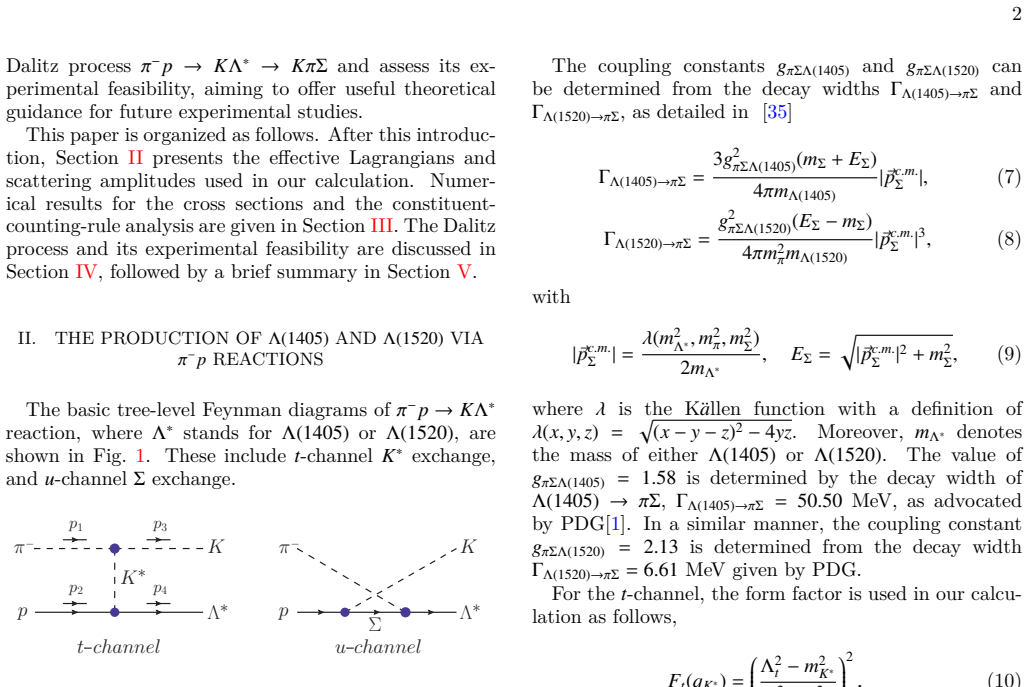
Summary. The manuscript studies π−p → KΛ(1405) and π−p → KΛ(1520) in an effective Lagrangian approach with t-channel K* exchange and u-channel Σ exchange, Reggeizing the t-channel. It fits three free parameters per channel to total and differential cross-section data, reporting χ²/d.o.f. = 2.343 and 1.259, and concludes that u-channel exchange dominates Λ(1405) production while t-channel exchange dominates Λ(1520) production. It then applies the constituent counting rule to model-generated dσ/dt values at θ_cm = 90° over √s = 2.3–3.0 GeV, extracting n ≈ 10 for Λ(1520) and n ≈ 8 for Λ(1405), and interprets the latter as evidence for a more exotic structure. Finally, it computes the Dalitz process π−p → KΛ* → KπΣ and estimates its experimental feasibility.
Significance. The work fills a genuine gap in pion-induced hyperon production phenomenology and provides a useful framework for future experiments. The global fits are reasonable, the production-mechanism picture is plausible, and the Dalitz-process predictions are concrete and testable at AMBER, J-PARC, HIKE, and HIAF. The authors are transparent about the absence of high-|t| data. However, the paper's central structural claim — that Λ(1405) shows a deviation from three-quark counting and is therefore exotic — rests on fitting a scaling exponent to model-generated points, not measured data at θ = 90°. That claim is therefore not established. The paper's main value is as a model prediction and experimental motivation, not as a determination of the Λ(1405) quark content.
major comments (3)
- [§III.C, Tables IV–V] The scaling exponent n for Λ(1405) is obtained by fitting dσ/dt = C s^{2−n} to the entries of Table IV, which the authors explicitly state are “the results of our theoretical calculations” (§III.C). The model was constrained by total and low-|t| differential cross sections (Figs. 2–4 and 8–10), but nothing in the fit controls θ_cm = 90°. Thus the fitted n ≈ 7.9 measures the model's energy dependence generated by the dipole form factor (Eq. 10), the squared-Lorentzian baryon form factor (Eq. 11), and the Regge trajectory (Eq. 20), rather than QCD constituent scaling. This circularity directly undercuts the abstract's statement that Λ(1405) “shows a clear deviation, suggesting a more exotic structure.” The structural claim should be downgraded to a model prediction pending actual θ = 90° data, or supported by an independent validation.
- [§III.C, Eqs. (10)–(11), (20)] No sensitivity analysis is given for the extracted n. The s-dependence of dσ/dt at fixed θ = 90° depends on the functional form and cutoff values of Eqs. (10) and (11) and on the slope/intercept of Eq. (20). Since the fit range is only √s = 2.3–3.0 GeV, the power-law exponent is not in an asymptotic regime and pre-asymptotic corrections are expected. I request a sensitivity study showing how n changes under (i) alternative form-factor shapes, (ii) variations of Λ_t and Λ_u within their quoted errors, and (iii) different fit ranges. Without this, the deviation of n ≈ 8 from both the three-quark value 10 and five-quark value 12 has no quantitative interpretation.
- [§II, Fig. 1] The amplitude includes only t-channel K* exchange and u-channel Σ exchange. At the fitted energies (W ≈ 1.9–3.1 GeV), s-channel baryon resonances can contribute to π−p → KΛ*; their neglect is not discussed. This omission weakens the uniqueness of the production-mechanism conclusion, particularly the claim of u-channel dominance for Λ(1405). The authors should either discuss the possible role of N* intermediate states and how they would affect the t/u decomposition, or restrict the mechanism claim to the energy region and observables where the model was actually tested.
minor comments (5)
- [Eq. (14)] The notation “p1v + p3v” should be “p1^ν + p3^ν”; the current text is inconsistent with the tensor structure of the amplitude.
- [Figs. 2–18] Several axis labels appear as raw symbol codes in the text version; please ensure the final PDF rendering of all figures is correct.
- [Eq. (22)] The Dalitz invariant-mass distribution is computed with a simple Breit-Wigner line shape and no non-resonant background. This is acceptable for a feasibility estimate, but the limitation should be stated explicitly.
- [§III.A] The phrase “global fits” is somewhat strong: the fitted data set is limited to Refs. [44–46], and the reduced χ² for Λ(1405) is 2.343. A brief comment on the possible source of the excess would be helpful.
- [After Eq. (20)] The sentence noting that no free parameters are added after Reggeization is useful and should be retained. However, the fixed Regge-trajectory parameters are model inputs and should be varied in the sensitivity analysis requested above.
Circularity Check
Constituent-counting structural claim for Λ(1405) is circular: n≈8 is fitted to model-generated 90° cross sections whose s-dependence is already fixed by the fitted model.
-
fitted input called prediction
[Section III.C, Tables IV and V]
"Notably, there is currently no experimental data on the t-distribution cross section at cos θ = 0. The data points shown in Table IV are the results of our theoretical calculations, which is very unfavorable for us to obtain an accurate value of n."
Table IV is model output at θ=90°, produced by the same effective-Lagrangian/Regge model whose parameters (Λt, Λu, gK*NΛ*) were fitted to total and low-|t| differential cross sections (Tables I/II; Eqs. 10, 11, 19, 20). At θ=90°, u ≈ -s + const, so the u-channel form factor Eq. (11) forces |Fu|² ∼ s^{-4}, and the Regge trajectory Eq. (20) fixes the t-channel s-dependence. Fitting dσ/dt = C s^{2-n} to these generated points therefore returns an exponent already encoded in the model, not an independent QCD constituent-scaling exponent. The interpretation of n≈8 for Λ(1405) as evidence of exotic structure is a re-description of the fitted model's high-|t| behavior, not a measurement or first-principles prediction.
-
self citation load bearing
[Section III.C, paragraph introducing the constituent-counting application]
"In our previous work, we calculated the cross sections of π− p → K∗Σ at θc.m. = 90◦, by fitting the experimental data and the numerical results to the expression dσ/dt = (constant) × s2−n, We found that the fitted values of n are very close to 10, confirming the accuracy of the theoretical prediction for the cross section. [32]."
Ref. [32] is the same group's prior paper (Wang, Gao, Liu) using the same procedure: fit the scaling law to model-generated 90° cross sections and read off n. The text invokes it to validate the methodology on which the Λ(1405) structural claim rests. Since this prior work is neither machine-checked nor externally benchmarked here, it is not independent confirmation. The present Λ(1520) result n≈10 provides an internal consistency check, so this self-citation is secondary to the main circularity but still load-bearing for the method's credibility.
full rationale
The production-mechanism part of the paper is a normal, data-driven effective-Lagrangian/Regge fit: amplitudes from Eqs. (14)-(17), fit parameters in Tables I and II constrained by measured total and differential cross sections, and conclusions about u-channel vs t-channel dominance follow from those fits. That portion is not circular and could stand on its own. The circularity is confined to Section III.C: the constituent-counting analysis takes the Table IV differential cross sections, which the paper explicitly admits are 'the results of our theoretical calculations,' fits dσ/dt = C s^{2-n}, and then treats the resulting n values as probes of the hadrons' quark content. Because the θ=90° points inherit their s-dependence from the fitted model—the dipole form factor Eq. (10), the squared-Lorentzian form factor Eq. (11), and the linear K* Regge trajectory Eq. (20)—the fitted exponent n measures the model's high-|t| falloff, not the independent QCD scaling behavior. The paper is commendably transparent about the lack of cosθ=0 data and calls for future measurements, which mitigates severity, but the structural conclusion for Λ(1405) is nevertheless a model self-consistency statement rather than an external prediction. A self-citation ([32]) is also used to vouch for the same methodology, adding to the concern, although the Λ(1520) n≈10 result provides some internal consistency. Overall, the central structural claim is partially circular: a 'prediction' about inner structure reduces to an exponent fitted to model-generated points, while the reaction-mechanism analysis remains empirically grounded.
Assumptions & free parameters
free parameters (8)
- Λ_t (t-channel cutoff) for Λ(1405) =
1.856 ± 0.051 GeV
- Λ_u (u-channel cutoff) for Λ(1405) =
1.345 ± 0.056 GeV
- g_{K*NΛ(1405)} =
2.476 ± 0.370
- Λ_t (t-channel cutoff) for Λ(1520) =
1.488 ± 0.036 GeV
- Λ_u (u-channel cutoff) for Λ(1520) =
0.514 ± 0.040 GeV
- g_{K*NΛ(1520)} =
13.200 ± 1.883
- scaling exponent n for π−p → KΛ(1405) =
7.568 ± 0.347 (2.3–2.8 GeV); 7.871 ± 0.249 (2.3–3.0 GeV)
- scaling exponent n for π−p → KΛ(1520) =
10.291 ± 0.363 (2.3–2.8 GeV); 9.747 ± 0.531 (2.3–3.0 GeV)
assumptions (5)
- domain assumption Effective Lagrangian vertices and fixed couplings (gπKK* = 3.10, gKNΣ = 2.69) are taken from prior hadronic models.
- domain assumption The Reggeized propagator Eq. (19) with trajectory α(t) = 1 + 0.85(t − m_K*²) replaces the Feynman t-channel propagator.
- domain assumption Only t-channel K* and u-channel Σ exchanges contribute; s-channel and contact terms are omitted.
- domain assumption The constituent counting rule dσ/dt ∼ s^{2−n} applies at √s = 2.3–3.0 GeV and θ_cm = 90° with n = nπ + np + nK + nΛ*.
- domain assumption The functional forms of the form factors in Eqs. (10) and (11) are physically appropriate.
Cite this review
Pith. "Pith review of Producing $\Lambda(1405)$ and $\Lambda(1520)$ in $\pi^-p$ reaction to explore their inner structures." pith.science (2026). https://pith.science/paper/HAKX3IW6
@misc{pith2026260211480,
  author       = {Pith},
  title        = {Pith review of: Producing $\Lambda(1405)$ and $\Lambda(1520)$ in $\pi^-p$ reaction to explore their inner structures},
  year         = {2026},
  howpublished = {\url{https://pith.science/paper/HAKX3IW6}},
  note         = {Machine review of arXiv:2602.11480}
}
abstract
In this work, the production mechanisms of the hyperon resonances $\Lambda(1405)$ and $\Lambda(1520)$ in the $\pi^- p$ scattering are investigated within an effective Lagrangian approach incorporating Regge trajectories. By including contributions from $t$-channel $K^*$ and $u$-channel $\Sigma$ exchanges, we perform global fits to the total and differential cross sections for $\pi^{-} p \rightarrow K\Lambda(1405)$ and $\pi^{-} p \rightarrow K\Lambda(1520)$. The results show good agreement with available experimental data. For the total cross section of $\Lambda(1405)$ production, the $u$-channel contribution is dominant, whereas the $t$-channel contribution plays the primary role in $\Lambda(1520)$ production. Furthermore, the differential cross sections of the two processes exhibit distinctly different shapes, reflecting their distinct underlying reaction mechanisms. An analysis based on the constituent counting rule indicates that $\Lambda(1520)$ is consistent with a conventional three-quark configuration, while $\Lambda(1405)$ shows a clear deviation, suggesting a more exotic structure. Owing to the large branching ratio of $\Lambda^* \to \pi \Sigma$, the Dalitz process $\pi^{-} p \rightarrow K \Lambda^{*} \rightarrow K \pi \Sigma$ is also calculated. Our results demonstrate that reconstructing $\Lambda^*$ via the $K\pi\Sigma$ final state is experimentally feasible. This study provides important theoretical insights into the production dynamics of these hyperon resonances, and suggests future high-precision measurements of the $t$-distribution at large momentum transfer at facilities such as AMBER, J-PARC, HIKE, and HIAF, which can further clarify their reaction mechanisms and structural properties.
Figures


Figures from the paper (12 more)


Reference graph
Works this paper leans on
-
[1]
Navas et al
S. Navas et al. [Particle Data Group], Review of Particle Physics, Phys. Rev. D 110, 030001 (2024)
2024
-
[2]
X. Y. Wang, C. Dong, and X. Liu, Analysis of Strong Coupling Constant with Machine Learning and Its Ap- plication, Chin. Phys. Lett. 41, 031201 (2024)
2024
-
[3]
X. Y. Wang and X. Liu, Development Status and Future Plan of Meson Beam Experiments at Home and Abroad, Nucl. Phys. Rev. 42, 10-24 (2025)
2025
-
[4]
M. H. Alston, L. W. Alvarez, P. Eberhard, M. L. Good, W. Graziano, H. K. Ticho, and S. G. Wojcicki, Study of Resonances of the Σ − π System, Phys. Rev. Lett. 6, 698-702 (1961)
1961
-
[5]
R. H. Dalitz, T. C. Wong, and G. Rajasekaran, Model calculation for Y ∗ 0 (1405) resonance state, Phys. Rev. 153, 1617-1623 (1967)
1967
-
[6]
Isgur and G
N. Isgur and G. Karl, P Wave Baryons in the Quark Model, Phys. Rev. D 18, 4187 (1978)
1978
-
[7]
Kaiser, T
N. Kaiser, T. Waas, and W. Weise, SU(3) chiral dynamics with coupled channels: Eta and kaon photoproduction, Nucl. Phys. A 612, 297-320 (1997)
1997
-
[8]
J. A. Oller and U. G. Meissner, Chiral dynamics in the presence of bound states: Kaon-nucleon interactions re- 10 visited, Phys. Lett. B 500, 263-272 (2001)
2001
Show all 67 references
-
[9]
D. Jido, J. A. Oller, E. Oset, A. Ramos, and U. G. Meiss- ner, Chiral dynamics of the two Λ(1405) states, Nucl. Phys. A 725, 181-200 (2003)
2003
-
[10]
Ikeda, T
Y. Ikeda, T. Hyodo, and W. Weise, Chiral SU(3) theory of antikaon-nucleon interactions with improved threshold constraints, Nucl. Phys. A 881, 98-114 (2012)
2012
-
[11]
J. X. Lu, L. S. Geng, M. Doering, and M. Mai, Cross- Channel Constraints on Resonant Antikaon-Nucleon Scattering, Phys. Rev. Lett. 130, 071902 (2023)
2023
-
[12]
Z. H. Guo and J. A. Oller, Meson-baryon reactions with strangeness -1 within a chiral framework, Phys. Rev. C 87, 035202 (2013)
2013
-
[13]
J. M. Xie, J. X. Lu, L. S. Geng, and B. S. Zou, Dynami- cal origin of universal two-pole structures and their light quark mass evolution, EPJ Web Conf. 303, 01011 (2024)
2024
-
[14]
U. G. Meißner, Two-pole structures in QCD: Facts, not fantasy!, Symmetry 12, 981 (2020)
2020
-
[15]
Nemoto, N
Y. Nemoto, N. Nakajima, H. Matsufuru, and H. Sug- anuma, Negative parity baryons in quenched anisotropic lattice QCD, Phys. Rev. D 68, 094505 (2003)
2003
-
[16]
C. S. An, B. Saghai, S. G. Yuan, and J. He, Role of five- quark components in radiative and strong decays of the Λ(1405) resonance, Phys. Rev. C 81, 045203 (2010)
2010
-
[17]
Moriya et al
K. Moriya et al. [CLAS], Differential Photoproduction Cross Sections of the Σ0(1385), Λ(1405), and Λ(1520), Phys. Rev. C 88, 045201 (2013)
2013
-
[18]
Boyarski, R
A. Boyarski, R. E. Diebold, and S. D. Ecklund, et al., PHOTOPRODUCTION OF K+ HYPERON FROM HY- DROGEN AND DEUTERIUM AT 11-GeV, Phys. Lett. B 34, 547-550 (1971)
1971
-
[19]
D. P. Barber, J. B. Dainton, L. C. Y. Lee et al., Strangeness Exchange in the Photoproduction of K+Λ (1520) Between 2.8-GeV and 4.8-GeV, Z. Phys. C 7, 17 (1980)
1980
-
[20]
Kohri et al
H. Kohri et al. [LEPS], Near-threshold Λ(1520) produc- tion by the ⃗γp → K+Λ(1520) reaction at forward K+ an- gles, Phys. Rev. Lett. 104, 172001 (2010)
2010
-
[21]
Muramatsu, J
N. Muramatsu, J. Y. Chen, and W. C. Chang, et al., Near-threshold photoproduction of Λ(1520) from protons and deuterons, Phys. Rev. Lett. 103, 012001 (2009)
2009
-
[22]
F. W. Wieland, J. Barth, K. H. Glander et al., Measure- ment of the reaction γp → K+Λ(1520) at photon energies up to 2.65 GeV, Eur. Phys. J. A 47, 47 (2011)
2011
-
[23]
A. I. Titov, B. Kampfer, S. Date, and Y. Ohashi, Co- herent Θ+ and Λ(1520) photoproduction off the deuteron, Phys. Rev. C 72, 035206 (2005)
2005
-
[24]
Sibirtsev, J
A. Sibirtsev, J. Haidenbauer, S. Krewald, U. G. Meissner, and A. W. Thomas, K ¯K photoproduction from protons, Eur. Phys. J. A 31, 221-232 (2007)
2007
-
[25]
S. I. Nam, A. Hosaka, and H. C. Kim, Photoproduction of Θ baryon from the neutron, Phys. Lett. B 579, 43-51 (2004)
2004
-
[26]
S. I. Nam, A. Hosaka, and H. C. Kim, Λ(1520, 3/2−) pho- toproduction reaction via γN → KΛ(1520), Phys. Rev. D 71, 114012 (2005)
2005
-
[27]
S. I. Nam, A. Hosaka, and H. C. Kim, Suppression of Θ+(JP = 3/2+−) photoproduction from the proton, Phys. Lett. B 633, 483-487 (2006)
2006
-
[28]
S. I. Nam, A. Hosaka, and H. C. Kim, Photoproduction of the pentaquark Θ+ with positive and negative parities, J. Korean Phys. Soc. 49, 1928 (2006)
1928
-
[29]
J. J. Xie and J. Nieves, The role of the N∗(2080) resonance in the ⃗γp → K+Λ(1520) reaction, Phys. Rev. C 82, 045205 (2010)
-
[30]
S. I. Nam, J. H. Park, A. Hosaka, and H. C. Kim, Λ(1405, 1/2−) photoproduction from the γp → K+Λ(1405) reaction, J. Korean Phys. Soc. 59, 2676-2683 (2011)
2011
-
[31]
N. C. Wei, Y. Zhang, F. Huang, and D. M. Li, Photo- production γp → K+Λ(1520) in an effective Lagrangian approach, Phys. Rev. D 103, 034007 (2021)
2021
-
[32]
X. Y. Wang, Y. Gao, and X. Liu, Production poten- tial of hidden-strange molecular pentaquarks through the π− p → K∗Σ process, Phys. Rev. D 111, 034021 (2025)
2025
-
[33]
Xiang, X
J. Xiang, X. Y. Wang, H. Xu, and J. He, Pion-induced K∗ production with Σ∗ baryon off proton target, Commun. Theor. Phys. 72, 115303 (2020)
2020
-
[34]
X. Y. Wang, H. F. Zhou, and X. Liu, Prospects for de- tecting the hidden-strange pentaquarklike state N∗(2080) in the π− p → ϕn reaction, Phys. Rev. D 110, 014026 (2024)
-
[35]
X. Y. Wang, J. He, X. R. Chen, Q. Wang, and X. Zhu, Pion-induced production of hidden-charm pentaquarks Pc(4312), Pc(4440), and Pc(4457), Phys. Lett. B 797, 134862 (2019)
2019
-
[36]
Cheng and X
C. Cheng and X. Y. Wang, The production of neutral N∗(11052) resonance with hidden beauty from π− p scat- tering, Adv. High Energy Phys. 2017, 9398732 (2017)
2017
-
[37]
He, Nucleon resonances N(1875) and N(2100) as strange partners of LHCb pentaquarks, Phys
J. He, Nucleon resonances N(1875) and N(2100) as strange partners of LHCb pentaquarks, Phys. Rev. D 95, 074031 (2017)
2017
-
[38]
S. H. Kim, A. Hosaka, H. C. Kim, and H. Noumi, Pro- duction of strange and charmed baryons in pion induced reactions, Phys. Rev. D 92, 094021 (2015)
2015
-
[39]
X. Y. Wang, J. He, and H. Haberzettl, Analysis of recent CLAS data on Σ∗(1385) photoproduction off a neutron target, Phys. Rev. C 93, 045204 (2016)
2016
-
[40]
X. Y. Wang and J. He, K∗0Λ photoproduction off a neu- tron, Phys. Rev. C 93, 035202 (2016)
2016
-
[41]
Ozaki, H
S. Ozaki, H. Nagahiro, and A. Hosaka, Charged K∗ Pho- toproduction in a Regge model, Phys. Rev. C 81, 035206 (2010)
2010
-
[42]
X. Y. Wang and J. He, Investigation of pion-induced f1(1285) production off a nucleon target within an inter- polating Reggeized approach, Phys. Rev. D 96, 034017 (2017)
2017
-
[43]
J. K. Storrow, BARYON EXCHANGE PROCESSES, Phys. Rept. 103, 317 (1984)
1984
-
[44]
O. I. Dahl, L. M. Hardy, R. I. Hess, J. Kirz, and D. H. Miller, Strange-particle production in π− p inter- actions from 1.5 to 4.2 BeV/c. 1. Three-and-more-body final states, Phys. Rev. 163, 1377-1429 (1967)
1967
-
[45]
D. J. Crennell, H. A. Gordon, K. W. Lai, and J. M. Scarr, Two-body strange-particle final states in π− p interactions at 4.5 and 6 GeV/c, Phys. Rev. D 6, 1220-1254 (1972)
1972
-
[46]
D. W. Thomas, A. Engler, H. E. Fisk, and R. W. Krae- mer, Strange particle production from π− p interactions at 1.69 GeV/c, Nucl. Phys. B 56, 15-45 (1973)
1973
-
[47]
G. P. Lepage and S. J. Brodsky, Exclusive Processes in Perturbative Quantum Chromodynamics, Phys. Rev. D 22, 2157 (1980)
1980
-
[48]
A. H. Mueller, Perturbative QCD at High-Energies, Phys. Rept. 73, 237 (1981)
1981
-
[49]
G. P. Lepage and S. J. Brodsky, Exclusive Processes in Quantum Chromodynamics: Evolution Equations for Hadronic Wave Functions and the Form-Factors of Mesons, Phys. Lett. B 87, 359-365 (1979)
1979
-
[50]
Dong and P
Y. Dong and P. Shen, Constituent counting rule and the 11 production of at high energies, Chin. Phys. C 43, 054102 (2019)
2019
-
[51]
S. J. Brodsky and G. R. Farrar, Scaling Laws at Large Transverse Momentum, Phys. Rev. Lett. 31, 1153-1156 (1973)
1973
-
[52]
S. J. Brodsky and G. R. Farrar, Scaling Laws for Large Momentum Transfer Processes, Phys. Rev. D 11, 1309 (1975)
1975
-
[53]
V. A. Matveev, R. M. Muradian, and A. N. Tavkhelidze, Automodellism in the large-angle elastic scattering and structure of hadrons, Lett. Nuovo Cim. 7, 719-723 (1973)
1973
-
[54]
Polchinski and M
J. Polchinski and M. J. Strassler, Hard scattering and gauge/string duality, Phys. Rev. Lett. 88, 031601 (2002)
2002
-
[55]
B. R. Baller, G. C. Blazey, H. Courant, K. J. Heller, S. Heppelmann, M. L. Marshak, E. A. Peterson, M. A. Shupe, D. S. Wahl, and D. S. Barton, et al., Com- parison of Exclusive Reactions at Large T , Phys. Rev. Lett. 60, 1118-1121 (1988)
1988
-
[56]
L. Y. Zhu et al. [Jefferson Lab Hall A], Cross-section mea- surement of charged pion photoproduction from hydro- gen and deuterium, Phys. Rev. Lett. 91, 022003 (2003)
2003
-
[57]
L. Y. Zhu et al. [Jefferson Lab Hall A and Jefferson Lab E94-104], Cross section measurements of charged pion photoproduction in hydrogen and deuterium from 1.1 GeV to 5.5 GeV, Phys. Rev. C 71, 044603 (2005)
2005
-
[58]
White, R
C. White, R. Appel, D. S. Barton, G. Bunce, A. S. Car- roll, H. Courant, G. Fang, S. Gushue, K. J. Heller, and S. Heppelmann, et al., Comparison of 20 exclusive reac- tions at large t, Phys. Rev. D 49, 58-78 (1994)
1994
-
[59]
M. J. Amaryan, W. J. Briscoe, M. G. Ryskin, and I. I. Strakovsky, High Energy Behaviour of Light Meson Photoproduction, Phys. Rev. C 103, 055203 (2021)
2021
-
[60]
X. Y. Wang, H. F. Zhou, and X. Liu, Exploring kaon induced reactions for unraveling the nature of the scalar meson a0(1817), Phys. Rev. D 108, 034015 (2023)
2023
-
[61]
S. H. Kim, S. i. Nam, D. Jido, and H. C. Kim, Photo- production of Λ(1405) with the N∗ and t-channel Regge contributions, Phys. Rev. D 96, 014003 (2017)
2017
-
[62]
Goussu, M
O. Goussu, M. Sene, B. Ghidini, S. Mongelli, A. Romano, P. Waloschek, and V. Alles-Borelli, Analysis of strange- particle production in π− p collisions at 1.59 GeV/c, Nuovo Cim. A 42, 606-618 (1966)
1966
-
[63]
Adams, C
B. Adams, C. A. Aidala, R. Akhunzyanov, G. D. Alexeev, M. G. Alexeev, A. Amoroso, V. Andrieux, N. V. Anfimov, V. Anosov, A. Antoshkin et al., Letter of Intent: A New QCD facility at the M2 beam line of the CERN SPS (COMPASS++/AMBER), [arXiv:1808.00848 [hep-ex]]
-
[64]
K. Aoki, H. Fujioka, T. Gogami, Y. Hidaka, E. Hiyama, R. Honda, A. Hosaka, Y. Ichikawa, M. Ieiri, M. Isaka et al., Extension of the J-PARC Hadron Experimental Fa- cility: Third White Paper, [arXiv:2110.04462 [nucl-ex]]
-
[65]
M. U. Ashraf et al. [HIKE], High Intensity Kaon Exper- iments (HIKE) at the CERN SPS Proposal for Phases 1 and 2, [arXiv:2311.08231 [hep-ex]]
-
[66]
G. Q. Xiao, H. S. Xu, and S. C. Wang, HIAF and CiADS national research facilities: Progress and prospect[J], Nucl. Phys. Rev. 34(3), 275 (2017)
2017
-
[67]
X. Chen, Y. Fan, S. Fang, Z. Q. Feng, F. K. Guo, W. Han, J. He, Q. He, X. He, H. Huang et al., Huizhou Hadron Spectrometer – a Proposed High-rate Experi- mental Setup at the High Intensity Heavy-ion Acceler- ator Facility, [arXiv:2511.22864 [hep-ex]]
Reviewed August 3, 2026 · model on record in the stance chip above.
Discussion (0). Continue with ORCID to comment.