REVIEW 2 major objections 1 minor 38 references
Quantum discord of mixed states under noisy channels in the curved spacetime
T0 review · 2 major / 1 minor · reviewed 2026-05-15 · grok-4.3
Pith's one-line read Accessible quantum discord in two-qubit states degrades with Hawking acceleration but never suffers sudden death under standard noise channels in Schwarzschild spacetime.
desk verdict The paper delivers explicit analytic expressions for geometric discord on mixed two-qubit states in Schwarzschild spacetime under three noise channels, showing accessible discord degrades without sudden death while inaccessible discord rises monotonically. read the letter →
The pith
A machine-rendered reading of the paper's core claim, the machinery that carries it, and where it could break.
The reading
What carries the argument
Geometric measure of quantum discord evaluated on the reduced density matrices obtained after tracing out the inaccessible region in the Schwarzschild metric under the three Pauli noise channels.
What would settle it
An explicit calculation of the geometric discord that shows sudden death at a finite value of the Hawking acceleration, or a numerical violation of any of the derived complementary relations, would falsify the central claims.
Extended reading notes
Core claim
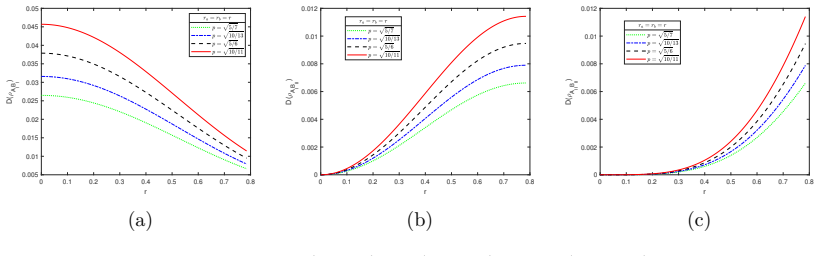
For two-qubit mixed states in Schwarzschild spacetime subject to phase-damping, phase-flip or bit-flip noise, the geometric quantum discord of the accessible subsystem decreases monotonically with rising Hawking acceleration without sudden death, the discord of the inaccessible subsystem increases monotonically from zero, and closed-form complementary relations hold between the two quantities; in the bit-flip and phase-flip cases the discord is symmetric under interchange of the decay probability with its complement.
Load-bearing premise
The geometric measure continues to quantify quantum correlations faithfully when the two-qubit system is placed in curved Schwarzschild spacetime and subjected to the standard noise channels.
Editorial extensions
If this is right
- Analytical complementary relations allow the inaccessible discord to be obtained directly from the accessible one without recomputing the full density matrix.
- Absence of sudden death implies that some quantum correlations remain available for information processing at arbitrarily large but finite accelerations.
- Identical qualitative behavior across the three channels indicates that the degradation pattern is insensitive to the precise form of the Pauli noise.
- Symmetry of the discord with respect to decay probability in the flip channels supplies a simple predictive rule for how correlations change when the noise strength varies.
Reading between the lines
- The persistence of accessible discord without sudden death suggests that certain quantum-communication protocols could still function in the vicinity of a black-hole horizon provided the acceleration is not infinite.
- The complementary relations may extend to other correlation measures such as entanglement of formation, offering a unified description of quantum resources near black holes.
- Repeating the calculation for rotating or charged black holes would test whether the monotonic degradation and absence of sudden death are universal features of stationary spacetimes.
Editorial analysis
A structured set of objections, weighed in public.
Referee Report
Summary. The manuscript examines the geometric measure of quantum discord for two-qubit mixed states in Schwarzschild spacetime under phase-damping, phase-flip, and bit-flip channels. It reports several analytical complementary relationships between accessible and inaccessible discords, claiming that accessible discords degrade monotonically with increasing Hawking acceleration without sudden death, inaccessible discords increase from zero, and symmetric behaviors appear for bit-flip and phase-flip channels as a function of decay probability.
Significance. If the geometric discord measure remains a faithful quantifier once redshift, Unruh/Hawking mode mixing, and the standard noise channels are incorporated, the results would provide concrete analytical insights into the combined effects of gravitational redshift and decoherence on quantum correlations, including the absence of sudden death and the reported monotonicity and symmetry properties.
major comments (2)
- [Section defining the geometric discord and the combined channel map] The central application of the geometric measure of quantum discord (defined via the Hilbert-Schmidt distance to the nearest classical-quantum state) is performed without deriving or justifying its faithfulness for two-qubit states in Schwarzschild coordinates; the measure is known to be basis-dependent, and the paper does not check whether the algebraic expression survives the coordinate transformation, redshift factors, or mode mixing induced by the accelerated observers.
- [Results section presenting the analytical relations and numerical plots] The abstract asserts several analytical complementary relationships, yet the provided text contains no explicit formulas, intermediate steps, or verification that the reported monotonicity and symmetry hold independently of parameter choices in the initial mixed states or the specific form of the Hawking temperature factor.
minor comments (1)
- [Abstract] In the abstract, the clause 'as the Hawking acceleration rising' is grammatically incorrect and should read 'as the Hawking acceleration rises'.
Simulated Author's Rebuttal
We thank the referee for the careful reading of our manuscript and the constructive comments. We address each major comment below and indicate the revisions we plan to incorporate.
read point-by-point responses
-
Referee: [Section defining the geometric discord and the combined channel map] The central application of the geometric measure of quantum discord (defined via the Hilbert-Schmidt distance to the nearest classical-quantum state) is performed without deriving or justifying its faithfulness for two-qubit states in Schwarzschild coordinates; the measure is known to be basis-dependent, and the paper does not check whether the algebraic expression survives the coordinate transformation, redshift factors, or mode mixing induced by the accelerated observers.
Authors: We acknowledge that the geometric discord is basis-dependent in general and that the manuscript does not contain an explicit derivation of its faithfulness under the Schwarzschild coordinate transformations. Our calculations apply the standard Bogoliubov transformations to define the accessible and inaccessible modes for the accelerated observers, after which the geometric discord is evaluated in the natural basis of those modes. This procedure follows the approach used in prior works on quantum correlations in curved spacetime. To strengthen the presentation, we will add a concise justification subsection citing the relevant literature on the applicability of the Hilbert-Schmidt geometric discord to two-qubit states after relativistic mode mixing. The numerical and analytical results themselves are unaffected, as they are obtained directly from the transformed density matrices. revision: partial
-
Referee: [Results section presenting the analytical relations and numerical plots] The abstract asserts several analytical complementary relationships, yet the provided text contains no explicit formulas, intermediate steps, or verification that the reported monotonicity and symmetry hold independently of parameter choices in the initial mixed states or the specific form of the Hawking temperature factor.
Authors: We agree that the main text would be improved by including the explicit analytical expressions. In the revised manuscript we will insert the full closed-form expressions for the accessible and inaccessible geometric discords under each of the three channels, together with the intermediate steps that yield the complementary relations. We will also add a short analytical argument demonstrating that the monotonic degradation of accessible discord (without sudden death) and the monotonic rise of inaccessible discord hold for the family of initial two-qubit mixed states considered, and that the symmetry observed for the bit-flip and phase-flip channels is independent of the precise value of the Hawking temperature factor. These additions will be supported by the existing numerical plots. revision: yes
Circularity Check
No significant circularity; discord derivations rest on standard definitions
full rationale
The paper computes geometric quantum discord for two-qubit mixed states after applying Hawking/Unruh mode transformations and standard phase-damping/phase-flip/bit-flip channels. Explicit analytical expressions for accessible and inaccessible discords are obtained directly from the post-channel density matrices without fitting parameters or reducing to self-citations by construction. Complementary relationships follow from algebraic manipulation of those expressions. Any prior citations on the geometric measure or curved-spacetime channels supply independent background rather than load-bearing premises that collapse the present results. The validity assumption for the measure in Schwarzschild coordinates is an external modeling choice, not a definitional loop.
Assumptions & free parameters
assumptions (2)
- domain assumption Geometric measure of quantum discord is an appropriate quantifier for the correlations in this setting
- domain assumption Standard Kraus-operator representations of phase-damping, phase-flip, and bit-flip channels remain valid in curved spacetime
Cite this review
Pith. "Pith review of Quantum discord of mixed states under noisy channels in the curved spacetime." pith.science (2026). https://pith.science/paper/2602.20819
@misc{pith2026260220819,
  author       = {Pith},
  title        = {Pith review of: Quantum discord of mixed states under noisy channels in the curved spacetime},
  year         = {2026},
  howpublished = {\url{https://pith.science/paper/2602.20819}},
  note         = {Machine review of arXiv:2602.20819}
}
read the original abstract
We focus our attention on two-qubit mixed states as initial states, and apply the geometric measure of quantum discord to investigate quantum discord properties in the background of a Schwarzschild black hole under phase damping, phase flip and bit flip channels, respectively. Several analytical complementary relationships based on quantum discords for bipartite subsystems are proposed. For the three channel noises, the behaviors of discords are similar, the accessible discords always degrade as the Hawking acceleration rising, but sudden death never occurs, while the inaccessible discords increase from zero monotonically. Interestingly, in the case of the bit flip channel and phase flip channel, the discords perform symmetrically with the decay probability rising.
Figures


Figures from the paper (1 more)

Reference graph
Works this paper leans on
-
[1]
S. Luo, Using measurement-induced disturbance to characterize correlations as classical or quantum, Phys. Rev. A 77, 022301 (2008)
work page 2008
- [2]
-
[3]
C. Radhakrishnan, M. Lauriere, and T. Byrnes, A multipartite generalization of quantum discord, Phys. Rev. Lett. 124, 110401 (2020)
work page 2020
-
[4]
Y. Inui and Y. Yamamoto, Entanglement and quantum discord in optically coupled coherent Ising machines, Phys. Rev. A 102, 062419 (2020)
work page 2020
-
[5]
J. Zhou, X. Hu, and N. Jing, Quantum discord of certain two-qubit states, Int. J. Theo. Phys. 59, 415(2020)
work page 2020
-
[6]
C.C. Rulli and M.S. Sarandy, Global quantum discord in multipartite systems, Phys. Rev. A 84, 042109 (2011)
work page 2011
- [7]
-
[8]
H. Ollivier and W. H. Zurek, Quantum discord: a measure of the quantumness of correla- tions, Phys. Rev. Lett. 88, 017901 (2001)
work page 2001
Show all 38 references
-
[9]
X. Liu, C. Zeng, and J. Wang, Generation of quantum entanglement in superposed diamond spacetime, arXiv:2501.00246
-
[10]
Q. Liu, S. Wu, C. Wen, and J. Wang, Quantum properties of fermionic fields in multi-event horizon spacetime, Sci. China-Phys. Mech. Astron. 66, 120413 (2023)
2023
-
[11]
J. Wang, C. Wen, S. Chen, and J. Jing, Generation of genuine tripartite entanglement for continuous variables in de Sitter space, Phys. Lett. B 800, 135109 (2020)
2020
-
[12]
G. Mi, X. Huang, S. Fei, and T. Zhang, Impact of the Hawking effect on the fully en- tangled fraction of three-qubit states in Schwarzschild spacetime, Ann. Phys. (Berlin), 2400308(2024)
2024
-
[13]
W. Li, J. Lu, and S. Wu, Multiqubit coherence of mixed states near event horizon, arXiv:2505.07476
-
[14]
S. Wu, H. Zeng, and H. Cao, Quantum coherence and distribution of N-partite bosonic fields in noninertial frame, arXiv.2201.00986
-
[15]
T. Liao, J. Yang, T. Zhang, and X. Huang, Quantum coherence of mixed states under noisy channels in noninertial frames, Results in Phys. 70, 108169 (2025). 11
2025
-
[16]
G. Mi, X. Huang, S. Fei, and T. Zhang, Genuine four-partite Bell nonlocality in the curved spacetime, Eur. Phys. J. C 85, 354(2025)
2025
-
[17]
Zhang, X
T. Zhang, X. Wang, and S. Fei, Hawking effect can generate physically inaccessible genuine tripartite nonlocality, Eur. Phys. J. C 83, 607(2023)
2023
-
[18]
S. Wu, J. Li, Y. Wang, S. Shang, and J. Lu, Fermionic steering in multi-event horizon spacetime, Eur. Phys. J. C 85, 54(2025)
2025
-
[19]
S. Wu, H. Wu, Y. Wang, and J. Wang, Gaussian tripartite steering in Schwarzschild black hole, Phys. Lett. B 865, 139493 (2025)
2025
-
[20]
T. Liu, J. Wang, J. Jing, and H. Fan, The influence of Unruh effect on quantum steering for accelerated two-level detectors with different measurements, Ann. Phys. 390, 334(2018)
2018
-
[21]
T. Liu, J. Jing, and J. Wang, Satellite-based quantum steering under the influence of spacetime curvature of the Earth, Adv. Quantum Technol. 1, 1800072(2018)
2018
-
[22]
T. Liu, S. Cao, S. Wu, and H. Zeng, The influence of the Earth¡¯s curved spacetime on Gaussian quantum coherence, Laser Phys. Lett. 16, 095201(2019)
2019
-
[23]
Wang and J
J. Wang and J. Jing, Multipartite entanglement of fermionic systems in noninertial frames, Phys. Rev. A 83, 022314 (2011)
2011
-
[24]
Torres-Arenasa, Q
A.J. Torres-Arenasa, Q. Dong, G.H. Sun, W.C. Qiang, and S.H. Dong, Entanglement mea- sures of W-state in noninertial frames, Phys. Lett. B 789, 93(2019)
2019
-
[25]
S. Wu, Z. Li, and H. Zeng, Quantum steering between two accelerated parties, Laser Phys. Lett. 17, 035202(2020)
2020
-
[26]
Huang and H
Z. Huang and H. Situ, Quantum coherence behaviors of fermionic systems in non-inertial frame, Quantum Inf. Process. 17, 95(2018)
2018
-
[27]
Ding, C.C
Z.Y. Ding, C.C. Liu, W.Y. Sun, J. He, and L. Ye, Quantum coherence of fermionic systems in noninertial frames beyond the single-mode approximation, Quantum Inf. Process. 17, 279 (2018)
2018
-
[28]
Alsing, I
P.M. Alsing, I. Fuentes-Schuller, R.B. Mann, and T.E. Tessier, Entanglement of Dirac fields in noninertial frames, Phys. Rev. A 74, 032326(2006). 12
2006
-
[29]
Henderson and V
L. Henderson and V. Vedral, Classical, quantum and total correlations, J. Phys. A 34, 6899 (2001)
2001
-
[30]
Luo, Quantum discord for two-qubit systems, Phys
S. Luo, Quantum discord for two-qubit systems, Phys. Rev. A 77, 042303 (2008)
2008
-
[31]
C. Zhu, B. Hu, B. Li, Z. Wang, and S. Fei, Geometric discord for multiqubit systems, arXiv:2104.12344
-
[32]
B. Li, C. Zhu, X. Liang, B. Ye, and S. Fei, Quantum discord for multiqubit systems, Phys. Rev. A 104, 012428 (2021)
2021
-
[33]
Hunt, I.V
M.A. Hunt, I.V. Lerner, I.V. Yurkevich, and Y. Gefen, How to observe and quantify quantum-discorded states, Phys. Rev. A 100, 022321 (2019)
2019
-
[34]
Szasz, A measure of quantum correlations that lies approximately between entanglement and discord, Phys
A. Szasz, A measure of quantum correlations that lies approximately between entanglement and discord, Phys. Rev. A 99, 062313 (2019)
2019
-
[35]
J. Zhou, X. Hu, H. Zhang, and N. Jing, Analytic formulas for quantum discord of special families of n-qubit states, Quant. Inf. Process. 24, (2025)
2025
-
[36]
Daki´c, V
B. Daki´c, V. Vedral, and ˇC Brukner, Necessary and sufficient condition for nonzero quantum discord, Phys. Rev. Lett. 105, 190502 (2010)
2010
-
[37]
Werner, Quantum states with Einstein-Podolsky-Rosen correlations admitting a hidden-variable model, Phys
R.F. Werner, Quantum states with Einstein-Podolsky-Rosen correlations admitting a hidden-variable model, Phys. Rev. A 40, 4277 (1989)
1989
-
[38]
Nielsen and I.L
M.A. Nielsen and I.L. Chuang, Quantum computation and quantum information (Cam- bridge: Cambridge University Press) 2010. 5 Appendix It is worth noting that the linear map given by (2) and (3), exactly, induces a linear map on the operator space from C to C ⊗ C (here, we call ...
2010
Reviewed May 15, 2026 · model on record in the stance chip above.
Discussion (0). Continue with ORCID to comment.