REVIEW 3 major objections 3 minor 2 cited by
The paper classifies domain-wall types in Δ(54), Δ(27) and Σ(36×3) scalar potentials and shows that merging vacuum orbits under a CP symmetry produces a second, CP-related wall type.
Reviewed by Pith at T0; open to challenge. T0 means a machine referee read the full paper against a public rubric. the ladder, T0–T4 →
T0 review · deepseek-v4-flash
2026-08-02 18:49 UTC pith:AAD6A7GX
load-bearing objection Useful extension of the non-Abelian domain-wall classification to Δ(27)/Δ(54)/Σ(36×3), with one unproved accidental-SU(3) claim that needs backing. the 3 major comments →
Domain Walls from Sigma(36 times 3), Delta(54) and Delta(27) potentials
The pith
A machine-rendered reading of the paper's core claim, the machinery that carries it, and where it could break.
Core claim
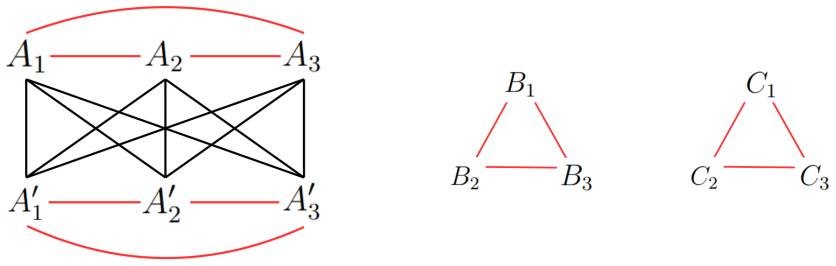
For the Δ(54) potential without CP, each of the four vacua orbits A, A′, B, C supports exactly one topologically distinct domain-wall type. Imposing a CP symmetry that merges two orbits—such as the trivial CP S0 (or S1) merging A with A′, S2 (or S8) merging A with C, or S3 (or S9) merging A′ with C—does not reduce the number of walls to one. Instead, a second, CP-related wall type appears between the previously separate orbits, while walls within each original orbit remain equivalent. In the Σ(36×3) limit, the generator d merges orbits B and C, again producing two distinct wall types between them, while A and A′ merge under trivial CP with the same two-type structure. The numerical tensions
What carries the argument
The four vacuum orbits A, A′, B, C—sets of degenerate minima related by the group symmetry—and the specific symmetry operations that merge them: the CP transformations S0–S3 (and their group-related partners) and the generator d in Σ(36×3). The central mechanism is that walls are classified by whether the symmetry relating two minima lies inside the original discrete group (giving one wall type per orbit) or is a CP symmetry that identifies two orbits (giving a distinct, CP-related wall type).
Load-bearing premise
The claim that CP symmetries S6, S7, S10, S11 almost fully constrain the Δ(54) potential, making it accidentally SU(3)-invariant and merging all four vacuum orbits, is asserted without a shown derivation in Section 2.4.
What would settle it
Directly compute the quartic potential with each of the CP symmetries S6, S7, S10, S11 imposed; if any of them leaves a term like λ3 or a nontrivial λ4 alive, the accidental SU(3) symmetry is broken and the orbits do not all merge. Alternatively, numerically search for domain walls between an A and a B minimum under these CP symmetries: if a stable wall with nonzero tension exists, the four orbits are not all connected and the classification is incomplete.
If this is right
- In plain Δ(54) or Δ(27), each of the four vacuum orbits yields exactly one domain-wall type, so four distinct wall tensions are expected.
- Imposing trivial CP (S0 or S1) merges A and A′; walls between A minima are equivalent to walls between A′ minima, but a separate, CP-related wall connects A to A′.
- Imposing S2 (or S8) or S3 (or S9) merges A with C or A′ with C, respectively, each creating a second wall type between the merged orbits.
- In Σ(36×3), the B and C orbits merge through the generator d, producing two distinct wall types between B and C, while A and A′ merge through trivial CP.
- Numerically, cross-orbit walls (e.g., A–A′) have lower tension than within-orbit walls, which would affect the evolution and gravitational-wave emission of the wall network.
Where Pith is reading between the lines
- The pattern suggests a general rule: one domain-wall type per vacuum orbit, plus one extra type per pair of orbits merged by a CP symmetry. This could be tested in other discrete flavor groups such as A4 or S4, where similar orbit-merging structures may exist.
- If the S6, S7, S10, S11 CP symmetries indeed force the potential to be accidentally SU(3)-invariant, then in those parameter regions the discrete vacuum structure disappears entirely, so no stable domain walls would form—a testable prediction for gravitational-wave searches.
- The lower tension of cross-orbit walls implies that a network containing these walls will spend more of its lifetime in a scaling regime, potentially producing a distinct stochastic gravitational-wave background peak.
- The numerical method of varying the global phase of the two minima to find the minimum-tension wall could be applied to potentials with other discrete symmetries to map out their wall spectrum.
Editorial analysis
A structured set of objections, weighed in public.
Referee Report
Summary. This paper classifies the domain-wall types that can form in scalar potentials invariant under the discrete non-Abelian symmetries Σ(36×3), Δ(54), and Δ(27), for a triplet representation. The minima of the Δ(54) potential fall into four orbits, A, A′, B, C. The authors argue that in the generic case each orbit supports exactly one topologically distinct domain-wall type. When a CP symmetry merges two orbits, a second, CP-related wall type appears between the merged orbits; for example, S0 merges A with A′, while S2 and S3 merge A with C and A′ with C, respectively. In the Σ(36×3) case, the generator d merges B with C and again produces two wall types. The paper presents benchmark numerical tensions obtained with CosmoTransitions. It further claims that the CP symmetries S6, S7, S10, S11 make the Δ(54) potential accidentally SU(3)-invariant, thereby removing the discrete vacuum structure, but this claim is not derived.
Significance. If the classification is correct, this extends the existing domain-wall analysis beyond A4 and S4 to the Δ(27), Δ(54), and Σ(36×3) groups, which are common in flavour model building. The qualitative statement that orbit merging under CP enhances the number of distinct domain-wall types is interesting and potentially relevant for gravitational-wave phenomenology. The paper is clear in presenting the orbit structure, and the numerical side, while based on a simplified λ2=0 singlet potential, is reproducible in principle. The main weakness is the undeveloped assertion about an accidental SU(3) symmetry for S6/S7/S10/S11, which is necessary for the completeness of the claimed classification.
major comments (3)
- [Section 2.4, last paragraph] The claim that CP symmetries S6, S7, S10, and S11 'connect all orbits' and lead accidentally to the SU(3)-invariant potential is asserted without any derivation. This is load-bearing because the abstract promises a classification 'with or without imposed CP symmetries', yet Section 3 treats only S0/S1, S2, S3, and the Σ(36×3) case, and never returns to S6/S7/S10/S11. The statement is not a formal consequence of Eq. (8); it requires solving V(S_i φ*)=V(φ) for the full Δ(54) potential (7) and demonstrating that the quartic sector collapses to (φ†φ)^2. Please supply this derivation (or a reference with the explicit proof) and state clearly in Section 3 what happens to the four orbits in these cases. If only some of these symmetries enforce SU(3), or if they instead enforce Σ(36×3), the resulting discrete vacua and domain-wall types must be added to the classification.
- [Section 2.3 and Tables 1–5] The numerical tensions are computed for the SU(2)-singlet potential with λ2 set to zero, as explicitly noted in the paragraph beginning 'Although the most general forms...'. However, the potentials written in Eqs. (6) and (7) are for three SU(2) doublets and include the λ2 term. The sentence 'The direction of the minima in the triplet direction are the same [44,45]' justifies the VEV directions but does not justify the wall tensions. The λ2 term contributes to the energy density along the wall profile, so the values of σ listed in Tables 1–5 are not the tensions of the advertised 3HDM potentials unless λ2=0. The paper should either compute representative cases with λ2≠0 or explicitly and prominently state that all quantitative results are only for the λ2=0 singlet limit, and cannot be used for 3HDM phenomenology without additional computation.
- [Conclusion, paragraph 4] The summary sentence 'Adding different CP symmetries to Δ(54) will merge two of the 4 general orbits' is incomplete and potentially misleading, because according to Section 2.4 the CP symmetries S6, S7, S10, S11 merge all four orbits into a continuous SU(3) vacuum manifold. The conclusion should either include these cases or explicitly qualify the statement to the CP symmetries that preserve a discrete vacuum structure.
minor comments (3)
- [Section 2.3, paragraph on CP effects] The sentence 'The other CP symmetries, when imposed on the renormalizable potential, either give rise to the Σ(36×3) potential or even to the SU(3) potential' is vague. Please specify which symmetries do what, or defer to the explicit list in Section 2.4.
- [Section 2.2, Eq. (4)] The statement 'CP symmetries associated with S0 and with S1 act in the same way in the potential' is terse. Since S0 is the trivial CP and S1 is a permutation CP, the equality of their effects on the potential deserves a one-sentence explanation (e.g., both force λ4 real).
- [Tables 3 and 4] The values of Im λ4 in Tables 3 and 4 (-2.60 and 2.60) satisfy the S2/S3 condition Eq. (8) only approximately, given the stated λ3=1.00 and Re λ4=-0.50. This is likely a rounding artifact, but the text should note that the benchmark points are chosen on the corresponding CP-invariant hypersurface.
Circularity Check
No significant circularity: the DW classification follows from group-theoretic orbit structure and direct numerical minimization, with no fitted parameter renamed as a prediction.
full rationale
The derivation chain is self-contained and not circular. The potentials (Eqs. (6)-(7)) and minima orbits (Eqs. (9)-(10)) are taken from independent external analyses [43-45] with stated assumptions; the paper's own contribution is the classification of domain-wall types from the orbit structure of Delta(54) and Sigma(36 x 3) and the numerical tensions. No parameter is fitted to a target quantity and then renamed a prediction: the tensions in Tables 1-5 are direct CosmoTransitions minimizations at stated benchmark points. The distinction between one type and two types of walls tracks the group-theoretic relation between minima (within an orbit vs. between orbits merged by an imposed CP or d symmetry); although this is the organizing definition of the classification, it is independently corroborated by the numerical tensions (e.g., 4.24 vs 2.76 in Table 2), so the claim does not reduce to its input. Self-citations ([16] for generator conventions; [33,34] for previous S4/A4 DW studies) are background and not load-bearing: the Delta(54)/Sigma(36 x 3) results are re-derived from the stated potentials and minima, and the CP-merged wall type is checked numerically here. The one passage that warrants scrutiny is Sec. 2.4's assertion that CP symmetries S6,S7,S10,S11 'constrain the potential so much that we obtain accidentally the potential corresponding to the continuous SU(3) symmetry'; this is unproved and could affect completeness if wrong, but it is a rigor/correctness gap, not a circular reduction, because the paper does not define those symmetries in terms of the claimed outcome. Hence circularity score 0.
Axiom & Free-Parameter Ledger
free parameters (1)
- benchmark quartic couplings (λ3, Re λ4, Im λ4) per alignment =
see Tables 1-5
axioms (6)
- domain assumption The scalar potentials in Eqs. (6) and (7) are the most general renormalizable potentials invariant under Σ(36×3) and Δ(54), respectively.
- domain assumption The minima of the Δ(54) potential fall into the four orbits A, A', B, C of Eq. (9), with stability conditions Eq. (10).
- domain assumption The CP transformations of Eq. (4) and their effects on the potential (e.g., Eq. (8) for S2/S3) are as given by [43].
- domain assumption The DW classification rule (Section 3): distinct wall types are determined by whether the two vacua are connected by elements of the flavor group or by a CP symmetry.
- domain assumption For SU(2) singlet potentials, λ2 is absent, and the minima directions are the same as in the doublet case (Section 2.3, citing [44,45]).
- ad hoc to paper The CP symmetries S6, S7, S10, S11 make the potential accidentally SU(3)-symmetric, eliminating discrete degenerate vacua (Section 2.4).
read the original abstract
We consider the degenerate minima arising from scalar potentials invariant under $\Sigma(36\times 3)$, or under its subgroups $\Delta(54)$ and $\Delta(27)$ (with or without imposed CP symmetries), for a triplet of those symmetries. In this framework, we classify the distinct Domain Walls between the degenerate minima and calculate the respective tensions.
Figures



Forward citations
Cited by 2 Pith papers
-
One-Dimensional Simulations of the Topological Defects in a 3:1 $U(1)$ Model
In a 3:1 U(1) model, the Z3 domain wall develops a growing bias angle beta as v1/v2 is lowered, and no static wall exists below R12 ≈ 0.768.
-
Radiative Lifting of $\mathbb{Z}_3$ Domain-Wall Degeneracy in a Type-III Seesaw Model: Implications for Leptogenesis and Gravitational Waves
A Z3-symmetric Type-III seesaw model uses radiative Coleman-Weinberg effects to lift vacuum degeneracy and annihilate domain walls, fitting neutrino data, generating baryon asymmetry via leptogenesis at 10^9 GeV tripl...
Reference graph
Works this paper leans on
-
[1]
Z. z. Xing, Phys. Rept.854(2020), 1-147 doi:10.1016/j.physrep.2020.02.001 [arXiv:1909.09610 [hep-ph]]
Pith/arXiv arXiv 2020
-
[2]
F. Feruglio and A. Romanino, Rev. Mod. Phys.93(2021) no.1, 015007 doi:10.1103/RevModPhys.93.015007 [arXiv:1912.06028 [hep-ph]]
Pith/arXiv arXiv 2021
-
[3]
G. J. Ding and S. F. King, Rept. Prog. Phys.87(2024) no.8, 084201 doi:10.1088/1361- 6633/ad52a3 [arXiv:2311.09282 [hep-ph]]
Pith/arXiv arXiv 2024
-
[4]
V. Keus, S. F. King and S. Moretti, JHEP01(2014), 052 doi:10.1007/JHEP01(2014)052 [arXiv:1310.8253 [hep-ph]]
Pith/arXiv arXiv 2014
-
[5]
I. P. Ivanov, Prog. Part. Nucl. Phys.95(2017), 160-208 doi:10.1016/j.ppnp.2017.03.001 [arXiv:1702.03776 [hep-ph]]
Pith/arXiv arXiv 2017
-
[6]
I. P. Ivanov and E. Vdovin, Eur. Phys. J. C73(2013) no.2, 2309 doi:10.1140/epjc/s10052- 013-2309-x [arXiv:1210.6553 [hep-ph]]. 11
Pith/arXiv arXiv 2013
-
[7]
N. Darvishi and A. Pilaftsis, Phys. Rev. D101(2020) no.9, 095008 doi:10.1103/PhysRevD.101.095008 [arXiv:1912.00887 [hep-ph]]
Pith/arXiv arXiv 2020
-
[8]
N. Darvishi, M. R. Masouminia and A. Pilaftsis, Phys. Rev. D104(2021) no.11, 115017 doi:10.1103/PhysRevD.104.115017 [arXiv:2106.03159 [hep-ph]]
Pith/arXiv arXiv 2021
-
[9]
I. de Medeiros Varzielas and I. P. Ivanov, Phys. Rev. D100(2019) no.1, 015008 doi:10.1103/PhysRevD.100.015008 [arXiv:1903.11110 [hep-ph]]
Pith/arXiv arXiv 2019
-
[10]
A. E. C´ arcamo Hern´ andez, I. de Medeiros Varzielas, M. L. L´ opez-Ib´ a˜ nez and A. Melis, JHEP05(2021), 215 doi:10.1007/JHEP05(2021)215 [arXiv:2102.05658 [hep-ph]]
Pith/arXiv arXiv 2021
-
[11]
I. de Medeiros Varzielas, I. P. Ivanov and M. Levy, Eur. Phys. J. C81(2021) no.10, 918 doi:10.1140/epjc/s10052-021-09681-w [arXiv:2107.08227 [hep-ph]]
Pith/arXiv arXiv 2021
-
[12]
J. Kalinowski, W. Kotlarski, M. N. Rebelo and I. de Medeiros Varzielas, JHEP02(2023), 231 doi:10.1007/JHEP02(2023)231 [arXiv:2112.12699 [hep-ph]]
Pith/arXiv arXiv 2023
-
[13]
I. de Medeiros Varzielas and D. Ivo, Eur. Phys. J. C82(2022) no.5, 415 doi:10.1140/epjc/s10052-022-10331-y [arXiv:2202.00681 [hep-ph]]
Pith/arXiv arXiv 2022
-
[14]
S. Carrolo, J. C. Romao and J. P. Silva, Eur. Phys. J. C82(2022) no.8, 749 doi:10.1140/epjc/s10052-022-10712-3 [arXiv:2207.02928 [hep-ph]]
Pith/arXiv arXiv 2022
-
[15]
A. Kunˇ cinas, O. M. Ogreid, P. Osland and M. N. Rebelo, JHEP07(2023), 013 doi:10.1007/JHEP07(2023)013 [arXiv:2302.07210 [hep-ph]]
Pith/arXiv arXiv 2023
-
[16]
G. Barreto and I. de Medeiros Varzielas, Eur. Phys. J. C85(2025) no.12, 1416 doi:10.1140/epjc/s10052-025-15140-7 [arXiv:2509.04369 [hep-ph]]
arXiv 2025
-
[17]
I. de Medeiros Varzielas, M. S. Liu, A. Sengupta and J. Talbert, [arXiv:2512.19789 [hep- ph]]
-
[18]
I. de Medeiros Varzielas and J. Talbert, Phys. Lett. B800(2020), 135091 doi:10.1016/j.physletb.2019.135091 [arXiv:1908.10979 [hep-ph]]
arXiv 2020
-
[19]
A. E. C´ arcamo Hern´ andez, C. Espinoza, J. C. G´ omez-Izquierdo, J. Marchant Gonz´ alez and M. Mondrag´ on, Eur. Phys. J. C84(2024) no.11, 1239 doi:10.1140/epjc/s10052-024- 13633-5 [arXiv:2212.12000 [hep-ph]]
Pith/arXiv arXiv 2024
-
[20]
I. Bree, S. Carrolo, J. C. Romao and J. P. Silva, Eur. Phys. J. C83(2023) no.4, 292 doi:10.1140/epjc/s10052-023-11463-5 [arXiv:2301.04676 [hep-ph]]
Pith/arXiv arXiv 2023
-
[21]
V. V. Vien, Chin. J. Phys.93(2025), 418-429 doi:10.1016/j.cjph.2024.12.010
-
[22]
T. W. B. Kibble, J. Phys. A9(1976), 1387-1398 doi:10.1088/0305-4470/9/8/029
-
[23]
Afzalet al.[NANOGrav], Astrophys
A. Afzalet al.[NANOGrav], Astrophys. J. Lett.951(2023) no.1, L11 [erratum: As- trophys. J. Lett.971(2024) no.1, L27; erratum: Astrophys. J.971(2024) no.1, L27] doi:10.3847/2041-8213/acdc91 [arXiv:2306.16219 [astro-ph.HE]]. 12
Pith/arXiv arXiv 2023
-
[24]
Saikawa, Universe3(2017) no.2, 40 doi:10.3390/universe3020040 [arXiv:1703.02576 [hep-ph]]
K. Saikawa, Universe3(2017) no.2, 40 doi:10.3390/universe3020040 [arXiv:1703.02576 [hep-ph]]
Pith/arXiv arXiv 2017
-
[25]
N. Kitajima, J. Lee, K. Murai, F. Takahashi and W. Yin, Phys. Lett. B851(2024), 138586 doi:10.1016/j.physletb.2024.138586 [arXiv:2306.17146 [hep-ph]]
arXiv 2024
-
[26]
R. Z. Ferreira, S. Gasparotto, T. Hiramatsu, I. Obata and O. Pujolas, JCAP05(2024), 066 doi:10.1088/1475-7516/2024/05/066 [arXiv:2312.14104 [hep-ph]]
Pith/arXiv arXiv 2024
-
[27]
R. Z. Ferreira, A. Notari, O. Pujol` as and F. Rompineve, JCAP06(2024), 020 doi:10.1088/1475-7516/2024/06/020 [arXiv:2401.14331 [astro-ph.CO]]
Pith/arXiv arXiv 2024
-
[28]
I. Dankovsky, E. Babichev, D. Gorbunov, S. Ramazanov and A. Vikman, JCAP09 (2024), 047 doi:10.1088/1475-7516/2024/09/047 [arXiv:2406.17053 [astro-ph.CO]]
Pith/arXiv arXiv 2024
-
[29]
Y. J. Li, J. Liu and Z. K. Guo, Phys. Rev. D112(2025) no.10, 103510 doi:10.1103/rnpp- 7wh2 [arXiv:2502.13644 [astro-ph.CO]]
arXiv 2025
- [30]
-
[31]
Y. Wu, K. P. Xie and Y. L. Zhou, Phys. Rev. D105(2022) no.9, 095013 doi:10.1103/PhysRevD.105.095013 [arXiv:2204.04374 [hep-ph]]
Pith/arXiv arXiv 2022
-
[32]
Y. Wu, K. P. Xie and Y. L. Zhou, Phys. Rev. D106(2022) no.7, 075019 doi:10.1103/PhysRevD.106.075019 [arXiv:2205.11529 [hep-ph]]
Pith/arXiv arXiv 2022
-
[33]
B. Fu, S. F. King, L. Marsili, S. Pascoli, J. Turner and Y. L. Zhou, JHEP04(2025), 142 doi:10.1007/JHEP04(2025)142 [arXiv:2409.16359 [hep-ph]]
Pith/arXiv arXiv 2025
-
[34]
B. Fu, S. F. King, L. Marsili, J. Turner and Y. L. Zhou, [arXiv:2512.13784 [hep-ph]]
-
[35]
G. B. Gelmini, S. Pascoli, E. Vitagliano and Y. L. Zhou, JCAP02(2021), 032 doi:10.1088/1475-7516/2021/02/032 [arXiv:2009.01903 [hep-ph]]
Pith/arXiv arXiv 2021
-
[36]
M. C. Chen, H. J. Matias and C. Moffett-Smith, [arXiv:2601.14394 [hep-ph]]
-
[37]
W. M. Fairbairn, T. Fulton and W. H. Klink, J. Math. Phys.5(1964) no.8, 1038 doi:10.1063/1.1704204
-
[38]
W. Grimus and P. O. Ludl, J. Phys. A43(2010), 445209 doi:10.1088/1751- 8113/43/44/445209 [arXiv:1006.0098 [hep-ph]]
Pith/arXiv arXiv 2010
-
[39]
G. C. Branco, J. M. Gerard and W. Grimus, Phys. Lett. B136(1984), 383-386 doi:10.1016/0370-2693(84)92024-0
-
[40]
I. de Medeiros Varzielas and D. Emmanuel-Costa, Phys. Rev. D84(2011), 117901 doi:10.1103/PhysRevD.84.117901 [arXiv:1106.5477 [hep-ph]]
Pith/arXiv arXiv 2011
-
[41]
I. de Medeiros Varzielas, D. Emmanuel-Costa and P. Leser, Phys. Lett. B716(2012), 193-196 doi:10.1016/j.physletb.2012.08.008 [arXiv:1204.3633 [hep-ph]]. 13
Pith/arXiv arXiv 2012
-
[42]
G. Bhattacharyya, I. de Medeiros Varzielas and P. Leser, Phys. Rev. Lett.109(2012), 241603 doi:10.1103/PhysRevLett.109.241603 [arXiv:1210.0545 [hep-ph]]
Pith/arXiv arXiv 2012
-
[43]
C. C. Nishi, Phys. Rev. D88(2013) no.3, 033010 doi:10.1103/PhysRevD.88.033010 [arXiv:1306.0877 [hep-ph]]
Pith/arXiv arXiv 2013
-
[44]
I. de Medeiros Varzielas, S. F. King, C. Luhn and T. Neder, Phys. Lett. B775(2017), 303-310 doi:10.1016/j.physletb.2017.11.005 [arXiv:1704.06322 [hep-ph]]
Pith/arXiv arXiv 2017
-
[45]
I. P. Ivanov and C. C. Nishi, JHEP01(2015), 021 doi:10.1007/JHEP01(2015)021 [arXiv:1410.6139 [hep-ph]]
Pith/arXiv arXiv 2015
-
[46]
C. L. Wainwright, Comput. Phys. Commun.183(2012), 2006-2013 doi:10.1016/j.cpc.2012.04.004 [arXiv:1109.4189 [hep-ph]]. 14
Pith/arXiv arXiv 2012
discussion (0)
Sign in with ORCID, Apple, or X to comment. Anyone can read and Pith papers without signing in.