REVIEW 4 major objections 3 minor 57 references
A holographic QCD model predicts that chiral and U(1) axial symmetries restore at separate temperatures.
Reviewed by Pith at T0; open to challenge. T0 means a machine referee read the full paper against a public rubric. the ladder, T0–T4 →
T0 review · deepseek-v4-flash
2026-08-02 18:17 UTC pith:ZRURNKSZ
load-bearing objection The paper is a substantial, explicit holographic computation with real internal checks, but its central claim of a separate U(1)_A restoration scale at 0.190 GeV rests on a hand-imposed pion-susceptibility normalization, so that number should not be trusted as is. the 4 major comments →
Probing the chiral and U(1) axial symmetry restoration via meson susceptibilities in holographic QCD
The pith
A machine-rendered reading of the paper's core claim, the machinery that carries it, and where it could break.
Core claim
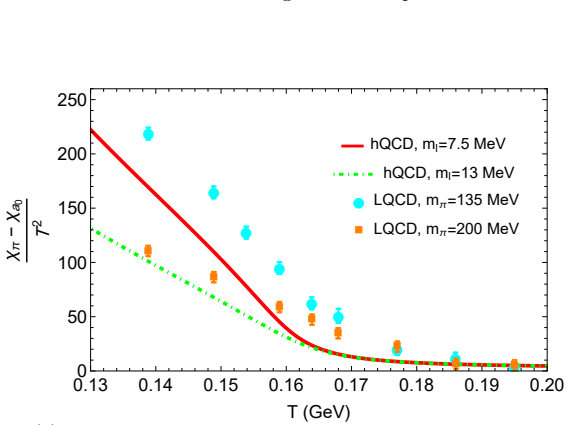
Within the soft-wall AdS/QCD setup, the chiral condensate melts in a crossover with pseudocritical temperatures of 0.157 GeV (Case I) and 0.154 GeV (Case II), both tuned to give a physical pion mass. Screening masses of chiral partners (π–σ and η–a0) become nearly degenerate at Tpc, and the susceptibility differences χπ − χσ and χηl − χa0 drop sharply there, signaling chiral restoration. However, the U(1) axial partner difference χπ − χa0 does not vanish at Tpc; it crosses zero near T ≈ 0.190 GeV in both parameter sets. The paper claims this indicates a distinct restoration scale for U(1) axial symmetry, decoupled from the chiral condensate dynamics, and that the topological susceptibility χ
What carries the argument
Meson susceptibilities are extracted from holographic two-point correlation functions of scalar and pseudoscalar fluctuations around the chiral condensate background in a soft-wall AdS/QCD model with a determinant term that encodes the U(1) axial anomaly. The central quantities are χπ, χσ, χηl, and χa0, computed at zero momentum transfer, and their differences serve as symmetry-restoration indicators. A crucial step is the use of the Ward–Takahashi identity to fix the overall normalization: the model's bare pion susceptibility χπ = ½ mπ² fπ² has mass dimension 4, and the paper multiplies it by 1/ml² to match the WTI result χπ = i⟨q̄q⟩/ml, a choice that carries the argument.
Load-bearing premise
The central 190 MeV restoration scale rests on a hand-imposed normalization of the pion susceptibility (dividing the holographic result by the light quark mass squared) to force agreement with the Ward–Takahashi identity, rather than on an emergent scale from the gravitational dynamics.
What would settle it
A lattice QCD calculation of χπ − χa0 at physical quark masses that locates the vanishing point at a temperature clearly different from 190 MeV, or that shows the difference staying nonzero well above 200 MeV, would falsify the claimed separation scale. A simpler falsifier is a sensitivity check: varying the 1/ml² normalization and watching whether the crossing temperature moves; if it shifts significantly, the 190 MeV number is not robust.
If this is right
- If the central claim holds, chiral and U(1) axial symmetries restore at two distinct temperatures, with U(1) axial restoration delayed by roughly 30–35 MeV beyond the chiral crossover.
- The separation of scales implies that between Tpc and about 190 MeV there exists a window where chiral partners are degenerate but U(1) axial partners are not, so meson susceptibility differences can be used as separate order parameters.
- The topological susceptibility, being proportional to ml² (χπ − χηl), inherits the sharp chiral-transition drop, predicting a fast suppression of topological fluctuations near Tpc followed by a slower tail.
- Because the same restoration temperature appears in two independent parameter sets, the model suggests the separation is a structural feature of the soft-wall geometry rather than a fine-tuned artifact.
- The behavior of χπ − χa0 becoming quark-mass independent above roughly 165 MeV indicates that the remaining splitting there is anomaly-driven, not mass-driven.
Where Pith is reading between the lines
- The 1/ml² normalization imposed to match the Ward–Takahashi identity is the load-bearing hinge of the 190 MeV number; changing that normalization, or deriving it from bulk dynamics, could move the U(1) restoration temperature substantially.
- If the separation of scales is real in QCD, then axion cosmology bounds based on topological susceptibility behavior would need to account for a two-stage restoration, with the axion mass dropping earlier than the full U(1) axial recovery.
- A direct testable extension would be to compute the same susceptibility differences in a holographic model with an explicit bulk coupling between the axial anomaly and the gluon field strength, to see if the 190 MeV scale moves toward Tpc.
- The paper's own comparison with lattice data at intermediate temperatures suggests the holographic prediction for the temperature profile of χπ − χa0 is wrong even if its zero-crossing point is right; resolving that tension would require new dynamics in the soft-wall background.
Editorial analysis
A structured set of objections, weighed in public.
Referee Report
Summary. The paper studies finite-temperature restoration of chiral and U(1)_A symmetries in a soft-wall holographic QCD model with 2+1 flavors. Two parameter sets (Case I and Case II) are tuned to give a chiral pseudocritical temperature near 155 MeV and a physical pion mass. The authors compute light and strange quark condensates, screening masses of chiral partners (π–σ, η–a0), meson susceptibilities, and the topological susceptibility via Ward–Takahashi identities. They report a smooth chiral crossover (T_pc = 0.157/0.154 GeV for Cases I/II), degeneracy of chiral partners near T_pc, and a separate U(1)_A restoration scale at T ~ 0.190 GeV identified with the vanishing of χ_π − χ_{a0}. The topological susceptibility χ_top^{1/4} shows a sharp drop near the chiral transition.
Significance. If the central claim holds, the paper provides a holographic prediction that chiral and U(1)_A symmetries restore at distinct temperatures, with a topological susceptibility that drops at the chiral scale. The work has several strengths: explicit equations are given for all correlators; a genuine internal consistency check is performed for χ_σ by comparing the holographic expression (Eq. (36)) with the thermodynamic derivative ∂σ_l/∂m_l; and the conclusions are tested in two different parameter sets. The main weakness is that the key U(1)_A observable, χ_π, is obtained by an ad hoc rescaling of the holographic two-point function, and the claimed 0.190 GeV crossing is therefore not robustly grounded in the bulk dynamics.
major comments (4)
- [§III.B, Eqs. (49)–(53)] The pion susceptibility is defined by hand. The holographic result G_π(p) gives Eq. (51), χ_π = ½ m_π² f_π², which has mass dimension 4. The paper then notes the actual susceptibility has dimension 2 and, using the WTI χ_π = i⟨q̄q⟩/m_l plus the GOR relation, multiplies by 1/m_l² to obtain Eq. (53). This factor is not derived from the 5D action; it is a post hoc normalization. Since χ_π is one of the two quantities whose crossing with χ_{a0} defines the claimed U(1)_A restoration temperature T ~ 0.190 GeV (Figs. 8–9), the central claim depends on this imposed factor. No sensitivity analysis is given: the crossing temperature as a function of the normalization factor is not explored. This should be addressed by deriving the normalization from the holographic dictionary or by demonstrating that the crossing is stable under variations of the factor.
- [§III.B, Eqs. (45) and (49)] There is a second dimensionality issue: in Eq. (45) m_π² is explicitly defined as −p², the momentum variable. The two-point function in Eq. (49) is then proportional to m_π², so the limit p²→0 used in Eq. (50) would give G_π(0)=0, i.e., χ_π=0, not ½ m_π² f_π². The subsequent identification of m_π² with the physical pion mass appears to replace the zero-momentum limit with the on-shell pole. The paper should clarify whether m_π in Eqs. (49)–(53) is the momentum variable or the physical mass, and reconcile the p²→0 limit with the nonzero result in Eq. (53).
- [§V.B and §VI, Figs. 8–9] The paper itself states that the χ_π − χ_{a0} results 'do not align with the LQCD data at the low and mid temperatures' (Sec. V.B). The claimed restoration scale is the single crossing point of a curve that is otherwise in disagreement with lattice data; this crossing could be accidental. Moreover, the companion U(1)_A indicator χ_{η_l} − χ_σ listed in Eq. (82) is never shown, so the 'distinct restoration scale' rests on a single observable. A sensitivity analysis and a plot of χ_{η_l} − χ_σ would be needed to support the separation of scales.
- [§IV, Eqs. (77)–(78) and §V.C] The topological susceptibility is constructed from χ_π and χ_{η_l} via the WTI. Because χ_π carries the hand-imposed 1/m_l² normalization, χ_top inherits that ambiguity. The authors also find (Fig. 11) that varying the determinant coupling γ changes the overall magnitude but not the temperature dependence of χ_top, which they interpret as a property of the gravitational background. However, this does not address the normalization dependence of χ_π; the sharp drop of χ_top near T_pc is therefore not an independent prediction. The paper should state clearly how much of the temperature dependence of χ_top comes from the imposed normalization of χ_π.
minor comments (3)
- [General] There are several typographical errors, e.g., 'nymerical' in Sec. V.B and 'color online' in several figure captions; these should be corrected. Some equations have inconsistent notation for the dimensionless vs. dimensionful fields (e.g., χ_l vs. χ_l(z)).
- [Tables I–II] The tables list two values of m_l per case, but the text describes only one as physical. In particular, Case II with m_l = 3.22 MeV gives m_π = 141.6 MeV, which is not the physical pion mass (≈139.6 MeV); the paper should clarify which parameter set is used for the 'physical' calibration.
- [References] The paper cites Refs. [10–16] extensively for the susceptibility framework. The new contribution is the holographic computation, but the structural relations (WTI-based χ_top, partner decomposition) are taken from these references. This should be acknowledged more explicitly in the introduction so the novelty is clear.
Circularity Check
Partial circularity: the U(1)_A restoration scale is partly an artifact of the hand-imposed WTI normalization of χπ, and T_pc is a calibrated input reported as a determined output.
specific steps
-
fitted input called prediction
[Abstract; Section V (Results), Figs. 1–2]
"The study employs two distinct parameter sets (Case I and Case II), both calibrated to reproduce a pseudocritical temperature T_pc ~ 155 MeV and the physical pion mass. ... the pseudocritical temperature is determined to be T_pc|_hQCD = 0.157 GeV. A similar result for case II is shown in Fig. 2, where the pseudocritical temperature is determined to be T_pc|_hQCD = 0.154 GeV."
The 155 MeV crossover temperature is a calibration input chosen before the calculation, and the paper later reports T_pc = 0.157/0.154 GeV as a determined result. This is a consistency check of the fit rather than an independent prediction. It is not the main U(1)_A claim, but it is a reported output that equals its input up to tuning tolerance.
-
self definitional
[Section III.B, Eqs. (51)–(53); Section V.B, Figs. 8–9]
"From the dimensional analysis point of view, we can see that the mass dimension of χπ is [4], which is higher than the actual mass dimension of the susceptibility, which is [2]. ... By using the GOR relation 2m_l⟨q̄q⟩_l = m_π² f_π², we can match Eq. (51) with the one found from the WTI in Eq. (52), and conclude that we need to normalize Eq. (51) with 1/(m_l²), χπ = 1/(2m_l²) m_π² f_π²."
The model's raw two-point function gives χπ with the wrong mass dimension; instead of deriving the normalization from the bulk action, the paper sets χπ equal to the WTI/GOR value by inserting 1/m_l². This normalized χπ is one of the two legs of the U(1)_A indicator χπ − χa0 whose zero crossing defines T ~ 0.190 GeV. The crossing is therefore a comparison between an externally imposed WTI quantity and the un-rescaled holographic χa0; a different dimension-2 normalization would move the crossing, and no sensitivity analysis is given. The claimed distinct U(1)_A scale is thus in part an input-dependent construct.
-
self citation load bearing
[Section IV, Eqs. (77)–(78)]
"we will use the final form of the topological susceptibility expressed by fermionic operators as [16] χtop = − 1/4 [m_l⟨ψ̄ψ⟩ + i m_l² χηl]. ... By using Eq. (52), the topological susceptibility is written in terms of the pion susceptibility ... χtop = i m_l²/4 [χπ − χηl]."
The key formula for χtop is taken from ref. [16], a prior work by co-author Kawaguchi, rather than derived here. Since χπ has already been forced to the WTI value, the sharp drop of χtop near T_pc follows from the condensate's drop by construction. This is not the main U(1)_A claim, and the formula is a standard WTI relation, so it is a minor self-citation debt rather than a full circularity.
full rationale
The paper contains no step where the full U(1)_A result is identical to its input by definition: the screening masses, χa0, χσ, χηl and condensates are computed numerically from the bulk EOMs, so the chiral-partner degeneracy and even the χπ−χa0 crossing have genuine dynamical content. However, the central U(1)_A indicator is partially constructed. Equation (53) discards the dimension-4 holographic χπ and replaces it with the WTI value by a hand-inserted 1/m_l² factor; the zero of χπ−χa0 at ~0.190 GeV is therefore not a pure prediction of the bulk model. The χtop calculation likewise imports the WTI form from a self-cited paper [16] and, because χπ is normalized to WTI, its sharp drop near T_pc tracks the condensate by construction. In addition, T_pc ~ 155 MeV is a calibration input that is later reported as a determined output. These debts are real but partial: the crossing temperature is not fixed solely by the normalization (χa0 enters nontrivially), and the two parameter sets give the same crossing. The paper also concedes that χπ−χa0 does not align with LQCD below ~0.175 GeV, which heightens the normalization concern without by itself proving circularity. Overall score 4: some self-citation and one input-normalized 'prediction' in the central claim, but the claim retains independent dynamical content.
Axiom & Free-Parameter Ledger
free parameters (7)
- Light quark mass m_l (Case I) =
7.5 MeV (m_π = 132.5 MeV); 13 MeV variant
- Light quark mass m_l (Case II) =
3.22 MeV (m_π = 141.6 MeV); 6 MeV variant
- Dilaton profile μ₁, μ₂, μ_g (Case I) =
0.81, 0.176, 0.44 GeV
- Modified 5D mass μ_c and dilaton slope μ_g (Case II) =
1.27, 0.44 GeV
- Bulk quartic coupling λ =
80 (both cases)
- Determinant coupling γ =
−10 (Case I), −23 (Case II)
- χ_π normalization (imposed 1/m_l²) =
1/m_l² rescaling of Eq. (51)
axioms (5)
- domain assumption AdS/CFT dictionary: varying the on-shell action gives QCD two-point functions; m₅² = −3 for a Δ = 3 operator
- domain assumption The determinant term γ Re(det X) encodes the U(1)_A anomaly's effect on meson susceptibilities
- domain assumption WTI relations: χ_π = i⟨q̄q⟩/m_l and χ_top = −(1/4)(m_l⟨ψ̄ψ⟩ + i m_l² χ_{η_l})
- domain assumption Chiral and U(1)_A partner assignments in 2+1 flavors: (π↔σ), (η_l↔a₀), (π↔a₀), (η_l↔σ), with π₀/π₈ decomposed at ϕ = 54.7°
- standard math Screening masses located as poles of the spatial two-point function (s₁(p²)=0)
read the original abstract
We investigate the restoration patterns of chiral and $U(1)$ axial symmetries at finite temperature using a soft-wall holographic QCD model. The study employs two distinct parameter sets (Case I and Case II), both calibrated to reproduce a pseudocritical temperature $T_{\rm pc} \sim 155$ MeV and the physical pion mass. The temperature dependence of the light and strange quark condensates confirms a smooth chiral crossover transition, with pseudocritical temperatures of $T_{\rm pc}=0.157$ GeV and $T_{\rm pc}=0.154$ GeV for Cases I and II, respectively. The screening masses of chiral partner mesons ($\pi$-$\sigma$ and $\eta$-$a_0$) become degenerate near $T_{\rm pc}$, providing a clear signature of chiral symmetry restoration. Analysis of the corresponding meson susceptibilities further supports this conclusion. However, the indicator for $U(1)$ axial symmetry restoration, $\chi_\pi - \chi_{a_0}$, vanishes at a temperature $T \sim 0.190 $ GeV, which indicates a distinct restoration scale with chiral symmetry restoration scale within the present holographic framework. The temperature-dependent topological susceptibility $\chi_{\rm top}^{1/4}$ is also computed, showing a sharp drop near $T_{\rm pc}$ and a subsequent slight decrease. While the model qualitatively captures established features of the chiral transition, the results highlight a limitation in the qualitative description of the $U(1)$ axial anomaly compared to LQCD in our work.
Figures




Reference graph
Works this paper leans on
-
[1]
Case I: The specific profile of the dilaton field, which respects both the IR and UV behavior with a standard 5D mass [38, 39], Φ(z) =−µ 2 1z2 + (µ2 1 +µ 2 g)z2tanh(µ2 2z2) &m 2 5 =−3.(6)
-
[2]
Case II: An IR-modified soft-wall AdS/QCD model with a modified 5D mass and quadratic dilaton field [41] 1, Φ(z) =µ 2 gz2 &m 2 5 =−3−µ 2 cz2.(7) We analyze both variants of the model (Case I and Case II). To study chiral symmetry breaking, we consider the static, homogeneous expectation value of the scalar fieldX, which takes the form: X(z) =X 0(z) = diag...
-
[3]
T. D. Cohen, The High temperature phase of QCD and U(1)-A symmetry, Phys. Rev. D54, R1867 (1996), arXiv:hep- ph/9601216. 21
arXiv 1996
-
[4]
T. Hatsuda and T. Kunihiro, QCD phenomenology based on a chiral effective Lagrangian, Phys. Rept.247, 221 (1994), arXiv:hep-ph/9401310
Pith/arXiv arXiv 1994
-
[5]
The expansions are as follows: Case I: χl(z→0) =m lζz− γ 4 mlmsζ 2z2 + mlζ 4 −4µ2 1 +m 2 l ζ 2λ− γ2 8 (m2 l ζ 2 +m 2 sζ 2) z3 log(z) + σl ζ z3, χl(z→z h) =c l,0 − cl,0(−2c2 l,0λ+ 12−γc s,0) 16zh (zh −z) +O[(z h −z) 2], (11) χs(z→0) =m sζz− γ 4 m2 l ζ 2z2 + 1 4 −4µ2 1msζ+m 3 sζ 3λ− γ2 4 m2 l msζ 3 z3 log(z) + σs ζ z3, χs(z→z h) =c s,0 − (−2c3 s,0λ+ 12c s,0...
-
[6]
Weinberg, The U(1) Problem, Phys
S. Weinberg, The U(1) Problem, Phys. Rev. D11, 3583 (1975)
1975
-
[7]
S. Aoki, H. Fukaya, and Y. Taniguchi, Chiral symmetry restoration, eigenvalue density of Dirac operator and axial U(1) anomaly at finite temperature, Phys. Rev. D86, 114512 (2012), arXiv:1209.2061 [hep-lat]
Pith/arXiv arXiv 2012
-
[8]
A. Bazavov et al. (HotQCD), The chiral transition andU(1) A symmetry restoration from lattice QCD using Domain Wall Fermions, Phys. Rev. D86, 094503 (2012), arXiv:1205.3535 [hep-lat]
Pith/arXiv arXiv 2012
-
[9]
Bhattacharya et al., QCD Phase Transition with Chiral Quarks and Physical Quark Masses, Phys
T. Bhattacharya et al., QCD Phase Transition with Chiral Quarks and Physical Quark Masses, Phys. Rev. Lett.113, 082001 (2014), arXiv:1402.5175 [hep-lat]
Pith/arXiv arXiv 2014
-
[10]
S. Aoki, Y. Aoki, H. Fukaya, S. Hashimoto, C. Rohrhofer, and K. Suzuki (JLQCD), Role of the axial U(1) anomaly in the chiral susceptibility of QCD at high temperature, PTEP2022, 023B05 (2022), arXiv:2103.05954 [hep-lat]
Pith/arXiv arXiv 2022
-
[11]
Bazavov et al., Meson screening masses in (2+1)-flavor QCD, Phys
A. Bazavov et al., Meson screening masses in (2+1)-flavor QCD, Phys. Rev. D100, 094510 (2019), arXiv:1908.09552 [hep-lat]
Pith/arXiv arXiv 2019
-
[12]
H.-T. Ding, J.-B. Gu, S.-T. Li, and R. Thakkar, Chiral condensates and screening masses of neutral pseudoscalar mesons from lattice QCD at physical quark masses, Phys. Rev. D111, 074513 (2025), arXiv:2501.11262 [hep-lat]
Pith/arXiv arXiv 2025
-
[13]
A. G´ omez Nicola and J. Ruiz de Elvira, Pseudoscalar susceptibilities and quark condensates: chiral restoration and lattice screening masses, JHEP03, 186, arXiv:1602.01476 [hep-ph]
-
[14]
A. Gomez Nicola and J. Ruiz de Elvira, Patterns and partners for chiral symmetry restoration, Phys. Rev. D97, 074016 (2018), arXiv:1704.05036 [hep-ph]
Pith/arXiv arXiv 2018
-
[15]
C.-X. Cui, J.-Y. Li, S. Matsuzaki, M. Kawaguchi, and A. Tomiya, New interpretation of the chiral phase transition: Violation of the trilemma in QCD, Phys. Rev. D105, 114031 (2022), arXiv:2106.05674 [hep-ph]
Pith/arXiv arXiv 2022
-
[16]
C.-X. Cui, J.-Y. Li, S. Matsuzaki, M. Kawaguchi, and A. Tomiya, New Aspect of Chiral SU(2) and U(1) Axial Breaking in QCD, Particles7, 237 (2024), arXiv:2205.12479 [hep-ph]
Pith/arXiv arXiv 2024
-
[17]
M. Kawaguchi, S. Matsuzaki, and A. Tomiya, Nonperturbative flavor breaking in topological susceptibility at chiral crossover, Phys. Lett. B813, 136044 (2021), arXiv:2003.11375 [hep-ph]
Pith/arXiv arXiv 2021
-
[18]
M. Kawaguchi, S. Matsuzaki, and A. Tomiya, Analysis of nonperturbative flavor violation at chiral crossover criticality in QCD, Phys. Rev. D103, 054034 (2021), arXiv:2005.07003 [hep-ph]
Pith/arXiv arXiv 2021
-
[19]
M. Kawaguchi and D. Suenaga, Fate of the topological susceptibility in two-color dense QCD, JHEP08, 189, arXiv:2305.18682 [hep-ph]
-
[20]
S. Borsanyi et al., Calculation of the axion mass based on high-temperature lattice quantum chromodynamics, Nature 539, 69 (2016), arXiv:1606.07494 [hep-lat]
Pith/arXiv arXiv 2016
-
[21]
C. Bonati, M. D’Elia, M. Mariti, G. Martinelli, M. Mesiti, F. Negro, F. Sanfilippo, and G. Villadoro, Axion phenomenology andθ-dependence fromN f = 2 + 1 lattice QCD, JHEP03, 155, arXiv:1512.06746 [hep-lat]
-
[22]
P. Petreczky, H.-P. Schadler, and S. Sharma, The topological susceptibility in finite temperature QCD and axion cosmology, Phys. Lett. B762, 498 (2016), arXiv:1606.03145 [hep-lat]
Pith/arXiv arXiv 2016
-
[23]
A. Tomiya, G. Cossu, S. Aoki, H. Fukaya, S. Hashimoto, T. Kaneko, and J. Noaki, Evidence of effective axial U(1) symmetry restoration at high temperature QCD, Phys. Rev. D96, 034509 (2017), [Addendum: Phys.Rev.D 96, 079902 (2017)], arXiv:1612.01908 [hep-lat]
Pith/arXiv arXiv 2017
-
[24]
S. Aoki, Y. Aoki, G. Cossu, H. Fukaya, S. Hashimoto, T. Kaneko, C. Rohrhofer, and K. Suzuki (JLQCD), Study of the axialU(1) anomaly at high temperature with lattice chiral fermions, Phys. Rev. D103, 074506 (2021), arXiv:2011.01499 [hep-lat]
Pith/arXiv arXiv 2021
-
[25]
M. I. Buchoff et al., QCD chiral transition, U(1)A symmetry and the dirac spectrum using domain wall fermions, Phys. Rev. D89, 054514 (2014), arXiv:1309.4149 [hep-lat]
Pith/arXiv arXiv 2014
-
[26]
H.-T. Ding, S.-T. Li, X.-D. Wang, Y. Zhang, A. Tomiya, and S. Mukherjee, Correlated Dirac Eigenvalues and Axial Anomaly in Chiral Symmetric QCD, PoSLA TTICE2021, 619 (2022), arXiv:2112.00465 [hep-lat]
Pith/arXiv arXiv 2022
-
[27]
J. M. Maldacena, The Large N limit of superconformal field theories and supergravity, Adv. Theor. Math. Phys.2, 231 (1998), arXiv:hep-th/9711200
Pith/arXiv arXiv 1998
-
[28]
Witten, Anti-de Sitter space and holography, Adv
E. Witten, Anti-de Sitter space and holography, Adv. Theor. Math. Phys.2, 253 (1998), arXiv:hep-th/9802150
Pith/arXiv arXiv 1998
-
[29]
A. Karch and E. Katz, Adding flavor to AdS / CFT, JHEP06, 043, arXiv:hep-th/0205236
-
[30]
T. Sakai and S. Sugimoto, Low energy hadron physics in holographic QCD, Prog. Theor. Phys.113, 843 (2005), arXiv:hep- th/0412141
arXiv 2005
-
[31]
J. Erlich, E. Katz, D. T. Son, and M. A. Stephanov, QCD and a holographic model of hadrons, Phys. Rev. Lett.95, 261602 (2005), arXiv:hep-ph/0501128
Pith/arXiv arXiv 2005
-
[32]
L. Da Rold and A. Pomarol, Chiral symmetry breaking from five dimensional spaces, Nucl. Phys. B721, 79 (2005), arXiv:hep-ph/0501218
Pith/arXiv arXiv 2005
-
[33]
A. Karch, E. Katz, D. T. Son, and M. A. Stephanov, Linear confinement and AdS/QCD, Phys. Rev. D74, 015005 (2006), arXiv:hep-ph/0602229
Pith/arXiv arXiv 2006
-
[34]
S. S. Gubser and A. Nellore, Mimicking the QCD equation of state with a dual black hole, Phys. Rev. D78, 086007 (2008), arXiv:0804.0434 [hep-th]
Pith/arXiv arXiv 2008
-
[35]
S. S. Gubser, A. Nellore, S. S. Pufu, and F. D. Rocha, Thermodynamics and bulk viscosity of approximate black hole duals to finite temperature quantum chromodynamics, Phys. Rev. Lett.101, 131601 (2008), arXiv:0804.1950 [hep-th]
Pith/arXiv arXiv 2008
-
[36]
U. Gursoy and E. Kiritsis, Exploring improved holographic theories for QCD: Part I, JHEP02, 032, arXiv:0707.1324 [hep-th]
-
[37]
U. Gursoy, E. Kiritsis, and F. Nitti, Exploring improved holographic theories for QCD: Part II, JHEP02, 019, arXiv:0707.1349 [hep-th]
-
[38]
P. Colangelo, F. Giannuzzi, S. Nicotri, and V. Tangorra, Temperature and quark density effects on the chiral condensate: An AdS/QCD study, Eur. Phys. J. C72, 2096 (2012), arXiv:1112.4402 [hep-ph]. 22
Pith/arXiv arXiv 2096
-
[39]
L.-X. Cui and Y.-L. Wu, Thermal Mass Spectra of Scalar and Pseudo-Scalar Mesons in IR-improved Soft-Wall AdS/QCD Model with Finite Chemical Potential, Mod. Phys. Lett. A28, 1350132 (2013), arXiv:1302.4828 [hep-ph]
Pith/arXiv arXiv 2013
-
[40]
S. P. Bartz and T. Jacobson, Chiral Phase Transition and Meson Melting from AdS/QCD, Phys. Rev. D94, 075022 (2016), arXiv:1607.05751 [hep-ph]
Pith/arXiv arXiv 2016
-
[41]
K. Chelabi, Z. Fang, M. Huang, D. Li, and Y.-L. Wu, Realization of chiral symmetry breaking and restoration in holographic QCD, Phys. Rev. D93, 101901 (2016), arXiv:1511.02721 [hep-ph]
Pith/arXiv arXiv 2016
-
[42]
K. Chelabi, Z. Fang, M. Huang, D. Li, and Y.-L. Wu, Chiral Phase Transition in the Soft-Wall Model of AdS/QCD, JHEP 04, 036, arXiv:1512.06493 [hep-ph]
-
[43]
Z. Fang, S. He, and D. Li, Chiral and Deconfining Phase Transitions from Holographic QCD Study, Nucl. Phys. B907, 187 (2016), arXiv:1512.04062 [hep-ph]
Pith/arXiv arXiv 2016
-
[44]
Z. Fang, Y.-L. Wu, and L. Zhang, Chiral phase transition and meson spectrum in improved soft-wall AdS/QCD, Phys. Lett. B762, 86 (2016), arXiv:1604.02571 [hep-ph]
Pith/arXiv arXiv 2016
-
[45]
D. Li and M. Huang, Chiral phase transition of QCD withN f = 2 + 1 flavors from holography, JHEP02, 042, arXiv:1610.09814 [hep-ph]
-
[46]
S. P. Bartz and T. Jacobson, Chiral phase transition at finite chemical potential in 2+1 -flavor soft-wall anti–de Sitter space QCD, Phys. Rev. C97, 044908 (2018), arXiv:1801.00358 [hep-ph]
Pith/arXiv arXiv 2018
-
[47]
H. A. Ahmed, M. Kawaguchi, and M. Huang, Effect of charm quark on chiral phase transition in Nf=2+1+1 holographic QCD, Phys. Rev. D110, 046002 (2024), arXiv:2401.04355 [hep-ph]
Pith/arXiv arXiv 2024
-
[48]
X. Cao, S. Qiu, H. Liu, and D. Li, Thermal properties of light mesons from holography, JHEP08, 005, arXiv:2102.10946 [hep-ph]
-
[49]
X. Cao, M. Baggioli, H. Liu, and D. Li, Pion dynamics in a soft-wall AdS-QCD model, JHEP12, 113, arXiv:2210.09088 [hep-ph]
-
[50]
T. Gherghetta, J. I. Kapusta, and T. M. Kelley, Chiral symmetry breaking in the soft-wall AdS/QCD model, Phys. Rev. D79, 076003 (2009), arXiv:0902.1998 [hep-ph]
Pith/arXiv arXiv 2009
-
[51]
M. Rinaldi, F. A. Ceccopieri, and V. Vento, The pion in the graviton soft-wall model: phenomenological applications, Eur. Phys. J. C82, 626 (2022), arXiv:2204.09974 [hep-ph]
Pith/arXiv arXiv 2022
-
[52]
A. Ballon-Bayona, T. Frederico, L. A. H. Mamani, and W. de Paula, Dynamical holographic QCD model for spontaneous chiral symmetry breaking and confinement, Phys. Rev. D108, 106016 (2023), arXiv:2308.07503 [hep-ph]
Pith/arXiv arXiv 2023
-
[53]
A. Cherman, T. D. Cohen, and E. S. Werbos, The Chiral condensate in holographic models of QCD, Phys. Rev. C79, 045203 (2009), arXiv:0804.1096 [hep-ph]
Pith/arXiv arXiv 2009
-
[54]
Z. Fang, Y.-L. Wu, and L. Zhang, Octet meson spectra and chiral phase diagram in the improved soft-wall AdS/QCD model, Phys. Rev. D100, 054008 (2019), arXiv:1904.04695 [hep-ph]
Pith/arXiv arXiv 2019
-
[55]
X. Cao, H. Liu, and D. Li, Pion quasiparticles and QCD phase transitions at finite temperature and isospin density from holography, Phys. Rev. D102, 126014 (2020), arXiv:2009.00289 [hep-ph]
Pith/arXiv arXiv 2020
-
[56]
Cheng et al., Meson screening masses from lattice QCD with two light and the strange quark, Eur
M. Cheng et al., Meson screening masses from lattice QCD with two light and the strange quark, Eur. Phys. J. C71, 1564 (2011), arXiv:1010.1216 [hep-lat]
Pith/arXiv arXiv 2011
-
[57]
Y. Jiang, K. Ren, T. Xia, and P. Zhuang, Meson Screening Mass in a Strongly Coupled Pion Superfluid, Eur. Phys. J. C 71, 1822 (2011), arXiv:1104.0094 [hep-ph]
Pith/arXiv arXiv 2011
discussion (0)
Sign in with ORCID, Apple, or X to comment. Anyone can read and Pith papers without signing in.