REVIEW 3 major objections 4 minor 61 references
Fine-tuning a universal machine-learning interatomic potential on systematically enumerated alloy structures gives near-DFT mixing energies for the 2D high-entropy alloy (Mo,Ta,Nb,W,V)S2 and predicts VS2 phase separation below about 400 K.
Reviewed by Pith at T0; open to challenge. T0 means a machine referee read the full paper against a public rubric. the ladder, T0–T4 →
T0 review · deepseek-v4-flash
2026-08-04 05:40 UTC pith:PPCPEEAQ
load-bearing objection Useful fine-tuning recipe with a clean benchmark, but the phase-separation conclusion is only as good as the 2H-PBE ground states behind it. the 3 major comments →
Fine-tuning of universal machine-learning interatomic potentials for high-entropy alloys with application to 2D (Mo,Ta,Nb,W,V)S₂
The pith
A machine-rendered reading of the paper's core claim, the machinery that carries it, and where it could break.
Core claim
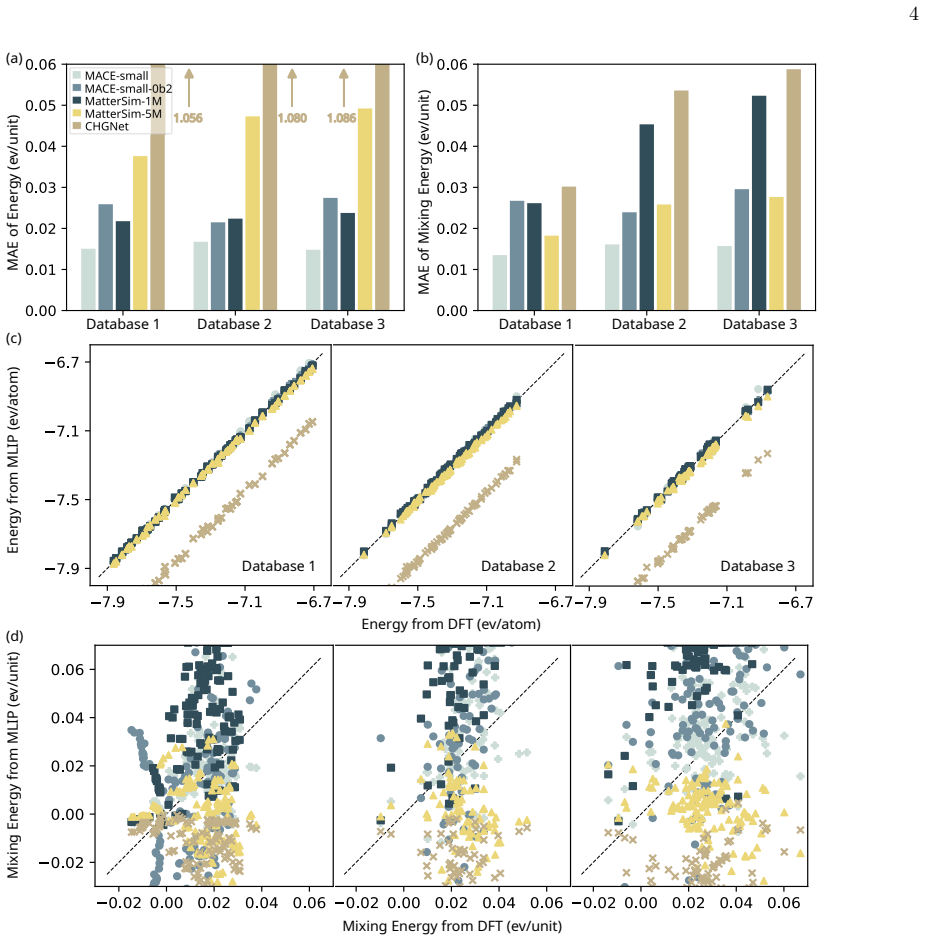
All five universal potentials tested reproduce total energies of the alloys reasonably well but fail on mixing energies, with mean absolute errors of 16–25 meV/unit. The discovery is that fine-tuning one of the better universal models on systematically enumerated alloy configurations — exhaustive symmetry-distinct structures rather than random ones — brings the mixing-energy MAE down to about 2 meV/unit, enough to make Monte-Carlo simulations meaningful. The paper then uses this model to show that (Mo,Ta,Nb,W,V)S2 is not a homogeneous solid solution at low temperature: cluster-vector Monte-Carlo and Gibbs free-energy analysis both place decomposition near 400 K, with VS2 separating first whi
What carries the argument
The device that carries the argument is the enumerated structure set: every symmetrically distinct arrangement of the metal atoms over the metal sites in a 2H TMDC supercell, generated for all binary through quinary combinations and supercell sizes up to eight unit cells. Unlike random structures, this set includes ordered configurations that bracket the minimum and maximum mixing energies, so a model trained on it keeps its accuracy for every local environment it might encounter in later simulations. The fine-tuned potential is built by taking a universal pretrained interatomic potential and fitting it to the relaxation trajectories of these enumerated structures, with energy, force, and st
Load-bearing premise
The reference energies are computed with a standard semilocal density-functional approximation in the undistorted hexagonal 2H crystal phase, ignoring magnetism, charge-density waves, and alternative metal coordination geometries; if any real composition is stabilized by one of those effects, the fine-tuned mixing energies and the predicted ~400 K VS2 separation would be wrong.
What would settle it
Take the alloys with the most asymmetric mixing-energy curves, such as (V,Nb)S2 or (Mo,Nb,V)S2, and recompute their reference energies while allowing magnetic ordering, lattice distortions, and alternative metal coordination geometries; if the lowest-energy state changes the mixing energy by more than a few meV/unit relative to the simple undistorted reference, the fine-tuned model's energy rankings and the predicted 400 K VS2 separation no longer hold.
If this is right
- Near-DFT mixing energies are now available from a potential fast enough for Monte-Carlo sampling, making it possible to map finite-temperature phase behavior of the five-metal alloy; the paper maps VS2 separation at about 400 K.
- A minimal training set that reaches near-converged accuracy exists: the diagonal of the enumeration table, consisting of equimolar structures for every element combination, so expensive random-dataset generation is not needed for this system.
- Fine-tuned models stay stable where from-scratch training fails: at equal small dataset sizes, from-scratch models fail to relax structures outside the training set, while fine-tuned models do not.
- The disorder-based descriptor for (Mo,Ta,Nb,W,V)S2 comes out well above thresholds reported for related HEA ceramic families, which the authors interpret as supporting synthesizability and which agrees with successful synthesis.
Where Pith is reading between the lines
- The near-convergence of a model trained only on binary and ternary alloys suggests that pair and triplet metal interactions dominate the mixing-energy surface in this chemistry; if true, cluster-expansion fits of order two or three should reproduce the fine-tuned energies within the same ~2 meV/unit error, a directly testable claim on the enumerated data.
- Because enumerated fine-tuning removes blind spots for ordered configurations, the same recipe should be tested on other 2D high-entropy layered materials, such as metal phosphorus trichalcogenides or layered double hydroxides; the enumeration cost stays manageable because the supercells needed for equimolar minimal structures are small.
- The Monte-Carlo result that partial VS2 separation is already visible at high temperatures has an experimental signature: samples synthesized at 1000 K should show V depletion even before full phase separation, and the V distribution should become more inhomogeneous with slower cooling — a prediction checkable against existing elemental maps.
- The stochasticity analysis, where varying seeds shifts MAE by a few meV/unit, implies that reported MAE differences between models below that noise floor should not be over-interpreted; practical users should compare several seeds before choosing a model.
Editorial analysis
A structured set of objections, weighed in public.
Referee Report
Summary. The paper benchmarks five universal machine-learning interatomic potentials (MACE, MatterSim, CHGNet) for the 2D high-entropy alloy system (Mo,Ta,Nb,W,V)S2 and shows that, without fine-tuning, all foundation models give unsatisfactory mixing energies. The authors then systematically compare fine-tuning strategies based on random structures and enumerated structures, using three benchmark databases. For Databases 1 and 2, which are held out from training, the best fine-tuned models reach mixing-energy MAEs of about 1.5–2 meV/unit, compared with 16–25 meV/unit for the foundation models. They also examine the influence of training-set size, composition, and stochasticity, and find that enumerated training sets give more transferable models. Finally, using the most accurate fine-tuned model, the paper performs Monte Carlo simulations and random-structure sampling, concluding that VS2 separates from the quinary alloy below about 400 K and that this is qualitatively consistent with experimental synthesis observations.
Significance. If the central claims hold, the paper makes a useful methodological contribution: it demonstrates a practical fine-tuning recipe for universal MLIPs in compositionally complex 2D materials and shows that small, systematically enumerated training sets can be more transferable than random sets of comparable size. The benchmark portion is carefully designed: clean train/test separation for Databases 1 and 2, multiple training seeds, and explicit acknowledgment that Database 3 is partially a training-set-retrieval test. The models and data are made publicly available on Zenodo, which supports reproducibility. The main caveat concerns the physical phase-separation conclusion, which is computed entirely within 2H, PBE, and apparently non-spin-polarized DFT; this limitation is not merely cosmetic because the text itself flags possible 1T, charge-density-wave, or magnetic instabilities near the V-rich endpoint. The MLIP benchmarking is solid, but the real-material prediction of VS2 decomposition below 400 K is not established without addressing those alternative ground states.
major comments (3)
- [Section II and Section III.D] All DFT labels and all Monte Carlo energies are computed in the 2H phase with PBE, and no spin polarization is reported. The paper itself notes in Section III.A that asymmetric mixing-energy curves 'may indicate contributions ... formation of charge density wave, magnetism, or 1T-phase near the end-point.' For V-based TMDCs this is a known possibility: if monolayer VS2 or V-rich compositions have a lower-energy 1T, CDW, or magnetic state than the 2H nonmagnetic structure used here, then the V-containing mixing energies and the decomposition endpoint in Fig. 6(a,c) are shifted by the stabilization energy of that alternative state. The predicted ~400 K VS2 phase separation is therefore a prediction about the 2H-PBE model, not necessarily about the synthesized material. The authors should either test spin-polarized/1T/CDW endpoints and include them in the training/benchmark data, or clearly
- [Section III.C, Fig. 5] Database 3 is presented as a benchmark, but Models 4 and 16 include all structures in Database 3 in their training sets. The text acknowledges this: 'The comparison on Database 3 is unfair due to inherent bias.' Yet Fig. 5 and the surrounding discussion use the Database 3 MAEs to support the accuracy of the enumerated models. These numbers should be labeled as near-training-set retrieval, not independent generalization. To claim generalization on enumerated equimolar structures, a held-out subset of Database 3 not used in training would be needed. This does not undermine the Database 1 and 2 results, but the presentation should be corrected.
- [Section III.D, Fig. 6(c)] The Monte Carlo decomposition temperature is given as 'around 400 K' with no uncertainty estimate. The methods state that 5000 trials were run four times for each temperature, but Fig. 6(c) shows only mean cluster vectors without run-to-run spread or error bars. Since the phase-separation temperature is a central physical claim, the authors should report the standard deviation across the four runs or otherwise demonstrate that the 400 K feature is robust to stochastic sampling and to the choice of averaging window (last 3000 trials).
minor comments (4)
- [Section II] The mixing energy is never explicitly defined in the main text. The definition (endpoint reference and sign convention) should be given as an equation, since all benchmark claims are expressed in terms of this quantity.
- [Section III.D] The description of the Monte Carlo protocol is terse: '5000 trials 4 times' could be clearer, e.g., 'four independent runs of 5000 trials each.' Also, the final structural configurations in Fig. 6(c) are visually informative but their selection criteria should be stated.
- [Throughout] The notation 'MACE-0b2' and 'MACE-small-0b2' is used inconsistently; the authors should use one name and introduce it once. Minor typographical issues and inconsistent figure-label formatting (e.g., 'ev/unit' vs 'eV/unit') should also be cleaned up.
- [Section III.C] The comparison between random and enumerated models in Fig. 5 is useful, but the random models' poor performance on Database 3 is partly due to the same training-set overlap bias. A sentence clarifying that the random-model Database 3 comparison is also 'unfair' in the same sense would avoid confusion.
Circularity Check
No significant circularity: held-out mixing-energy benchmarks and downstream Monte Carlo phase-separation predictions are uses of a fitted surrogate, not redefinitions of its inputs.
full rationale
The paper's central claims are empirical benchmark results, not first-principles derivations, and the derivation chain is self-contained. The near-DFT mixing-energy accuracy on Database 2 is a genuine held-out test: the paper states that "none of the structures in Database 2 were used in training these models," and the fine-tuned models are built from enumerated structures while Database 2 contains random binary-to-quinary configurations. The only overlap with training is Database 3, and the paper explicitly flags it: "The comparison on Database 3 is unfair due to inherent bias," so no benchmark is silently recycled as a prediction. The Monte Carlo phase-separation analysis and random-structure sampling use the fine-tuned model as a surrogate for DFT energies; the Gibbs decomposition is checked against DFT SQS energies, and the cluster-vector signal is an independent observable not used in training. No equation defines a claimed prediction in terms of the same fitted values that produced it. The two self-citations (refs [36] and [56], sharing authors with the present work) are used only as general support for uMLIP validation and local-environment coverage; neither is load-bearing, and no uniqueness theorem or shape ansatz is imported from them. The manuscript's admitted restriction that "All TMDCs were modeled in their 2H phase" with PBE and without spin polarization is a correctness/transferability limitation of the DFT target (the paper itself notes possible CDW/magnetism/1T contributions near endpoints), but it does not make the ML benchmark or the MC prediction circular. Overall, inputs are DFT labels, the claimed prediction is generalization to unseen structures, and the phase-separation conclusion is a downstream application rather than an identity.
Axiom & Free-Parameter Ledger
free parameters (4)
- Neural network weights of fine-tuned MACE-0b2 model =
Not disclosed numerically; Zenodo archive provided
- Energy/force/stress loss weighting =
100:10:1
- Train/validation/test split ratio =
80/15/5 (90/10 for smallest sets)
- Monte Carlo trial and averaging convention =
5000 trials; last 3000 averaged
axioms (5)
- domain assumption DFT-PBE total energies are a faithful ground truth for 2D HEA mixing energetics.
- domain assumption All TMDCs remain in the 2H phase without spin polarization, charge density waves, or 1T distortions across the studied composition range.
- domain assumption The universal MLIPs (MACE, MatterSim, CHGNet) are valid pretrained feature extractors for this chemistry.
- standard math ICET enumeration and SQS generation correctly and exhaustively sample the ordered and random structure spaces for given supercell sizes.
- domain assumption Canonical Monte Carlo with 5000 trials and last-3000 averaging is sufficient for converged cluster vectors.
read the original abstract
High-entropy alloy (HEA) materials and their two-dimensional counterparts (2D-HEAs) have recently attracted attention due to their tunable properties and catalytic potential, yet their chemical complexity makes direct density functional theory (DFT) calculations computationally prohibitive. The complexity also makes training of machine-learning interatomic potentials (MLIPs) challenging, but this could possibly be overcome by employing universal MLIPs as starting point. In this work, we investigate the applicability of universal MLIP models for 2D transition metal dichalcogenide HEAs and develop effective fine-tuning strategies. Training structures are systematically generated and selected, and the performance of universal and fine-tuned models are benchmarked against DFT. We find that all universal MLIPs employed in this work yield unsatisfactory mixing energies without fine-tuning. Applied to the experimentally synthesized (Mo,Ta,Nb,W,V)S$_2$ system, fine-tuned models based on enumerated structures can achieve near-DFT accuracy in predicting mixing energies while enabling Monte-Carlo simulations and random structure sampling at scales inaccessible to DFT.
Figures



Reference graph
Works this paper leans on
-
[1]
This makes the enu- merated model safer to use in sampling the config- uration space
Training with random structures may yield lower MAE, i.e., works better for average structure, but may also fail badly for structures beyond training set, usually the ordered ones. This makes the enu- merated model safer to use in sampling the config- uration space
-
[2]
This can 11 be done systematically with the enumeration ap- proach
More data generally yielded better model, as long as structural variety was guaranteed. This can 11 be done systematically with the enumeration ap- proach
-
[3]
Here, e.g., model trained using 2- and 3-component alloys could be used for 5-component alloy
Reasonably good models for describing HEAs can be obtained even when trained using structures with a smaller number of elements. Here, e.g., model trained using 2- and 3-component alloys could be used for 5-component alloy
-
[4]
However, at smaller dataset size, fine-tuned models still result in stable structural relaxation whereas models trained from scratch showed instabilities
At large dataset size, training from scratch led to a similar MAE as from fine-tuning. However, at smaller dataset size, fine-tuned models still result in stable structural relaxation whereas models trained from scratch showed instabilities
-
[5]
We emphasize that successful simu- lation of phase decomposition necessitates a model that yields accurate results for any alloy composi- tion
Structure selection by Monte-Carlo annealing ap- peared as a good alternative to the enumera- tion, yielding similar model accuracy for the same dataset size. We emphasize that successful simu- lation of phase decomposition necessitates a model that yields accurate results for any alloy composi- tion. We expect these findings to be applicable also to other...
-
[6]
Cantor, I
B. Cantor, I. T. Chang, P. Knight, and A. Vincent, Microstructural development in equiatomic multicompo- nent alloys, Materials Science and Engineering: A 375, 213 (2004)
2004
-
[7]
Yeh, S.-K
J.-W. Yeh, S.-K. Chen, S.-J. Lin, J.-Y. Gan, T.-S. Chin, T.-T. Shun, C.-H. Tsau, and S.-Y. Chang, Nanostruc- tured high-entropy alloys with multiple principal ele- ments: novel alloy design concepts and outcomes, Ad- vanced engineering materials 6, 299 (2004)
2004
-
[8]
C. M. Rost, E. Sachet, T. Borman, A. Moballegh, E. C. Dickey, D. Hou, J. L. Jones, S. Curtarolo, and J.-P. Maria, Entropy-stabilized oxides, Nature Communica- tions 6, 8485 (2015)
2015
-
[9]
X. Yan, L. Constantin, Y. Lu, H. Chen, Y. Zhang, S. Duan, T. Li, Z. Huang, C. Wang, and Y. Zhang, High-entropy single-phase carbides (hf–nb–ta–ti–zr) syn- thesized by a carbothermal reduction method, Journal of the American Ceramic Society 101, 4486 (2018). 12
2018
-
[10]
J. Gild, J. Braun, K. Kaufmann, E. Marin, T. Harring- ton, P. Hopkins, K. Vecchio, and J. Luo, High-entropy metal diborides: A new class of high-entropy materials, Scientific Reports 6, 37946 (2016)
2016
-
[11]
J. Gild, Y. Zhang, T. Harrington, S. Jiang, T. Hu, M. C. Quinn, W. M. Mellor, N. Zhou, K. S. Vecchio, and J. Luo, High-entropy nitride ceramics: An overview, Journal of Materials Research 33, 3825 (2018)
2018
-
[12]
C. Oses, C. Toher, and S. Curtarolo, High-entropy ce- ramics, Nature Reviews Materials 5, 295 (2020)
2020
-
[13]
Divilov, H
S. Divilov, H. Eckert, D. Hicks, C. Oses, C. Toher, R. Friedrich, M. Esters, M. J. Mehl, A. C. Zettel, Y. Led- erer, et al. , Disordered enthalpy–entropy descriptor for high-entropy ceramics discovery, Nature 625, 66 (2024)
2024
-
[14]
T. Ying, T. Yu, Y.-S. Shiah, C. Li, J. Li, Y. Qi, and H. Hosono, High-entropy van der waals materials formed from mixed metal dichalcogenides, halides, and phospho- rus trisulfides, Journal of the American Chemical Society 143, 7042 (2021)
2021
-
[15]
S. K. Nemani, M. Torkamanzadeh, B. C. Wyatt, V. Presser, and B. Anasori, Functional two-dimensional high-entropy materials, Communications Materials 4, 16 (2023)
2023
-
[16]
R. Wang, J. Huang, X. Zhang, J. Han, Z. Zhang, T. Gao, L. Xu, S. Liu, P. Xu, and B. Song, Two-dimensional high- entropy metal phosphorus trichalcogenides for enhanced hydrogen evolution reaction, ACS nano 16, 3593 (2022)
2022
-
[17]
Cavin, A
J. Cavin, A. Ahmadiparidari, L. Majidi, A. S. Thind, S. N. Misal, A. Prajapati, Z. Hemmat, S. Rastegar, A. Beukelman, M. R. Singh, et al. , 2d high-entropy tran- sition metal dichalcogenides for carbon dioxide electro- catalysis, Advanced Materials 33, 2100347 (2021)
2021
-
[18]
M. A. Akhound, K. W. Jacobsen, and K. S. Thyge- sen, Activating the basal plane of 2d transition metal dichalcogenides via high-entropy alloying, Journal of the American Chemical Society 147, 5743 (2025)
2025
-
[19]
D. Liu, P. Guo, X. Yan, Y. He, and R. Wu, Manip- ulating the configuration entropy of layered hydroxides toward efficient oxygen evolution reaction for anion ex- change membrane electrolyzer, Materials Today 80, 101 (2024)
2024
-
[20]
H. Wu, J. Zhang, Q. Lu, Y. Li, R. Jiang, Y. Liu, X. Zheng, N. Zhao, J. Li, Y. Deng, et al. , High-entropy layered double hydroxides with highly adjustable com- ponents for enhancing electrocatalytic oxygen evolution, ACS Applied Materials & Interfaces 15, 38423 (2023)
2023
-
[21]
Li, S.-K
F. Li, S.-K. Sun, Y. Chen, T. Naka, T. Hashishin, J. Maruyama, and H. Abe, Bottom-up synthesis of 2d lay- ered high-entropy transition metal hydroxides, Nanoscale advances 4, 2468 (2022)
2022
-
[22]
Tanaka, H
K. Tanaka, H. Zaid, T. Aoki, A. Deshpande, K. Hojo, C. V. Ciobanu, and S. Kodambaka, Growth of highly ori- ented (vnbmotaw) s2 layers, Nano Letters24, 493 (2023)
2023
-
[23]
S. Wang, S. V. Sunkara, S. Manna, A. Ahmadiparidari, K. Kumar, T. Yang, S. Namvar, P. Seraji, Z. Huang, J. Cabana, et al. , Self-lubricating tribo-catalytic activity of 2d high entropy alloy nanoflakes, Small 21, 2500322 (2025)
2025
-
[24]
Behler and M
J. Behler and M. Parrinello, Generalized neural-netwo rk representation of high-dimensional potential-energy sur - faces, Physical review letters 98, 146401 (2007)
2007
-
[25]
A. P. Bart´ ok, M. C. Payne, R. Kondor, and G. Cs´ anyi, Gaussian approximation potentials: The accuracy of quantum mechanics, without the electrons, Physical re- view letters 104, 136403 (2010)
2010
-
[26]
A. V. Shapeev, Moment tensor potentials: A class of sys- tematically improvable interatomic potentials, Multiscale Modeling & Simulation 14, 1153 (2016)
2016
-
[27]
Mishin, Machine-learning interatomic potentials f or materials science, Acta Materialia 214, 116980 (2021)
Y. Mishin, Machine-learning interatomic potentials f or materials science, Acta Materialia 214, 116980 (2021)
2021
-
[28]
Byggm¨ astar, K
J. Byggm¨ astar, K. Nordlund, and F. Djurabekova, Modeling refractory high-entropy alloys with efficient machine-learned interatomic potentials: Defects and seg- regation, Physical Review B 104, 104101 (2021)
2021
-
[29]
Zhang, X
J. Zhang, X. Liu, S. Bi, J. Yin, G. Zhang, and M. Eisen- bach, Robust data-driven approach for predicting the configurational energy of high entropy alloys, Materials & Design 185, 108247 (2020)
2020
-
[30]
X. Liu, J. Zhang, J. Yin, S. Bi, M. Eisenbach, and Y. Wang, Monte carlo simulation of order-disorder tran- sition in refractory high entropy alloys: A data-driven approach, Computational Materials Science 187, 110135 (2021)
2021
-
[31]
Zhang, C
Y. Zhang, C. Wen, C. Wang, S. Antonov, D. Xue, Y. Bai, and Y. Su, Phase prediction in high entropy alloys with a rational selection of materials descriptors and machine learning models, Acta Materialia 185, 528 (2020)
2020
-
[32]
D. Dai, T. Xu, X. Wei, G. Ding, Y. Xu, J. Zhang, and H. Zhang, Using machine learning and feature engineer- ing to characterize limited material datasets of high- entropy alloys, Computational Materials Science 175, 109618 (2020)
2020
-
[33]
Z. Pei, J. Yin, J. A. Hawk, D. E. Alman, and M. C. Gao, Machine-learning informed prediction of high-entropy solid solution formation: Beyond the hume-rothery rules, npj Computational Materials 6, 50 (2020)
2020
-
[34]
B. Deng, P. Zhong, K. Jun, J. Riebesell, K. Han, C. J. Bartel, and G. Ceder, Chgnet as a pretrained universal neural network potential for charge-informed atomistic modelling, Nature Machine Intelligence , 1–11 (2023)
2023
-
[35]
Batatia, D
I. Batatia, D. P. Kovacs, G. Simm, C. Ortner, and G. Cs´ anyi, Mace: Higher order equivariant message pass- ing neural networks for fast and accurate force fields, Advances in neural information processing systems 35, 11423 (2022)
2022
-
[36]
H. Yang, C. Hu, Y. Zhou, X. Liu, Y. Shi, J. Li, G. Li, Z. Chen, S. Chen, C. Zeni, M. Horton, R. Pinsler, A. Fowler, D. Z¨ ugner, T. Xie, J. Smith, L. Sun, Q. Wang, L. Kong, C. Liu, H. Hao, and Z. Lu, Mattersim: A deep learning atomistic model across elements, temperatures and pressures, arXiv preprint arXiv:2405.04967 (2024), arXiv:2405.04967 [cond-mat.mtrl-sci]
Pith/arXiv arXiv 2024
-
[37]
Musaelian, S
A. Musaelian, S. Batzner, A. Johansson, L. Sun, C. J. Owen, M. Kornbluth, and B. Kozinsky, Learning local equivariant representations for large-scale atomistic dy - namics, Nature Communications 14, 579 (2023)
2023
-
[38]
B. Deng, Z. Peichen, K. Jun, R. Janosh, K. Han, C. Bartel, and C. Gerbrand, Materials project trajectory (mptrj) dataset, Figshare. https://doi. org/10.6084/m9. figshare 23713842, v2 (2023)
doi:10.6084/m9 2023
-
[39]
Focassio, L
B. Focassio, L. P. M. Freitas, and G. R. Schleder, Per- formance assessment of universal machine learning inter- atomic potentials: Challenges and directions for mate- rials’ surfaces, ACS Applied Materials & Interfaces 17, 13111 (2024)
2024
-
[40]
H. Yu, M. Giantomassi, G. Materzanini, J. Wang, and G.-M. Rignanese, Systematic assessment of various uni- versal machine-learning interatomic potentials, Materials 13 Genome Engineering Advances 2, e58 (2024)
2024
-
[41]
E. Berger, M. Bagheri, and H.-P. Komsa, Screening of material defects using universal machine-learning interatomic potentials, Small 21, e03956 (2025), https://onlinelibrary.wiley.com/doi/pdf/10.1002/smll.202503956
-
[42]
Z. Li, T. Wen, Y. Zhang, X. Liu, C. Zhang, A. Patta- matta, X. Gong, B. Ye, H. Wang, L. Zhang, et al. , An extendable cloud-native alloy property explorer, arXiv preprint arXiv:2404.17330 (2024)
Pith/arXiv arXiv 2024
-
[43]
X. Liu, K. Zeng, Z. Luo, Y. Wang, T. Zhao, and Z. Xu, Fine-tuning universal machine-learned interatomic po- tentials: A tutorial on methods and applications, arXiv preprint arXiv:2506.21935 (2025)
Pith/arXiv arXiv 2025
-
[44]
Radova, W
M. Radova, W. G. Stark, C. S. Allen, R. J. Maurer, and A. P. Bart´ ok, Fine-tuning foundation models of materials interatomic potentials with frozen transfer learning, npj Computational Materials 11, 237 (2025)
2025
-
[45]
Rao, P.-Y
Z. Rao, P.-Y. Tung, R. Xie, Y. Wei, H. Zhang, A. Ferrari, T. Klaver, F. K¨ ormann, P. T. Sukumar, A. Kwiatkowski da Silva, et al. , Machine learning– enabled high-entropy alloy discovery, Science 378, 78 (2022)
2022
-
[46]
M. Poul, L. Huber, and J. Neugebauer, Automated gen- eration of structure datasets for machine learning poten- tials and alloys, npj Computational Materials 11, 174 (2025)
2025
-
[47]
P. E. Bl¨ ochl, Projector augmented-wave method, Physi- cal review B 50, 17953 (1994)
1994
-
[48]
Hafner, Ab-initio simulations of materials using va sp: Density-functional theory and beyond, Journal of com- putational chemistry 29, 2044 (2008)
J. Hafner, Ab-initio simulations of materials using va sp: Density-functional theory and beyond, Journal of com- putational chemistry 29, 2044 (2008)
2044
-
[49]
J. P. Perdew, K. Burke, and M. Ernzerhof, Generalized gradient approximation made simple, Physical review let- ters 77, 3865 (1996)
1996
-
[50]
Batatia, S
I. Batatia, S. Batzner, D. P. Kov´ acs, A. Musaelian, G. N. Simm, R. Drautz, C. Ortner, B. Kozinsky, and G. Cs´ anyi, The design space of e (3)-equivariant atom-centred in- teratomic potentials, Nature Machine Intelligence 7, 56 (2025)
2025
-
[51]
A. H. Larsen, J. J. Mortensen, J. Blomqvist, I. E. Castelli, R. Christensen, M. Du/suppress lak, J. Friis, M. N. Groves, B. Hammer, C. Hargus, et al. , The atomic sim- ulation environment—a python library for working with atoms, Journal of Physics: Condensed Matter 29, 273002 (2017)
2017
-
[52]
D. P. Kingma and J. Ba, Adam: A method for stochastic optimization, arXiv preprint arXiv:1412.6980 (2014)
Pith/arXiv arXiv 2014
-
[53]
˚ Angqvist, W
M. ˚ Angqvist, W. A. Mu˜ noz, J. M. Rahm, E. Fransson, C. Durniak, P. Rozyczko, T. H. Rod, and P. Erhart, Icet–a python library for constructing and sampling alloy cluster expansions, Advanced Theory and Simulations 2, 1900015 (2019)
2019
-
[54]
G. L. Hart and R. W. Forcade, Algorithm for generat- ing derivative structures, Physical Review B—Condensed Matter and Materials Physics 77, 224115 (2008)
2008
-
[55]
G. L. Hart and R. W. Forcade, Generating derivative structures from multilattices: Algorithm and application to hcp alloys, Physical Review B—Condensed Matter and Materials Physics 80, 014120 (2009)
2009
-
[56]
Zunger, S.-H
A. Zunger, S.-H. Wei, L. G. Ferreira, and J. E. Bernard, Special quasirandom structures, Physical review letters 65, 353 (1990)
1990
-
[57]
van de Walle, P
A. van de Walle, P. Tiwary, M. de Jong, D. L. Olm- sted, M. Asta, A. Dick, D. Shin, Y. Wang, L.-Q. Chen, and Z.-K. Liu, Efficient stochastic generation of special quasirandom structures, Calphad 42, 13 (2013)
2013
-
[58]
Ekborg-Tanner, P
P. Ekborg-Tanner, P. Rosander, E. Fransson, and P. Er- hart, Construction and sampling of alloy cluster expan- sions—a tutorial, PRX Energy 3, 042001 (2024)
2024
-
[59]
Y. Cao, K. Sheriff, and R. Freitas, Capturing short-range order in high-entropy alloys with machine learning poten- tials, npj Computational Materials 11, 268 (2025)
2025
-
[60]
Kostiuchenko, F
T. Kostiuchenko, F. K¨ ormann, J. Neugebauer, and A. Shapeev, Impact of lattice relaxations on phase transi- tions in a high-entropy alloy studied by machine-learning potentials, npj Computational Materials 5, 55 (2019)
2019
-
[61]
R. Li, C. Zhou, A. Singh, Y. Pei, G. Henkelman, and L. Li, Local-environment-guided selection of atomic structures for the development of machine-learning po- tentials, The Journal of Chemical Physics 160 (2024)
2024
discussion (0)
Sign in with ORCID, Apple, or X to comment. Anyone can read and Pith papers without signing in.