REVIEW 4 major objections 4 minor 38 references
Low-Order Bessel-Type PID Dynamics in Lithium-Based Tritium Breeding and Heat-Removal Systems
T0 review · 4 major / 4 minor · reviewed 2026-08-04 · deepseek-v4-flash
Pith's one-line read A PID feedback law on tritium-inventory error is shown to be locally equivalent to a Bessel-type differential operator, giving a unified analytic view of lithium-based breeding and heat-removal control.
desk verdict A cleanly written but essentially circular exercise: the PID-to-Bessel map rests on an assumed error equation, so the central claim is a re-parameterization rather than a result. read the letter →
The pith
A machine-rendered reading of the paper's core claim, the machinery that carries it, and where it could break.
The reading
What carries the argument
The argument rests on comparing the PID operator C=K(I+(1/Ti)∫+Td d/dt) with the Bessel shift/recurrence operator and the full Bessel differential operator Lν=x²(d²/dx²)+x(d/dx)+(x²−ν²). The load-bearing step is localizing Lν around a reference point x0 (freezing coefficients) and rescaling x=αt, which converts it into a constant-coefficient second-order operator. Combining this with a second-order error model yields the explicit map from PID gains (a,b,c) to Bessel parameters (x0,ν), realizing PID as a localized Bessel mode.
What would settle it
Run a high-fidelity simulation or experiment of a lithium jet with a PID controller on tritium inventory, perturb the setpoint, and record the error. If the error trajectory is not well fit by a second-order linear ODE with coefficients a/b and c/b, or if the fitted Bessel parameters deviate beyond tolerance from (23), the claim is falsified. In particular, if the residual of the second-order fit grows with time or with perturbation amplitude, the local equivalence fails.
Extended reading notes
Core claim
The central claim is that the PID increment Δr∞(t)=aE(t)+bE'(t)+c∫E(τ)dτ, acting on the error trajectory E(t), can be identified with a localized Bessel-type operator. Around a reference point x0, the Bessel operator x²(d²/dx²)+x(d/dx)+(x²−ν²) approximates to a constant-coefficient second-order operator. Under the time scaling x=αt and matching coefficients with the closed-loop error equation E''+(a/b)E'+(c/b)E=0, the authors derive the explicit correspondence x0=b/a and ν²=(1−c/b)(b²/a²). Thus the PID controller's gains select an effective Bessel order and radius, so the closed-loop error behaves locally like a Bessel mode of order ν near x0. The equivalence is local, not global: the spectr
Load-bearing premise
The entire correspondence rests on the unproven assumption that the closed-loop error obeys E'' + (a/b)E' + (c/b)E = 0, justified by asserting the plant responds proportionally to the PID increment on a short timescale and the integral term is a slow drift; this error equation is not derived from the jet or blanket physics.
Editorial extensions
If this is right
- PID tuning for tritium inventory can be reinterpreted as selecting an effective Bessel order and radius, enabling mode-based insight into error dynamics.
- The local equivalence means different PID gain sets correspond to different Bessel modes, so controller design can be guided by Bessel-function properties.
- The reduced jet model suggests beam-induced thermal perturbations are captured by a few scalar observables, so low-order controllers suffice near an operating point.
- If the equivalence holds, the same analytical language applies to tritium breeding and heat-removal control, possibly simplifying multi-loop design in lithium systems.
- The mapping provides a testable prediction: closed-loop error should follow E''+(a/b)E'+(c/b)E=0, with the Bessel parameters fixed by (23).
Reading between the lines
- A natural extension is to ask whether a multivariable PID controller on several errors (tritium inventory, temperature, impurity level) maps to a product or tensor of Bessel operators; if so, mode-decoupling may be possible.
- The local nature suggests the identification may fail during large transients or actuator saturation; a gain-scheduled PID that preserves the map would be a testable follow-up.
- Since the mapping only uses the second-order error model, it likely generalizes to any plant with approximately second-order linearized error dynamics, not just lithium fusion systems; this could be checked on standard benchmark control problems.
- The Bessel-order parameter ν acts like a tunable damping/frequency knob; linking it to physical quantities (e.g., 6Li enrichment sensitivity) could yield engineering guidelines for choosing a and b.
Editorial analysis
A structured set of objections, weighed in public.
Referee Report
Summary. The paper proposes a unified analytical framework connecting tritium breeding in lithium-based fusion blankets, thermal response of a liquid-lithium jet, and PID feedback control. The authors derive a reduced jet thermal-expansion model from mass and heat transport equations, express PID control as a linear operator, and define a local correspondence between the PID increment and a Bessel-type differential operator acting on the tritium-inventory error. The central claim is that any PID-tuned second-order error dynamics can be interpreted as a localized Bessel mode via the explicit map x0 = b/a, ν² = (1 − c/b) b²/a² (Eq. 23). The paper illustrates this mapping with a numerical jet/blanket–PID simulation and discusses limitations.
Significance. If the central claim were valid, the paper would provide a genuinely compact analytical bridge between neutronics, thermohydraulics, and control in Li-based fusion systems, complementing purely numerical PID-tuning studies. The manuscript is clearly structured, uses explicit operator notation, and the algebraic steps from Eqs. (15)–(23) are internally consistent. The numerical experiments in Section VI are described in sufficient detail that the fits in Figs. 4–5 are plausible and reproducible. However, the central identification is not actually derived from the fusion or jet physics: it rests on an assumed second-order error model (Eq. 21) whose coefficients are set to PID gain ratios, and the numerical validation fits the same second-order template. The paper's own limitation section acknowledges reduced fidelity of the thermohydraulic and TBR models, but it does not flag the missing derivation of the error equation. Because the core contribution depends on this unproven and, in the specific plant model used, contradicted assumption, the claimed unification is not established.
major comments (4)
- [§IV.B, Eq. (21)] Equation (21) is assumed, not derived. It asserts that the closed-loop error obeys E'' + (a/b)E' + (c/b)E = 0, but the PID increment (15) is a control signal, not a dynamical law for E(t). For the first-order lumped jet model actually used in Section VI, τ dT/dt + T = q_in + u with u = aE + bE' + c∫E and E = T_target − T, the homogeneous closed-loop error equation is (τ+b)E'' + (1+a)E' + cE = 0, i.e., E'' + [(1+a)/(τ+b)]E' + [c/(τ+b)]E = 0, not Eq. (21). Agreement with Eq. (21) would require c = 0 and τ = 0 simultaneously (or τ = b/a when c = 0). Thus Eq. (23) is not a generic consequence of PID control of a jet; it is an imposed ansatz.
- [§IV.B, Eqs. (20)–(23)] The PID-to-Bessel map is circular. Equation (20) postulates a second-order error model with coefficients a0 and a1, and Eq. (21) identifies those coefficients with PID gain ratios. Equation (23) then derives (x0, ν) from that same assumed model. The claimed 'prediction' of Bessel-type behavior is therefore built into the construction. The numerical example in Section VI and Figs. 4–5 does not break the circularity: it generates error trajectories from a Bessel-modulated source and then fits E'' + a1E' + a0E ≈ 0, confirming that the simulated data can be fit by the assumed second-order template. This validates the fitting procedure, not the derivation of Eq. (21) from the jet/blanket physics.
- [§V, Eq. (28)] The TBR connection depends on the linear surrogate TBR(t) ≈ αR(t) + β, where α and β are free fit parameters. The paper acknowledges that α and β are local effective parameters, but it does not provide any neutronics calculation or data supporting the chosen values (α = 0.08, β = 1.0). Since the central claim involves 'lithium-based tritium breeding,' the absence of a concrete neutronics link weakens the claim that the PID–Bessel dynamics are tied to TBR physics rather than to a generic linear model.
- [§III and §VI] The jet thermal-expansion model is not actually solved. Section III derives Eqs. (5)–(6) and presents Figure 3, but no closed-form or numerical solution of those partial differential equations is given. Section VI substitutes a lumped-parameter jet model with a Bessel-modulated heat source q_in(t), which is not derived from the PDEs and does not test the earlier reduction chain. The numerical experiment therefore does not provide independent support for the claimed coupling between jet thermohydraulics and the PID–Bessel correspondence.
minor comments (4)
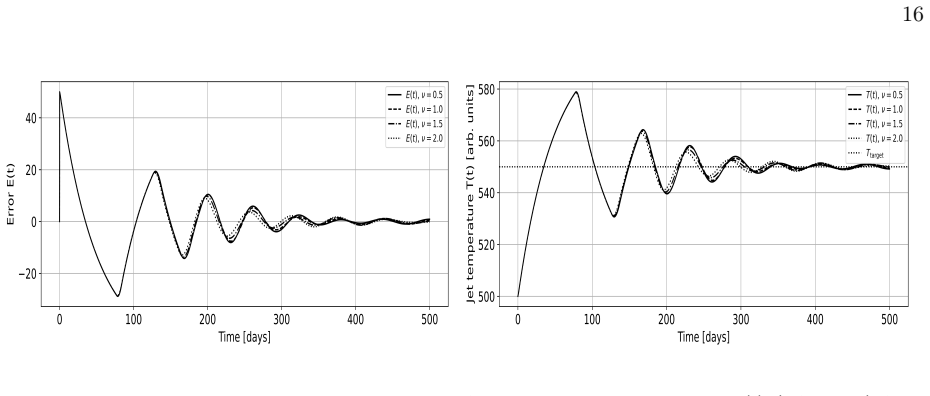
- [Abstract / Introduction] The sentence 'Our results indicate that Li-based breeding and heat-removal systems exhibit low-order.' is grammatically incomplete. Also, 'fast' is typo for 'first' and 'Ttarge' for 'T_target' in the caption of Figure 5.
- [Figure 3] The caption 'Different values for the maximum velocity vz...' is vague; the figure lacks axis labels and a description of which parameter is varied, making it difficult to interpret.
- [References] Some references are in nonstandard format (e.g., [2], [3], [14]) and several URLs are incomplete or missing access dates. The manuscript would benefit from a uniform citation style.
- [§IV.A] The discussion of the analogy between PID and Bessel shift operators is purely structural; it may help the reader to explicitly state that no physical equivalence is being claimed beyond the local second-order identification.
Circularity Check
The PID-to-Bessel correspondence is constructed by imposing the error-model coefficients and then renaming them as Bessel parameters.
-
self definitional
[Section IV.B, Eqs. (20)–(23)]
"A simple second-order error model can be constructed to match the PID gains (a,b,c) [34] to the parameters of a localized Bessel operator. ... Assuming that the physical system responds approximately proportionally to ∆r∞ on a short time scale, and that the integral term contributes mainly to a slow drift of the operating point, we can associate equation (15), an effective second-order error dynamics of the form (20), with (b≠0) a1 = a/b, a0 = c/b. ... Comparing (22) with the generic form (20), and considering identification (21), we can match PID gains to Bessel parameters, yielding the expli"
The coefficients of the assumed second-order error equation are set by flat to the PID gain ratios a/b and c/b; the Bessel parameters x0 and ν are then solved from those same ratios. Equation (22) is a generic constant-coefficient second-order ODE, so any second-order error model can be written in that form by choosing x0 and ν. The mapping is therefore a parameter renaming of the assumed model, not a consequence of PID control or of the blanket/jet physics. For the first-order jet plant used in Section VI, the closed-loop homogeneous error equation is (τ+b)E′′+(1+a)E′+cE=0, which would not give a1=a/b, a0=c/b except in nongeneric cases; Eq. (21) is chosen, not derived.
-
fitted input called prediction
[Section VI, Figure 5 validation paragraph]
"The jet thermal response is modeled using a lumped-parameter temperature field T(t)... driven by a Bessel-modulated heat source q_in(t)... The resulting closed-loop error response is subsequently approximated by a second-order model, whose coefficients are then mapped onto effective Bessel parameters using the previously derived relations. This procedure explicitly demonstrates that a physically motivated Li-based system ... can exhibit local error dynamics that are accurately characterized by a Bessel-type operator using PID control."
The numerical experiment fits E′′(t)+a1E′(t)+a0E(t)≈0 to the simulated error and then maps the fitted a1 and a0 through Eq. (23). The claimed Bessel-type behavior is therefore guaranteed by the fitting step plus the definitional map, rather than independently predicted. Moreover, the heat source is already constructed as a Bessel-modulated function, so Bessel structure is injected at the input. The simulation validates the fitting procedure, not the derivation of Eq. (21).
1 more flagged steps
-
renaming known result
[Section IV.B, paragraph after Eq. (25)]
"During the time interval t∈[t1,t2], the Bessel mode of order ν exhibits error dynamics that are accurately approximated by a second-order model parameterized by the coefficients (a0,a1), which, in turn, correspond to a set of effective PID gains (a,b,c). Within this regime, the resulting closed-loop T-dynamics are, to leading order, indistinguishable from those generated by a conventional PID controller."
This sentence effectively concedes that the 'Bessel mode' is indistinguishable from an ordinary second-order PID-controlled error model. Since every constant-coefficient second-order ODE can be rewritten in the form of Eq. (22) by defining x0=1/a1 and ν2=x0²(1−a0), calling it a localized Bessel mode is a relabeling of a known low-order structure rather than a new physical prediction. The central claim is thus a renaming of the assumed second-order error dynamics.
full rationale
The paper contains substantial non-circular material: D-T and Li reaction cross-sections, the reduced jet thermohydraulic equations, and the numerical ODE integrations are independent of the PID-Bessel claim. However, the paper's central novel result — that PID gains can be embedded in a Bessel-type operator — is not derived from plant physics. Equation (21) simply imposes the second-order error-model coefficients as a/b and c/b, and Eq. (23) then solves for x0 and ν from those same coefficients. Because Eq. (22) is a generic second-order constant-coefficient equation, this is a parameter renaming, not an empirical or derived correspondence. The numerical section does not break the circularity: it fits a second-order template to simulated data and maps the fitted coefficients through the same definitional formula, while the input heat source is already Bessel-modulated. No self-citation chain is load-bearing; the circularity is definitional and structural. Score 8 reflects that the central claim is forced by the construction and the assumed error model, even though the surrounding review material is independent.
Assumptions & free parameters
free parameters (4)
- α (TBR sensitivity) =
0.08
- β (TBR offset) =
1.0
- PID gains (a,b,c) =
a=0.5, b=1.0, c=0.2 (illustrative)
- k_x, k_y
assumptions (5)
- standard math Bessel function recurrence relations (9)-(10) and operator Lν
- domain assumption Local Taylor approximation of Bessel operator around x0 (Eq. 18)
- ad hoc to paper Closed-loop error dynamics are second-order with a1=a/b, a0=c/b (Eq. 21)
- domain assumption TBR is approximately linear in 6Li enrichment R(t) (Eq. 28)
- domain assumption Jet is weakly compressible with transverse velocity parameterization (Eq. 4)
invented entities (2)
-
Localized Bessel modes
-
Bessel-modulated heat source q_in(t)
Cite this review
Pith. "Pith review of Low-Order Bessel-Type PID Dynamics in Lithium-Based Tritium Breeding and Heat-Removal Systems." pith.science (2026). https://pith.science/paper/6EU5IIBO
@misc{pith2026260328799,
  author       = {Pith},
  title        = {Pith review of: Low-Order Bessel-Type PID Dynamics in Lithium-Based Tritium Breeding and Heat-Removal Systems},
  year         = {2026},
  howpublished = {\url{https://pith.science/paper/6EU5IIBO}},
  note         = {Machine review of arXiv:2603.28799}
}
read the original abstract
Lithium plays a dual role in deuterium-tritium fusion systems by enabling tritium breeding in blankets and providing an efficient heat-removal medium in liquid-metal components. However, most existing investigations treat neutronic behavior, jet thermohydraulics, and feedback control as largely decoupled layers, and there is currently no compact analytical framework that simultaneously links lithium-based tritium breeding, jet thermal response, and controller dynamics. In this work, we integrate nuclear cross-section data for deuterium-tritium and lithium reactions with a reduced thermohydraulic model of a liquid-lithium jet and an operator-theoretic formulation of feedback control. The resulting blanket/jet configuration should be interpreted as a conceptual, reduced-order demonstration of how two Li-based subsystems can be coupled in a unified analytical framework, rather than as a fully realistic reactor design in which an IFMIF-type neutron source is directly attached to a self-sufficient power blanket. We derive a low-order model describing jet thermal expansion under deuteron-beam loading and demonstrate that a continuous-time proportional-integral-derivative controller, expressed in operator form, can be locally embedded within a family of Bessel-type differential operators acting on the tritium-inventory tracking error. The results suggest that lithium-based breeding and heat-removal systems admit low-order, proportional-integral-derivative controllable dynamics that can be interpreted in terms of localized Bessel modes, providing a compact analytical framework for guiding future controller design and blanket/jet optimization.
Figures


Figures from the paper (2 more)

Reference graph
Works this paper leans on
-
[1]
Fusion Energy.https://www.iaea.org/sites/ default/files/fusionenergy.pdf
International Atomic Energy Agency Bulletin. Fusion Energy.https://www.iaea.org/sites/ default/files/fusionenergy.pdf
-
[2]
Ciampichetti, P
A. Ciampichetti, P. Rocco, and M. Zucchetti. Accidental and Long-Term Safety Assessment of Fission and Fusion Power Reactors. Fusion Engineering and Design 63-64, 229-234 (2002). 18
2002
-
[3]
W. M. Nevins. A Review of Confinement Requirements for Advanced Fuels. Journal of Fusion Energy 17(1), (1998)
1998
-
[4]
MIT MITEI. The Role of Fusion Energy in a Decarbonized Electricity System, (2024): https://energy.mit.edu/wp-content/uploads/2024/09/MITEI_FusionReport_091124_final_ COMPLETE-REPORT_fordistribution.pdf
2024
-
[5]
J. Huet al.. All Superconducting Tokamak: EAST. AAPPS Bulletin 33, 8 (2023):https://doi.org/ 10.1007/s43673-023-00080-9
-
[6]
Dinget al
S. Dinget al.. A High-Density and High-Confinement Tokamak Plasma Regime for Fusion Energy. Nature 629, 555-560 (2024)
2024
-
[7]
Villariet al
R. Villariet al.. Overview of Deuterium-Tritium Nuclear Operations at JET. Fusion Engineering and Design 217, 115113 (2025)
2025
-
[8]
E. R. Solano. Fusion Research in a Deuterium–Tritium Tokamak. Fund. Plasma Phys. 15, 100096 (2025)
2025
Show all 38 references
-
[9]
Bosch and G
H.-S. Bosch and G. M. Hale. Improved Formulas for Fusion Cross-Sections and Thermal Reactivities. Nucl. Fusion 32(4), 611 (1992)
1992
-
[10]
R. S. de Souzaet al.. Thermonuclear Fusion Rates for Tritium Deuterium Using Bayesian Methods. arXiv:1901.04857 (2019)
1901 arXiv
-
[11]
M. E. Sawan and M. A. Abdou. Physics and Technology Conditions for Attaining Tritium Self- Sufficiency for the DT Fuel Cycle. Fusion Engineering and Design 81, 1131–1144 (2006)
2006
-
[12]
L. A. El-Guebaly and S. Malang. Toward the Ultimate Goal of Tritium Self-Sufficiency: Technical Issues and Requirements Imposed on ARIES Advanced Power Plants. Fusion Engineering and Design 84, 2072–2083 (2009)
-
[13]
Abdouet al
M. Abdouet al.. Physics and Technology Considerations for the Deuterium–Tritium Fuel Cycle and Conditions for Tritium Fuel Self Sufficiency. Nucl. Fusion 61, 013001 (2021)
2021
-
[14]
J. D. Lee. Tritium Breeding and Direct Energy Conversion. Proc. of the Am. Chem. Soc. Symposium on The Role of Chemistry in the Development of Controlled Fusion. Boston, Massachusetts, (1972): https://inis.iaea.org/records/ehtrj-62m95/preview/4037886.pdf?include_deleted=0
1972
-
[15]
Máneket al..Fast Regression of the Tritium Breeding Ratio in Fusion Reactors
P. Máneket al..Fast Regression of the Tritium Breeding Ratio in Fusion Reactors. Mach. Learn.: Sci. Technol. 4, 015008 (2023)
2023
-
[16]
Morgan and J
L. Morgan and J. Pasley. Tritium Breeding Control Within Liquid Metal Blankets. Fusion Engineering and Design 88, 107–112 (2013)
2013
-
[17]
Flament, P
T. Flament, P. Tortorelli, V. Coen, and H. U. Borgstedt. Compatibility of Materials in Fusion First Wall and Blanket Structures Cooled by Liquid Metals. Journal of Nuclear Materials 191-194, 132-138 (1992)
1992
-
[18]
Fukada, Y
S. Fukada, Y. Edao, and A. Sagara. Effects of Simultaneous Transfer of Heat and Tritium Through Li–Pb or Flibe Blanket. Fusion Engineering and Design 85, 1314–1319 (2010). 19
2010
-
[19]
Loarteet al
A. Loarteet al.. Initial Evaluations in Support of the New ITER Baseline and Research Plan. Report no. ITR-24-004, (2024):https://www.iter.org/sites/default/files/media/2024-04/ itr-24-004-baseline-ok.pdf
2024
-
[20]
R. A. Pittset al.. Plasma-Wall Interaction Impact of the ITER Re-Baseline. Nuclear Mate- rials and Energy 42, 101854 (2025):https://www.sciencedirect.com/science/article/pii/ S2352179124002771?via%3Dihub
2025
-
[21]
Aubertet al
J. Aubertet al.. Status of the EU DEMO HCLL Breeding Blanket Design Development. Fusion Engi- neering and Design 136(B), 1428-1432 (2018)
2018
-
[22]
F. A. Hernandezet al.. Overview of the HCPB Research Activities in EUROfusion. IEEE Transactions on Plasma Science IEEE Transactions on Plasma Science 46(6), 2247-2261 (2018)
2018
-
[23]
G. Zhou, Y. Lu, and F. A. Hernández. A Water Cooled Lead Ceramic Breeder Blanket for European DEMO. Fusion Engineering and Design 168, 112397 (2021)
2021
-
[24]
Morgan and J
L. Morgan and J. Pasley. The Impact of Time Dependant Spectra on Fusion Blanket Burn-up. Fusion Engineering and Design 88, 100-105 (2013)
2013
-
[25]
D.W. S. Clarket al.. Breeder Blanket and Tritium Fuel Cycle Feasibility of the Infinity Two Fusion Pilot Plant. J. Plasma Phys. 91, E86 (2025)
2025
-
[26]
Kuan and M
W. Kuan and M. A. Abdou. A New Approach for Assessing the Required Tritium Breeding Ratio and Startup Inventory in Future Fusion Reactors. Fusion Technology 35, 309 (1999)
1999
-
[27]
S. Zheng T. N. Todd. Study of Impacts on Tritium Breeding Ratio of a Fusion DEMO Reactor. Fusion Engineering and Design 98–99, 1915-1918 (2015)
1915
-
[28]
Abdouet al
M. Abdouet al.. Physics and Technology Considerations for the Breeding Blanket. Nucl. Fusion 61(1), 013001 (2021)
2021
-
[29]
Knasteret al
J. Knasteret al.. IFMIF, the European–Japanese Efforts Under the Broader Approach Agreement Towards a Li(d,xn) Neutron Source: Current Status and Future Options. Nuclear Materials and Energy 9, 46-54 (2016)
2016
-
[30]
D’Ovidio, F
G. D’Ovidio, F. Martín-Fuertes, J. C. Marugan, S. Bermejo, and F. S. Nitti. Lithium Fire Protection Design Approach in IFMIF-DONES Facility. Fusion Engineering and Design 189, 113446 (2023)
2023
-
[31]
Hassanein
A. Hassanein. Deuteron Beam Interaction with Lithium Jet in a Neutron Source Test Facility. Journal of Nuclear Materials 233-237, 1547-1551 (1996)
1996
-
[32]
A. Möslang. IFMIF: the Intense Neutron Source to Qualify Materials for Fusion Reactors. C. R. Physique 9, 457–468 (2008)
2008
-
[33]
K. J. Åström and R. M. Murray. Feedback Systems: An Introduction for Scientists and Engineers,2nd. edition, (2020)
2020
-
[34]
Morgan and J
L. Morgan and J. Pasley. Tritium Breeding Control within Liquid Metal Blankets. Fusion Engineering and Design 88, 107-112 (2013)
2013
-
[35]
Wanget al
H. Wanget al.. Enhancement of Element Production by Incomplete Fusion Reaction with Weakly Bound Deuteron. Commun. Phys.2, 78 (2019). 20
2019
-
[36]
Wielunska, M
B. Wielunska, M. Mayer, T. Schwarz-Selinger, U. von Toussaint, and J. Bauer. Cross Section Data for theD( 3He, p)4HeNuclear Reaction from 0.25 to 6 MeV. Nucl. Instrum. and Meth. in Phys. Research B 371, 41 (2016)
2016
-
[37]
G. B. Arfken and H. J. Weber. Mathematical Methods for Physicists, 6th edition. Harcourt, (2005)
2005
-
[38]
Jianga, S
Y. Jianga, S. Adulojua, and S. Smolentsev. Design and Analysis of the Open-Surface Slow Li Flow Divertor and Comparison to Fast Li Flow Divertor. Fusion Science and Technology 82(1–2), 135–155 (2026)
2026
Reviewed August 4, 2026 · model on record in the stance chip above.
Discussion (0). Continue with ORCID to comment.