REVIEW 4 major objections 2 minor 45 references
Development of a 3D-CNN-based Prediction Model for Migration Barriers in Plasma-Wall Interactions
T0 review · 4 major / 2 minor · reviewed 2026-07-13 · grok-4.5
Pith's one-line read A 3D convolutional network predicts hydrogen migration barriers in tungsten fast enough to drive on-the-fly hybrid simulations of plasma-facing walls.
desk verdict The abstract promises a useful 3D-CNN NEB surrogate for W–H barriers, but the supplied full text is an unrelated Omni-LLM paper, so the claims cannot be checked. read the letter →
The pith
A machine-rendered reading of the paper's core claim, the machinery that carries it, and where it could break.
The reading
What carries the argument
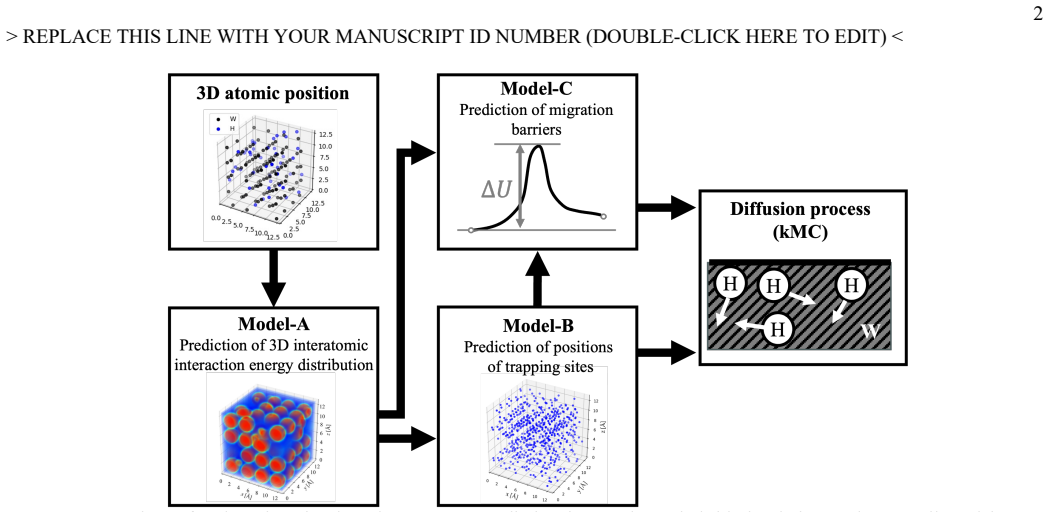
The two-channel volumetric 3D-CNN: one channel carries the local potential-energy distribution, the other the voxelized start- and end-site coordinates; the network maps this volume directly to a scalar migration barrier.
What would settle it
Compare the network’s barriers against fresh NEB or DFT calculations on configurations drawn from long irradiation MD trajectories that were never seen in training; a large rise in MAE would falsify the surrogate’s fitness for on-the-fly use.
Extended reading notes
Core claim
A two-channel 3D-CNN that ingests the local three-dimensional potential-energy field together with the voxelized coordinates of the initial and final trapping sites predicts hydrogen migration barriers in tungsten to MAE 0.124 eV and coefficient of determination 0.890, at approximately 2.7 ms per evaluation and a speed-up exceeding 23,000 relative to NEB, thereby supplying the missing fast transition-rate engine for on-the-fly MD–kMC hybrid modeling of plasma-facing materials.
Load-bearing premise
That a network trained only on Embedded Atom Method tungsten–hydrogen snapshots remains accurate for the continuously evolving atomic structures that appear under real plasma irradiation.
Editorial extensions
If this is right
- Transition rates inside kinetic Monte Carlo can be refreshed after every structural change without waiting for NEB.
- Hybrid MD–kMC simulations of hydrogen isotope transport in tungsten become feasible at reactor-relevant length and time scales.
- The same two-channel volumetric design can be retrained for other plasma-facing metals once EAM or equivalent data exist.
- Steady-state tritium inventory and permeation estimates for fusion devices can incorporate dynamically evolving trap landscapes rather than static barriers.
Reading between the lines
- If the local-energy representation proves transferable, the same architecture could serve as a drop-in barrier oracle for any interstitial or vacancy hop problem already solved by classical potentials.
- Uncertainty estimates on the CNN output would let kMC reject or recompute NEB only for high-variance hops, further reducing cost while controlling error.
- Training on mixed EAM–DFT labels could close the accuracy gap to first-principles barriers without sacrificing the millisecond inference speed.
Editorial analysis
A structured set of objections, weighed in public.
Referee Report
Summary. The abstract claims a 3D-CNN surrogate that maps a two-channel volumetric input (local 3D potential-energy field plus voxelized initial/final trapping sites) to hydrogen migration barriers in tungsten, trained on EAM-evaluated W–H configurations. Reported headline metrics are MAE 0.124 eV and R² 0.890, with GPU inference ~2.7 ms per barrier and a claimed >23,000× speedup over NEB, positioned as the missing piece for on-the-fly MD–kMC hybrid simulations of plasma–wall interactions. The body of the supplied manuscript, however, is an unrelated work on cross-modal coreference in Omni-LLMs (CROSSOMNI), so none of the plasma-physics methods, data, architecture, or results can be inspected.
Significance. If the abstract claims were substantiated, a validated, fast barrier surrogate for evolving W–H defect landscapes would be a genuine enabler for long-timescale kinetic Monte Carlo under continuous irradiation and would matter for fusion materials modeling. The contribution would rest on (i) demonstrated accuracy under structural evolution, (ii) comparison to NEB/DFT/experiment, and (iii) an actual hybrid MD–kMC demonstration. None of those elements are present in the manuscript as provided, so the significance remains conditional and unverified.
major comments (4)
- Manuscript–claim mismatch: the title, paper_id (2604.05521), and abstract describe a 3D-CNN migration-barrier model for plasma–wall interactions, but the full text is the CROSSOMNI Omni-LLM coreference paper (arXiv-style CS/CL content). No architecture, dataset construction, training protocol, figures, or tables for the 3D-CNN exist in the body. Peer review of the claimed contribution is therefore impossible from the supplied document.
- Abstract-only metrics (MAE 0.124 eV, R² 0.890, 2.7 ms inference, >23,000× NEB speedup) cannot be audited: there is no train/validation/test split, no error bars or residual analysis, no baseline (analytical estimates, other ML surrogates, or NEB timing protocol), and no definition of the NEB reference cost used for the speedup ratio.
- Central scientific assumption is untested in the document: that local EAM potential-energy voxels plus start/end site coordinates suffice for barriers under continuously evolving, irradiation-driven structures. The abstract reports only in-distribution EAM W–H performance; there is no OOD test vs DFT barriers, experimental activation energies, multi-defect environments, or structures outside the training distribution—yet the claim is that the model enables dynamic on-the-fly MD–kMC.
- The enabling claim for hybrid MD–kMC is not demonstrated: the abstract asserts the model is “the final component necessary to realize on-the-fly MD and kMC hybrid simulations,” but the manuscript contains no coupling interface, rate-table update protocol, stability under structure evolution, or any hybrid simulation result.
minor comments (2)
- Even at abstract level, units and protocol for the speedup (hardware, NEB image count, convergence criteria, batching) should be stated so the 23,000× figure is reproducible.
- If a corrected manuscript is resubmitted, it should include architecture details (depth, kernel sizes, channel design), voxelization resolution, EAM potential citation, and full hyperparameter/training settings.
Circularity Check
No circular derivation: abstract describes standard supervised surrogate learning of NEB/EAM barriers; claims do not reduce to inputs by construction.
full rationale
The claimed chain is empirical ML, not a first-principles derivation: migration barriers computed by NEB under an EAM potential are used as training labels; a 3D-CNN maps two-channel volumetric inputs (local potential-energy voxels plus voxelized initial/final sites) to a scalar barrier; reported MAE 0.124 eV and R² 0.890 are predictive accuracy metrics, and the 2.7 ms / >23,000× speedup is an engineering comparison to NEB. None of these steps is self-definitional (the barrier is not defined by the network output), none renames a fitted constant as a prediction of the same quantity, and the abstract invokes no uniqueness theorem or load-bearing self-citation that forces the result. Standard supervised fitting of a surrogate to expensive labels is not circular under the stated criteria. Note: the supplied full-manuscript body is an unrelated Omni-LLM/CROSSOMNI paper, so architecture, splits, and OOD checks cannot be inspected; that is a verification gap, not circularity. Score 0 with empty steps is therefore the honest finding on the available text.
Assumptions & free parameters
free parameters (2)
- 3D-CNN architecture and training hyperparameters
- EAM potential parameters for W–H
assumptions (3)
- ad hoc to paper Local 3D potential-energy distribution plus voxelized initial/final site coordinates are sufficient features to determine the migration barrier.
- domain assumption EAM-evaluated barriers are adequate targets for a surrogate intended to support plasma–wall transport modeling.
- domain assumption A static training distribution of W–H configurations generalizes to structures that evolve under continuous plasma irradiation.
invented entities (1)
-
Two-channel volumetric input (potential-energy field + voxelized trapping sites)
Cite this review
Pith. "Pith review of Development of a 3D-CNN-based Prediction Model for Migration Barriers in Plasma-Wall Interactions." pith.science (2026). https://pith.science/paper/XWO4DTZI
@misc{pith2026260405521,
  author       = {Pith},
  title        = {Pith review of: Development of a 3D-CNN-based Prediction Model for Migration Barriers in Plasma-Wall Interactions},
  year         = {2026},
  howpublished = {\url{https://pith.science/paper/XWO4DTZI}},
  note         = {Machine review of arXiv:2604.05521}
}
read the original abstract
Understanding the long-term transport of hydrogen isotopes in plasma-facing materials, such as tungsten, is critical for the steady-state operation of magnetic confinement fusion reactors. However, dynamically updating the transition parameters for kinetic Monte Carlo (kMC) simulations as the atomic structure evolves under continuous plasma irradiation remains a severe computational bottleneck. Conventionally, calculating these migration barriers requires the iterative and computationally expensive Nudged Elastic Band (NEB) method. To overcome this limitation, this article presents a highly efficient surrogate model for predicting migration barriers using a three-dimensional Convolutional Neural Network (3D-CNN), establishing the final component necessary to realize on-the-fly molecular dynamics (MD) and kMC hybrid simulations. The proposed deep learning model takes a two-channel volumetric input, the local three-dimensional potential energy distribution and the voxelized spatial coordinates of the initial and final trapping sites, to directly output the migration barrier as a scalar value. Trained on a comprehensive dataset of tungsten-hydrogen configurations evaluated using the Embedded Atom Method (EAM) potential, the model demonstrated robust predictive accuracy, achieving a Mean Absolute Error (MAE) of 0.124 eV and a high coefficient of determination of 0.890. Furthermore, utilizing GPU acceleration, the inference time is reduced to approximately 2.7 milliseconds per barrier, achieving a speed-up ratio of over 23,000 compared to conventional NEB calculations. This extraordinary acceleration effectively resolves the computational barrier of transition rate evaluations, paving the way for large-scale, dynamic modeling of plasma-wall interactions.
Figures
Reference graph
Works this paper leans on
-
[1]
Jack Hong, Shilin Yan, Jiayin Cai, Xiaolong Jiang, Yao Hu, and Weidi Xie
M2-omni: Advancing omni-mllm for com- prehensive modality support with competitive perfor- mance.arXiv preprint arXiv:2502.18778. Jack Hong, Shilin Yan, Jiayin Cai, Xiaolong Jiang, Yao Hu, and Weidi Xie. 2025. Worldsense: Evaluating real-world omnimodal understanding for multimodal llms.arXiv preprint arXiv:2502.04326. Inclusion, Bowen Ma, Cheng Zou, Canx...
arXiv 2025
-
[2]
Ming-flash-omni: A sparse, unified architec- ture for multimodal perception and generation.arXiv preprint arXiv:2510.24821. Xu Jin, Zhifang Guo, Hangrui Hu, Yunfei Chu, Xiong Wang, Jinzheng He, Yuxuan Wang, Xian Shi, Ting He, Xinfa Zhu, Yuanjun Lv, Yongqi Wang, Dake Guo, He Wang, Linhan Ma, Pei Zhang, Xinyu Zhang, Hongkun Hao, Zishan Guo, and 19 oth- ers....
arXiv 2025
-
[3]
Hongcheng Liu, Pingjie Wang, Yu Wang, and Yanfeng Wang
Anchornet: Adaptive anchor token enhance- ment in video-grounded dialogue generation.IEEE Journal of Selected Topics in Signal Processing, pages 1–11. Hongcheng Liu, Pingjie Wang, Yu Wang, and Yanfeng Wang. 2024b. M2k-vdg: Model-adaptive multimodal knowledge anchor enhanced video-grounded dia- logue generation.arXiv preprint arXiv:2402.11875. Hongcheng Li...
arXiv 2024
-
[4]
Zhenghao Xing, Xiaowei Hu, Chi-Wing Fu, Wen- hai Wang, Jifeng Dai, and Pheng-Ann Heng
Mmlu-pro: A more robust and challenging multi-task language understanding benchmark.Ad- vances in Neural Information Processing Systems, 37:95266–95290. Zhenghao Xing, Xiaowei Hu, Chi-Wing Fu, Wen- hai Wang, Jifeng Dai, and Pheng-Ann Heng. 2025. Echoink-r1: Exploring audio-visual reasoning in multimodal llms via reinforcement learning.arXiv preprint arXiv...
arXiv 2025
-
[5]
Omnivinci: Enhancing architecture and data for omni-modal understanding llm.arXiv preprint arXiv:2510.15870. LI Yizhi, Ge Zhang, Yinghao Ma, Ruibin Yuan, King Zhu, Hangyu Guo, Yiming Liang, Jiaheng Liu, Noah Wang, Jian Yang, and 1 others. 2025. Omnibench: Towards the future of universal omni-language mod- els. Xiang Yue, Yuansheng Ni, Kai Zhang, Tianyu Zh...
arXiv 2025
-
[6]
In paral- lel, many works have been proposed to probe uni- modal reasoning capabilities (Yizhi et al., 2025; Xing et al., 2025)
for image understanding and MMLU (Wang et al., 2024) for text comprehension. In paral- lel, many works have been proposed to probe uni- modal reasoning capabilities (Yizhi et al., 2025; Xing et al., 2025). For example, DailyOmni (Zhou et al., 2025) targets audio and visual reasoning in everyday scenarios, and WorldSense (Hong et al.,
2024
-
[7]
focuses on assessing collaborative under- standing and reasoning over omni-modal inputs. While these datasets are effective for measuring overall unimodal or holistic omni-modal perfor- mance, they typically do not isolate the key step of cross-modality coreference alignment, which lim- its their ability to diagnose why unimodal success does not translate...
2025
-
[8]
Ola- 7B in our table), indicating that data/recipe matters as much as parameter count
Model size helps but is not sufficient: We observe that a smaller model can outperform a larger one (e.g., Qwen2.5-Omni-3B vs. Ola- 7B in our table), indicating that data/recipe matters as much as parameter count
Show all 45 references
-
[9]
Architecture, especially the audio encoder, is critical: models using stronger Whisper variants tend to be markedly better, consis- tent with MiniCPM-o building on Whisper- medium while Qwen2.5-Omni is designed with Whisper-large-v3
-
[10]
thinking
Training paradigm matters: “thinking”- enhanced omni variants (e.g., Qwen3-Omni- Thinking) show stronger reasoning and can improve cross-modal alignment
-
[11]
think- ing
Data scaling is essential: expanding alignment-focused data consistently improves both SFT and GRPO in our experiments, highlighting the importance of sufficient, well-curated training signals. Overall, for cross-modal alignment, strong results typically require adequate model...
-
[12]
b.Track any changes in their appearance or actions across images
People: a.Describe the individuals in each image (clothing, appearance, expressions, body language). b.Track any changes in their appearance or actions across images. 2.Background and Environment: a.Include detailed descriptions of the setting (e.g., buildings, nature, objects...
-
[13]
**Overall Video Description**: This description provides the general background, theme, and main content of the video
-
[14]
**Segment Descriptions**: These provide detailed descriptions of each segment of the video, which may contain specific events or scenes. Please generate the final, complete description as follows: - Integrate the overall description with the individual segment descriptions, en...
-
[15]
**Place of birth and upbringing**: Where they were born and raised, family environment, education background, etc
-
[16]
**Significant life events**: Major life events or turning points that shaped their life
-
[17]
**Career and achievements**: Their career path, important achievements, and contributions
-
[18]
**Relationships**: Key relationships with others, such as family, friends, enemies, or partners
-
[19]
Ensure the biography covers all provided background details, and the name used in the biography must match the one provided
**Personality and psychological development**: Their personality traits and any psychological or emotional growth. Ensure the biography covers all provided background details, and the name used in the biography must match the one provided. The format is: Name + Biography. <bac...
-
[20]
b.Track any changes in their appearance or actions across images
People: a.Describe the individuals in each image (clothing, appearance, expressions, body language). b.Track any changes in their appearance or actions across images. 2.Background and Environment: a.Include detailed descriptions of the setting (e.g., buildings, nature, objects...
-
[21]
child girl); mutually exclusive key actions/events (e.g., driving vs
People conflicts: significantly different number of main people; clearly contradictory identity/type (e.g., adult man vs. child girl); mutually exclusive key actions/events (e.g., driving vs. cooking at a desk)
-
[22]
highway); strongly contradictory environment (e.g., heavy rain outdoors vs
Background conflicts: clearly different main scene type (e.g., kitchen vs. highway); strongly contradictory environment (e.g., heavy rain outdoors vs. quiet indoor office); incompatible main objects/interactions
-
[23]
Allowed Differences (do NOT count as fundamental conflicts):
Narrative conflicts: overall story/sequence cannot reasonably align as the same video; descriptions refer to different scenarios/storylines. Allowed Differences (do NOT count as fundamental conflicts):
-
[24]
Different level of detail (one richer, one concise)
-
[25]
Minor omissions or reordering without contradicting main events
-
[26]
Person Double Check Analyzes the consistency of descriptions for each name and outputs whether they are correct or not
Small secondary-detail differences (e.g., unmentioned background object, ambiguous colors/positions) when core people/setting/actions match. Person Double Check Analyzes the consistency of descriptions for each name and outputs whether they are correct or not. Rules:
-
[27]
If the same name has multiple completely different descriptions, choose the description that appears most frequently as the final description
-
[28]
If any description contains terms like ’failed’, ’cannot describe’, or anything that indicates the description is not valid, directly output <Failed>
-
[29]
If different names have the same description (roughly similar), directly output <Failed>
-
[30]
The format is: name + description
If there no failed casess, output the name and its description. The format is: name + description. Table 14: Prompt for modality annotation double check. Prompt QA Generation Design a question where the model infers **factual description** from **visual actions**, using the fo...
-
[31]
**Visual Actions**: - These include body language, gestures, and facial expressions
-
[32]
<failure>
**Factual description**: - These refer to stated details such as names, dates, locations, occupations, and major life events (e.g., education, career milestones, relationships). Design a question to infer **factual description** from **visual actions**. If you cannot design an...
-
[33]
2) You MUST act as if all background/identity information about people comes from the person biography
You MUST act as if all visual information (who/what appears, appearance, position, actions, environment, etc.) comes directly from watching the video. 2) You MUST act as if all background/identity information about people comes from the person biography
-
[34]
You MUST act as if all background/identity information about objects comes from the object biography
-
[35]
Do not mention or allude to them
The Visual description and Person description are only internal tools to help you reconstruct what WOULD HA VE BEEN seen in the video and how it connects to the biographies. Do not mention or allude to them
-
[36]
Reasoning Details Rules:
In your reasoning, always frame information as observations from: - watching the video, and - reading the relevant biography (person or object). Reasoning Details Rules:
-
[37]
First, determine whether the Question is about a person or an object, and identify which specific person or object it refers to, as if you are using only the video content (internally you may rely on the Visual description, but never mention it)
-
[38]
Second, if the Question is about a person, infer their name and identity as if you know it from the person’s biography (internally using the Person description + person biography); if it is about an object, infer its identity/type as if you recognize it from the video and the ...
-
[39]
Third, match this person to the person biography, or this object to the object biography, and explain how their background or properties are relevant to the Question
-
[40]
Make the reasoning explicit and multi-step, not just one short sentence
Then, using the relevant biography information (person or object) together with what is seen in the video, logically derive and justify the correct Answer step by step. Make the reasoning explicit and multi-step, not just one short sentence
-
[41]
Your final conclusion MUST exactly match the hidden Answer above, but you MUST NOT reveal that this Answer was given to you
-
[42]
A”, “B”, “C
The Reasoning Details must be entirely in English. Output format: <Reasoning Details>: Your step-by-step reasoning here <Final Answer>: State the final answer here, matching the hidden Answer Table 16: Prompt for CoT generation. We use the visual→text questions as a case study...
-
[43]
Question-guided visual localization (1 point): The reasoning interprets the question and uses it to identify and localize the relevant person/object in the video, including describing its visual appearance, rather than directly searching the text
-
[44]
Text retrieval via visual description (1 point): Using this visual description, the reasoning explicitly finds the corresponding Additional Information about this person/object in the text (e.g., matching name or described appearance), clearly linking video appearance to a spe...
-
[45]
Scoring rule: - Award 1 point for each criterion that is clearly satisfied
Answer grounded in retrieved text (1 point): The reasoning then uses the retrieved textual Additional Information as the key evidence to select the final option A/B/C/D, with the answer clearly supported by that text and without major unsupported assumptions or contradictions....
Reviewed July 13, 2026 · model on record in the stance chip above.
Discussion (0). Continue with ORCID to comment.