REVIEW 3 major objections 2 minor 106 references
Models Know Their Shortcuts: Deployment-Time Shortcut Mitigation
T0 review · 3 major / 2 minor · reviewed 2026-07-12 · grok-4.5
Pith's one-line read A converged biased text encoder alone carries a usable signal of its own shortcuts, enough to mitigate them at deployment without training data.
desk verdict The abstract is an ML shortcut-mitigation claim; the supplied full text is an unrelated condensed-matter paper, so the central result cannot be checked. read the letter →
The pith
A machine-rendered reading of the paper's core claim, the machinery that carries it, and where it could break.
The reading
What carries the argument
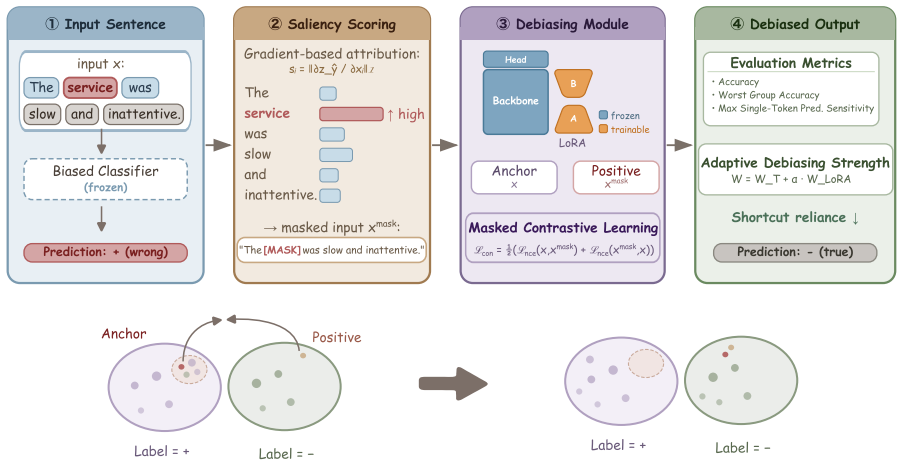
Unsupervised gradient-based attribution on the converged model, which isolates the model’s internalized shortcut fingerprint and feeds the proposed Shortcut Guardrail mitigation framework.
What would settle it
On a controlled shortcut-shift benchmark (e.g., sentiment with deliberately flipped lexical cues), measure whether Shortcut Guardrail recovers accuracy comparable to a training-time baseline that had full access to the original data and shortcut annotations; a large, consistent gap would falsify the claim that the frozen model’s gradient signal is sufficient.
Extended reading notes
Core claim
A biased pretrained text encoder internalizes a detectable signal of the shortcuts it learned; that signal can be extracted by unsupervised gradient-based attribution on the frozen model alone and then used to mitigate the shortcuts at deployment time, recovering most of the performance lost under distribution shift without any access to training data or shortcut annotations.
Load-bearing premise
That gradient attribution on a frozen model, with no training data or labels, yields a pure enough shortcut signal to drive mitigation that matches methods that saw the original data.
Editorial extensions
If this is right
- Practitioners can retrofit already-deployed text encoders against shortcut failure without needing the original training corpus.
- Model cards or audit tools can report a gradient-derived shortcut fingerprint as a diagnostic that requires only the weights.
- The information-theoretic upper bound implies that any future deployment-only method cannot beat the best training-time method on the same shortcuts.
- The same gradient signal may serve as a cheap monitor for detecting when a deployed model is relying on brittle correlations.
Reading between the lines
- If the gradient fingerprint is stable across fine-tunes of the same base encoder, a single pre-computed guardrail could be reused for many downstream tasks.
- The technique may transfer to other modalities (vision, speech) wherever a frozen encoder exhibits analogous token- or patch-level shortcuts.
- Regulators could require release of the shortcut attribution map alongside model weights as a lightweight audit artifact.
Editorial analysis
A structured set of objections, weighed in public.
Referee Report
Summary. The submission is titled and abstracted as a machine-learning paper (arXiv:2604.12277, cs.LG) claiming that a converged biased pretrained text encoder alone internalizes a recoverable shortcut signal, extractable by unsupervised gradient-based attribution, and that the proposed framework Shortcut Guardrail recovers performance under shortcut distribution shift on sentiment, toxicity, and NLI while being information-theoretically upper-bounded by training-time mitigation. The full manuscript body supplied with the submission is an unrelated condensed-matter paper (arXiv:2604.12275v1, cond-mat.mes-hall) on the magnetoelectric conductivity of gapped nodal rings in the presence of strain-induced axial pseudomagnetic fields. No definitions, proofs, algorithms, or experiments supporting the abstract’s ML claims appear in the body.
Significance. If the abstract’s claims were supported by a matching manuscript—i.e., a clean unsupervised deployment-time mitigation method that matches training-time baselines without training data, dynamics, or shortcut labels, plus a rigorous information-theoretic upper bound—the work would be of clear practical and conceptual interest for robust NLP deployment. As submitted, that contribution cannot be assessed: the body contains only analytical transport calculations for gapped nodal rings (Berry curvature, orbital magnetic moment, planar-Hall setups I–III). No credit can be assigned for machine-checked proofs, code, or falsifiable ML predictions because none of those artifacts are present for the claimed paper.
major comments (3)
- Title/abstract vs. full text: the abstract and paper_id (2604.12277, cs.LG, Shortcut Guardrail) do not correspond to the manuscript body (2604.12275, cond-mat.mes-hall, magnetoelectric conductivity of gapped nodal rings). Every load-bearing claim in the abstract—internalized shortcut signal, unsupervised gradient attribution, the Shortcut Guardrail procedure, the information-theoretic upper bound, and the sentiment/toxicity/NLI results—is unsupported by any section, equation, table, or figure in the supplied text. The central claim is therefore unevaluable.
- Because the body is a different paper, the weakest assumption identified for the claimed work (that unsupervised gradient attribution on a frozen encoder yields a pure, actionable shortcut signal without training data/dynamics/annotations) cannot be checked against any definition of the attribution map, faithfulness/purity diagnostics, or ablation. No method section, algorithm box, or experimental protocol for Shortcut Guardrail exists in the manuscript.
- The information-theoretic upper bound asserted in the abstract (“deployment-time mitigation is information-theoretically upper-bounded by training-time mitigation”) is not stated or proved anywhere in the body. There is no theorem, lemma, or information-theoretic argument to review.
minor comments (2)
- Even as a standalone physics manuscript, the body has presentation issues (e.g., mixed notation for B5 vs. B_5, long unparsed expressions in appendices) that would need cleanup if that paper were under review; they are secondary here because the body is not the paper under review.
- arXiv identifiers in the header (2604.12275) and the claimed paper_id (2604.12277) differ by two; this should be corrected at the source before any resubmission.
Circularity Check
No circularity: the manuscript is a self-contained semiclassical calculation of magnetoelectric conductivity for strained gapped nodal rings; results follow from explicit integration, not from fitted inputs or self-definitional premises.
full rationale
The full manuscript (arXiv:2604.12275) derives planar-Hall and related magnetoelectric conductivities for an ideal gapped nodal ring in the simultaneous presence of E, B, and a strain-induced axial field B5. The load-bearing chain is: (i) the two-band GNR Hamiltonian linearized in toroidal coordinates; (ii) standard two-band formulas for Berry curvature and orbital magnetic moment; (iii) the axial gauge field A5 from nonuniform strain, giving vortex-like B5 co-aligned with BC/OMM; (iv) the weak-field semiclassical Boltzmann conductivity (in-plane Drude/BC/OMM/concurrent pieces plus Lorentz-force series) expanded to O(|B_tot|^2) or O(|B_tot|^3); (v) explicit angular integration over the toroidal Fermi surface, which yields nonvanishing linear-in-B5 terms precisely because B5·Ω and B5·m are ϕ-independent. Those integrals are not tautological: for isotropic Weyl nodes the same angular integrals vanish, and the paper contrasts the two cases rather than assuming the GNR result. Self-citations (especially the unstrained GNR baselines in Ref. [39] and the Boltzmann/LF operator machinery in the authors’ prior works) supply the unstrained limit and the formal expansion, but the B5-dependent coefficients are recomputed and tabulated; they are not imported as uniqueness theorems or renamed empirical fits. Parameter values in Table I are taken from the literature for representative plots only; no quantity is fitted to data and then re-presented as a prediction. Consequently there is no self-definitional step, no fitted-input-called-prediction, no load-bearing uniqueness import, and no ansatz smuggled in via citation that forces the central claims. Score 0 is appropriate. (Note: the supplied abstract/title claim an unrelated ML shortcut-mitigation paper; circularity of that abstract cannot be assessed because its method, proof, and experiments are absent from the manuscript body.)
Assumptions & free parameters
assumptions (3)
- domain assumption Pretrained text encoders learn token-label shortcuts that fail under deployment distribution shift.
- ad hoc to paper A biased converged model internalizes a recoverable unsupervised signal of its shortcuts accessible via gradient-based attribution.
- ad hoc to paper Deployment-time mitigation is information-theoretically upper-bounded by training-time mitigation.
invented entities (1)
-
Shortcut Guardrail
Cite this review
Pith. "Pith review of Models Know Their Shortcuts: Deployment-Time Shortcut Mitigation." pith.science (2026). https://pith.science/paper/3BPO6NN7
@misc{pith2026260412277,
  author       = {Pith},
  title        = {Pith review of: Models Know Their Shortcuts: Deployment-Time Shortcut Mitigation},
  year         = {2026},
  howpublished = {\url{https://pith.science/paper/3BPO6NN7}},
  note         = {Machine review of arXiv:2604.12277}
}
read the original abstract
Pretrained text encoders are prone to shortcut learning, relying on token-label correlations that fail once the distribution shifts in deployment. Existing shortcut mitigation methods mainly operate at training time and assume access to training data, training dynamics, or shortcut annotations, which are hardly available during deployment, where only the converged model remains. We show that this model alone suffices to mitigate shortcuts during deployment: a biased model internalizes a signal of its learned shortcuts that can be captured via unsupervised gradient-based attribution. We further prove that deployment-time mitigation is information-theoretically upper-bounded by training-time mitigation. Nevertheless, exploiting this gradient signal, our proposed unsupervised deployment-time shortcut mitigation framework for pretrained text encoders, Shortcut Guardrail, recovers substantial performance under shortcut distribution shift, matching or outperforming training-time baselines across sentiment classification, toxicity detection, and natural language inference.
Figures

Figures from the paper (4 more)

Reference graph
Works this paper leans on
-
[1]
Longitudinal conductivity: ¯σxx 12
-
[2]
Planar-Hall conductivity: ¯σyx 13
-
[3]
LF-induced in-plane contributions:σ (lf) xx andσ (lf) yx 13
-
[4]
Set-up II 13
Out-of-plane conductivity:σ zx 13 B. Set-up II 13
-
[5]
Longitudinal conductivity: ¯σxx 13
-
[6]
LF-induced contributions:σ (lf) xx andσ (lf) zx 14
-
[7]
Set-up III 14
Out-of-plane conductivity:σ yx 14 C. Set-up III 14
-
[8]
Longitudinal conductivity: ¯σzz 14
Show all 106 references
-
[9]
LF-induced in-plane contributions:σ (lf) zz andσ (lf) xz 14
-
[10]
Summary, concluding remarks, and future perspectives 15 A
Out-of-plane conductivity:σ yz 15 V. Summary, concluding remarks, and future perspectives 15 A. Full expressions for the OMM-induced corrections to band-velocities 16 B. Details for the current density originating from the action of the Lorentz-force operator 17 1.n= 1: Terms ...
2026 arXiv
-
[11]
Set-up III 21 References 22 I. INTRODUCTION The discovery of three-dimensional (3d) semimetals with symmetry-protected band-crossings has opened a direct path- way from the abstract mathematics of topology to the concrete physics of material band structures. These remarkable s...
-
[12]
The generic expression for the in-plane components of the magnetoelectric conductivity tensor contributed by the band with indexs, is given by ¯σs ij =−e 2 τ Z d3k (2π) 3 Ds (vs)i +e(v s ·Ω s)B tot i h (vs)j +e(v s ·Ω s)B tot j i ∂f0(Es) ∂Es .(15) For the ease of calculations,...
-
[13]
anomalous Hall
The out-of-plane components are captured by the so-called anomalous-Hall part (denoted byσ AH,s) and the Lorentz- force-operator contributions [17, 19, 63]. Expanding up toO |Btot|3 , we find that (σ(ah) s )ij =−e 2 ϵijl Z d3k (2π) 3 Ωl s f0(εs) +ε (m) f ′ 0(εs) + 1 2 ε(m) 2 f...
-
[14]
+B 5-term 0 Υ3 Bx � 1 + Υ4 (B2 x + 4B 2 5) � +B 5-term (b) Set-up I:� 5- and� i-dependence in LF-induced terms, organised by the values of�and physical origins. σlf,(h) σlf,(bc) σlf,(m) σlf, (conc) n= 1,σ zx By By B5, B y B2 5 , B y (B2 x +B 2 y) By B5, By B2 5 , B y (B2 x +B ...
-
[15]
Therefore, it is the OMM that dictates the sign of the total non-Drude longitudinal response
Longitudinal conductivity:¯σ xx In the absence of strain (i.e.,B 5 =0),σ (bc) xx is positive and∝(B 2 x + 3B 2 y).σ (m) xx shows the same∝(B 2 x + 3B 2 y)- dependence, but with a larger coefficient of opposite sign.σ (conc) xx is also negative. Therefore, it is the OMM that di...
-
[16]
Overall, the BC-only part is opposite in sign to the OMM-only and concurrent contributions
for the BC-only part while the OMM-only parts gets two competing contributions, i.e., a negative contribution from − B2 x + 3B 2 y + 4B 2 5 k0 6µ 2 −5 ∆2 and a positive contribution weighted by 2(B� � +3B � � )µ� v� ζ . Overall, the BC-only part is opposite in sign to the OMM-...
-
[17]
EveryB 5-dependent integrand for this component depends onϕ in a way which yields zero uponϕ-integration
Planar-Hall conductivity:¯σ yx ¯σyx iscompletely blindto the pseudomagnetic field. EveryB 5-dependent integrand for this component depends onϕ in a way which yields zero uponϕ-integration. As a result, ¯σ yx retains precisely the form ¯σyx ∝B x By found in Ref. [39]. From an e...
-
[18]
Strain induces additional terms (cf
LF-induced in-plane contributions:σ ���� xx andσ ���� yx ForB 5 =0, the only in-plane LF-induced parts arise from then= 2 term inY s [39]. Strain induces additional terms (cf. Appendix C 1): (I) FromN 2,2, a term∝B 2 5 (∆2 −µ 2)<0 appears inσ lf,(h) xx . (II) FromN 2,3, terms ...
-
[19]
Eqs (26) and (28)] are preserved with respect to theB 5 =0results [39]: then= 1,3 terms of Eq
Out-of-plane conductivity:σ zx The overall structures of the anomalous-Hall and LF-induced response [cf. Eqs (26) and (28)] are preserved with respect to theB 5 =0results [39]: then= 1,3 terms of Eq. (20) produce out-of-plane response, whilen= 2 produces in-plane (longitudinal...
-
[20]
The concurrent part is also negative, resulting in a net negative value for the non-Drude part of ¯σxx [39]
Longitudinal conductivity:¯σ xx ForB 5 =0, the BC-only part is positive, the OMM-only part is negative and dominant. The concurrent part is also negative, resulting in a net negative value for the non-Drude part of ¯σxx [39]. Strain introduces the following extra terms [cf. Eq...
-
[21]
Their coefficients in the BC-only term are opposite to those of OMM-only and concurrent parts
in the terms not having aµ 4-dependence. Their coefficients in the BC-only term are opposite to those of OMM-only and concurrent parts. 14
-
[22]
Strain adds nonzero LF-induced contributions as follows (cf
LF-induced contributions:σ ���� xx andσ ���� zx ForB 5 =0, the sole in-plane contribution is obtained forn= 2, such thatσ lf,(bc) xx =σ lf,(m) xx =σ lf,(conc) xx = 0 — only σlf,(h) xx is nonzero [39]. Strain adds nonzero LF-induced contributions as follows (cf. Appendix C 2): ...
-
[23]
Here, theN 1,1 part for the unstrained case is zero [39], unlike set-ups I and III
Out-of-plane conductivity:σ yx Set-up II is the only configuration where the out-of-plane response is entirely of LF origin (i.e., has no contribution from anomalous-Hall effect). Here, theN 1,1 part for the unstrained case is zero [39], unlike set-ups I and III. This makes it...
-
[24]
Sinceσ (conc) zz is also negative, the net non-Drude response is negative and dominated by the by OMM, analogous to set-ups I and II
Longitudinal conductivity:¯σ zz ForB 5 =0, the non-Drude part of ¯σzz has a positive BC-only part∝B 2 x, whileσ (m) zz comes with an opposite sign with a larger magnitude. Sinceσ (conc) zz is also negative, the net non-Drude response is negative and dominated by the by OMM, an...
-
[25]
is observed in all three non-Drude parts. The B2 5 coefficient of 2 (rather than 4, which appear in the first 2 set-ups) is a direct consequence ofE∥ˆz— only one of the two in-plane components ofB 5 contributes to the integral, compared to both in-plane components contributing...
-
[26]
Unlike set-up II, there is noB 2 z contribution fromN 2,2
LF-induced in-plane contributions:σ (lf) zz andσ (lf) xz ForB 5 =0, the sole in-plane LF-induced contributions appear fromN 2,2 [39], being∝B 2 x ∆2 −µ 2 <0, with σlf,(bc) zz =σ lf,(m) zz =σ lf,(conc) zz = 0. Unlike set-up II, there is noB 2 z contribution fromN 2,2. Strain in...
-
[27]
ForN 2,2,B 2 x is replaced by (B 2 x + 2B 2 5), accompanying (∆2 −µ 2)
-
[28]
These are proportional toB 5 B2 x,B 5 B2 z, andB 3
ForN 2,3, linear-in-B5 and cubic-in-B5 terms emerge inσ lf,(bc) zz andσ lf,(m) zz . These are proportional toB 5 B2 x,B 5 B2 z, andB 3
-
[29]
Additionally,N 2,3 generates contributions inσ lf,(bc) xz andσ lf,(m) xz , which are∝B 5 Bx Bz. 15
-
[30]
Eqs (34) and (36)] are preserved with respect to theB 5 =0results [39]: then= 1,3 terms of Eq
Out-of-plane conductivity:σ yz The anomalous-Hall and LF-induced response [cf. Eqs (34) and (36)] are preserved with respect to theB 5 =0results [39]: then= 1,3 terms of Eq. (20) produce out-of-plane response, whilen= 2 produces in-plane (longitudinal and transverse) response ...
-
[31]
Linear-in-|B|: N 1,1 =v (0,s) f ′ 0(εs) v(0,s) ×B · ∇k v(0,s) ·E .(B6)
-
[32]
Quadratic-in-|B|: N 1,2 =v (0,s) v(0,s) ·E f ′ 0(εs)(v(0,s) ×B)· ∇ k [−e(Ω s ·B)] +v (0,s) f ′ 0 (εs) v(0,s) ×B · ∇k h v(m) +V s ·E i + hn −2e(Ω s ·B)v (0,s) + v(m) +V s o f ′ 0(εs)−(m s ·B)v (0,s) f ′′ 0 (εs) i v(0,s) ×B · ∇k v(0,s) ·E +v (0,s) f ′ 0(εs) v(m) ×B · ∇k v(0,s) ·E .(B7)
-
[33]
Let us express the current density as Jlf s =−e 4 τ 3 Z d3k (2π) 3 3X p=2 N 2,p ,(B10) whereN 2,p has a|B| p-dependence
Cubic-in-|B|: N 1,3 = hn −e(Ω s ·B)v (0,s) v(0,s) ·E +v (0,s) v(m) +V s ·E+ v(0,s) ·E v(m) +V s o f ′ 0(εs) −(m s ·B)v (0,s) v(0,s) ·E f ′′ 0 (εs) i × h v(0,s) ×B · ∇k {−e(Ω s ·B)} i +v (0,s) v(0,s) ·E f ′ 0(εs) h v(0,s) ×B · ∇k h e2 (Ωs ·B) 2 i + v(m) ×B · ∇k {−e(Ω s ·B)} i +...
-
[34]
Quadratic-in-|B|: N 2,2 =v (0,s) f ′ 0(εs) v(0,s) ×B · ∇k h v(0,s) ×B · ∇k v(0,s) ·E i .(B11)
-
[35]
Cubic-in-|B|: N 2,3 =v (0,s) f ′ 0(εs) v(0,s) ×B · ∇k h −e(Ω s ·B) v(0,s) ×B · ∇k v(0,s) ·E + v(0,s) ×B · ∇k n v(m) +V s ·E o + v(m) ×B · ∇k v(0,s) ·E i +v (0,s) f ′ 0(εs) v(m) ×B · ∇k h v(0,s) ×B · ∇k v(0,s) ·E i +v (0,s) f ′ 0(εs) v(0,s) ×B · ∇k h v(0,s) ·E v(0,s) ×B · ∇k {−...
-
[36]
Set-up I The individual expressions shown here feed into the final expressions summarised in Sec. III A. 1.n= 1 — This part comprises 3 sub-parts, which give us nonzero values for the out-of-plane conductivity.N 1,1 contributes to σlf,(h) zx = τ 2 e3 v0 vz k0 By 8π µ 2 ∆2 −µ 2...
-
[37]
Set-up II The individual expressions shown here feed into the final expressions summarised in Sec. III B. 1.n= 1 — Only the out-of-plane conductivity is nonzero, sourced by 2 sub-parts.N 1,2 contributes to σlf,(h) yx =σ lf,(bc) yx =σ lf, (conc) yx = 0, σ lf,(m) yx =− e4 k0 v4 ...
-
[38]
Set-up III The individual expressions shown here feed into the final expressions summarised in Sec. III C. 1.n= 1 — The surviving ones are the out-of-plane components, which arise from three parts.N 1,1 contributes to σlf,(h) yz = τ 2 e3 vz v0 k0 Bx 8π µ 2 ∆2 −µ 2 .(C13) N 1,2...
-
[39]
A. A. Burkov and L. Balents, Weyl semimetal in a topological insulator multilayer, Phys. Rev. Lett.107, 127205 (2011)
2011
-
[40]
Yan and C
B. Yan and C. Felser, Topological materials: Weyl semimetals, Annual Rev. of Condensed Matter Phys.8, 337 (2017)
2017
-
[41]
Bradlyn, J
B. Bradlyn, J. Cano, Z. Wang, M. G. Vergniory, C. Felser, R. J. Cava, and B. A. Bernevig, Beyond Dirac and Weyl fermions: Unconventional quasiparticles in conventional crystals, Science353(2016)
2016
-
[42]
A. A. Burkov, M. D. Hook, and L. Balents, Topological nodal semimetals, Phys. Rev. B84, 235126 (2011)
2011
-
[43]
W. B. Rui, Y. X. Zhao, and A. P. Schnyder, Topological transport in Dirac nodal-line semimetals, Phys. Rev. B97, 161113 (2018)
2018
-
[44]
Q. Wu, A. A. Soluyanov, and T. Bzduˇ sek, Non-abelian band topology in noninteracting metals, Science365, 1273 (2019)
2019
-
[45]
C. Fang, Y. Chen, H.-Y. Kee, and L. Fu, Topological nodal line semimetals with and without spin-orbital coupling, Phys. Rev. B92, 081201 (2015)
2015
-
[46]
B. Yang, Y. Bi, R.-X. Zhang, R.-Y. Zhang, O. You, Z. Zhu, J. Feng, H. Sun, C. T. Chan, C.-X. Liu, and S. Zhang, Momentum space toroidal moment in a photonic metamaterial, Nature Communications12, 1784 (2021)
2021
-
[47]
Xiao, M.-C
D. Xiao, M.-C. Chang, and Q. Niu, Berry phase effects on electronic properties, Rev. Mod. Phys.82, 1959 (2010)
1959
-
[48]
Sundaram and Q
G. Sundaram and Q. Niu, Wave-packet dynamics in slowly perturbed crystals: Gradient corrections and Berry-phase effects, Phys. Rev. B59, 14915 (1999)
1999
-
[49]
Knoll, C
A. Knoll, C. Timm, and T. Meng, Negative longitudinal magnetoconductance at weak fields in Weyl semimetals, Phys. Rev. B 101, 201402 (2020)
2020
-
[50]
Ghosh and I
R. Ghosh and I. Mandal, Electric and thermoelectric response for Weyl and multi-Weyl semimetals in planar Hall configurations including the effects of strain, Physica E: Low-dimensional Systems and Nanostructures159, 115914 (2024)
2024
-
[51]
Graf and F
A. Graf and F. Pi´ echon, Berry curvature and quantum metric inN-band systems: An eigenprojector approach, Phys. Rev. B 104, 085114 (2021)
2021
-
[52]
Ghosh and I
R. Ghosh and I. Mandal, Direction-dependent conductivity in planar Hall set-ups with tilted Weyl/multi-Weyl semimetals, Journal of Physics: Condensed Matter36, 275501 (2024)
2024
-
[53]
Mandal and K
I. Mandal and K. Saha, Thermoelectric response in nodal-point semimetals, Ann. Phys. (Berlin)536, 2400016 (2024)
2024
-
[54]
Medel, R
L. Medel, R. Ghosh, A. Mart´ ın-Ruiz, and I. Mandal, Electric, thermal, and thermoelectric magnetoconductivity for Weyl/multi- Weyl semimetals in planar Hall set-ups induced by the combined effects of topology and strain, Scientific Reports14, 21390 (2024)
2024
-
[55]
Ghosh, F
R. Ghosh, F. Haidar, and I. Mandal, Linear response in planar Hall and thermal Hall setups for Rarita-Schwinger-Weyl semimetals, Phys. Rev. B110, 245113 (2024)
2024
-
[56]
Mandal, Anisotropic conductivity for the type-I and type-II phases of Weyl/multi-Weyl semimetals in planar Hall set-ups, Annals of Physics482, 170181 (2025)
I. Mandal, Anisotropic conductivity for the type-I and type-II phases of Weyl/multi-Weyl semimetals in planar Hall set-ups, Annals of Physics482, 170181 (2025)
2025
-
[57]
Haidar and I
F. Haidar and I. Mandal, Reflections of topological properties in the planar-Hall response for semimetals carrying pseudospin-1 quantum numbers, Annals of Physics478, 170010 (2025)
2025
-
[58]
F. D. M. Haldane, Berry curvature on the Fermi surface: Anomalous Hall effect as a topological Fermi-liquid property, Phys. Rev. Lett.93, 206602 (2004)
2004
-
[59]
Goswami and S
P. Goswami and S. Tewari, Axionic field theory of (3 + 1)-dimensional Weyl semimetals, Phys. Rev. B88, 245107 (2013)
2013
-
[60]
A. A. Burkov, Anomalous Hall effect in Weyl metals, Phys. Rev. Lett.113, 187202 (2014)
2014
-
[61]
Zhang, H.-Z
S.-B. Zhang, H.-Z. Lu, and S.-Q. Shen, Linear magnetoconductivity in an intrinsic topological Weyl semimetal, New Journal of Phys.18, 053039 (2016)
2016
-
[62]
Chen and G
Q. Chen and G. A. Fiete, Thermoelectric transport in double-Weyl semimetals, Phys. Rev. B93, 155125 (2016)
2016
-
[63]
Nandy, G
S. Nandy, G. Sharma, A. Taraphder, and S. Tewari, Chiral anomaly as the origin of the planar Hall effect in Weyl semimetals, Phys. Rev. Lett.119, 176804 (2017)
2017
-
[64]
Das and A
K. Das and A. Agarwal, Linear magnetochiral transport in tilted type-I and type-II Weyl semimetals, Phys. Rev. B99, 085405 (2019)
2019
-
[65]
O. Pal, B. Dey, and T. K. Ghosh, Berry curvature induced magnetotransport in 3D noncentrosymmetric metals, Journal of Phys.: Condensed Matter34, 025702 (2022)
2022
-
[66]
L. X. Fu and C. M. Wang, Thermoelectric transport of multi-Weyl semimetals in the quantum limit, Phys. Rev. B105, 035201 (2022)
2022
-
[67]
Y. P. Mizuta and F. Ishii, Contribution of Berry curvature to thermoelectric effects,Proceedings of the International Conference on Strongly Correlated Electron Systems (SCES2013), JPS Conf. Proc.3, 017035 (2014)
2014
-
[68]
Mandal, Effects of time-periodic drive in the linear response for planar-Hall set-ups with Weyl and multi-Weyl semimetals, Canadian Journal of Physics103, 1147 (2025)
I. Mandal, Effects of time-periodic drive in the linear response for planar-Hall set-ups with Weyl and multi-Weyl semimetals, Canadian Journal of Physics103, 1147 (2025)
2025
-
[69]
Balduini, A
F. Balduini, A. Molinari, L. Rocchino, V. Hasse, C. Felser, M. Sousa, C. Zota, H. Schmid, A. G. Grushin, and B. Gotsmann, Intrinsic negative magnetoresistance from the chiral anomaly of multifold fermions, Nature Communications15, 6526 (2024)
2024
-
[70]
L. Li, J. Cao, C. Cui, Z.-M. Yu, and Y. Yao, Planar Hall effect in topological Weyl and nodal-line semimetals, Phys. Rev. B 108, 085120 (2023)
2023
-
[71]
M.-X. Yang, H. Geng, W. Luo, L. Sheng, W. Chen, and D. Y. Xing, Sign reversal of magnetoresistivity in massive nodal-line semimetals due to the Lifshitz transition of the Fermi surface, Phys. Rev. B104, 165149 (2021)
2021
-
[72]
W. L. Min-Xue Yang and W. Chen, Quantum transport in topological nodal-line semimetals, Advances in Physics: X7, 2065216 (2022)
2022
-
[73]
M. N. Chen, W. C. Chen, and Y. Zhou, Topological hybrid semimetal phases and anomalous Hall effects in a three dimensional magnetic topological insulator, Journal of Physics: Condensed Matter34, 025502 (2021)
2021
-
[74]
Sekh and I
S. Sekh and I. Mandal, Magnus Hall effect in three-dimensional topological semimetals, Eur. Phys. J. Plus137, 736 (2022)
2022
-
[75]
J. Noky, Q. Xu, C. Felser, and Y. Sun, Large anomalous Hall and Nernst effects from nodal line symmetry breaking in Fe 2MnX 23 (X = P, As, Sb), Phys. Rev. B99, 165117 (2019)
2019
-
[76]
E. Liu, Y. Sun, N. Kumar, L. Muechler, A. Sun, L. Jiao, S.-Y. Yang, D. Liu, A. Liang, Q. Xu, J. Kroder, V. S¨ uß, H. Borrmann, C. Shekhar, Z. Wang, C. Xi, W. Wang, W. Schnelle, S. Wirth, Y. Chen, S. T. B. Goennenwein, and C. Felser, Giant anomalous Hall effect in a ferromagnet...
2018
-
[77]
Hussain Rather, M
F. Hussain Rather, M. Jaffar A., and I. Mandal, Direction-dependent linear response for gapped nodal-line semimetals in planar-Hall configurations, Eur. Phys. J. B99, 41 (2026)
2026
-
[78]
I. Mandal, Unconventional magnetoelectric conductivity and electrochemical response from dipole-like sources of Berry curva- ture, arXiv e-prints (2026), arXiv:2602.08844 [cond-mat.mes-hall]
2026
-
[79]
M. M. Hosen, G. Dhakal, B. Wang, N. Poudel, K. Dimitri, F. Kabir, C. Sims, S. Regmi, K. Gofryk, D. Kaczorowski, A. Bansil, and M. Neupane, Experimental observation of drumhead surface states in SrAs 3, Scientific Reports10, 2776 (2020)
2020
-
[80]
L. S. Xie, L. M. Schoop, E. M. Seibel, Q. D. Gibson, W. Xie, and R. J. Cava, A new form of Ca 3P2 with a ring of Dirac nodes, APL Materials3, 083602 (2015)
2015
-
[81]
Okamoto, T
Y. Okamoto, T. Inohara, A. Yamakage, Y. Yamakawa, and K. Takenaka, Low carrier density metal realized in candidate line-node Dirac semimetals CaAgP and CaAgAs, Journal of the Physical Society of Japan85, 123701 (2016)
2016
-
[82]
Hirayama, R
M. Hirayama, R. Okugawa, T. Miyake, and S. Murakami, Topological Dirac nodal lines and surface charges in fcc alkaline earth metals, Nature Communications8, 14022 (2017)
2017
-
[83]
S. Li, Y. Liu, B. Fu, Z.-M. Yu, S. A. Yang, and Y. Yao, Almost ideal nodal-loop semimetal in monoclinic CuTeO 3 material, Phys. Rev. B97, 245148 (2018)
2018
-
[84]
Cheng, Y.-J
Z. Cheng, Y.-J. Guan, H. Xue, Y. Ge, D. Jia, Y. Long, S.-Q. Yuan, H.-X. Sun, Y. Chong, and B. Zhang, Three-dimensional flat Landau levels in an inhomogeneous acoustic crystal, Nature Communications15, 2174 (2024)
2024
-
[85]
Matsushita, S
T. Matsushita, S. Fujimoto, and A. P. Schnyder, Topological piezoelectric effect and parity anomaly in nodal line semimetals, Phys. Rev. Res.2, 043311 (2020)
2020
-
[86]
A. Lau, T. Hyart, C. Autieri, A. Chen, and D. I. Pikulin, Designing three-dimensional flat bands in nodal-line semimetals, Phys. Rev. X11, 031017 (2021)
2021
-
[87]
Guinea, M
F. Guinea, M. I. Katsnelson, and A. Geim, Energy gaps and a zero-field quantum Hall effect in graphene by strain engineering, Nature Phys.6, 30 (2010)
2010
-
[88]
Guinea, A
F. Guinea, A. K. Geim, M. I. Katsnelson, and K. S. Novoselov, Generating quantizing pseudomagnetic fields by bending graphene ribbons, Phys. Rev. B81, 035408 (2010)
2010
-
[89]
Low and F
T. Low and F. Guinea, Strain-induced pseudomagnetic field for novel graphene electronics, Nano Lett.10, 3551 (2010)
2010
-
[90]
Cortijo, Y
A. Cortijo, Y. Ferreir´ os, K. Landsteiner, and M. A. H. Vozmediano, Elastic gauge fields in Weyl semimetals, Phys. Rev. Lett. 115, 177202 (2015)
2015
-
[91]
C.-X. Liu, P. Ye, and X.-L. Qi, Chiral gauge field and axial anomaly in a Weyl semimetal, Phys. Rev. B87, 235306 (2013)
2013
-
[92]
D. I. Pikulin, A. Chen, and M. Franz, Chiral anomaly from strain-induced gauge fields in Dirac and Weyl semimetals, Phys. Rev. X6, 041021 (2016)
2016
-
[93]
Medel Onofre and A
L. Medel Onofre and A. Mart´ ın-Ruiz, Planar Hall effect in Weyl semimetals induced by pseudoelectromagnetic fields, Phys. Rev. B108, 155132 (2023)
2023
-
[94]
Kamboj, P
S. Kamboj, P. S. Rana, A. Sirohi, A. Vasdev, M. Mandal, S. Marik, R. P. Singh, T. Das, and G. Sheet, Generation of strain- induced pseudo-magnetic field in a doped type-II Weyl semimetal, Phys. Rev. B100, 115105 (2019)
2019
-
[95]
A. G. Grushin, J. W. F. Venderbos, A. Vishwanath, and R. Ilan, Inhomogeneous Weyl and Dirac semimetals: Transport in axial magnetic fields and Fermi Arc surface states from pseudo-Landau Levels, Phys. Rev. X6, 041046 (2016)
2016
-
[96]
Chen, H.-Z
W. Chen, H.-Z. Lu, and O. Zilberberg, Weak localization and antilocalization in nodal-line semimetals: Dimensionality and topological effects, Phys. Rev. Lett.122, 196603 (2019)
2019
-
[97]
Graf,Aspects of multiband systems: Quantum geometry, flat bands, and multifold fermions, Theses, Universit´ e Paris-Saclay (2022)
A. Graf,Aspects of multiband systems: Quantum geometry, flat bands, and multifold fermions, Theses, Universit´ e Paris-Saclay (2022)
2022
-
[98]
Arovas,Lecture Notes on Condensed Matter Physics(CreateSpace Independent Publishing Platform, 2014)
D. Arovas,Lecture Notes on Condensed Matter Physics(CreateSpace Independent Publishing Platform, 2014)
2014
-
[99]
Mandal, S
I. Mandal, S. Saha, and R. Ghosh, Signatures of topology in generic transport measurements for Rarita-Schwinger-Weyl semimetals, Solid State Communications397, 115799 (2025)
2025
-
[100]
Ashcroft and N
N. Ashcroft and N. Mermin,Solid State Physics(Cengage Learning, 2011)
2011
-
[101]
Mandal, Linear response of tilted anisotropic two-dimensional Dirac cones, Eur
I. Mandal, Linear response of tilted anisotropic two-dimensional Dirac cones, Eur. Phys. J. B98, 123 (2025)
2025
-
[102]
Arjona and M
V. Arjona and M. A. Vozmediano, Rotational strain in Weyl semimetals: A continuum approach, Physical Rev. B97, 201404 (2018)
2018
-
[103]
Mandal, Longitudinal magnetoconductivity in multifold semimetals exemplified by pseudospin-1 nodal points, Eur
I. Mandal, Longitudinal magnetoconductivity in multifold semimetals exemplified by pseudospin-1 nodal points, Eur. Phys. J. Plus141, 75 (2026)
2026
-
[104]
Mandal, Disentangling contributions to longitudinal magnetoconductivity for Kramers-Weyl nodes, Sci
I. Mandal, Disentangling contributions to longitudinal magnetoconductivity for Kramers-Weyl nodes, Sci. Rep.15, 37542 (2025)
2025
-
[105]
Mandal, Distinguishing features of longitudinal magnetoconductivity for a Rarita-Schwinger-Weyl node, arXiv e-prints (2025), arXiv:2506.12380 [cond-mat.mes-hall]
I. Mandal, Distinguishing features of longitudinal magnetoconductivity for a Rarita-Schwinger-Weyl node, arXiv e-prints (2025), arXiv:2506.12380 [cond-mat.mes-hall]
2025 arXiv
-
[106]
Lim and R
L.-K. Lim and R. Moessner, Pseudospin vortex ring with a nodal line in three dimensions, Phys. Rev. Lett.118, 016401 (2017)
2017
Reviewed July 12, 2026 · model on record in the stance chip above.
Discussion (0). Continue with ORCID to comment.