REVIEW 3 major objections 2 minor 64 references
Persistent Free Volume Governs (Anti)plasticization in Chitosan-Water Mixtures
T0 review · 3 major / 2 minor · reviewed 2026-07-12 · grok-4.5
Pith's one-line read Dynamically accessible free volume, opened by connected water-accessible pockets, governs why chitosan first stiffens then softens as water is added.
desk verdict The abstract promises a free-volume connectivity model for chitosan–water (anti)plasticization, but the supplied full text is an unrelated video face restoration paper (DVFace), so the claim cannot be checked. read the letter →
The pith
A machine-rendered reading of the paper's core claim, the machinery that carries it, and where it could break.
The reading
What carries the argument
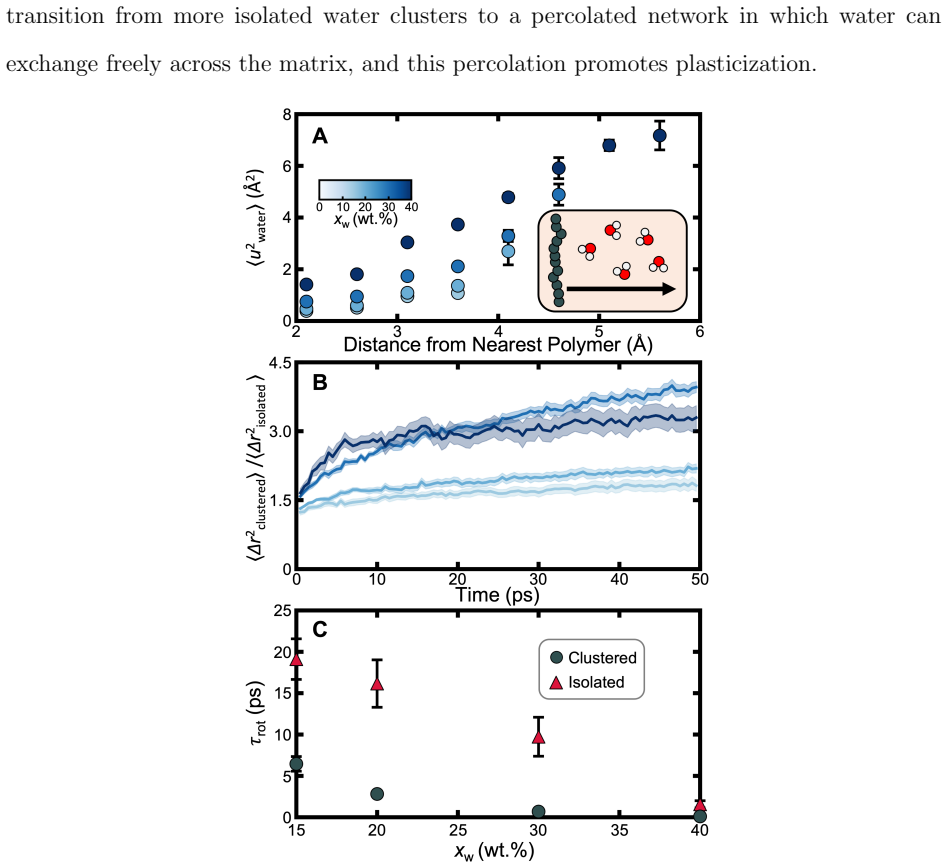
Dynamically accessible free volume (with accessibility set by connectivity of additive-accessible volume regions): the quantity the authors treat as the key driver of polymer mobility that maps onto the observed (anti)plasticization of elastic properties.
What would settle it
Measure elastic moduli and free-volume connectivity across a controlled water series (simulation or experiment): if connectivity of additive-accessible voids rises while the antiplasticization-to-plasticization crossover fails to appear, or if moduli track interaction energies without tracking free-volume accessibility, the free-volume model fails.
Extended reading notes
Core claim
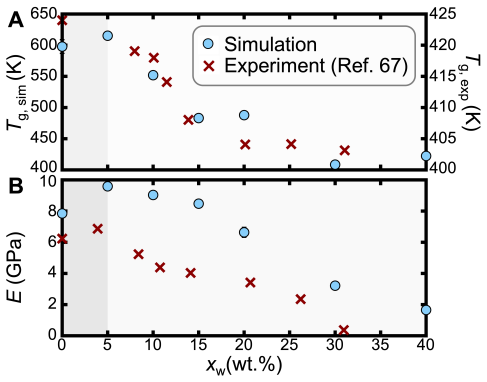
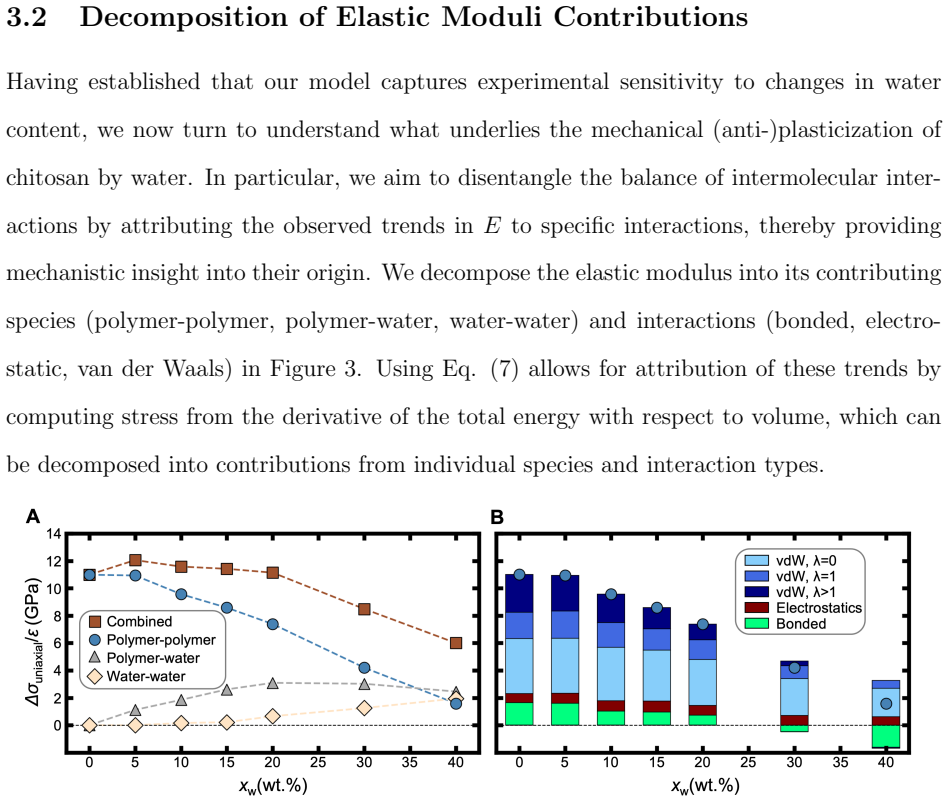
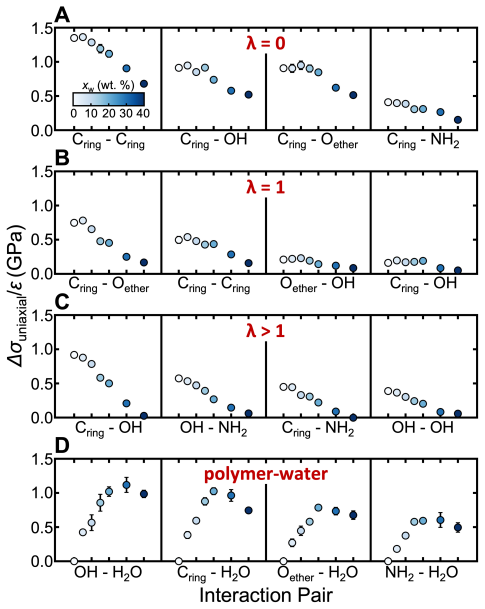
In chitosan–water mixtures the non-monotonic elastic response—antiplasticization at low water followed by plasticization at higher water—is captured by a simple model whose central driver is dynamically accessible free volume. Accessibility itself is enabled by connectivity among additive-accessible volume regions, while elastic moduli reflect competition between weakened polymer–polymer interactions and enhanced polymer–water interactions.
Load-bearing premise
That free-volume connectivity measured in the same molecular-dynamics trajectories that supply the elastic moduli is a true cause of the stiffness trend rather than a correlated descriptor of those same simulations.
Editorial analysis
A structured set of objections, weighed in public.
Referee Report
Summary. The submission is presented as arXiv:2604.14559, a soft-matter MD study of chitosan–water mixtures. Its abstract claims that elastic antiplasticization then plasticization with water content arises from competition between polymer–polymer and polymer–water interactions, and that a simple model of dynamically accessible free volume—enabled by connectivity of additive-accessible volume regions—captures the elastic response. The body supplied as the full manuscript, however, is an unrelated computer-vision paper (DVFace: one-step diffusion for video face restoration, with dual codebooks, asymmetric spatio-temporal fusion, and benchmarks on VFHQ/HDTF/RFV-LQ). No MD methods, free-volume definitions, moduli decomposition, connectivity measures, or chitosan results appear in the provided full text.
Significance. If the abstract’s free-volume accessibility model were supported by a complete, consistent soft-matter manuscript with clear operational definitions, moduli decomposition, and independent checks against experiment or alternative mobility proxies, it could be a useful design insight for hydrated biopolymers. That significance cannot be assessed here: the load-bearing scientific content for the chitosan claim is absent from the supplied manuscript body, so neither the model’s causal status nor its novelty relative to free-volume literature can be evaluated.
major comments (3)
- Title/abstract vs. full text: the abstract and paper_id describe chitosan–water MD and a free-volume (anti)plasticization model, but the full manuscript is DVFace (video face restoration). There are no MD trajectories, force fields, free-volume definitions, connectivity criteria, elastic-moduli decompositions, or chitosan results. The central claim of 2604.14559 is therefore not present in the document under review and cannot be checked for soundness or circularity.
- Even taking the abstract alone, the claim that a model of ‘dynamically accessible free volume’ ‘effectively captures’ elastic (anti)plasticization is untestable without the operational definition of accessibility/connectivity, the moduli decomposition procedure, system sizes/error bars, and any comparison that is independent of the same trajectories used to define free volume. Those elements are missing from the supplied corpus.
- Because the body does not implement the abstract’s methods or results, no revision confined to presentation can restore a reviewable soft-matter argument. The submission as packaged fails the basic requirement that title, abstract, and full text describe the same work.
minor comments (2)
- If this is a production/packaging error (wrong PDF attached to 2604.14559), the correct chitosan manuscript should be resubmitted as a new package; the present DVFace text is not a soft-matter paper and should not be reviewed under that title.
- Abstract-only wording such as ‘effectively capturing’ and ‘key driver’ should, in a correct resubmission, be tied to named equations, free-volume thresholds, and quantitative fits with reported residuals.
Circularity Check
No circular derivation: DVFace is an empirical one-step diffusion VFR method validated on external benchmarks; no load-bearing claim reduces to its inputs by construction.
full rationale
The supplied full manuscript is DVFace (video face restoration), not the chitosan free-volume abstract. DVFace proposes a one-step diffusion pipeline with a spatio-temporal dual-codebook and asymmetric fusion, then reports metrics and ablations on VFHQ-Test, HDTF, RFV-LQ, and VoxCeleb2 against external baselines (KEEP, AverNet, PGTFormer, BFVR, DicFace, SVFR). Training objectives (reconstruction, perceptual, temporal warp losses) and codebook learning are standard supervised/self-supervised constructions; they are not presented as first-principles predictions of independent quantities. Ablations (priors on/off, fusion variants, prior types) compare design choices rather than rename fitted parameters as out-of-sample predictions. Citations are ordinary related-work support, not uniqueness theorems or ansatzes that force the central claim. There is no self-definitional loop, fitted-input-as-prediction, or self-citation chain that makes the reported superiority true by construction. Score 0 is therefore the correct outcome for the actual manuscript body. (The abstract/body mismatch means the chitosan free-volume claim cannot be checked here; that is a corpus issue, not circularity in DVFace.)
Assumptions & free parameters
free parameters (2)
- Water contents / composition grid
- Accessible free-volume threshold / connectivity criterion
assumptions (3)
- domain assumption Classical molecular dynamics trajectories of chitosan–water mixtures yield elastic moduli that are comparable to experimental thermomechanical (anti)plasticization trends.
- domain assumption Elastic moduli can be decomposed into polymer–polymer and polymer–water interaction contributions whose relative strengths govern stiffening vs softening.
- ad hoc to paper Dynamically accessible free volume (not total free volume alone) is the key driver of polymer mobility in these mixtures.
invented entities (2)
-
Dynamically accessible free volume regions (as operational model quantity)
-
Connectivity of additive-accessible volume regions
Cite this review
Pith. "Pith review of Persistent Free Volume Governs (Anti)plasticization in Chitosan-Water Mixtures." pith.science (2026). https://pith.science/paper/GFTKVQ43
@misc{pith2026260414559,
  author       = {Pith},
  title        = {Pith review of: Persistent Free Volume Governs (Anti)plasticization in Chitosan-Water Mixtures},
  year         = {2026},
  howpublished = {\url{https://pith.science/paper/GFTKVQ43}},
  note         = {Machine review of arXiv:2604.14559}
}
read the original abstract
Chitosan is a highly versatile and sustainable polymer with a broad range of potential biological and materials engineering applications. Despite its versatility, the native brittleness of chitosan limits its broader utilization. This limitation can be addressed by blending chitosan with small-molecule additives to modulate its thermomechanical properties. We employ molecular dynamics (MD) simulations to investigate the mechanism underlying antiplasticization followed by plasticization at increasing water content. Decomposition of the elastic moduli reveals a competition between weakened polymer-polymer interactions and enhanced polymer-water interactions, with their relative strengths governing the resulting properties. We introduce a simple model incorporating dynamically accessible free volume regions as a key driver of polymer mobility, effectively capturing the (anti)plasticization of elastic properties. We show that accessibility of free volume regions is enabled by connectivity of additive-accessible volume regions. This study provides new insights into the molecular interactions that dictate the properties of chitosan-water mixtures and may inform the rational design of chitosan-based materials and other hydrated biopolymers.
Figures

Figures from the paper (4 more)


Reference graph
Works this paper leans on
-
[1]
Andreas Blattmann, Robin Rombach, Huan Ling, Tim Dockhorn, Seung Wook Kim, Sanja Fidler, and Karsten Kreis. 2023. Align your latents: High-resolution video synthesis with latent diffusion models. InCVPR
2023
-
[2]
Kelvin CK Chan, Shangchen Zhou, Xiangyu Xu, and Chen Change Loy. 2022. Basicvsr++: Improving video super-resolution with enhanced propagation and alignment. InCVPR
2022
-
[3]
Kelvin CK Chan, Shangchen Zhou, Xiangyu Xu, and Chen Change Loy. 2022. Investigating tradeoffs in real-world video super-resolution. InCVPR
2022
-
[4]
Yan Chen, Hanlin Shang, Ce Liu, Yuxuan Chen, Hui Li, Weihao Yuan, Hao Zhu, Zilong Dong, and Siyu Zhu. 2025. Dicface: Dirichlet-constrained variational codebook learning for temporally coherent video face restoration.arXiv preprint arXiv:2506.13355(2025)
arXiv 2025
-
[5]
Zeyuan Chen, Yinbo Chen, Jingwen Liu, Xingqian Xu, Vidit Goel, Zhangyang Wang, Humphrey Shi, and Xiaolong Wang. 2022. Videoinr: Learning video implicit neural representation for continuous space-time super-resolution. In CVPR
2022
-
[6]
Ziyan Chen, Jingwen He, Xinqi Lin, Yu Qiao, and Chao Dong. 2024. Towards real-world video face restoration: A new benchmark. InCVPR
2024
-
[7]
Zheng Chen, Zichen Zou, Kewei Zhang, Xiongfei Su, Xin Yuan, Yong Guo, and Yulun Zhang. 2025. DOVE: Efficient One-Step Diffusion Model for Real-World Video Super-Resolution. InNeurIPS
2025
-
[8]
Joon Son Chung, Arsha Nagrani, and Andrew Zisserman. 2018. Voxceleb2: Deep speaker recognition.arXiv preprint arXiv:1806.05622(2018)
arXiv 2018
Show all 64 references
-
[9]
Keyan Ding, Kede Ma, Shiqi Wang, and Eero P Simoncelli. 2020. Image quality assessment: Unifying structure and texture similarity.TPAMI(2020)
2020
-
[10]
Linwei Dong, Qingnan Fan, Yihong Guo, Zhonghao Wang, Qi Zhang, Jinwei Chen, Yawei Luo, and Changqing Zou. 2025. TSD-SR: One-Step Diffusion with Target Score Distillation for Real-World Image Super-Resolution. InCVPR
2025
-
[11]
Ruicheng Feng, Chongyi Li, and Chen Change Loy. 2024. Kalman-inspired feature propagation for video face super-resolution. InECCV
2024
-
[12]
Yuchao Gu, Xintao Wang, Liangbin Xie, Chao Dong, Gen Li, Ying Shan, and Ming-Ming Cheng. 2022. Vqfr: Blind face restoration with vector-quantized dictionary and parallel decoder. InECCV
2022
-
[13]
Jonathan Ho, Ajay Jain, and Pieter Abbeel. 2020. Denoising diffusion probabilistic models. InNeurIPS
2020
-
[14]
Xiaobin Hu, Wenqi Ren, John LaMaster, Xiaochun Cao, Xiaoming Li, Zechao Li, Bjoern Menze, and Wei Liu. 2020. Face super-resolution guided by 3d facial priors. InECCV
2020
-
[15]
Junjie Ke, Qifei Wang, Yilin Wang, Peyman Milanfar, and Feng Yang. 2021. Musiq: Multi-scale image quality transformer. InICCV
2021
-
[16]
Wei-Sheng Lai, Jia-Bin Huang, Oliver Wang, Eli Shechtman, Ersin Yumer, and Ming-Hsuan Yang. 2018. Learning blind video temporal consistency. InECCV
2018
-
[17]
Aijin Li, Gen Li, Lei Sun, and Xintao Wang. 2022. Faceformer: Scale-aware blind face restoration with transformers.arXiv preprint arXiv:2207.09790(2022)
2022 arXiv
-
[18]
Jianze Li, Jiezhang Cao, Zichen Zou, Xiongfei Su, Xin Yuan, Yulun Zhang, Yong Guo, and Xiaokang Yang. 2024. Unleashing the power of one-step diffusion based image super-resolution via a large-scale diffusion discriminator.arXiv preprint arXiv:2410.04224(2024)
2024 arXiv
-
[19]
Jianze Li, Yong Guo, Yulun Zhang, and Xiaokang Yang. 2025. Asymmetric VAE for One-Step Video Super-Resolution Acceleration.arXiv preprint arXiv:2509.24142 (2025)
2025
-
[20]
Senmao Li, Kai Wang, Joost van de Weijer, Fahad Shahbaz Khan, Chun-Le Guo, Shiqi Yang, Yaxing Wang, Jian Yang, and Ming-Ming Cheng. 2025. InterLCM: Low- quality images as intermediate states of latent consistency models for effective blind face restoration.arXiv preprint arXiv...
2025 arXiv
-
[21]
Wenjie Li, Mei Wang, Kai Zhang, Juncheng Li, Xiaoming Li, Yuhang Zhang, Guangwei Gao, and Zhanyu Ma. 2025. Survey on deep face restoration: From non-blind to blind and beyond.Comput. Surveys(2025)
2025
-
[22]
Xiaohui Li, Yihao Liu, Shuo Cao, Ziyan Chen, Shaobin Zhuang, Xiangyu Chen, Yinan He, Yi Wang, and Yu Qiao. 2025. DiffVSR: Enhancing Real-World Video Super-Resolution with Diffusion Models for Advanced Visual Quality and Tem- poral Consistency.arXiv preprint arXiv:2501.10110(2025)
2025 arXiv
-
[23]
Xinqi Lin, Jingwen He, Ziyan Chen, Zhaoyang Lyu, Bo Dai, Fanghua Yu, Yu Qiao, Wanli Ouyang, and Chao Dong. 2024. Diffbir: Toward blind image restoration with generative diffusion prior. InECCV
2024
-
[24]
Jinshan Pan, Haoran Bai, Jiangxin Dong, Jiawei Zhang, and Jinhui Tang. 2021. Deep blind video super-resolution. InCVPR
2021
-
[25]
Wenqi Ren, Jiaolong Yang, Senyou Deng, David Wipf, Xiaochun Cao, and Xin Tong. 2019. Face video deblurring using 3D facial priors. InICCV
2019
-
[26]
Robin Rombach, Andreas Blattmann, Dominik Lorenz, Patrick Esser, and Björn Ommer. 2022. High-resolution image synthesis with latent diffusion models. In CVPR
2022
-
[27]
Claudio Rota, Marco Buzzelli, Simone Bianco, and Raimondo Schettini. 2023. Video restoration based on deep learning: a comprehensive survey.AIR(2023)
2023
-
[28]
Yujing Sun, Lingchen Sun, Shuaizheng Liu, Rongyuan Wu, Zhengqiang Zhang, and Lei Zhang. 2025. One-step diffusion for detail-rich and temporally consistent video super-resolution. InNeurIPS Workshop
2025
-
[29]
Thomas Unterthiner, Sjoerd Van Steenkiste, Karol Kurach, Raphaël Marinier, Marcin Michalski, and Sylvain Gelly. 2019. FVD: A new metric for video genera- tion. InICLR Workshop
2019
-
[30]
Team Wan, Ang Wang, Baole Ai, Bin Wen, Chaojie Mao, Chen-Wei Xie, Di Chen, Feiwu Yu, Haiming Zhao, Jianxiao Yang, et al. 2025. Wan: Open and advanced large-scale video generative models.arXiv preprint arXiv:2503.20314(2025)
2025 arXiv
-
[31]
Jianyi Wang, Kelvin CK Chan, and Chen Change Loy. 2023. Exploring clip for assessing the look and feel of images. InAAAI
2023
-
[32]
Jingkai Wang, Jue Gong, Lin Zhang, Zheng Chen, Xing Liu, Hong Gu, Yutong Liu, Yulun Zhang, and Xiaokang Yang. 2025. OSDFace: One-Step Diffusion Model for Face Restoration. InCVPR
2025
-
[33]
Jianyi Wang, Zhijie Lin, Meng Wei, Yang Zhao, Ceyuan Yang, Fei Xiao, Chen Change Loy, and Lu Jiang. 2025. Seedvr: Seeding infinity in diffusion transformer towards generic video restoration. InCVPR
2025
-
[34]
Xintao Wang, Kelvin CK Chan, Ke Yu, Chao Dong, and Chen Change Loy. 2019. Edvr: Video restoration with enhanced deformable convolutional networks. In CVPRW
2019
-
[35]
Xintao Wang, Yu Li, Honglun Zhang, and Ying Shan. 2021. Towards real-world blind face restoration with generative facial prior. InCVPR
2021
-
[36]
Yutong Wang, Jiajie Teng, Jiajiong Cao, Yuming Li, Chenguang Ma, Hongteng Xu, and Dixin Luo. 2025. Efficient video face enhancement with enhanced spatial- temporal consistency. InCVPR
2025
-
[37]
Zhou Wang, Alan C Bovik, Hamid R Sheikh, and Eero P Simoncelli. 2004. Image quality assessment: from error visibility to structural similarity.TIP(2004)
2004
-
[38]
Zhiyao Wang, Xu Chen, Chengming Xu, Junwei Zhu, Xiaobin Hu, Jiangning Zhang, Chengjie Wang, Yuqi Liu, Yiyi Zhou, and Rongrong Ji. 2025. Svfr: A unified framework for generalized video face restoration. InCVPR
2025
-
[39]
Zhouxia Wang, Jiawei Zhang, Tianshui Chen, Wenping Wang, and Ping Luo. 2023. Restoreformer++: Towards real-world blind face restoration from undegraded key-value pairs.TPAMI(2023)
2023
-
[40]
Zhouxia Wang, Jiawei Zhang, Xintao Wang, Tianshui Chen, Ying Shan, Wenping Wang, and Ping Luo. 2024. Analysis and benchmarking of extending blind face image restoration to videos.TIP(2024)
2024
-
[41]
Haoning Wu, Erli Zhang, Liang Liao, Chaofeng Chen, Jingwen Hou, Annan Wang, Wenxiu Sun, Qiong Yan, and Weisi Lin. 2023. Exploring video quality assessment on user generated contents from aesthetic and technical perspectives. InICCV
2023
-
[42]
Rongyuan Wu, Lingchen Sun, Zhiyuan Ma, and Lei Zhang. 2024. One-step effective diffusion network for real-world image super-resolution. InNeurIPS
2024
-
[43]
Rongyuan Wu, Tao Yang, Lingchen Sun, Zhengqiang Zhang, Shuai Li, and Lei Zhang. 2024. SeeSR: Towards Semantics-Aware Real-World Image Super- Resolution. InCVPR
2024
-
[44]
Liangbin Xie, Xintao Wang, Honglun Zhang, Chao Dong, and Ying Shan. 2022. Vfhq: A high-quality dataset and benchmark for video face super-resolution. In CVPR
2022
-
[45]
Rui Xie, Yinhong Liu, Penghao Zhou, Chen Zhao, Jun Zhou, Kai Zhang, Zhenyu Zhang, Jian Yang, Zhenheng Yang, and Ying Tai. 2025. STAR: Spatial-Temporal Augmentation with Text-to-Video Models for Real-World Video Super-Resolution. arXiv preprint arXiv:2501.02976(2025)
2025 arXiv
-
[46]
Kepeng Xu, Li Xu, Gang He, Wenxin Yu, and Yunsong Li. 2024. Beyond alignment: Blind video face restoration via parsing-guided temporal-coherent transformer. arXiv preprint arXiv:2404.13640(2024)
2024 arXiv
-
[47]
Sidi Yang, Tianhe Wu, Shuwei Shi, Shanshan Lao, Yuan Gong, Mingdeng Cao, Jiahao Wang, and Yujiu Yang. 2022. Maniqa: Multi-dimension attention network for no-reference image quality assessment. InCVPRW
2022
-
[48]
Tao Yang, Peiran Ren, Xuansong Xie, and Lei Zhang. 2021. Gan prior embedded network for blind face restoration in the wild. InCVPR
2021
-
[49]
Chang-Han Yeh, Hau-Shiang Shiu, Chin-Yang Lin, Zhixiang Wang, Chi-Wei Hsiao, Ting-Hsuan Chen, and Yu-Lun Liu. 2024. Diffir2vr-zero: Zero-shot video restoration with diffusion-based image restoration models.arXiv preprint arXiv:2407.01519(2024)
2024
-
[50]
Zongsheng Yue and Chen Change Loy. 2024. Difface: Blind face restoration with diffused error contraction.TPAMI(2024)
2024
-
[51]
Lvmin Zhang, Anyi Rao, and Maneesh Agrawala. 2023. Adding Conditional Control to Text-to-Image Diffusion Models. InICCV
2023
-
[52]
Lin Zhang, Lei Zhang, and Alan C Bovik. 2015. A feature-enriched completely blind image quality evaluator.TIP(2015)
2015
-
[53]
Richard Zhang, Phillip Isola, Alexei A Efros, Eli Shechtman, and Oliver Wang
-
[54]
The unreasonable effectiveness of deep features as a perceptual metric. In CVPR
-
[55]
Shulian Zhang, Yong Guo, Long Peng, Ziyang Wang, Ye Chen, Wenbo Li, Xiao Zhang, Yulun Zhang, and Jian Chen. 2025. Vividface: High-quality and efficient one-step diffusion for video face enhancement.arXiv preprint arXiv:2509.23584 (2025)
2025
-
[56]
Weixia Zhang, Guangtao Zhai, Ying Wei, Xiaokang Yang, and Kede Ma. 2023. Blind image quality assessment via vision-language correspondence: A multitask learning perspective. InCVPR. ������� ��������� ���� ���� �� ���
2023
-
[57]
Zhimeng Zhang, Lincheng Li, Yu Ding, and Changjie Fan. 2021. Flow-guided one-shot talking face generation with a high-resolution audio-visual dataset. In CVPR
2021
-
[58]
Ziqing Zhang, Kai Liu, Zheng Chen, Xi Li, Yucong Chen, Bingnan Duan, Linghe Kong, and Yulun Zhang. 2025. InfVSR: Breaking Length Limits of Generic Video Super-Resolution.arXiv preprint arXiv:2510.00948(2025)
2025 arXiv
-
[59]
Haiyu Zhao, Lei Tian, Xinyan Xiao, Peng Hu, Yuanbiao Gou, and Xi Peng. 2024. AverNet: All-in-one video restoration for time-varying unknown degradations. InNeurIPS
2024
-
[60]
Shangchen Zhou, Kelvin Chan, Chongyi Li, and Chen Change Loy. 2022. Towards robust blind face restoration with codebook lookup transformer. InNeurIPS
2022
-
[61]
Shangchen Zhou, Peiqing Yang, Jianyi Wang, Yihang Luo, and Chen Change Loy
-
[62]
Upscale-a-video: Temporal-consistent diffusion model for real-world video super-resolution. InCVPR
-
[63]
Feida Zhu, Junwei Zhu, Wenqing Chu, Xinyi Zhang, Xiaozhong Ji, Chengjie Wang, and Ying Tai. 2022. Blind face restoration via integrating face shape and generative priors. InCVPR
2022
-
[64]
Junhao Zhuang, Shi Guo, Xin Cai, Xiaohui Li, Yihao Liu, Chun Yuan, and Tianfan Xue. 2025. Flashvsr: Towards real-time diffusion-based streaming video super- resolution.arXiv preprint arXiv:2510.12747(2025)
2025
Reviewed July 12, 2026 · model on record in the stance chip above.
Discussion (0). Continue with ORCID to comment.