REVIEW 2 major objections 2 minor 1 cited by
NNLO QCD corrections to deeply virtual pion production are large and positive, improving agreement with JLab data at leading twist.
Reviewed by Pith at T0; open to challenge. T0 means a machine referee read the full paper against a public rubric. the ladder, T0–T4 →
T0 review · grok-4.3
2026-07-01 07:50 UTC pith:QP2CL7YU
load-bearing objection First NNLO for these DV pion channels, but the JLab data improvement claim rests on an untested assumption that leading-twist factorization already works at those kinematics. the 2 major comments →
Deeply virtual pion production through two-loop order
The pith
A machine-rendered reading of the paper's core claim, the machinery that carries it, and where it could break.
Core claim
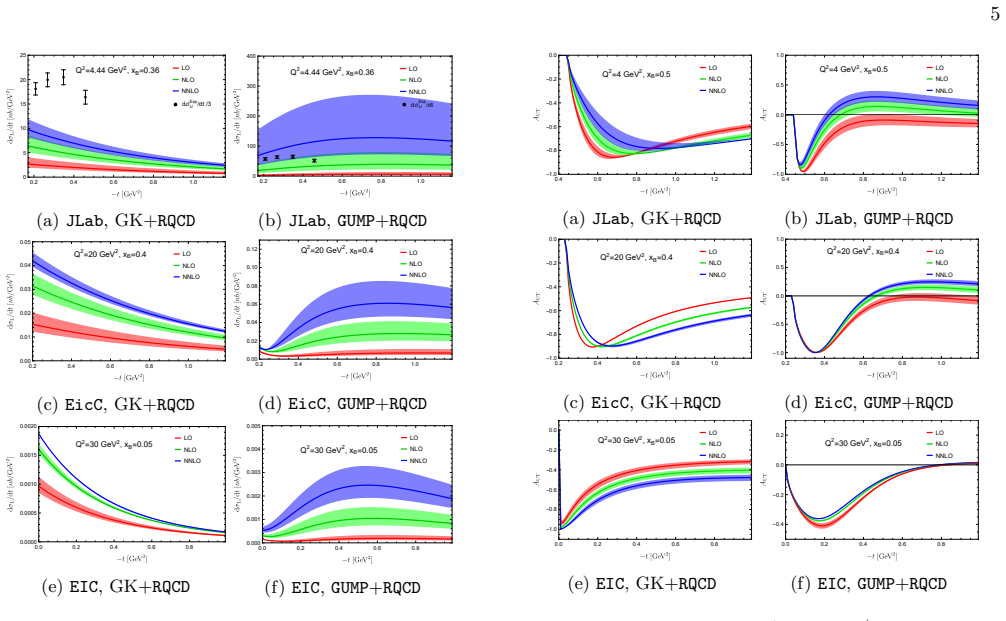
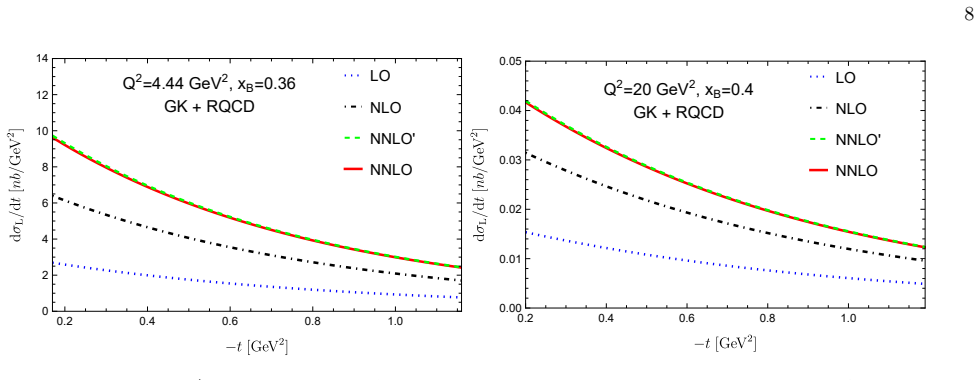
The authors present the first NNLO QCD calculation for the processes γ_L^* p → π^+ n and γ_L^* p → π^0 p, finding that the two-loop corrections considerably increase the differential longitudinal cross sections and improve the match with JLab data, while also modifying the predictions for transverse single-spin asymmetries.
What carries the argument
The two-loop order QCD radiative corrections within the collinear factorization framework for deeply virtual meson production.
Load-bearing premise
The processes can be described at leading twist in the collinear factorization framework when Q squared is much larger than the momentum transfer squared and the QCD scale.
What would settle it
A measurement of the longitudinal cross section at Q2 values significantly above current JLab data that deviates from the NNLO prediction would falsify the claim of substantial positive corrections improving agreement.
Editorial analysis
A structured set of objections, weighed in public.
Referee Report
Summary. The manuscript computes the first NNLO QCD corrections to the longitudinal cross sections for deeply virtual pion production (γ_L^* p → π^+ n and γ_L^* p → π^0 p) within leading-twist collinear factorization in the generalized Bjorken limit. It reports that the two-loop hard-scattering coefficients are positive and substantial, leading to considerably improved agreement with existing JLab data, and examines the impact of these corrections on transverse single-spin asymmetries in benchmark kinematics at JLab, EIC, and EicC.
Significance. If the leading-twist framework applies quantitatively, the explicit NNLO results represent a technical advance for precision GPD phenomenology at current and future facilities. The work supplies the first two-loop hard coefficients for DVπP, which are a necessary ingredient for reducing perturbative uncertainty in extractions.
major comments (2)
- [Abstract and data comparison] Abstract and the data-comparison section: the central claim that NNLO corrections 'considerably improve' agreement with JLab data is load-bearing for the paper's impact statement, yet no controlled estimate or discussion of 1/Q² power corrections (higher-twist GPDs, target-mass effects) is provided. Typical JLab kinematics (Q² ~ 1–5 GeV², |t| ~ 0.2–1 GeV²) violate the Q² ≫ |t| assumption by factors that can reach O(20–100 %), so the reported improvement cannot be unambiguously attributed to the perturbative shift.
- [Kinematic assumptions and comparison to data] The generalized Bjorken limit statement (abstract) is used to justify the leading-twist formula, but the manuscript does not quantify the size of the neglected power corrections at the specific JLab points used for comparison, leaving the validity of the quantitative comparison untested.
minor comments (2)
- [Abstract] Abstract: the clause 'including which considerably improves' is grammatically awkward and should be rephrased.
- [Notation and formalism] Notation for the two-loop coefficient functions should be introduced with explicit reference to the factorization formula (e.g., the convolution with GPDs) at first appearance to aid readability.
Simulated Author's Rebuttal
We thank the referee for the careful reading and constructive feedback. We address the two major comments below on the data comparison and power corrections. Our responses focus on what can be addressed within the scope of this NNLO calculation in the leading-twist framework.
read point-by-point responses
-
Referee: [Abstract and data comparison] Abstract and the data-comparison section: the central claim that NNLO corrections 'considerably improve' agreement with JLab data is load-bearing for the paper's impact statement, yet no controlled estimate or discussion of 1/Q² power corrections (higher-twist GPDs, target-mass effects) is provided. Typical JLab kinematics (Q² ~ 1–5 GeV², |t| ~ 0.2–1 GeV²) violate the Q² ≫ |t| assumption by factors that can reach O(20–100 %), so the reported improvement cannot be unambiguously attributed to the perturbative shift.
Authors: We agree that the manuscript provides no quantitative estimate of power corrections and that the comparison to JLab data is performed strictly within the leading-twist collinear factorization. The central result of the work is the explicit computation of the two-loop hard coefficients and their positive, substantial size; the data comparison is presented as an illustration of their impact inside that approximation. In the revised version we will (i) moderate the abstract language to state that the NNLO corrections improve agreement within the leading-twist framework, (ii) add a short paragraph in the data-comparison section noting the expected magnitude of higher-twist effects at JLab kinematics (drawing on existing literature estimates for DVMP), and (iii) emphasize that a full separation of perturbative and power corrections requires dedicated higher-twist calculations. These changes constitute a partial revision. revision: partial
-
Referee: [Kinematic assumptions and comparison to data] The generalized Bjorken limit statement (abstract) is used to justify the leading-twist formula, but the manuscript does not quantify the size of the neglected power corrections at the specific JLab points used for comparison, leaving the validity of the quantitative comparison untested.
Authors: We acknowledge that the manuscript does not quantify power corrections at the precise JLab kinematic points shown. Such a quantification would require a separate higher-twist analysis that lies outside the scope of the present NNLO perturbative calculation. In the revision we will insert a brief discussion of the kinematic assumptions, referencing typical estimates of 1/Q² corrections in the DVMP literature, and will qualify the comparison accordingly. This addresses the concern without altering the technical NNLO results. revision: partial
- Quantitative evaluation of the size of 1/Q² power corrections at the specific JLab data points used for comparison.
Circularity Check
No circularity: direct perturbative computation of NNLO coefficients
full rationale
The paper computes the two-loop hard-scattering coefficient for DVπP in the collinear factorization framework at leading twist. This is a standard Feynman-diagram evaluation whose output is independent of the data to which it is later compared. The reported improvement in agreement with JLab data is a post-hoc numerical comparison, not a quantity obtained by fitting parameters to those data or by self-referential definition. No load-bearing step reduces to a prior result of the same authors by construction, nor is any ansatz or uniqueness theorem imported in a circular manner. The derivation chain is therefore self-contained.
Axiom & Free-Parameter Ledger
axioms (1)
- domain assumption Collinear factorization at leading twist holds in the generalized Bjorken limit.
read the original abstract
Deeply virtual meson production (DVMP) is among the most prominent channels to extract the nucleon's generalized parton distributions (GPDs) at $ep$ scattering facilities such as {\tt JLab} and the upcoming {\tt EIC/EicC} experiments, which plays a vital role in unravelling the three-dimensional internal structure of nucleon. In this work we calculate for the first time the next-to-next-to-leading order (NNLO) QCD radiative corrections to the DV$\pi$P processes $\gamma_L^* p\to \pi^+ n$ and $\gamma_L^* p\to \pi^0 p$ in the generalized Bjorken limit $Q^2\gg \vert t\vert, \Lambda_{\text{QCD}}^2$, accurate at the leading twist within collinear factorization framework. The impact of the two-loop QCD corrections appears to be positive and substantial, including which considerably improves the agreement between the perturbative QCD prediction and the available {\tt JLab} data. In addition to the differential longitudinal DV$\pi$P cross section, we also study the impact of the two-loop QCD corrections on the transverse single-spin asymmetries (TSSA) in some benchmark kinematics at {\tt JLab}, {\tt EIC} and {\tt EicC}.
Figures




Forward citations
Cited by 1 Pith paper
-
Next-to-next-to-leading order QCD corrections to pion (kaon)-induced exclusive Drell-Yan process
NNLO QCD corrections to pion- and kaon-induced exclusive Drell-Yan are obtained by analytic continuation and found to be large, often exceeding NLO.
Reference graph
Works this paper leans on
-
[1]
D. M \"u ller, D. Robaschik, B. Geyer, F. M. Dittes and J. Ho r ej s i, Fortsch. Phys. 42 (1994), 101-141
work page 1994
-
[2]
X. D. Ji, Phys. Rev. D 55 (1997), 7114-7125
work page 1997
-
[3]
A. V. Radyushkin, Phys. Lett. B 380 (1996), 417-425
work page 1996
-
[4]
M. Burkardt, Phys. Rev. D 62 (2000), 071503 [erratum: Phys. Rev. D 66 (2002), 119903]
work page 2000
-
[5]
X. D. Ji, Phys. Rev. Lett. 78 (1997), 610-613
work page 1997
- [6]
-
[7]
C. A. Aidala, S. D. Bass, D. Hasch and G. K. Mallot, Rev. Mod. Phys. 85 (2013), 655-691
work page 2013
-
[8]
X. Ji, F. Yuan and Y. Zhao, Nature Rev. Phys. 3 (2021) no.1, 27-38
work page 2021
-
[9]
V. D. Burkert, L. Elouadrhiri, F. X. Girod, C. Lorc\'e, P. Schweitzer and P. E. Shanahan, Rev. Mod. Phys. 95 (2023) no.4, 041002
work page 2023
- [10]
-
[11]
A. Freese and I. C. Clo \"e t, Phys. Rev. C 100 (2019) no.1, 015201 [erratum: Phys. Rev. C 105 (2022) no.5, 059901]
work page 2019
-
[12]
B. D. Sun and Y. B. Dong, Phys. Rev. D 101 (2020) no.9, 096008
work page 2020
- [13]
-
[14]
D. C. Hackett, D. A. Pefkou and P. E. Shanahan, Phys. Rev. Lett. 132 (2024) no.25, 251904
work page 2024
-
[15]
X. H. Cao, F. K. Guo, Q. Z. Li and D. L. Yao, Nature Commun. 16 (2025), 6979
work page 2025
-
[16]
Y. Guo, F. Yuan and W. Zhao, Phys. Rev. Lett. 135 (2025) no.11, 111902
work page 2025
- [17]
- [18]
-
[19]
M. V. Polyakov, Phys. Lett. B 555 (2003), 57-62
work page 2003
-
[20]
M. V. Polyakov and P. Schweitzer, Int. J. Mod. Phys. A 33 (2018) no.26, 1830025
work page 2018
-
[21]
V. D. Burkert, L. Elouadrhiri and F. X. Girod, Nature 557 (2018) no.7705, 396-399
work page 2018
-
[22]
C. Lorc\'e, H. Moutarde and A. P. Trawi\'nski, Eur. Phys. J. C 79 (2019) no.1, 89
work page 2019
-
[23]
Kumeri c ki, Nature 570 (2019) no.7759, E1-E2
K. Kumeri c ki, Nature 570 (2019) no.7759, E1-E2
work page 2019
-
[24]
P. E. Shanahan and W. Detmold, Phys. Rev. Lett. 122 (2019) no.7, 072003
work page 2019
- [25]
- [26]
- [27]
-
[28]
A. V. Belitsky and A. V. Radyushkin, Phys. Rept. 418 (2005), 1-387
work page 2005
- [29]
- [30]
-
[31]
M. Vanderhaeghen, P. A. M. Guichon and M. Guidal, Phys. Rev. D 60 (1999), 094017
work page 1999
-
[32]
S. V. Goloskokov and P. Kroll, Eur. Phys. J. C 65 (2010), 137-151
work page 2010
-
[33]
S. V. Goloskokov and P. Kroll, Eur. Phys. J. A 47 (2011), 112
work page 2011
- [34]
-
[35]
S. V. Goloskokov and P. Kroll, Eur. Phys. J. C 53 (2008), 367-384
work page 2008
- [36]
-
[37]
K. Kumericki, S. Liuti and H. Moutarde, Eur. Phys. J. A 52 (2016) no.6, 157
work page 2016
-
[38]
H. Moutarde, P. Sznajder and J. Wagner, Eur. Phys. J. C 79 (2019) no.7, 614
work page 2019
-
[39]
B. Kriesten, P. Velie, E. Yeats, F. Y. Lopez and S. Liuti, Phys. Rev. D 105 (2022) no.5, 056022
work page 2022
-
[40]
Y. Guo, F. P. Aslan, X. Ji and M. G. Santiago, Phys. Rev. Lett. 135 (2025) no.26, 261903
work page 2025
-
[41]
H. T. Ding, X. Gao, S. Mukherjee, P. Petreczky, Q. Shi, S. Syritsyn and Y. Zhao, JHEP 02 (2025), 056
work page 2025
-
[42]
X. Gao, S. Mukherjee, Q. Shi, F. Yao and Y. Zhao, Phys. Rev. D 113 (2026) no.1, 014505
work page 2026
-
[43]
H. W. Lin, Phys. Lett. B 846 (2023), 138181
work page 2023
-
[44]
S. Bhattacharya, K. Cichy, M. Constantinou, J. Dodson, X. Gao, A. Metz, J. Miller, S. Mukherjee, P. Petreczky and F. Steffens, et al. Phys. Rev. D 109 (2024) no.3, 034508
work page 2024
-
[45]
S. Bhattacharya, K. Cichy, M. Constantinou, X. Gao, A. Metz, J. Miller, S. Mukherjee, P. Petreczky, F. Steffens and Y. Zhao, JHEP 01 (2025), 146
work page 2025
-
[46]
M. H. Chu, M. Cola c o, S. Bhattacharya, K. Cichy, M. Constantinou, A. Metz and F. Steffens, Phys. Rev. D 112 (2025) no.9, 094510
work page 2025
- [47]
-
[48]
C. Alexandrou, K. Cichy, M. Constantinou, K. Hadjiyiannakou, K. Jansen, A. Scapellato and F. Steffens, Phys. Rev. Lett. 125 (2020) no.26, 262001
work page 2020
-
[49]
H. W. Lin, Phys. Lett. B 824 (2022), 136821
work page 2022
-
[50]
A. V. Radyushkin, Phys. Lett. B 385 (1996), 333-342
work page 1996
-
[51]
L. Mankiewicz, G. Piller and T. Weigl, Eur. Phys. J. C 5 (1998), 119-128
work page 1998
-
[52]
L. L. Frankfurt, M. V. Polyakov, M. Strikman and M. Vanderhaeghen, Phys. Rev. Lett. 84 (2000), 2589-2592
work page 2000
-
[53]
L. L. Frankfurt, P. V. Pobylitsa, M. V. Polyakov and M. Strikman, Phys. Rev. D 60 (1999), 014010
work page 1999
-
[54]
L. Mankiewicz, G. Piller and A. Radyushkin, Eur. Phys. J. C 10 (1999), 307-312
work page 1999
-
[55]
F. D. Aaron et al. [H1], Phys. Lett. B 681 (2009), 391-399
work page 2009
- [56]
- [57]
-
[58]
N. Hirlinger Saylor et al. [CLAS], Phys. Rev. C 98 (2018) no.4, 045203
work page 2018
- [59]
-
[60]
R. Akhunzyanov et al. [COMPASS], Phys. Lett. B 793 (2019), 188-194 [erratum: Phys. Lett. B 800 (2020), 135129]
work page 2019
- [61]
- [62]
-
[63]
T. Horn, X. Qian, J. Arrington, R. Asaturyan, F. Benmokthar, W. Boeglin, P. Bosted, A. Bruell, M. E. Christy and E. Chudakov, et al. Phys. Rev. C 78 (2008), 058201
work page 2008
- [64]
-
[65]
S. A. Morrow et al. [CLAS], Eur. Phys. J. A 39 (2009), 5-31
work page 2009
- [66]
-
[67]
M. Defurne et al. [Jefferson Lab Hall A], Phys. Rev. Lett. 117 (2016) no.26, 262001
work page 2016
-
[68]
M. Mazouz et al. [Jefferson Lab Hall A], Phys. Rev. Lett. 118 (2017) no.22, 222002
work page 2017
-
[69]
M. Dlamini et al. [Jefferson Lab Hall A], Phys. Rev. Lett. 127 (2021) no.15, 152301
work page 2021
-
[70]
G. D. Alexeev et al. [COMPASS], Eur. Phys. J. C 83 (2023) no.10, 924
work page 2023
- [71]
-
[72]
G. D. Alexeev et al. [COMPASS], Phys. Lett. B 870 (2025), 139832
work page 2025
-
[73]
A. Accardi, P. Achenbach, D. Adhikari, A. Afanasev, C. S. Akondi, N. Akopov, M. Albaladejo, H. Albataineh, M. Albrecht and B. Almeida-Zamora, et al. Eur. Phys. J. A 60 (2024) no.9, 173
work page 2024
-
[74]
R. Abdul Khalek, A. Accardi, J. Adam, D. Adamiak, W. Akers, M. Albaladejo, A. Al-bataineh, M. G. Alexeev, F. Ameli and P. Antonioli, et al. Nucl. Phys. A 1026 (2022), 122447
work page 2022
-
[75]
D. P. Anderle, V. Bertone, X. Cao, L. Chang, N. Chang, G. Chen, X. Chen, Z. Chen, Z. Cui and L. Dai, et al. Front. Phys. (Beijing) 16 (2021) no.6, 64701
work page 2021
-
[76]
V. M. Braun, Y. Ji and J. Schoenleber, Phys. Rev. Lett. 129 (2022) no.17, 172001
work page 2022
- [77]
-
[78]
V. M. Braun, P. Gotzler and A. N. Manashov,
-
[79]
V. M. Braun, H. Y. Jiang, A. N. Manashov and A. von Manteuffel, JHEP 01 (2025), 069
work page 2025
- [80]
discussion (0)
Sign in with ORCID, Apple, or X to comment. Anyone can read and Pith papers without signing in.