REVIEW 2 major objections 2 minor 87 references
Neural inference accumulates positive evidence over a graph to monotonically increase Dirichlet precision and recover Bayes-optimal predictions under ideal conditions.
Reviewed by Pith at T0; open to challenge. T0 means a machine referee read the full paper against a public rubric. the ladder, T0–T4 →
T0 review · grok-4.3
2026-06-30 15:47 UTC pith:DFE3UJYD
load-bearing objection NBSR puts exact Dirichlet conjugate updates inside a Gumbel-routed DAG and gets monotonic precision growth for free, but the Bayes-optimal terminal claim still rests on unshown idealized capacity assumptions. the 2 major comments →
Neural Bayesian Sequential Routing
The pith
A machine-rendered reading of the paper's core claim, the machinery that carries it, and where it could break.
Core claim
Within a Dirichlet-Categorical conjugate model, neural experts query a persistent global oracle to obtain positive evidence vectors that update a shared belief state by conjugate addition. Hard path-dependent routing is realized with a Gumbel-Softmax Straight-Through estimator. The resulting Dirichlet precision and entropy support uncertainty-aware controls such as entropy-based early exit and abstention. The central theorems establish that, whenever evidence extraction remains strictly positive, total Dirichlet precision increases monotonically along every valid trajectory and marginal predictive variance remains bounded; under idealized capacity and optimization the terminal Dirichlet expe
What carries the argument
Dirichlet belief state updated by exact conjugate addition of positive evidence vectors extracted by neural experts, with Gumbel-Softmax Straight-Through routing preserving surrogate gradients.
Load-bearing premise
Evidence extraction must remain strictly positive on every step and the network must satisfy idealized capacity plus perfect optimization so that the terminal Dirichlet expectation equals the Bayes-optimal distribution.
What would settle it
Run a controlled synthetic task with known Bayes-optimal posterior; observe whether any valid trajectory exhibits non-monotonic Dirichlet precision or whether the final Dirichlet mean deviates from the known optimum once capacity and optimization assumptions are met.
If this is right
- Predictive accuracy stays competitive with standard networks while exposing explicit routing traces and path-dependent evidence attribution.
- Dirichlet precision and entropy supply direct mechanisms for entropy-based early exiting, out-of-distribution abstention, and cost-aware evidence acquisition.
- The framework applies across visual categorization, medical diagnosis, language modeling, partially observable control, and Bayesian experimental design.
- Resource-rational inference emerges naturally from the monotonic sharpening property without separate regularization terms.
Where Pith is reading between the lines
- The conjugate update structure could be swapped for other exponential-family priors if the evidence vectors remain positive.
- The same routing-plus-precision mechanism might serve as an internal clock for deciding computation budgets in larger agent loops.
- If the idealized recovery result holds only under perfect optimization, practical training schedules that approach but do not reach the optimum would produce a quantifiable gap to Bayes optimality.
Editorial analysis
A structured set of objections, weighed in public.
Referee Report
Summary. The paper introduces Neural Bayesian Sequential Routing (NBSR), which models neural inference as sequential evidence accumulation over a hierarchical DAG within a Dirichlet-Categorical conjugate framework. Neural experts extract positive evidence vectors from a global knowledge oracle to update a Dirichlet belief state exactly, with Gumbel-Softmax Straight-Through enabling hard routing and end-to-end training. The central claims are a proof that total Dirichlet precision increases monotonically (and marginal predictive variance is bounded) under strictly positive evidence extraction, plus recovery of the Bayes-optimal conditional distribution at termination under idealized capacity and optimization assumptions. Empirical results across five domains are asserted to show competitive performance with added interpretability, uncertainty control, and resource rationality.
Significance. If the monotonicity result and Bayes-optimal recovery can be rigorously established without unattainable assumptions, the framework would provide a mathematically grounded approach to uncertainty-aware, path-dependent neural computation that integrates exact conjugate updates with learned routing. This could advance interpretable and resource-rational agentic systems, particularly where evidence attribution and early exiting matter.
major comments (2)
- [Abstract] Abstract (final paragraph): The claim that 'under idealized capacity and optimization assumptions, the terminal Dirichlet expectation recovers the Bayes-optimal conditional distribution' is central to the theoretical contribution, yet these assumptions are never formalized, nor is it demonstrated that they are attainable by the finite-capacity neural experts, Gumbel-Softmax routing, and gradient-based training described in the framework.
- [Abstract] Abstract: The stated proof that 'under strictly positive evidence extraction, total Dirichlet precision increases monotonically along any valid trajectory' is load-bearing for the 'hypothesis sharpening' formalization, but the manuscript provides no derivation steps, lemmas, or verification that the oracle and routing mechanism automatically enforce strictly positive extraction.
minor comments (2)
- The empirical evaluations are described only qualitatively ('competitive predictive performance') without quantitative metrics, error bars, baseline comparisons, or domain-specific results, which limits assessment of the practical claims.
- The 'persistent global knowledge oracle' is introduced as an invented entity without a precise interface definition or discussion of how its capacity interacts with the idealized assumptions.
Simulated Author's Rebuttal
We thank the referee for the constructive comments highlighting the need for greater rigor in the theoretical claims. We address each point below and will revise the manuscript accordingly to formalize assumptions and include derivations.
read point-by-point responses
-
Referee: [Abstract] Abstract (final paragraph): The claim that 'under idealized capacity and optimization assumptions, the terminal Dirichlet expectation recovers the Bayes-optimal conditional distribution' is central to the theoretical contribution, yet these assumptions are never formalized, nor is it demonstrated that they are attainable by the finite-capacity neural experts, Gumbel-Softmax routing, and gradient-based training described in the framework.
Authors: We agree the assumptions require explicit formalization. The revised manuscript will add a dedicated theoretical subsection defining the idealized assumptions (infinite expert capacity as universal approximators of the evidence function, and convergence to the global optimum of the routing objective). We will also include a discussion of attainability, noting that finite networks provide approximations whose error can be bounded under standard neural network approximation theory, with the Gumbel-Softmax and conjugate updates preserving the recovery property in the limit. This will clarify the scope without overstating practical attainment. revision: yes
-
Referee: [Abstract] Abstract: The stated proof that 'under strictly positive evidence extraction, total Dirichlet precision increases monotonically along any valid trajectory' is load-bearing for the 'hypothesis sharpening' formalization, but the manuscript provides no derivation steps, lemmas, or verification that the oracle and routing mechanism automatically enforce strictly positive extraction.
Authors: The monotonicity follows directly from the Dirichlet conjugate update rule when evidence vectors are strictly positive. We will insert the full derivation as a lemma in the main text (with steps showing precision = sum of Dirichlet parameters strictly increases by the L1 norm of the evidence vector). For enforcement, the oracle is defined to output positive vectors by construction (as pseudo-counts), and routing selects only such experts; we will add an explicit proposition and verification in the methods. This supplies the missing steps and confirmation. revision: yes
Circularity Check
No significant circularity; claims rest on conjugate properties and explicit assumptions
full rationale
The derivation chain centers on Dirichlet-Categorical conjugate updates for evidence accumulation, with the monotonic precision increase and bounded variance proved under the stated condition of strictly positive evidence extraction. The Bayes-optimal recovery is separately conditioned on idealized capacity and optimization assumptions that are not derived from or equivalent to the model's fitted parameters or routing mechanism. No self-definitional reductions, fitted inputs renamed as predictions, or load-bearing self-citations appear in the provided abstract or claims; the framework introduces new components (Gumbel-Softmax routing, oracle queries) whose properties are analyzed via standard conjugate mathematics rather than reducing to the inputs by construction.
Axiom & Free-Parameter Ledger
axioms (2)
- standard math Dirichlet-Categorical conjugacy permits exact pseudo-count addition that preserves the Dirichlet form
- standard math Gumbel-Softmax Straight-Through estimator supplies unbiased surrogate gradients for hard categorical routing
invented entities (1)
-
persistent global knowledge oracle
no independent evidence
read the original abstract
Human decision-making is sequential and uncertainty-aware, yet standard neural networks often rely on static, dense forward computation with limited visibility into evidence acquisition, uncertainty evolution, or when computation should stop. We introduce \textbf{Neural Bayesian Sequential Routing (NBSR)}, a framework that models neural inference as active evidence accumulation over a hierarchical Directed Acyclic Graph (DAG). Within a Dirichlet--Categorical conjugate framework, neural experts query a persistent global knowledge oracle to extract positive evidence vectors, which act as pseudo-counts and update a Dirichlet belief state by exact conjugate addition. Coupled with a Gumbel-Softmax Straight-Through estimator, this update enables hard, path-dependent routing while preserving surrogate gradients for end-to-end training. The resulting Dirichlet precision and entropy provide mechanisms for uncertainty quantification, entropy-based early exiting, OOD abstention, and cost-aware evidence acquisition. We prove that, under strictly positive evidence extraction, total Dirichlet precision increases monotonically along any valid trajectory and marginal predictive variance is bounded, formalizing sequential ``hypothesis sharpening''; under idealized capacity and optimization assumptions, the terminal Dirichlet expectation recovers the Bayes-optimal conditional distribution. Empirical evaluations across visual categorization, structured medical diagnosis, language modeling, partially observable control, and cost-aware Bayesian experimental design show that NBSR achieves competitive predictive performance while providing transparent routing traces, path-dependent evidence attribution, uncertainty-aware decision control, and resource-rational inference. Overall, NBSR offers a mathematically grounded framework for interpretable, modular, and resource-rational agentic AI.
Figures

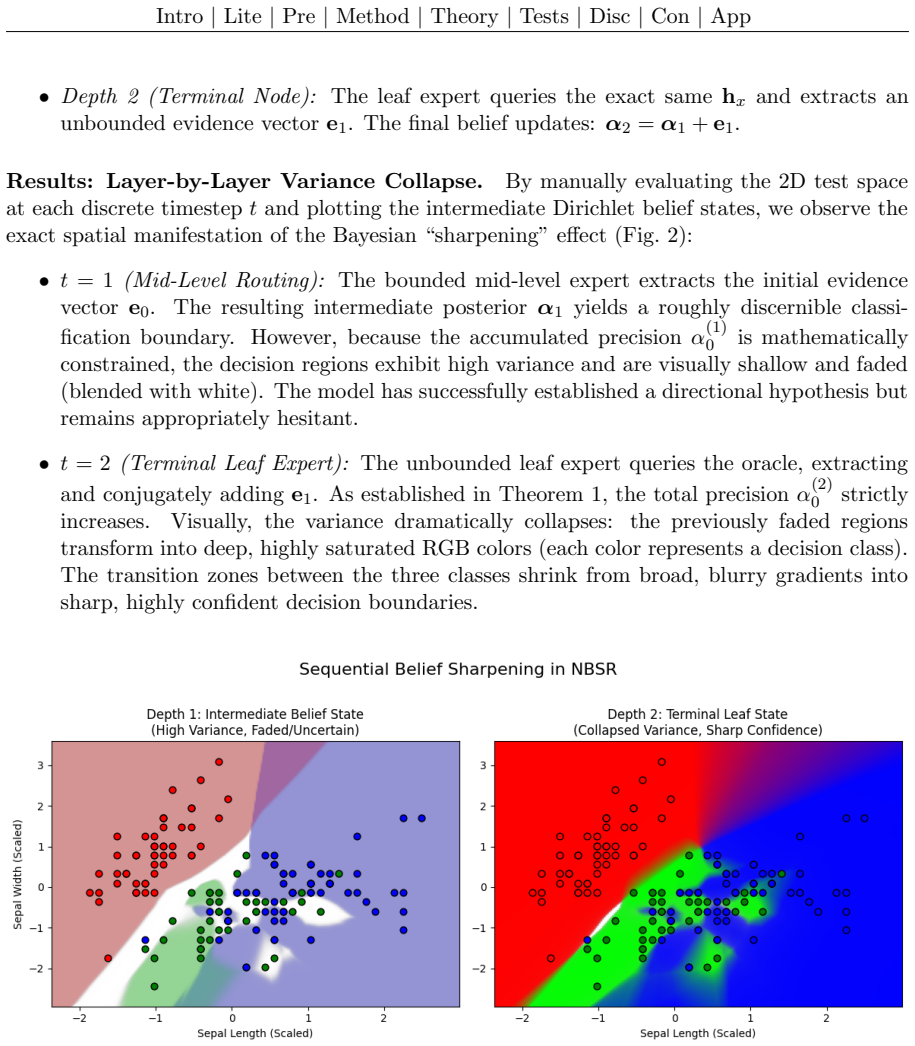


Reference graph
Works this paper leans on
-
[1]
Mart´ ın Abadi, Ashish Agarwal, Paul Barham, Eugene Brevdo, Zhifeng Chen, Craig Citro, Greg S. Corrado, Andy Davis, Jeffrey Dean, Matthieu Devin, Sanjay Ghemawat, Ian Goodfellow, Andrew Harp, Geoffrey Irving, Michael Isard, Yangqing Jia, Rafal Jozefowicz, Lukasz Kaiser, Manjunath Kudlur, Josh Levenberg, Dandelion Man´ e, Rajat Monga, Sherry Moore, Derek M...
-
[2]
Software available from tensorflow.org
- [3]
-
[4]
Estimating or propagating gradi- ents through stochastic neurons for conditional computation, 2013
Yoshua Bengio, Nicholas L´ eonard, and Aaron Courville. Estimating or propagating gradi- ents through stochastic neurons for conditional computation, 2013
work page 2013
-
[5]
Bishop.Pattern Recognition and Machine Learning
Christopher M. Bishop.Pattern Recognition and Machine Learning. Information Science and Statistics. Springer, New York, NY, 1 edition, 2006
work page 2006
-
[6]
Weight uncer- tainty in neural networks
Charles Blundell, Julien Cornebise, Koray Kavukcuoglu, and Daan Wierstra. Weight uncer- tainty in neural networks. InProceedings of the 32nd International Conference on Machine Learning - Volume 37, ICML’15, page 1613–1622. JMLR.org, 2015
work page 2015
-
[7]
Meltzoff, James Woodward, and Laura E
Elizabeth Baraff Bonawitz, Darlene Ferranti, Rebecca Saxe, Alison Gopnik, Andrew N. Meltzoff, James Woodward, and Laura E. Schulz. Just do it? investigating the gap between prediction and action in toddlers’ causal inferences.Cognition, 115(1):104–117, 2010
work page 2010
-
[8]
Leo Breiman, Jerome H. Friedman, Richard A. Olshen, and Charles J. Stone.Classification and Regression Trees. Chapman and Hall/CRC, 1 edition, 1984
work page 1984
-
[9]
Xgboost: A scalable tree boosting system
Tianqi Chen and Carlos Guestrin. Xgboost: A scalable tree boosting system. InProceedings of the 22nd ACM SIGKDD International Conference on Knowledge Discovery and Data Mining, KDD ’16, page 785–794, New York, NY, USA, 2016. Association for Computing Machinery
work page 2016
-
[10]
Collins, Ilia Sucholutsky, Umang Bhatt, et al
Katherine M. Collins, Ilia Sucholutsky, Umang Bhatt, et al. Building machines that learn and think with people.Nature Human Behaviour, 8:1851–1863, 2024
work page 2024
-
[11]
George Cybenko. Approximation by superpositions of a sigmoidal function.Mathematics of Control, Signals, and Systems, 2:303–314, 1989
work page 1989
-
[12]
ImageNet: A large-scale hierarchical image database
Jia Deng, Wei Dong, Richard Socher, Li-Jia Li, Kai Li, and Li Fei-Fei. ImageNet: A large-scale hierarchical image database . In2009 IEEE Computer Society Conference on Computer Vision and Pattern Recognition Workshops (CVPR Workshops), pages 248–255, Los Alamitos, CA, USA, June 2009. IEEE Computer Society
work page 2009
-
[13]
Calibration of pre-trained transformers, 2020
Shrey Desai and Greg Durrett. Calibration of pre-trained transformers, 2020
work page 2020
-
[14]
An image is worth 16x16 words: Transformers for image recognition at scale, 2021
Alexey Dosovitskiy, Lucas Beyer, Alexander Kolesnikov, Dirk Weissenborn, Xiaohua Zhai, Thomas Unterthiner, Mostafa Dehghani, Matthias Minderer, Georg Heigold, Sylvain Gelly, Jakob Uszkoreit, and Neil Houlsby. An image is worth 16x16 words: Transformers for image recognition at scale, 2021
work page 2021
-
[15]
von mises conditions revisited.The Annals of Probability, 21(3):1310–1328, 1993
Michael Falk and Frank Marohn. von mises conditions revisited.The Annals of Probability, 21(3):1310–1328, 1993. Intro|Lite|Pre|Method|Theory|Tests|Disc|Con|App
work page 1993
-
[16]
Hierarchical neural story generation
Angela Fan, Mike Lewis, and Yann Dauphin. Hierarchical neural story generation. In Iryna Gurevych and Yusuke Miyao, editors,Proceedings of the 56th Annual Meeting of the Association for Computational Linguistics (Volume 1: Long Papers), pages 889–898, Melbourne, Australia, July 2018. Association for Computational Linguistics
work page 2018
-
[17]
Switch transformers: scaling to trillion parameter models with simple and efficient sparsity.J
William Fedus, Barret Zoph, and Noam Shazeer. Switch transformers: scaling to trillion parameter models with simple and efficient sparsity.J. Mach. Learn. Res., 23(1), January 2022
work page 2022
-
[18]
R. A. Fisher and L. H. C. Tippett. Limiting forms of the frequency distribution of the largest and smallest member of a sample.Mathematical Proceedings of the Cambridge Philosophical Society, 24(2):180–190, 1928
work page 1928
-
[19]
Variational bayesian optimal experimental design
Adam Foster, Martin Jankowiak, Elias Bingham, Paul Horsfall, Yee Whye Teh, Thomas Rainforth, and Noah Goodman. Variational bayesian optimal experimental design. In H. Wallach, H. Larochelle, A. Beygelzimer, F. d'Alch´ e-Buc, E. Fox, and R. Garnett, editors, Advances in Neural Information Processing Systems, volume 32. Curran Associates, Inc., 2019
work page 2019
-
[20]
Maurice Fr´ echet. Sur la loi de probabilit´ e de l’´ ecart maximum.Annales de la Soci´ et´ e Polonaise de Math´ ematique, 6(1):93–116, 1927
work page 1927
-
[21]
Dropout as a bayesian approximation: representing model uncertainty in deep learning
Yarin Gal and Zoubin Ghahramani. Dropout as a bayesian approximation: representing model uncertainty in deep learning. InProceedings of the 33rd International Conference on International Conference on Machine Learning - Volume 48, ICML’16, page 1050–1059. JMLR.org, 2016
work page 2016
-
[22]
Andrew Gelman, John B. Carlin, Hal S. Stern, David B. Dunson, Aki Vehtari, and Don- ald B. Rubin.Bayesian Data Analysis. Chapman and Hall/CRC, New York, 3 edition, 2013
work page 2013
-
[23]
Gil-Leyva, Antonio Lijoi, Rams´ es H
Mar´ ıa F. Gil-Leyva, Antonio Lijoi, Rams´ es H. Mena, and Igor Pr¨ unster. Markov stick- breaking processes, 2026
work page 2026
-
[24]
B. V. Gnedenko. Sur la distribution limite du terme maximum d’une s´ erie al´ eatoire.Annals of Mathematics, 44(3):423–453, 1943
work page 1943
-
[25]
Gemini 3 developer guide, 2026
Google. Gemini 3 developer guide, 2026. Google AI for Developers
work page 2026
-
[26]
Adaptive computation time for recurrent neural networks, 2017
Alex Graves. Adaptive computation time for recurrent neural networks, 2017
work page 2017
-
[27]
Chuan Guo, Geoff Pleiss, Yu Sun, and Kilian Q. Weinberger. On calibration of modern neural networks. InProceedings of the 34th International Conference on Machine Learning - Volume 70, ICML’17, page 1321–1330. JMLR.org, 2017
work page 2017
-
[28]
Yizeng Han, Gao Huang, Shiji Song, Le Yang, Honghui Wang, and Yulin Wang. Dy- namic Neural Networks: A Survey .IEEE Transactions on Pattern Analysis & Machine Intelligence, 44(11):7436–7456, November 2022
work page 2022
-
[29]
Deep residual learning for image recognition
Kaiming He, Xiangyu Zhang, Shaoqing Ren, and Jian Sun. Deep residual learning for image recognition. In2016 IEEE Conference on Computer Vision and Pattern Recognition (CVPR), pages 770–778, 2016
work page 2016
-
[30]
A baseline for detecting misclassified and out-of- distribution examples in neural networks
Dan Hendrycks and Kevin Gimpel. A baseline for detecting misclassified and out-of- distribution examples in neural networks. InInternational Conference on Learning Repre- sentations, 2017. Intro|Lite|Pre|Method|Theory|Tests|Disc|Con|App
work page 2017
-
[31]
Geoffrey E. Hinton. Training products of experts by minimizing contrastive divergence. Neural Comput., 14(8):1771–1800, August 2002
work page 2002
-
[32]
Long short-term memory.Neural Comput., 9(8):1735–1780, November 1997
Sepp Hochreiter and J¨ urgen Schmidhuber. Long short-term memory.Neural Comput., 9(8):1735–1780, November 1997
work page 1997
-
[33]
The curious case of neural text degeneration, 2020
Ari Holtzman, Jan Buys, Li Du, Maxwell Forbes, and Yejin Choi. The curious case of neural text degeneration, 2020
work page 2020
-
[34]
Approximation capabilities of multilayer feedforward networks.Neural Net- works, 4(2):251–257, 1991
Kurt Hornik. Approximation capabilities of multilayer feedforward networks.Neural Net- works, 4(2):251–257, 1991
work page 1991
-
[35]
Sampling via gaussian mixture approximations, 2025
Yongchao Huang. Sampling via gaussian mixture approximations, 2025
work page 2025
-
[36]
Vjepa: Variational joint embedding predictive architectures as proba- bilistic world models, 2026
Yongchao Huang. Vjepa: Variational joint embedding predictive architectures as proba- bilistic world models, 2026
work page 2026
-
[37]
On the information bottleneck of VJEPA.OpenReview, May 2026
Yongchao Huang. On the information bottleneck of VJEPA.OpenReview, May 2026
work page 2026
-
[38]
Imitation learning: A survey of learning methods.ACM Comput
Ahmed Hussein, Mohamed Medhat Gaber, Eyad Elyan, and Chrisina Jayne. Imitation learning: A survey of learning methods.ACM Comput. Surv., 50(2), April 2017
work page 2017
-
[39]
Gibbs sampling methods for stick-breaking priors
Hemant Ishwaran and Lancelot F James. Gibbs sampling methods for stick-breaking priors. Journal of the American Statistical Association, 96(453):161–173, 2001
work page 2001
-
[40]
Robert A. Jacobs, Michael I. Jordan, Steven J. Nowlan, and Geoffrey E. Hinton. Adaptive mixtures of local experts.Neural Computation, 3(1):79–87, 1991
work page 1991
-
[41]
Categorical reparameterization with gumbel- softmax
Eric Jang, Shixiang Gu, and Ben Poole. Categorical reparameterization with gumbel- softmax. InInternational Conference on Learning Representations, 2017
work page 2017
-
[42]
Survey of hallucination in natural language generation.ACM Comput
Ziwei Ji, Nayeon Lee, Rita Frieske, Tiezheng Yu, Dan Su, Yan Xu, Etsuko Ishii, Ye Jin Bang, Andrea Madotto, and Pascale Fung. Survey of hallucination in natural language generation.ACM Comput. Surv., 55(12), March 2023
work page 2023
-
[43]
M.I. Jordan and R.A. Jacobs. Hierarchical mixtures of experts and the em algorithm. InProceedings of 1993 International Conference on Neural Networks (IJCNN-93-Nagoya, Japan), volume 2, pages 1339–1344 vol.2, 1993
work page 1993
-
[44]
Artificial Intelligence: Foundations, Theory, and Algorithms
Audun Jøsang.Subjective Logic: A Formalism for Reasoning Under Uncertainty. Artificial Intelligence: Foundations, Theory, and Algorithms. Springer Cham, 1 edition, 2016
work page 2016
-
[45]
Prentice Hall, 1st edition, 2000
Daniel Jurafsky and James H Martin.Speech and Language Processing: An Introduction to Natural Language Processing, Computational Linguistics, and Speech Recognition. Prentice Hall, 1st edition, 2000
work page 2000
-
[46]
Leslie Pack Kaelbling, Michael L. Littman, and Anthony R. Cassandra. Planning and acting in partially observable stochastic domains.Artificial Intelligence, 101(1):99–134, 1998
work page 1998
-
[47]
Daniel Kahneman.Thinking, Fast and Slow. Penguin Books, London, 2011
work page 2011
-
[48]
Diederik P. Kingma and Jimmy Ba. Adam: A method for stochastic optimization, 2017
work page 2017
-
[49]
SAGE Publications Ltd, apr 2018
Ben Lambert.A Student’s Guide to Bayesian Statistics. SAGE Publications Ltd, apr 2018
work page 2018
-
[50]
A path towards autonomous machine intelligence version 0.9.2, 2022-06-27
Yann LeCun. A path towards autonomous machine intelligence version 0.9.2, 2022-06-27. Open Review, 62(1):1–62, 2022. Intro|Lite|Pre|Method|Theory|Tests|Disc|Con|App
work page 2022
-
[51]
Deep learning.Nature, 521:436–444, 2015
Yann LeCun, Yoshua Bengio, and Geoffrey Hinton. Deep learning.Nature, 521:436–444, 2015
work page 2015
-
[52]
Zachary C. Lipton. The mythos of model interpretability.Commun. ACM, 61(10):36–43, September 2018
work page 2018
-
[53]
Scott M. Lundberg and Su-In Lee. A unified approach to interpreting model predictions. InProceedings of the 31st International Conference on Neural Information Processing Sys- tems, NIPS’17, page 4768–4777, Red Hook, NY, USA, 2017. Curran Associates Inc
work page 2017
-
[54]
Maddison, Andriy Mnih, and Yee Whye Teh
Chris J. Maddison, Andriy Mnih, and Yee Whye Teh. The concrete distribution: A con- tinuous relaxation of discrete random variables. InInternational Conference on Learning Representations, 2017
work page 2017
-
[55]
Maddison, Daniel Tarlow, and Tom Minka
Chris J. Maddison, Daniel Tarlow, and Tom Minka. A* sampling. InProceedings of the 28th International Conference on Neural Information Processing Systems - Volume 2, NIPS’14, page 3086–3094, Cambridge, MA, USA, 2014. MIT Press
work page 2014
-
[56]
Marcus, Beatrice Santorini, and Mary Ann Marcinkiewicz
Mitchell P. Marcus, Beatrice Santorini, and Mary Ann Marcinkiewicz. Building a large annotated corpus of English: The Penn Treebank.Computational Linguistics, 19(2):313– 330, 1993
work page 1993
-
[57]
Bayesian neural networks in mortality modelling
Patrick Moehrke and Yongchao Huang. Bayesian neural networks in mortality modelling. The Actuarial, 2024
work page 2024
-
[58]
Yuval Netzer, Tao Wang, Adam Coates, A. Bissacco, Bo Wu, and A. Ng. Reading digits in natural images with unsupervised feature learning, 2011
work page 2011
-
[59]
Maxime Oquab, Timoth´ ee Darcet, Th´ eo Moutakanni, Huy V. Vo, Marc Szafraniec, Vasil Khalidov, Pierre Fernandez, Daniel HAZIZA, Francisco Massa, Alaaeldin El-Nouby, Mido Assran, Nicolas Ballas, Wojciech Galuba, Russell Howes, Po-Yao Huang, Shang-Wen Li, Ishan Misra, Michael Rabbat, Vasu Sharma, Gabriel Synnaeve, Hu Xu, Herve Jegou, Julien Mairal, Patrick...
work page 2024
-
[60]
Sculley, Sebastian Nowozin, Joshua V
Yaniv Ovadia, Emily Fertig, Jie Ren, Zachary Nado, D. Sculley, Sebastian Nowozin, Joshua V. Dillon, Balaji Lakshminarayanan, and Jasper Snoek.Can you trust your model’s uncertainty? evaluating predictive uncertainty under dataset shift. Curran Associates Inc., Red Hook, NY, USA, 2019
work page 2019
-
[61]
On the difficulty of training recurrent neural networks
Razvan Pascanu, Tomas Mikolov, and Yoshua Bengio. On the difficulty of training recurrent neural networks. InProceedings of the 30th International Conference on International Con- ference on Machine Learning - Volume 28, ICML’13, page III–1310–III–1318. JMLR.org, 2013
work page 2013
-
[62]
Curran Associates Inc., Red Hook, NY, USA, 2019
Adam Paszke, Sam Gross, Francisco Massa, Adam Lerer, James Bradbury, Gregory Chanan, Trevor Killeen, Zeming Lin, Natalia Gimelshein, Luca Antiga, Alban Desmai- son, Andreas K¨ opf, Edward Yang, Zach DeVito, Martin Raison, Alykhan Tejani, Sasank Chilamkurthy, Benoit Steiner, Lu Fang, Junjie Bai, and Soumith Chintala.PyTorch: an imperative style, high-perfo...
work page 2019
-
[63]
Dean A. Pomerleau. Alvinn: an autonomous land vehicle in a neural network. InPro- ceedings of the 2nd International Conference on Neural Information Processing Systems, NIPS’88, page 305–313, Cambridge, MA, USA, 1988. MIT Press. Intro|Lite|Pre|Method|Theory|Tests|Disc|Con|App
work page 1988
-
[64]
Puterman.Markov Decision Processes: Discrete Stochastic Dynamic Program- ming
Martin L. Puterman.Markov Decision Processes: Discrete Stochastic Dynamic Program- ming. Wiley Series in Probability and Statistics. John Wiley & Sons, 1994
work page 1994
-
[65]
Learning transferable visual models from natural language supervision, 2021
Alec Radford, Jong Wook Kim, Chris Hallacy, Aditya Ramesh, Gabriel Goh, Sandhini Agarwal, Girish Sastry, Amanda Askell, Pamela Mishkin, Jack Clark, Gretchen Krueger, and Ilya Sutskever. Learning transferable visual models from natural language supervision, 2021
work page 2021
-
[66]
Harvard Univer- sity Press, Boston, 1961
Howard Raiffa and Robert Schlaifer.Applied Statistical Decision Theory. Harvard Univer- sity Press, Boston, 1961
work page 1961
-
[67]
”why should i trust you?”: Ex- plaining the predictions of any classifier
Marco Tulio Ribeiro, Sameer Singh, and Carlos Guestrin. ”why should i trust you?”: Ex- plaining the predictions of any classifier. InProceedings of the 22nd ACM SIGKDD Inter- national Conference on Knowledge Discovery and Data Mining, KDD ’16, page 1135–1144, New York, NY, USA, 2016. Association for Computing Machinery
work page 2016
-
[68]
Cynthia Rudin. Stop explaining black box machine learning models for high stakes decisions and use interpretable models instead.Nature Machine Intelligence, 1:206–215, 2019
work page 2019
-
[69]
Paola Sebastiani and Henry P. Wynn. Maximum entropy sampling and optimal bayesian experimental design.Journal of the Royal Statistical Society. Series B (Statistical Method- ology), 62(1):145–157, 2000
work page 2000
-
[70]
Evidential deep learning to quantify classification uncertainty
Murat Sensoy, Lance Kaplan, and Melih Kandemir. Evidential deep learning to quantify classification uncertainty. InProceedings of the 32nd International Conference on Neural Information Processing Systems, NIPS’18, page 3183–3193, Red Hook, NY, USA, 2018. Curran Associates Inc
work page 2018
-
[71]
Outrageously large neural networks: The sparsely-gated mixture- of-experts layer
Noam Shazeer, *Azalia Mirhoseini, *Krzysztof Maziarz, Andy Davis, Quoc Le, Geoffrey Hinton, and Jeff Dean. Outrageously large neural networks: The sparsely-gated mixture- of-experts layer. InInternational Conference on Learning Representations, 2017
work page 2017
-
[72]
Opening the black box of deep neural networks via information, 2017
Ravid Shwartz-Ziv and Naftali Tishby. Opening the black box of deep neural networks via information, 2017
work page 2017
-
[73]
Richard von Mises. La distribution de la plus grande de n valeurs.Revue de Math´ ematiques de l’Union Interbalkanique, 1:141–160, 1936
work page 1936
-
[74]
A. Wald. Sequential tests of statistical hypotheses.The Annals of Mathematical Statistics, 16(2):117–186, 1945
work page 1945
-
[75]
S. R. Waterhouse and A. J. Robinson. Constructive algorithms for hierarchical mixtures of experts. InProceedings of the 9th International Conference on Neural Information Processing Systems, NIPS’95, page 584–590, Cambridge, MA, USA, 1995. MIT Press
work page 1995
-
[76]
George Kingsley Zipf.Human behavior and the principle of least effort: an introduction to human ecology. Addison-Wesley, 1949. A The Dirichlet Distribution This section provides a formal overview of the Dirichlet distribution, detailing the mathematical properties that make it the foundational engine for the uncertainty-tracking and evidence- accumulating...
work page 1949
-
[77]
The Irreducible Noise:the expectation of the first term depends entirely on the true distribution and representsthe inherent uncertainty in the data generation process(the Shannon entropy): Ey∼P ∗ −logP ∗(y|x) =H(P ∗) (36)
-
[78]
The Bias:the expectation of the second term measures the distance between the true distribution and the model’s average prediction. This is precisely the Kullback-Leibler (KL) divergence: Ey∼P ∗ logP ∗(y|x)−log ¯PG(y|x) =D KL P ∗∥ ¯PG (37)
-
[79]
The Variance:The expectation of the third term captures how much the predictions from models trained on specific datasets fluctuate around the average model prediction: Ey∼P ∗ log ¯PG(y|x)−logP G(y|x;D) = X y P ∗(y|x) log ¯PG(y|x) PG(y|x;D) (38) In standard generalized bias-variance decompositions for likelihood estimators, it is common practice to approx...
-
[80]
The Role of Intermediate Nodes: Routing Gates vs. Sequential Evidence Extrac- torsIn classical differentiable decision trees and hierarchical MoEs, the graph is composed of two strictly distinct types of nodes: •Internal Nodes (Routers):these nodes do not produce any classification output. They act purely as routing gates that calculate transitional proba...
discussion (0)
Sign in with ORCID, Apple, or X to comment. Anyone can read and Pith papers without signing in.