REVIEW 1 major objections 5 minor 2 cited by
Programmable local spin control is now possible in large rotating Penning-trap ion crystals, using a steered AC Stark beam timed to the crystal rotation.
Reviewed by Pith at T0; open to challenge. T0 means a machine referee read the full paper against a public rubric. the ladder, T0–T4 →
T0 review · grok-4.5
2026-07-13 07:43 UTC pith:IJ6GW5A6
load-bearing objection Solid experimental first: programmable coherent single-ion Rz control on large rotating Penning crystals, with usable fidelity and clear applications. the 1 major comments →
Programmable coherent site-selective spin control in rotating Penning-trap ion crystals
The pith
A machine-rendered reading of the paper's core claim, the machinery that carries it, and where it could break.
Core claim
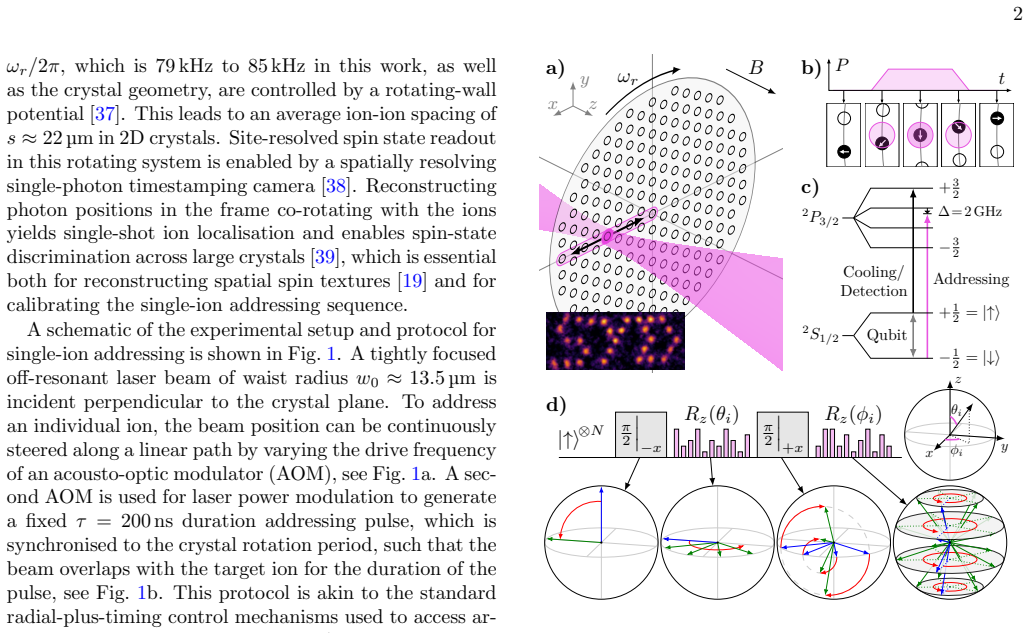
The authors establish that programmable coherent site-selective spin control is achievable across large rotating 9Be+ crystals: a tightly focused off-resonant beam drives local Rz phase rotations via differential AC Stark shifts, with beam steering and power modulation synchronised to the crystal rotation so that arbitrary ions can be addressed. Ramsey characterisation yields Rz(π) fidelity of 0.950(4) (body text 94.6±1.6%) and nearest-neighbour crosstalk of 0.021(6) (body 1.2±0.5%), sufficient for a biskyrmion spin texture, layer-selective bilayer operations, and dual-quadrature Ramsey sensing.
What carries the argument
Site-selective Rz phase gates realised by a tightly focused off-resonant laser that imprints differential AC Stark shifts, with AOM steering and power modulation timed to the rigid-body crystal rotation so that a short pulse overlaps only the chosen ion(s).
Load-bearing premise
That the still-unexplained roughly 3.6% phase-independent addressing error (after SPAM and dephasing corrections) does not undermine the claimed gate fidelity or the multi-step state-preparation results.
What would settle it
A repeated Rz(π) Ramsey characterisation that isolates and removes the constant amplitude offset, or a quantitative decomposition showing that residual ion motion, beam pointing and power noise fully account for all measured infidelity and crosstalk.
If this is right
- Spatially structured product states (domain walls, vortices, topological textures) can be prepared deterministically and then evolved under native long-range spin interactions.
- Layer-selective rotations and readout become available in bilayer and multilayer Penning crystals for interlayer correlation and entanglement studies.
- Dual-quadrature sensing removes Ramsey phase ambiguities and can be extended to multi-region protocols that measure several spin components in one shot.
- Combined with spin-dependent forces, the method supports seeded nonequilibrium dynamics relevant to proposed simulations of chiral superconductors and skyrmion physics.
- Fidelity improvements via tighter beams, better cooling and composite pulses would convert global Penning arrays into programmable multidimensional simulators.
Where Pith is reading between the lines
- The same hard-disk-style radial-plus-timing control could be reused for local optical pumping or sideband addressing once a second focused beam or higher power is available.
- Crosstalk-aware compilation that pre-compensates known neighbour phases could raise effective multi-ion pattern fidelity without hardware changes.
- If residual pointing and motion noise are the dominant limit, active feed-forward from the co-rotating camera image could push single-gate error below 1% on the next hardware iteration.
Editorial analysis
A structured set of objections, weighed in public.
Referee Report
Summary. The manuscript reports programmable coherent site-selective spin control of individual ions in large rotating 9Be+ Coulomb crystals confined in a Penning trap. A tightly focused off-resonant laser (waist ~13.5 µm) induces local Rz phase gates via differential AC Stark shifts; AOM-based radial steering and power modulation are synchronized to the crystal rotation (79–85 kHz) so that arbitrary ions can be addressed sequentially. Ramsey spin-echo characterization yields an SPAM-corrected Rz(π) fidelity of 94.6±1.6 % (abstract quotes 0.950(4)) with nearest-neighbour crosstalk 1.2±0.5 % (abstract 0.021(6)). The capability is used to prepare a biskyrmion spin texture (~150 ions, mean local fidelity 92±2 %), to perform layer-selective addressing in a partially bilayer crystal, and to implement dual-quadrature Ramsey sensing by imprinting a relative π/2 phase between spatial sub-ensembles.
Significance. If the reported fidelities and crosstalk hold, the work removes a long-standing obstacle to flexible local control in Penning-trap arrays that already support hundreds of spins and long-range interactions. The experimental demonstration is concrete: shot-by-shot ion localization, radius-dependent power calibration, geometric models of beam travel and position uncertainty (Supplemental Material), and three independent applications (structured product states, bilayer operations, dual-quadrature sensing) all support the central claim. The residual ~3.6 % phase-independent offset is stated openly and does not reverse the conclusion that usable programmable control has been achieved. The result therefore opens practical routes to engineered domain walls, topological textures, and multilayer sensing protocols that were previously inaccessible in this architecture.
major comments (1)
- PERFORMANCE section and abstract: the quoted Rz(π) fidelity and crosstalk differ between the abstract (0.950(4), 0.021(6)) and the body text (94.6±1.6 %, 1.2±0.5 %). The body further decomposes the error into a Gaussian envelope (σ = 3.7±0.2 π → 98.2 % envelope-limited fidelity), an unexplained constant offset of ~3.6 %, and ~0.4 % off-resonant scattering. The abstract numbers appear to be a rounded or differently averaged subset of the same data. For a load-bearing performance claim these values must be reconciled in a single, fully specified analysis (including how the mean fidelity is obtained from the envelope plus offset) so that readers can reproduce the quoted figures.
minor comments (5)
- PERFORMANCE, paragraph on residual offset: the text states “The origin of this offset is not resolved by the present data.” A short quantitative bound (e.g., upper limits from measured beam-pointing stability, localization precision, or residual radial temperature) would strengthen the error budget without requiring new experiments.
- Fig. 2c and associated text: the SPAM correction of 3.5 % is applied before fitting; it would help readers if the raw (uncorrected) fringe amplitudes were also quoted or shown in the Supplemental Material.
- Supplemental Material, geometric models: the white trajectories in Fig. 7b for τ = 100/200/400 ns are useful; adding the measured crosstalk values from the main-text crystal onto the same plot would make the comparison quantitative.
- Throughout: minor typographic inconsistencies appear (e.g., “R z” vs “Rz”, missing spaces after periods in some figure captions, “biskyrmion” vs “bi-skyrmion”). A uniform pass would improve readability.
- INTRODUCTION and CONCLUSION: the comparison with the earlier radius-selective optical-pumping work (Ref. [19]) is clear, but a one-sentence quantitative contrast of addressing time scaling (linear in N versus power-limited global beams) would help non-specialist readers.
Circularity Check
No significant circularity: experimental fidelities, crosstalk and state preparations are measured against independent SPAM-corrected populations and multi-basis tomography, not derived from fitted inputs or self-citation chains.
full rationale
The paper is an experimental demonstration of site-selective Rz control via AC Stark shifts with rotation-synchronised beam steering. Load-bearing claims (Rz(π) fidelity 94.6±1.6% after SPAM correction, nearest-neighbour crosstalk 1.2±0.5%, biskyrmion mean local fidelity 92±2%, layer-selective fidelities, dual-quadrature contrasts) are obtained from Ramsey fringes, bright-state probabilities and three-basis Bloch-vector reconstruction on the ions themselves. Geometric models and off-resonant-scattering calculations in the Supplemental Material are used only for post-hoc interpretation and mitigation suggestions; they do not generate the reported numbers. Self-citations (e.g. prior radius-selective work [19]) supply context and comparison but are not required to establish the measured gate performance or the new programmable addressing capability. No self-definitional loops, fitted-parameter-as-prediction steps, uniqueness theorems imported from the authors, or ansatz smuggling appear in the derivation chain. The residual unexplained ~3.6% phase-independent offset is reported explicitly and does not close any circular loop.
Axiom & Free-Parameter Ledger
free parameters (4)
- addressing beam waist w0 =
≈13.5 µm
- addressing pulse duration τ =
200 ns
- radius-dependent power calibration Pπ(r) =
radius-dependent curve
- laser detuning Δ =
2 GHz
axioms (4)
- domain assumption Differential AC Stark shift produced by a far-detuned linearly polarized beam generates a pure Rz rotation on the 9Be+ qubit with negligible population transfer when scattering is small.
- domain assumption The ion crystal undergoes rigid-body rotation at a known, stable frequency ωr set by the rotating-wall potential, allowing laboratory-frame beam steering to map onto co-rotating ion positions.
- domain assumption Single-shot photon timestamping followed by derotation yields ion coordinates accurate enough that residual localization error is sub-dominant to thermal motion and beam pointing.
- domain assumption SPAM errors can be independently measured and subtracted to obtain corrected bright-state probabilities that faithfully report the addressing fidelity.
read the original abstract
Large ion crystals in Penning traps provide a platform for quantum simulation and sensing with hundreds of spins, but their continuous rigid-body rotation has so far limited flexible local qubit control. Here we demonstrate programmable coherent site-selective spin control across large rotating ${}^{9}\mathrm{Be}^{+}$ crystals in a Penning trap. A tightly focused off-resonant laser beam drives local $R_z$ phase rotations via differential AC Stark shifts. Beam steering synchronised with crystal rotation enables addressing of arbitrary ions throughout the crystal. Ramsey-based characterisation shows $R_z(\pi)$ gate fidelity of 0.950(4) and nearest-neighbour crosstalk error of 0.021(6). We demonstrate preparing spatially structured spin patterns, generating a biskyrmion spin texture in a single-layer crystal, and then extend the method to bilayer crystals where we perform layer-selective addressing operations. We further demonstrate dual-quadrature Ramsey sensing by imprinting a relative $\pi/2$ phase shift between spatial sub-ensembles, enabling simultaneous measurement of orthogonal spin components within a single experimental realisation. These results establish programmable local control in large rotating ion crystals, opening new routes for engineering spatially structured quantum states in multidimensional trapped-ion systems.
Figures


Forward citations
Cited by 2 Pith papers
-
Localized control of large ion crystals in a Penning trap using a spatial light modulator
A UV SLM creates co-rotating AC Stark patterns that deliver localized coherent control of single-plane Penning crystals with >100 ions, validated by independent CMOS pattern measurements.
-
Localized control of large ion crystals in a Penning trap using a spatial light modulator
A UV-compatible deformable-mirror SLM imprints co-rotating AC Stark-shift patterns that enable localized coherent control of single-plane Penning-trap crystals with >100 ions, validated by population agreement within ~0.1.
Reference graph
Works this paper leans on
-
[1]
C. D. Bruzewicz, J. Chiaverini, R. McConnell, and J. M. Sage, Applied Physics Reviews6, 021314 (2019)
2019
-
[2]
Monroe, W
C. Monroe, W. C. Campbell, L.-M. Duan, Z.-X. Gong, A. V. Gorshkov, P. W. Hess, R. Islam, K. Kim, N. M. Linke, G. Pagano, P. Richerme, C. Senko, and N. Y. Yao, Reviews of Modern Physics93, 025001 (2021)
2021
-
[3]
K. A. Gilmore, M. Affolter, R. J. Lewis-Swan, D. Barber- ena, E. Jordan, A. M. Rey, and J. J. Bollinger, Science 373, 673 (2021)
2021
-
[4]
R. J. Lewis-Swan, A. Safavi-Naini, A. M. Kaufman, and A. M. Rey, Nature Reviews Physics (2019), 10.1038/s42254-019-0090-y
-
[5]
Debnath, N
S. Debnath, N. M. Linke, C. Figgatt, K. A. Landsman, K. Wright, and C. Monroe, Nature536, 63 (2016)
2016
-
[6]
Kokail, C
C. Kokail, C. Maier, R. van Bijnen, T. Brydges, M. K. Joshi, P. Jurcevic, C. A. Muschik, P. Silvi, R. Blatt, C. F. Roos, and P. Zoller, Nature569, 355 (2019)
2019
-
[7]
Y. Nam, J.-S. Chen, N. C. Pisenti, K. Wright, C. Delaney, D. Maslov, K. R. Brown, S. Allen, J. M. Amini, J. Apis- dorf, K. M. Beck, A. Blinov, V. Chaplin, M. Chmielewski, C. Collins, S. Debnath, K. M. Hudek, A. M. Ducore, M. Keesan, S. M. Kreikemeier, J. Mizrahi, P. Solomon, M. Williams, J. D. Wong-Campos, D. Moehring, C. Mon- roe, and J. Kim, npj Quantum...
-
[8]
Foss-Feig, G
M. Foss-Feig, G. Pagano, A. C. Potter, and N. Y. Yao, Annu. Rev. Conden. Ma. P.16, 145 (2025)
2025
-
[9]
D’Onofrio, Y
M. D’Onofrio, Y. Xie, A. J. Rasmusson, E. Wolanski, J. Cui, and P. Richerme, Phys. Rev. Lett.127, 020503 (2021)
2021
-
[10]
Kiesenhofer, H
D. Kiesenhofer, H. Hainzer, A. Zhdanov, P. C. Holz, M. Bock, T. Ollikainen, and C. F. Roos, PRX Quan- tum4, 020317 (2023)
2023
-
[11]
S.-A. Guo, Y.-K. Wu, J. Ye, L. Zhang, W.-Q. Lian, R. Yao, Y. Wang, R.-Y. Yan, Y.-J. Yi, Y.-L. Xu, B.-W. Li, Y.-H. Hou, Y.-Z. Xu, W.-X. Guo, C. Zhang, B.-X. Qi, Z.-C. Zhou, L. He, and L.-M. Duan, Nature (2024), 10.1038/s41586-024-07459-0
-
[12]
M. Qiao, Z. Cai, Y. Wang, B. Du, N. Jin, W. Chen, P. Wang, C. Luan, E. Gao, X. Sun, H. Tian, J. Zhang, and K. Kim, Nat. Phys.20, 623 (2024)
2024
-
[13]
Z. Sun, Y. H. Teoh, F. Rajabi, and R. Islam, Physical Review A109, 032426 (2024)
2024
-
[14]
Y.-H. Hou, Y.-J. Yi, Y.-K. Wu, Y.-Y. Chen, L. Zhang, Y. Wang, Y.-L. Xu, C. Zhang, Q.-X. Mei, H.-X. Yang, J.-Y. Ma, S.-A. Guo, J. Ye, B.-X. Qi, Z.-C. Zhou, P.- Y. Hou, and L.-M. Duan, Nat. Commun.15(2024), 10.1038/s41467-024-53405-z
-
[15]
Mitchell, J
T. Mitchell, J. Bollinger, D. Dubin, X.-P. Huang, W. Itano, and R. Baughman, Science282, 1290 (1998)
1998
-
[16]
J. W. Britton, B. C. Sawyer, A. C. Keith, C.-C. J. Wang, J. K. Freericks, H. Uys, M. J. Biercuk, and J. J. Bollinger, Nature484, 489 (2012)
2012
-
[17]
Safavi-Naini, R
A. Safavi-Naini, R. J. Lewis-Swan, J. G. Bohnet, M. G¨ arttner, K. A. Gilmore, J. E. Jordan, J. Cohn, J. K. Freericks, A. M. Rey, and J. J. Bollinger, Phys. Rev. Lett.121, 040503 (2018)
2018
-
[18]
B. Bullock, S. R. Muleady, J. F. Lilieholm, Y. Zhang, A. Safavi-Naini, R. J. Lewis-Swan, J. J. Bollinger, A. M. Rey, and A. L. Carter, (2026), 10.48550/ARXIV.2602.06114, arXiv:2602.06114 [quant- ph]
-
[19]
J. Y. Z. Jee, N. Makadia, J. H. Pham, G. C. de Miranda, M. J. Biercuk, A. Shankar, and R. N. Wolf, (2026), 10.48550/ARXIV.2604.13872, arXiv:2604.13872 [quant- ph]
-
[20]
Hawaldar, P
S. Hawaldar, P. Shahi, A. L. Carter, A. M. Rey, J. J. Bollinger, and A. Shankar, Phys. Rev. X14, 031030 (2024)
2024
-
[21]
A. L. Carter, S. R. Muleady, A. Shankar, J. F. Lilieholm, B. B. Bullock, M. Affolter, A. M. Rey, and J. J. Bollinger, Phys. Rev. A107, 042618 (2023)
2023
-
[22]
D. P. DiVincenzo and IBM, quant-ph/0002077v3 10.1002/1521-3978(200009)48:9/11¡771::AID- PROP771¿3.0.CO;2-E, quant-ph/0002077v3
-
[23]
Shankar, E
A. Shankar, E. A. Yuzbashyan, V. Gurarie, P. Zoller, J. J. Bollinger, and A. M. Rey, PRX Quantum3, 040324 (2022)
2022
-
[24]
R. Kaubruegger and A. M. Kaufman, (2025), 10.48550/ARXIV.2512.02202, arXiv:2512.02202 [quant- ph]
-
[25]
A. M. Polloreno, A. M. Rey, and J. J. Bollinger, Physical Review Research4, 033076 (2022)
2022
-
[26]
Carter et al., in preparation
A. Carter et al., in preparation
-
[27]
B. J. McMahon, K. R. Brown, C. D. Herold, and B. C. Sawyer, Phys. Rev. Lett.133, 173201 (2024)
2024
-
[28]
Kaneda and H
T. Kaneda and H. Saito, Phys. Rev. A93, 033611 (2016)
2016
-
[29]
S. Shengbin, Y. Zhao, S. Jiajun, X. Hou, H. Zhou, and J. Wang, New Journal of Physics25(2023), 10.1088/1367-2630/aceff5
-
[30]
Psaroudaki and C
C. Psaroudaki and C. Panagopoulos, Phys. Rev. Lett. 127, 067201 (2021)
2021
-
[31]
Koshibae, Y
W. Koshibae, Y. Kaneko, J. Iwasaki, M. Kawasaki, Y. Tokura, and N. Nagaosa, Japanese Journal of Ap- plied Physics54, 053001 (2015)
2015
-
[32]
Luo and L
S. Luo and L. You, APL Materials9, 050901 (2021)
2021
-
[33]
W. Li, S. Wu, A. Smerzi, and L. Pezz` e, Physical Review A105, 053116 (2022)
2022
-
[34]
Zheng, J
X. Zheng, J. Dolde, and S. Kolkowitz, Physical Review X14, 011006 (2024). 7
2024
-
[35]
H. Ball, C. D. Marciniak, R. N. Wolf, A. T.-H. Hung, K. Pyka, and M. J. Biercuk, Rev. Sci. Instrum.90, 053103 (2019)
2019
-
[36]
J. H. Pham, J. Y. Z. Jee, A. Rischka, M. J. Biercuk, and R. N. Wolf, Adv. Quantum Technol.2024, 2400086 (2024)
2024
-
[37]
Huang, J
X.-P. Huang, J. J. Bollinger, T. B. Mitchell, and W. M. Itano, Phys. Rev. Lett.80, 73 (1998)
1998
-
[38]
Nomerotski, I
A. Nomerotski, I. Chakaberia, M. Fisher-Levine, Z. Janoska, P. Takacs, and T. Tsang, J. Instrum.12, C01017 (2017)
2017
-
[39]
R. N. Wolf, J. H. Pham, J. Y. Z. Jee, A. Rischka, and M. J. Biercuk, Phys. Rev. Applied21, 054067 (2024)
2024
-
[40]
Sinanan-Singh, G
J. Sinanan-Singh, G. L. Mintzer, I. L. Chuang, and Y. Liu, Quantum8, 1427 (2024)
2024
-
[41]
Budker, P
D. Budker, P. W. Graham, H. Ramani, F. Schmidt-Kaler, C. Smorra, and S. Ulmer, PRX Quantum3, 010330
-
[42]
Carney, H
D. Carney, H. Haeffner, D. C. Moore, and J. M. Taylor, Phys. Rev. Lett.127, 061804
-
[43]
C. D. Marciniak, H. B. Ball, A. T.-H. Hung, and M. J. Biercuk, Opt. Express25, 15643 (2017)
2017
-
[44]
B. C. Sawyer, J. G. Bohnet, J. W. Britton, and J. J. Bollinger, Physical Review A91, 011401(R) (2015)
2015
-
[45]
D. H. E. Dubin, Phys. Rev. A88, 013403 (2013)
2013
-
[46]
H. Uys, M. J. Biercuk, A. VanDevender, C. Ospelkaus, D. Meiser, R. Ozeri, and J. J. Bollinger, Phys. Rev. Lett. 105, 200401 (2010). SUPPLEMENTAL MATERIAL EXPERIMENTAL SETUP The addressing implementation for single-qubit phase gates relies on three technical advances compared to our previous setup for radius-selective optical pumping, de- scribed in Ref. [...
2010
-
[47]
Geometric models for addressing crosstalk and target-ion infidelity.a)Crosstalk model
3 σ/w 0 m/w 0 10−1 10−3 10−5 Infidelity 1 − F Figure 7. Geometric models for addressing crosstalk and target-ion infidelity.a)Crosstalk model. During a finite ad- dressing pulse, the ion moves relative to the addressing beam in the co-rotating frame, so that the accumulated phase is de- termined by the time-integrated beam intensity. For a pulse in which ...
discussion (0)
Sign in with ORCID, Apple, or X to comment. Anyone can read and Pith papers without signing in.