REVIEW 1 major objections 1 cited by
Stacking switching between correlation-protected radial Rashba field and persistent spin textures in graphene encapsulated by 1T-TaS$_2$ monolayers
T0 review · 1 major / 0 minor · reviewed 2026-06-27 · grok-4.3
Pith's one-line read Stacking order in graphene-1T-TaS2 heterostructures switches between a radial Rashba spin pattern and a persistent out-of-plane spin texture.
desk verdict This paper computes stacking-dependent proximity effects in graphene/1T-TaS2, finding AA stacking produces a near-pi/2 radial Rashba that makes unconventional REE dominate by ~35 while AA' gives out-of-plane persistent spin texture, plus a much larger orbital Hall response with plateau. read the letter →
The pith
A machine-rendered reading of the paper's core claim, the machinery that carries it, and where it could break.
The reading
What carries the argument
Stacking-dependent interference of proximity-induced Rashba fields from the two 1T-TaS2 interfaces, which either add to a radial pattern or are constrained by mirror symmetry to an out-of-plane texture.
What would settle it
Transport measurements showing that the unconventional Rashba-Edelstein effect does not exceed the conventional response by a large factor in AA stacking, or that spin Hall conductivity remains nonzero inside the proximity gaps.
Extended reading notes
Core claim
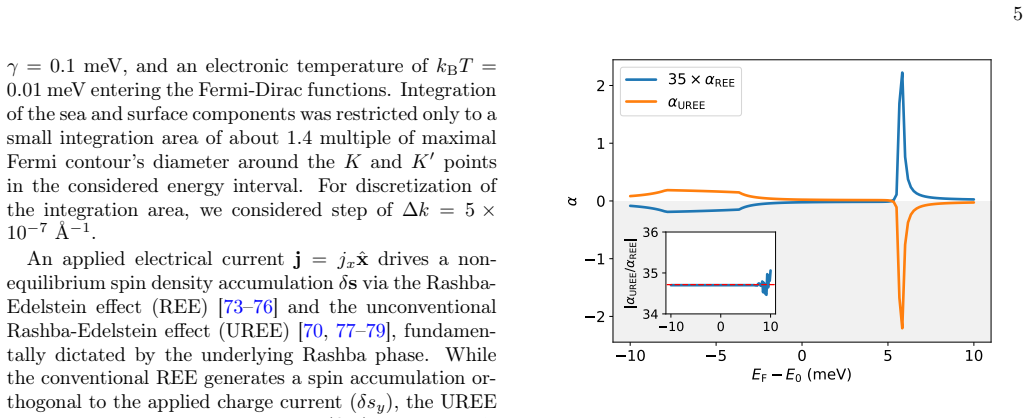
In the asymmetrical (AA) stacking, proximity fields from both interfaces constructively interfere, yielding a cumulative Rashba phase of nearly π/2. This pure radial Rashba spin pattern leads to the unconventional Rashba-Edelstein effect, which robustly dominates over the conventional response by a factor of 35 across a wide energy range. Conversely, the symmetrical (AA') stacking preserves a horizontal mirror symmetry, establishing a stable, purely out-of-plane persistent spin texture. The computed orbital Hall effect surpasses the spin Hall effect by three orders of magnitude, with a finite plateau inside the proximity-induced gaps while the spin Hall conductivity vanishes.
Load-bearing premise
First-principles calculations and the Kubo formalism accurately capture the proximity-induced fields and transport without significant errors from approximations or neglected effects.
Editorial analysis
A structured set of objections, weighed in public.
Referee Report
Summary. The manuscript investigates graphene encapsulated by 1T-TaS2 monolayers in the CDW phase using first-principles calculations, tight-binding modeling, and the Kubo formalism. It claims that stacking order controls distinct transport regimes: asymmetrical (AA) stacking produces constructive interference of proximity fields yielding a pure radial Rashba spin texture with cumulative phase near π/2, causing the unconventional Rashba-Edelstein effect to dominate the conventional response by a factor of 35 over a wide energy range; symmetrical (AA') stacking preserves horizontal mirror symmetry and yields a stable out-of-plane persistent spin texture. The orbital Hall effect exceeds the spin Hall effect by three orders of magnitude, with a finite plateau inside proximity-induced gaps while spin Hall conductivity vanishes.
Significance. If the quantitative results hold, the work establishes stacking as a deterministic control knob for realizing pure radial Rashba textures, robust unconventional REE, and orbital-dominated transport in a single van der Waals platform. The reported factor-of-35 dominance and three-order-of-magnitude OHE/SHE contrast, together with the gap-plateau behavior, would constitute concrete, falsifiable predictions for spin- and orbitronic device design.
major comments (1)
- [Methods and Results (proximity-field and transport sections)] The headline claims (cumulative Rashba phase of nearly π/2, REE dominance by exactly 35, OHE/SHE ratio of 10^3) rest on the accuracy of the DFT-derived proximity fields in the CDW-reconstructed 1T-TaS2/graphene interfaces. No convergence tests with respect to supercell size for the CDW reconstruction, no comparisons to hybrid functionals or GW, and no experimental benchmarks for the stacking-dependent spin textures are reported; this directly affects the reliability of the constructive-interference assertion in AA stacking and the numerical dominance factors.
Simulated Author's Rebuttal
We thank the referee for their thorough review and constructive feedback. We respond point-by-point to the major comment below.
read point-by-point responses
-
Referee: [Methods and Results (proximity-field and transport sections)] The headline claims (cumulative Rashba phase of nearly π/2, REE dominance by exactly 35, OHE/SHE ratio of 10^3) rest on the accuracy of the DFT-derived proximity fields in the CDW-reconstructed 1T-TaS2/graphene interfaces. No convergence tests with respect to supercell size for the CDW reconstruction, no comparisons to hybrid functionals or GW, and no experimental benchmarks for the stacking-dependent spin textures are reported; this directly affects the reliability of the constructive-interference assertion in AA stacking and the numerical dominance factors.
Authors: The referee correctly identifies the absence of reported convergence tests, hybrid/GW comparisons, and experimental benchmarks. We agree these points bear on the quantitative reliability of the reported factors. In the revised manuscript we will add explicit convergence tests with respect to supercell size and k-point density to substantiate the stability of the proximity fields and the resulting spin textures in both stackings. Hybrid-functional and GW calculations remain computationally prohibitive for the large CDW supercells (>100 atoms), so we will note this limitation while observing that the PBE results are consistent with prior DFT studies on graphene/TMD interfaces. As a purely theoretical work, experimental benchmarks cannot be provided, but the manuscript supplies concrete, falsifiable predictions for future measurements. We will qualify the numerical dominance factors (35 and three orders of magnitude) as DFT-PBE estimates and add a brief methods discussion of these constraints. This is a partial revision. revision: partial
Circularity Check
No significant circularity; derivation relies on standard external methods
full rationale
The paper's central claims rest on first-principles DFT calculations, tight-binding modeling, and Kubo formalism applied to the heterostructure. These are standard computational tools whose outputs are not defined in terms of the target quantities (Rashba phase, REE dominance factor, OHE/SHE ratio) by construction within the work. No self-citations are invoked to justify uniqueness theorems or ansatzes, no parameters are fitted to subsets and then relabeled as predictions, and no renaming of known results occurs. The derivation chain is self-contained against external benchmarks and does not reduce to its inputs.
Assumptions & free parameters
Cite this review
Pith. "Pith review of Stacking switching between correlation-protected radial Rashba field and persistent spin textures in graphene encapsulated by 1T-TaS$_2$ monolayers." pith.science (2026). https://pith.science/paper/UG7TBNGH
@misc{pith2026260612239,
  author       = {Pith},
  title        = {Pith review of: Stacking switching between correlation-protected radial Rashba field and persistent spin textures in graphene encapsulated by 1T-TaS$_2$ monolayers},
  year         = {2026},
  howpublished = {\url{https://pith.science/paper/UG7TBNGH}},
  note         = {Machine review of arXiv:2606.12239}
}
abstract
We investigate the electronic structure, spin textures, and charge to spin/orbital transport in graphene encapsulated by 1T-TaS$_{2}$ monolayers in the charge density wave phase. Using first-principles calculations, tight-binding modeling, and the Kubo formalism, we show that the encapsulation stacking dictates fundamentally distinct transport regimes. In the asymmetrical (AA) stacking, proximity fields from both interfaces constructively interfere, yielding a cumulative Rashba phase of nearly $\pi/2$. This pure radial Rashba spin pattern leads to the unconventional Rashba-Edelstein effect, which robustly dominates over the conventional response by a factor of 35 across a wide energy range. Conversely, the symmetrical (AA') stacking preserves a horizontal mirror symmetry, establishing a stable, purely out-of-plane persistent spin texture. Furthermore, the computed orbital Hall effect is exceptionally efficient, surpassing the spin Hall effect by three orders of magnitude. Within the proximity-induced spectral gaps, the orbital Hall conductivity exhibits a finite plateau, whereas the spin Hall conductivity vanishes. Our findings establish graphene encapsulated heterostructures as a promising system for realizing distinct charge to spin and charge to orbital interconversion regimes determined by the choice of stacking order.
Figures


Figures from the paper (1 more)

Forward citations
Cited by 1 Pith paper
-
Layer-selective chirality switch in bilayer graphene intercalated by Janus monolayers
DFT and tight-binding calculations show that Janus monolayers intercalated in bilayer graphene induce opposite Rashba spin-orbit coupling signs in the two graphene layers, enabling layer-selective spin current reversa...
Reference graph
Works this paper leans on
-
[1]
A. K. Geim and I. V. Grigorieva, Nature499, 419 (2013)
2013
-
[2]
P. Wang, C. Jia, Y. Huang, and X. Duan, Matter4, 552 (2021)
2021
-
[3]
Žutić, J
I. Žutić, J. Fabian, and S. Das Sarma, Review of Modern Physics76, 323 (2004)
2004
-
[4]
W. Han, R. K. Kawakami, M. Gmitra, and J. Fabian, Nature Nanotechnology9, 794 (2014)
2014
-
[5]
J. F. Sierra, J. Fabian, R. K. Kawakami, S. Roche, and S. O. Valenzuela, Nature Nanotechnology16, 856 (2021)
2021
-
[6]
Kurebayashi, J
H. Kurebayashi, J. H. Garcia, S. Khan, J. Sinova, and S. Roche, Nature Reviews Physics4, 150 (2022)
2022
-
[7]
Zollner, M
K. Zollner, M. Kurpas, M. Gmitra, and J. Fabian, Nature Reviews Physics7, 255 (2025)
2025
-
[8]
Gmitra and J
M. Gmitra and J. Fabian, Physical Review B92, 155403 (2015)
2015
Show all 89 references
-
[9]
Gmitra, D
M. Gmitra, D. Kochan, P. Högl, and J. Fabian, Physical Review B93, 155104 (2016)
2016
-
[10]
Gmitra and J
M. Gmitra and J. Fabian, Phys. Rev. Lett.119, 146401 (2017)
2017
-
[11]
T. P. Cysne, L. M. Canonico, M. Costa, R. B. Muniz, and T. G. Rappoport, npj Spintronics3, 39 (2025)
2025
-
[12]
Avsar, J
A. Avsar, J. Y. Tan, T. Taychatanapat, J. Balakrishnan, G. K. W. Koon, Y. Yeo, J. Lahiri, A. Carvalho, A. S. Rodin, E.C.T.O’Farrell, G.Eda, A.H.CastroNeto,and B. Özyilmaz, Nature Communications5, 4875 (2014)
2014
-
[13]
Zollner, M
K. Zollner, M. Gmitra, T. Frank, and J. Fabian, Physical Review B94, 155441 (2016)
2016
-
[14]
Zollner and J
K. Zollner and J. Fabian, Phys. Rev. B104, 075126 (2021)
2021
-
[15]
K.Zollner, S.M.João, B.Nikolić,andJ.Fabian,Physical Review B108, 235166 (2023)
2023
-
[16]
Milivojević, M
M. Milivojević, M. Gmitra, M. Kurpas, I. Štich, and J. Fabian, 2D Materials11, 035036 (2024)
2024
-
[17]
Fülöp, A
B. Fülöp, A. Márffy, S. Zihlmann, M. Gmitra, E. Tóvári, B. Szentpéteri, M. Kedves, K. Watanabe, T. Taniguchi, J. Fabian, C. Schönenberger, P. Makk, and S. Csonka, npj 2D Materials and Applications5, 82 (2021)
2021
-
[18]
David, P
A. David, P. Rakyta, A. Kormányos, and G. Burkard, Physical Review B100, 085412 (2019)
2019
-
[19]
Naimer, K
T. Naimer, K. Zollner, M. Gmitra, and J. Fabian, Phys- ical Review B104, 195156 (2021)
2021
-
[21]
Veneri, D
A. Veneri, D. T. S. Perkins, C. G. Péterfalvi, and A. Fer- reira, Physical Review B106, L081406 (2022)
2022
-
[22]
S. Lee, D. J. P. de Sousa, Y.-K. Kwon, F. de Juan, Z. Chi, F. Casanova, and T. Low, Phys. Rev. B106, 165420 (2022)
2022
-
[23]
Pasquier and O
D. Pasquier and O. V. Yazyev, Physical Review B100, 201103 (2019)
2019
-
[24]
Wilson, F
J. Wilson, F. Di Salvo, and S. Mahajan, Advances in Physics24, 117 (1975)
1975
-
[25]
Brouwer and F
R. Brouwer and F. Jellinek, Physica B+C99, 51 (1980)
1980
-
[26]
D. C. Miller, S. D. Mahanti, and P. M. Duxbury, Physical Review B97, 045133 (2018)
2018
-
[27]
Zhang, C
K. Zhang, C. Si, C.-S. Lian, J. Zhou, and Z. Sun, Journal of Materials Chemistry C8, 9742 (2020)
2020
-
[28]
Jiang, T
T. Jiang, T. Hu, G.-D. Zhao, Y. Li, S. Xu, C. Liu, Y. Cui, and W. Ren, Phys. Rev. B104, 075147 (2021)
2021
-
[29]
Tresca and M
C. Tresca and M. Calandra, 2D Materials6, 035041 (2019)
2019
-
[30]
Calandra, Phys
M. Calandra, Phys. Rev. Lett.121, 026401 (2018)
2018
-
[31]
L. Liu, H. Yang, Y. Huang, X. Song, Q. Zhang, Z. Huang, Y. Hou, Y. Chen, Z. Xu, T. Zhang, X. Wu, J. Sun, Y. Huang, F. Zheng, X. Li, Y. Yao, H.-J. Gao, and Y. Wang, Nature Communications12, 1978 (2021)
1978
-
[32]
M.Liu, J.Leveillee, S.Lu, J.Yu, H.Kim, C.Tian, Y.Shi, K. Lai, C. Zhang, F. Giustino, and C.-K. Shih, Science Advances7, eabi6339 (2021)
2021
-
[33]
K.Szałowski, M.Milivojević, D.Kochan,andM.Gmitra, 2D Materials10, 025013 (2023)
2023
-
[34]
Z. Chi, S. Lee, H. Yang, E. Dolan, C. K. Safeer, J. Ingla-Aynés, F. Herling, N. Ontoso, B. Martín-García, M. Gobbi, T. Low, L. E. Hueso, and F. Casanova, Ad- vanced Materialsn/a, 2310768 (2024)
2024
-
[35]
Frank, P
T. Frank, P. E. F. Junior, K. Zollner, and J. Fabian, Phys. Rev. B109, L241403 (2024)
2024
-
[36]
W.-H. Kang, M. Barth, A. Costa, A. Garcia-Ruiz, A. Mreńca-Kolasińska, M.-H. Liu, and D. Kochan, Phys. Rev. Lett.133, 216201 (2024)
2024
-
[37]
Przybysz, K
P. Przybysz, K. Tenzin, B. Kilic, W. Kozłowski, P. J. Kowalczyk, P. Dabrowski, and J. Sławińska, Applied Physics Letters128, 062401 (2026)
2026
-
[38]
B. A. Bernevig, T. L. Hughes, and S.-C. Zhang, Phys. Rev. Lett.95, 066601 (2005)
2005
-
[39]
D. Go, D. Jo, C. Kim, and H.-W. Lee, Phys. Rev. Lett. 121, 086602 (2018)
2018
-
[40]
Dyakonov and V
M. Dyakonov and V. Perel, Physics Letters A35, 459 (1971)
1971
-
[41]
Sinova, S
J. Sinova, S. O. Valenzuela, J. Wunderlich, C. H. Back, and T. Jungwirth, Rev. Mod. Phys.87, 1213 (2015)
2015
-
[42]
P. Sahu, J. K. Bidika, B. Biswal, S. Satpathy, and B. R. K. Nanda, Phys. Rev. B110, 054403 (2024)
2024
-
[43]
Thonhauser, D
T. Thonhauser, D. Ceresoli, D. Vanderbilt, and R. Resta, Phys. Rev. Lett.95, 137205 (2005)
2005
-
[44]
Busch, I
O. Busch, I. Mertig, and B. Göbel, Phys. Rev. Res.5, 043052 (2023)
2023
-
[45]
Bhowal and G
S. Bhowal and G. Vignale, Phys. Rev. B103, 195309 (2021)
2021
-
[46]
Spijkerman, J
A. Spijkerman, J. L. de Boer, A. Meetsma, G. A. Wiegers, and S. van Smaalen, Phys. Rev. B56, 13757 (1997)
1997
-
[47]
Stahl, M
Q. Stahl, M. Kusch, F. Heinsch, G. Garbarino, N. Kretzschmar, K. Hanff, K. Rossnagel, J. Geck, and T. Ritschel, Nature Communications11, 1247 (2020)
2020
-
[48]
Giannozzi, S
P. Giannozzi, S. Baroni, N. Bonini, M. Calandra, R. Car, C. Cavazzoni, D. Ceresoli, G. L. Chiarotti, M. Cococ- cioni, I. Dabo, A. D. Corso, S. de Gironcoli, S. Fabris, G. Fratesi, R. Gebauer, U. Gerstmann, C. Gougoussis, A. Kokalj, M. Lazzeri, L. Martin-Samos, N. Marzari, F. M...
2009
-
[49]
Giannozzi, O
P. Giannozzi, O. Andreussi, T. Brumme, O. Bunau, M. B. Nardelli, M. Calandra, R. Car, C. Cavazzoni, D. Ceresoli, M. Cococcioni, N. Colonna, I. Carnimeo, A. D. Corso, S. de Gironcoli, P. Delugas, R. A. DiStasio, A. Ferretti, A. Floris, G. Fratesi, G. Fugallo, R. Gebauer, U. Ger...
2017
-
[50]
Hohenberg and W
P. Hohenberg and W. Kohn, Physical Review136, B864 (1964)
1964
-
[51]
J. P. Perdew, K. Burke, and M. Ernzerhof, Physical Re- view Letters77, 3865 (1996)
1996
-
[52]
Kresse and D
G. Kresse and D. Joubert, Physical Review B59, 1758 (1999)
1999
-
[53]
Grimme, Journal of Computational Chemistry27, 1787 (2006)
S. Grimme, Journal of Computational Chemistry27, 1787 (2006)
2006
-
[54]
Barone, M
V. Barone, M. Casarin, D. Forrer, M. Pavone, M. Sambi, and A. Vittadini, Journal of Computational Chemistry 30, 934 (2009)
2009
-
[55]
Dal Corso, Computational Materials Science95, 337 (2014)
A. Dal Corso, Computational Materials Science95, 337 (2014)
2014
-
[56]
Bengtsson, Physical Review B59, 12301 (1999)
L. Bengtsson, Physical Review B59, 12301 (1999)
1999
-
[57]
Methfessel and A
M. Methfessel and A. T. Paxton, Physical Review B40, 3616 (1989)
1989
-
[58]
Kochan, M
D. Kochan, M. Gmitra, and J. Fabian, inSpintronics V, Vol. 8461 (SPIE, 2012) pp. 64–75
2012
-
[59]
Kochan, S
D. Kochan, S. Irmer, and J. Fabian, Physical Review B 95, 165415 (2017)
2017
-
[60]
Kubo, Canadian Journal of Physics34, 1274–1277 (1956)
R. Kubo, Canadian Journal of Physics34, 1274–1277 (1956)
1956
-
[61]
Kubo, Journal of the Physical Society of Japan12, 570–586 (1957)
R. Kubo, Journal of the Physical Society of Japan12, 570–586 (1957)
1957
-
[62]
Smrčka and P
L. Smrčka and P. Středa, Journal of Physics C: Solid State Physics10, 2153 (1977)
1977
-
[63]
Crépieux and P
A. Crépieux and P. Bruno, Physical Review B64, 014416 (2001)
2001
-
[64]
Bonbien and A
V. Bonbien and A. Manchon, Physical Review B102, 085113 (2020)
2020
-
[65]
Thonhauser, International Journal of Modern Physics B25, 1429 (2011)
T. Thonhauser, International Journal of Modern Physics B25, 1429 (2011)
2011
-
[66]
Vanderbilt,Berry Phases in Electronic Structure Theory: Electric Polarization, Orbital Magnetization and Topological Insulators(Cambridge University Press, 2018)
D. Vanderbilt,Berry Phases in Electronic Structure Theory: Electric Polarization, Orbital Magnetization and Topological Insulators(Cambridge University Press, 2018)
2018
-
[67]
Aryasetiawan and K
F. Aryasetiawan and K. Karlsson, Journal of Physics and Chemistry of Solids128, 87 (2019), spin-Orbit Coupled Materials
2019
-
[68]
H. Lee, I. Baek, M. Sastges, Y. Mokrousov, H.- W. Lee, and D. Go, Anatomy of the modern the- ory of orbital magnetism from first-principles: term-by- term analysis in the gauge-covariant formalism (2026), arXiv:2603.19875 [cond-mat.mes-hall]
2026 arXiv
-
[69]
A. Pezo, D. García Ovalle, and A. Manchon, Phys. Rev. B108, 075427 (2023)
2023
-
[70]
S. Lee, D. J. P. de Sousa, Y.-K. Kwon, F. de Juan, Z. Chi, F.Casanova,andT.Low,PhysicalReviewB106,165420 (2022)
2022
-
[71]
Freimuth, S
F. Freimuth, S. Blügel, and Y. Mokrousov, Physical Re- view B90, 174423 (2014)
2014
-
[72]
Železný, Y
J. Železný, Y. Zhang, C. Felser, and B. Yan, Physical Review Letters119, 187204 (2017)
2017
-
[73]
V. M. Edelstein, Solid State Communications73, 233–235 (1990)
1990
-
[74]
A.Dyrdał, J.Barnaś,andV.K.Dugaev,PhysicalReview B89, 075422 (2014)
2014
-
[75]
Offidani, M
M. Offidani, M. Milletarì, R. Raimondi, and A. Ferreira, Physical Review Letters119, 196801 (2017)
2017
-
[76]
T. S. Ghiasi, J. Ingla-Aynés, A. A. Kaverzin, and B. J. Van Wees, Nano Letters17, 7528 (2017)
2017
-
[77]
C. G. Péterfalvi, A. David, P. Rakyta, G. Burkard, and A. Kormányos, Physical Review Research4, L022049 (2022)
2022
-
[78]
H. Yang, B. Martín-García, J. Kimák, E. Schmoranze- rová, E. Dolan, Z. Chi, M. Gobbi, P. Němec, L. E. Hueso, and F. Casanova, Nature Materials23, 1502 (2024)
2024
-
[79]
Ontoso, C
N. Ontoso, C. K. Safeer, F. Herling, J. Ingla-Aynés, H. Yang, Z. Chi, B. Martin-Garcia, I. Robredo, M. G. Vergniory, F. de Juan, M. Reyes Calvo, L. E. Hueso, and F.Casanova,PhysicalReviewApplied19,014053(2022)
2022
-
[80]
J. H. Garcia, A. W. Cummings, and S. Roche, Nano Let- ters17, 5078 (2017)
2017
-
[81]
T. S. Ghiasi, A. A. Kaverzin, P. J. Blah, and B. J. van Wees, Nano Letters19, 5959 (2019)
2019
-
[82]
Herling, C
F. Herling, C. K. Safeer, J. Ingla-Aynés, N. Ontoso, L. E. Hueso, and F. Casanova, APL Materials8, 071103 (2020)
2020
-
[83]
Khokhriakov, A
D. Khokhriakov, A. M. Hoque, B. Karpiak, and S. P. Dash, Nature Communications11, 3657 (2020)
2020
-
[84]
A. M. Hoque, D. Khokhriakov, K. Zollner, B. Zhao, B. Karpiak, J. Fabian, and S. P. Dash, Communication Physics4, 124 (2021)
2021
-
[85]
Ingla-Aynés, I
J. Ingla-Aynés, I. Groen, F. Herling, N. Ontoso, C. K. Safeer, F. de Juan, L. E. Hueso, M. Gobbi, and F. Casanova, 2D Materials9, 045001 (2022)
2022
-
[86]
Camosi, J
L. Camosi, J. Světlík, M. V. Costache, W. S. Torres, I. F. Aguirre, V. Marinova, D. Dimitrov, M. Gospodinov, J. F. Sierra, and S. O. Valenzuela, 2D Materials9, 035014 (2022)
2022
-
[87]
D. Hara, M. S. Bahramy, and S. Murakami, Phys. Rev. B102, 184404 (2020)
2020
-
[88]
Leiva-Montecinos, J
S. Leiva-Montecinos, J. Henk, I. Mertig, and A. Johans- son, Phys. Rev. Res.5, 043294 (2023)
2023
-
[89]
T. P. Cysne, W. J. M. Kort-Kamp, and T. G. Rappoport, Phys. Rev. Res.6, 023271 (2024)
2024
-
[90]
A. Pezo, D. García Ovalle, and A. Manchon, Phys. Rev. B106, 104414 (2022)
2022
Reviewed June 27, 2026 · model on record in the stance chip above.
Discussion (0). Continue with ORCID to comment.