REVIEW 3 major objections 2 minor
SOAP-Bubbles turn a cheap diagonal uncertainty method into structured weight posteriors by running it inside SOAP’s eigenspace.
Reviewed by Pith at T0; open to challenge. T0 means a machine referee read the full paper against a public rubric. the ladder, T0–T4 →
T0 review · grok-4.5
2026-07-12 12:42 UTC pith:J6GNMOOS
load-bearing objection Abstract-only: a clean SOAP+IVON construction for structured weight uncertainty that looks useful if the exact-recovery and LM claims hold, but neither is checkable yet. the 3 major comments →
SOAP-Bubbles: Structured Weight Uncertainty for Neural Networks
The pith
A machine-rendered reading of the paper's core claim, the machinery that carries it, and where it could break.
Core claim
Running the diagonal variational method IVON in the eigenspace of SOAP’s preconditioner, then transforming the diagonal covariance by that same preconditioner, yields structured Gaussian posteriors (SOAP-Bubbles) whose estimation cost is comparable to SOAP itself and that recover the exact covariance for logistic regression while outperforming diagonal methods on language-model pretraining.
What carries the argument
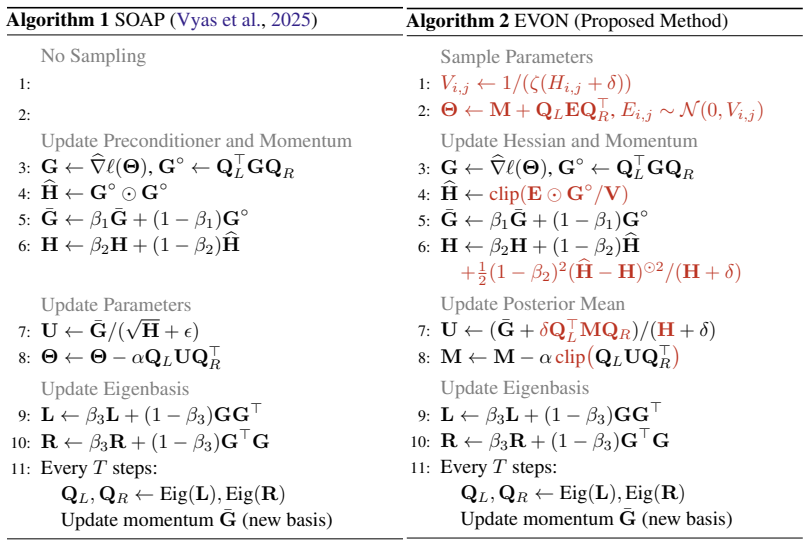
EVON (Eigenspace-VON): IVON’s diagonal covariance is estimated after rotating parameters into SOAP’s eigenbasis; the SOAP preconditioner then maps that diagonal matrix into a non-diagonal structured covariance in the original parameter space.
Load-bearing premise
That the eigenbasis already maintained by SOAP is a sufficiently faithful coordinate system for the dominant posterior correlations of deep networks, so a diagonal approximation performed there becomes a useful structured posterior after transformation.
What would settle it
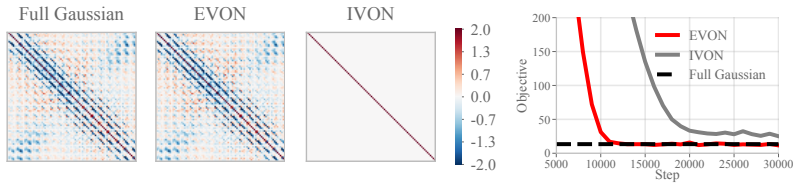
On a logistic-regression problem of moderate dimension, check whether the EVON covariance matrix matches the exact closed-form Gaussian posterior covariance (within numerical tolerance); any systematic mismatch falsifies the recovery claim.
Editorial analysis
A structured set of objections, weighed in public.
Referee Report
Summary. The manuscript proposes EVON (Eigenspace-VON) and the associated SOAP-Bubbles posteriors: run the diagonal variational method IVON in the eigenspace of SOAP’s preconditioner, then transform the resulting diagonal covariance by that preconditioner to obtain a structured (non-diagonal) weight posterior. The abstract asserts two central results: (i) for logistic regression, EVON recovers the exact Gaussian covariance; (ii) for language-model pretraining, EVON yields significantly better results than existing diagonal-covariance methods, at costs comparable to SOAP and without major pipeline changes. The claimed contribution is therefore a practical route to more expressive Bayesian posteriors at deep-learning scale.
Significance. If the exact-recovery claim and the controlled LM gains hold, the work would materially lower the barrier to structured weight uncertainty: it reuses an already-deployed optimizer geometry, keeps wall-clock cost near SOAP, and requires no drastic training-pipeline redesign. That combination would be of clear interest to Bayesian deep learning and large-scale uncertainty quantification. The constructive nature of the method (diagonal IVON in a fixed eigenspace, then a linear transform) is also a strength if the mathematics and experiments are sound. These strengths cannot yet be credited, because only the abstract is available.
major comments (3)
- Abstract, exact-recovery claim: the statement that EVON “recovers the exact Gaussian covariance” for logistic regression is load-bearing for the paper’s theoretical contribution. With only the abstract, there is no theorem statement, derivation, or proof sketch. The claim cannot be audited; a full derivation (or a clear statement of the precise sense of “exact”) is required before the result can be accepted.
- Abstract, empirical claim: the assertion of “significantly better results” than diagonal-covariance methods on language-model pretraining is the other load-bearing claim. No tables, metrics, error bars, compute-matched baselines, or ablations are available. Without those, superiority cannot be assessed and may be confounded by hyper-parameter or compute differences.
- Abstract, geometric premise: the construction assumes that SOAP’s preconditioner eigenspace is a sufficiently faithful basis for the dominant posterior correlations, so that a diagonal IVON estimate transformed by the same preconditioner yields a valid structured posterior. This premise underpins both the exact-recovery claim and the claimed gains over diagonal methods; it is not independently justified in the abstract and must be stated and tested in the full manuscript.
minor comments (2)
- Abstract only: notation for the transformed covariance, the precise role of IVON’s variational hyperparameters, and the SOAP rank/update schedule are not specified; these should be made explicit once the full text is available.
- The name “SOAP-Bubbles” is introduced without a short formal definition of the object (e.g., the family of covariances obtained by the EVON transform); a one-line definition would aid readers.
Circularity Check
No circularity found: abstract presents a constructive method (IVON in SOAP eigenspace + transform) without definitional loops or fitted-as-prediction reductions.
full rationale
Only the abstract is available. It describes EVON as running the existing diagonal method IVON in the eigenspace of SOAP’s preconditioner and transforming the diagonal estimate back into a structured covariance. The logistic-regression claim is an exact-recovery statement for a known Gaussian posterior; the LM claim is an empirical comparison to diagonal baselines. Neither claim, as stated, reduces by construction to a fitted target, a self-definition, or a load-bearing self-citation uniqueness theorem. No equations, uniqueness results, or self-citation chains appear in the provided text that would allow exhibiting a specific circular reduction. Residual risk that SOAP’s optimization geometry correlates with reported gains is not circularity under the stated criteria. Per hard rules, absence of quotable reduction implies score 0 and empty steps.
Axiom & Free-Parameter Ledger
free parameters (2)
- IVON variational hyperparameters (learning rates, prior precision, temperature, etc.)
- SOAP preconditioner rank / update schedule
axioms (3)
- ad hoc to paper A diagonal variational approximation (IVON) run in SOAP’s eigenspace, after transformation by the preconditioner, yields a useful structured posterior for deep networks.
- domain assumption SOAP’s preconditioner provides a stable, optimizable change of basis during training.
- standard math Standard variational inference and Gaussian posterior assumptions for logistic regression.
invented entities (1)
-
SOAP-Bubbles (named structured posteriors)
no independent evidence
read the original abstract
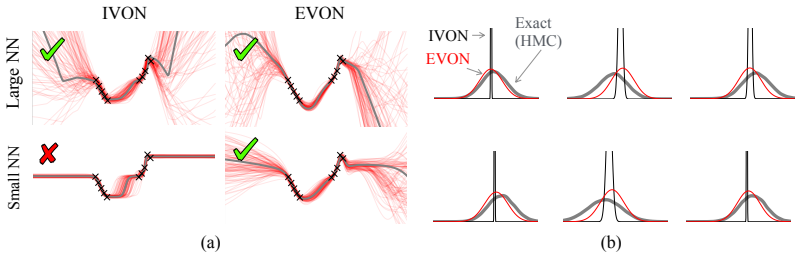
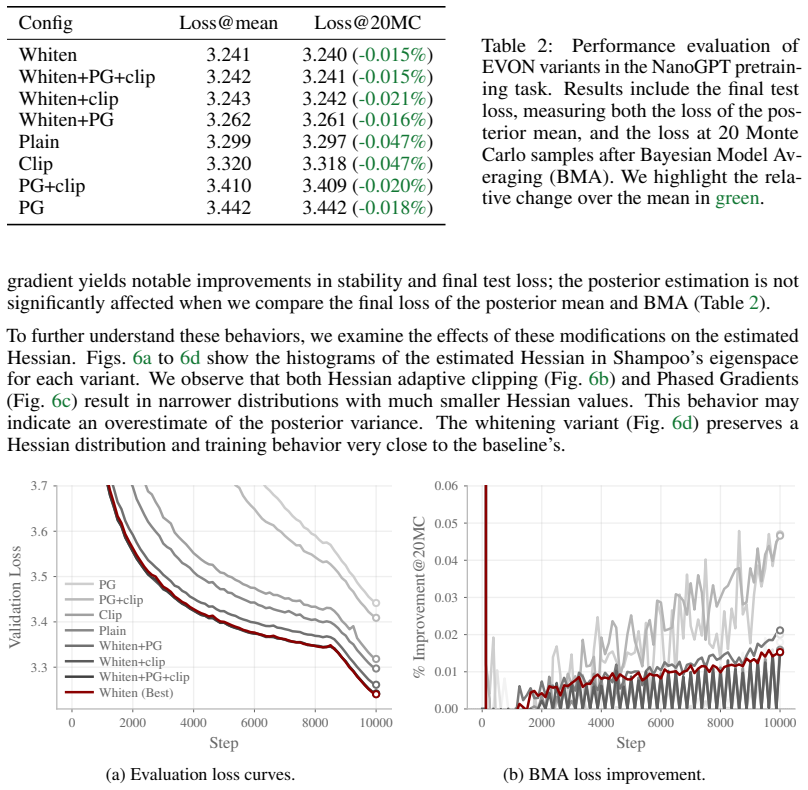
Structured weight-uncertainty can improve many aspects of deep learning, but it remains costly to estimate and difficult to implement. Here, we show that these issues can be addressed by adapting the SOAP optimizer. Our key idea is to run IVON, an existing diagonal-covariance variational method, in the eigenspace of SOAP's preconditioner and then use the preconditioner to transform the diagonal estimate into a non-diagonal covariance. The resulting method has costs similar to those of SOAP and requires no drastic changes to training pipelines. We call the posteriors obtained in this way SOAP-Bubbles and our new optimizer Eigenspace-VON (EVON). We show that, for logistic regression, EVON recovers the exact Gaussian covariance and that, for language model pretraining, it yields significantly better results than existing diagonal-covariance methods. Our work makes it easier to estimate more expressive posterior distributions for deep learning at scale.
Figures


discussion (0)
Sign in with ORCID, Apple, or X to comment. Anyone can read and Pith papers without signing in.