REVIEW 2 major objections 2 minor 71 references
Cross-correlation transmission spectroscopy of ultra-hot Jupiters WASP-189b, HAT-P-57b, KELT-17b, and KELT-21b with GIANO-B
T0 review · 2 major / 2 minor · reviewed 2026-06-26 · grok-4.3
Pith's one-line read Cross-correlation of NIR spectra yields a 3.8 sigma water detection in HAT-P-57b and a 5.3 sigma FeH detection in KELT-17b.
desk verdict This paper adds first NIR transmission spectra for three UHJs plus a new FeH detection, but the claimed significances rest on untested residual removal. read the letter →
The pith
A machine-rendered reading of the paper's core claim, the machinery that carries it, and where it could break.
The reading
What carries the argument
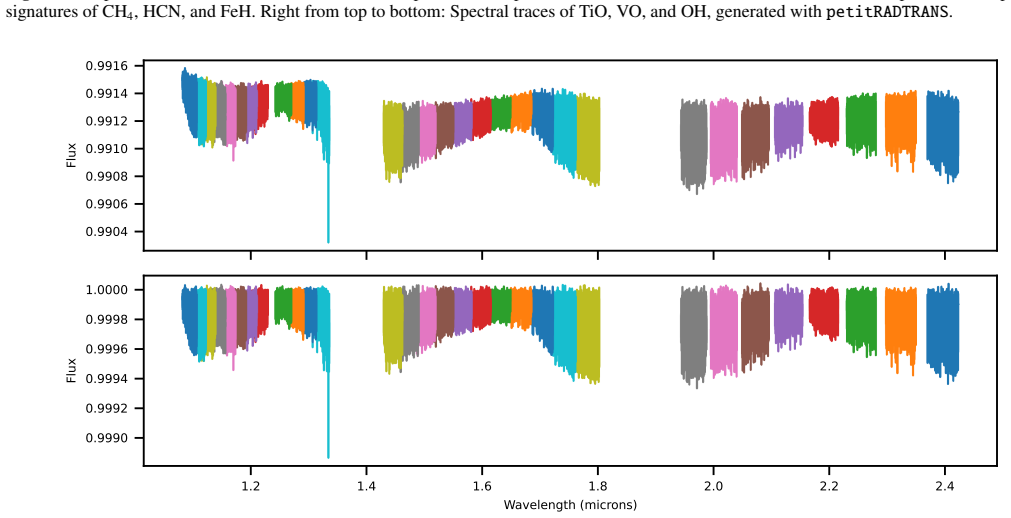
Cross-correlation technique applied to NIR transmission spectra from GIANO-B to extract molecular signals after removal of telluric and stellar lines.
What would settle it
A higher signal-to-noise follow-up observation that fails to recover the 5.3 sigma FeH peak in KELT-17b at the expected orbital velocity would falsify the reported detection.
Extended reading notes
Core claim
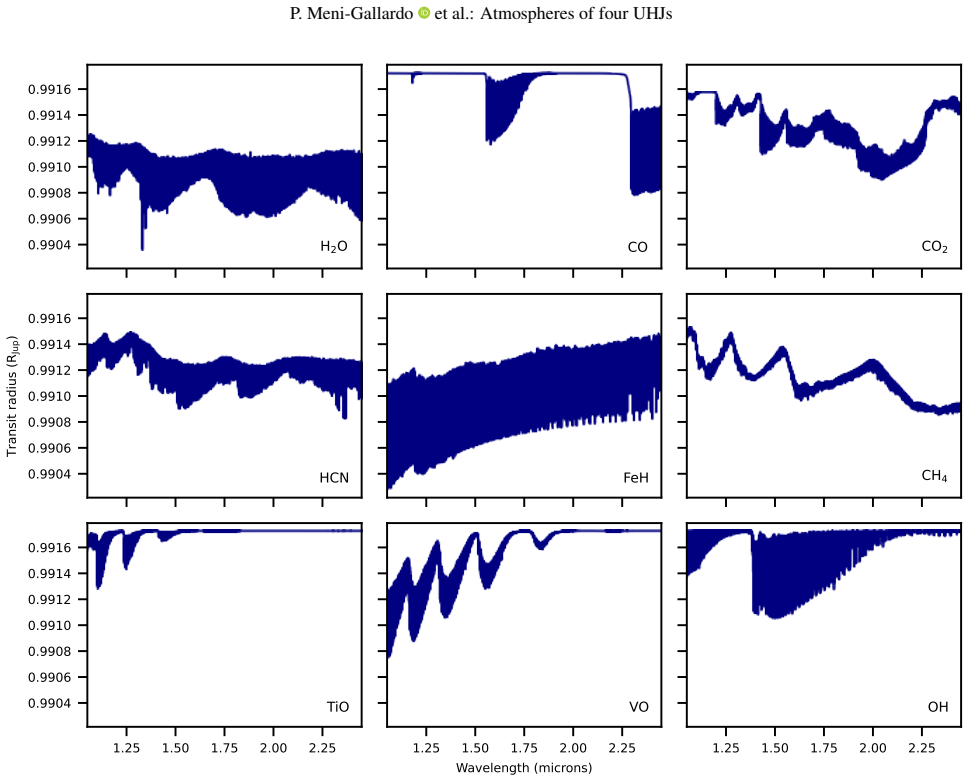
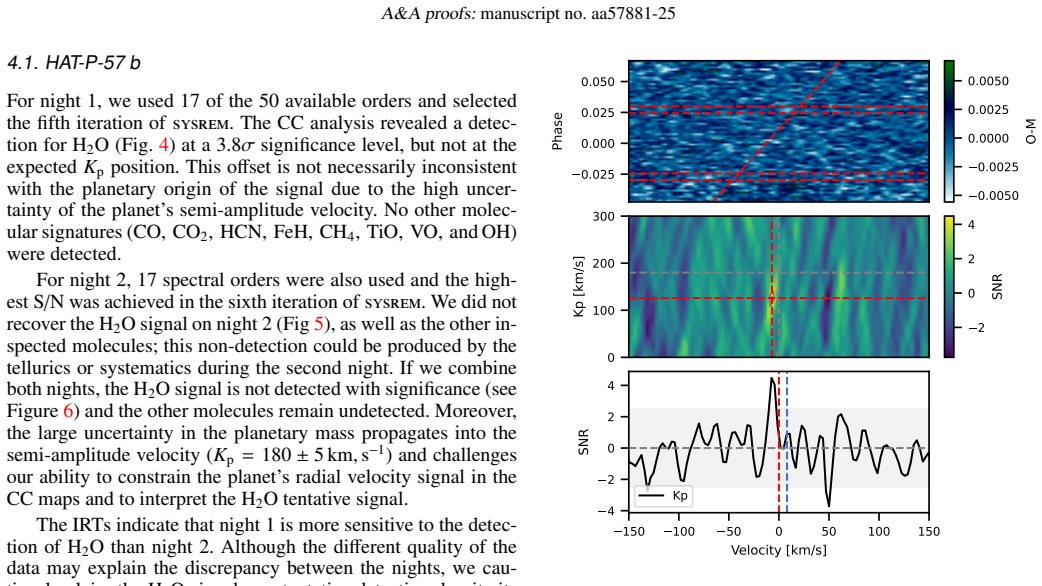
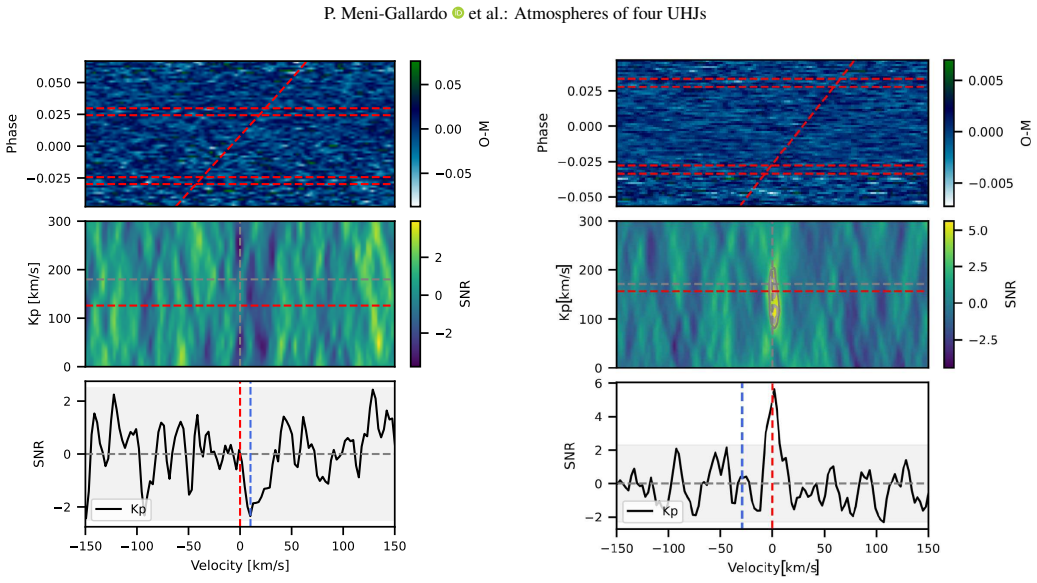
We report a tentative detection (3.8 sigma) of H2O in HAT-P-57 b and a detection (5.3 sigma) of FeH in KELT-17 b, which is the third FeH detection ever in a UHJ and with the lowest equilibrium temperature. No molecular signals were found in KELT-21b and WASP-189b, or for other molecules in HAT-P-57b and KELT-17b. The cross-correlation results align with the species detected in the UHJ population.
Load-bearing premise
The cross-correlation peaks are assumed to come from the planet after telluric and stellar signals are removed, without residual systematics or template mismatches that could create false positives.
Editorial extensions
If this is right
- The detected species in HAT-P-57b and KELT-17b match the inventory already reported for other ultra-hot Jupiters.
- NIR transmission spectra from 4 m telescopes can recover molecular signals in UHJs.
- KELT-17b supplies the lowest-temperature FeH detection yet, extending the range of conditions where this molecule appears.
- Absence of signals in KELT-21b and WASP-189b is consistent with current limits on what NIR cross-correlation can extract from these targets.
Reading between the lines
- Additional NIR epochs on the same targets could test whether the reported significances hold or arise from noise.
- The success with GIANO-B suggests similar instruments on other 4 m telescopes could enlarge the sample of NIR molecular detections.
- Lower equilibrium temperatures may still permit FeH to remain detectable, which future surveys can check by targeting cooler UHJs.
Editorial analysis
A structured set of objections, weighed in public.
Referee Report
Summary. The manuscript applies the cross-correlation technique to GIANO-B near-infrared transmission spectra of four ultra-hot Jupiters (HAT-P-57b, KELT-17b, KELT-21b, WASP-189b) to search for H₂O, CO, CO₂, CH₄, HCN, and FeH. It reports a tentative 3.8σ detection of H₂O in HAT-P-57b and a 5.3σ detection of FeH in KELT-17b (the third such detection in a UHJ and at the lowest Teq), with no other molecular signals detected.
Significance. If the detections are robust, the work adds to the census of molecular species in ultra-hot Jupiter atmospheres via NIR transmission spectroscopy and demonstrates the capabilities of 4-m-class telescopes for such observations.
major comments (2)
- [Data reduction and cross-correlation analysis] Data reduction and cross-correlation sections: No injection-recovery tests, false-positive rate estimates, or quantitative assessment of residual systematics after molecfit/PCA telluric and stellar removal are presented to support the claimed 3.8σ and 5.3σ significances; this is load-bearing because the central detections rest on the assumption that CCF peaks arise solely from the planet.
- [Results for KELT-17b] Results for KELT-17b FeH detection: The manuscript provides no sensitivity analysis showing how the assumed T-P profile and dissociation equilibrium in the FeH template affect the CCF peak height and reported 5.3σ value, despite the known sensitivity of FeH templates to these assumptions.
minor comments (2)
- [Abstract] Abstract: The statement that results 'align with the species detected in the UHJ population' is not accompanied by a quantitative comparison or table of prior detections.
- Notation: Inconsistent use of spacing around 'KELT-17~b' versus other targets; ensure uniform formatting throughout.
Simulated Author's Rebuttal
We thank the referee for their detailed and constructive report. We address each major comment below. Where the comments identify gaps in the presented analysis, we agree that revisions are warranted and will incorporate additional tests and discussion in the revised manuscript.
read point-by-point responses
-
Referee: Data reduction and cross-correlation sections: No injection-recovery tests, false-positive rate estimates, or quantitative assessment of residual systematics after molecfit/PCA telluric and stellar removal are presented to support the claimed 3.8σ and 5.3σ significances; this is load-bearing because the central detections rest on the assumption that CCF peaks arise solely from the planet.
Authors: We acknowledge that the manuscript does not present explicit injection-recovery tests, false-positive rate estimates, or a quantitative residual assessment after the molecfit and PCA steps. The reported significances follow the standard cross-correlation procedure used in the high-resolution spectroscopy literature, with noise estimated from the off-peak CCF standard deviation. Nevertheless, the referee is correct that these additional checks would strengthen the robustness claims. In the revised manuscript we will add injection-recovery tests for the reported H2O and FeH signals, together with a quantitative evaluation of residual systematics after telluric and stellar removal. revision: yes
-
Referee: Results for KELT-17b FeH detection: The manuscript provides no sensitivity analysis showing how the assumed T-P profile and dissociation equilibrium in the FeH template affect the CCF peak height and reported 5.3σ value, despite the known sensitivity of FeH templates to these assumptions.
Authors: We agree that FeH line lists and templates are known to be sensitive to the adopted temperature-pressure profile and dissociation assumptions. The current analysis employed a single equilibrium-chemistry template generated at the planet’s equilibrium temperature. To address the referee’s concern, the revised manuscript will include a sensitivity analysis in which the T-P profile and dissociation parameters are varied within plausible ranges, with the resulting changes to the CCF peak height and significance reported explicitly. revision: yes
Circularity Check
No significant circularity: observational cross-correlation analysis
full rationale
This is a standard high-resolution transmission spectroscopy paper that applies the cross-correlation technique to GIANO-B NIR data for four UHJs. Detections (e.g., 5.3σ FeH in KELT-17b) are reported from empirical CCF peaks after telluric/stellar subtraction; significances derive directly from the observed data distribution rather than from any fitted parameter that is then renamed as a prediction. No self-definitional equations, fitted-input predictions, or load-bearing self-citations appear in the derivation chain. The work is self-contained against external benchmarks (template libraries, standard pipelines) and does not invoke uniqueness theorems or ansatzes from prior author work to force results.
Assumptions & free parameters
assumptions (1)
- domain assumption The cross-correlation technique can reliably extract planetary atmospheric signals from high-resolution spectra after removing stellar and telluric contributions.
Cite this review
Pith. "Pith review of Cross-correlation transmission spectroscopy of ultra-hot Jupiters WASP-189b, HAT-P-57b, KELT-17b, and KELT-21b with GIANO-B." pith.science (2026). https://pith.science/paper/GAFPZUFR
@misc{pith2026260627221,
  author       = {Pith},
  title        = {Pith review of: Cross-correlation transmission spectroscopy of ultra-hot Jupiters WASP-189b, HAT-P-57b, KELT-17b, and KELT-21b with GIANO-B},
  year         = {2026},
  howpublished = {\url{https://pith.science/paper/GAFPZUFR}},
  note         = {Machine review of arXiv:2606.27221}
}
abstract
Since the discovery of the first exoplanet, significant efforts have been made to characterise their atmospheres. Ultra-hot Jupiters (UHJs) are of particular interest due to their extended and hot atmospheres. Although previous studies have focused on the detection of atomic species at optical wavelengths, near-infrared (NIR) observations offer the potential to detect molecules. In our study, we applied the cross-correlation technique to NIR transmission spectra from \giano. The analysis focuses on the search for H$_2$O, CO, CO$_2$, CH$_4$, HCN, and FeH molecular signals in the atmospheres of four UHJs: HAT-P-57 b, KELT-17 b, KELT-21 b, and WASP-189 b. For the first time, we report results on the NIR transmission spectra of KELT-17b, KELT-21b, and WASP-189b. We report a tentative detection ($3.8\sigma$) of H$_2$O in HAT-P-57 b and a detection ($5.3\sigma$) of FeH in KELT-17~b, which is the third FeH detection ever in a UHJ and with the lowest equilibrium temperature. No molecular signals were found in KELT-21b and WASP-189b, or for other molecules in HAT-P-57b and KELT-17b. The cross-correlation results for HAT-P-57 b, KELT-17 b, KELT-21 b, and WASP-189 b in transmission align with the species detected in the UHJ population. This work underscores the need for further observations to confirm and expand the transmission study of UHJs in the NIR, and the capabilities of high-resolution spectrographs on 4-m-class telescopes.
Figures

Figures from the paper (6 more)


Reference graph
Works this paper leans on
-
[1]
R., Temple, L
Anderson, D. R., Temple, L. Y ., Nielsen, L. D., et al. 2018, MNRAS Article number, page 10 of 12 P. Meni-Gallardo et al.: Atmospheres of four UHJs
2018
-
[2]
J., & Scott, P
Asplund, M., Grevesse, N., Sauval, A. J., & Scott, P. 2009, ARA&A, 47, 481
2009
-
[3]
2020, A&A, 639, A36
Baxter, C., Désert, J.-M., Parmentier, V ., et al. 2020, A&A, 639, A36
2020
-
[4]
Bernath, P. F. 2020, J. Quant. Spectr. Rad. Transf., 240, 106687
2020
-
[5]
L., De Kok, R
Birkby, J. L., De Kok, R. J., Brogi, M., et al. 2013, MNRAS, 436, L35
2013
-
[6]
L., Kok, R
Birkby, J. L., Kok, R. J. D., Brogi, M., Schwarz, H., & Snellen, I. A. G. 2017, AJ, 153, 138
2017
-
[7]
2024, AJ, 167, 179
Blain, D., Sánchez-López, A., & Mollière, P. 2024, AJ, 167, 179
2024
-
[8]
R., et al
Brogi, M., Emeka-Okafor, V ., Line, M. R., et al. 2023, AJ, 165, 91
2023
Show all 71 references
-
[9]
2018, A&A, 615, A16
Brogi, M., Giacobbe, P., Guilluy, G., et al. 2018, A&A, 615, A16
2018
-
[10]
2018, A&A, 616, A1
Brown, A., Vallenari, A., Prusti, T., et al. 2018, A&A, 616, A1
2018
-
[11]
H., Madhusudhan, N., Hawker, G
Cabot, S. H., Madhusudhan, N., Hawker, G. A., & Gandhi, S. 2019, MNRAS, 482, 4422
2019
-
[12]
2022, AJ, 164, 101
Carleo, I., Giacobbe, P., Guilluy, G., et al. 2022, AJ, 164, 101
2022
-
[13]
2020, A&A, 640, C6
Casasayas-Barris, N., Pallé, E., Yan, F., et al. 2020, A&A, 640, C6
2020
-
[14]
F., et al
Changeat, Q., Edwards, B., Al-Refaie, A. F., et al. 2022, AJ, 260, 3
2022
-
[15]
L., Rocchetto, M., Yurchenko, S
Chubb, K. L., Rocchetto, M., Yurchenko, S. N., et al. 2021, A&A, 646, A21
2021
-
[16]
2016, in SPIE, ed
Claudi, R., Benatti, S., Carleo, I., et al. 2016, in SPIE, ed. C. J. Evans, L. Simard, & H. Takami, V ol. 9908, 99081A
2016
-
[17]
2021, A&A
Cont, D., Yan, F., Reiners, A., et al. 2021, A&A
2021
-
[18]
2018, A&A, 616, A5
Cropper, M., Katz, D., Sartoretti, P., et al. 2018, A&A, 616, A5
2018
-
[19]
P., et al
Czesla, S., Schröter, S., Schneider, C. P., et al. 2019, ASCL de Regt, S., Snellen, I. A. G., Allard, N. F., et al. 2025, A&A, 696, A225
2019
-
[20]
K., Langeveld, A
Deibert, E. K., Langeveld, A. B., Young, M. E., et al. 2024, AJ, 168, 148
2024
-
[21]
W., et al
Finnerty, L., Xin, Y ., Xuan, J. W., et al. 2025, AJ, 169, 333
2025
-
[22]
K., Lothringer, J
Fu, G., Sing, D. K., Lothringer, J. D., et al. 2022, ApJ, 925, L3
2022
-
[23]
& Hirano, T
Gaidos, E. & Hirano, T. 2023, MNRAS, 525, 6303
2023
-
[24]
2021, Nature, 592, 205
Giacobbe, P., Brogi, M., Gandhi, S., et al. 2021, Nature, 592, 205
2021
-
[25]
2022, A&A, 665, A104
Guilluy, G., Giacobbe, P., Carleo, I., et al. 2022, A&A, 665, A104
2022
-
[26]
J., Tennyson, J., Kaminsky, B
Harris, G. J., Tennyson, J., Kaminsky, B. M., Pavlenko, Y . V ., & Jones, H. R. A. 2006, MNRAS, 367, 400
2006
-
[27]
D., Bakos, G., Buchhave, L
Hartman, J. D., Bakos, G., Buchhave, L. A., et al. 2015, AJ, 150, 197
2015
-
[28]
2019, A&A, 626, A133
Helling, C., Gourbin, P., Woitke, P., & Parmentier, V . 2019, A&A, 626, A133
2019
-
[29]
2021, A&A, 649, A44
Helling, C., Lewis, D., Samra, D., et al. 2021, A&A, 649, A44
2021
-
[30]
2023, A&A, 671, A122
Helling, C., Samra, D., Lewis, D., et al. 2023, A&A, 671, A122
2023
-
[31]
Ivshina, E. S. & Winn, J. N. 2022, ApJS, 259, 62
2022
-
[32]
C., Rodriguez, J
Johnson, M. C., Rodriguez, J. E., Zhou, G., et al. 2018, AJ, 155, 100
2018
-
[33]
2013, A&A, 560, A91
Jones, A., Noll, S., Kausch, W., Szyszka, C., & Kimeswenger, S. 2013, A&A, 560, A91
2013
-
[34]
2019, A&A, 622, A205
Katz, D., Sartoretti, P., Cropper, M., et al. 2019, A&A, 622, A205
2019
-
[35]
Y ., Snellen, I
Kesseli, A. Y ., Snellen, I. A. G., Alonso-Floriano, F. J., Mollière, P., & Serindag, D. B. 2020, AJ, 160, 228
2020
-
[36]
2023, ApJS, 265, 4
Kokori, A., Tsiaras, A., Edwards, B., et al. 2023, ApJS, 265, 4
2023
-
[37]
2025, A&A, 693, A72
Lesjak, F., Nortmann, L., Cont, D., et al. 2025, A&A, 693, A72
2025
-
[38]
E., Rothman, L
Li, G., Gordon, I. E., Rothman, L. S., et al. 2015, ApJS, 216, 15
2015
-
[39]
L., Stevenson, K
Mansfield, M., Bean, J. L., Stevenson, K. B., et al. 2020, ApJ, 888, L15
2020
-
[40]
K., Masseron, T., Hoeijmakers, H
McKemmish, L. K., Masseron, T., Hoeijmakers, H. J., et al. 2019, MNRAS, 488, 2836
2019
-
[41]
K., Yurchenko, S
McKemmish, L. K., Yurchenko, S. N., & Tennyson, J. 2016, MNRAS, 463, 771
2016
-
[42]
R., Gibson, N
Merritt, S. R., Gibson, N. P., Nugroho, S. K., et al. 2021, MNRAS, 506, 3853 Mollière, P., Wardenier, J. P., van Boekel, R., et al. 2019, A&A, 627, A67
2021
-
[43]
2012, A&A, 543, A92
Noll, S., Kausch, W., Barden, M., et al. 2012, A&A, 543, A92
2012
-
[44]
2025, A&A, 693, A213
Nortmann, L., Lesjak, F., Yan, F., et al. 2025, A&A, 693, A213
2025
-
[45]
2012, in Proceedings of the SPIE, ed
Oliva, E., Origlia, L., Maiolino, R., et al. 2012, in Proceedings of the SPIE, ed. I. S. McLean, S. K. Ramsay, & H. Takami, Amsterdam, Netherlands, 84463T
2012
-
[46]
2024, A&A, 689, A179
Orell-Miquel, J., Murgas, F., Pallé, E., et al. 2024, A&A, 689, A179
2024
-
[47]
R., Bean, J
Parmentier, V ., Line, M. R., Bean, J. L., et al. 2018, A&A, 617, A110
2018
-
[48]
2023, Nature, 619, 491
Pelletier, S., Benneke, B., Ali-Dib, M., et al. 2023, Nature, 619, 491
2023
-
[49]
2020, ApJ, 894, L27
Pino, L., Désert, J.-M., Brogi, M., et al. 2020, ApJ, 894, L27
2020
-
[50]
L., Kyuberis, A
Polyansky, O. L., Kyuberis, A. A., Zobov, N. F., et al. 2018, MNRAS, 480, 2597
2018
-
[51]
J., Kitzmann, D., et al
Prinoth, B., Hoeijmakers, H. J., Kitzmann, D., et al. 2022, Nature, 6, 449
2022
-
[52]
J., Pelletier, S., et al
Prinoth, B., Hoeijmakers, H. J., Pelletier, S., et al. 2023, A&A, 678, A182
2023
-
[53]
G., et al
Prusti, T., De Bruijne, J., Brown, A. G., et al. 2016, A&A, 595, A1
2016
-
[54]
2018, in SPIE, V ol
Rainer, M., Harutyunyan, A., Carleo, I., et al. 2018, in SPIE, V ol. 10702 (SPIE), 1855–1864
2018
-
[55]
A., Smith, P
Sanchez, J. A., Smith, P. C. B., Kanumalla, K., et al. 2025, Nature, arXiv:2512.10904
2025
-
[56]
J., Casasayas-Barris, N., et al
Sedaghati, E., MacDonald, R. J., Casasayas-Barris, N., et al. 2021, MNRAS, 505, 435
2021
-
[57]
P., et al
Simonnin, A., Parmentier, V ., Wardenier, J. P., et al. 2025, A&A, 698, A314
2025
-
[58]
2022, A&A, 662, A101
Stangret, M., Casasayas-Barris, N., Pallé, E., et al. 2022, A&A, 662, A101
2022
-
[59]
2020, A&A, 638, A26
Stangret, M., Casasayas-Barris, N., Pallé, E., et al. 2020, A&A, 638, A26
2020
-
[60]
2021, A&A, 654, A73
Stangret, M., Pallé, E., Casasayas-Barris, N., et al. 2021, A&A, 654, A73
2021
-
[61]
G., Collins, K
Stassun, K. G., Collins, K. A., & Gaudi, B. S. 2017, AJ, 153, 136
2017
-
[62]
2005, MNRAS, 356, 1466
Tamuz, O., Mazeh, T., & Zucker, S. 2005, MNRAS, 356, 1466
2005
-
[63]
2021, ApJ, 909, 40
Turrini, D., Schisano, E., Fonte, S., et al. 2021, ApJ, 909, 40
2021
-
[64]
2025, A&A, 700, A9
Vaulato, V ., Pelletier, S., Ehrenreich, D., et al. 2025, A&A, 700, A9
2025
-
[65]
R., Visscher, C., Lewis, N
Wakeford, H. R., Visscher, C., Lewis, N. K., et al. 2017, MNRAS, 464, 4247
2017
-
[66]
2022, A&A, 661, L6
Yan, F., Pallé, E., Reiners, A., et al. 2022, A&A, 661, L6
2022
-
[67]
2024, ApJ, 971, L8
Yang, Y ., Chen, G., Yan, F., Tan, X., & Ji, J. 2024, ApJ, 971, L8
2024
-
[68]
F., Hodges, J., & Masseron, T
Yousefi, M., Bernath, P. F., Hodges, J., & Masseron, T. 2018, J. Quant. Spectr. Rad. Transf., 217, 416
2018
-
[69]
N., Mellor, T
Yurchenko, S. N., Mellor, T. M., Freedman, R. S., & Tennyson, J. 2020, MNRAS, 496, 5282
2020
-
[70]
N., Owens, A., Kefala, K., & Tennyson, J
Yurchenko, S. N., Owens, A., Kefala, K., & Tennyson, J. 2024, MNRAS, 528, 3719
2024
-
[71]
E., Collins, K
Zhou, G., Rodriguez, J. E., Collins, K. A., et al. 2016, AJ, 152, 136 Article number, page 11 of 12 A&A proofs:manuscript no. aa57881-25 Appendix A: Helium triplet analyses ofKELT−17 bandKELT−21 b We performed single-line transmission spectroscopy technique to study the possib...
2016
Reviewed June 26, 2026 · model on record in the stance chip above.
Discussion (0). Sign in to comment.