REVIEW 2 major objections 5 minor 1 cited by
Static atomic buses replace atom shuttling for long-range gates in fault-tolerant neutral-atom quantum computers, cutting logical error rates by over an order of magnitude.
Reviewed by Pith at T0; open to challenge. T0 means a machine referee read the full paper against a public rubric. the ladder, T0–T4 →
T0 review · grok-4.5
2026-07-12 06:56 UTC pith:PZDS6K47
load-bearing objection Concrete static-bus architecture with co-designed high-fidelity CZ pulses and Stim sims; the >10x logical-error edge over shuttling is real under their model but hangs on the optimistic heating constant and omitted laser/field noise they themselves flag. the 2 major comments →
Fault-tolerant quantum computation with static atomic buses
The pith
A machine-rendered reading of the paper's core claim, the machinery that carries it, and where it could break.
Core claim
Static atomic buses of mediator atoms can mediate high-fidelity long-range CZ gates that support both long-range stabilizer readout in high-rate LDPC codes and transversal logical gates between neighboring surface-code patches, yielding more than an order-of-magnitude improvement in logical error rates over atom-shuttling architectures and cycle times of about 1 ms for distances d ≲ 12.
What carries the argument
Bus-mediated CZ gates obtained by co-designing time-optimal GRAPE pulses with interaction-flatness (local maxima of the van der Waals potential) and robustness constraints so that mediator atoms begin and end fully disentangled while the end qubits acquire a controlled phase.
Load-bearing premise
The comparison assumes shuttling heating grows as A times distance to the two-thirds power with an optimistic A, while treating idle errors as zero in the static case and omitting laser phase noise and stray fields that affect high-n Rydberg states.
What would settle it
Repeat the Monte-Carlo logical-error simulations of the Bell-pair and La-cross memory circuits after replacing the shuttling-heating model with measured heating rates from a real dual-species array and after injecting laser-phase and electric-field noise into the bus-gate fidelities; if the static advantage disappears below physical error rates of 10^{-3}, the central claim fails.
If this is right
- Logical transversal gates between surface-code patches become possible in ~100 µs without physical atom transport for distances up to d=11 (and potentially d=25 with higher Rydberg states).
- High-rate La-cross and bivariate-bicycle LDPC memories can run full syndrome-extraction cycles in ~0.25–1.3 ms using only static bus gates.
- Atom shuttling can be relegated to background reloading and offline magic-state factories, removing transport latency from the algorithmic clock.
- A modular layout interleaving high-rate LDPC memories with surface-code processing units becomes practical under present-day Rabi rates and lattice spacings.
Where Pith is reading between the lines
- The same flat-interaction design may transfer to other dual-species platforms once suitable Rydberg pairs are identified, reducing the need for continuous recooling in deep circuits.
- If measurement heating can also be made negligible, the static architecture could widen its speed advantage over shuttling by another factor of several because recooling overheads would be largely eliminated.
- Extending the bus to three or more mediators while keeping spontaneous-emission errors below threshold would allow transversal operations between non-adjacent surface-code patches without any physical rearrangement.
Editorial analysis
A structured set of objections, weighed in public.
Referee Report
Summary. The manuscript introduces a primarily static neutral-atom architecture in which chains of auxiliary mediator atoms (atomic buses) realize long-range CZ gates without qubit transport. Optimal-control (GRAPE) pulses are co-designed for both symmetric (data–ancilla–data) and asymmetric (data–ancilla–ancilla) buses, incorporating interaction-flatness and robustness constraints; the resulting gates reach fidelities approaching 0.999 with durations of a few hundred nanoseconds. The architecture is shown to support transversal logical CZ/CNOT between neighboring surface-code patches (up to d=11, with a path to d=25) and long-range stabilizer readout for La-cross and bivariate-bicycle LDPC codes. Large-scale Stim+BPOSD Monte-Carlo simulations under a hardware-motivated noise model predict more than an order-of-magnitude reduction in logical error rate relative to an atom-shuttling baseline, together with logical-gate times ~100 µs and QEC-cycle times ~1 ms for d ≲ 12. A modular bridging scheme to surface-code compute units and a hybrid quasi-static magic-state factory complete the path to universality.
Significance. If the performance claims hold under realistic noise, the work supplies a concrete, co-designed alternative to shuttling that removes transport latency and heating from the algorithmic clock cycle while retaining the connectivity needed for high-rate LDPC memories and transversal Clifford operations. The combination of microscopic pulse engineering (analytic Rydberg-time scalings, flat-potential selection, ensemble robustness), explicit gate scheduling, and end-to-end logical simulations for multiple code families is a substantial advance over prior conceptual bus proposals. The dual-species layout and restriction of active transport to background reloading and magic-state routing are practically attractive. These elements make the manuscript a valuable blueprint for the next generation of neutral-atom FTQC architectures.
major comments (2)
- [Secs. III C, IV B 2; Figs. 4(b), 6; Eq. (19); App. D] The headline claim of “more than an order-of-magnitude improvement in logical error rates” (abstract; Figs. 4(b), 6) rests on a deliberately asymmetric noise model (Secs. III C, IV B 2). Shuttling heating is injected as independent single-qubit depolarizing noise of strength A·d^{2/3} with the optimistic prefactor A=6×10^{-4} (App. D), while static-bus idle errors are set identically to zero and laser phase/frequency noise plus stray-field perturbations of high-n Rydberg states are explicitly excluded from all reported gate infidelities (Sec. III A). The same A and the f(d) scaling of Eq. (19) (and App. E) feed every Monte-Carlo comparison and the cycle-time arithmetic of Secs. III B and IV B 3. A modest reduction in A, or inclusion of the omitted laser/field noise that would raise the bus-gate floor above the ~2–3× nearest-neighbor value used for f(d), would shrink or eliminate the clai
- [Sec. IV C 1; Table I] For the bivariate-bicycle [[144,12,12]] code the authors compute a weighted average physical infidelity ⟨1−F⟩=3.4×10^{-3} (Table I) and note that it lies below the pseudo-threshold of Ref. [44], but they explicitly defer a full circuit-level Monte-Carlo simulation “to future work” (Sec. IV C 1). Given that the same architecture is advertised for high-rate LDPC memories, the absence of even a single distance-scaling curve under the bus-gate noise model leaves a gap between the gate-level results and the logical-performance claims made for La-cross codes. Either a limited Stim simulation for the Gross code (or a clear statement that the BB results are only gate-level) is needed to keep the logical claims uniform across code families.
minor comments (5)
- [Abstract; Sec. I] The abstract and introduction state “d ≲ 12” / “d < 12” while the body discusses explicit constructions up to d=11 (one- and two-mediator) and a scaling argument to d=25. Align the numerical bounds for consistency.
- [Figs. 2, 3] Fig. 2(c.2) and the corresponding panels in Fig. 3 would benefit from an explicit horizontal scale bar (in µm) so that the claimed local-maximum condition can be read off without referring back to the text.
- [Sec. III B] In Sec. III B the total transversal-CZ time of 88 µs for d=9 assumes a 1 µs switching overhead and neglects ancilla-reset time; a one-sentence justification that dual-species reset is faster than the switching budget would strengthen the estimate.
- [App. E; Eq. (18)] App. E, Eq. (E4) retains the black-body term g2(n+g1)^{-2}; the main-text scaling Eq. (18) drops it. A brief remark that the room-temperature correction is sub-dominant for the n range considered would avoid confusion.
- [References] Several self-citations appear as arXiv preprints with future dates (e.g., 2604.25987). Update or replace with published versions where available, or mark clearly as concurrent work.
Circularity Check
No significant circularity: gate fidelities from independent GRAPE on the microscopic Hamiltonian; logical-error advantage from Stim Monte-Carlo under an explicit (asymmetric) noise model; self-citations supply methods/background only.
full rationale
The derivation chain is self-contained and non-circular. Time-optimal/robust bus-mediated CZ pulses are obtained by GRAPE minimization of the Bell-state infidelity (or the ensemble-robust cost) on the dual-species Rydberg Hamiltonian (Eqs. 1–3, 7–9); the resulting T and τ_ryd are numerical outputs, not definitions of the target fidelity. Spontaneous-emission and motional infidelities are estimated from those pulses (App. C, F) or from the fitted scalings (Eqs. 15–16, App. E) and then injected as range-dependent depolarizing rates p* = f(d)·p into Stim circuits. Logical error rates (Figs. 4(b), 6) and cycle-time arithmetic (Secs. III B, IV B 3) are therefore Monte-Carlo predictions under a stated noise model (A = 6×10^{-4}, zero static idle, laser/field noise omitted). None of these quantities reduces by construction to a fitted parameter that defines the claim. Self-citations (e.g., [16–18, 44, 75]) supply prior gate-optimization techniques, La-cross/BB constructions, and layout heuristics; they are not uniqueness theorems or load-bearing premises that force the order-of-magnitude advantage. The noise-model asymmetry is a correctness/assumption risk, not circularity. Score 1 reflects only the presence of ordinary self-citations that are not load-bearing.
Axiom & Free-Parameter Ledger
free parameters (4)
- shuttling heating prefactor A =
6e-4
- Rabi frequency Ω_max and principal quantum numbers (n_Rb, n_Cs) =
Ω_max=2π×2 MHz (baseline); n pairs such as (75,78), (71,69), etc.
- lattice spacing r_0 =
2.57–3 µm (baseline)
- BPOSD scaling factor s =
0.3
axioms (5)
- standard math CSS stabilizer formalism and transversal CNOT/CZ for surface codes; hypergraph-product construction for La-cross and bivariate bicycle codes.
- domain assumption Van der Waals Rydberg interactions B ∝ R^{-6} with species- and n-dependent C6 coefficients computed via ARC; dual-species (Rb/Cs) encoding suppresses crosstalk.
- domain assumption Idle errors negligible in static arrays (via lattice spacing or pulse optimization); measurement/reset error = p; single-qubit gates noiseless.
- domain assumption Minimum-jerk shuttling trajectory yields wall-clock time ∝ d^{1/3} and heating infidelity ∝ d^{2/3}.
- ad hoc to paper Laser phase/frequency noise and stray electric fields can be neglected relative to spontaneous emission and residual motion for the reported fidelities.
invented entities (1)
-
static atomic bus (mediator chain of ancilla atoms)
independent evidence
read the original abstract
Efficient quantum error correction and fault-tolerant quantum computing require scalable, high-fidelity long-range connectivity. In neutral-atom quantum computers, this is commonly achieved through atom transport, but shuttling introduces latency and motional heating that worsen with system size. Here, we introduce a neutral-atom architecture based on static atomic buses, in which auxiliary mediator atoms enable long-range entangling operations without qubit transport. The architecture naturally supports long-range stabilizer measurements in high-rate LDPC codes and transversal logical gates between neighboring surface-code patches, enabling a modular framework for efficient logical memories, Clifford computation, and magic-state distillation. To realize these capabilities, we co-design optimal-control protocols for bus-mediated controlled-Z gates that incorporate both microscopic neutral-atom dynamics and architectural constraints. We obtain smooth bus-mediated gates with fidelities approaching 99.9% and durations of a few hundred nanoseconds by combining time-optimal control with interaction-flatness and robustness constraints. Large-scale simulations of quantum error correction and logical entangling operations between neighboring surface-code patches predict more than an order-of-magnitude improvement in logical error rates compared with atom-shuttling architectures under realistic noise. The architecture achieves logical gate times of approximately 100 us and quantum-error-correction cycle times of about 1 ms for code distances d<12. These results establish static atomic buses as a practical alternative to atom shuttling for scalable fault-tolerant neutral-atom quantum computing.
Figures




Forward citations
Cited by 1 Pith paper
-
Protocols of coherent motion control for an interaction-driven Rydberg gate
Lattice pinning plus a motion-echo sequence suppresses position-induced errors in interaction-driven Rydberg CZ gates to the 10^-4 level at ~10 ns Rydberg dwell times.
Reference graph
Works this paper leans on
-
[1]
We find a pulse durationT (1b)Ωmax = 9.82 (10.8) and a sim- ulated infidelity 1−F= 1.6 (1.0)×10 −2, dominated by both thermal motion and spontaneous emission
Gates performance and robustness Figure 5(a.1) (5(b.1)) shows the time-optimal phases ϕD,A(t) that implement the long-range CZ gate for the stabilizers in ak= 2 (k= 3)-La-cross code, using a single ancilla bus and with lattice spacingr 0 = 3µm, principal quantum numbersn Rb = 71 (78) andn Cs = 69 (78). We find a pulse durationT (1b)Ωmax = 9.82 (10.8) and ...
-
[2]
These code instances feature moder- ate long-range connectivity and are hence highly suitable for static implementations
Noise model and numerical simulations WithStim, we perform memory simulations ofk= 2- andk= 3-La-cross codes encoding 4 and 9 logical qubits, respectively. These code instances feature moder- ate long-range connectivity and are hence highly suitable for static implementations. We simulatedrounds of syn- drome extraction to ensure robustness against measur...
-
[3]
La-cross gate scheduling We now discuss optimal gate scheduling of La-cross codes when implemented statically via Rydberg atomic busses made of a single ancilla atom. First, we note that, contrary to the Bell-pair protocol between surface codes, syndrome-extraction two-qubit gates act over moderate ranges and entangle ancilla and data qubits, making them ...
-
[4]
time steps are necessary to compile ak-La-cross code. Considering the optimal pulses derived in the previ- ous section, we can now quantitatively estimate the time of a single syndrome extraction round for thek= 2- andk= 3-La-cross codes. Fork= 2-La-cross codes, assuming a Rabi frequency Ω max = 2π×2 MHz, the duration of a single time-optimal gate between...
-
[5]
Gate performance and robustness Bivariate Bicycle codes require the implementation of long-range CZ gates between non-nearest-neighbor data and ancilla atoms [configuration (ii) as defined in Sec. II B 1]. To mediate interactions between atoms separated by more than 4.5r 0, an additional ancilla atom is intro- duced. There are eight possible configuration...
-
[6]
8, respectively
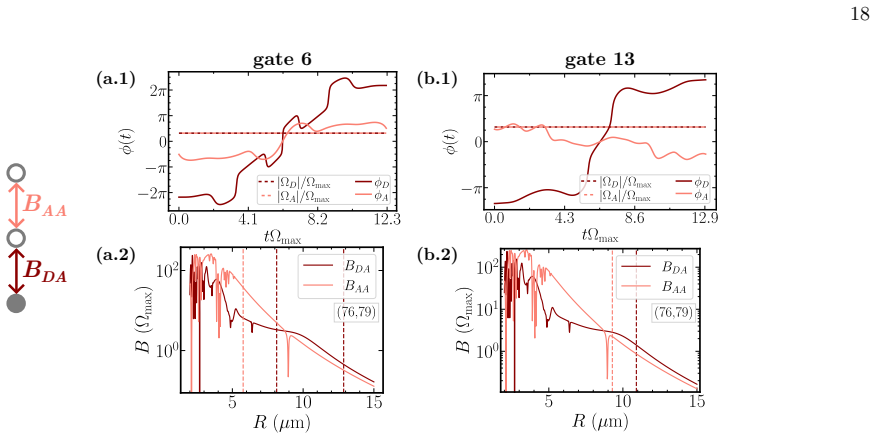
gates in panels (a.1) and (b.1) of Fig. 8, respectively. We consider a lattice spacingr 0 = 2.57µm and princi- pal quantum numbersn Rb = 76 andn Cs = 79. The corresponding pulse durations areT (1b)Ωmax = 12.2 and T (1b)Ωmax = 12.8, with infidelities 1−F= 5.9×10 −3 and 1−F= 9.2×10 −3 for gates 6 and 13, respectively, with spontaneous emission and motional ...
-
[7]
We perform a qubit layout search using the same strategy as [17] with some alterations to match the new problem
Bivariate bicycle layout We expect both sensitivity to errors and the time re- quired to execute to scale with the number of bus qubits used. We perform a qubit layout search using the same strategy as [17] with some alterations to match the new problem. The initial planar folding scheme from [17] re- sults in a layout where stabilizer and data qubits are...
-
[8]
The first will perform all X stabilizer operations using cleanly prepared Z bus qubits
Bivariate bicycle gate scheduling The full syndrome extraction circuit is divided into two sub-circuits. The first will perform all X stabilizer operations using cleanly prepared Z bus qubits. Then, all stabilizer qubits are measured and cleanly prepared X bus qubits for the Z stabilizer operations. Some of the stabilizer operations within each sub-circui...
2021
-
[9]
A. R. Calderbank and P. W. Shor, Good quantum error- correcting codes exist, Physical Review A54, 1098–1105 (1996)
1996
-
[10]
S. J. Evered, D. Bluvstein, M. Kalinowski, S. Ebadi, T. Manovitz, H. Zhou, S. H. Li, A. A. Geim, T. T. Wang, N. Maskara, H. Levine, G. Semeghini, M. Greiner, V. Vuleti´ c, and M. D. Lukin, High-fidelity parallel entan- gling gates on a neutral-atom quantum computer, Nature 622, 268 (2023)
2023
-
[11]
A. G. Radnaev, W. C. Chung, D. C. Cole, D. Ma- son, T. G. Ballance, M. J. Bedalov, D. A. Belknap, M. R. Berman, M. Blakely, I. L. Bloomfield, P. D. Buttler, C. Campbell, A. Chopinaud, E. Copenhaver, M. K. Dawes, S. Y. Eubanks, A. J. Friss, D. M. Gar- cia, J. Gilbert, M. Gillette, P. Goiporia, P. Gokhale, J. Goldwin, D. Goodwin, T. M. Graham, C. Guttorms- ...
2025
-
[12]
R. B.-S. Tsai, X. Sun, A. L. Shaw, R. Finkelstein, and M. Endres, Benchmarking and fidelity response theory of high-fidelity Rydberg entangling gates, PRX Quantum6, 010331 (2025)
2025
-
[13]
Peper, Y
M. Peper, Y. Li, D. Y. Knapp, M. Bileska, S. Ma, G. Liu, P. Peng, B. Zhang, S. P. Horvath, A. P. Burgers, and J. D. Thompson, Spectroscopy and modeling of 171Yb Rydberg states for high-fidelity two-qubit gates, Phys. Rev. X15, 011009 (2025)
2025
-
[14]
J. A. Muniz, M. Stone, D. T. Stack, M. Jaffe, J. M. Kindem, L. Wadleigh, E. Zalys-Geller, X. Zhang, C.-A. Chen, M. A. Norcia, J. Epstein, E. Halperin, F. Hum- mel, T. Wilkason, M. Li, K. Barnes, P. Battaglino, T. C. Bohdanowicz, G. Booth, A. Brown, M. O. Brown, W. B. Cairncross, K. Cassella, R. Coxe, D. Crow, M. Feldkamp, C. Griger, A. Heinz, A. M. W. Jon...
2025
-
[15]
S. J. Evered, M. Xu, S. H. Li, A. A. Geim, J. P. B. Ataides, M. Kalinowski, D. Bluvstein, N. Maskara, C. Kokail, M. Greiner, V. Vuleti´ c, and M. D. Lukin, High-fidelity entangling gates and nonlocal circuits with neutral atoms (2026), arXiv:2604.25987 [quant-ph]
Pith/arXiv arXiv 2026
-
[16]
G. Liu, G. Bornet, D. Kurdak, M. Xiao, C. Li, B. Zhang, and J. D. Thompson, High-fidelity neutral atom gates leveraging low-rank hessian optimization (2026), arXiv:2606.05060 [quant-ph]. 25
Pith/arXiv arXiv 2026
-
[17]
H. Zhou, C. Zhao, M. Cain, D. Bluvstein, N. Maskara, C. Duckering, H.-Y. Hu, S.-T. Wang, A. Kubica, and M. D. Lukin, Low-overhead transversal fault tolerance for universal quantum computation, Nature646, 303–308 (2025)
2025
-
[18]
M. Cain, D. Bluvstein, C. Zhao, S. Gu, N. Maskara, M. Kalinowski, A. A. Geim, A. Kubica, M. D. Lukin, and H. Zhou, Fast correlated decoding of transversal log- ical algorithms (2025), arXiv:2505.13587 [quant-ph]
Pith/arXiv arXiv 2025
-
[19]
Serra-Peralta, M
M. Serra-Peralta, M. H. Shaw, and B. M. Terhal, Decod- ing across transversal clifford gates in the surface code, PRX Quantum7, 010335 (2026)
2026
-
[20]
Bluvstein, H
D. Bluvstein, H. Levine, G. Semeghini, T. T. Wang, S. Ebadi, M. Kalinowski, A. Keesling, N. Maskara, H. Pichler, M. Greiner, V. Vuleti´ c, and M. D. Lukin, A quantum processor based on coherent transport of en- tangled atom arrays, Nature604, 451 (2022)
2022
-
[21]
Bluvstein, S
D. Bluvstein, S. J. Evered, A. A. Geim, S. H. Li, H. Zhou, T. Manovitz, S. Ebadi, M. Cain, M. Kali- nowski, D. Hangleiter, J. P. Ataides, N. Maskara, I. Cong, X. Gao, P. S. Rodriguez, T. Karolyshyn, G. Semeghini, M. Greiner, V. Vuleti´ c, and M. D. Lukin, Logical quan- tum processor based on reconfigurable atom arrays, Na- ture626, 58 (2024)
2024
-
[22]
Bluvstein, A
D. Bluvstein, A. A. Geim, S. H. Li, S. J. Evered, J. P. Bonilla Ataides, G. Baranes, A. Gu, T. Manovitz, M. Xu, M. Kalinowski, S. Majidy, C. Kokail, N. Maskara, E. C. Trapp, L. M. Stewart, S. Hollerith, H. Zhou, M. J. Gullans, S. F. Yelin, M. Greiner, V. Vuleti´ c, M. Cain, and M. D. Lukin, A fault-tolerant neutral-atom architec- ture for universal quantu...
2026
-
[23]
R. Rines, B. Hall, M. H. Teo, J. Viszlai, D. C. Cole, D. Mason, C. Barker, M. J. Bedalov, M. Blakely, T. Bothwell, C. Carnahan, F. T. Chong, S. Y. Eubanks, B. Fields, M. Gillette, P. Goiporia, P. Gokhale, G. T. Hickman, M. Iliev, E. B. Jones, R. A. Jones, K. W. Kuper, S. Lee, M. T. Lichtman, K. Loeffler, N. Mack- intosh, F. Majdeteimouri, P. T. Mitchell, ...
Pith/arXiv arXiv 2025
-
[24]
Jandura and G
S. Jandura and G. Pupillo, Time-optimal two- and three- qubit gates for Rydberg atoms, Quantum6, 712 (2022)
2022
-
[25]
Poole, T
C. Poole, T. M. Graham, M. A. Perlin, M. Otten, and M. Saffman, Architecture for fast implementation of quantum low-density parity-check codes with optimized Rydberg gates, Phys. Rev. A111, 022433 (2025)
2025
-
[26]
Pecorari, S
L. Pecorari, S. Jandura, G. K. Brennen, and G. Pupillo, High-rate quantum LDPC codes for long- range-connected neutral atom registers, Nat. Commun. 16, 1111 (2025)
2025
-
[27]
I. N. Ashkarin, S. Lepoutre, P. Pillet, I. I. Beterov, I. I. Ryabtsev, and P. Cheinet, Long-rangeccΦ gates via radio-frequency-induced f¨ orster resonances, Phys. Rev. Res.7, 013034 (2025)
2025
-
[28]
Kurdak, P
D. Kurdak, P. R. Banner, Y. Li, S. R. Muleady, A. V. Gorshkov, S. L. Rolston, and J. V. Porto, Enhancement of rydberg blockade via microwave dressing, Phys. Rev. Lett.134, 123404 (2025)
2025
-
[30]
Friesen, A
M. Friesen, A. Biswas, X. Hu, and D. Lidar, Efficient multiqubit entanglement via a spin bus, Phys. Rev. Lett. 98, 230503 (2007)
2007
-
[31]
W¨ uster, C
S. W¨ uster, C. Ates, A. Eisfeld, and J. M. Rost, Newton’s cradle and entanglement transport in a flexible Rydberg chain, Phys. Rev. Lett.105, 053004 (2010)
2010
-
[32]
Cesa and J
A. Cesa and J. Martin, Two-qubit entangling gates be- tween distant atomic qubits in a lattice, Phys. Rev. A 95, 052330 (2017)
2017
-
[33]
Sun, Buffer-atom-mediated quantum logic gates with off-resonant modulated driving, Sci China Phys, Mech
Y. Sun, Buffer-atom-mediated quantum logic gates with off-resonant modulated driving, Sci China Phys, Mech. & Astron.67, 120311 (2024)
2024
-
[34]
Doultsinos and D
G. Doultsinos and D. Petrosyan, Quantum gates between distant atoms mediated by a Rydberg excitation antifer- romagnet, Phys. Rev. Res.7, 023246 (2025)
2025
-
[35]
Delakouras, G
A. Delakouras, G. Doultsinos, and D. Petrosyan, Multi- qubit Rydberg gates between distant atoms, Quantum 10, 1990 (2026)
1990
-
[36]
M. Kim, K. Kim, J. Hwang, E.-G. Moon, and J. Ahn, Rydberg quantum wires for maximum independent set problems, Nat. Phys.18, 755 (2022)
2022
-
[37]
Anand, C
S. Anand, C. E. Bradley, R. White, V. Ramesh, K. Singh, and H. Bernien, A dual-species Rydberg array, Nat. Phys. 20, 1744 (2024)
2024
-
[38]
J. Miles, M. T. Lichtman, A. M. Scott, J. Scott, S. A. Norrell, M. J. Bedalov, D. A. Belknap, D. C. Cole, S. Y. Eubanks, M. Gillette, P. Gokhale, J. Goldwin, M. Iliev, R. A. Jones, K. W. Kuper, D. Mason, P. T. Mitchell, J. D. Murphree, N. A. Neff-Mallon, T. W. Noel, A. G. Radnaev, I. V. Vinogradov, and M. Saffman, Qubit syn- drome measurements with a high...
arXiv 2026
-
[39]
Warttmann, F
G. Warttmann, F. Meinert, H. P. B¨ uchler, and S. We- ber, Suppressing crosstalk for Rydberg quantum gates, Quantum10, 2045 (2026)
2045
-
[40]
A. K. Mohapatra, T. R. Jackson, and C. S. Adams, Co- herent optical detection of highly excited Rydberg states using electromagnetically induced transparency, Phys. Rev. Lett.98, 113003 (2007)
2007
-
[41]
Saßmannshausen, F
H. Saßmannshausen, F. Merkt, and J. Deiglmayr, High- resolution spectroscopy of Rydberg states in an ultracold cesium gas, Phys. Rev. A87, 032519 (2013)
2013
-
[42]
J. Wang, J. Bai, J. He, and J. Wang, Single-photon ce- sium rydberg excitation spectroscopy using 318.6-nm uv laser and room-temperature vapor cell, Opt. Express25, 22510 (2017)
2017
-
[43]
S. B. S., S. K. Barik, S. Chaudhuri, and S. Roy, Transition frequency measurement of highly excited rydberg states of 87rb for a wide range of principal quantum numbers, Opt. Continuum1, 1176 (2022)
2022
-
[44]
A. R. Calderbank and P. W. Shor, Good quantum error- correcting codes exist, Phys. Rev. A54, 1098 (1996)
1996
-
[45]
Steane, Multiple particle interference and quantum er- ror correction, Proceedings of the Royal Society of Lon- don
A. Steane, Multiple particle interference and quantum er- ror correction, Proceedings of the Royal Society of Lon- don. Series A: Mathematical, Physical and Engineering Sciences452, 2551–2577 (1996)
1996
-
[46]
Bombin and M
H. Bombin and M. A. Martin-Delgado, Optimal resources for topological two-dimensional stabilizer codes: Com- parative study, Phys. Rev. A76, 012305 (2007)
2007
-
[47]
A. G. Fowler, M. Mariantoni, J. M. Martinis, and A. N. Cleland, Surface codes: Towards practical large-scale quantum computation, Phys. Rev. A86, 032324 (2012). 26
2012
-
[48]
Kitaev, Fault-tolerant quantum computation by anyons, Annals of Physics303, 2–30 (2003)
A. Kitaev, Fault-tolerant quantum computation by anyons, Annals of Physics303, 2–30 (2003)
2003
-
[49]
S. Bravyi and A. Y. Kitaev, Quantum codes on a lattice with boundary, arXiv:quant-ph/9811052 (1998)
Pith/arXiv arXiv 1998
-
[50]
Tillich and G
J.-P. Tillich and G. Z´ emor, Quantum ldpc codes with positive rate and minimum distance proportional to the square root of the blocklength, IEEE Transactions on Information Theory60, 1193 (2014)
2014
-
[51]
A. A. Kovalev and L. P. Pryadko, Quantum kronecker sum-product low-density parity-check codes with finite rate, Physical Review A88, 10.1103/physreva.88.012311 (2013)
-
[52]
Bravyi, A
S. Bravyi, A. W. Cross, J. M. Gambetta, D. Maslov, P. Rall, and T. J. Yoder, High-threshold and low- overhead fault-tolerant quantum memory, Nature627, 778 (2024)
2024
-
[53]
Pecorari, S
L. Pecorari, S. Jandura, and G. Pupillo, Low-depth quan- tum error correction via three-qubit gates in Rydberg atom arrays, Phys. Rev. Lett.135, 240602 (2025)
2025
-
[54]
Levine, A
H. Levine, A. Keesling, G. Semeghini, A. Omran, T. T. Wang, S. Ebadi, H. Bernien, M. Greiner, V. Vuleti´ c, H. Pichler, and M. D. Lukin, Parallel implementation of high-fidelity multiqubit gates with neutral atoms, Phys. Rev. Lett.123, 170503 (2019)
2019
-
[55]
Pagano, S
A. Pagano, S. Weber, D. Jaschke, T. Pfau, F. Meinert, S. Montangero, and H. P. B¨ uchler, Error budgeting for a controlled-phase gate with Strontium-88 Rydberg atoms, Phys. Rev. Res.4, 033019 (2022)
2022
-
[56]
Mohan, R
M. Mohan, R. de Keijzer, and S. Kokkelmans, Robust control and optimal Rydberg states for neutral atom two- qubit gates, Phys. Rev. Res.5, 033052 (2023)
2023
-
[57]
Graham, M
T. Graham, M. Kwon, B. Grinkemeyer, A. Marra, X. Jiang, M. Lichtman, Y. Sun, M. Ebert, and M. Saffman, Rydberg mediated entanglement in a two- dimensional neutral atom qubit array, Phys. Rev. Lett. 123, 230501 (2019)
2019
-
[58]
L. S. Theis, F. Motzoi, F. K. Wilhelm, and M. Saffman, A high fidelity Rydberg blockade entangling gate using shaped, analytic pulses, Phys. Rev. A94, 032306 (2016)
2016
-
[59]
Robicheaux, T
F. Robicheaux, T. Graham, and M. Saffman, Photon re- coil and laser focusing limits to Rydberg gate fidelity, Phys. Rev. A103, 022424 (2021)
2021
-
[60]
Khaneja, T
N. Khaneja, T. Reiss, C. Kehlet, T. Schulte-Herbr¨ uggen, and S. J. Glaser, Optimal control of coupled spin dynam- ics: design of NMR pulse sequences by gradient ascent algorithms, J. Mag. Res.172, 296 (2005)
2005
-
[61]
Garon, S
A. Garon, S. J. Glaser, and D. Sugny, Time-optimal control of su(2) quantum operations, Phys. Rev. A88, 043422 (2013)
2013
-
[62]
B. Riaz, C. Shuang, and S. Qamar, Optimal control methods for quantum gate preparation: a comparative study: B. riaz et al., Quantum Information Processing 18, 100 (2019)
2019
-
[63]
F. K. Wilhelm, S. Kirchhoff, S. Machnes, N. Wittler, and D. Sugny, An introduction into optimal control for quantum technologies, arXiv preprint arXiv:2003.10132 https://doi.org/10.48550/arXiv.2003.10132 (2020)
-
[64]
Jandura, J
S. Jandura, J. D. Thompson, and G. Pupillo, Optimiz- ing Rydberg gates for logical-qubit performance, PRX Quantum4, 020336 (2023)
2023
-
[65]
M. Bergonzoni, R. R. Riso, and G. Pupillo, Fast quan- tum gates for neutral atoms separated by a few tens of micrometers, arXiv:2511.20437 (2026)
Pith/arXiv arXiv 2026
-
[66]
Virtanen, R
P. Virtanen, R. Gommers, T. E. Oliphant, M. Haber- land, T. Reddy, D. Cournapeau, E. Burovski, P. Pe- terson, W. Weckesser, J. Bright, S. J. van der Walt, M. Brett, J. Wilson, K. J. Millman, N. Mayorov, A. R. J. Nelson, E. Jones, R. Kern, E. Larson, C. J. Carey, ˙I. Po- lat, Y. Feng, E. W. Moore, J. VanderPlas, D. Laxalde, J. Perktold, R. Cimrman, I. Henr...
2020
-
[67]
A. C. Hughes, V. M. Sch¨ afer, K. Thirumalai, D. P. Nadlinger, S. R. Woodrow, D. M. Lucas, and C. J. Bal- lance, Benchmarking a high-fidelity mixed-species entan- gling gate, Phys. Rev. Lett.125, 080504 (2020)
2020
-
[68]
M. H. Goerz, T. Calarco, and C. P. Koch, The quantum speed limit of optimal controlled phasegates for trapped neutral atoms, Journal of Physics B: Atomic, Molecular and Optical Physics44, 154011 (2011)
2011
-
[69]
C. Chen, D. Dong, R. Long, I. R. Petersen, and H. A. Ra- bitz, Sampling-based learning control of inhomogeneous quantum ensembles, Phys. Rev. A89, 023402 (2014)
2014
-
[70]
Giudici, S
G. Giudici, S. Veroni, G. Giudice, H. Pichler, and J. Zei- her, Fast entangling gates for Rydberg atoms via reso- nant dipole-dipole interaction, PRX Quantum6, 030308 (2025)
2025
-
[71]
Cantat-Moltrecht, R
T. Cantat-Moltrecht, R. Corti˜ nas, B. Ravon, P. M´ ehaignerie, S. Haroche, J. M. Raimond, M. Favier, M. Brune, and C. Sayrin, Long-lived circular rydberg states of laser-cooled rubidium atoms in a cryostat, Phys. Rev. Res.2, 022032(R) (2020)
2020
-
[72]
Schymik, S
K.-N. Schymik, S. Pancaldi, F. Nogrette, D. Barredo, J. Paris, A. Browaeys, and T. Lahaye, Single atoms with 6000-second trapping lifetimes in optical-tweezer ar- rays at cryogenic temperatures, Phys. Rev. Applied16, 034013 (2021)
2021
-
[73]
Pichard, D
G. Pichard, D. Lim, E. Bloch, J. Vaneecloo, L. Boura- chot, G.-J. Both, G. M´ eriaux, S. Dutartre, R. Hostein, J. Paris, B. Ximenez, A. Signoles, A. Browaeys, T. La- haye, and D. Dreon, Rearrangement of individual atoms in a 2000-site optical-tweezer array at cryogenic temper- atures, Phys. Rev. Appl.22, 024073 (2024)
2000
-
[74]
Z. Zhang, T.-W. Hsu, T. Y. Tan, D. H. Slichter, A. M. Kaufman, M. Marinelli, and C. A. Regal, A high optical access cryogenic system for Rydberg atom arrays with a 3000-second trap lifetime, arXiv:2412.09780 (2024)
Pith/arXiv arXiv 2024
-
[75]
J. Jin, Y. Shi, Y. A. Alaoui, J. Deng, Y. Lu, J. D. Thompson, and W. S. Bakr, Extended rydberg life- times in a cryogenic atom array (2026), arXiv:2602.05959 [physics.atom-ph]
Pith/arXiv arXiv 2026
-
[76]
Gidney, Stim: a fast stabilizer circuit simulator, Quan- tum5, 497 (2021)
C. Gidney, Stim: a fast stabilizer circuit simulator, Quan- tum5, 497 (2021)
2021
-
[77]
Warttmann, F
G. Warttmann, F. Meinert, H. P. B¨ uchler, and S. Weber, Suppressing crosstalk for rydberg quantum gates, Quan- tum10, 2045 (2026)
2045
-
[78]
J. Roffe, D. R. White, S. Burton, and E. Campbell, De- coding across the quantum low-density parity-check code landscape, Physical Review Research2, 10.1103/phys- revresearch.2.043423 (2020)
doi:10.1103/phys- 2020
-
[79]
Bravyi, A
S. Bravyi, A. W. Cross, J. M. Gambetta, D. Maslov, P. Rall, and T. J. Yoder, High-threshold and low- overhead fault-tolerant quantum memory, Nature627, 778–782 (2024)
2024
-
[80]
Pecorari, S
L. Pecorari, S. Jandura, G. K. Brennen, and G. Pupillo, High-rate quantum ldpc codes for long-range-connected 27 neutral atom registers, Nature Communications16, 1111 (2025)
2025
-
[81]
Poole, T
C. Poole, T. M. Graham, M. A. Perlin, M. Otten, and M. Saffman, Architecture for fast implementation of quantum low-density parity-check codes with optimized rydberg gates, Phys. Rev. A111, 022433 (2025)
2025
discussion (0)
Sign in with ORCID, Apple, or X to comment. Anyone can read and Pith papers without signing in.