REVIEW 3 major objections 6 minor 57 references
If decoherence damps the scalar two-point covariance by a factor Q_dec, induced gravitational waves scale as Q_dec squared while PBH abundance falls through the classical variance.
Reviewed by Pith at T0; open to challenge. T0 means a machine referee read the full paper against a public rubric. the ladder, T0–T4 →
T0 review · grok-4.5
2026-07-12 05:58 UTC pith:SBUDE2EP
load-bearing objection Clean, conservative Q_dec insertion into PBH/SIGW; the algebra is solid, the load-bearing channel assumption is the real limit. the 3 major comments →
Decoherence Effects on Primordial Black Holes and Scalar-Induced Gravitational Waves
The pith
A machine-rendered reading of the paper's core claim, the machinery that carries it, and where it could break.
Core claim
A dissipative Gaussian loss channel acting on the squeezed scalar modes multiplies the scalar power by a model-dependent covariance-survival factor Q_dec(k). The radiation-era induced-gravitational-wave spectrum then contains the product Q_dec(ku)Q_dec(kv); under a narrow-peak and slowly varying Q_dec approximation this yields the benchmark relation Omega_GW^eff approximately equal to Q_dec squared times the classical spectrum, while primordial-black-hole abundance is modified only through the classical collapse variance.
What carries the argument
The covariance-survival factor Q_dec(k), defined as the ratio of the effective to classical scalar power spectrum after a local Gaussian attenuation channel; it multiplies the two-point function that enters both the density variance for black-hole formation and the quadratic source of induced tensors, and is kept distinct from Gaussian discord.
Load-bearing premise
The environment must act as a dissipative loss channel that actually damps the equal-time scalar covariance, and that damping must already be finished before the modes source gravitational waves; pure dephasing would leave the power spectrum and both observables unchanged.
What would settle it
Measure or compute a scalar-induced gravitational-wave spectrum whose overall amplitude is suppressed by a constant factor relative to the classical prediction from the same scalar peak, with no shape distortion, while the corresponding primordial-black-hole abundance is exponentially reduced in the manner predicted by a constant Q_dec less than one.
If this is right
- Induced gravitational-wave detectors can constrain residual decoherence of small-scale inflationary modes even when black-hole abundance is negligible.
- A pure-dephasing environment leaves both primordial-black-hole and induced-wave predictions identical to the classical calculation, so null results do not rule out decoherence itself.
- Scale- or time-dependent Q_dec would distort the induced spectrum away from pure amplitude rescaling and require a full open-system plus second-order tensor calculation.
- Discord can remain nonzero after entanglement vanishes, so separability alone does not prove that the curvature modes have become a purely classical stochastic field.
Where Pith is reading between the lines
- If future pulsar-timing or space-based data show an induced spectrum whose amplitude is systematically lower than expected from an independently inferred scalar peak, the discrepancy could be re-interpreted as a lower bound on cumulative attenuation rather than on the inflationary amplitude alone.
- The same covariance-survival logic would apply to any secondary gravitational-wave background sourced by a two-point scalar correlator, not only the radiation-era induced spectrum treated here.
- A laboratory analogue of a two-mode squeezed optical state passed through a controlled loss channel could test the predicted discord-versus-transmissivity curves that the paper uses as its quantum-information baseline.
Editorial analysis
A structured set of objections, weighed in public.
Referee Report
Summary. The paper proposes a conservative extension of the standard PBH and scalar-induced GW (SIGW) framework in which each (k,−k) pair of curvature modes is treated as a two-mode Gaussian state. Gaussian quantum discord is used only as a diagnostic of residual quantum correlations after decoherence, not as a new collapse criterion. Using a Lindblad-motivated Gaussian loss (attenuator) channel, the authors introduce a model-dependent covariance-survival factor Q_dec(k) that multiplies the scalar power spectrum, carefully distinguishing it from discord itself and from pure dephasing. If the channel suppresses the equal-time two-point covariance, the PBH abundance is modified through the classical smoothed variance, while the radiation-era SIGW convolution acquires factors Q_dec(ku)Q_dec(kv). For a narrow scalar peak and slowly varying Q_dec this yields the benchmark scaling Ω_GW^eff ≃ Q_dec² Ω_GW^class. Numerical illustrations show pure-state discord growth with squeezing, the greater robustness of discord versus entanglement under attenuation, and the exponential sensitivity of f_PBH and the quadratic suppression of SIGWs to constant Q_dec benchmarks.
Significance. If the load-bearing open-system assumption holds, the work supplies a controlled language for the quantum-to-classical transition of PBH-producing modes and a clean, falsifiable imprint of covariance suppression in SIGWs (the Q_dec² scaling). Strengths include: (i) explicit separation of discord from Q_dec and of pure dephasing from dissipation; (ii) correct insertion of P_eff = Q_dec P_class into the standard Gaussian SIGW integral (Eq. 111) without circular fitting; (iii) retention of the classical collapse threshold; and (iv) transparent pure/mixed/separable-but-discordant regimes. The contribution is primarily conceptual and phenomenological rather than a first-principles derivation of a new decoherence rate. Its value for the community is as a parametrization and diagnostic framework that can be confronted with more realistic microphysical channels.
major comments (3)
- [Sec. IV.B, Eqs. (56)–(58), (61)] Sec. IV.B, Eqs. (56)–(58) and (61): The Gaussian attenuator multiplies the inter-mode block V_C by η and can reduce the equal-time scalar power. For super-Hubble modes that are conserved (or growing in USR), a reduction of ⟨ζ_k ζ_−k⟩ requires the environment to absorb that power. The paper motivates this only schematically via a linear Lindblad coupling (Eq. 49). Compatibility with the Mukhanov–Sasaki dynamics, residual diffeomorphism constraints, and energy conservation is not shown. This is load-bearing: the entire two-point-level PBH/SIGW imprint vanishes if realistic channels are pure dephasing (Q_dec = 1), a possibility the paper itself flags in IV.B, V, and VII.D. A concrete microphysical example (or a clear no-go argument) for Q_dec < 1 on PBH scales is needed, or the observational claims must be more tightly conditioned on dissipative channels.
- [Sec. V, VII.C] Sec. V and VII.C, Eqs. (82), (114)–(117): The static approximation Q_dec(k,τ) ≃ Q_dec(k) underpins the benchmark scaling and all numerical SIGW/PBH plots. The paper correctly notes that a fully time-dependent treatment is more involved and leaves it for future work, but provides no estimate of the decoherence/damping timescale relative to the Hubble time near re-entry for the relevant k. Without even an order-of-magnitude domain of validity, the applicability of Ω_GW^eff ≃ Q_dec² Ω_GW^class remains unclear. A short estimate or a stated criterion (e.g., Γ/H ≫ 1 before efficient sourcing) would make the central claim more robust.
- [Sec. VI.B, Eq. (93)] Sec. VI.B, Eq. (93): The diagnostic β_QI(M) = β_f(M) Θ[D_G(k_M) − D_th] is presented as a way to include quantum-information information without changing the classical collapse condition. In the pure squeezed limit the threshold is automatically satisfied (as the paper shows), and in the mixed case D_G is not tied to Q_dec. As written, the step function does not affect any observable unless it is correlated with covariance suppression. Either remove or demote this construction, or supply a model in which the discord threshold is linked to a measurable change in the variance or the SIGW kernel.
minor comments (6)
- [Abstract, Sec. IX] Abstract and Sec. IX already condition the Q_dec² scaling on covariance suppression, but the phrasing still presents it as the main imprint. A single clarifying sentence that pure dephasing leaves the two-point PBH/SIGW observables unchanged would reduce the risk of over-reading.
- [Throughout] Notation for the survival factor alternates between Q_dec, Qdec, and Q_dec in text and equations; standardize throughout.
- [Fig. 3] Fig. 3 panel (b) shows constant-Q_dec rescalings; a brief note in the caption that a scale-dependent Q_dec would distort the shape (as stated in the text) would help readers who only inspect the figure.
- [Introduction, Refs.] Several concurrent self-citations (arXiv:2606.21901, 2606.21835, 2606.27992, 2605.12948) are closely related. A short sentence distinguishing the present scope from those works would improve clarity of novelty.
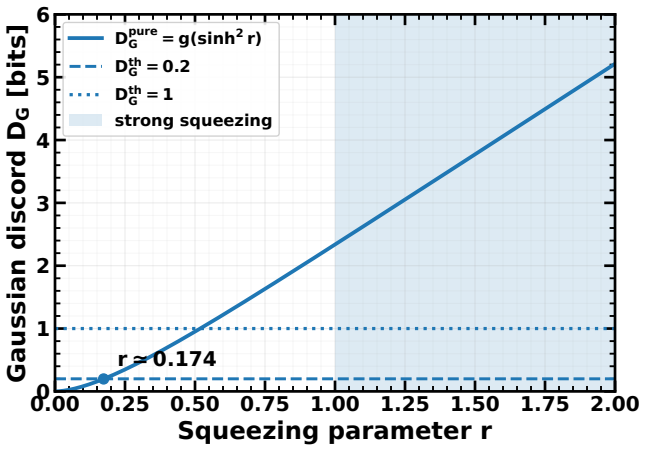
- [Sec. III.B] Eq. (42) writes D_pure_G(r) = g(sinh² r); the numerical values in (43)–(46) and Fig. 1 are consistent, but stating the base-2 convention once near Eq. (41) would avoid ambiguity for readers used to nats.
- [Sec. II.B] In Sec. II the USR enhancement P_ζ ∝ e^{6ΔN} is idealized; a one-sentence reminder that realistic peak height also depends on transitions into/out of USR (already noted later) would help when the same peak is used in Sec. VIII.
Circularity Check
No significant circularity: Q_dec^{2} SIGW scaling is transparent algebra from a free covariance-survival parameter, not a fitted or self-defined prediction.
full rationale
The paper’s central chain is: (i) standard two-mode squeezed Gaussian states for (k,−k) pairs; (ii) standard pure-state Gaussian discord D_G = g(sinh^{2} r); (iii) a Lindblad-motivated Gaussian attenuator that yields a free, model-dependent covariance-survival factor defined by Q_dec(k) ≡ P_eff_ζ(k)/P_class_ζ(k); (iv) substitution of P_eff into the known radiation-era SIGW convolution, which is quadratic in P_ζ, producing the product Q_dec(ku)Q_dec(kv); (v) the narrow-peak/slowly-varying limit Ω_GW^eff ≃ Q_dec^{2} Ω_GW^class. That last step is immediate algebra once Q_dec is defined and the standard kernel is used; it is not a data fit renamed as a prediction, nor is Q_dec extracted from the same observable it is said to predict. Discord is carefully kept separate from Q_dec and is not used as a collapse criterion. Self-citations to the author’s related arXiv notes ([45], [46], and the dark-dimension papers) appear only as “related questions” and do not underwrite the derivation of the Q_dec^{2} scaling or the PBH variance replacement. There is no uniqueness theorem imported from prior self-work, no ansatz smuggled in as a theorem, and no self-definitional loop. The honest finding is that the derivation is self-contained against external benchmarks (standard SIGW formula, standard Gaussian-channel algebra); residual risk is physical (whether a realistic channel can suppress equal-time ζ power rather than only dephase), not circular.
Axiom & Free-Parameter Ledger
free parameters (4)
- Q_dec(k) (covariance-survival factor)
- η (Gaussian attenuator transmissivity)
- n_env (environmental occupation)
- A_ζ, σ_lnk, δ_c, k_* (peak amplitude, width, collapse threshold, peak scale)
axioms (5)
- domain assumption Each (k,−k) pair of curvature modes is a two-mode Gaussian state whose pure limit is the standard two-mode squeezed vacuum of inflation.
- domain assumption The open-system evolution of the reduced covariance matrix can be approximated by a Markovian Lindblad equation that preserves Gaussianity and yields a local attenuation channel.
- domain assumption PBH formation remains a classical threshold process on the smoothed density contrast; quantum discord does not replace δ_c.
- domain assumption Scalar perturbations remain Gaussian, so the SIGW four-point function factorizes into products of two-point functions.
- ad hoc to paper Decoherence has saturated to a time-independent Q_dec(k) before the scalars efficiently source tensors (static approximation).
invented entities (1)
-
Covariance-survival factor Q_dec(k)
no independent evidence
read the original abstract
Primordial black holes (PBHs) form when large primordial curvature perturbations re-enter the Hubble radius and exceed the classical collapse threshold. These perturbations originate as quantum fluctuations of the inflationary vacuum, motivating a quantum-information description of the PBH-producing scalar sector. We develop a conservative extension of the standard PBH and scalar-induced gravitational-wave (SIGW) framework in which Gaussian quantum discord is used as a diagnostic of residual quantum correlations, not as a new PBH-formation criterion. We describe each \((\bm k,-\bm k)\) pair as a two-mode Gaussian state and show that, in the pure squeezed limit, discord grows rapidly with the squeezing parameter, so low discord thresholds are automatically satisfied for strongly squeezed modes. The nontrivial regime is the mixed state produced by decoherence. Using a Lindblad open-system description, we motivate a Gaussian loss channel for the scalar covariance matrix and distinguish the discord from a covariance-survival factor \(Q_{\rm dec}(k)\). If the decoherence channel suppresses the scalar two-point covariance, PBH abundance can be affected through the classical collapse variance, while the SIGW spectrum is modified more directly by the factors \(Q_{\rm dec}(ku)Q_{\rm dec}(kv)\) inside the radiation-era convolution. For a narrow scalar peak and slowly varying \(Q_{\rm dec}\), this gives the benchmark scaling \(\Omega_{\rm GW}^{\rm eff}\simeq Q_{\rm dec}^2\Omega_{\rm GW}^{\rm class}\). Thus quantum discord and decoherence provide a controlled way to characterize the quantum-to-classical transition of PBH-producing perturbations, with the clearest imprint appearing in scalar-induced gravitational waves.
Figures


Reference graph
Works this paper leans on
-
[1]
Snowmass2021 Cosmic Frontier White Paper: Primordial black hole dark matter
Simeon Bird et al. Snowmass2021 Cosmic Frontier White Paper: Primordial black hole dark matter. Phys. Dark Univ., 41:101231, 2023
2023
-
[2]
Carr and S
Bernard J. Carr and S. W. Hawking. Black holes in the early Universe.Mon. Not. Roy. Astron. Soc., 168:399–415, 1974
1974
-
[3]
Primordial black holes—perspectives in gravitational wave astronomy.Class
Misao Sasaki, Teruaki Suyama, Takahiro Tanaka, and Shuichiro Yokoyama. Primordial black holes—perspectives in gravitational wave astronomy.Class. Quant. Grav., 35(6):063001, 2018
2018
-
[4]
Green and Bradley J
Anne M. Green and Bradley J. Kavanagh. Primordial Black Holes as a dark matter candidate.J. Phys. G, 48(4):043001, 2021
2021
-
[5]
Constraints on primordial black holes.Rept
Bernard Carr, Kazunori Kohri, Yuuiti Sendouda, and Jun’ichi Yokoyama. Constraints on primordial black holes.Rept. Prog. Phys., 84(11):116902, 2021
2021
-
[6]
Primordial black holes as dark matter candidates.SciPost Phys
Bernard Carr and Florian Kuhnel. Primordial black holes as dark matter candidates.SciPost Phys. Lect. Notes, 48:1, 2022
2022
-
[7]
Ilia Musco and John C. Miller. Primordial black hole formation in the early universe: critical behaviour and self-similarity.Class. Quant. Grav., 30:145009, 2013
2013
-
[8]
Threshold of primordial black hole formation
Tomohiro Harada, Chul-Moon Yoo, and Kazunori Kohri. Threshold of primordial black hole formation. Phys. Rev. D, 88(8):084051, 2013. [Erratum: Phys.Rev.D 89, 029903 (2014)]
2013
-
[9]
Albert Escriv` a, Cristiano Germani, and Ravi K. Sheth. Universal threshold for primordial black hole formation.Phys. Rev. D, 101(4):044022, 2020
2020
-
[10]
Threshold for primordial black holes
Ilia Musco, Valerio De Luca, Gabriele Franciolini, and Antonio Riotto. Threshold for primordial black holes. II. A simple analytic prescription.Phys. Rev. D, 103(6):063538, 2021
2021
-
[11]
William H. Kinney. Horizon crossing and inflation with large eta.Phys. Rev. D, 72:023515, 2005. 32
2005
-
[12]
Violation of non-Gaussianity consistency relation in a single field inflationary model.EPL, 101(3):39001, 2013
Mohammad Hossein Namjoo, Hassan Firouzjahi, and Misao Sasaki. Violation of non-Gaussianity consistency relation in a single field inflationary model.EPL, 101(3):39001, 2013
2013
-
[13]
Primordial black holes and second order gravitational waves from ultra- slow-roll inflation.JCAP, 07:007, 2018
Haoran Di and Yungui Gong. Primordial black holes and second order gravitational waves from ultra- slow-roll inflation.JCAP, 07:007, 2018
2018
-
[14]
Byrnes, Philippa S
Christian T. Byrnes, Philippa S. Cole, and Subodh P. Patil. Steepest growth of the power spectrum and primordial black holes.JCAP, 06:028, 2019
2019
-
[15]
Byrnes and Philippa S
Christian T. Byrnes and Philippa S. Cole. Lecture notes on inflation and primordial black holes. 12 2021
2021
-
[16]
Semianalytic calculation of gravitational wave spectrum nonlin- early induced from primordial curvature perturbations.Phys
Kazunori Kohri and Takahiro Terada. Semianalytic calculation of gravitational wave spectrum nonlin- early induced from primordial curvature perturbations.Phys. Rev. D, 97(12):123532, 2018
2018
-
[17]
Enhancement of Gravi- tational Waves Induced by Scalar Perturbations due to a Sudden Transition from an Early Matter Era to the Radiation Era.Phys
Keisuke Inomata, Kazunori Kohri, Tomohiro Nakama, and Takahiro Terada. Enhancement of Gravi- tational Waves Induced by Scalar Perturbations due to a Sudden Transition from an Early Matter Era to the Radiation Era.Phys. Rev. D, 100:043532, 2019. [Erratum: Phys.Rev.D 108, 049901 (2023)]
2019
-
[18]
Waqas Ahmed and George K. Leontaris. Probing Two Dark Dimensions through Primordial Black Holes, Gravitational Waves, and Colliders.arXiv:2606.27992, 6 2026
Pith/arXiv arXiv 2026
-
[19]
Waqas Ahmed and George K. Leontaris. Secondary Gravitational Wave Signatures from 5D Rotating Primordial Black Holes in the Dark Dimension.arXiv:2605.12948, 5 2026
Pith/arXiv arXiv 2026
-
[20]
Ananda, Chris Clarkson, and David Wands
Kishore N. Ananda, Chris Clarkson, and David Wands. The Cosmological gravitational wave back- ground from primordial density perturbations.Phys. Rev. D, 75:123518, 2007
2007
-
[21]
Steinhardt, Keitaro Takahashi, and Kiyotomo Ichiki
Daniel Baumann, Paul J. Steinhardt, Keitaro Takahashi, and Kiyotomo Ichiki. Gravitational Wave Spectrum Induced by Primordial Scalar Perturbations.Phys. Rev. D, 76:084019, 2007
2007
-
[22]
Gravitational wave background as a probe of the primordial black hole abundance.Phys
Ryo Saito and Jun’ichi Yokoyama. Gravitational wave background as a probe of the primordial black hole abundance.Phys. Rev. Lett., 102:161101, 2009. [Erratum: Phys.Rev.Lett. 107, 069901 (2011)]
2009
-
[23]
Scalar Induced Gravitational Waves Review.Universe, 7(11):398, 2021
Guillem Dom` enech. Scalar Induced Gravitational Waves Review.Universe, 7(11):398, 2021
2021
-
[24]
A topic review on probing primordial black hole dark matter with scalar induced gravitational waves.iScience, 24:102860, 2021
Chen Yuan and Qing-Guo Huang. A topic review on probing primordial black hole dark matter with scalar induced gravitational waves.iScience, 24:102860, 2021
2021
-
[25]
Mukhanov and G
Viatcheslav F. Mukhanov and G. V. Chibisov. Quantum Fluctuations and a Nonsingular Universe. JETP Lett., 33:532–535, 1981
1981
-
[26]
Guth and S
Alan H. Guth and S. Y. Pi. Fluctuations in the New Inflationary Universe.Phys. Rev. Lett., 49:1110– 1113, 1982
1982
-
[27]
S. W. Hawking. The Development of Irregularities in a Single Bubble Inflationary Universe.Phys. Lett. B, 115:295, 1982
1982
-
[28]
L. P. Grishchuk and Yu. V. Sidorov. Squeezed quantum states of relic gravitons and primordial density fluctuations.Phys. Rev. D, 42:3413–3421, 1990
1990
-
[29]
Inflation and squeezed quantum states.Phys
Andreas Albrecht, Pedro Ferreira, Michael Joyce, and Tomislav Prokopec. Inflation and squeezed quantum states.Phys. Rev. D, 50:4807–4820, 1994
1994
-
[30]
Starobinsky
David Polarski and Alexei A. Starobinsky. Semiclassicality and decoherence of cosmological perturba- 33 tions.Class. Quant. Grav., 13:377–392, 1996
1996
-
[31]
Starobinsky
Claus Kiefer, David Polarski, and Alexei A. Starobinsky. Quantum to classical transition for fluctuations in the early universe.Int. J. Mod. Phys. D, 7:455–462, 1998
1998
-
[32]
Decoherence, einselection, and the quantum origins of the classical.Rev
Wojciech Hubert Zurek. Decoherence, einselection, and the quantum origins of the classical.Rev. Mod. Phys., 75:715–775, 2003
2003
-
[33]
Harold Ollivier and Wojciech H. Zurek. Introducing Quantum Discord.Phys. Rev. Lett., 88(1):017901, 2001
2001
-
[34]
Paolo Giorda and Matteo G. A. Paris. Gaussian Quantum Discord.Phys. Rev. Lett., 105(2):020503, 2010
2010
-
[35]
Gaussian Geometric Discord.Int
Gerardo Adesso and Davide Girolami. Gaussian Geometric Discord.Int. J. Quant. Inf., 09(07n08):1773–1786, 2011
2011
-
[36]
Cerf, Timothy C
Christian Weedbrook, Stefano Pirandola, Ra´ ul Garc´ ıa-Patr´ on, Nicolas J. Cerf, Timothy C. Ralph, Jeffrey H. Shapiro, and Seth Lloyd. Gaussian quantum information.Rev. Mod. Phys., 84(2):621, 2012
2012
-
[37]
Quantum Discord of Cosmic Inflation: Can we Show that CMB Anisotropies are of Quantum-Mechanical Origin?Phys
Jerome Martin and Vincent Vennin. Quantum Discord of Cosmic Inflation: Can we Show that CMB Anisotropies are of Quantum-Mechanical Origin?Phys. Rev. D, 93(2):023505, 2016
2016
-
[38]
Discord and decoherence.JCAP, 04(04):051, 2022
Jerome Martin, Amaury Micheli, and Vincent Vennin. Discord and decoherence.JCAP, 04(04):051, 2022
2022
-
[39]
Comparing quantumness criteria.EPL, 142(1):18001, 2023
Jerome Martin, Amaury Micheli, and Vincent Vennin. Comparing quantumness criteria.EPL, 142(1):18001, 2023
2023
-
[40]
Quantum Cosmological Gravitational Waves?arXiv:2211.00182, 10 2022
Amaury Micheli and Patrick Peter. Quantum Cosmological Gravitational Waves?arXiv:2211.00182, 10 2022
Pith/arXiv arXiv 2022
-
[41]
Amaury Micheli, Yuto Oshima, and Tomo Takahashi. Quantum state of interacting primordial inho- mogeneities: de-squeezing and decoherence.arXiv:2512.17622, 12 2025
arXiv 2025
-
[42]
Burgess, R
Cliff P. Burgess, R. Holman, and D. Hoover. Decoherence of inflationary primordial fluctuations.Phys. Rev. D, 77:063534, 2008
2008
-
[43]
C. P. Burgess, R. Holman, G. Tasinato, and M. Williams. EFT Beyond the Horizon: Stochastic Inflation and How Primordial Quantum Fluctuations Go Classical.JHEP, 03:090, 2015
2015
-
[44]
Quantum Decoherence During Inflation from Gravitational Nonlinearities.JCAP, 03:022, 2016
Elliot Nelson. Quantum Decoherence During Inflation from Gravitational Nonlinearities.JCAP, 03:022, 2016
2016
-
[45]
Entanglement, Discord, and Residual Coherence in Scalar-Induced Gravitational Waves
Waqas Ahmed. Entanglement, Discord, and Residual Coherence in Scalar-Induced Gravitational Waves. arXiv:2606.21901, 6 2026
Pith/arXiv arXiv 2026
-
[46]
Quantum Memory in Scalar-Induced Gravitational Waves.arXiv:2606.21835, 6 2026
Waqas Ahmed. Quantum Memory in Scalar-Induced Gravitational Waves.arXiv:2606.21835, 6 2026
Pith/arXiv arXiv 2026
-
[47]
N. C. Tsamis and Richard P. Woodard. Improved estimates of cosmological perturbations.Phys. Rev. D, 69:084005, 2004
2004
-
[48]
Liddle, Paul Parsons, and John D
Andrew R. Liddle, Paul Parsons, and John D. Barrow. Formalizing the slow roll approximation in inflation.Phys. Rev. D, 50:7222–7232, 1994
1994
-
[49]
Inflation
Daniel Baumann. Inflation. InTheoretical Advanced Study Institute in Elementary Particle Physics: 34 Physics of the Large and the Small, pages 523–686, 2011
2011
-
[50]
Mukhanov
Viatcheslav F. Mukhanov. Gravitational Instability of the Universe Filled with a Scalar Field.JETP Lett., 41:493–496, 1985
1985
-
[51]
Large Scale Quantum Fluctuations in the Inflationary Universe.Prog
Misao Sasaki. Large Scale Quantum Fluctuations in the Inflationary Universe.Prog. Theor. Phys., 76:1036, 1986
1986
-
[52]
Mukhanov, H
Viatcheslav F. Mukhanov, H. A. Feldman, and Robert H. Brandenberger. Theory of cosmological perturbations. Part 1. Classical perturbations. Part 2. Quantum theory of perturbations. Part 3. Ex- tensions.Phys. Rept., 215:203–333, 1992
1992
-
[53]
On the decoherence of primordial fluctuations during inflation.Class
Patrick Martineau. On the decoherence of primordial fluctuations during inflation.Class. Quant. Grav., 24:5817–5834, 2007
2007
-
[54]
Observational constraints on quantum decoherence during infla- tion.JCAP, 05:063, 2018
Jerome Martin and Vincent Vennin. Observational constraints on quantum decoherence during infla- tion.JCAP, 05:063, 2018
2018
-
[55]
C. P. Burgess, R. Holman, Greg Kaplanek, Jerome Martin, and Vincent Vennin. Minimal decoherence from inflation.JCAP, 07:022, 2023
2023
-
[56]
H. P. Breuer and F. Petruccione.The theory of open quantum systems. 2002
2002
-
[57]
Concepts and methods in the theory of open quantum systems
Heinz-Peter Breuer and Francesco Petruccione. Concepts and methods in the theory of open quantum systems. 2 2003. 35
2003
discussion (0)
Sign in with ORCID, Apple, or X to comment. Anyone can read and Pith papers without signing in.