REVIEW 2 major objections 6 minor 59 references
Operator Learning in Lattice QCD: Spectral Reconstruction
T0 review · 2 major / 6 minor · reviewed 2026-07-12 · grok-4.5
Pith's one-line read DeepONet ensembles can reconstruct lattice spectral densities with far smaller total uncertainty than the leading linear method on the same correlators.
desk verdict First solid DeepONet pipeline for lattice spectral reconstruction; precision win over HLT is real on the O(3) data but not yet shown to be prior-independent. read the letter →
The pith
A machine-rendered reading of the paper's core claim, the machinery that carries it, and where it could break.
The reading
What carries the argument
DeepONet estimator: the product of a Branch net (latent encoding of the correlator vector) and a Trunk net (latent encoding of continuous (E,σ)), whose ensemble-weighted average and spread furnish both the reconstruction and its systematic error.
What would settle it
Repeat the entire reconstruction pipeline on identical O(3) correlators after replacing the physics-informed GP mean by a flat or zero mean and increasing the prior variance; if the uncertainty advantage over HLT disappears while consistency with the analytic density is lost, the central claim fails.
Extended reading notes
Core claim
An ensemble of DeepONets trained on Gaussian-process mock data can approximate the operator that maps a noisy Euclidean correlator to its Gaussian-smeared spectral density continuously in energy and smearing width; after all continuum and volume limits the reconstruction of the O(3) inclusive rate matches the analytic density and carries substantially smaller total uncertainty than the same data analysed with the Hansen–Lupo–Tantalo algorithm.
Load-bearing premise
That the large error reduction versus the linear method is not mainly an artifact of training on a Gaussian process whose mean is already the exact two-particle contribution of the target model.
Editorial analysis
A structured set of objections, weighed in public.
Referee Report
Summary. The paper reformulates spectral reconstruction of smeared densities from Euclidean correlators as an operator-learning problem and approximates the map with DeepONet architectures (Branch net on the correlator vector, Trunk net on continuous (E, σ)). An ensemble of 15 networks of varying capacity and training-set size is trained on noisy mock correlators drawn from a Gaussian-process prior whose mean is the exact two-particle contribution of the O(3) model and whose variance is suppressed below the four-particle threshold; the ensemble supplies both the central value and a systematic uncertainty for the operator approximation. After validation on 1000 unseen noisy mocks (coverage consistent with or more conservative than Gaussian), the method is applied to the same Monte-Carlo correlators used in the HLT benchmark of Ref. [4]. Infinite-volume, continuum and σ→0 limits are performed with explicit systematic budgets, yielding a spectral density consistent with the known analytic result (largest deviation 1.1σ) and with total uncertainties up to an order of magnitude smaller than HLT on the same data. The authors note that the contribution of the physics-informed prior to this precision gain remains unquantified.
Significance. If the operator-learning formulation and ensemble systematics prove robust beyond the present prior, the work supplies a flexible, continuous-parameter alternative to HLT that can be reused across lattice spacings and smearing kernels without retraining, and that can be exported to other lattice operations. The first application of DeepONets in lattice QCD, the thorough mock-data closure tests, the explicit multi-source error budget (statistical, network, FVE, continuum, σ→0 via BMA), and the direct analytic comparison on a controlled integrable model are genuine strengths. The demonstrated reduction relative to HLT on identical correlators is striking, even though its origin is not yet disentangled from the GP mean. The method therefore has clear potential for high-impact observables such as the R-ratio once the prior dependence is quantified.
major comments (2)
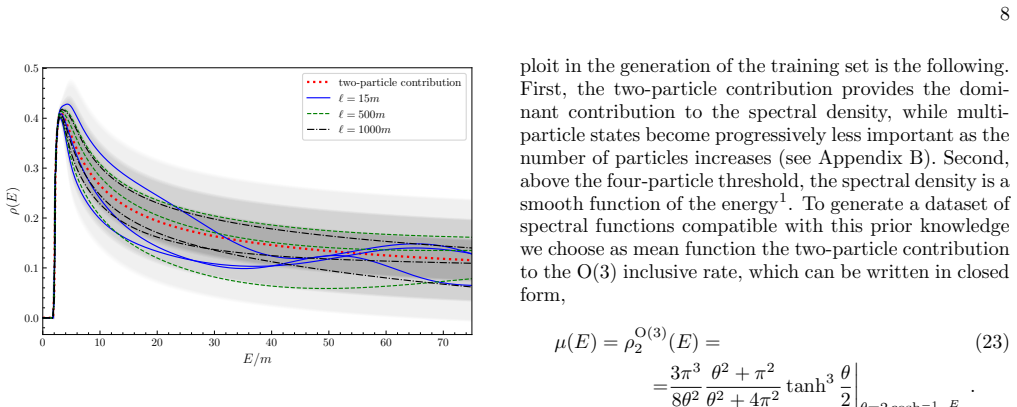
- Abstract, §I, §V.D (Fig. 15) and §VI: the headline claim of a “significant reduction in the total uncertainty” relative to HLT is obtained exclusively with networks trained on a GP whose mean is exactly the analytic two-particle density ρ₂^{O(3)}(E) (Eq. 23) and whose local variance is deliberately suppressed below the four-particle threshold (Eqs. 24–25, Fig. 2). The paper itself states that “the extent to which this improvement persists in the absence of prior physical knowledge remains to be quantified.” Without at least one controlled ablation (e.g., a flat or zero mean, or a substantially larger σ_GP as sketched in App. C) the comparison cannot be read as a pure test of the DeepONet architecture versus HLT. Either such a test or a more prominent, quantitative caveat in the abstract and conclusions is required before the precision gain can be advertised as a general feature of the me
- §III.B and App. D: the out-of-distribution checks enlarge only σ_GP while retaining the same two-particle mean. They therefore do not address the load-bearing question of how much of the final precision and the recovery of multi-particle content is inherited from the mean function itself. A short additional paragraph quantifying the sensitivity of the continuum-extrapolated, σ→0 result to the choice of mean (or to the correlation-length range) would strengthen the central claim that the networks are learning the operator rather than merely interpolating the prior.
minor comments (6)
- §II.C and Fig. 1: the DeepONet schematic is clear, but the text never states whether a bias term is included in the final linear combination (Eq. 13). A one-sentence clarification would help reproducibility.
- Table II: the validation-loss values and weights are given to only one significant figure after the decimal; reporting one more digit would make the relative ranking of the networks more transparent.
- Fig. 9: the interpolation of the A2 correlator is shown only for a short time window; a supplementary panel covering the full range used by the Branch net (up to 540 a m) would reassure the reader that the cubic-spline procedure does not introduce visible artifacts at large t.
- §V.B: the continuum ansatz (Eq. 51) saturates the three available lattice spacings. While the subsequent erf-based systematic is conservative, a brief remark on the expected size of residual a^6 or logarithmic terms (citing Balog et al.) would be useful.
- App. B: the correction of two typographical errors in the published formulae of Ref. [4] is valuable; it would be helpful to state explicitly that the numerical values in Table III were recomputed with the corrected expressions.
- Throughout: the noise-level parameter λ is introduced in §III.C but the two ensembles (λ=1 and λ=3.5) are sometimes referred to only by the ensemble labels A/B; a consistent notation would reduce cognitive load.
Circularity Check
Training GP mean is exactly the target two-particle spectral density, so the headline precision gain vs HLT is not demonstrated to be prior-free.
-
fitted input called prediction
[Section III.B, Eqs. (23)–(25) and Fig. 2; abstract, §I, §VI, App. C]
"we choose as mean function the two-particle contribution to the O(3) inclusive rate, which can be written in closed form, µ(E)=ρ_O(3)_2(E)=… The covariance kernel is instead … with ξ(E)=σ_GP/(1+e^{-(E-4m)/ε}). … While the extent to which this improvement persists in the absence of prior physical knowledge remains to be quantified"
The supervised training distribution is constructed so that its mean is exactly the dominant analytic component of the target spectral density that is later reconstructed; variance is deliberately kept small below the four-particle threshold. The networks therefore receive the leading piece of the answer as a fitted/prior input. The subsequent claim of a large precision gain versus HLT (same correlators) is obtained only under this prior; without an ablation that removes or flattens the mean, the reduction cannot be attributed solely to the DeepONet operator approximation.
-
other
[Appendix D and Fig. 15]
"we generated out-of-distribution spectral functions by enlarging σ_GP … by a factor of five … while still using the two-particle contribution … as the mean function. … at high energies, our reconstructed spectral density differs from the GP mean by more than one standard deviation"
Even the out-of-distribution checks retain the same exact two-particle mean and only enlarge the variance; they therefore do not remove the load-bearing prior that supplies the dominant piece of the target. The high-energy deviation from the GP mean shows some generalization, but does not eliminate the circularity of the precision comparison.
full rationale
The paper is largely self-contained: reconstruction is performed on independent Monte-Carlo correlators (ensembles A1–B2), multi-particle content above the four-particle threshold is recovered, the final continuum+volume+σ→0 result lies outside the one-σ GP band at high energy, and the analytic O(3) spectral density (including n=4,6) is an external benchmark. The ensemble uncertainty procedure is validated on held-out mock data. The only partial circularity is that the supervised training distribution is deliberately centered on the exact dominant piece of the target (ρ₂^{O(3)}), with variance suppressed below 4m; the claimed factor-of-ten uncertainty reduction relative to HLT is therefore obtained only under this physics-informed prior, and the paper itself repeatedly flags that the improvement without prior knowledge remains unquantified. This is a fitted/prior-informed input used for a closely related prediction, not a pure self-definitional loop or load-bearing self-citation of an unverified uniqueness theorem. Score 4 reflects partial rather than fatal circularity.
Assumptions & free parameters
free parameters (6)
- GP correlation-length range ℓ
- GP local variance σ_GP and transition scale ε
- Ensemble weight temperature α
- Noise levels λ=1 and λ=3.5
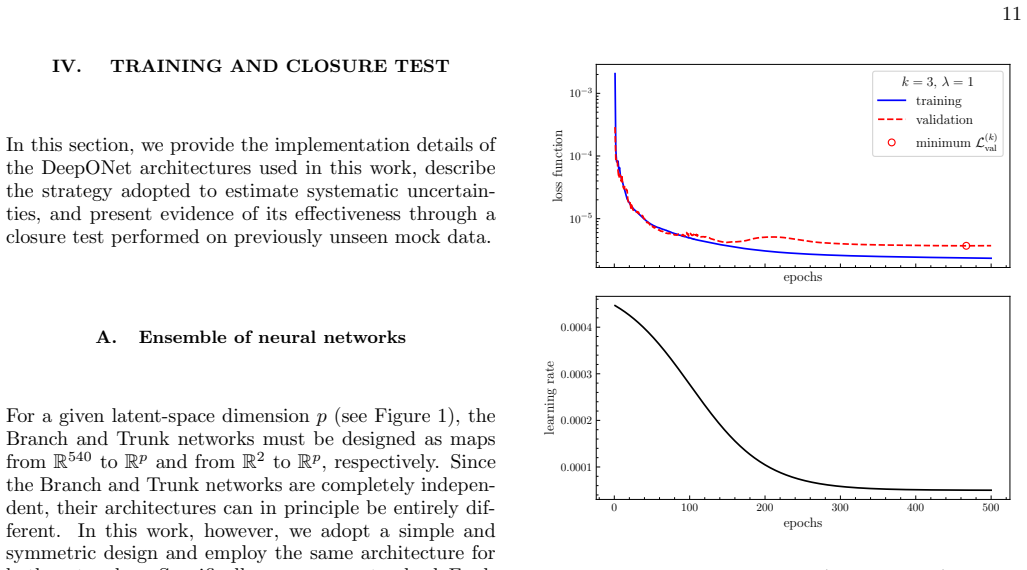
- Latent dimension p, layer counts, neuron counts
- Domains Ω_t, Ω_E, Ω_σ and prediction grids
assumptions (4)
- standard math DeepONet universal approximation theorem for continuous operators (Chen & Chen 1995 / Lu et al. 2021)
- domain assumption Finite-volume spectral densities admit a well-defined infinite-volume limit only after smearing with a Schwartz kernel
- ad hoc to paper The two-particle contribution ρ₂^{O(3)}(E) is an adequate mean function for the GP that generates the training set
- ad hoc to paper Ensemble spread of independently trained networks of varying capacity supplies a reliable estimate of operator-approximation systematic error
invented entities (2)
-
Physics-informed GP training distribution for spectral reconstruction
-
Weighted neural-network ensemble for operator systematic uncertainty
Cite this review
Pith. "Pith review of Operator Learning in Lattice QCD: Spectral Reconstruction." pith.science (2026). https://pith.science/paper/TS6H32FO
@misc{pith2026260703311,
  author       = {Pith},
  title        = {Pith review of: Operator Learning in Lattice QCD: Spectral Reconstruction},
  year         = {2026},
  howpublished = {\url{https://pith.science/paper/TS6H32FO}},
  note         = {Machine review of arXiv:2607.03311}
}
abstract
In this work, we propose a novel supervised machine-learning-based strategy for extracting smeared spectral functions from Euclidean correlation functions. The strategy revisits the numerically ill-posed spectral reconstruction problem within the framework of Operator Learning through the use of DeepONet-like architectures. To illustrate the method, we construct an ensemble of neural networks trained on mock data generated from a specific class of functions. This ensemble is then employed to estimate the systematic uncertainty associated with the fact that a neural network provides only an approximation to the target operator. The procedure is fully validated on previously unseen noisy mock data. To demonstrate the potential of the method for phenomenological applications, we reconstruct the inclusive rate above the four-particle threshold and up to high energies in the $1+1$-dimensional O(3) non-linear $\sigma$ model, starting from correlation functions computed in Monte Carlo simulations. The final result is consistent with the known analytic spectral density and, compared with the state-of-the-art Hansen-Lupo-Tantalo algorithm, exhibits a significant reduction in the total uncertainty. While the extent to which this improvement persists in the absence of prior physical knowledge remains to be quantified, the proposed strategy can be naturally extended to more phenomenologically relevant observables and, more generally, to other operations commonly encountered in lattice QCD.
Figures

Figures from the paper (15 more)


Reference graph
Works this paper leans on
- [4]
- [1]
-
[2]
A. Lupo and N. Tantalo, Extraction of spectral densi- ties from lattice correlators: decoupling signal from noise (2026), arXiv:2605.14652 [hep-lat]
arXiv 2026
-
[3]
Backus and F
G. Backus and F. Gilbert, The resolving power of gross earth data, Geophysical Journal International16, 169 (1968)
1968
-
[5]
C. Alexandrouet al.(Extended Twisted Mass Collabo- ration (ETMC)), Probing the Energy-Smeared R Ratio Using Lattice QCD, Phys. Rev. Lett.130, 241901 (2023), arXiv:2212.08467 [hep-lat]
arXiv 2023
-
[6]
A. Evangelista, R. Frezzotti, N. Tantalo, G. Gagliardi, F. Sanfilippo, S. Simula, and V. Lubicz (Extended Twisted Mass), Inclusive hadronic decay rate of theτlep- ton from lattice QCD, Phys. Rev. D108, 074513 (2023), arXiv:2308.03125 [hep-lat]
arXiv 2023
-
[7]
C. Alexandrouet al.(Extended Twisted Mass), Inclusive Hadronic Decay Rate of theτLepton from Lattice QCD: The ¯usFlavor Channel and the Cabibbo Angle, Phys. Rev. Lett.132, 261901 (2024), arXiv:2403.05404 [hep- lat]
arXiv 2024
-
[8]
A. De Santiset al., Inclusive semileptonic decays of the Ds meson: A first-principles lattice QCD calculation, Phys. Rev. D112, 054503 (2025), arXiv:2504.06063 [hep- lat]
arXiv 2025
Show all 59 references
-
[9]
De Santiset al., Inclusive Semileptonic Decays of the Ds Meson: Lattice QCD Confronts Experiments, Phys
A. De Santiset al., Inclusive Semileptonic Decays of the Ds Meson: Lattice QCD Confronts Experiments, Phys. Rev. Lett.135, 121901 (2025), arXiv:2504.06064 [hep- lat]
2025
-
[10]
De Santiset al., Inclusive ¯Bs 7→X ¯scℓ¯νdecays from lattice QCD: computational strategy and a first physical result (2026), arXiv:2607.01116 [hep-lat]
A. De Santiset al., Inclusive ¯Bs 7→X ¯scℓ¯νdecays from lattice QCD: computational strategy and a first physical result (2026), arXiv:2607.01116 [hep-lat]
2026 arXiv
-
[11]
Bonanno, F
C. Bonanno, F. D’Angelo, M. D’Elia, L. Maio, and M. Naviglio, Sphaleron rate from a modified backus- gilbert inversion method, Phys. Rev. D108, 074515 (2023)
2023
-
[12]
Bonanno, F
C. Bonanno, F. D’Angelo, M. D’Elia, L. Maio, and M. Naviglio, Sphaleron rate ofN f = 2 + 1 qcd, Phys. Rev. Lett.132, 051903 (2024)
2024
-
[13]
J. C. A. Barata and K. Fredenhagen, Particle scattering in Euclidean lattice field theories, Commun. Math. Phys. 138, 507 (1991)
1991
-
[14]
Bailas, S
G. Bailas, S. Hashimoto, and T. Ishikawa, Recon- struction of smeared spectral function from Euclidean correlation functions, PTEP2020, 043B07 (2020), arXiv:2001.11779 [hep-lat]
2020 arXiv
-
[15]
Asakawa, T
M. Asakawa, T. Hatsuda, and Y. Nakahara, Maxi- mum entropy analysis of the spectral functions in lattice QCD, Prog. Part. Nucl. Phys.46, 459 (2001), arXiv:hep- lat/0011040
2001
-
[17]
Burnier and A
Y. Burnier and A. Rothkopf, Bayesian Approach to Spec- tral Function Reconstruction for Euclidean Quantum Field Theories, Phys. Rev. Lett.111, 182003 (2013), arXiv:1307.6106 [hep-lat]
2013 arXiv
-
[18]
Del Debbio, A
L. Del Debbio, A. Lupo, M. Panero, and N. Tantalo, Bayesian solution to the inverse problem and its rela- tion to Backus–Gilbert methods, Eur. Phys. J. C85, 185 (2025), arXiv:2409.04413 [hep-lat]
2025 arXiv
-
[19]
Tsuji and S
R. Tsuji and S. Hashimoto, Spectral reconstruction from Euclidean lattice correlators through singular value de- composition (2026), arXiv:2605.15674 [hep-lat]
2026 arXiv
-
[20]
Abbott, S
R. Abbott, S. Fields, W. I. Jay, P. Oare, and M. Sac- cardi, The Causal Bootstrap: Bounding Smeared Spec- tral Functions from Non-Perturbative Euclidean Data (2026), arXiv:2605.20509 [hep-lat]
2026 arXiv
-
[21]
Bruno, L
M. Bruno, L. Giusti, and M. Saccardi, Spectral densities from Euclidean lattice correlators via the Mellin transform, Phys. Rev. D111, 094515 (2025), arXiv:2407.04141 [hep-lat]
2025 arXiv
-
[22]
Bergamaschi, W
T. Bergamaschi, W. I. Jay, and P. R. Oare, Hadronic structure, conformal maps, and analytic continuation, Phys. Rev. D108, 074516 (2023), arXiv:2305.16190 [hep- lat]
2023 arXiv
-
[23]
W. I. Jay and M. Saccardi, Kernel transformations and bounds for smeared spectral functions (2026), arXiv:2606.19503 [hep-lat]
2026 arXiv
-
[24]
Giusti, M
L. Giusti, M. Saccardi, and D. Toniolo, Spectral densities from Euclidean correlators via integral transforms: the- oretical framework (2026), arXiv:2606.28167 [hep-lat]
2026 arXiv
-
[25]
Buzzicotti, A
M. Buzzicotti, A. De Santis, and N. Tantalo, Teaching to extract spectral densities from lattice correlators to a broad audience of learning-machines, Eur. Phys. J. C84, 32 (2024), arXiv:2307.00808 [hep-lat]
2024 arXiv
-
[26]
Del Debbio, Some Inverse Problems in Particle Physics (2026) arXiv:2606.08316 [hep-lat]
L. Del Debbio, Some Inverse Problems in Particle Physics (2026) arXiv:2606.08316 [hep-lat]
2026 arXiv
-
[27]
Kades, J
L. Kades, J. M. Pawlowski, A. Rothkopf, M. Scherzer, J. M. Urban, S. J. Wetzel, N. Wink, and F. P. G. Ziegler, Spectral Reconstruction with Deep Neural Networks, Phys. Rev. D102, 096001 (2020), arXiv:1905.04305 [physics.comp-ph]
2020 arXiv
-
[28]
Karpie, K
J. Karpie, K. Orginos, A. Rothkopf, and S. Zafeiropoulos, Reconstructing parton distribution functions from Ioffe time data: from Bayesian methods to Neural Networks, JHEP04, 057, arXiv:1901.05408 [hep-lat]
1901 arXiv
-
[29]
L. Wang, S. Shi, and K. Zhou, Automatic differen- tiation approach for reconstructing spectral functions with neural networks, in35th Conference on Neural In- formation Processing Systems(2021) arXiv:2112.06206 [physics.comp-ph]
2021 arXiv
-
[30]
Chen, H.-T
S.-Y. Chen, H.-T. Ding, F.-Y. Liu, G. Papp, and C.- B. Yang, Machine learning Hadron Spectral Functions in Lattice QCD, PoSLATTICE2021, 148 (2022), arXiv:2112.00460 [hep-lat]
2022 arXiv
-
[31]
L. Wang, S. Shi, and K. Zhou, Reconstructing spec- tral functions via automatic differentiation, Phys. Rev. D106, L051502 (2022)
2022
-
[32]
S. Y. Chen, H. T. Ding, F. Y. Liu, G. Papp, and C. B. Yang, Machine learning spectral functions in lattice qcd (2022), arXiv:2110.13521 [hep-lat]
2022 arXiv
-
[33]
M. Zhou, F. Gao, J. Chao, Y.-X. Liu, and H. Song, Appli- cation of radial basis functions neutral networks in spec- tral functions, Phys. Rev. D104, 076011 (2021)
2021
-
[34]
Lechien and D
T. Lechien and D. Dudal, Neural network approach to reconstructing spectral functions and complex poles of confined particles, SciPost Phys.13, 097 (2022), arXiv:2203.03293 [hep-lat]
2022 arXiv
-
[35]
Fournier, L
R. Fournier, L. Wang, O. V. Yazyev, and Q. Wu, Artifi- cial neural network approach to the analytic continuation problem, Phys. Rev. Lett.124, 056401 (2020)
2020
-
[36]
Andratschke, B
C. Andratschke, B. B. Brandt, E. Garnacho-Velasco, L. Pannullo, S. Singh, and A. D. M. Valois, Spectral reconstruction techniques, their shortcomings and rele- vance to the electric conductivity coefficient, in42nd In- ternational Symposium on Lattice Field Theory(2026) arXiv:...
2026
-
[37]
L. Lu, P. Jin, G. Pang, Z. Zhang, and G. E. Karniadakis, Learning nonlinear operators via deeponet based on the universal approximation theorem of operators, Nature machine intelligence3, 218 (2021). 30
2021
-
[38]
Patella and N
A. Patella and N. Tantalo, Scattering amplitudes from Euclidean correlators: Haag-Ruelle theory and approxi- mation formulae, JHEP01, 091, arXiv:2407.02069 [hep- lat]
-
[39]
Bulava and M
J. Bulava and M. T. Hansen, Scattering amplitudes from finite-volume spectral functions, Phys. Rev. D100, 034521 (2019)
2019
-
[40]
M. T. Hansen, H. B. Meyer, and D. Robaina, From deep inelastic scattering to heavy-flavor semileptonic decays: Total rates into multihadron final states from lattice qcd, Phys. Rev. D96, 094513 (2017)
2017
-
[41]
Chen and H
T. Chen and H. Chen, Universal approximation to non- linear operators by neural networks with arbitrary acti- vation functions and its application to dynamical sys- tems, IEEE transactions on neural networks6, 911 (1995)
1995
-
[42]
Zaheer, S
M. Zaheer, S. Kottur, S. Ravanbakhsh, B. Poczos, R. R. Salakhutdinov, and A. J. Smola, Deep sets, Advances in neural information processing systems30(2017)
2017
-
[43]
Cipriani, A
A. Cipriani, A. De Santis, G. Di Russo, A. Grillo, and L. Tabarroni, Hamiltonian neural network approach to fuzzball geodesics, Phys. Rev. D112, 026018 (2025), arXiv:2502.20881 [hep-th]
2025 arXiv
-
[44]
Margari, S
F. Margari, S. Bacchio, A. De Santis, A. Evangelista, R. Frezzotti, G. Gagliardi, M. Garofalo, F. Sanfilippo, and N. Tantalo (Extended Twisted Mass), The smeared R-ratio in isoQCD from first-principles lattice simula- tions (2026), arXiv:2603.19070 [hep-lat]
2026
-
[45]
A. P. Valentine and M. Sambridge, Gaussian process models—i. a framework for probabilistic continuous in- verse theory, Geophysical Journal International220, 1632 (2020)
2020
-
[46]
C. K. Williams and C. E. Rasmussen,Gaussian processes for machine learning, Vol. 2 (MIT press Cambridge, MA, 2006)
2006
-
[47]
Luscher and U
M. Luscher and U. Wolff, How to Calculate the Elastic Scattering Matrix in Two-dimensional Quantum Field Theories by Numerical Simulation, Nucl. Phys. B339, 222 (1990)
1990
-
[48]
Lellouch and M
L. Lellouch and M. Luscher, Weak transition matrix ele- ments from finite volume correlation functions, Commun. Math. Phys.219, 31 (2001), arXiv:hep-lat/0003023
2001 arXiv
-
[49]
Tancik, P
M. Tancik, P. Srinivasan, B. Mildenhall, S. Fridovich- Keil, N. Raghavan, U. Singhal, R. Ramamoorthi, J. Bar- ron, and R. Ng, Fourier features let networks learn high frequency functions in low dimensional domains, Ad- vances in neural information processing systems33, 7537 (2020)
2020
-
[50]
Hendrycks and K
D. Hendrycks and K. Gimpel, Gaussian error linear units (gelus) (2023), arXiv:1606.08415 [cs.LG]
2023 arXiv
-
[51]
Google, Google colaboratory,https://colab.google (2026)
2026
-
[52]
Abadi, A
M. Abadi, A. Agarwal, P. Barham, E. Brevdo, Z. Chen, C. Citro, G. S. Corrado, A. Davis, J. Dean, M. Devin, S. Ghemawat, I. Goodfellow, A. Harp, G. Irving, M. Is- ard, Y. Jia, R. Jozefowicz, L. Kaiser, M. Kudlur, J. Lev- enberg, D. Man´ e, R. Monga, S. Moore, D. Murray, C. Olah...
2015
-
[53]
Cholletet al., Keras,https://keras.io(2015)
F. Cholletet al., Keras,https://keras.io(2015)
2015
-
[54]
D. P. Kingma and J. Ba, Adam: A method for stochastic optimization, arXiv preprint arXiv:1412.6980 (2014)
2014 arXiv
-
[55]
F. A. Bresciani, M. Bruno, and M. T. Hansen, Finite- volume effects on smeared spectral densities (2026), arXiv:2606.14349 [hep-lat]
2026
-
[56]
Balog, F
J. Balog, F. Niedermayer, and P. Weisz, Logarithmic cor- rections to o (a2) lattice artifacts, Physics Letters B676, 188 (2009)
2009
-
[57]
Balog, F
J. Balog, F. Niedermayer, and P. Weisz, The puzzle of apparent linear lattice artifacts in the 2d non-linearσ- model and symanzik’s solution, Nuclear physics B824, 563 (2010)
2010
-
[58]
Akaike, A new look at the statistical model identifi- cation, IEEE transactions on automatic control19, 716 (1974)
H. Akaike, A new look at the statistical model identifi- cation, IEEE transactions on automatic control19, 716 (1974)
1974
-
[59]
D. A. Nix and A. S. Weigend, Estimating the mean and variance of the target probability distribution, inPro- ceedings of 1994 ieee international conference on neural networks (ICNN’94), Vol. 1 (IEEE, 1994) pp. 55–60
1994
-
[60]
Balog and M
J. Balog and M. Niedermaier, Off-shell dynamics of the O(3) NLS model beyond Monte Carlo and perturba- tion theory, Nucl. Phys. B500, 421 (1997), arXiv:hep- th/9612039
1997
Reviewed July 12, 2026 · model on record in the stance chip above.
Discussion (0). Sign in to comment.