REVIEW 3 major objections 27 references
Aligning neural-network weight representations with the datasets they were trained on yields a navigable latent space for retrieving, generating, and refining models from data prompts.
Reviewed by Pith at T0; open to challenge. T0 means a machine referee read the full paper against a public rubric. the ladder, T0–T4 →
T0 review · grok-4.5
2026-07-12 01:39 UTC pith:YLUTT6ZC
load-bearing objection Solid empirical WSL paper: reshaping the weight latent with dataset contrastive alignment is real and useful, even if generation gains are partly head-repair and scope is narrow. the 3 major comments →
WeightCLIP: Aligning Datasets and Models for Weight Space Learning
The pith
A machine-rendered reading of the paper's core claim, the machinery that carries it, and where it could break.
Core claim
Explicitly aligning weight-space embeddings with dataset embeddings via a contrastive loss reorganizes the latent manifold of neural networks by training-data identity, and that reorganization is what makes dataset-to-model retrieval, generation of strong model initializations from data prompts, and constrained latent refinement work better than reconstruction-only weight spaces or alignment used only as external retrieval or guidance.
What carries the argument
WeightCLIP: a weight autoencoder and a set-based dataset encoder trained jointly so that token-level contrastive alignment reshapes the autoencoder latent around datasets; a lightweight mapper then turns a data prompt into model tokens, which can be shell-projected and refined by backpropagating task loss through the decoder.
Load-bearing premise
The signal that identifies which dataset a model was trained on is spread evenly enough across weight tokens, and trained models sit on a hyperspherical shell that stays a valid constraint, so the same aligned space and refinement recipe transfer to held-out datasets of the same architecture.
What would settle it
On the same held-out vision datasets and fixed architecture, remove the contrastive alignment (or break the shell constraint) and check whether dataset-to-model generation and matched-budget latent refinement stop outperforming reconstruction-only latents, nearest-neighbor retrieval, and standard fine-tuning on accuracy after 0–10 adaptation steps.
If this is right
- Dataset prompts become a practical interface for zero-shot or few-shot model retrieval inside a same-architecture zoo.
- A small image set can be mapped into decoded weights that serve as better initializations than training from scratch or retrieving the nearest zoo model.
- Test-time adaptation can be done by moving latents on a hyperspherical shell rather than only fine-tuning raw weights, sometimes with higher accuracy under the same data and step budget.
- Upfront cost of building the aligned space and mappers amortizes over many new target datasets for a known architecture family.
- Linear interpolation of dataset prompts produces smooth trade-offs in decoded model accuracy between those datasets, making the latent navigable by data semantics.
Where Pith is reading between the lines
- If the same alignment works beyond single-architecture vision zoos, weight hubs could be queried and specialized the way image banks are queried with text—without re-running full training for every new domain.
- The residual cross-modal gap that forces a mapper suggests that pure nearest-neighbor retrieval will keep underperforming generative mapping even after strong alignment, so future systems will need both structure and a learned bridge.
- Extending the idea to heterogeneous architectures would require an explicit way to encode architecture identity alongside dataset identity; otherwise clusters would mix task and structure signals.
- Latent refinement outperforming fine-tuning under matched budgets hints that staying near the trained-model manifold is a useful regularizer whenever generated heads or class counts mismatch the target.
Editorial analysis
A structured set of objections, weighed in public.
Referee Report
Summary. The paper proposes WeightCLIP, a contrastive alignment method that reshapes a weight-space autoencoder latent (built on SANE-style tokenization) so that model embeddings and DeepSets dataset embeddings share a common space. Alignment is used for three tasks: dataset-to-model retrieval, mapping a dataset prompt to a token sequence that is decoded into network weights (linear and memory-bank mappers), and test-time latent refinement under a hyperspherical-shell constraint that is claimed to match or beat weight-space fine-tuning under matched steps and data. Experiments use two same-architecture model zoos (CNN ~11k params; ResNet-18 ~2.8M) trained on multiple image datasets, with held-out OOD datasets for evaluation, plus ablations of alignment, mapper type, nearest-neighbor vs generation, and shell/alignment for refinement.
Significance. If the results hold under stronger controls, this is a useful step for weight-space learning: it treats datasets as the natural semantic reference frame for model zoos and shows that joint contrastive reshaping of the weight latent (rather than retrieval-only alignment or frozen-latent conditioning) can improve retrieval, promptable generation, and constrained test-time adaptation. Strengths include a clear problem framing relative to TANS and D2NWG-style projection, multi-task evaluation on two architecture scales, OOD dataset splits, and concrete ablations (Tabs. 1–7, Figs. 4–5). The work is empirical rather than theorem-driven; its value is the demonstration that dataset-conditioned weight latents can serve as amortizable initializations for a fixed architecture family.
major comments (3)
- Central attribution of generation gains to dataset-aligned semantics is not fully isolated. Tab. 4 shows Ep.0 average accuracy rising from 14.5 (no alignment) to 23.9 (D2NWG-style projection) to 26.6 (WeightCLIP), which supports alignment, but Sec. 3.5 explicitly states that mapped models often need classifier-head repair, and Tabs. 3 and 6 evaluate after fine-tuning/refinement that can fix heads. Without a control that freezes the autoencoder and only toggles alignment, or freezes/reinitializes only the head and reports body-only transfer, Ep.1/Ep.10 gains may partly reflect reconstruction quality plus rapid head adaptation rather than transferable task geometry in the body weights.
- The load-bearing token-uniformity and shell-manifold assumptions are only weakly validated for the claimed transfer. Sec. 3.3 applies token-level contrastive loss under the hypothesis that dataset signal is uniform across tokens; App. B.2 only shows that linear probes recover dataset ID with similar accuracy across positions, not that token directions encode transferable task structure for held-out datasets. Sec. 3.5 and Tab. 7 show that the hyperspherical shell helps refinement, but c and r are estimated from training latents of the same architecture family; there is no diagnostic that the shell remains the correct manifold for OOD datasets or multi-window ResNets beyond the reported averages.
- Baselines and generation protocol leave residual ambiguity about novelty of the mapped models. Tab. 5 shows mappers beat nearest-neighbor selection in the same latent (26.3 vs 30.9/31.5 Ep.0 avg), which is important, yet the memory-bank mapper is still a soft mixture of training tokens (Eqs. 6–7), and generation reports top-m of 100 subsampled prompts (Sec. 4.1). The paper should more clearly quantify how often generated models differ from the nearest zoo entry in weight space / accuracy, and how sensitive results are to the top-m selection, so that gains are not partly selection effects.
Circularity Check
Empirical method paper: alignment, mapping, and refinement are trained and measured on held-out models/datasets; no central result reduces by construction to its inputs.
full rationale
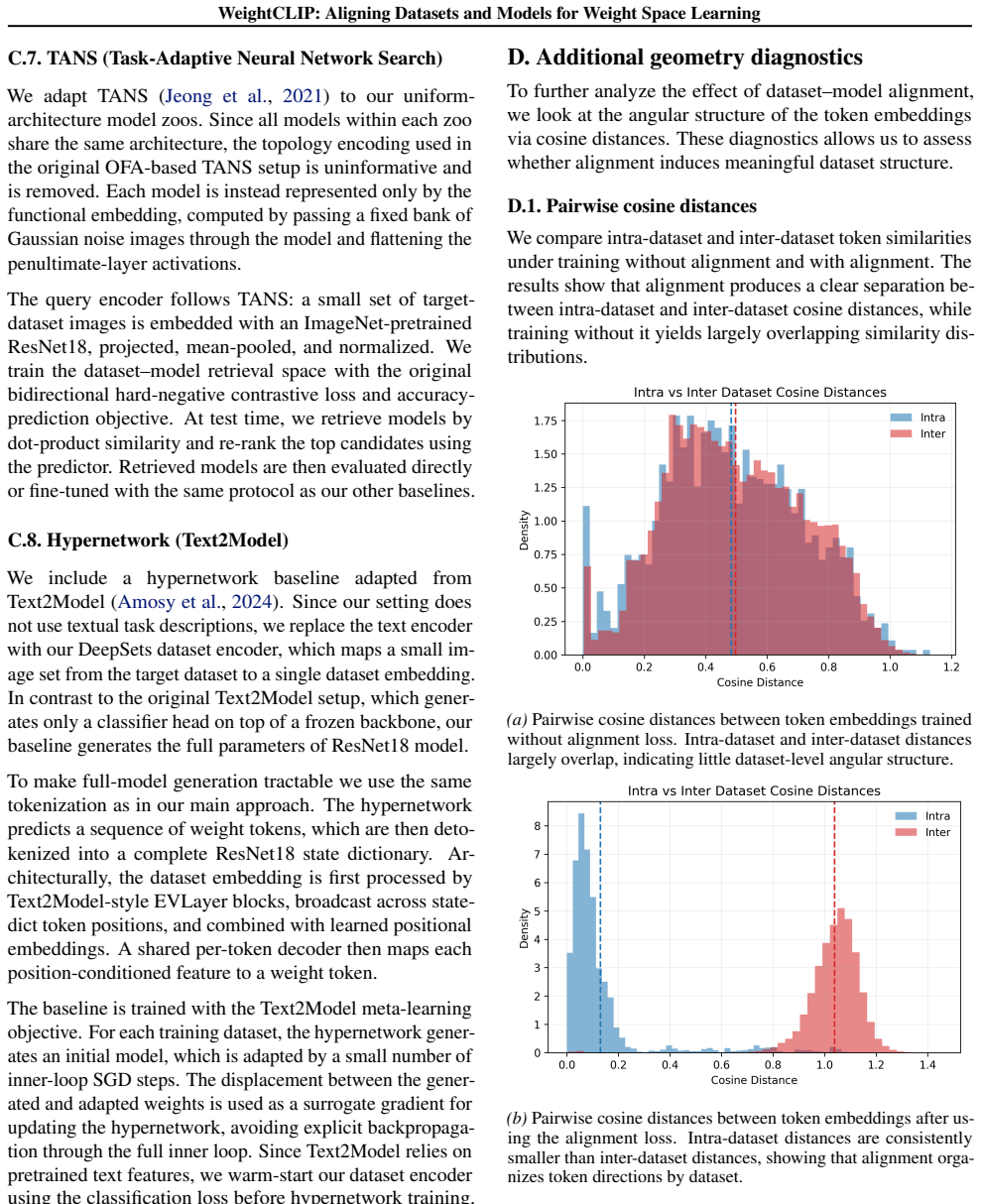
WeightCLIP’s chain is standard supervised/contrastive ML, not a first-principles derivation. The autoencoder is trained with reconstruction plus a bidirectional token–dataset contrastive loss (Eqs. 1–4); mappers are fit on training (e_D, Z) pairs (linear ridge or memory-bank soft neighborhood loss); refinement optimizes task loss through the decoder under an empirical shell prior (Eqs. 8–11). Downstream claims—OOD retrieval accuracy, decoded Ep.0/Ep.1/Ep.10 accuracy, and latent refine vs fine-tune under matched budgets—are measured on held-out model instances and held-out image datasets, so they are not forced by the fit. In-distribution retrieval (Tab. 1) is close to the training objective but still evaluates held-out models, not a tautological re-read of fitted free parameters. Self-citations (SANE/Schürholt et al. for the weight autoencoder; prior WSL geometry for the hyperspherical shell) supply infrastructure and a geometric prior; they do not uniquely force the alignment objective or the reported generation/refinement gains. No uniqueness theorem, ansatz smuggled as external fact, or renaming of a known closed-form result appears. Correctness concerns about attributing gains to alignment vs reconstruction/head repair are orthogonal to circularity.
Axiom & Free-Parameter Ledger
free parameters (5)
- contrastive temperature / logit bias
- alignment loss weight
- hyperspherical shell center c and radius r
- latent dimension d and token/window sizes
- refinement neighborhood penalty γ and step count
axioms (5)
- domain assumption Contrastive alignment of heterogeneous modalities yields a shared space in which cosine similarity is semantically meaningful (CLIP-style).
- ad hoc to paper Dataset identity signal is distributed roughly uniformly across weight tokens of a trained network.
- domain assumption Trained weight embeddings concentrate near a hyperspherical shell that can be used as a manifold constraint for latent optimization.
- domain assumption DeepSets on small image subsets produces embeddings that identify dataset distribution well enough to serve as prompts.
- domain assumption SANE-style windowed tokenization and transformer autoencoder can reconstruct and decode useful weight sequences for the studied architectures.
invented entities (3)
-
dataset-aligned weight latent manifold (WeightCLIP space)
no independent evidence
-
memory-bank mapper with soft neighborhood supervision
no independent evidence
-
shell-constrained latent refinement procedure
no independent evidence
read the original abstract
Weight space learning aims to learn representations of neural network (NN) weights, enabling different downstream tasks. Existing approaches show promising performance, but lacking a way to shape these weight-space representations using information about the datasets the models were trained on, thus limiting downstream applications. We propose WeightCLIP, a method for learning a dataset-aligned latent space for neural networks, where datasets information is induced during training. The NNs are encoded as latent representations using an autoencoder, while dataset samples are encoded using a dataset encoder. The two representations are aligned using a contrastive objective, effectively reshaping the weight-space representations according to the datasets. We demonstrate that such representations can be used for different downstream tasks, including mapping dataset information to a weight-space representation that decode to strong models. In addition, we introduce a latent refinement process for generating models that outperforms standard fine-tuning. Overall, our results demonstrate that explicitly incorporating dataset information improves what can be achieved with weight-space representations across retrieval, generation, and refinement. Code will be available at https://github.com/HSG-AIML/WeightCLIP.
Figures



Reference graph
Works this paper leans on
-
[1]
S., Willmott, D., Bair, A., Ganesh, M
Akinwande, V ., Norouzzadeh, M. S., Willmott, D., Bair, A., Ganesh, M. R., and Kolter, J. Z. Hyperclip: Adapt- ing vision-language models with hypernetworks.arXiv preprint arXiv:2412.16777,
-
[2]
Alam, S., Reasat, T., Doha, R. M., and Humayun, A. I. NumtaDB: Assembled bengali handwritten digits.arXiv preprint arXiv:1806.02452,
-
[3]
Text2model: Text-based model in- duction for zero-shot image classification
Amosy, O., V olk, T., Shapira, E., Ben-David, E., Reichart, R., and Chechik, G. Text2model: Text-based model in- duction for zero-shot image classification. InFindings of the Association for Computational Linguistics: EMNLP 2024, pp. 155–172,
2024
-
[4]
Bedionita, S., Andreis, B., Chong, S., and Hwang, S. J. Instruction-guided autoregressive neural network parame- ter generation.ICLR 2025 Workshop on Neural Network Weights as a New Data Modality, 2025a. Bedionita, S., Andreis, B., Lee, H., Jeong, W., Chong, S., Hutter, F., and Hwang, S. J. Diffusion-based Neural Network Weights Generation. In13th Interna...
2025
-
[5]
doi: 10.1109/ACCESS.2020.3010287. D’Orazio, A., Briglia, M. R., Crisostomi, D., Loi, D., Rodol`a, E., and Masi, I. Implicit inversion turns CLIP into a decoder. InThe Fourteenth International Confer- ence on Learning Representations,
-
[6]
Falk, D., Sch ¨urholt, K., Tzevelekakis, K., Meynent, L., and Borth, D
arXiv preprint. Falk, D., Sch ¨urholt, K., Tzevelekakis, K., Meynent, L., and Borth, D. Learning Model Representations Us- ing Publicly Available Model Hubs.arXiv preprint arXiv:2510.02096,
-
[7]
doi: 10.1145/1015330.1015376. Han, X., Wang, Z., Zhao, B., Zhang, B., Li, J., Borth, D., Yu, R., Maron, H., Ye, Y ., Yin, L., et al. A survey of weight space learning: Understanding, representation, and generation.arXiv preprint arXiv:2603.10090,
-
[8]
Hanna, J., Falk, D., Yu, S. X., and Borth, D. Geosane: Learning geospatial representations from models, not data.arXiv preprint arXiv:2603.23408,
-
[9]
Ho, J., Jain, A., and Abbeel, P
doi: 10.1109/JSTARS.2019.2918242. Ho, J., Jain, A., and Abbeel, P. Denoising Diffusion Prob- abilistic Models. InAdvances in Neural Information Processing Systems (NeurIPS),
-
[10]
doi: 10.13026/4nae-zg36. Version 1.3.1. Hssayeni, M. D., Croock, M. S., Salman, A. D., Al-khafaji, H. F., Yahya, Z. A., and Ghoraani, B. Intracranial hem- orrhage segmentation using deep convolutional model. Data, 5(1):14,
-
[11]
Jeong, W., Lee, H., Park, G., Hyung, E., Baek, J., and Hwang, S
doi: 10.3390/data5010014. Jeong, W., Lee, H., Park, G., Hyung, E., Baek, J., and Hwang, S. J. Task-adaptive neural network search with meta-contrastive learning.Advances in Neural Informa- tion Processing Systems, 34:21310–21324,
-
[12]
Conditional lora parameter generation.arXiv preprint arXiv:2408.01415,
Jin, X., Wang, K., Tang, D., Zhao, W., Zhou, Y ., Tang, J., and You, Y . Conditional lora parameter generation.arXiv preprint arXiv:2408.01415,
-
[13]
Accelerating training with neuron interaction and nowcasting networks
Knyazev, B., Moudgil, A., Lajoie, G., Belilovsky, E., and Lacoste-Julien, S. Accelerating training with neuron interaction and nowcasting networks. InInternational Conference on Learning Representations, volume 2025, pp. 29569–29588,
2025
-
[14]
doi: 10.1016/j.ecoinf.2019.05.005. Mahoney, M. and Martin, C. Traditional and heavy tailed self regularization in neural network models. InInterna- tional Conference on Machine Learning, pp. 4284–4293. PMLR,
-
[15]
A., Zhang, T., Wang, S., Wang, C., Feizi, A., Suresh, A
Masry, A., Rodriguez, J. A., Zhang, T., Wang, S., Wang, C., Feizi, A., Suresh, A. K., Puri, A., Jian, X., No ¨el, P.- A., and others. Alignvlm: Bridging vision and language 11 WeightCLIP: Aligning Datasets and Models for Weight Space Learning latent spaces for multimodal understanding. InSecond Workshop on Representational Alignment at ICLR 2025,
2025
-
[16]
K., and Grewe, B
Nava, E., Kobayashi, S., Yin, Y ., Katzschmann, R. K., and Grewe, B. Meta-learning via classifier (-free) diffusion guidance.Transactions on Machine Learning Research, 2023(8),
2023
-
[17]
Oord, A. v. d., Li, Y ., and Vinyals, O. Representation learn- ing with contrastive predictive coding.arXiv preprint arXiv:1807.03748,
-
[18]
Styleclip: Text-driven manipulation of stylegan imagery
Patashnik, O., Wu, Z., Shechtman, E., Cohen-Or, D., and Lischinski, D. Styleclip: Text-driven manipulation of stylegan imagery. InProceedings of the IEEE/CVF inter- national conference on computer vision, pp. 2085–2094,
2085
-
[19]
Ramesh, A., Dhariwal, P., Nichol, A., Chu, C., and Chen, M
doi: 10.1016/j.compbiomed.2021.104319. Ramesh, A., Dhariwal, P., Nichol, A., Chu, C., and Chen, M. Hierarchical text-conditional image generation with clip latents.arXiv preprint arXiv:2204.06125, 1(2):3,
-
[20]
doi: 10.1109/WACV . 2018.00011. Rombach, R., Blattmann, A., Lorenz, D., Esser, P., and Om- mer, B. High-Resolution Image Synthesis with Latent Diffusion Models. InIEEE/CVF Conference on Com- puter Vision and Pattern Recognition (CVPR),
doi:10.1109/wacv 2018
-
[21]
Hyper-Representations for Pre-Training and Transfer Learning
Sch¨urholt, K., Knyazev, B., Gir ´o-i Nieto, X., and Borth, D. Hyper-Representations for Pre-Training and Transfer Learning. InFirst Workshop of Pre-training: Perspectives, Pitfalls, and Paths Forward at ICML 2022, 2022a. Sch¨urholt, K., Knyazev, B., Gir ´o-i Nieto, X., and Borth, D. Hyper-Representations as Generative Models: Sam- pling Unseen Neural Net...
2022
-
[22]
doi: 10.1109/TBME. 2015.2496264. Tian, B., Chen, W., Li, Z., Lai, S., Wu, J., and Yue, Y . Text2weight: Bridging natural language and neural net- work weight spaces. InProceedings of the 33rd ACM In- ternational Conference on Multimedia, pp. 10152–10160,
doi:10.1109/tbme 2015
-
[23]
Predicting neural network accuracy from weights.arXiv preprint arXiv:2002.11448,
Unterthiner, T., Keysers, D., Gelly, S., Bousquet, O., and Tolstikhin, I. Predicting neural network accuracy from weights.arXiv preprint arXiv:2002.11448,
Pith/arXiv arXiv 2002
-
[24]
Wang, C. and Mahadevan, S. A General Framework for Manifold Alignment. InAAAI Conference on Artificial Intelligence (AAAI), 2009a. 12 WeightCLIP: Aligning Datasets and Models for Weight Space Learning Wang, C. and Mahadevan, S. Manifold Alignment without Correspondence. InInternational Joint Conference on Artificial Intelligence (IJCAI), 2009b. Wang, K., ...
-
[25]
Additional Related Work A.1
13 WeightCLIP: Aligning Datasets and Models for Weight Space Learning A. Additional Related Work A.1. Weight-space learning Representation learning in the space of neural-network weights has grown into a broad field spanning both model analysis and weight generation. Early work focuses on predicting model properties, such as accuracy, directly from weight...
2020
-
[26]
Instances
meta-dataset collection, but re- stricted to 20 training datasets for the CNN zoo and 10 for the ResNet18 zoo. As in TANS, we cap datasets to at most 20 classes during zoo construction. When available, we cite the original dataset papers for the Kaggle sources, including Aerial Cactus (L´opez-Jim´enez et al., 2019), BreakHis (Span- hol et al., 2016), Numt...
2019
-
[27]
Since all models within each zoo share the same architecture, the topology encoding used in the original OFA-based TANS setup is uninformative and is removed
to our uniform- architecture model zoos. Since all models within each zoo share the same architecture, the topology encoding used in the original OFA-based TANS setup is uninformative and is removed. Each model is instead represented only by the functional embedding, computed by passing a fixed bank of Gaussian noise images through the model and flattenin...
2024
discussion (0)
Sign in with ORCID, Apple, or X to comment. Anyone can read and Pith papers without signing in.