REVIEW 3 major objections 5 minor 101 references
Euclidean Yang-Mills matrix path-integral weights equal Haar-averaged Floquet fidelities, so gauge theories on dynamical spacetimes can be simulated without a lattice.
Reviewed by Pith at T0; open to challenge. T0 means a machine referee read the full paper against a public rubric. the ladder, T0–T4 →
T0 review · grok-4.5
2026-07-11 22:05 UTC pith:JKW6EPJK
load-bearing objection Solid method paper: the Floquet-fidelity map to Euclidean matrix weights is new and carefully derived; the cosmological deconfinement claim is oversold relative to the numerics and the Euclidean/Lorentzian caveats. the 3 major comments →
Quantum simulation of gauge theories on dynamical spacetimes via Floquet-induced matrix models
The pith
A machine-rendered reading of the paper's core claim, the machinery that carries it, and where it could break.
Core claim
At leading order in the coupling, the Euclidean path-integral weight e^{-S[X]} of a Yang-Mills matrix model is identical to the ensemble-averaged fidelity of Haar-random states evolved under the composite Floquet sequence built from the matrix operators themselves: e^{-S[X]} ≃ ∫ dμ(ψ) |⟨ψ| ∏_{a,b} F_2(X_a,X_b; Δt) |ψ⟩|², with the identification 1/g² = 2 Δt⁴/(N+1).
What carries the argument
The four-step symmetric Floquet sequence F_2(X_a,X_b; Δt) = e^{iΔt X_b} e^{iΔt X_a} e^{-iΔt X_b} e^{-iΔt X_a}, whose Baker-Campbell-Hausdorff expansion isolates the commutator i[X_a,X_b] at second order; Haar-averaged fidelity of the resulting unitary then equals the squared Frobenius norm of that commutator and therefore the matrix-model action.
Load-bearing premise
The fidelity equals the path-integral weight only when higher-order terms in the Floquet expansion stay negligible, which requires high drive frequency or weak coupling; outside that window the measured Loschmidt echo is no longer the Boltzmann weight.
What would settle it
Measure Haar-averaged fidelity versus exact e^{-S[X]} for a fixed matrix ensemble while scanning Floquet frequency; if the curves fail to converge once Δt^6 Tr([X_a,[X_a,X_b]]²) is small, or if Wilson-loop deconfinement signals disappear on the FLRW matrix background when the same high-frequency condition is met, the central claim fails.
If this is right
- Programmable quantum platforms can sample matrix-model path integrals with only 2 log2 N qubits instead of the polynomial resources of lattice or entry-wise quantization.
- Gauge-field observables, Wilson loops, and deconfinement transitions become accessible on curved and expanding backgrounds without adding or removing lattice sites.
- Any periodic drive whose Magnus expansion begins with commutators automatically generates matrix-model statistics, so geometric structure may appear spontaneously in driven quantum matter.
- Quasi-coherent-state post-processing converts global matrix data into local field and metric expectation values on the emergent classical manifold.
- The same protocol extends in principle to supersymmetric matrix models once fermions are included via Jordan-Wigner or platform-native statistics.
Where Pith is reading between the lines
- If the high-frequency identification holds on hardware, near-term Rydberg or trapped-ion arrays with a few dozen qubits could already probe SU(2) deconfinement on small FLRW slices.
- The spontaneous-emergence remark suggests searching existing Floquet-engineered materials for unexpected Yang-Mills-like correlators without deliberate matrix encoding.
- Stabilizing genuine Lorentzian saddles inside the Euclidean sampling protocol remains an open experimental bottleneck for real-time cosmology.
Editorial analysis
A structured set of objections, weighed in public.
Referee Report
Summary. The manuscript proposes a Floquet protocol for quantum simulation of large-N Yang–Mills matrix models, in which spacetime geometry and gauge fields are encoded in the commutation structure of Hermitian matrices rather than on a spatial lattice. The central claim is that, at leading order in the coupling, the Euclidean Boltzmann weight e^{-S[X]} of a matrix configuration is reproduced by the Haar-averaged fidelity (Loschmidt echo) of a composite four-step Floquet sequence F_2 built from the matrix operators (Eq. 8), with the identification 1/g^{2} = 2Δt^{4}/(N+1). Controlled Floquet circuits are then used to sample an ensemble of matrix states with probabilities proportional to those weights, after which local field observables are extracted by classical post-processing with quasi-coherent states. Numerically, the authors validate the fidelity–weight correspondence, demonstrate globally and locally controlled parallel circuits, and report Metropolis Monte Carlo evidence for an SU(2) deconfinement transition on both a flat Moyal–Weyl plane and a k=−1 FLRW background.
Significance. If the leading-order fidelity–weight map and the resource claims hold under controlled conditions, the work offers a genuine alternative to lattice-based quantum simulation of gauge theories: continuous symmetries are preserved, dynamical and curved backgrounds (including expanding cosmologies) can be encoded without adding or removing degrees of freedom, and the qubit cost scales as O(log N) rather than as a Fock-space truncation of N^{2} matrix entries. The BCH isolation of commutators, the Weingarten evaluation of Haar fidelity, and the explicit identification of the effective coupling with experimental knobs (Δt, N) are carefully derived and constitute a concrete, falsifiable protocol compatible with randomized benchmarking. Demonstrating a deconfinement signal on a quantum-simulable FLRW encoding would be of clear interest for quantum simulation of cosmology and for matrix-model approaches to emergent geometry.
major comments (3)
- [Eq. (8); §II; Figs. 3–4, 7] Eq. (8) and the validity condition Δt^{6} Tr([X_a,[X_a,X_b]]^{2}) ≪ 1 (main text after Eq. 8; S.I. 5, Eqs. 46–49): the fidelity–weight identification is controlled only for high-weight configurations. The manuscript itself notes that low-probability states sit at a Haar-overlap floor ~1/N, so measured fidelities there are dominated by residual BCH terms and the universal 1/N floor rather than by e^{-S}. Figs. 4 and 7 claim to sample the path-integral measure via parallel circuits; without a quantitative bound on the distortion of the tails (e.g., a cutoff S ≲ log N and its effect on operator product expansions), the claim that the circuits reproduce the full Euclidean measure is overstated. A controlled error analysis or an explicit restriction of the sampled measure is needed.
- [Abstract; §IV; Fig. 6] Fig. 6 and §IV: the deconfinement transitions on flat and FLRW backgrounds are obtained by classical Metropolis Monte Carlo of the matrix model, not by executing the Floquet fidelity protocol. The abstract and introduction present these results as part of the quantum-simulation framework’s capabilities. The encoding demonstration is valuable, but the manuscript should clearly separate (i) numerical validation of the quantum protocol (fidelity–weight map and circuit sampling) from (ii) classical Monte Carlo evidence that the matrix encoding captures known gauge-theory physics. Claims of the form “first identification … within a quantum-simulable encoding” should be rephrased so that readers do not infer a quantum-circuit measurement of the transition.
- [Appendix H; Figs. 5–6b] Appendix H and the FLRW results (Figs. 5–6b): Lorentzian matrix saddles are not in general saddles of the Euclidean action sampled by the Floquet protocol. The three mitigation routes (Wick rotation of generators, fixed-background restriction, analytic continuation of observables) are stated but not quantified for the cosmological matrices used in the paper. For the k=−1 FLRW deconfinement signal to be load-bearing, the manuscript should either (a) restrict the path integral to field fluctuations on a fixed geometric background and show that the Wilson-loop order parameter is stable under that restriction, or (b) provide a controlled estimate of the Euclidean–Lorentzian mismatch for the SO(4,2)-based matrices employed.
minor comments (5)
- [Abstract] Abstract and introduction: “Yang-Mills matrix models” / “a Yang-Mills matrix models” — fix the grammar and make the leading-order caveat explicit in the abstract sentence that states the fidelity–weight correspondence.
- [Fig. 3; S.I. 5] Fig. 3 caption and main text: residual deviation at high frequency is attributed to O(Δt^{3}) BCH remainders; the expansion of |Tr(F_2)|^{2} in S.I. 5 shows the first discarded term in the fidelity is O(Δt^{6}) in the exponent expansion (and O(Δt^{8}) after squaring under the stated cancellations). Align the order counting between main text and S.I.
- [Appendix G] Resource estimate (Appendix G): the worst-case example of eight 500×500 matrices (~18 qubits) is helpful; a short table relating N, localization radius, and number of Floquet cycles needed to resolve S up to ~log N would make the experimental target clearer.
- [§II; Appendix C] Notation: the same symbol F_2 is used for the two-operator sequence and for the multi-operator product; a brief distinction (e.g., F_2 vs. F_2({X_a})) in the main text would reduce ambiguity when reading Eq. (8) against Eq. (5).
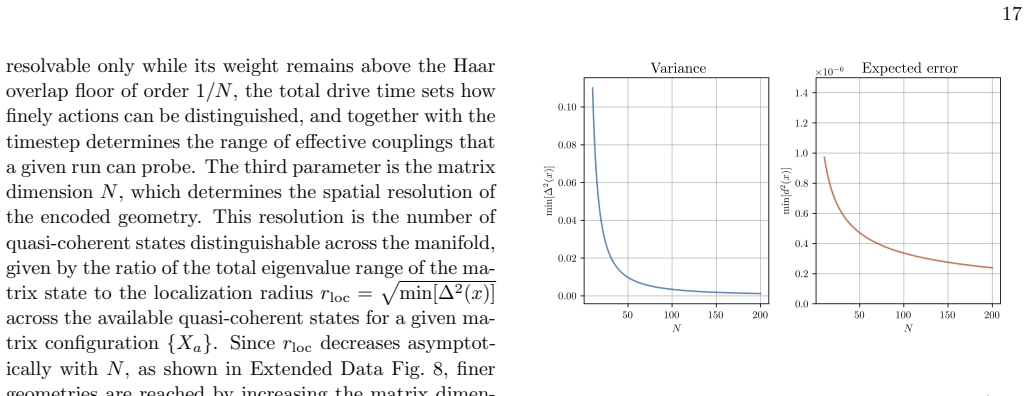
- [Extended Data Fig. 8] Extended Data Fig. 8: the asymptotic decrease of min Δ^{2} and d^{2} with N is important for the continuum claim; stating the fitted scaling (or a theoretical large-N expectation) would strengthen the finite-size discussion.
Circularity Check
No significant circularity: the fidelity–weight map is an independent BCH/Haar derivation with free experimental knobs, not a fit or self-definition.
full rationale
The central claim (Eq. 8) equates Haar-averaged Floquet fidelities to Euclidean Boltzmann weights e^{-S[X]} at leading order. The derivation chain is: (i) the matrix action is the standard Yang–Mills commutator action S[X]∝∑∥[Xa,Xb]∥²_F; (ii) the four-step sequence F2 isolates i[Xa,Xb] via BCH (S.I. 5); (iii) the Haar fidelity identity ⟨f⟩=(N+|Tr(U)|²)/(N(N+1)) is proved from Weingarten calculus (S.I. 7); (iv) expanding |Tr(F2)|² to O(Δt⁴) yields ⟨fab⟩≃1−(2Δt⁴/(N+1))∥i[Xa,Xb]∥²_F, which matches e^{-S} under the free identification 1/g²=2Δt⁴/(N+1). None of these steps defines the target in terms of the measurement, fits a parameter to the deconfinement data and then re-predicts it, or imports a uniqueness theorem from the present authors. Steinacker citations supply the geometric dictionary (quasi-coherent states, FLRW matrix encodings) as external background formalism; they are not load-bearing for the fidelity–weight equality and are not self-citations. Numerical Monte Carlo Wilson-loop results (Fig. 6) use the matrix model action directly and do not close a definitional loop with the Floquet protocol. Higher-order BCH truncation and Euclidean–Lorentzian continuation are validity caveats, not circular reductions. Score 0 is therefore appropriate.
Axiom & Free-Parameter Ledger
free parameters (3)
- Floquet timestep Δt (or frequency ω_F)
- Matrix dimension N
- Element-wise Gaussian noise variance σ/|λ_N|
axioms (5)
- standard math Baker-Campbell-Hausdorff / Magnus expansion isolates i[X_a,X_b] at second order for the symmetric four-step (or phase-offset periodic) drive, with higher orders O(Δt³) or O(1/ω³).
- standard math Haar-averaged fidelity equals (N + |Tr U|²)/(N(N+1)) (Weingarten calculus).
- domain assumption Steinacker’s covariant matrix states and quasi-coherent states correctly encode Riemannian geometry and Yang-Mills fields via commutators and direct-sum fluctuations.
- domain assumption Finite Jordan-Schwinger truncations of SU(2), Moyal plane, and SO(4,2) generators approach the desired continuum geometries as N→∞ with controllable edge effects.
- ad hoc to paper Lorentzian matrix saddles can be accessed from Euclidean Floquet sampling via Wick rotation of generators, fixed-background restriction, or analytic continuation of observables (Appendix H).
invented entities (1)
-
Floquet-induced matrix-model path-integral sampler (F_2 sequences + Haar fidelity as e^{-S})
no independent evidence
read the original abstract
Quantum simulations of gauge theories are typically built on spatial lattices, an approach that has enabled major progress at the cost of requiring fixed background geometries and obscuring the treatment of curved and dynamical spacetimes. Large-$N$ matrix models offer an alternative, encoding spacetime geometry and gauge fields in the commutation structure of a set of Hermitian matrices, with the classical continuum emerging smoothly at large matrix dimensions. Here we introduce a Floquet framework that makes these models directly accessible to programmable quantum platforms. We show that Euclidean path integral weights of a Yang-Mills matrix models are reproduced, at leading order in the coupling, by the ensemble-averaged fidelities of Haar-random states evolved under periodic sequences of matrix operators. The observables for the simulated matrix model can then be accessed through established randomized benchmarking protocols in terms of the Loschmidt echo. The encoding requires exponentially fewer qubits than canonically quantized approaches. Numerically, we validate the fidelity-weight correspondence, demonstrate parallelized quantum circuits that sample the path-integral measure, and identify the deconfinement transition of an $SU(2)$ gauge field on both flat and expanding cosmological backgrounds. By avoiding a fixed spacetime lattice, the framework preserves continuous symmetries and unitarity on dynamical geometries, opening quantum simulation to field and spacetime dynamics beyond the reach of conventional lattice methods.
Figures


Reference graph
Works this paper leans on
-
[1]
Yamamoto, Lattice qcd in curved spacetimes, Phys
A. Yamamoto, Lattice qcd in curved spacetimes, Phys. Rev. D90, 054510 (2014)
2014
-
[2]
Jers´ ak, C
J. Jers´ ak, C. B. Lang, and T. Neuhaus, Non-gaussian fixed point in four-dimensional pure compact u(1) gauge 10 theory on the lattice, Phys. Rev. Lett.77, 1933 (1996)
1933
-
[3]
Campos, A
I. Campos, A. Cruz, and A. Taranc´ on, A study of the phase transition in 4d pure compact u(1) lgt on toroidal and spherical lattices, Nuclear Physics B528, 325 (1998)
1998
-
[4]
J. Cotler and A. Strominger, The universe as a quantum encoder (2022), arXiv:2201.11658 [hep-th]
Pith/arXiv arXiv 2022
-
[5]
Byrnes and Y
T. Byrnes and Y. Yamamoto, Simulating lattice gauge theories on a quantum computer, Phys. Rev. A73, 022328 (2006)
2006
-
[6]
S. P. Jordan, K. S. M. Lee, and J. Preskill, Quantum algorithms for quan- tum field theories, Science336, 1130 (2012), https://www.science.org/doi/pdf/10.1126/science.1217069
-
[7]
M. Meth, J. Zhang, J. F. Haase, C. Edmunds, L. Postler, A. J. Jena, A. Steiner, L. Dellantonio, R. Blatt, P. Zoller, T. Monz, P. Schindler, C. Muschik, and M. Ringbauer, Simulating two-dimensional lattice gauge theories on a qudit quantum computer, Nature Physics21, 570 (2025)
2025
-
[8]
Gonz´ alez-Cuadra, M
D. Gonz´ alez-Cuadra, M. Hamdan, T. V. Zache, B. Braverman, M. Kornjaˇ ca, A. Lukin, S. H. Cant´ u, F. Liu, S.-T. Wang, A. Keesling, M. D. Lukin, P. Zoller, and A. Bylinskii, Observation of string breaking on a (2 + 1)d rydberg quantum simulator, Nature642, 321 (2025)
2025
-
[9]
Hooft, A planar diagram theory for strong interac- tions, Nuclear Physics B72, 461 (1974)
G. Hooft, A planar diagram theory for strong interac- tions, Nuclear Physics B72, 461 (1974)
1974
-
[10]
Eguchi and H
T. Eguchi and H. Kawai, Reduction of dynamical degrees of freedom in the large-ngauge theory, Phys. Rev. Lett. 48, 1063 (1982)
1982
-
[11]
Gonzalez-Arroyo and M
A. Gonzalez-Arroyo and M. Okawa, A twisted model for large n lattice gauge theory, Physics Letters B120, 174 (1983)
1983
-
[12]
Steinacker, Emergent geometry and gravity from ma- trix models: an introduction, Classical and Quantum Gravity27, 133001 (2010)
H. Steinacker, Emergent geometry and gravity from ma- trix models: an introduction, Classical and Quantum Gravity27, 133001 (2010)
2010
-
[13]
Berenstein and E
D. Berenstein and E. Dzienkowski, Matrix embeddings on flat∖ 3 and the geometry of membranes, Phys. Rev. D86, 086001 (2012)
2012
-
[14]
H. C. Steinacker,Quantum Geometry, Matrix Theory, and Gravity(Cambridge University Press, 2024)
2024
-
[15]
Rinaldi, X
E. Rinaldi, X. Han, M. Hassan, Y. Feng, F. Nori, M. McGuigan, and M. Hanada, Matrix-model simula- tions using quantum computing, deep learning, and lat- tice monte carlo, PRX Quantum3, 010324 (2022)
2022
-
[16]
H. Gharibyan, M. Hanada, M. Honda, and J. Liu, Toward simulating superstring/m-theory on a quan- tum computer, Journal of High Energy Physics2021, 10.1007/jhep07(2021)140 (2021)
-
[17]
Gonzalez-Arroyo and M
A. Gonzalez-Arroyo and M. Okawa, Twisted-eguchi- kawai model: A reduced model for large-nlattice gauge theory, Phys. Rev. D27, 2397 (1983)
1983
-
[18]
Bellissard, A
J. Bellissard, A. van Elst, and H. Schulz- Baldes, The noncommutative geometry of the quantum hall effect, Journal of Mathematical Physics35, 5373 (1994), https://pubs.aip.org/aip/jmp/article- pdf/35/10/5373/19099403/5373 1 online.pdf
1994
-
[19]
Marcolli and V
M. Marcolli and V. Mathai, Towards the fractional quan- tum hall effect: a noncommutative geometry perspec- tive, inNoncommutative Geometry and Number Theory: Where Arithmetic meets Geometry and Physics, edited by C. Consani and M. Marcolli (Vieweg, Wiesbaden,
-
[20]
Pasquier, Quantum hall effect and non-commutative geometry, inQuantum Spaces: Poincar´ e Seminar 2007, edited by B
V. Pasquier, Quantum hall effect and non-commutative geometry, inQuantum Spaces: Poincar´ e Seminar 2007, edited by B. Duplantier (Birkh¨ auser Basel, Basel, 2007) pp. 1–17
2007
-
[21]
S. S. Gubser, I. R. Klebanov, and A. M. Polyakov, Gauge theory correlators from non-critical string theory, Physics Letters B428, 105 (1998)
1998
-
[22]
Polyakov and V
A. Polyakov and V. Rychkov, Gauge fields–strings dual- ity and the loop equation, Nuclear Physics B581, 116 (2000)
2000
-
[23]
J. M. Maldacena, The LargeNlimit of superconformal field theories and supergravity, Adv. Theor. Math. Phys. 2, 231 (1998), arXiv:hep-th/9711200
Pith/arXiv arXiv 1998
-
[24]
A. M. Polyakov, Quarks, strings and beyond, inThe Birth of String Theory, edited by A. Cappelli, E. Castel- lani, F. Colomo, and P. Di Vecchia (Cambridge Univer- sity Press, 2012) p. 544–551
2012
-
[25]
Banks, W
T. Banks, W. Fischler, S. H. Shenker, and L. Susskind, mtheory as a matrix model: A conjecture, Phys. Rev. D 55, 5112 (1997)
1997
-
[26]
Seiberg, Why is the matrix model correct?, Phys
N. Seiberg, Why is the matrix model correct?, Phys. Rev. Lett.79, 3577 (1997)
1997
-
[27]
Ishibashi, H
N. Ishibashi, H. Kawai, Y. Kitazawa, and A. Tsuchiya, A large-n reduced model as superstring, Nuclear Physics B498, 467 (1997)
1997
-
[28]
H. Aoki, S. Iso, H. Kawai, Y. Kitazawa, A. Tsuchiya, and T. Tada, Iib matrix model, Progress of Theoretical Physics Supplement134, 47 (1999)
1999
-
[29]
H. S. Snyder, Quantized space-time, Phys. Rev.71, 38 (1947)
1947
-
[30]
Sperling and H
M. Sperling and H. C. Steinacker, The fuzzy 4- hyperboloid hn4 and higher-spin in yang–mills matrix models, Nuclear Physics B941, 680 (2019)
2019
-
[31]
H. C. Steinacker, Quantized open frw cosmology from yang–mills matrix models, Physics Letters B782, 176 (2018)
2018
-
[32]
H. C. Steinacker, Quantum (matrix) geometry and quasi- coherent states, Journal of Physics A: Mathematical and Theoretical54, 055401 (2021)
2021
-
[33]
Nishimura, Signature change of the emergent space- time in the IKKT matrix model, PoSCORFU2021, 255 (2022)
J. Nishimura, Signature change of the emergent space- time in the IKKT matrix model, PoSCORFU2021, 255 (2022)
2022
-
[34]
A. A. Kirillov,Lectures on the Orbit Method, Graduate Studies in Mathematics, Vol. 64 (American Mathemati- cal Society, Providence, Rhode Island, 2004)
2004
-
[35]
B. C. Hall, Lie groups, lie algebras, and representations, inQuantum Theory for Mathematicians(Springer New York, New York, NY, 2013) pp. 333–366
2013
-
[36]
Madore, The Fuzzy sphere, Class
J. Madore, The Fuzzy sphere, Class. Quant. Grav.9, 69 (1992)
1992
-
[37]
Hoppe, Quantum theory of a massless relativistic sur- face and a two-dimensional bound state problem (1982)
J. Hoppe, Quantum theory of a massless relativistic sur- face and a two-dimensional bound state problem (1982)
1982
-
[38]
H. Grosse, C. Klimcik, and P. Presnajder, Towards fi- nite quantum field theory in non-commutative geometry (1996), hep-th/9505175. 11
Pith/arXiv arXiv 1996
-
[39]
Barenco, C
A. Barenco, C. H. Bennett, R. Cleve, D. P. DiVincenzo, N. Margolus, P. Shor, T. Sleator, J. A. Smolin, and H. Weinfurter, Elementary gates for quantum computa- tion, Phys. Rev. A52, 3457 (1995)
1995
-
[40]
Jandura and G
S. Jandura and G. Pupillo, Time-optimal two- and three- qubit gates for rydberg atoms, Quantum6, 712 (2022)
2022
-
[41]
S. J. Evered, D. Bluvstein, M. Kalinowski, S. Ebadi, T. Manovitz, H. Zhou, S. H. Li, A. A. Geim, T. T. Wang, N. Maskara, H. Levine, G. Semeghini, M. Greiner, V. Vuleti´ c, and M. D. Lukin, High-fidelity parallel entan- gling gates on a neutral-atom quantum computer, Nature 622, 268 (2023)
2023
-
[42]
Saffman, Quantum computing with atomic qubits and rydberg interactions: progress and challenges, Journal of Physics B: Atomic, Molecular and Optical Physics49, 202001 (2016)
M. Saffman, Quantum computing with atomic qubits and rydberg interactions: progress and challenges, Journal of Physics B: Atomic, Molecular and Optical Physics49, 202001 (2016)
2016
-
[43]
Vidal, K
G. Vidal, K. Hammerer, and J. I. Cirac, Interaction cost of nonlocal gates, Phys. Rev. Lett.88, 237902 (2002)
2002
-
[44]
C. H. Bennett, J. I. Cirac, M. S. Leifer, D. W. Leung, N. Linden, S. Popescu, and G. Vidal, Optimal simulation of two-qubit hamiltonians using general local operations, Phys. Rev. A66, 012305 (2002)
2002
-
[45]
H.-Y. Hu, A. M. Gomez, L. Chen, A. Trowbridge, A. J. Goldschmidt, Z. Manchester, F. T. Chong, A. Jaffe, and S. F. Yelin, Universal dynamics with globally controlled analog quantum simulators (2026), arXiv:2508.19075 [quant-ph]
arXiv 2026
-
[46]
Starodubtsev, A note on quantization of matrix mod- els, Nuclear Physics B674, 533 (2003)
A. Starodubtsev, A note on quantization of matrix mod- els, Nuclear Physics B674, 533 (2003)
2003
-
[47]
H. F. Baker, Alternants and continuous groups, Proceed- ings of the London Mathematical Society 2,3, 24 (1905)
1905
-
[48]
J. E. Campbell, On a law of combination of operators (second paper), Proceedings of the London Mathematical Society 1,29, 14 (1897)
-
[49]
F. Hausdorff, Die symbolische Exponentialformel in der Gruppentheorie, Berichte ¨ uber die Verhandlun- gen der K¨ oniglich-S¨ achsischen Gesellschaft der Wis- senschaften zu Leipzig, Mathematisch-Physische Klasse 58, 19 (1906)
1906
-
[50]
Collins and P
B. Collins and P. ´Sniady, Integration with respect to the haar measure on unitary, orthogonal and symplectic group, Communications in Mathematical Physics264, 773 (2006)
2006
-
[51]
Horodecki, P
M. Horodecki, P. Horodecki, and R. Horodecki, General teleportation channel, singlet fraction, and quasidistilla- tion, Phys. Rev. A60, 1888 (1999)
1999
-
[52]
M. A. Nielsen, A simple formula for the average gate fi- delity of a quantum dynamical operation, Physics Letters A303, 249 (2002)
2002
-
[53]
Liu and Y.-Z
J. Liu and Y.-Z. Li, Quantum simulation of cosmic infla- tion, Phys. Rev. D104, 086013 (2021)
2021
-
[54]
Brandenberger and V
R. Brandenberger and V. Kamali, Unitarity problems for an effective field theory description of early universe cosmology, The European Physical Journal C82, 818 (2022)
2022
-
[55]
Martin and R
J. Martin and R. H. Brandenberger, Trans-planckian problem of inflationary cosmology, Phys. Rev. D63, 123501 (2001)
2001
-
[56]
Swingle, Entanglement renormalization and hologra- phy, Phys
B. Swingle, Entanglement renormalization and hologra- phy, Phys. Rev. D86, 065007 (2012)
2012
-
[57]
Pastawski, B
F. Pastawski, B. Yoshida, D. Harlow, and J. Preskill, Holographic quantum error-correcting codes: toy models for the bulk/boundary correspondence, Journal of High Energy Physics2015, 149 (2015)
2015
-
[58]
Jordan and E
P. Jordan and E. Wigner, ¨Uber das paulische ¨ aquivalenzverbot, Zeitschrift f¨ ur Physik47, 631 (1928)
1928
-
[59]
Verstraete and J
F. Verstraete and J. I. Cirac, Mapping local hamiltoni- ans of fermions to local hamiltonians of spins, Journal of Statistical Mechanics: Theory and Experiment2005, P09012 (2005)
2005
-
[60]
C. M. Bender and S. Boettcher, Real spectra in non- hermitian hamiltonians having pt symmetry, Phys. Rev. Lett.80, 5243 (1998)
1998
-
[61]
Z.-D. Liu, H. Lyyra, Y.-N. Sun, B.-H. Liu, C.-F. Li, G.- C. Guo, S. Maniscalco, and J. Piilo, Experimental im- plementation of fully controlled dephasing dynamics and synthetic spectral densities, Nature Communications9, 3453 (2018)
2018
-
[62]
Sperling and H
M. Sperling and H. C. Steinacker, Intersecting branes, higgs sector, and chirality fromN= 4 sym with soft susy breaking, Journal of High Energy Physics2018, 116 (2018)
2018
-
[63]
Emerson, R
J. Emerson, R. Alicki, and K. ˙Zyczkowski, Scalable noise estimation with random unitary operators, Journal of Optics B: Quantum and Semiclassical Optics7, S347 (2005)
2005
-
[64]
Knill, D
E. Knill, D. Leibfried, R. Reichle, J. Britton, R. B. Blakestad, J. D. Jost, C. Langer, R. Ozeri, S. Seidelin, and D. J. Wineland, Randomized benchmarking of quan- tum gates, Phys. Rev. A77, 012307 (2008)
2008
-
[65]
Magesan, J
E. Magesan, J. M. Gambetta, and J. Emerson, Scalable and robust randomized benchmarking of quantum pro- cesses, Phys. Rev. Lett.106, 180504 (2011)
2011
-
[66]
C. Dankert, R. Cleve, J. Emerson, and E. Livine, Ex- act and approximate unitary 2-designs and their ap- plication to fidelity estimation, Physical Review A80, 10.1103/physreva.80.012304 (2009)
-
[67]
D. Yang, A. Grankin, L. M. Sieberer, D. V. Vasilyev, and P. Zoller, Quantum non-demolition measurement of a many-body hamiltonian, Nature Communications11, 775 (2020)
2020
-
[68]
D. V. Vasilyev, A. Grankin, M. A. Baranov, L. M. Sieberer, and P. Zoller, Monitoring quantum simulators via quantum nondemolition couplings to atomic clock qubits, PRX Quantum1, 020302 (2020)
2020
-
[69]
Anand, C
S. Anand, C. E. Bradley, R. White, V. Ramesh, K. Singh, and H. Bernien, A dual-species rydberg array, Nature Physics20, 1744 (2024)
2024
-
[70]
H. M. Nguyen, Y. J. Zhu, C. E. Staub, B. Bao, and G. Se- meghini, Towards a continuously reloadable Yb-Rb Ryd- berg atom array, 56th Annual Meeting of the APS Divi- sion of Atomic, Molecular and Optical Physics (DAMOP) (2025)
2025
-
[71]
H. Aoki, S. Iso, H. Kawai, Y. Kitazawa, and T. Tada, Space-time structures from iib ma- trix model, Progress of Theoretical Physics99, 12 713 (1998), https://academic.oup.com/ptp/article- pdf/99/5/713/5471260/99-5-713.pdf
1998
-
[72]
S. ISO and H. KAWAI, Space–time and matter in the iib matrix model — gauge symmetry and diffeomorphism, International Journal of Modern Physics A15, 651 (2000), https://doi.org/10.1142/S0217751X0000032X
-
[73]
J. E. Moyal, Quantum mechanics as a statistical theory, Proc. Cambridge Phil. Soc.45, 99 (1949)
1949
-
[74]
Weyl and H
H. Weyl and H. Robertson,The Theory of Groups and Quantum Mechanics(E. P. Dutton and Company, 1931)
1931
-
[75]
Groenewold, On the principles of elementary quantum mechanics, Physica12, 405 (1946)
H. Groenewold, On the principles of elementary quantum mechanics, Physica12, 405 (1946)
1946
-
[76]
J. M. Radcliffe, Some properties of coherent spin states, Journal of Physics A: General Physics4, 313 (1971)
1971
-
[77]
J. v. Neumann, Die eindeutigkeit der schr¨ odingerschen operatoren, Mathematische Annalen104, 570 (1931)
1931
-
[78]
J. v. Neumann, ¨Uber einen satz von herrn m. h. stone, Annals of Mathematics33, 567 (1932)
1932
-
[79]
M. H. Stone, Linear transformations in hilbert space, Proceedings of the Na- tional Academy of Sciences16, 172 (1930), https://www.pnas.org/doi/pdf/10.1073/pnas.16.2.172
-
[80]
M. H. Stone, On one-parameter unitary groups in hilbert space, Annals of Mathematics33, 643 (1932)
1932
discussion (0)
Sign in with ORCID, Apple, or X to comment. Anyone can read and Pith papers without signing in.