REVIEW 3 major objections 4 minor 41 references
A MeV-Scale Dark QCD Solution to the Axion Domain Wall Problem
T0 review · 3 major / 4 minor · reviewed 2026-07-11 · grok-4.5
Pith's one-line read A cold MeV-scale dark QCD sector lifts axion domain-wall degeneracy while keeping the strong-CP angle small enough to solve the problem.
desk verdict A clean MeV-window idea for tilting axion walls with dark instantons; the balance is real but the collapse and DIGA inputs leave the window only order-of-magnitude controlled. read the letter →
The pith
A machine-rendered reading of the paper's core claim, the machinery that carries it, and where it could break.
The reading
What carries the argument
The dark cosine potential Vd = −χ0 cos(Ad θeff + δ) generated by the mixed U(1)PQ–SU(Nc)^{2} anomaly; its temperature-dependent topological susceptibility supplies the vacuum bias ΔV ∼ χ0 that lifts the NDW-fold degeneracy while the upper bound χ0/χQCD ≲ 10^{-10}/δ keeps θeff safe.
What would settle it
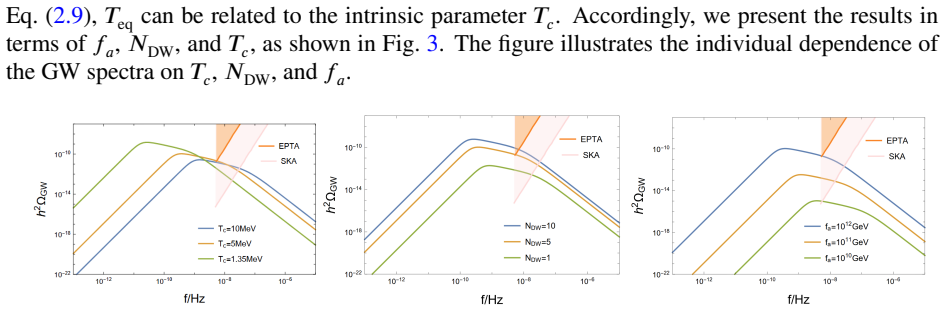
A stochastic gravitational-wave background whose peak frequency and doubly-broken power-law shape match the domain-wall collapse prediction for Teq ∼ few–tens of MeV and fa ∼ 10^{12} GeV, already testable by current PTA data and definitively by SKA.
Extended reading notes
Core claim
When the PQ symmetry also has a mixed anomaly with a pure Yang-Mills dark SU(Nc), the resulting dark-instanton potential explicitly breaks the residual Z_NDW symmetry. For a dark critical temperature Tc inside the narrow window 0.1–3 MeV (and a temperature ratio ξ ≲ 0.5), the vacuum bias is large enough to drive domain-wall collapse before BBN while the induced shift in the effective theta angle stays below the neutron-EDM bound, thereby solving the domain-wall problem without reintroducing the strong CP problem.
Load-bearing premise
The temperature dependence of the dark topological susceptibility is assumed to follow continuum lattice results for pure Yang-Mills even at MeV scales and for a cooler dark sector.
Editorial extensions
If this is right
- Current PTA signals at nHz frequencies can already be interpreted as axion domain-wall collapse for NDW ≳ 5 and fa ∼ 10^{12} GeV.
- Future SKA will reconstruct the doubly-broken power-law spectrum and distinguish it from supermassive black-hole binaries.
- Next-generation MeV telescopes (COSI, AMEGO-X, e-ASTROGAM) can search for the di-photon line from the lightest dark glueball near 15 MeV in the most optimistic corners of parameter space.
- A cold dark sector (ξ ≲ 0.01) automatically satisfies dark-glueball relic-density bounds while enlarging the viable Tc window.
- A possible double-line gamma-ray signature (from 0++–0−+ mixing controlled by the dark theta term) would uniquely fingerprint the scenario.
Reading between the lines
- If PTA data firm up a domain-wall-like spectrum, the required cold dark QCD sector becomes a concrete target for lattice studies of MeV-scale pure Yang-Mills.
- The same mixed anomaly that solves the domain-wall problem automatically supplies a portal for freeze-in production of dark glueballs, linking two otherwise separate dark-matter candidates.
- The opposite dependence of the GW amplitude and the glueball lifetime on fa and Tc means a joint detection would over-constrain the model and either confirm or kill it cleanly.
- Models with Ad = NDW and vanishing relative theta would evade the MeV upper bound entirely, recovering a high-scale mirror-QCD limit that the paper only briefly notes.
Editorial analysis
A structured set of objections, weighed in public.
Referee Report
Summary. The paper proposes that a mixed U(1)_PQ–SU(N_c) anomaly with a hidden dark QCD sector generates an additional cosine potential for the axion (Eqs. 2.3–2.4). This explicitly breaks the residual Z_NDW symmetry, lifting vacuum degeneracy and allowing domain walls to collapse. A delicate balance is claimed: the dark critical temperature must lie in a narrow MeV window (0.1–3 MeV, with temperature ratio ξ ≲ 0.01–0.5) so that the induced bias ΔV ∼ χ0 collapses walls before BBN (Teq ≳ 1 MeV) while keeping |NDW ⟨θ_eff⟩| ≲ 10^{-10} and preserving the PQ solution to strong CP (Eqs. 2.6–2.12 and Figs. 1–2). Two signatures are developed: a stochastic GW background from wall collapse (using published lattice templates, Eqs. 3.1–3.5) already touching current PTA sensitivity, and di-photon lines from axion–dark-glueball mixing (Eqs. 3.9–3.11) that may be accessible to next-generation MeV telescopes. The scenario prefers a cold dark sector consistent with glueball relic-density bounds.
Significance. If the claimed window is robust, the work supplies a simple, dynamical alternative to higher-dimensional PQ-breaking operators for solving the axion domain-wall problem while remaining compatible with the strong-CP solution. The GW prediction is falsifiable with existing and near-future PTA data (NANOGrav/EPTA already probe the benchmark region; SKA can reconstruct the doubly-broken spectrum), and the di-photon channel offers a complementary, albeit more challenging, probe. The analysis re-uses continuum-extrapolated lattice susceptibilities and published domain-wall GW simulations rather than inventing new non-perturbative inputs, and it cleanly links the solution to cold dark-glueball dark matter. These concrete, multi-messenger predictions constitute a genuine strength even if the precise boundaries of the MeV window require refinement.
major comments (3)
- [Sec. II.C, Eqs. (2.9)–(2.12); Figs. 1–2; Sec. III.A] Sec. II.C and Eqs. (2.9)–(2.12) convert the vacuum bias ΔV ∼ χ0 into a collapse temperature Teq via the simple acceleration-balance condition |a| ≃ ΔV/σ ∼ H(Teq). Later, Sec. III.A cites the 3+1 lattice results of Ref. [24] showing that GW emission continues until Hend ≈ 0.1 H(Teq), so the actual collapse occurs at a lower temperature Tend = Cs Teq with Cs ≈ 0.3. This correction is applied only to the GW amplitude (enhancing it by ∼100 while lowering ε to 0.07) and is never fed back into the (Tc, ξ) windows of Figs. 1–2. Because those windows are already only a few MeV wide and sit against the Teq > 1 MeV BBN edge, an O(1) downward shift in Teq can empty the region that simultaneously satisfies both the strong-CP bound (Eq. 2.7) and successful wall collapse. The viable parameter space must be re-mapped with the lattice-calibrated Cs factor before the central claim can be considered contr
- [Sec. II.B, Eq. (2.5); Sec. II.C, Eq. (2.10); Fig. 2] For the pre-transition channel the temperature dependence of χ_top(T) is taken from the DIGA form (Eq. 2.5) normalized to the lattice jump χ(Tc+)/χ0 ≈ 0.23 e^{-0.45 Nc}. The text itself notes (Sec. II.B) that DIGA overestimates the dilute-gas density by an order of magnitude even near Tc for Nc = 3, and the exponential e^{-SI} becomes extreme for Nc ≥ 4 and T/Tc ≳ 2. The post-transition channel (preferred for ξ ≪ 1) is less sensitive, yet the paper still presents both channels as viable. An O(1)–O(10) uncertainty in the effective χ_top therefore propagates directly into the claimed 0.1–3 MeV window. A quantitative error band on Figs. 1–2 (or an explicit statement that only the post-transition, lattice-normalized χ0 channel is robust) is required for the balance to be trustworthy.
- [Sec. II.C, Eq. (2.7)] The strong-CP bound (Eq. 2.7) is written as χ0/χQCD ≲ 10^{-10}/δ. The text invokes a “reasonably small” δ ∼ 10^{-3} to push Tc up to ∼3 MeV, but never quantifies how natural such a cancellation between Θ and Θd is, nor how the bound degrades for generic O(1) phases. Because the upper edge of the window is set by this bound, the naturalness assumption on δ is load-bearing and should be stated as an explicit free-parameter scan or justified by a symmetry argument.
minor comments (4)
- [Abstract; Sec. I] Abstract and Introduction contain several typos (“re-incuring”, “vaccuum”, “midly”, “axiondark-glueball”). A careful proof-read is needed.
- [Fig. 1 caption; Sec. II.C] Fig. 1 caption states “0.001 GeV < T_SM_eq < 0.17 GeV” while the text uses 1 MeV; units and numerical thresholds should be made consistent throughout.
- [Sec. II.B; Sec. III.B] The relation Λd ≈ 0.5 √σ s and m0 ≈ 6–7 Λd is used without citing the precise lattice sources for general Nc; a short table or explicit references would improve reproducibility.
- [Sec. III.A, Eq. (3.4)] Eq. (3.4) and the subsequent GW spectra assume g_*s(Teq) ≈ 20; for Teq near 1 MeV this is only approximate and should be stated with the corresponding uncertainty.
Circularity Check
No significant circularity: MeV window and observables derived from external lattice/DIGA inputs plus free-parameter scan, not by construction from the targets.
full rationale
The load-bearing chain (Secs. II.B–C) starts from the mixed-anomaly dark cosine potential Vd = −χ0 cos(𝒜d θeff + δ), takes χ0 ≃ A0 Tc^4 and the DIGA form χtop(T) (Eq. 2.5) from continuum-extrapolated pure-YM lattice results of independent groups, then imposes the external strong-CP bound |NDW ⟨θeff⟩| ≲ 10^{-10} (Eq. 2.7) against the acceleration-balance collapse criterion ΔV ∼ H(Teq)σ that yields Teq > 1 MeV (Eqs. 2.9–2.12). Free parameters Tc, ξ, fa, NDW are scanned; the resulting window and the GW peak (Eq. 3.4) / glueball lifetime (Eq. 3.11) are therefore predictions, not tautologies. Self-citations ([17], [18], [33]) supply only ancillary technical statements (undetectable dark-PT GWs, UV freeze-in for small ξ) that are not required to close the central argument. No equation reduces a claimed observable to a quantity defined by the same data, and no uniqueness theorem or ansatz is imported from the authors’ prior work as an external fact. The derivation is therefore self-contained against external benchmarks.
Assumptions & free parameters
free parameters (7)
- Tc (dark critical temperature)
- xi = Td / TSM
- fa (axion decay constant)
- NDW (domain-wall number)
- Ad (dark anomaly coefficient)
- δ (relative dark θ phase)
- Nc (dark colors)
assumptions (4)
- domain assumption The mixed U(1)_PQ–SU(3)_c anomaly coefficient A3 is an integer, so the low-energy axion potential is Z_NDW-symmetric with NDW = |A3|.
- domain assumption Zero-temperature topological susceptibility of pure Yang-Mills is χ0 ≃ A0 Tc^4 with A0 ≈ 0.2, and above Tc it follows the DIGA form with n_YM = 11 Nc/3 − 4 and a jump factor ∼ 0.23 e^{-0.45 Nc}.
- domain assumption Domain-wall tension σ ≃ 9 NDW χ_QCD^{1/2} fa and collapse occurs when ΔV ∼ H(Teq) σ.
- domain assumption Dark glueball relic density is given by the 3→2 freeze-out formula Ω h^2 ≃ (g_d*s ξ^3 / g*s) Tf / 3.6 eV with Tf ∼ Λd.
invented entities (2)
-
Hidden SU(Nc) dark QCD sector with mixed U(1)_PQ anomaly
-
Dark glueballs (0++ and 0−+) as possible dark-matter components
Cite this review
Pith. "Pith review of A MeV-Scale Dark QCD Solution to the Axion Domain Wall Problem." pith.science (2026). https://pith.science/paper/CRQ6HZGC
@misc{pith2026260704137,
  author       = {Pith},
  title        = {Pith review of: A MeV-Scale Dark QCD Solution to the Axion Domain Wall Problem},
  year         = {2026},
  howpublished = {\url{https://pith.science/paper/CRQ6HZGC}},
  note         = {Machine review of arXiv:2607.04137}
}
abstract
PQ solution to the strong CP problem probably encounters the axion domain wall problem. In this article, we propose a simple and testable solution, assuming that the $U(1)_{\rm PQ}$ possesses mixed anomaly to a hidden $SU(N_c)$ color. Then, the axion field receives a new cosine potential from the hidden instantons, which breaks the $Z_{N_{\rm DW}}$ subgroup explicitly. The new potential lifts the vacua degeneracy, but also drives the effective $\theta$ angle away from the origin, re-incuring the strong CP problem. However, we find that the dark QCD scale within the 0.1 to 3 MeV window survives, maintaining a delicate balance. Two observational signatures are explored: gravitational waves from domain wall collapse, already probed by current PTAs, and di-photon signals from axion-dark-glueball mixing, which require next-generation MeV telescopes. The scenario favors a cold dark QCD sector consistent with dark glueball relic constraints.
Figures


Reference graph
Works this paper leans on
-
[24]
The spectrum of gravitational waves from annihilating domain walls
Alessio Notari, Fabrizio Rompineve, and Francisco Torrenti. The spectrum of gravitational waves from annihilating domain walls. JCAP, 07:049, 2025
2025
-
[1]
R. D. Peccei and Helen R. Quinn. CP Conservation in the Presence of Instantons. Phys. Rev. Lett., 38:1440–1443, 1977. 13
1977
-
[2]
R. D. Peccei and Helen R. Quinn. Constraints Imposed by CP Conservation in the Presence of Instan- tons. Phys. Rev. D, 16:1791–1797, 1977
1977
-
[3]
P. Sikivie. Of Axions, Domain Walls and the Early Universe. Phys. Rev. Lett., 48:1156–1159, 1982
1982
-
[4]
P. Sikivie. Of axions, domain walls and the new inflationary universe. Phys. Rev. D, 32:776–788, 1985
1985
-
[5]
Beyer and Subir Sarkar
Konstantin A. Beyer and Subir Sarkar. Ruling out light axions: The writing is on the wall. SciPost Phys., 15:003, 2023
2023
-
[6]
Jihn E. Kim. Weak interaction singlet and strong cp invariance. Phys. Rev. Lett., 43:103, 1979
1979
-
[7]
M. A. Shifman, A. I. Vainshtein, and V . I. Zakharov. Can confinement ensure natural cp invariance of strong interactions? Nucl. Phys. B, 166:493–506, 1980
1980
Show all 41 references
-
[8]
A Simple Solution to the Strong CP Problem with a Harmless Axion
Michael Dine, Willy Fischler, and Mark Srednicki. A Simple Solution to the Strong CP Problem with a Harmless Axion. Phys. Lett. B, 104:199–202, 1981
1981
-
[9]
A. R. Zhitnitsky. On Possible Suppression of the Axion Hadron Interactions. (In Russian). Sov. J. Nucl. Phys., 31:260, 1980
1980
-
[10]
Studies of the motion and decay of axion walls bounded by strings
Sanghyeon Chang, Christian Hagmann, and Pierre Sikivie. Studies of the motion and decay of axion walls bounded by strings. Phys. Rev. D, 59:023505, 1999
1999
-
[11]
The high temperature phase transition in SU(N) gauge theories
Biagio Lucini, Michael Teper, and Urs Wenger. The high temperature phase transition in SU(N) gauge theories. Phys. Lett. B, 545:197–206, 2002
2002
-
[12]
The 𝜃-dependence of the 𝑆𝑈 (𝑁) critical temperature at large 𝑁
Claudio Bonanno, Massimo D’Elia, and Lorenzo Verzichelli. The 𝜃-dependence of the 𝑆𝑈 (𝑁) critical temperature at large 𝑁. JHEP, 02:156, 2024
2024
-
[13]
Gross, R
David J. Gross, R. David Pisarski, and Laurence G. Yaffe. Qcd and the finite temperature phase tran- sition. Phys. Rev. D, 25:330, 1982
1982
-
[14]
Topological Susceptibility and QCD at Finite Theta Angle
Claudio Bonanno, Claudio Bonati, and Massimo D’Elia. Topological Susceptibility and QCD at Finite Theta Angle. 4 2026. Invited chapter for the Encyclopedia of Nuclear Physics
2026
-
[15]
High Quality QCD Axion and the LHC
Anson Hook, Soubhik Kumar, Zhen Liu, and Raman Sundrum. High Quality QCD Axion and the LHC. Phys. Rev. Lett., 124(22):221801, 2020
2020
-
[16]
Big bang nucleosynthesis and physics beyond the standard model
Subir Sarkar. Big bang nucleosynthesis and physics beyond the standard model. Rept. Prog. Phys., 59:1493–1610, 1996
1996
-
[17]
Dark confinement-deconfinement phase transition: a roadmap from Polyakov loop models to gravitational waves
Zhaofeng Kang, Jiang Zhu, and Shinya Matsuzaki. Dark confinement-deconfinement phase transition: a roadmap from Polyakov loop models to gravitational waves. JHEP, 09:060, 2021
2021
-
[18]
Confinement bubble wall velocity via quasiparticle determination
Zhaofeng Kang and Jiang Zhu. Confinement bubble wall velocity via quasiparticle determination. JHEP, 05:056, 2025
2025
-
[19]
David J. E. Marsh. Axion Cosmology. Physics Reports, 643:1–79, 07 2016
2016
-
[20]
Domain walls in the scaling regime: Equal Time Correlator and Gravitational Waves
Simone Blasi, Alberto Mariotti, Aäron Rase, and Miguel Vanvlasselaer. Domain walls in the scaling regime: Equal Time Correlator and Gravitational Waves. 11 2025
2025
-
[22]
On the estimation of gravitational wave spectrum from cosmic domain walls
Takashi Hiramatsu, Masahiro Kawasaki, and Ken’ichi Saikawa. On the estimation of gravitational wave spectrum from cosmic domain walls. JCAP, 02:031, 2014
2014
-
[23]
A review of gravitational waves from cosmic domain walls
Ken’ichi Saikawa. A review of gravitational waves from cosmic domain walls. Universe, 3(2):40, 2017
2017
-
[25]
The NANOGrav 15 yr Data Set: Evidence for a Gravitational-wave Background
Gabriella Agazie et al. The NANOGrav 15 yr Data Set: Evidence for a Gravitational-wave Background. Astrophys. J. Lett., 951(1):L8, 2023
2023
-
[26]
Janssen et al
G. Janssen et al. Gravitational wave astronomy with the SKA. PoS, AASKA14:037, 2015. 14
2015
-
[27]
Glueballs and k-strings in SU(N) gauge theories: Calculations with improved operators
Biagio Lucini, Michael Teper, and Urs Wenger. Glueballs and k-strings in SU(N) gauge theories: Calculations with improved operators. JHEP, 06:012, 2004
2004
-
[28]
SU(N) gauge theories in 3+1 dimensions: glueball spec- trum, string tensions and topology
Andreas Athenodorou and Michael Teper. SU(N) gauge theories in 3+1 dimensions: glueball spec- trum, string tensions and topology. JHEP, 12:082, 2021
2021
-
[29]
Carlson, Marie E
Eric D. Carlson, Marie E. Machacek, and Lawrence J. Hall. Self-interacting dark matter. Astrophys. J., 398:43–52, 1992
1992
-
[30]
Nelson, and Fabian Ruehle
James Halverson, Brent D. Nelson, and Fabian Ruehle. String theory and the dark glueball problem. Phys. Rev. D, 95(4):043527, 2017
2017
-
[31]
Morrissey, and Kris Sigurdson
Lindsay Forestell, David E. Morrissey, and Kris Sigurdson. Cosmological Bounds on Non-Abelian Dark Forces. Phys. Rev. D, 97(7):075029, 2018
2018
-
[32]
Glueball dark matter revis- ited
Pierluca Carenza, Roman Pasechnik, Gustavo Salinas, and Zhi-Wei Wang. Glueball dark matter revis- ited. Phys. Rev. Lett., 129:261302, 2022
2022
-
[33]
Slightly Ultra-violet Freeze-in a Hidden Gluonic Sector
Zhaofeng Kang. Slightly Ultra-violet Freeze-in a Hidden Gluonic Sector. Phys. Lett. B, 801:135149, 2020
2020
-
[34]
Y. Chen, A. Alexandru, S. J. Dong, T. Draper, I. Horváth, F. X. Lee, K. F. Liu, N. Mathur, C. Morn- ingstar, M. Peardon, S. Tamhankar, B. L. Young, and J. B. Zhang. Glueball spectrum and matrix elements on anisotropic lattices. Phys. Rev. D, 73:014516, 2006
2006
-
[35]
Composite Heavy Axionlike Dark Matter
Pierluca Carenza, Roman Pasechnik, and Zhi-Wei Wang. Composite Heavy Axionlike Dark Matter. Phys. Rev. Lett., 135(2):021001, 2025
2025
-
[36]
Fischer, D
S. Fischer, D. Malyshev, L. Ducci, and A. Santangelo. New constraints on decaying dark matter from INTEGRAL/SPI. Mon. Not. Roy. Astron. Soc., 520(4):6322–6334, 2023
2023
-
[37]
Constraints on light decaying dark matter candidates from 16 yr of INTEGRAL/SPI observations
Francesca Calore, Ariane Dekker, Pasquale Dario Serpico, and Thomas Siegert. Constraints on light decaying dark matter candidates from 16 yr of INTEGRAL/SPI observations. Mon. Not. Roy. Astron. Soc., 520(3):4167–4172, 2023. [Erratum: Mon.Not.Roy.Astron.Soc. 538, 132 (2025)]
2023
-
[38]
Tomsick et al
John A. Tomsick et al. The Compton Spectrometer and Imager. 8 2019
2019
-
[39]
Dark matter prospects with COSI: ALPs, PBHs and sub-GeV dark matter
Andrea Caputo, Michela Negro, Marco Regis, and Marco Taoso. Dark matter prospects with COSI: ALPs, PBHs and sub-GeV dark matter. JCAP, 02:006, 2023
2023
-
[40]
All-sky Medium Energy Gamma-ray Observatory eXplorer mission concept
Regina Caputo et al. All-sky Medium Energy Gamma-ray Observatory eXplorer mission concept. J. Astron. Telesc. Instrum. Syst., 8(4):044003, 2022
2022
-
[41]
Tavani et al
M. Tavani et al. Science with e-ASTROGAM: A space mission for MeV–GeV gamma-ray astrophysics. JHEAp, 19:1–106, 2018
2018
-
[42]
O’Donnell and Tracy R
Kayla E. O’Donnell and Tracy R. Slatyer. Constraints on dark matter with future MeV gamma-ray telescopes. Phys. Rev. D, 111(8):083037, 2025. 15
2025
Reviewed July 11, 2026 · model on record in the stance chip above.
Discussion (0). Continue with ORCID to comment.