REVIEW 3 major objections 5 minor 60 references
Neumann scalars in AdS: partition functions and phases
T0 review · 3 major / 5 minor · reviewed 2026-08-04 · deepseek-v4-flash
Pith's one-line read The one-loop Neumann partition function for scalars in AdS_{d+1} is obtained from the Dirichlet answer by analytically continuing Δ+ to Δ−, and in large-N models the resulting effective potentials exclude the symmetry-breaking M^2=0 saddle.
desk verdict A workmanlike extension of earlier Dirichlet results to Neumann scalars whose one-loop determinants are probably right, but the finite-temperature large-N phase claims rest on a convergence condition that looks regulator-dependent. read the letter →
The pith
A machine-rendered reading of the paper's core claim, the machinery that carries it, and where it could break.
The reading
What carries the argument
The engine is the spectral representation of the one-loop trace as an integral over λ, the eigenvalue label of the Laplacian in AdS, with measure μ(λ) = 2λ/π^2 sinh(πλ). For Dirichlet boundary conditions the λ-integral runs over R; the paper deforms this contour in two ways, picking up poles of Γ(d/2+iλ) in the upper half-plane and the pole at λ=iν. The net effect is to replace Δ+ by Δ−, and the resulting trace is Γ(d/2−ν)Γ(1/2−d/2)/(Γ(1−d/2−ν))(4π)^{(d+1)/2}. The same analytic continuation is carried into the thermal quotient sums, where the exponent d/2−ν appears in log Z. This single replacement—Δ+ → Δ−—is what produces the altered phase constraints and the absence of the M^2=0 saddle in
What would settle it
Compute the one-loop Neumann determinant by an independent method—say a direct heat-kernel or zeta-function evaluation on thermal AdS without contour deformation—and check whether it matches Eq. (2.26) for the trace and the finite-temperature sums (2.30)–(2.32). A mismatch would invalidate the claimed analytic continuation. Alternatively, find a finite regularization of the thermal series that satisfies the unitarity bound and yields a well-defined effective potential at M^2=0; then the paper's no-symmetry-breaking conclusion for large N would be shown to depend on the chosen regulator.
Extended reading notes
Core claim
A free scalar in AdS_{d+1} admits a Neumann (alternate) quantization with conformal dimension Δ− = d/2 − ν, obtained from the Dirichlet dimension Δ+ = d/2 + ν. The paper finds that the one-loop effective action for the Neumann scalar is the Dirichlet expression evaluated at Δ−, and gives two contour prescriptions for the eigenvalue integral of the Laplacian that produce this continuation directly. Feeding these determinants into ϕ^4-type effective potentials yields phase diagrams that differ from Dirichlet: for example, in AdS2 the symmetry-broken region of the O(N) model shrinks as N grows and ultimately disappears, and in several large-N models the combination of the unitarity bound and th
Load-bearing premise
The thermal free-energy series must converge term by term; the paper enforces β(d/2−ν)>0 and therefore drops the M^2=0 saddle. A different convergence criterion or resummation could leave M^2=0 accessible and restore symmetry breaking.
Editorial extensions
If this is right
- The Neumann boundary condition yields phase diagrams that differ from Dirichlet: in AdS2 the symmetry-breaking region of the O(N) model shrinks with increasing N and vanishes beyond a critical N, while the Dirichlet model retains it.
- In AdS3, the single-scalar and finite-N O(N) models admit both symmetry-preserving and symmetry-breaking phases with Neumann boundary conditions, but the large-N model loses its symmetry-broken phase at finite temperature due to the convergence constraint.
- In AdS4 with Neumann boundary conditions, both the single scalar and the O(N) model have only an unstable symmetry-preserving phase: M^2=0 is inaccessible under the unitarity bound, and the potential is unbounded below, with the field settling at the endpoints.
- At finite temperature, the convergence requirement β(d/2−ν)>0 imposes a stricter constraint than unitarity, removing the M^2=0 saddle in the large-N models considered across dimensions.
- The long-distance correlator analysis gives a consistency check: the two-point function stays finite at M^2=0 in the cases where a symmetry-broken phase is found, and vanishes or diverges at that point where the phase is ruled out.
Reading between the lines
- The same contour-deformation logic could be extended to spinors and vectors with Neumann-like boundary conditions, or to double-trace deformations that interpolate between Δ+ and Δ−, potentially connecting these phase diagrams to boundary RG flows.
- If the thermal convergence condition β(d/2−ν)>0 is viewed as a regularization choice, then a different resummation of the thermal series might leave M^2=0 accessible and restore symmetry breaking in the large-N models; this is a testable alternative.
- The microcanonical ensemble, which the paper itself flags as a possible alternative, might restore some of the phase space that the canonical ensemble loses in the unstable Neumann phases.
- The correlator diagnostic used here—checking whether the M^2=0 limit of the coincident propagator is finite—could serve as a general probe of symmetry breaking for other boundary conditions in AdS.
Editorial analysis
A structured set of objections, weighed in public.
Referee Report
Summary. The paper computes one-loop effective potentials/partition functions for scalars in Euclidean AdS_{d+1} with Neumann boundary conditions by analytically continuing the Dirichlet results of [50] from Δ_+ to Δ_-. Two contour deformations for the spectral parameter λ are proposed in Sec. 2.1, and thermal AdS versions are derived in Sec. 2.2 and Appendix A. The effective potentials are then used to map out phases of single-scalar, O(N), and large-N theories in AdS_2 through AdS_5 at zero and finite temperature, with results summarized in Table 1. The paper also checks the phase structure against long-distance behavior of two-point correlators in Sec. 3.4. The authors emphasize that the Neumann/Δ_- mode is not square-integrable and that the Sec. 2.1 computation is a formal 'derivation'; this is an important caveat.
Significance. If correct, the paper provides explicit one-loop Neumann determinants for scalars in AdS and a systematic phase analysis that contrasts Dirichlet and Neumann boundary conditions, including a claimed mechanism (unitarity plus thermal convergence) that blocks symmetry breaking in large-N models. The two contour prescriptions of Sec. 2.1 are independent and are reported to give the same trace, which is a useful internal consistency check. The effective-potential expressions for d=1,...,4 are explicit and the correlator analysis in Sec. 3.4 provides a qualitative cross-check. However, the phase claims rest on a formal analytic continuation, and I find a specific technical error in the thermal-convergence argument that affects the finite-temperature large-N phase classification.
major comments (3)
- [Sec. 3.3.2, Eq. (3.97); Table 1] The claim that the finite-temperature series converges only if β(d/2-ν)>0, and therefore that M^2=0 is inaccessible, is not correct for d≥2. For the AdS_3 large-N series in Eq. (3.94), the n-th term at ν=1 (M^2=0) is e^{-nβ(1-ν)}/[n(1-e^{-nβ})^2] ~ 1/(β^2 n^3), which is absolutely convergent. The same is true for the d=3 and d=4 finite-temperature series in Eqs. (3.103) and (3.104): at ν=d/2 the denominator behaves as (β n)^d, giving terms ~ n^{-(d+1)}. Only the d=1 series genuinely diverges at ν=1/2. Thus the strict inequality (3.97) does not follow from convergence of the log-Z series, and the exclusion of M^2=0 in the large-N finite-temperature analysis is unjustified for AdS_3 large N. This directly undermines the finite-temperature 'SP (unstable)' entry for AdS_3 large N in Table 1 and the analogous statements in Secs. 3.3.3 and 3.3.4. The authors should either prove non-convergence
- [Sec. 2.1, Eqs. (2.19), (2.26)] The central trace computation is expressly formal: the Introduction states that the Δ_- bulk-to-bulk propagator is not square-integrable, and Sec. 2.1 puts 'derivation' in quotes. The two contour prescriptions are internally consistent, which is good, but the result is an analytic continuation in ν, not a direct Neumann spectral computation. Because the phase analysis inherits this continuation, particularly the tan(πν) terms that are singular at certain ν, the paper should state precisely how the Neumann determinant is defined (e.g., as an analytic continuation in ν, or via zeta regularization) and verify that the phase conclusions are unchanged under different regulators. As written, the abstract's 'we show' overstates the status of the trace derivation.
- [Sec. 3.3.2, Eq. (3.95); Sec. 3.4.2] The saddle-point equation (3.95) is the derivative of the effective potential with respect to M^2, and at ν=1 the relevant n-sum is ∑ ~ β/[2(1-e^{-β n})^2] ~ ∑ 1/(β n^2), which converges. So even the derivative, not merely log Z, is finite at M^2=0. The correlator argument in Sec. 3.4.2 for AdS_3 large-N Neumann also assumes M^2=0 is excluded by the convergence constraint; if that constraint is relaxed, the correlator does not vanish at M^2=0 (Eq. (3.125)), consistent with symmetry breaking. The paper should reconcile these statements.
minor comments (5)
- [Eq. (3.39)] The expression for δm^2 appears to contain 'log(4π) + log(4π)' where probably one factor should be the Euler constant or another combination; please check the renormalization algebra.
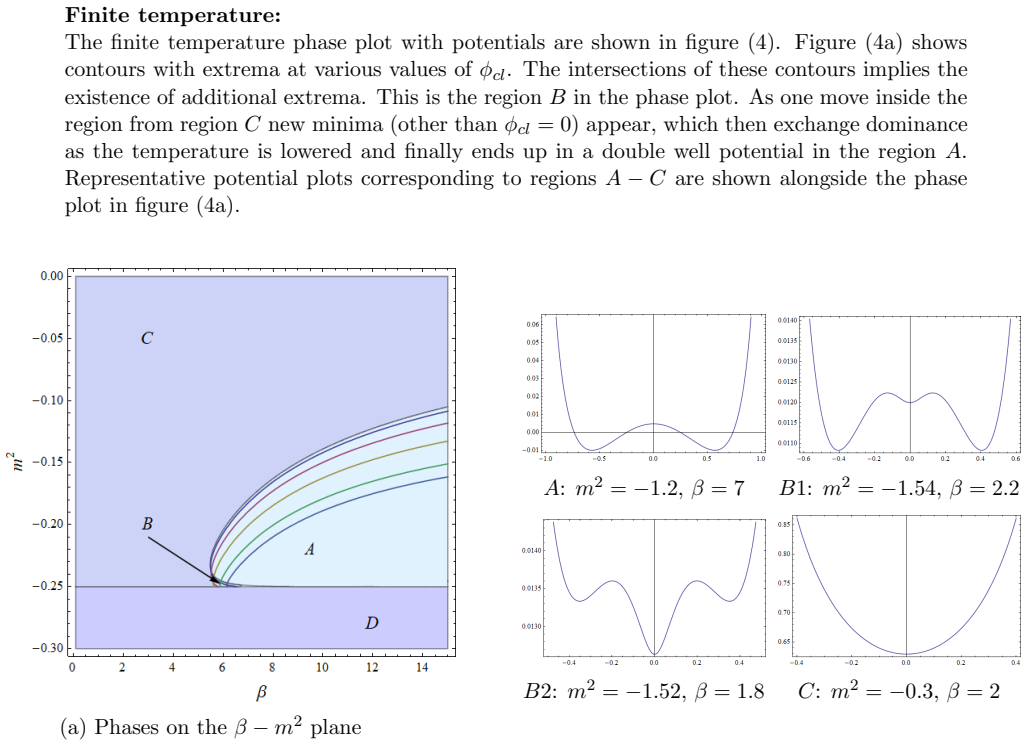
- [Fig. 4 caption] The finite-temperature phase plots use n=10 terms in the thermal series (3.41). The dependence on this truncation is not discussed; for small β (high temperature) the exponential suppression is weaker, and the phase boundaries may shift. Please provide a convergence check or estimate.
- [Eq. (3.96)] The range '−1/L^2 ≤ m^2 ≤ ± λ/(2π L)' is ambiguous because of the '±' sign; for the Neumann boundary condition only the minus sign is meant. Please write the two cases separately.
- [Sec. 3.1.1 and Fig. 3] The statement that 'whenever the central curve of the derivative has a root, it always satisfies the unitarity bound' is asserted but not proven. Given the infinite tan(πν) branches, a short argument or plot showing the central root stays in M^2L^2≤0 would help.
- [Various] Typographical issues: 'potenatial' in Sec. 3.3.2; Fig. 1 labels are cryptic ('contour 1', 'OR 2×'); Eq. (2.13) uses Γ(d/2±iλ) without defining the shorthand. These should be cleaned up.
Circularity Check
Correlator 'corroboration' in Sec. 3.4 is built from the same one-loop traces as the effective potentials, so it is a consistency check that reduces by construction; the central analytic-continuation derivation is otherwise independent.
-
other
[Sec. 3.4.2, before eqs. (3.121), (3.129), (3.131)]
"Using the results presented above and the trace expressions computed in the previous sections we explore the possibility of symmetry breaking in various theories with the two boundary conditions by evaluating the correlator in equation (3.109). The structure of the correlators that are presented next is the following: the last (or ξ dependent) terms in the exponentials come from the large distance behaviour of the trace given in equations (3.111), (3.113), (3.115) and (3.117) while the other terms are the coincident point propagators/traces we evaluated in the previous sections."
The correlator 'verification' is constructed from exactly the same trace expressions that determined the effective potentials. For example, the ψ−πtan combination in eq. (3.121) is the divergent-trace term already present in eqs. (3.88)-(3.89), and the tan-pole in eq. (3.129)/B.162 is the same tan-pole used in eq. (3.103) to rule out M^2=0. The paper even says that the correlator result 'reiterates our findings in section 3.3.1'. Thus the long-distance correlator test is not an independent corroboration: the conclusion at M^2=0 is already encoded in the input used to build the correlator. This is a consistency check that reduces by construction to the quantity it is supposed to verify.
full rationale
The central trace computation is not circular: the authors transparently obtain the Neumann one-loop trace by analytic continuation Δ+→Δ− from the Dirichlet expression, and Sec. 2.1 exhibits two contour deformations that lead to the same continued result (eqs. 2.19, 2.26). That is a legitimate mathematical continuation rather than a renaming, because the Neumann answer is not among the inputs and the contour computation does not simply assume the final expression. The Dirichlet trace is cited to the authors' prior work [50], but that is a published, reproducible computation whose relevant thermal steps are re-derived in Appendix A; the self-citation is not load-bearing. The finite-temperature convergence condition β(d/2−ν)>0 (eq. 3.97) is a derived requirement on one series representation; whether it is the physically correct regulator is a correctness risk, not a circularity. The single genuine circular element is Sec. 3.4's 'corroboration': the correlators are assembled from the same one-loop traces that already produced the effective potentials and the tan-pole at M^2=0, so the long-range correlator test re-expresses the phase conclusion rather than independently verifying it. Because the central partition-function and phase derivation does not reduce to its inputs or to a self-citation chain, the circularity is limited and secondary.
Assumptions & free parameters
free parameters (3)
- lambda (quartic coupling) =
0.4, 0.5, 1.0 (chosen per plot)
- renormalization scale mu (AdS2 O(N) model) =
not specified
- thermal series truncation n_max =
10 (Figure 4)
assumptions (4)
- domain assumption The one-loop Neumann determinant is obtained by analytic continuation Delta_+ to Delta_-; the contour deformations in Figs. 1-2 pick exactly the Delta_- residue set and no other contributions.
- domain assumption The effective potential with spatially constant phi_cl and the stated renormalization conditions determine the phase structure.
- domain assumption Thermal AdS trace is computed by the method-of-images quotient sum; normalization by N removes the overcount and the n=0 divergence.
- ad hoc to paper The finite-temperature series must converge termwise, giving beta(d/2-nu)>0, so M^2=0 is excluded from the phase space.
Cite this review
Pith. "Pith review of Neumann scalars in AdS: partition functions and phases." pith.science (2026). https://pith.science/paper/A2RMQY2A
@misc{pith2026260704417,
  author       = {Pith},
  title        = {Pith review of: Neumann scalars in AdS: partition functions and phases},
  year         = {2026},
  howpublished = {\url{https://pith.science/paper/A2RMQY2A}},
  note         = {Machine review of arXiv:2607.04417}
}
abstract
We present an analysis of one-loop partition functions for scalars in AdS$_{d+1}$ obeying the Neumann boundary condition and explore phases of scalar field theories in several dimensions at zero and finite temperature. The partition function computation involves an analytic continuation from $\Delta_+$ corresponding to the Dirichlet boundary condition to $\Delta_-$ corresponding to Neumann boundary condition. We show that this can be implemented by deformations of the contour for integral over eigenvalue ($\lambda$) of the Laplace operator as compared to the integral over ${\mathbb R}$ in [arXiv:2201.09043] for the Dirichlet boundary condition. We further contrast these phases with those appearing for the case of scalars obeying the Dirichlet boundary condition and corroborate the occurrence of these phases by studying the long range behaviour of correlators.
Figures


Figures from the paper (8 more)


Reference graph
Works this paper leans on
-
[50]
On partition functions and phases of scalars in AdS,
A. Kakkar and S. Sarkar, “On partition functions and phases of scalars in AdS,” JHEP07 (2022), 089 doi:10.1007/JHEP07(2022)089 [arXiv:2201.09043 [hep-th]]
arXiv 2022
-
[1]
INFRARED BEHA VIOR AT NEGATIVE CUR V A- TURE,
C. G. Callan, Jr. and F. Wilczek, “INFRARED BEHA VIOR AT NEGATIVE CUR V A- TURE,” Nucl. Phys. B340(1990), 366-386 doi:10.1016/0550-3213(90)90451-I
-
[2]
NAMBU-GOLDSTONE BOSONS IN CUR VED SPACE-TIME,
T. Inami and H. Ooguri, “NAMBU-GOLDSTONE BOSONS IN CUR VED SPACE-TIME,” Phys. Lett. B163(1985), 101-105 doi:10.1016/0370-2693(85)90201-1
-
[3]
Propagators and Effective Potentials in Anti-de Sitter Space,
C. P. Burgess and C. A. Lutken, “Propagators and Effective Potentials in Anti-de Sitter Space,” Phys. Lett. B153(1985), 137-141 doi:10.1016/0370-2693(85)91415-7
-
[4]
One Loop Effective Potential in Anti-de Sitter Space,
T. Inami and H. Ooguri, “One Loop Effective Potential in Anti-de Sitter Space,” Prog. Theor. Phys.73(1985), 1051 doi:10.1143/PTP.73.1051
-
[5]
Massive scalar effective actions on Anti-de Sitter space- time,
M. Kamela and C. P. Burgess, “Massive scalar effective actions on Anti-de Sitter space- time,” Can. J. Phys.77(1999), 85-99 doi:10.1139/cjp-77-2-85 [arXiv:hep-th/9808107 [hep- th]]
arXiv 1999
-
[6]
Harmonic analysis and propagators on homogeneous spaces,
R. Camporesi, “Harmonic analysis and propagators on homogeneous spaces,” Phys. Rept. 196(1990), 1-134 doi:10.1016/0370-1573(90)90120-Q 41
-
[7]
zeta function regularization of one loop effective potentials in anti-de Sitter space-time,
R. Camporesi, “zeta function regularization of one loop effective potentials in anti-de Sitter space-time,” Phys. Rev. D43(1991), 3958-3965 doi:10.1103/PhysRevD.43.3958
Show all 60 references
-
[8]
Quantum fields and extended objects in space-times with constant curvature spatial section,
A. A. Bytsenko, G. Cognola, L. Vanzo and S. Zerbini, “Quantum fields and extended objects in space-times with constant curvature spatial section,” Phys. Rept.266(1996), 1-126 doi:10.1016/0370-1573(95)00053-4 [arXiv:hep-th/9505061 [hep-th]]
1996 arXiv
-
[9]
Quantum scalar fields on anti-de Sitter space-time,
M. M. Caldarelli, “Quantum scalar fields on anti-de Sitter space-time,” Nucl. Phys. B549 (1999), 499-515 doi:10.1016/S0550-3213(99)00137-6 [arXiv:hep-th/9809144 [hep-th]]
1999 arXiv
-
[10]
Double trace operators and one loop vacuum energy in AdS / CFT,
S. S. Gubser and I. Mitra, “Double trace operators and one loop vacuum energy in AdS / CFT,” Phys. Rev. D67(2003), 064018 doi:10.1103/PhysRevD.67.064018 [arXiv:hep- th/0210093 [hep-th]]
2003
-
[11]
Large-order Perturbation Theory and de Sitter/Anti de Sitter Effective Actions,
A. K. Das and G. V. Dunne, “Large-order Perturbation Theory and de Sitter/Anti de Sitter Effective Actions,” Phys. Rev. D74(2006), 044029 doi:10.1103/PhysRevD.74.044029 [arXiv:hep-th/0607168 [hep-th]]
2006 arXiv
-
[12]
Conformal field theories in anti-de Sitter space,
O. Aharony, D. Marolf and M. Rangamani, “Conformal field theories in anti-de Sitter space,” JHEP02(2011), 041 doi:10.1007/JHEP02(2011)041 [arXiv:1011.6144 [hep-th]]
2011 arXiv
-
[13]
Confinement in Anti-de Sitter Space,
O. Aharony, M. Berkooz, D. Tong and S. Yankielowicz, “Confinement in Anti-de Sitter Space,” JHEP02(2013), 076 doi:10.1007/JHEP02(2013)076 [arXiv:1210.5195 [hep-th]]
2013 arXiv
-
[14]
Double-Trace Deformations and Entangle- ment Entropy in AdS,
T. Miyagawa, N. Shiba and T. Takayanagi, “Double-Trace Deformations and Entangle- ment Entropy in AdS,” Fortsch. Phys.64(2016), 92-105 doi:10.1002/prop.201500098 [arXiv:1511.07194 [hep-th]]
2016 arXiv
-
[15]
Entanglement entropy for free scalar fields in AdS,
S. Sugishita, “Entanglement entropy for free scalar fields in AdS,” JHEP09(2016), 128 doi:10.1007/JHEP09(2016)128 [arXiv:1608.00305 [hep-th]]
2016 arXiv
-
[16]
A Study of Quantum Field Theories in AdS at Finite Coupling,
D. Carmi, L. Di Pietro and S. Komatsu, “A Study of Quantum Field Theories in AdS at Finite Coupling,” JHEP01(2019), 200 doi:10.1007/JHEP01(2019)200 [arXiv:1810.04185 [hep-th]]
2019 arXiv
-
[17]
Snowmass White Paper: S-matrix Bootstrap,
M. Kruczenski, J. Penedones and B. C. van Rees, “Snowmass White Paper: S-matrix Bootstrap,” [arXiv:2203.02421 [hep-th]]
-
[18]
Scalar QED in AdS,
Ankur, D. Carmi and L. Di Pietro, “Scalar QED in AdS,” JHEP10(2023), 089 doi:10.1007/JHEP10(2023)089 [arXiv:2306.05551 [hep-th]]
2023 arXiv
-
[19]
CFT in AdS and boundary RG flows,
S. Giombi and H. Khanchandani, “CFT in AdS and boundary RG flows,” JHEP11(2020), 118 doi:10.1007/JHEP11(2020)118 [arXiv:2007.04955 [hep-th]]
2020
-
[20]
Fermions in AdS and Gross-Neveu BCFT,
S. Giombi, E. Helfenberger and H. Khanchandani, “Fermions in AdS and Gross-Neveu BCFT,” JHEP07(2022), 018 doi:10.1007/JHEP07(2022)018 [arXiv:2110.04268 [hep-th]]
2022 arXiv
-
[21]
Free energy and defectC-theorem in free scalar theory,
T. Nishioka and Y. Sato, “Free energy and defectC-theorem in free scalar theory,” JHEP 05(2021), 074 doi:10.1007/JHEP05(2021)074 [arXiv:2101.02399 [hep-th]]
2021 arXiv
-
[22]
Loops in AdS: From the Spectral Representation to Position Space,
D. Carmi, “Loops in AdS: From the Spectral Representation to Position Space,” JHEP06 (2020), 049 doi:10.1007/JHEP06(2020)049 [arXiv:1910.14340 [hep-th]]
2020 arXiv
-
[23]
Loops in AdS: from the spectral representation to position space. Part II,
D. Carmi, “Loops in AdS: from the spectral representation to position space. Part II,” JHEP07(2021), 186 doi:10.1007/JHEP07(2021)186 [arXiv:2104.10500 [hep-th]]. 42
2021 arXiv
-
[24]
Taming Mass Gaps with Anti–de Sitter Space,
C. Copetti, L. Di Pietro, Z. Ji and S. Komatsu, “Taming Mass Gaps with Anti–de Sitter Space,” Phys. Rev. Lett.133(2024) no.8, 081601 doi:10.1103/PhysRevLett.133.081601 [arXiv:2312.09277 [hep-th]]
2024 arXiv
-
[25]
Exploring confinement in Anti-de Sitter space,
R. Ciccone, F. De Cesare, L. Di Pietro and M. Serone, “Exploring confinement in Anti-de Sitter space,” JHEP12(2024), 218 [erratum: JHEP06(2025), 037] doi:10.1007/JHEP12(2024)218 [arXiv:2407.06268 [hep-th]]
2024 arXiv
-
[26]
A Bootstrap Study of Confinement in AdS,
L. Di Pietro, S. R. Kousvos, M. Meineri, A. Piazza, M. Serone and A. Vichi, “A Bootstrap Study of Confinement in AdS,” [arXiv:2512.00150 [hep-th]]
-
[27]
QCD in AdS,
R. Ciccone, F. De Cesare, L. Di Pietro and M. Serone, “QCD in AdS,” JHEP04(2026), 130 doi:10.1007/JHEP04(2026)130 [arXiv:2511.04752 [hep-th]]
2026
-
[28]
F-theorem for Quantum Field Theories in Anti-de Sitter Space,
D. Bason, C. Copetti, L. Di Pietro, Z. Ji and S. Komatsu, “F-theorem for Quantum Field Theories in Anti-de Sitter Space,” [arXiv:2512.18392 [hep-th]]
-
[29]
N= 2 super Yang-Mills in AdS 4 and FAdS- maximization,
D. Bason, C. Copetti, L. Di Pietro and Z. Ji, “N= 2 super Yang-Mills in AdS 4 and FAdS- maximization,” JHEP03(2026), 254 doi:10.1007/JHEP03(2026)254 [arXiv:2506.05162 [hep-th]]
2026 arXiv
-
[30]
Dressing and Screening in Anti-de Sitter,
Ankur, L. Di Pietro, V. Gorbenko, S. Komatsu and V. Sacchi, “Dressing and Screening in Anti-de Sitter,” [arXiv:2601.04321 [hep-th]]
-
[31]
Demystifying integrable QFTs in AdS: No-go theorems for higher-spin charges,
A. Antunes, N. Levine and M. Meineri, “Demystifying integrable QFTs in AdS: No-go theorems for higher-spin charges,” SciPost Phys.20(2026), 088 doi:10.21468/SciPostPhys.20.3.088 [arXiv:2502.06937 [hep-th]]
2026
-
[32]
Renormalization group flows in AdS and the bootstrap program,
M. Meineri, J. Penedones and T. Spirig, “Renormalization group flows in AdS and the bootstrap program,” [arXiv:2305.11209 [hep-th]]
-
[33]
Perturbative RG flows in AdS: an ´ etude,
E. Lauria, M. Milam and B. C. van Rees, “Perturbative RG flows in AdS: an ´ etude,” [arXiv:2309.10031 [hep-th]]
-
[34]
Towards bootstrapping RG flows: sine-Gordon in AdS,
A. Antunes, M. S. Costa, J. Penedones, A. Salgarkar and B. C. van Rees, “Towards bootstrapping RG flows: sine-Gordon in AdS,” JHEP12(2021), 094 doi:10.1007/JHEP12(2021)094 [arXiv:2109.13261 [hep-th]]
2021 arXiv
-
[35]
A bootstrap study of minimal model deforma- tions,
A. Antunes, E. Lauria and B. C. van Rees, “A bootstrap study of minimal model deforma- tions,” JHEP05(2024), 027 doi:10.1007/JHEP05(2024)027 [arXiv:2401.06818 [hep-th]]
2024 arXiv
-
[36]
Stability in Gauged Extended Supergravity,
P. Breitenlohner and D. Z. Freedman, “Stability in Gauged Extended Supergravity,” Annals Phys.144(1982), 249 doi:10.1016/0003-4916(82)90116-6
1982 doi
-
[37]
Large N field the- ories, string theory and gravity,
O. Aharony, S. S. Gubser, J. M. Maldacena, H. Ooguri and Y. Oz, “Large N field the- ories, string theory and gravity,” Phys. Rept.323(2000), 183-386 doi:10.1016/S0370- 1573(99)00083-6 [arXiv:hep-th/9905111 [hep-th]]
2000 arXiv
-
[38]
AdS / CFT correspondence and symmetry breaking,
I. R. Klebanov and E. Witten, “AdS / CFT correspondence and symmetry breaking,” Nucl. Phys. B556(1999), 89-114 doi:10.1016/S0550-3213(99)00387-9 [arXiv:hep-th/9905104 [hep-th]]
1999 arXiv
-
[39]
A Neumann Boundary Term for Gravity,
C. Krishnan and A. Raju, “A Neumann Boundary Term for Gravity,” Mod. Phys. Lett. A 32(2017) no.14, 1750077 doi:10.1142/S0217732317500778 [arXiv:1605.01603 [hep-th]]. 43
2017 arXiv
-
[40]
Dynamical boundary for anti–de Sitter space,
C. Krishnan, A. Raju and P. N. Bala Subramanian, “Dynamical boundary for anti–de Sitter space,” Phys. Rev. D94(2016) no.12, 126011 doi:10.1103/PhysRevD.94.126011 [arXiv:1609.06300 [hep-th]]
2016 arXiv
-
[41]
Partition functions, the Bekenstein bound and temperature inversion in anti-de Sitter space and its conformal boundary,
G. W. Gibbons, M. J. Perry and C. N. Pope, “Partition functions, the Bekenstein bound and temperature inversion in anti-de Sitter space and its conformal boundary,” Phys. Rev. D74(2006), 084009 doi:10.1103/PhysRevD.74.084009 [arXiv:hep-th/0606186 [hep-th]]
2006 arXiv
-
[42]
One-loop Partition Functions of 3D Gravity,
S. Giombi, A. Maloney and X. Yin, “One-loop Partition Functions of 3D Gravity,” JHEP 08(2008), 007 doi:10.1088/1126-6708/2008/08/007 [arXiv:0804.1773 [hep-th]]
2008 arXiv
-
[43]
Black hole determinants and quasinormal modes,
F. Denef, S. A. Hartnoll and S. Sachdev, “Black hole determinants and quasinormal modes,” Class. Quant. Grav.27(2010), 125001 doi:10.1088/0264-9381/27/12/125001 [arXiv:0908.2657 [hep-th]]
2010 arXiv
-
[44]
The Heat Kernel on AdS(3) and its Applications,
J. R. David, M. R. Gaberdiel and R. Gopakumar, “The Heat Kernel on AdS(3) and its Applications,” JHEP04(2010), 125 doi:10.1007/JHEP04(2010)125 [arXiv:0911.5085 [hep- th]]
2010 arXiv
-
[45]
The Heat Kernel onAdS,
R. Gopakumar, R. K. Gupta and S. Lal, “The Heat Kernel onAdS,” JHEP11(2011), 010 doi:10.1007/JHEP11(2011)010 [arXiv:1103.3627 [hep-th]]
2011 arXiv
-
[46]
Partition Functions for Higher-Spin theories in AdS,
R. K. Gupta and S. Lal, “Partition Functions for Higher-Spin theories in AdS,” JHEP07 (2012), 071 doi:10.1007/JHEP07(2012)071 [arXiv:1205.1130 [hep-th]]
2012 arXiv
-
[47]
Partition Functions in Even Dimensional AdS via Quasinormal Mode Methods,
C. Keeler and G. S. Ng, “Partition Functions in Even Dimensional AdS via Quasinormal Mode Methods,” JHEP06(2014), 099 doi:10.1007/JHEP06(2014)099 [arXiv:1401.7016 [hep-th]]
2014 arXiv
-
[48]
Normal modes in thermal AdS via the Selberg zeta function,
V. L. Martin and A. Svesko, “Normal modes in thermal AdS via the Selberg zeta function,” SciPost Phys.9(2020), 009 doi:10.21468/SciPostPhys.9.1.009 [arXiv:1910.11913 [hep-th]]
2020 arXiv
-
[49]
Anomalous dimensions from ther- mal AdS partition functions,
P. Kraus, S. Megas and A. Sivaramakrishnan, “Anomalous dimensions from ther- mal AdS partition functions,” JHEP10(2020), 149 doi:10.1007/JHEP10(2020)149 [arXiv:2004.08635 [hep-th]]
2020 arXiv
-
[51]
Phases of theories with fermions in AdS,
A. Kakkar and S. Sarkar, “Phases of theories with fermions in AdS,” JHEP06(2023), 009 doi:10.1007/JHEP06(2023)009 [arXiv:2303.02711 [hep-th]]
2023 arXiv
-
[52]
Partition functions for U(1) vectors and phases of scalar QED in AdS,
A. Kakkar and S. Sarkar, “Partition functions for U(1) vectors and phases of scalar QED in AdS,” JHEP06(2024), 095 doi:10.1007/JHEP06(2024)095 [arXiv:2311.06045 [hep-th]]
2024 arXiv
-
[53]
One-Loop Analysis of Phases of Scalar Field Theories in Thermal Anti-de Sitter Spaces,
A. Kakkar and S. Sarkar, “One-Loop Analysis of Phases of Scalar Field Theories in Thermal Anti-de Sitter Spaces,” Springer Proc. Phys.304(2024), 52-56 doi:10.1007/978-981-97- 0289-3 10
2024 doi
-
[54]
Partition Functions and Phases of Quantum Field Theories in AdS Spaces,
A. Kakkar and S. Sarkar, “Partition Functions and Phases of Quantum Field Theories in AdS Spaces,” Springer Proc. Phys.432(2026), 499-502 doi:10.1007/978-981-95-1513- 4 114
2026 doi
-
[55]
Absence of ferromagnetism or antiferromagnetism in one- dimensional or two-dimensional isotropic Heisenberg models,
N. D. Mermin and H. Wagner, “Absence of ferromagnetism or antiferromagnetism in one- dimensional or two-dimensional isotropic Heisenberg models,” Phys. Rev. Lett.17(1966), 1133-1136 doi:10.1103/PhysRevLett.17.1133. 44
1966 doi
-
[56]
There are no Goldstone bosons in two-dimensions,
S. R. Coleman, “There are no Goldstone bosons in two-dimensions,” Commun. Math. Phys. 31(1973), 259-264 doi:10.1007/BF01646487
1973 doi
-
[57]
Multitrace operators, boundary conditions, and AdS / CFT correspondence,
E. Witten, “Multitrace operators, boundary conditions, and AdS / CFT correspondence,” [arXiv:hep-th/0112258 [hep-th]]
-
[58]
’Double trace’ deformations, boundary conditions and space-time singularities,
M. Berkooz, A. Sever and A. Shomer, “’Double trace’ deformations, boundary conditions and space-time singularities,” JHEP05(2002), 034 doi:10.1088/1126-6708/2002/05/034 [arXiv:hep-th/0112264 [hep-th]]
2002 arXiv
-
[59]
Table of Integrals, Series, and Products
I.S. Gradshteyn and I.M. Ryzhik, “Table of Integrals, Series, and Products”
-
[60]
A treatise on the theory of Bessel functions
G. N. Watson “A treatise on the theory of Bessel functions”. 45
Reviewed August 4, 2026 · model on record in the stance chip above.
Discussion (0). Sign in to comment.