REVIEW 2 major objections 4 minor 48 references
DUNE can probe ultra-light neutrinophilic forces from a dark U(1)D sector and the same coupling that yields Hubble-relevant neutrino self-interactions.
Reviewed by Pith at T0; open to challenge. T0 means a machine referee read the full paper against a public rubric. the ladder, T0–T4 →
T0 review · grok-4.5
2026-07-11 19:09 UTC pith:7XNK6WLK
load-bearing objection Clean DUNE mapping of a known dark-neutrino portal onto long-range potentials and the Hubble-tension self-interaction window; solid enough to referee. the 2 major comments →
Probing Neutrinophilic Long-Range Forces at DUNE
The pith
A machine-rendered reading of the paper's core claim, the machinery that carries it, and where it could break.
Core claim
With ten years of DUNE exposure the experiment can set 3σ upper bounds on the long-range potential of order 10^{-14} eV in the eμ and eτ sectors, thereby excluding previously unexplored regions of the (mZD, geff) plane down to geff ≲ 10^{-28} at mZD ∼ 10^{-35} eV; the same underlying active–dark mixing simultaneously produces neutrino self-interaction strengths G4 u_eff ∼ 10^9–10^{10} GF that are cosmologically relevant for the Hubble tension.
What carries the argument
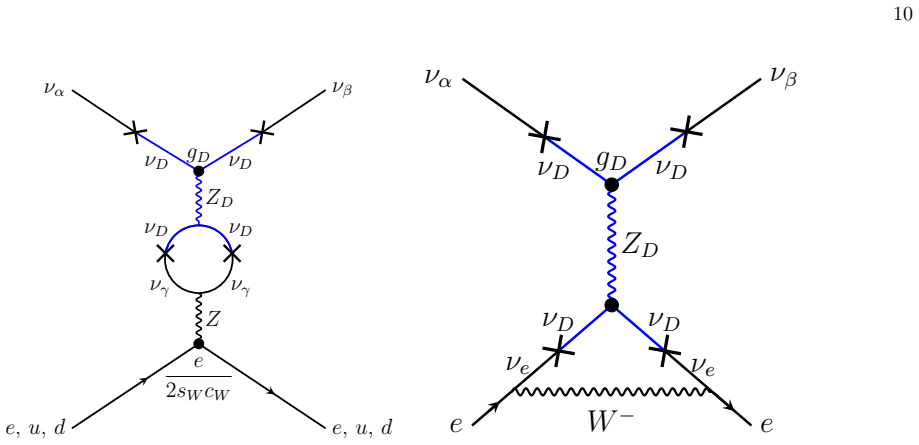
The dark-neutrino portal under U(1)D: active–dark mixing induces an effective coupling of the ultra-light ZD mediator to ordinary matter (via Z–ZD mass mixing), generating a fully populated 3 imes3 flavor-space potential VLRI that is sourced by celestial neutron distributions and is directly linked to the four-neutrino self-interaction strength G4 u_eff.
Load-bearing premise
The mapping from oscillation limits to mediator parameters assumes that Earth, the Milky Way and the cosmological matter can be treated as continuous isoscalar distributions and that only the average potential at the detector needs to be computed, rather than the full path-dependent potential inside the Earth.
What would settle it
If DUNE’s measured uμ o u e appearance spectrum after ten years shows no deviation from standard three-flavor oscillations at the level that would be produced by a long-range potential of size ∼10^{-14} eV, the claimed sensitivity contours (and the overlapping Hubble-tension region) are ruled out.
Editorial analysis
A structured set of objections, weighed in public.
Referee Report
Summary. The paper studies a dark-neutrino portal under a new U(1)_D symmetry in which SM fields are neutral and right-handed (dark) neutrinos carry charge. Active–dark mixing induces an effective coupling of the light Z_D mediator to active neutrinos, generating both a flavor-structured matter potential (short-range NSI or long-range Yukawa) sourced by Earth/Moon/Sun/Milky-Way/cosmological neutrons and non-standard neutrino self-interactions. Using GLoBES with the DUNE TDR configuration (10 yr, equal u/ u-bar), the authors compute appearance probabilities and event spectra for three benchmark 2 imes2 flavor textures (eµ, e au, µ au), extract 3σ limits on the long-range potential VLRI ~ 10^{-14} eV, map them onto the (m_ZD, g_eff) plane down to g_eff ≲ 10^{-28} at m_ZD ~ 10^{-35} eV, and recast the same parameters into G_4 u_eff/G_F, showing overlap with the region preferred for alleviating the Hubble tension.
Significance. If the projected contours hold, the work supplies a concrete, experimentally accessible link between a well-motivated inverse-seesaw dark-sector model, long-baseline oscillation data, and cosmologically relevant neutrino self-interactions. The calculation rests on a standard GLoBES implementation of the summed Yukawa potential (Eqs. 11–12), a transparent Poisson abla^{2} with pulls and marginalization over heta23 and heta CP, and an explicit mapping (Eq. 14) that simultaneously constrains matter effects and NSSI. These features make the result falsifiable and useful for both the DUNE and early-Universe communities; the paper also correctly identifies previously unexplored regions of parameter space while remaining consistent with existing oscillation bounds.
major comments (2)
- [Matter potential and self-interactions of neutrinos] In the paragraph following Eq. 12 the authors state that only the average Earth potential evaluated at the detector is used, citing Refs. [27,33] for a full path-dependent treatment. For the ultra-light regime (m_ZD ≲ 10^{-20} eV) that drives the strongest claimed reach (g_eff ≲ 10^{-28}), the potential is essentially constant across the 1285 km baseline, so the average is an excellent proxy. Nevertheless, a short quantitative estimate of the residual bias for the intermediate-mass window 10^{-20}–10^{-12} eV (where the Yukawa range becomes comparable to the Earth radius) would strengthen the mapping of VLRI limits onto the (m_ZD, g_eff) plane shown in Fig. 6.
- [Projected Sensitivity of DUNE / Fig. 7] Fig. 7 and the surrounding text fix ε' = 10^{-3} when translating g_eff into G_4 u_eff/G_F via Eq. 14. Because ε' is an independent free parameter of the model (Eq. 6), the location of the Hubble-tension band relative to the DUNE contours is sensitive to this choice. A brief scan over a plausible range of ε' (or an explicit statement that the band simply rescales) is needed to make the claimed overlap robust.
minor comments (4)
- [Framework / Statistical methods] The three benchmark textures are clearly defined, but the text never states whether the relative phase of the off-diagonal U_α4U_β4* entries is marginalized or fixed to zero; a one-sentence clarification would remove ambiguity in the abla^{2} definition.
- [Oscillation probability and event spectra] Fig. 4 lower panels show event spectra but lack an explicit legend distinguishing signal from the various backgrounds listed in the DUNE TDR; adding it would improve readability.
- [Matter potential … Eq. 8] In Eq. 8 the factor 4c_W m_Z^{2}/g appears without a brief derivation from the Z–Z_D mass-mixing Lagrangian (Eq. 5); a short intermediate step would help non-specialist readers.
- [Appendix / Conclusions] The appendix reinterprets the limits in terms of |U_α4|^{2} under loop-induced mixing, but the main-text abstract and conclusions emphasize only the tree-level case; a single cross-reference would unify the presentation.
Circularity Check
No significant circularity: DUNE projected limits arise from independent GLoBES mock-data fits; self-citations supply only the model Lagrangian and prior applications, not the sensitivity contours themselves.
full rationale
The paper's central results are the 3σ VLRI bounds (Table I, ~10^{-14} eV) obtained by generating true events under the Standard Model (λ=0) and test events under the new potential, then minimizing the Poissonian χ² over θ23, δCP and systematics (Eqs. 15 and surrounding text). These are standard projected-sensitivity calculations; they do not recycle previously fitted constants. The mapping of VLRI onto the (m_ZD, g_eff) plane follows directly from the Yukawa potential (Eq. 11) summed over celestial sources (Eq. 12), and the further recast onto G4ν_eff/GF (Eq. 14, Fig. 7) is an algebraic translation that fixes ε′=10^{-3} by hand. Self-citations ([15,16] for the U(1)_D Lagrangian and inverse-seesaw mass matrix, [18,19] for earlier NSSI/Hubble remarks) introduce the framework and note phenomenological overlap, but the DUNE event spectra, probability engines, and χ² contours are computed afresh and do not reduce to those earlier numerical results. The Earth-potential averaging approximation is flagged by the authors themselves and does not create a definitional loop. No self-definitional identity, fitted-input-as-prediction, uniqueness theorem, or ansatz smuggling is present. Score 1 reflects only the ordinary presence of non-load-bearing self-citations for model setup.
Axiom & Free-Parameter Ledger
free parameters (4)
- m_ZD
- g_eff
- ε′
- |Uα4|
axioms (4)
- domain assumption Standard three-flavor oscillation Hamiltonian plus SM charged-current matter potential VCC = √2 GF ne
- domain assumption Celestial matter distributions are electrically neutral and (except Sun and cosmology) isoscalar; Earth potential is replaced by its average at the detector
- domain assumption Kinetic mixing contribution vanishes in static unpolarized neutral matter; only mass mixing generates the potential
- ad hoc to paper Normal mass ordering and fixed solar/atmospheric parameters except θ23, δCP
invented entities (2)
-
U(1)D dark gauge boson ZD
no independent evidence
-
Dark neutrinos ND (right-handed neutrinos charged under U(1)D)
no independent evidence
read the original abstract
Neutrino oscillations provide compelling evidence for physics beyond the Standard Model, while the weakly interacting nature of neutrinos makes them powerful probes of new interactions and hidden sectors. In this work, we investigate a \textit{dark neutrino portal} scenario in which neutrino mass generation is linked to a light dark sector charged under a new $U(1)_D$ gauge symmetry. While Standard Model fields remain neutral under $U(1)_D$, the dark neutrino sector is charged and communicates with the Standard Model exclusively through active--dark neutrino mixing. The associated neutrinophilic mediator induces ultra-long-range interactions, whereby electrons and neutrons in the Earth, Moon, Sun, Milky Way, and the cosmological matter distribution generate sizable matter potentials that modify neutrino oscillations. We explore the sensitivity of the upcoming Deep Underground Neutrino Experiment (DUNE), whose long baseline and pronounced matter effects make it uniquely suited to probe such interactions. We show that DUNE can access previously unexplored regions of parameter space and demonstrate that the same underlying coupling can simultaneously give rise to sizable neutrino self-interactions, including regions relevant for alleviating the Hubble tension, while remaining consistent with current neutrino oscillation constraints.
Figures



Reference graph
Works this paper leans on
-
[1]
as point sources of electrons, protons, and neutrons. In contrast, the Earth (Ne,⊕ =N p,⊕ =N n,⊕ ∼4×10 51), the Milky Way (Ne,MW =N p,MW ≃N n,MW ∼10 67), and the cosmological matter distribution (N e,cos =N p,cos ∼ 1079,N n,cos ∼10 78) are modeled as continuous mat- ter distributions. The corresponding potentials from the Earth, Milky Way, and cosmologica...
-
[2]
2020 global reassessment of the neutrino oscillation picture,
P. F. de Salas, D. V. Forero, S. Gariazzo, P. Mart´ ınez-Mirav´ e, O. Mena, C. A. Ternes, M. T´ ortola, and J. W. F. Valle, “2020 global reassessment of the neutrino oscillation picture,”JHEP 02(2021) 071, [2006.11237]. [2]http://www.nu-fit.org/. NuFIT 5.1 (2021), http://www.nu-fit.org/
Pith/arXiv arXiv 2020
-
[3]
Unfinished fabric of the three neutrino paradigm,
F. Capozzi, E. Di Valentino, E. Lisi, A. Marrone, A. Melchiorri, and A. Palazzo, “Unfinished fabric of the three neutrino paradigm,”Phys. Rev. D104no. 8, (2021) 083031, [2107.00532]. 12
Pith/arXiv arXiv 2021
-
[4]
Neutrino Oscillations in Matter,
L. Wolfenstein, “Neutrino Oscillations in Matter,” Phys. Rev. D17(1978) 2369–2374
1978
-
[5]
Resonance Amplification of Oscillations in Matter and Spectroscopy of Solar Neutrinos,
S. P. Mikheyev and A. Y. Smirnov, “Resonance Amplification of Oscillations in Matter and Spectroscopy of Solar Neutrinos,”Sov. J. Nucl. Phys. 42(1985) 913–917
1985
-
[6]
Resonant amplification of neutrino oscillations in matter and solar neutrino spectroscopy,
S. P. Mikheev and A. Y. Smirnov, “Resonant amplification of neutrino oscillations in matter and solar neutrino spectroscopy,”Nuovo Cim. C9(1986) 17–26
1986
-
[7]
Non-Standard Interactions in Radiative Neutrino Mass Models,
K. S. Babu, P. S. B. Dev, S. Jana, and A. Thapa, “Non-Standard Interactions in Radiative Neutrino Mass Models,”JHEP03(2020) 006, [1907.09498]
Pith/arXiv arXiv 2020
-
[8]
Neutrino Non-Standard Interactions: A Status Report,
P. S. Bhupal Devet al., “Neutrino Non-Standard Interactions: A Status Report,”SciPost Phys. Proc. (2019) 1, [1907.00991].https: //scipost.org/10.21468/SciPostPhysProc.2.001
-
[9]
M. Bustamante and S. K. Agarwalla, “Universe’s Worth of Electrons to Probe Long-Range Interactions of High-Energy Astrophysical Neutrinos,”Phys. Rev. Lett. 122no. 6, (2019) 061103, [1808.02042]
Pith/arXiv arXiv 2019
-
[10]
M. Singh, M. Bustamante, and S. K. Agarwalla, “Flavor-dependent long-range neutrino interactions in DUNE & T2HK: alone they constrain, together they discover,”JHEP08(2023) 101, [2305.05184]
Pith/arXiv arXiv 2023
-
[11]
A plethora of long-range neutrino interactions probed by DUNE and T2HK,
S. K. Agarwalla, M. Bustamante, M. Singh, and P. Swain, “A plethora of long-range neutrino interactions probed by DUNE and T2HK,”JHEP09 (2024) 055, [2404.02775]
Pith/arXiv arXiv 2024
-
[12]
Study of long range force in P2SO and T2HKK,
P. Mishra, R. Majhi, S. K. Pusty, M. Ghosh, and R. Mohanta, “Study of long range force in P2SO and T2HKK,”JHEP09(2024) 100, [2402.19178]
Pith/arXiv arXiv 2024
-
[13]
First Constraints on Long-Range Neutrino Interactions using IceCube DeepCore,
G. Garg, J. Krishnamoorthi, A. Kumar, and S. K. Agarwalla, “First Constraints on Long-Range Neutrino Interactions using IceCube DeepCore,” [2601.01220]
-
[14]
G. Garg, J. Krishnamoorthi, A. Kumar, and S. K. Agarwalla, “Constraints on long-range neutrino interactions from a variety ofU(1) ′ symmetries using atmospheric neutrinos at IceCube DeepCore,” [2606.03443]
-
[15]
Neutrino Masses and Mixings Dynamically Generated by a Light Dark Sector,
E. Bertuzzo, S. Jana, P. A. N. Machado, and R. Zukanovich Funchal, “Neutrino Masses and Mixings Dynamically Generated by a Light Dark Sector,”Phys. Lett. B791(2019) 210–214, [1808.02500]
Pith/arXiv arXiv 2019
-
[16]
Dark Neutrino Portal to Explain MiniBooNE excess,
E. Bertuzzo, S. Jana, P. A. N. Machado, and R. Zukanovich Funchal, “Dark Neutrino Portal to Explain MiniBooNE excess,”Phys. Rev. Lett.121 no. 24, (2018) 241801, [1807.09877]
Pith/arXiv arXiv 2018
-
[17]
U(1)’ mediated decays of heavy sterile neutrinos in MiniBooNE,
P. Ballett, S. Pascoli, and M. Ross-Lonergan, “U(1)’ mediated decays of heavy sterile neutrinos in MiniBooNE,”Phys. Rev. D99(2019) 071701, [1808.02915]
Pith/arXiv arXiv 2019
-
[18]
The Hubble tension and a renormalizable model of gauged neutrino self-interactions,
M. Berbig, S. Jana, and A. Trautner, “The Hubble tension and a renormalizable model of gauged neutrino self-interactions,”Phys. Rev. D102no. 11, (2020) 115008, [2004.13039]
Pith/arXiv arXiv 2020
-
[19]
Neutrino self-interactions and XENON1T electron recoil excess,
A. Bally, S. Jana, and A. Trautner, “Neutrino self-interactions and XENON1T electron recoil excess,” Phys. Rev. Lett.125no. 16, (2020) 161802, [2006.11919]
Pith/arXiv arXiv 2020
-
[20]
Heavy neutrino as dark matter in a neutrinophilic U(1) model,
W. Abdallah, A. K. Barik, S. K. Rai, and T. Samui, “Heavy neutrino as dark matter in a neutrinophilic U(1) model,”Eur. Phys. J. C84no. 10, (2024) 1087, [2405.15333]. [21]DUNECollaboration, B. Abiet al., “Deep Underground Neutrino Experiment (DUNE), Far Detector Technical Design Report, Volume I Introduction to DUNE,”JINST15no. 08, (2020) T08008, [2002.029...
Pith/arXiv arXiv 2024
-
[21]
Neutrino puzzle: Anomalies, interactions, and cosmological tensions,
C. D. Kreisch, F.-Y. Cyr-Racine, and O. Dor´ e, “Neutrino puzzle: Anomalies, interactions, and cosmological tensions,”Phys. Rev. D101no. 12, (2020) 123505, [1902.00534]
Pith/arXiv arXiv 2020
-
[22]
ΛCDM or self-interacting neutrinos: How CMB data can tell the two models apart,
M. Park, C. D. Kreisch, J. Dunkley, B. Hadzhiyska, and F.-Y. Cyr-Racine, “ΛCDM or self-interacting neutrinos: How CMB data can tell the two models apart,”Phys. Rev. D100no. 6, (2019) 063524, [1904.02625]
Pith/arXiv arXiv 2019
-
[23]
P. Coloma, M. C. Gonzalez-Garcia, and M. Maltoni, “Neutrino oscillation constraints on U(1)’ models: from non-standard interactions to long-range forces,”JHEP 01(2021) 114, [2009.14220]. [Erratum: JHEP 11, 115 (2022)]
Pith/arXiv arXiv 2021
-
[24]
S. K. Agarwalla, M. Bustamante, S. Das, and A. Narang, “Present and future constraints on flavor-dependent long-range interactions of high-energy astrophysical neutrinos,”JHEP08(2023) 113, [2305.03675]
Pith/arXiv arXiv 2023
-
[25]
GaugedL µ −L τ and different Muon Neutrino and Anti-Neutrino Oscillations: MINOS and beyond,
J. Heeck and W. Rodejohann, “GaugedL µ −L τ and different Muon Neutrino and Anti-Neutrino Oscillations: MINOS and beyond,”J. Phys. G38 (2011) 085005, [1007.2655]
Pith/arXiv arXiv 2011
-
[26]
Distance measures in cosmology,
D. W. Hogg, “Distance measures in cosmology,” [astro-ph/9905116]
-
[27]
Primordial Nucleosynthesis in the Precision Cosmology Era,
G. Steigman, “Primordial Nucleosynthesis in the Precision Cosmology Era,”Ann. Rev. Nucl. Part. Sci. 57(2007) 463–491, [0712.1100]. [32]PlanckCollaboration, P. A. R. Adeet al., “Planck 2015 results. XIII. Cosmological parameters,”Astron. Astrophys.594(2016) A13, [1502.01589]
Pith/arXiv arXiv 2007
-
[28]
Lepton Flavorful Fifth Force and Depth-dependent Neutrino Matter Interactions,
M. B. Wise and Y. Zhang, “Lepton Flavorful Fifth Force and Depth-dependent Neutrino Matter Interactions,”JHEP06(2018) 053, [1803.00591]. [34]DUNECollaboration, V. Heweset al., “Deep Underground Neutrino Experiment (DUNE) Near Detector Conceptual Design Report,”Instruments5 no. 4, (2021) 31, [2103.13910]
Pith/arXiv arXiv 2018
-
[29]
The fate of hints: updated global analysis of three-flavor neutrino oscillations,
I. Esteban, M. C. Gonzalez-Garcia, M. Maltoni, T. Schwetz, and A. Zhou, “The fate of hints: updated global analysis of three-flavor neutrino oscillations,” JHEP09(2020) 178, [2007.14792]
Pith/arXiv arXiv 2020
-
[30]
Efficient numerical diagonalization of hermitian 3 x 3 matrices,
J. Kopp, “Efficient numerical diagonalization of hermitian 3 x 3 matrices,”Int. J. Mod. Phys. C19 (2008) 523–548, [physics/0610206]
Pith/arXiv arXiv 2008
-
[31]
Non-standard neutrino interactions in reactor and superbeam experiments,
J. Kopp, M. Lindner, T. Ota, and J. Sato, “Non-standard neutrino interactions in reactor and superbeam experiments,”Phys. Rev. D77(2008) 013007, [0708.0152]
Pith/arXiv arXiv 2008
-
[32]
P. Huber, M. Lindner, and W. Winter, “Simulation of 13 long-baseline neutrino oscillation experiments with GLoBES (General Long Baseline Experiment Simulator),”Comput. Phys. Commun.167(2005) 195, [hep-ph/0407333]
Pith/arXiv arXiv 2005
-
[33]
P. Huber, J. Kopp, M. Lindner, M. Rolinec, and W. Winter, “New features in the simulation of neutrino oscillation experiments with GLoBES 3.0: General Long Baseline Experiment Simulator,”Comput. Phys. Commun.177(2007) 432–438, [hep-ph/0701187]
Pith/arXiv arXiv 2007
-
[34]
A. S. Joshipura and S. Mohanty, “Constraints on flavor dependent long range forces from atmospheric neutrino observations at super-Kamiokande,”Phys. Lett. B584 (2004) 103–108, [hep-ph/0310210]
Pith/arXiv arXiv 2004
-
[35]
Constraints on flavor-dependent long range forces from solar neutrinos and KamLAND,
A. Bandyopadhyay, A. Dighe, and A. S. Joshipura, “Constraints on flavor-dependent long range forces from solar neutrinos and KamLAND,”Phys. Rev. D75 (2007) 093005, [hep-ph/0610263]. [42]Super-KamiokandeCollaboration, G. Mitsukaet al., “Study of Non-Standard Neutrino Interactions with Atmospheric Neutrino Data in Super-Kamiokande I and II,”Phys. Rev. D84(2...
Pith/arXiv arXiv 2007
-
[36]
Status of non-standard neutrino interactions,
T. Ohlsson, “Status of non-standard neutrino interactions,”Rept. Prog. Phys.76(2013) 044201, [1209.2710]
Pith/arXiv arXiv 2013
-
[37]
Determination of matter potential from global analysis of neutrino oscillation data,
M. C. Gonzalez-Garcia and M. Maltoni, “Determination of matter potential from global analysis of neutrino oscillation data,”JHEP09(2013) 152, [1307.3092]
Pith/arXiv arXiv 2013
-
[38]
Black Hole Superradiance Signatures of Ultralight Vectors,
M. Baryakhtar, R. Lasenby, and M. Teo, “Black Hole Superradiance Signatures of Ultralight Vectors,”Phys. Rev. D96no. 3, (2017) 035019, [1704.05081]
Pith/arXiv arXiv 2017
-
[39]
Ultralight Boson Dark Matter and Event Horizon Telescope Observations of M87*,
H. Davoudiasl and P. B. Denton, “Ultralight Boson Dark Matter and Event Horizon Telescope Observations of M87*,”Phys. Rev. Lett.123no. 2, (2019) 021102, [1904.09242]
Pith/arXiv arXiv 2019
-
[40]
The String landscape, black holes and gravity as the weakest force,
N. Arkani-Hamed, L. Motl, A. Nicolis, and C. Vafa, “The String landscape, black holes and gravity as the weakest force,”JHEP06(2007) 060, [hep-th/0601001]
Pith/arXiv arXiv 2007
-
[41]
Discovering leptonic forces using nonconserved currents,
J. A. Dror, “Discovering leptonic forces using nonconserved currents,”Phys. Rev. D101no. 9, (2020) 095013, [2004.04750]
Pith/arXiv arXiv 2020
-
[42]
Vector gauge boson radiation from compact binary systems in a gaugedL µ −L τ scenario,
T. Kumar Poddar, S. Mohanty, and S. Jana, “Vector gauge boson radiation from compact binary systems in a gaugedL µ −L τ scenario,”Phys. Rev. D100no. 12, (2019) 123023, [1908.09732]
Pith/arXiv arXiv 2019
-
[43]
Constraining the Self-Interacting Neutrino Interpretation of the Hubble Tension,
N. Blinov, K. J. Kelly, G. Z. Krnjaic, and S. D. McDermott, “Constraining the Self-Interacting Neutrino Interpretation of the Hubble Tension,”Phys. Rev. Lett.123no. 19, (2019) 191102, [1905.02727]
Pith/arXiv arXiv 2019
-
[44]
Improved Constraints on Sterile Neutrinos in the MeV to GeV Mass Range,
D. A. Bryman and R. Shrock, “Improved Constraints on Sterile Neutrinos in the MeV to GeV Mass Range,” Phys. Rev. D100no. 5, (2019) 053006, [1904.06787]
Pith/arXiv arXiv 2019
-
[45]
Constraints on Sterile Neutrinos in the MeV to GeV Mass Range,
D. A. Bryman and R. Shrock, “Constraints on Sterile Neutrinos in the MeV to GeV Mass Range,”Phys. Rev. D100(2019) 073011, [1909.11198]
Pith/arXiv arXiv 2019
-
[46]
HEAVY NEUTRINO SEARCH USING K(mu2) DECAY,
R. S. Hayanoet al., “HEAVY NEUTRINO SEARCH USING K(mu2) DECAY,”Phys. Rev. Lett.49(1982) 1305
1982
-
[47]
Limits on the mixing of tau neutrino to heavy neutrinos,
J. Orloff, A. N. Rozanov, and C. Santoni, “Limits on the mixing of tau neutrino to heavy neutrinos,”Phys. Lett. B550(2002) 8–15, [hep-ph/0208075]
Pith/arXiv arXiv 2002
-
[48]
Neutrinoless double beta decay versus other probes of heavy sterile neutrinos,
P. D. Bolton, F. F. Deppisch, and P. S. Bhupal Dev, “Neutrinoless double beta decay versus other probes of heavy sterile neutrinos,”JHEP03(2020) 170, [1912.03058]
Pith/arXiv arXiv 2020
discussion (0)
Sign in with ORCID, Apple, or X to comment. Anyone can read and Pith papers without signing in.