REVIEW 3 major objections 6 minor 42 references
Generalizable turbulence closures across bluff-body shapes by PINN-based solver-agnostic training
T0 review · 3 major / 6 minor · reviewed 2026-07-13 · grok-4.5
Pith's one-line read Turbulence closures trained without a CFD solver in the loop generalize across bluff-body shapes and beat SST k–ω on drag and mean flow.
desk verdict Solid methods paper: PINN trains multi-geometry RANS closures without a solver in the loop, and LOSO FEM results beat SST at Re=10^4; the generality claim is regime-bound but the evidence inside that regime is real. read the letter →
The pith
A machine-rendered reading of the paper's core claim, the machinery that carries it, and where it could break.
The reading
What carries the argument
Solver-agnostic PINN training: the shared closure network is optimized jointly with per-shape mean-field networks by soft residual penalties (momentum, continuity, and, when used, the k-transport equation) obtained by automatic differentiation; no forward RANS solve occurs during training, so intermediate iterates need not be solver-stable and no closure-specific adjoint is required.
What would settle it
Train the same four closures at Re = 10^4, freeze them, and deploy them without retraining on a bluff body at a substantially different Reynolds number (e.g., 5 × 10^3 or 10^5) or on a full-domain asymmetric mean flow with vortex shedding or lift; if mean-velocity or drag errors rise to or above the SST baseline, the claimed transfer fails.
Extended reading notes
Core claim
A PINN that imposes the RANS residual by automatic differentiation can train transferable turbulence closures without any CFD solver, mesh, or adjoint in the loop; the resulting frozen models, stabilized by input-gradient smoothing and a Lipschitz constraint, deploy stably in a standard finite-element solver and, under leave-one-shape-out testing across six bluff-body wakes, substantially outperform SST k–ω on mean velocity and drag (force model ~8.5% LOSO drag error) while the learned-length-scale stress model leads on the stress fields.
Load-bearing premise
The claim that geometry generalization shown at one Reynolds number on steady, spanwise-averaged, half-domain-symmetric wakes will also hold at other Reynolds numbers and for flows whose mean is not symmetric.
Editorial extensions
If this is right
- New closure hypotheses can be screened in minutes on one GPU instead of days of adjoint or ensemble solves.
- A single force-based model can recover mean velocity and drag across unseen bluff shapes more accurately than classical two-equation RANS.
- Patched experimental PIV can replace DNS for training, extending data-driven closures to geometries that cannot be simulated at high fidelity.
- Stable a-posteriori deployment of neural closures becomes routine once input-gradient smoothing and a Lipschitz penalty are applied.
Reading between the lines
- The same residual-based trainer could be applied to three-dimensional or unsteady RANS/URANS closures once full-domain data become available.
- Because the force model never needs a realizability cap, it may be the more scalable route when the stress tensor itself is not required for design.
- If the single-Re geometry transfer holds, multi-shape training sets could become a practical alternative to classical calibration on a handful of canonical flows.
Editorial analysis
A structured set of objections, weighed in public.
Referee Report
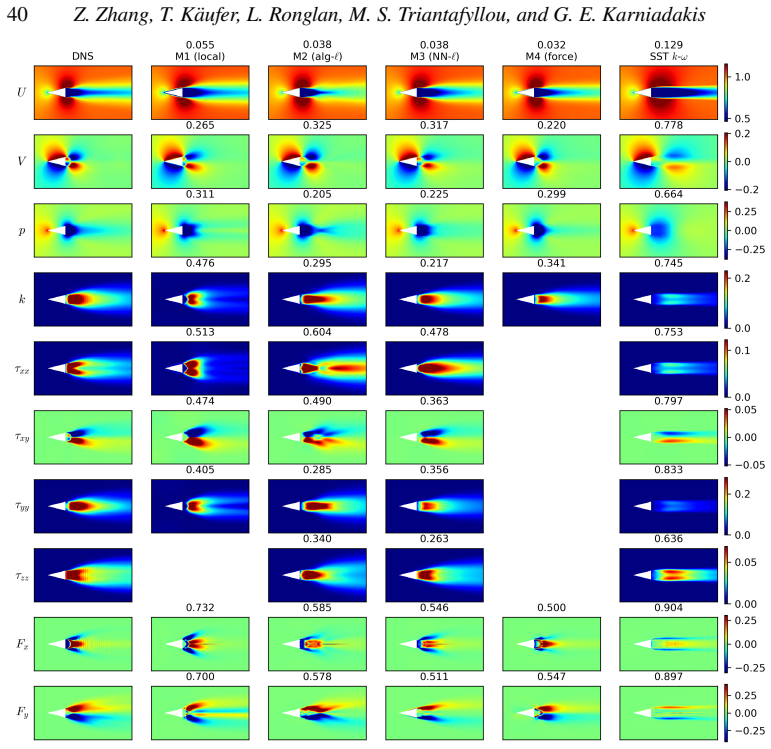
Summary. The paper proposes training RANS turbulence closures inside a physics-informed neural network so that the inverse problem is mesh-free and solver-agnostic: the RANS residual is imposed by automatic differentiation, with no CFD solver, mesh, or adjoint in the training loop. Four closures are developed on equal footing—three realizable tensor-basis Reynolds-stress models (local M1; non-local transported-k with algebraic length scale M2; non-local with a learned k-free length scale M3) and a structure-preserving Reynolds-force model M4 that targets F=−∇·τ with an energy-neutral residual projection. All four are trained on six 2-D bluff-body wakes at Re=10^4 (DNS, with a PIV demonstration) and deployed frozen in an independent finite-element RANS solver, stabilized by input-gradient smoothing and a Lipschitz penalty. Under a strict leave-one-shape-out protocol, all four substantially outperform a steady SST k–ω baseline; M3 is most accurate on the stress fields, while M4 generalizes best on mean velocity and drag (mean LOSO relative drag error ~8.5%).
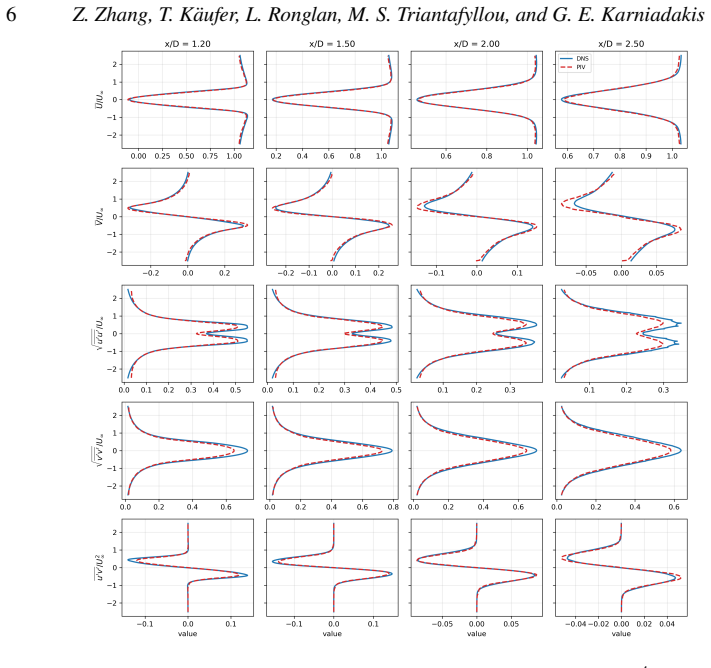
Significance. If the reported LOSO gains and stable a-posteriori FEM deployment hold, the work is a meaningful methodological contribution to data-driven RANS: it shows that PDE-consistent, solver-agnostic PINN training can produce transferable stress and force closures that clear the usual a-priori/a-posteriori gap without embedding a solver in the loop, at training costs of minutes per hypothesis on one GPU. Strengths include the strict LOSO design across six distinct wakes, the a-priori vs a-posteriori contrast (Fig. 4), the stabilizer ablation (Fig. 5), the PIV-trained demonstration (Fig. 6), the FIML/SA comparison (Fig. 9), and quantitative field and drag tables (Tables 3–4). The dual stress/force treatment within one trainer is also useful. The result is of clear interest to the turbulence-modelling and scientific-ML communities, even though the tested regime is steady, spanwise-averaged, symmetric-mean wakes at a single Re.
major comments (3)
- The title, abstract, and §1/§4.5–5 frame the result as geometry-generalizable closures, but all training and LOSO tests are at fixed Re=10^4 on steady, spanwise-averaged means with half-domain symmetry in FEM deployment (§2, §3.3). §5 correctly lists single-Re and half-domain limits and invokes analogy to prior cylinder Re-transfer work rather than new multi-Re or full-domain tests. The central LOSO claim at this Re is supported by Tables 3–4; the broader framing should be tightened so that “generalizable across shapes” is explicitly scoped to the tested regime, and any Re-transfer expectation is stated as a hypothesis, not an implied result.
- §3.3 and Fig. 5 establish that input-gradient Helmholtz smoothing (δ_f=c h, c=1) is decisive for Picard convergence of the frozen closure. Because this filter is applied to velocity gradients before they enter C, the deployed operator is not identical to the raw network map learned in the PINN. The paper should quantify how much a-posteriori accuracy (Tables 3–4, field figures) depends on this filter width—e.g., a short sensitivity on c or an explicit statement that reported errors include this deployment regularizer—so that the claimed transfer of the learned closure is not conflated with mesh-scale smoothing.
- Main quantitative claims rest on SST k–ω as the sole baseline in Tables 3–4 and the six-way field figures; the FIML+SA comparison (Fig. 9) is only in-sample on the cylinder. For a JFM-level claim of substantial outperformance of data-driven closures, at least one additional classical nonlinear/eddy-viscosity or algebraic stress baseline (or a brief note why SST alone is the appropriate industrial reference) would strengthen the interpretation that gains come from the PINN-trained forms rather than from beating a single linear Boussinesq model on massively separated wakes.
minor comments (6)
- §3.1, Eq. (3.12): the energy-neutral projection R_⊥ is central to M4’s structure preservation; a short remark on whether the projection is applied only at training, only at deployment, or both would help reproducibility.
- Table 3 reports mean relative-L2 over six shapes but not per-shape standard deviation or range; adding a brief dispersion measure (or pointing more explicitly to the per-shape field figures) would clarify whether LOSO averages are driven by one hard geometry (e.g., the ellipse in Fig. 12).
- §3.2 training cost comparison to the authors’ prior OpenFOAM adjoint (~1 day) is useful; stating mesh size / core count for that baseline next to the PINN GPU timing would make the “orders of magnitude” claim fully checkable.
- Notation: q7/q8 and the bounded limiter (Table 1) are clear, but C′ for the length-scale net is easy to miss in the text; a single sentence in §3.1 listing which methods use C′ would help.
- Appendix B Table 5 (training-recipe ablation) is valuable; a one-line pointer from §4.1 would make it easier to find.
- Minor typography: “Focus on Fluids articles must not exceed this page length” and similar production banners remain in the manuscript text and should be removed before typesetting.
Circularity Check
No load-bearing circularity: LOSO metrics are held-out a-posteriori evaluations against independent DNS, not fits renamed as predictions; only mild non-load-bearing self-citation for untested Re-transfer expectation.
-
self citation load bearing
[§4.5 (paragraph on Re generalization) and §5 Conclusion limitations]
"Although the present study fixes Re=10^4, the generalization is expected to extend in Reynolds number as well. Flows past a circular cylinder settle into a common, weakly Reynolds-dependent mean-flow regime above Re≈5000 until the emergence of the drag crisis after Re≈200,000—a pattern our prior cylinder study documents across Reynolds number up to Re=140,000 (Zhang et al. 2026). Therefore, we expect that a closure that transfers across shapes at a single Reynolds number will also transfer across Reynolds number in this regime."
The paper's framing of the six-shape LOSO results as evidence of broadly generalizable closures leans on an untested Re-transfer expectation justified only by the authors' own prior cylinder study. This is not load-bearing for the actual LOSO numbers (which rest on new multi-shape experiments in this paper), but it is a mild self-citation used to extend the claim beyond the tested regime. The main derivation chain (train on five shapes → freeze C → FEM deploy on held-out shape → measure vs DNS) does not reduce to that citation.
full rationale
The paper's central claim is empirical: four PINN-trained closures, trained with DNS/PIV supervision plus soft RANS residuals and no CFD solver in the loop, then frozen and deployed in an independent FEM RANS solver, outperform SST k–ω under strict leave-one-shape-out across six bluff bodies (Tables 3–4, Figs. 7–12). That chain does not reduce by construction. Training optimizes shared closure nets C (and C′) jointly with per-shape mean-field nets under data + PDE + BC losses; only C is retained. LOSO trains C on five shapes and deploys on the held-out sixth whose DNS never entered that training run, so reported U, V, p, k, τ, F, and Cd errors are genuine out-of-sample a-posteriori metrics, not fitted inputs. Classical constants (Cμ=0.09, κ=0.41) and the Lipschitz weight λlip=0.03 are regularizers/architecture choices, not the reported drag/velocity numbers. PDE-consistency (Fig. 4) is shown by contrasting a pure a-priori stress regression (fails FEM deployment) against the residual-supervised PINN (survives); that is an empirical demonstration, not a definitional identity. Tensor-basis, energy-neutral force split, and Prandtl–Kolmogorov form are taken from external literature (Pope, Ling, Cruz, etc.), not smuggled self-ansatz. The only mild self-citation is to Zhang et al. (2026) for prior cylinder Re-transfer and for the expectation that single-Re geometry transfer will extend in Re (§4.5, §5); that expectation is explicitly untested here and is not the evidence for the LOSO claim itself. Score 1 for that non-load-bearing self-citation; the derivation of the reported LOSO outperformance is self-contained against external DNS and the SST baseline.
Assumptions & free parameters
free parameters (6)
- λ_lip (closure Lipschitz penalty weight) =
0.03
- Length-scale network bounds (β, ℓ_min, ℓ_max) =
β=1.4, ℓ_min=1e-3, ℓ_max=6.0
- Eddy-viscosity multiplier range m=exp(β tanh(·)) =
m ∈ [0.25, 4]
- Input-gradient Helmholtz filter width δ_f = c h =
c=1
- Network widths/depths and training schedule =
64×4 / 24×2 / 16×2; 50k steps
- Picard under-relaxation and ν_t cap =
0.3; ν_t≤0.5
assumptions (6)
- domain assumption Steady incompressible RANS with Reynolds stress or equivalent force F=−∇·τ close the mean momentum equations.
- domain assumption Reynolds-stress anisotropy admits a finite integrity basis in (S,Ω) plus out-of-plane T0, with realizability caps.
- domain assumption Prandtl–Kolmogorov scaling ν_t ∼ √k ℓ with classical C_μ=0.09, κ=0.41 is an adequate backbone for non-local models.
- ad hoc to paper An energy-neutral residual force R_⊥ · U = 0 is required for a structure-preserving force closure.
- domain assumption Half-domain symmetry and steady mean fields adequately represent the spanwise-averaged 3D DNS wakes for closure training and deployment.
- ad hoc to paper Imposing RANS residuals by automatic differentiation (PINN) yields PDE-consistent closures that transfer to an independent FEM discretization.
invented entities (3)
-
Shared multi-geometry neural closures M1–M4 (local stress, algebraic-ℓ stress, learned-ℓ stress, structure-preserving force)
-
Auxiliary k-free length-scale network C′ producing ℓ(q7)
-
Energy-neutral projected residual force R_⊥ in M4
Cite this review
Pith. "Pith review of Generalizable turbulence closures across bluff-body shapes by PINN-based solver-agnostic training." pith.science (2026). https://pith.science/paper/G4HGDSW4
@misc{pith2026260704491,
  author       = {Pith},
  title        = {Pith review of: Generalizable turbulence closures across bluff-body shapes by PINN-based solver-agnostic training},
  year         = {2026},
  howpublished = {\url{https://pith.science/paper/G4HGDSW4}},
  note         = {Machine review of arXiv:2607.04491}
}
read the original abstract
Data-driven turbulence closures are usually calibrated by inverse methods that embed a CFD solver in the loop, tying the model to a particular discretization and requiring every iterate to yield a convergent solve. We instead train the closure inside a physics-informed neural network (PINN): the Reynolds-averaged Navier-Stokes residual is imposed by automatic differentiation, so the inverse problem is mesh-free, differentiable, and solver-agnostic. Because no forward solve runs during training, only the final closure need be solver-stable, arbitrary neural closures are admitted without an adjoint, and the iterative cost of adjoint or ensemble methods vanishes; each hypothesis trains in minutes on a single GPU, so the framework rapidly screens closure forms. We develop four closures: three model the Reynolds stress on a realizable tensor basis -- a local map, a non-local model transporting the turbulent kinetic energy and recovering the out-of-plane normal stress, and the same with a learned length scale l -- and a fourth models the Reynolds force F = -\nabla \cdot \tau directly, free of the realizability constraint. All four are trained across six two-dimensional bluff-body wakes at Re = 10^4 and deployed frozen in a standard finite-element solver, stabilized by input-gradient smoothing and a Lipschitz constraint. Under a strict leave-one-shape-out (LOSO) protocol, all four improve substantially on a steady SST k-omega baseline. The learned-length-scale closure is most accurate on the stress fields, while the force model generalizes best on the mean velocity and drag (LOSO drag error ~8.5%). The closures also train efficiently on Particle Image Velocimetry data, enabling geometries intractable for DNS.
Figures


Figures from the paper (24 more)




Reference graph
Works this paper leans on
-
[1]
and Duraisamy, Karthik , title =
Parish, Eric J. and Duraisamy, Karthik , title =. Journal of Computational Physics , volume =. 2016 , doi =
2016
-
[2]
AIAA Journal , volume =
Singh, Anand Pratap and Medida, Shivaji and Duraisamy, Karthik , title =. AIAA Journal , volume =. 2017 , doi =
2017
-
[3]
Annual Review of Fluid Mechanics , volume =
Duraisamy, Karthik and Iaccarino, Gianluca and Xiao, Heng , title =. Annual Review of Fluid Mechanics , volume =. 2019 , doi =
2019
-
[4]
Journal of Fluid Mechanics , volume =
Zhang, Xin-Lei and Xiao, Heng and Luo, Xiaodong and He, Guowei , title =. Journal of Fluid Mechanics , volume =. 2022 , doi =
2022
-
[5]
, title =
Weatheritt, Jack and Sandberg, Richard D. , title =. Journal of Computational Physics , volume =. 2016 , doi =
2016
-
[6]
and Weatheritt, Jack and Michelassi, Vittorio and Sandberg, Richard D
Zhao, Yaomin and Akolekar, Harshal D. and Weatheritt, Jack and Michelassi, Vittorio and Sandberg, Richard D. , title =. Journal of Computational Physics , volume =. 2020 , doi =
2020
-
[7]
and Cinnella, Paola , title =
Schmelzer, Martin and Dwight, Richard P. and Cinnella, Paola , title =. Flow, Turbulence and Combustion , volume =. 2020 , doi =
2020
-
[8]
, title =
Raissi, Maziar and Perdikaris, Paris and Karniadakis, George E. , title =. Journal of Computational Physics , volume =. 2019 , doi =
2019
Show all 42 references
-
[9]
Physics of Fluids , volume =
Eivazi, Hamidreza and Tahani, Mojtaba and Schlatter, Philipp and Vinuesa, Ricardo , title =. Physics of Fluids , volume =. 2022 , doi =
2022
-
[10]
Physical Review Fluids , volume =
Patel, Yusuf and Mons, Vincent and Marquet, Olivier and Rigas, Georgios , title =. Physical Review Fluids , volume =. 2024 , doi =
2024
-
[11]
and K\"aufer, Theo and Salauddin, S
Zhang, Zhen and Shukla, Khemraj and Wang, Zhicheng and Morales, A. and K\"aufer, Theo and Salauddin, S. and Walters, N. and Barrett, D. and Ahmed, K. and Triantafyllou, Michael S. and Karniadakis, George Em , title =. Journal of Fluid Mechanics , volume =. 2026 , doi =
2026
-
[12]
arXiv preprint arXiv:2604.23528 , year =
Wang, Sifan and Koohy, Shawn and Lu, Yiping and Perdikaris, Paris , title =. arXiv preprint arXiv:2604.23528 , year =
-
[13]
arXiv preprint arXiv:2310.16491 , year =
Cao, Wenbo and Zhang, Weiwei , title =. arXiv preprint arXiv:2310.16491 , year =
-
[14]
Pope, S. B. , title =. Journal of Fluid Mechanics , volume =. 1975 , doi =
1975
-
[15]
Gatski, T. B. and Speziale, C. G. , title =. Journal of Fluid Mechanics , volume =. 1993 , doi =
1993
-
[16]
and Johansson, A
Wallin, S. and Johansson, A. V. , title =. Journal of Fluid Mechanics , volume =. 2000 , doi =
2000
-
[17]
Craft, T. J. and Launder, B. E. and Suga, K. , title =. International Journal of Heat and Fluid Flow , volume =. 1996 , doi =
1996
-
[18]
Journal of Fluid Mechanics , volume =
Ling, Julia and Kurzawski, Andrew and Templeton, Jeremy , title =. Journal of Fluid Mechanics , volume =. 2016 , doi =
2016
-
[19]
and Freund, Jonathan B
Sirignano, Justin and MacArt, Jonathan F. and Freund, Jonathan B. , title =. Journal of Computational Physics , volume =. 2020 , doi =
2020
-
[20]
, title =
Sirignano, Justin and MacArt, Jonathan F. , title =. Journal of Fluid Mechanics , volume =. 2023 , doi =
2023
-
[21]
, title =
Schumann, U. , title =. Physics of Fluids , volume =. 1977 , doi =
1977
-
[22]
, title =
Lumley, John L. , title =. Advances in Applied Mechanics , volume =. 1978 , doi =
1978
-
[23]
and Angeli, P.-E
Cai, J. and Angeli, P.-E. and Martinez, J.-M. and Damblin, G. and Lucor, D. , title =. Computers & Fluids , volume =. 2024 , doi =
2024
-
[24]
Kaandorp, Mikael L. A. and Dwight, Richard P. , title =. Computers & Fluids , volume =. 2020 , doi =
2020
-
[25]
Scientific Data , volume =
McConkey, Ryley and Yee, Eugene and Lien, Fue-Sang , title =. Scientific Data , volume =. 2021 , doi =
2021
-
[26]
and Dwight, Richard P
Huijing, Jasper P. and Dwight, Richard P. and Schmelzer, Martin , title =. Computers & Fluids , volume =. 2021 , doi =
2021
-
[27]
Journal of Fluid Mechanics , volume =
Wu, Jinlong and Xiao, Heng and Sun, Rui and Wang, Qiqi , title =. Journal of Fluid Mechanics , volume =. 2019 , doi =
2019
-
[28]
and Cruz, Matheus A
Brener, Bernardo P. and Cruz, Matheus A. and Thompson, Roney L. and Anjos, Rodrigo P. , title =. Journal of Fluid Mechanics , volume =. 2021 , doi =
2021
-
[29]
and Thompson, Roney L
Cruz, Matheus A. and Thompson, Roney L. and Sampaio, Luiz E. B. and Bacchi, Raphael D. A. , title =. Computers & Fluids , volume =. 2019 , doi =
2019
-
[30]
End-to-end differentiable learning of turbulence models from indirect observations , journal =
Michel. End-to-end differentiable learning of turbulence models from indirect observations , journal =. 2021 , doi =
2021
-
[31]
Physical Review Fluids , volume =
Duraisamy, Karthik , title =. Physical Review Fluids , volume =. 2021 , doi =
2021
-
[32]
and Noack, Bernd R
Brunton, Steven L. and Noack, Bernd R. and Koumoutsakos, Petros , title =. Annual Review of Fluid Mechanics , volume =. 2020 , doi =
2020
-
[33]
and Allmaras, Steven R
Spalart, Philippe R. and Allmaras, Steven R. , title =. 30th Aerospace Sciences Meeting and Exhibit, AIAA Paper 92-0439 , year =
-
[34]
, title =
Menter, Florian R. , title =. AIAA Journal , volume =. 1994 , doi =
1994
-
[35]
SIAM Journal on Scientific Computing , volume =
Wang, Sifan and Teng, Yujun and Perdikaris, Paris , title =. SIAM Journal on Scientific Computing , volume =. 2021 , doi =
2021
-
[36]
arXiv preprint arXiv:2409.11321 , year =
Vyas, Nikhil and Morwani, Depen and Zhao, Rosie and Kwun, Mujin and Shapira, Itai and Brandfonbrener, David and Janson, Lucas and Kakade, Sham , title =. arXiv preprint arXiv:2409.11321 , year =
-
[37]
Proceedings of the 35th International Conference on Machine Learning (ICML) , pages =
Gupta, Vineet and Koren, Tomer and Singer, Yoram , title =. Proceedings of the 35th International Conference on Machine Learning (ICML) , pages =
-
[38]
and Hughes, Thomas J
Brooks, Alexander N. and Hughes, Thomas J. R. , title =. Computer Methods in Applied Mechanics and Engineering , volume =
-
[39]
and Hood, P
Taylor, C. and Hood, P. , title =. Computers & Fluids , volume =
-
[40]
Aln. The. Archive of Numerical Software , volume =. 2015 , doi =
2015
-
[41]
Parallel Computing , volume =
Fischer, Paul and Kerkemeier, Stefan and Min, Misun and Lan, Yu-Hsiang and Phillips, Malachi and Rathnayake, Thilina and Merzari, Elia and Tomboulides, Ananias and Karakus, Ali and Chalmers, Noel and Warburton, Tim , title =. Parallel Computing , volume =. 2022 , doi =
2022
-
[42]
, title =
Wolfshtein, M. , title =. International Journal of Heat and Mass Transfer , volume =. 1969 , doi =
1969
Reviewed July 13, 2026 · model on record in the stance chip above.
Discussion (0). Continue with ORCID to comment.