REVIEW 2 major objections 4 minor 85 references
Stacking current binary-black-hole events gives only moderate evidence for the full (2,0) gravitational-wave mode; decisive detection is projected after roughly 166 events.
Reviewed by Pith at T0; open to challenge. T0 means a machine referee read the full paper against a public rubric. the ladder, T0–T4 →
T0 review · grok-4.5
2026-07-11 11:35 UTC pith:RWWPH3G3
load-bearing objection Solid cumulative search for the full (2,0) mode on O4 data; the stacked log10 B = 1.38 ± 0.79 and memory SNR ~0.9 are clean, while the N_events ~166 forecast is explicitly optimistic and systematics-limited. the 2 major comments →
A stepping stone toward detecting gravitational wave memory: a cumulative analysis with the full (ell=2, m=0) spherical harmonic using events from GWTC-4.0 and GWTC-5.0
The pith
A machine-rendered reading of the paper's core claim, the machinery that carries it, and where it could break.
Core claim
For the 84 binary-black-hole events of GWTC-4.0 the stacked log-10 Bayes factor between the full-(2,0) model IMRPhenomTHM_20 and the model without that mode is 1.38 ± 0.79; under the fitted empirical distributions of the individual Bayes factors, decisive evidence is expected after N_events = 166^{+82}_{-55} detections at current sensitivity.
What carries the argument
Paired Bayesian model comparison of IMRPhenomTHM_20 (full (2,0) mode = oscillatory ringdown + displacement memory) versus IMRPhenomTHM (identical model without the mode), with per-event log-10 Bayes factors stacked under independence and validated by SNR stacking and high-SNR scaling relations.
Load-bearing premise
That the distribution of Bayes factors measured on the present GWTC-4.0 sample will continue to describe future detections, and that residual waveform modelling errors (especially the missing (3,±2) multipole) do not systematically bias those Bayes factors.
What would settle it
Accumulate a catalog of ~170 binary-black-hole events at O4/O5 sensitivity, recompute the stacked log-10 Bayes factor with the same two models (and with models that include the (3,±2) multipole), and check whether log-10 B − 1σ reaches or exceeds 2.
If this is right
- Decisive statistical evidence for the full (2,0) mode is expected before a clean detection of the memory component alone.
- Controlling the presence of the full (2,0) mode supplies a practical intermediate step that also helps isolate systematics before memory-only searches.
- Current individual events remain statistically consistent with either model; the (2,0) contribution is still too weak to shift recovered source parameters appreciably.
- An optimistic total of ~166 events at present sensitivity would suffice for decisive evidence under the measured Bayes-factor distribution.
Where Pith is reading between the lines
- Once the (2,0) mode is established, the same stacking pipeline can be re-run with the oscillatory piece subtracted to isolate the pure memory contribution and quantify how much extra catalog size it requires.
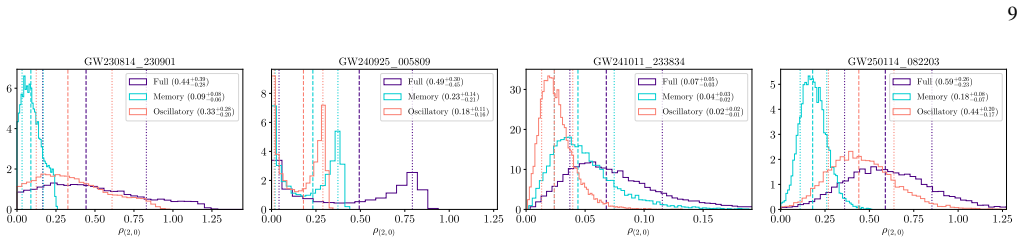
- The mild preference already seen for the loudest events (especially GW230814_230901) suggests that a handful of future high-SNR, edge-on systems could accelerate the climb to decisive evidence faster than the average-event forecast.
- Any future claim of memory detection that does not first demonstrate control of the full (2,0) mode will be vulnerable to the same systematics the authors flag for the missing higher multipoles.
Editorial analysis
A structured set of objections, weighed in public.
Referee Report
Summary. The manuscript reanalyzes the 84 BBH events of GWTC-4.0 (plus six selected high-SNR GWTC-5.0 events) with the quasi-circular, non-precessing IMRPhenomTHM_20 model that includes both the oscillatory ringdown and displacement-memory pieces of the (2,0) mode. Bayesian model comparison against IMRPhenomTHM yields a stacked log10 B = 1.38 ± 0.79 for the GWTC-4.0 sample; the corresponding stacked memory SNR after ~7.5 months of O4a is 0.89^{+0.29}_{-0.11}. A single precessing candidate is also examined with IMRPhenomTPHM_20 and shows no additional support. From the empirical distribution of the per-event Bayes factors the authors forecast that decisive evidence (log10 B - 1σ ≥ 2) would require N_events = 166^{+82}_{-55} under the assumptions of the present analysis.
Significance. The work supplies the first systematic, catalog-level Bayesian assessment of the full (2,0) multipole (oscillatory + memory) rather than memory alone, using public O4 data, measured PSDs, calibration envelopes, and a carefully documented nested-sampling pipeline. The zero-noise NR and model injections that recover the expected high-SNR scaling of the Bayes factor, the explicit quadrature propagation of evidence uncertainties, and the transparent stacking of both Bayes factors and SNRs are concrete strengths. The cumulative numbers and the N_events forecast give the community a concrete, if optimistic, benchmark for when the (2,0) mode (and ultimately memory) may become detectable with second-generation detectors.
major comments (2)
- Sec. V D and the abstract: the optimistic forecast N_events = 166^{+82}_{-55} is obtained by fitting a Student-t (2.85 dof) and a skew-normal to the 84 GWTC-4.0 log10 B values and drawing 500 Monte-Carlo trajectories. The same section notes that the loudest event, GW230814_230901, drops from log10 B = 0.63 ± 0.09 (vs THM) to 0.18 ± 0.10 when compared with the multipole-complete IMRPhenomXHM. Because the stacking formulae (Eqs. 4.3–4.4) treat every event as i.i.d., a coherent bias of even ~0.1–0.2 in the high-SNR tail would shift the median N_events by tens of events. The independence and representativeness assumptions are therefore load-bearing for the central forecast, yet they are not stress-tested against a multipole-complete model for more than one event. A short additional comparison (or an explicit statement that the forecast is conditional on the present mode content) is needed be
- Sec. V A / Fig. 1 and Tab. III: the cumulative log10 B = 1.38 ± 0.79 is dominated by a handful of high-SNR events, most notably GW230814_230901. The paper already shows that this event’s Bayes factor is sensitive to the missing (3,±2) multipole. Without a quantitative assessment of how residual waveform systematics propagate into the stacked evidence, the claim that the catalog provides “moderate support” for the (2,0) mode remains provisional. At minimum the authors should recompute the stack after replacing or down-weighting the systematics-sensitive events, or clearly label the result as model-dependent.
minor comments (4)
- Fig. 1: the dual color-coding (fill = full SNR, edge = (2,0) SNR) is hard to read once printed in grayscale; a second panel or a different visual encoding would help.
- Eq. (4.7)–(4.8): the high-SNR scaling is validated only with zero-noise injections; a brief remark that real noise can flip the sign of O(1) Bayes factors (already noted in Sec. IV E) would strengthen the interpretation of the small measured values.
- Appendix A: the relative-runtime plot is useful but the absolute wall-clock times (color bar) are given only for ΔlnZ = 0.10; quoting the corresponding numbers for ΔlnZ = 0.05 would make the cost of the tighter threshold clearer.
- Throughout: a few typographical inconsistencies remain (“W A VEFORM”, occasional missing spaces around math mode). A final copy-edit pass would remove them.
Circularity Check
No load-bearing circularity: Bayes factors and SNR stacks are direct measurements on real data; the N_events forecast is an explicit empirical bootstrap from the observed distribution, not a tautological derivation.
specific steps
-
self citation load bearing
[Sec. III (waveform model) and abstract / Sec. V A (model comparison)]
"As our signal model we use the quasi-circular, non-precessing IMRPhenomTHM_20 waveform model, which includes the oscillatory and displacement memory contributions. … To incorporate the memory effect in this analysis, we employ the phenomenological waveform model of the (ℓ=2,m=0) spherical harmonic mode … [24]. … Both the aligned-spin and the precessing models are implemented within IMRPhenomTHM and IMRPhenomTPHM, respectively, in the Python package phenomxpy [63]."
The signal hypothesis H_20 is defined by the authors’ own prior papers that construct IMRPhenomTHM_20 / TPHM_20. While the subsequent Bayes-factor computation on real data is independent, the very existence of the mode content being tested rests on that self-citation chain; without it there is no H_20 to compare against H_∅. This is minor (normal model-building practice) and does not force the numerical value of the stacked log10 B.
full rationale
The central results (per-event and stacked log10 B = 1.38 ± 0.79, SNR stacking of the full (2,0)/memory/oscillatory pieces) are obtained by nested sampling of real GWOSC strain against two nested, previously calibrated waveform models (IMRPhenomTHM_20 vs IMRPhenomTHM) with fixed priors and measured PSDs; no free parameter is adjusted to force a positive stacked evidence. The N_events = 166^{+82}_{-55} figure is obtained by maximum-likelihood fitting of a Student-t (2.85 dof) and skew-normal to the same 84 observed (log10 B, σ) pairs, then drawing 500 Monte-Carlo trajectories until the cumulative reaches the Jeffreys threshold of 2 (Sec. V D). This is an ordinary empirical forecast under the stated i.i.d. and representativeness assumptions; the paper itself labels it “optimistic” and “based on the specific assumptions adopted in this work.” Self-citations supply the waveform models and the prior PE pipeline, but those models are NR-calibrated and the data analysis is independent of the citations. No equation reduces by construction to its own input, no uniqueness theorem is imported to forbid alternatives, and no ansatz is smuggled in. Residual waveform systematics (missing (3,±2)) are a correctness risk, not circularity. Score 1 only for the minor self-citation of the authors’ own (2,0) models that define the signal hypothesis being tested.
Axiom & Free-Parameter Ledger
free parameters (2)
- Student-t degrees of freedom for log10 B distribution =
2.85
- skew-normal shape parameter for σ(log10 B) =
8.33
axioms (3)
- domain assumption Events are statistically independent so that log Bayes factors add.
- domain assumption IMRPhenomTHM_20 accurately captures the (2,0) mode (oscillatory + memory) for quasi-circular, non-precessing binaries up to mass ratio 10.
- standard math Jeffreys scale thresholds (log10 B ≥ 2 decisive) remain the appropriate decision criterion.
read the original abstract
We perform Bayesian model selection to test for the presence of the $(\ell=2,m=0)$ spherical harmonic mode in gravitational wave events that have previously been identified as binary black hole mergers. As our signal model we use the quasi-circular, non-precessing IMRPhenomTHM_20 waveform model, which includes the oscillatory and displacement memory contributions. Including the oscillatory component of the (2,0) mode increases the signal-to-noise ratio and evidence for this mode, compared to testing only for the presence of gravitational wave memory. Our analysis thus constitutes a natural stepping stone toward detecting gravitational wave memory. We perform our analysis for the binary black hole signals identified in the GWTC-4.0 catalog, and for selected GWTC-5.0 events. In our Bayesian model comparison we find a cumulative $\log_{10}\mathcal{B}=1.38\pm0.79$ in favor of the presence of the (2,0) mode for the GWTC-4.0 catalog. We also stack the signal-to-noise ratio of the full (2,0) mode and of its individual contributions, obtaining results consistent with previous studies and reaching $\mathrm{SNR}_{\mathrm{memory}} = 0.89^{+0.29}_{-0.11}$ after approximately 7.5 months of O4a observations. In addition, we study the precessing candidate GW241127_061008, and find no additional evidence for the (2,0) mode when precession is included in IMRPhenomTPHM_20. Overall, our results provide an assessment of the observational support for the (2,0) mode in current gravitational wave data and allow us to discuss prospects for its future detection. We find that decisive statistical evidence will likely require a larger catalog, with an optimistic estimated number of events of $N_{\mathrm{events}} = 166^{+82}_{-55}$, based on the specific assumptions adopted in this work. We also expect that decisive evidence will require a more extensive waveform systematics study.
Figures




Reference graph
Works this paper leans on
-
[1]
twisting-up
are expected to enable detections in individual events. In contrast, the detection of spin memory is likely to still rely on stacking even in these advanced scenarios [50]. In a recent work [51], the authors use hierarchical Bayesian inference on the GWTC-5.0 catalog of BBH observations to constrain the memory enhancement factor across the popula- tion, f...
2000
-
[2]
We choose a non-equal mass simulation so that all the modes in the model have a non-zero contribution to the waveform
Numerical relativity injection First we perform a zero-noise NR injection using a quasi-circular, non-precessing, waveform from the Simu- lating eXtreme Spacetimes (SXS) public Catalog [74–76], SXS:BBH:2497 (Q=2, χ 1 =χ 2 =0,N orbits =20 ). We choose a non-equal mass simulation so that all the modes in the model have a non-zero contribution to the wavefor...
-
[3]
Model injections Furthermore, to assess the correct scaling of the Bayes fac- tor with the SNR in the PE runs that have been performed in this work, we perform two zero-noise model injections: one at considerably high SNR and one at lower SNR, to check the scaling of the Bayes factor as a function of the SNR in- troduced in Sec. IVC. We choose model rathe...
-
[4]
J.N.Goldberg,A.J.Macfarlane,E.T.Newman,F.Rohrlich,and E. C. G. Sudarshan, Journal of Mathematical Physics8, 2155 (1967)
1967
-
[5]
Schmidt, M
P. Schmidt, M. Hannam, S. Husa, and P. Ajith, Phys. Rev. D84, 024046 (2011)
2011
-
[6]
C. Mills and S. Fairhurst, Phys. Rev. D103, 024042 (2021), arXiv:2007.04313 [gr-qc]
Pith/arXiv arXiv 2021
-
[7]
J. Calderón Bustillo, S. Husa, A. M. Sintes, and M. Pürrer, Phys. Rev. D93, 084019 (2016), arXiv:1511.02060 [gr-qc]
Pith/arXiv arXiv 2016
-
[8]
F. H. Shaik, J. Lange, S. E. Field, R. O’Shaughnessy, V. Varma, L. E. Kidder, H. P. Pfeiffer, and D. Wysocki, Phys. Rev. D101, 124054 (2020), arXiv:1911.02693 [gr-qc]
Pith/arXiv arXiv 2020
-
[9]
P. B. Graff, A. Buonanno, and B. S. Sathyaprakash, Phys. Rev. D92, 022002 (2015), arXiv:1504.04766 [gr-qc]
Pith/arXiv arXiv 2015
-
[10]
J.CalderónBustillo,S.H.W.Leong,T.Dietrich,andP.D.Lasky, Astrophys. J. Lett.912, L10 (2021), arXiv:2006.11525 [gr-qc]
Pith/arXiv arXiv 2021
-
[11]
J. Calderón Bustillo, S. H. W. Leong, and K. Chandra, Nature Astron.9, 1530 (2025), arXiv:2211.03465 [gr-qc]
arXiv 2025
-
[12]
TheLIGOScientificCollaboration,ClassicalandQuantumGrav- ity32, 074001 (2015)
2015
-
[13]
Virgo Collaboration, Classical and Quantum Gravity32, 024001 (2014)
2014
-
[14]
KAGRA Collaboration, Progress of Theoreti- cal and Experimental Physics2021, 05A101 (2020), https://academic.oup.com/ptep/article- pdf/2021/5/05A101/37974994/ptaa125.pdf
2020
-
[15]
R. Abbottet al. (LIGO Scientific, Virgo), Phys. Rev. D102, 043015 (2020), arXiv:2004.08342 [astro-ph.HE]
Pith/arXiv arXiv 2020
-
[16]
C. Hoy, C. Mills, and S. Fairhurst, Phys. Rev. D106, 023019 (2022), arXiv:2111.10455 [gr-qc]
Pith/arXiv arXiv 2022
-
[17]
R.Abbott etal.(LIGOScientific,Virgo),Astrophys.J.Lett.896, L44 (2020), arXiv:2006.12611 [astro-ph.HE]
Pith/arXiv arXiv 2020
-
[18]
M.Favata,Astrophys.J.Lett.696,L159(2009),arXiv:0902.3660 [astro-ph.SR]
Pith/arXiv arXiv 2009
-
[19]
M. Favata, Class. Quant. Grav.27, 084036 (2010), arXiv:1003.3486 [gr-qc]
Pith/arXiv arXiv 2010
-
[20]
K. Mitman, J. Moxon, M. A. Scheel, S. A. Teukolsky, M. Boyle, N.Deppe,L.E.Kidder,andW.Throwe,Phys.Rev.D102,104007 (2020), arXiv:2007.11562 [gr-qc]
Pith/arXiv arXiv 2020
-
[21]
Y. B. Zel’dovich and A. G. Polnarev, Astronomicheskii Zhurnal 51, 30 (1974)
1974
-
[22]
Blanchet and T
L. Blanchet and T. Damour, Phys. Rev. D46, 4304 (1992)
1992
-
[23]
Christodoulou, Phys
D. Christodoulou, Phys. Rev. Lett.67, 1486 (1991)
1991
-
[24]
Y. Xu, M. Rosselló-Sastre, S. Tiwari, M. Ebersold, E. Z. Hamil- ton, C. García-Quirós, H. Estellés, and S. Husa, Phys. Rev. D 109, 123034 (2024), arXiv:2403.00441 [gr-qc]
Pith/arXiv arXiv 2024
-
[25]
S. Gasparotto, R. Vicente, D. Blas, A. C. Jenkins, and E. Ba- rausse, Phys. Rev. D107, 124033 (2023), arXiv:2301.13228 [gr-qc]
Pith/arXiv arXiv 2023
-
[26]
J. Calderón Bustillo, N. Sanchis-Gual, A. Torres-Forné, J. A. Font, A. Vajpeyi, R. Smith, C. Herdeiro, E. Radu, and S. H. W. Leong, Phys. Rev. Lett.126, 081101 (2021), arXiv:2009.05376 [gr-qc]
Pith/arXiv arXiv 2021
-
[27]
M. Rosselló-Sastre, S. Husa, and S. Bera, Phys. Rev. D110, 084074 (2024), arXiv:2405.17302 [gr-qc]
Pith/arXiv arXiv 2024
-
[28]
A. G. Abacet al. (LIGO Scientific, KAGRA, Virgo), Astrophys. J. Lett.995, L18 (2025), arXiv:2508.18080 [gr-qc]
Pith/arXiv arXiv 2025
-
[29]
A. G. Abacet al. (LIGO Scientific, KAGRA, Virgo), Astrophys. J. Lett.1004, L21 (2025), arXiv:2508.18081 [gr-qc]
Pith/arXiv arXiv 2025
-
[30]
A. G. Abacet al. (LIGO Scientific, Virgo, KAGRA), Astrophys. J. Lett.1004, L22 (2025), arXiv:2508.18082 [gr-qc]
Pith/arXiv arXiv 2025
-
[31]
L. S. Collaboration, V. Collaboration, and K. Collaboration, 10.5281/zenodo.17014085 (2025)
- [32]
-
[33]
A. G. Abacet al. (LIGO Scientific, Virgo, KAGRA), (2026), arXiv:2605.27223 [gr-qc]
Pith/arXiv arXiv 2026
-
[34]
LIGOScientific,Virgo,andKAGRA, (2026),arXiv:2605.27224 [gr-qc]
Pith/arXiv arXiv 2026
-
[35]
LIGOScientific,Virgo,andKAGRA, (2026),arXiv:2605.27225 [gr-qc]
Pith/arXiv arXiv 2026
-
[36]
LIGOScientific,Virgo,andKAGRA, (2026),arXiv:2605.27227 [astro-ph.CO]
Pith/arXiv arXiv 2026
-
[37]
LIGOScientific,Virgo,andKAGRA, (2026),arXiv:2605.27226 [astro-ph.HE]
Pith/arXiv arXiv 2026
- [38]
-
[39]
A. G. Abacetal. (LIGO Scientific, Virgo, KAGRA), Phys. Rev. Lett.135, 111403 (2025), arXiv:2509.08054 [gr-qc]
Pith/arXiv arXiv 2025
-
[40]
A. G. Abacet al. (LIGO Scientific, Virgo, KAGRA), Astrophys. J. Lett.993, L21 (2025), arXiv:2510.26931 [astro-ph.HE]
arXiv 2025
-
[41]
H. Estelles, A. Ramos-Buades, S. Husa, C. Garcia-Quiros, M.Colleoni,L.Haegel,andR.Jaume,Phys.Rev.D103,124060 (2021), arXiv:2004.08302 [gr-qc]
Pith/arXiv arXiv 2021
-
[42]
H. Estelles, S. Husa, M. Colleoni, D. Keitel, M. Mateu-Lucena, C.Garcia-Quiros,A.Ramos-Buades,andA.Borchers,Phys.Rev. D105, 084039 (2022), arXiv:2012.11923 [gr-qc]
Pith/arXiv arXiv 2022
-
[43]
H. Estellés, M. Colleoni, C. García-Quirós, S. Husa, D. Keitel, M. Mateu-Lucena, M. d. L. Planas, and A. Ramos-Buades, Phys. Rev. D105, 084040 (2022), arXiv:2105.05872 [gr-qc]
Pith/arXiv arXiv 2022
-
[44]
Rosselló-Sastre and S
M. Rosselló-Sastre and S. Husa, Phys. Rev. D112, 124059 (2025)
2025
-
[45]
N. Khera, B. Krishnan, A. Ashtekar, and T. De Lorenzo, Phys. Rev. D103, 044012 (2021), arXiv:2009.06351 [gr-qc]
Pith/arXiv arXiv 2021
-
[46]
M. Hübner, C. Talbot, P. D. Lasky, and E. Thrane, Phys. Rev. D 101, 023011 (2020), arXiv:1911.12496 [astro-ph.HE]
Pith/arXiv arXiv 2020
-
[47]
Z.-C.Zhao,X.Liu,Z.Cao,andX.He,Phys.Rev.D104,064056 (2021), arXiv:2111.13882 [gr-qc]
Pith/arXiv arXiv 2021
-
[48]
M. Hübner, P. Lasky, and E. Thrane, Phys. Rev. D104, 023004 (2021), arXiv:2105.02879 [gr-qc]
Pith/arXiv arXiv 2021
-
[49]
S. Y. Cheung, P. D. Lasky, and E. Thrane, Class. Quant. Grav. 41, 115010 (2024), arXiv:2404.11919 [gr-qc]
Pith/arXiv arXiv 2024
-
[50]
P.D.Lasky,E.Thrane,Y.Levin,J.Blackman,andY.Chen,Phys. Rev. Lett.117, 061102 (2016), arXiv:1605.01415 [astro-ph.HE]
Pith/arXiv arXiv 2016
-
[51]
O. M. Boersma, D. A. Nichols, and P. Schmidt, Phys. Rev. D 101, 083026 (2020), arXiv:2002.01821 [astro-ph.HE]
Pith/arXiv arXiv 2020
-
[52]
D. Reitze et al., Bull. Am. Astron. Soc.51, 035 (2019), arXiv:1907.04833 [astro-ph.IM]
Pith/arXiv arXiv 2019
-
[53]
A.M.GrantandD.A.Nichols,Phys.Rev.D107,064056(2023), [Erratum: Phys.Rev.D 108, 029901 (2023)], arXiv:2210.16266 [gr-qc]
Pith/arXiv arXiv 2023
- [54]
-
[55]
Y. Chen et al., Phys. Rev. D110, 064049 (2024), arXiv:2405.06197 [gr-qc]
Pith/arXiv arXiv 2024
-
[56]
M.Colpi etal.(LISA), (2024),arXiv:2402.07571[astro-ph.CO]
Pith/arXiv arXiv 2024
-
[57]
H. Inchauspé, S. Gasparotto, D. Blas, L. Heisenberg, 18 J. Zosso, and S. Tiwari, Phys. Rev. D111, 044044 (2025), arXiv:2406.09228 [gr-qc]
Pith/arXiv arXiv 2025
-
[58]
A. Cogez, S. Gasparotto, J. Zosso, H. Inchauspé, C. Pitte, L. Magaña Zertuche, A. Petiteau, and M. Besancon, (2026), arXiv:2601.23230 [gr-qc]
Pith/arXiv arXiv 2026
-
[59]
J. Zosso, L. Magaña Zertuche, S. Gasparotto, A. Cogez, H. In- chauspé, and M. Jacobs, (2026), arXiv:2601.23019 [gr-qc]
Pith/arXiv arXiv 2026
-
[60]
G. Agazieet al. (NANOGrav), Astrophys. J.963, 61 (2024), arXiv:2307.13797 [gr-qc]
Pith/arXiv arXiv 2024
-
[61]
S. M. Tomson et al. 10.3847/2041-8213/ae2912 (2025), arXiv:2512.14650 [gr-qc]
-
[62]
M.d.L.Planas,A.Ramos-Buades,C.Garcia-Quiros,H.Estelles, S. Husa, and M. Haney, (2025), arXiv:2503.13062 [gr-qc]
arXiv 2025
-
[63]
P. Schmidt, F. Ohme, and M. Hannam, Phys. Rev. D91, 024043 (2015), arXiv:1408.1810 [gr-qc]
Pith/arXiv arXiv 2015
-
[64]
A. Ashtekar, T. De Lorenzo, and N. Khera, Gen. Rel. Grav.52, 107 (2020), arXiv:1906.00913 [gr-qc]
Pith/arXiv arXiv 2020
-
[65]
G. Compère, R. Oliveri, and A. Seraj, JHEP10, 116, [Erratum: JHEP 06, 045 (2024)], arXiv:1912.03164 [gr-qc]
Pith/arXiv arXiv 2024
-
[66]
García-Quirós, S
C. García-Quirós, S. Tiwari, and S. Babak, Phys. Rev. D112, 064017 (2025)
2025
-
[67]
A. G. Abacetal.(LIGO Scientific, Virgo, KAGRA),1004, 232 (2025), arXiv:2508.18079 [gr-qc]
Pith/arXiv arXiv 2025
-
[68]
D. M. Macleod, J. S. Areeda, S. B. Coughlin, T. J. Massinger, and A. L. Urban, SoftwareX13, 100657 (2021)
2021
-
[69]
G. Ashton et al., Astrophys. J. Suppl.241, 27 (2019), arXiv:1811.02042 [astro-ph.IM]
Pith/arXiv arXiv 2019
-
[70]
J. Valencia, R. Tenorio, M. Rosselló-Sastre, and S. Husa, Phys. Rev. D110, 124026 (2024), arXiv:2406.16636 [gr-qc]
Pith/arXiv arXiv 2024
-
[71]
Y. Xu, M. Rossello-Sastre, J. Valencia, A. Ramos Buades, J. Llobera Querol, and F. A. Ramis Vidal, Pe automator: v0.20.3 (2025)
2025
-
[72]
E. Thrane and C. Talbot, Publ. Astron. Soc. Austral.36, e010 (2019), [Erratum: Publ.Astron.Soc.Austral. 37, e036 (2020)], arXiv:1809.02293 [astro-ph.IM]
Pith/arXiv arXiv 2019
-
[73]
Jeffreys,The Theory of Probability(Oxford University Press, Oxford, 1998)
H. Jeffreys,The Theory of Probability(Oxford University Press, Oxford, 1998)
1998
-
[74]
W. Del Pozzo, K. Grover, I. Mandel, and A. Vecchio, Class. Quant. Grav.31, 205006 (2014), arXiv:1408.2356 [gr-qc]
Pith/arXiv arXiv 2014
-
[75]
B. J. Owen, Phys. Rev. D53, 6749 (1996), arXiv:gr-qc/9511032
Pith/arXiv arXiv 1996
-
[76]
J. S. Speagle, Monthly Notices of the Royal Astronomical Soci- ety493, 3132 (2020), https://academic.oup.com/mnras/article- pdf/493/3/3132/32890730/staa278.pdf
2020
-
[77]
Simulating eXtreme Spacetimes (SXS) Collaboration, SpEC: Spectral Einstein Code, https://www.black-holes.org/ code/SpEC.html
-
[78]
M. Boyle et al., Class. Quant. Grav.36, 195006 (2019), arXiv:1904.04831 [gr-qc]
Pith/arXiv arXiv 2019
-
[79]
M. A. Scheelet al., Class. Quant. Grav.42, 195017 (2025), arXiv:2505.13378 [gr-qc]
arXiv 2025
-
[80]
A.G.Abac etal.(LIGOScientific,Virgo,KAGRA)10.1103/gzrj- mwv3 (2026), arXiv:2605.11703 [gr-qc]
discussion (0)
Sign in with ORCID, Apple, or X to comment. Anyone can read and Pith papers without signing in.