REVIEW 3 major objections 5 minor 34 references
Isospin-violating J/ψ decay filters for molecular baryons
Reviewed by Pith at T0; open to challenge. T0 means a machine referee read the full paper against a public rubric. the ladder, T0–T4 →
T0 review · glm-5.2
2026-07-08 11:46 UTC pith:4COQBMTH
load-bearing objection Clean formalism, suggestive but thin data comparison, and a 'filter' claim that is partly circular the 3 major comments →
Role of the Sigma(1430)(1/2^-) in the J/psi to Λ bar{Λ} π⁰ reaction
The pith
A machine-rendered reading of the paper's core claim, the machinery that carries it, and where it could break.
Core claim
The paper identifies a selection rule: in isospin-violating decays driven by final-state rescattering from an SU(3)-singlet initial state, only dynamically generated resonances—those arising from meson-baryon interactions rather than from the strong interaction binding of three quarks—can appear in the invariant mass spectrum. Applied to J/ψ→ΛΛ̄π⁰, this rule predicts the Σ(1430)(1/2⁻) is visible and the Σ(1385)(3/2⁺) is absent, a pattern the limited BESIII data do not contradict.
What carries the argument
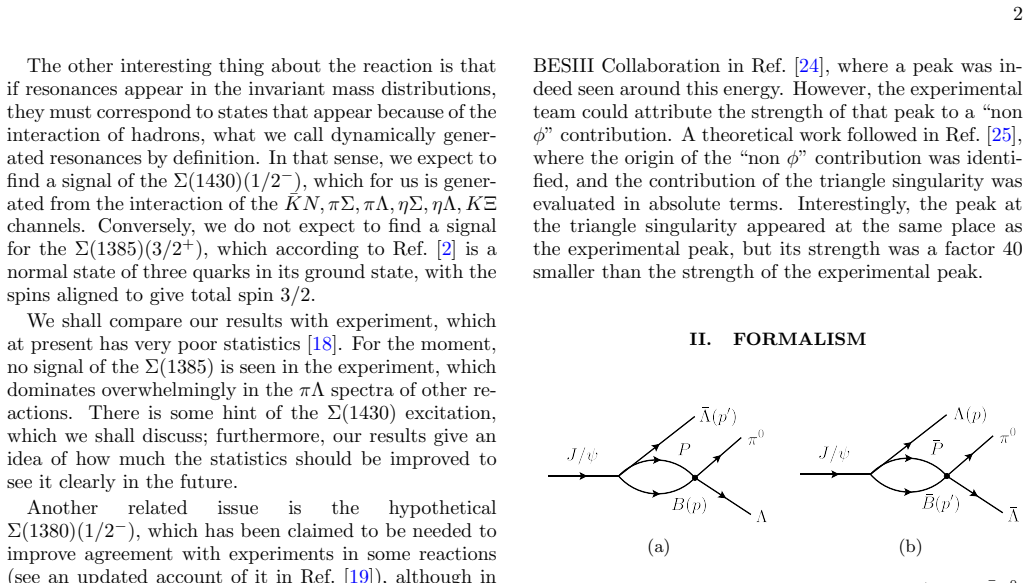
The central mechanism is the SU(3)-singlet rescattering topology: the J/ψ couples equally to all baryon-antibaryon-meson singlet combinations, and the ΛΛ̄π⁰ final state emerges only after meson-baryon (or meson-antibaryon) rescattering. Isospin violation enters because the loop amplitudes for different charge channels within the same isospin multiplet fail to cancel when physical masses are used. The scattering amplitudes themselves come from chiral unitary coupled-channel theory, which generates the Σ(1430) as a near-threshold pole in the K̄N, πΣ, πΛ, ηΣ, ηΛ, KΞ coupled channels.
Load-bearing premise
The prediction relies on the assumption that the SU(3)-singlet rescattering topology is the dominant mechanism for this isospin-violating decay. If other isospin-breaking mechanisms contribute substantially—such as direct η-π⁰ mixing, triangle singularities with unknown branching ratios, or different production topologies—the clean filter property distinguishing dynamically generated from conventional resonances could be compromised.
What would settle it
High-statistics BESIII data showing a clear Σ(1385) peak in the Λπ⁰ invariant mass spectrum of J/ψ→ΛΛ̄π⁰, or showing a line shape inconsistent with the Σ(1430) rescattering prediction, would falsify the central claim.
If this is right
- If higher-statistics BESIII data confirm a Σ(1430) peak and continued absence of Σ(1385) in J/ψ→ΛΛ̄π⁰, it would validate the claim that isospin-violating decays serve as a clean filter for dynamically generated baryon resonances.
- The same selection rule can be applied to other isospin-violating J/ψ decays to classify additional baryon states as molecular or three-quark in nature, extending the diagnostic tool beyond the Σ sector.
- If the hypothetical Σ(1380)(1/2⁻) exists and is not dynamically generated, it should also be absent from this reaction, providing a test of its nature through non-observation.
- The framework can be extended to the Λ(1405) double-pole structure, since the SU(3)-singlet filter may distinguish the two overlapping poles if applied to appropriate isospin-violating channels.
Where Pith is reading between the lines
- The paper dismisses a competing triangle-singularity mechanism proposed elsewhere because unknown branching ratios prevent quantitative comparison. A natural extension would be to measure or bound the J/ψ→Σ̄*Σ branching ratios needed to evaluate that alternative, which would determine whether the two mechanisms produce distinguishable line shapes or interfere.
- If the selection rule holds broadly, one could construct a systematic classification scheme: for each known or candidate baryon resonance, identify an isospin-violating J/ψ decay channel where the resonance's coupled channels appear, and use presence or absence in the spectrum as a binary diagnostic of its dynamical origin.
- The paper notes that a prior triangle-singularity prediction for a related reaction overestimated the experimental peak by a factor of 40. This suggests that triangle singularities in this kinematic regime may be systematically overestimated, strengthening the case that the rescattering mechanism dominates—but a direct comparison of the two mechanisms in the same channel would settle the question.
Editorial analysis
A structured set of objections, weighed in public.
Referee Report
Summary. The manuscript studies the isospin-violating decay J/ψ → Λ̄Λπ⁰ using an SU(3)-singlet construction of baryon–antibaryon–pseudoscalar meson states, followed by meson-baryon and meson-antibaryon rescattering amplitudes taken from chiral unitary coupled-channel approaches. The central claim is that this reaction acts as a 'filter' for dynamically generated resonances: the Σ(1430)(1/2⁻) appears because it is generated by meson-baryon interactions, while the conventional Σ(1385)(3/2⁺) does not because it is a three-quark state. The prediction is compared with limited-statistics BESIII data, where one data point near 1430 MeV is noted as suggestive.
Significance. The idea of using isospin-violating J/ψ decays as a selective probe of dynamically generated baryon states is interesting and potentially valuable for the hadron spectroscopy program. The formalism is built on established chiral unitary methods and prior work by the authors, and the prediction that Σ(1430) appears while Σ(1385) is absent is a genuine consequence of the chosen rescattering topology. The paper has essentially one free parameter (a global normalization), with the ratio Ã/B = 1.44 taken from prior work, which is a strength. The call for future high-statistics measurements at BESIII is well-motivated.
major comments (3)
- §I and §IV: The claim that this reaction 'serves as an excellent instrument to probe the nature of low-lying Σ states' because 'only resonances that are dynamically generated by these interactions show up' is not fully justified. The amplitudes in Eqs. (11)–(12) are constructed entirely from meson-baryon scattering amplitudes t_{MB,M'B'}, so the absence of the Σ(1385)(3/2⁺) is guaranteed by the model's inputs — it does not appear as an S-wave meson-baryon pole — rather than being derived as a consequence of the reaction's isospin-violating dynamics. The paper does not demonstrate that a generic isospin-violating J/ψ → Λ̄Λπ⁰ amplitude must suppress conventional qqq states. In particular, a direct isospin-violating J/ψ → Λ̄Σ*(1385) → Λ̄Λπ⁰ vertex (arising from quark mass differences in the decay Hamiltonian) is not discussed or bounded. The authors should qualify the 'filter' claim to make
- §I, discussion of Ref. [21]: The competing triangle mechanism (J/ψ → Σ̄*Σ, followed by Σ̄* → Λ̄π and πΣ fusion) is mentioned but dismissed because the J/ψ → Σ̄*Σ branching ratios are unknown. However, this mechanism could produce the same Σ(1430) signal in the πΛ spectrum through a very different topology, and its potential contribution would undermine the uniqueness of the interpretation. The authors should at least estimate an upper bound on the triangle contribution or discuss whether the two mechanisms can be distinguished experimentally (e.g., via angular distributions or the Λ̄π⁰ vs. Λπ⁰ spectra).
- §III, Fig. 4: The comparison with BESIII data is overstated. The 'signal' at 1430 MeV consists of a single data point above a smooth background that is itself taken from the experimental fit rather than derived from the theoretical framework. The statement that 'the data show a structure around M_{πΛ} = 1430 MeV that is reproduced by the theory' should be tempered to reflect that the data are consistent with the prediction but do not constitute evidence for it. The authors should also clarify the physical origin of the smooth background within their framework — is it from non-resonant rescattering, or is it purely phenomenological?
minor comments (5)
- §II, Eqs. (11)–(12): The notation eA and eB is introduced without explicit definition. Presumably e = Ã/B or a related combination, but this should be stated clearly.
- §II, Eq. (17): The factor 2M₁₂·2M₂₃ in the numerator appears without explanation. A brief comment on its origin (phase space convention) would help the reader.
- §II, below Eq. (10): The statement 'the terms with p_i in Eq. (10) will not contribute' for Type (a) diagrams should be cross-checked: the S-wave projection argument is standard but a one-sentence justification would improve clarity.
- Fig. 4: The y-axis label and units are not clearly specified. The data points also lack visible error bars in the figure as described; if error bars are present, they should be made more visible.
- References [19, 20, 25, 26, 29, 30, 31] are all dated 2026, suggesting these are very recent or concurrent preprints. The authors should ensure that any results borrowed from these works (particularly the ratio Ã/B = 1.44 from Refs. [26, 29]) are not themselves under revision.
Simulated Author's Rebuttal
We thank the referee for a careful and constructive report. The referee raises three major points: (1) the 'filter' claim is stronger than what the formalism demonstrates, since the absence of the Σ(1385) is built into the model inputs rather than derived from isospin-violating dynamics; (2) the competing triangle mechanism of Ref. [21] is dismissed without an upper bound or discussion of experimental discriminability; and (3) the comparison with BESIII data is overstated given that the 'signal' is a single data point and the background is phenomenological. We agree with the substance of all three points and will revise the manuscript accordingly.
read point-by-point responses
-
Referee: The claim that the reaction 'serves as an excellent instrument to probe the nature of low-lying Σ states' because 'only resonances that are dynamically generated by these interactions show up' is not fully justified. The amplitudes are constructed entirely from meson-baryon scattering amplitudes, so the absence of the Σ(1385) is guaranteed by the model's inputs rather than derived as a consequence of isospin-violating dynamics. A direct isospin-violating J/ψ → Λ̄Σ*(1385) → Λ̄Λπ⁰ vertex is not discussed or bounded.
Authors: The referee is correct. The absence of the Σ(1385) in our amplitudes is a direct consequence of the fact that we build the decay from meson-baryon rescattering amplitudes taken from chiral unitary approaches, which produce S-wave meson-baryon poles but do not contain the Σ(1385)(3/2⁺) as a three-quark state. This is a feature of the model's construction, not a consequence derived from the isospin-violating dynamics themselves. We acknowledge that a direct isospin-violating vertex J/ψ → Λ̄Σ*(1385) → Λ̄Λπ⁰, arising from quark mass differences in the decay Hamiltonian, is in principle possible and is not discussed or bounded in the present work. We will revise the manuscript to qualify the 'filter' claim accordingly. Specifically, we will rephrase the claim to state that within the rescattering mechanism considered here, only dynamically generated resonances appear, and we will explicitly note that a direct production vertex for conventional qqq states is not included in our framework and its potential contribution remains an open question that could be addressed in future work. revision: yes
-
Referee: The competing triangle mechanism (J/ψ → Σ̄*Σ, followed by Σ̄* → Λ̄π and πΣ fusion) is mentioned but dismissed because the J/ψ → Σ̄*Σ branching ratios are unknown. This mechanism could produce the same Σ(1430) signal through a very different topology, undermining the uniqueness of the interpretation. The authors should estimate an upper bound or discuss whether the two mechanisms can be distinguished experimentally.
Authors: This is a fair point. We agree that the triangle mechanism of Ref. [21] could in principle produce a Σ(1430) signal in the πΛ spectrum through a different topology, and that its dismissal on the grounds of unknown branching ratios is insufficient. We will expand the discussion in §I to address this more carefully. Regarding an upper bound: since the J/ψ → Σ̄*Σ branching ratios are unknown, a model-independent upper bound is not feasible without additional assumptions. However, we can discuss the question of experimental distinguishability. The two mechanisms differ in their angular distributions: the triangle mechanism involves a specific kinematic configuration (triangle singularity) that imposes characteristic angular correlations, while our rescattering mechanism produces a more isotropic distribution in the rest frame. Additionally, the triangle mechanism of Ref. [21] predicts a signal in the π⁺Λ (or π⁻Λ) channel but not simultaneously in both π⁰Λ and π⁰Λ̄ with equal strength, whereas our mechanism produces both symmetrically. We will add a discussion of these distinguishing features and acknowledge that, without a quantitative estimate of the triangle contribution, the uniqueness of our interpretation cannot be fully established at present. revision: partial
-
Referee: The comparison with BESIII data is overstated. The 'signal' at 1430 MeV consists of a single data point above a smooth background that is itself taken from the experimental fit rather than derived from the theoretical framework. The statement that 'the data show a structure around M_{πΛ} = 1430 MeV that is reproduced by the theory' should be tempered. The authors should also clarify the physical origin of the smooth background.
Authors: We agree completely. The statement that the data show a structure 'reproduced by the theory' overstates what the limited statistics support. We will revise the language to state that the data are consistent with the theoretical prediction but do not constitute evidence for it. Regarding the background: the smooth background shown in Fig. 4 is taken from the experimental fit of Ref. [18] and is not derived from our theoretical framework. Within our formalism, the non-resonant rescattering amplitudes (the smooth parts of the meson-baryon t-matrices away from the Σ(1430) pole) do contribute to the mass distribution, but we have not attempted to decompose our prediction into 'resonant' and 'non-resonant' pieces in a way that could replace the phenomenological background. We will clarify in the revised manuscript that the background is phenomenological, taken from the experimental analysis, and that a first-principles prediction of the full mass distribution including non-resonant contributions is beyond the scope of the present work. revision: yes
Circularity Check
The 'filter' prediction that Σ(1385) is absent is self-definitional: the model's amplitudes exclude it by construction, then its absence is cited as a confirmed prediction. The positive prediction (Σ(1430) appears) is genuinely independent.
specific steps
-
self definitional
[Abstract and Section I, second paragraph; Eqs. (11)-(12)]
"Since the reaction is tied to the interaction of particles, only resonances that are dynamically generated by these interactions show up in the reaction. In this sense, our approach produces the Σ(1430)(1/2−) state, but not the Σ(1385)(3/2+). [...] no signal is seen for the Σ(1385)(3/2+) as the theory predicts."
The amplitudes t1 and t2 in Eqs. (11)-(12) are built entirely from meson-baryon scattering amplitudes t_{MB,M'B'} taken from chiral unitary coupled-channel approaches (Refs. [4,32]). These S-wave meson-baryon amplitudes contain only dynamically generated poles (like Σ(1430)). The Σ(1385)(3/2+) is a conventional 3/2+ qqq state that does not appear as an S-wave meson-baryon pole, so the framework cannot produce it — not because the reaction physics suppresses it, but because the input amplitudes exclude it by construction. The paper then presents the absence of Σ(1385) as a 'prediction' confirmed by data ('as the theory predicts'). This is self-definitional: the filter is defined by the choice of amplitudes, and the prediction of absence is the filter by construction. The paper does not show
-
fitted input called prediction
[Section III, first paragraph]
"We have two parameters à and B̃, and we take the ratio Ã/B̃ = 1.44 from Refs. [26, 29]. Thus, we only have a global normalization factor that we adjust to the data."
The ratio Ã/B̃ = 1.44 is taken from Ref. [26] (Ikeno and Oset — Oset is a co-author of the present paper) and Ref. [29] (He, Liu, Geng, Guo, Xie — no author overlap). The global normalization is then fitted to the BESIII data. This is a minor self-citation: Ref [29] provides independent support for the ratio, and the ratio is not the central claim. The normalization fit is transparently stated. This step does not by itself make the central result circular, since the peak position and shape of Σ(1430) come from the chiral unitary amplitudes, not from this fit.
full rationale
The paper's central positive prediction — that Σ(1430) appears at ~1430 MeV in the invariant mass distribution — is genuinely independent: the pole position and line shape come from chiral unitary meson-baryon amplitudes (Refs. [4,32]) that were not fitted to this reaction's data, and only a global normalization is adjusted. However, the paper's claim that the reaction 'filters' for dynamically generated resonances, and specifically the 'prediction' that Σ(1385)(3/2+) is absent, is circular by construction: the amplitudes in Eqs. (11)-(12) use only S-wave meson-baryon scattering amplitudes that do not contain the 3/2+ qqq state, so its absence is guaranteed by the model's inputs, not derived from the reaction's physics. The paper presents this absence as a confirmed prediction ('as the theory predicts'), which elevates a model limitation to a physical prediction. The self-citation for the ratio Ã/B̃ is minor and has independent support from Ref [29]. Score 4 reflects that one component of the central claim (absence of Σ(1385)) reduces by construction while the other (presence of Σ(1430)) retains independent content.
Axiom & Free-Parameter Ledger
free parameters (3)
- Global normalization factor =
not stated
- Ratio Ã/B =
1.44
- Smooth background =
not stated
axioms (3)
- domain assumption J/ψ is an SU(3) singlet in u,d,s quarks.
- domain assumption The ⟨B̄B⟩⟨P⟩ structure is suppressed by large Nc counting and η-η' mixing.
- domain assumption Only final-state interactions generate the observed resonances.
read the original abstract
We study the $J/\psi \to \bar{\Lambda} \Lambda \pi^0$ reaction, an isospin violating reaction, by looking at the trios of baryon-antibaryon-pseudoscalar meson that conform a singlet of $\text{SU}(3)$ in the $u, d, s$ quarks. These terms conserve isospin; however, once the final-state interactions of meson-baryon and meson-antibaryon are taken into account, isospin is violated due to the different masses of particles within the same isospin multiplets. Since the reaction is tied to the interaction of particles, only resonances that are dynamically generated by these interactions show up in the reaction. In this sense, our approach produces the $\Sigma(1430)(1/2^-)$ state, but not the $\Sigma(1385)(3/2^+)$. Comparing with the BESIII data we observe that, within the limited statistics of the experiment, the data show a structure {around $M_{\pi\Lambda} = 1430$ MeV} that is reproduced by the theory, and no signal is seen for the $\Sigma(1385)(3/2^+)$ as the theory predicts. We call for a future update of the experiment once better statistics become available.
Figures


Reference graph
Works this paper leans on
-
[1]
Navaset al.(Particle Data Group), Review of particle physics, Phys
S. Navaset al.(Particle Data Group), Review of particle physics, Phys. Rev. D110, 030001 (2024)
work page 2024
-
[2]
S. Capstick and N. Isgur, Baryons in a relativized quark model with chromodynamics, Phys. Rev. D34, 2809 (1986). 6
work page 1986
-
[3]
G. Ecker, Chiral perturbation theory, Prog. Part. Nucl. Phys.35, 1 (1995), arXiv:hep-ph/9501357
work page internal anchor Pith review Pith/arXiv arXiv 1995
-
[4]
Non perturbative chiral approach to s-wave \bar{K}N interactions
E. Oset and A. Ramos, Nonperturbative chiral approach to s wave anti-K N interactions, Nucl. Phys. A635, 99 (1998), arXiv:nucl-th/9711022
work page internal anchor Pith review Pith/arXiv arXiv 1998
- [5]
- [6]
-
[7]
D. Jido, J. A. Oller, E. Oset, A. Ramos, and U. G. Meiss- ner, Chiral dynamics of the two Lambda(1405) states, Nucl. Phys. A725, 181 (2003), arXiv:nucl-th/0303062
work page internal anchor Pith review Pith/arXiv arXiv 2003
-
[8]
The nature of the Lambda(1405) resonance in chiral dynamics
T. Hyodo and D. Jido, The nature of the Lambda(1405) resonance in chiral dynamics, Prog. Part. Nucl. Phys.67, 55 (2012), arXiv:1104.4474 [nucl-th]
work page internal anchor Pith review Pith/arXiv arXiv 2012
- [9]
-
[10]
C. Garcia-Recio, J. Nieves, E. Ruiz Arriola, and M. J. Vicente Vacas, S = -1 meson baryon unitarized cou- pled channel chiral perturbation theory and the S(01) Lambda(1405) and Lambda(1670) resonances, Phys. Rev. D67, 076009 (2003), arXiv:hep-ph/0210311
work page internal anchor Pith review Pith/arXiv arXiv 2003
-
[11]
Measurement of the Sigma pi photoproduction line shapes near the Lambda(1405)
K. Moriyaet al.(CLAS), Measurement of the Σπpho- toproduction line shapes near the Λ(1405), Phys. Rev. C 87, 035206 (2013), arXiv:1301.5000 [nucl-ex]
work page internal anchor Pith review Pith/arXiv arXiv 2013
-
[12]
On the isospin 0 and 1 resonances from $\pi \Sigma$ photoproduction data
L. Roca and E. Oset, Isospin 0 and 1 resonances fromπΣ photoproduction data, Phys. Rev. C88, 055206 (2013), arXiv:1307.5752 [nucl-th]
work page internal anchor Pith review Pith/arXiv arXiv 2013
-
[13]
J.-X. Lin, J. Song, M. Albaladejo, A. Feijoo, and E. Oset, Testing the nature of the Σ*(1430), Phys. Rev. D112, 014044 (2025), arXiv:2505.15650 [hep-ph]
work page internal anchor Pith review Pith/arXiv arXiv 2025
-
[14]
Y. Maet al.(Belle), First Observation of Λπ+ and Λπ- Signals near the K¯N(I=1) Mass Threshold in Λc+→Λπ+π+π- Decay, Phys. Rev. Lett.130, 151903 (2023), arXiv:2211.11151 [hep-ex]
work page internal anchor Pith review Pith/arXiv arXiv 2023
-
[15]
J.-J. Xie and E. Oset, Search for the Σ ∗ state in Λ + c → π+π0π−Σ+ decay by triangle singularity, Phys. Lett. B 792, 450 (2019), arXiv:1811.07247 [hep-ph]
work page internal anchor Pith review Pith/arXiv arXiv 2019
-
[16]
N. N. Achasov, S. A. Devyanin, and G. N. Shestakov, The S* Delta0 Mixing as the Threshold Phenomenon, Phys. Lett. B88, 367 (1979)
work page 1979
-
[17]
C. Hanhart, B. Kubis, and J. R. Pelaez, Investiga- tion of a0-f0 mixing, Phys. Rev. D76, 074028 (2007), arXiv:0707.0262 [hep-ph]
work page internal anchor Pith review Pith/arXiv arXiv 2007
-
[18]
M. Ablikimet al.(BESIII), Measurements of the branch- ing fractions forJ/ψandψ ′ →Λ ¯Λπ0 and Λ ¯Λη, Phys. Rev. D87, 052007 (2013), arXiv:1211.4682 [hep-ex]
work page internal anchor Pith review Pith/arXiv arXiv 2013
-
[19]
W.-T. Lyu, S.-W. Liu, J.-J. Wu, D.-M. Li, and E. Wang, Unveiling the elusive Σ(1380) resonance through coupled- channel dynamics in Λ + c →ηπ +Λ reaction, (2026), arXiv:2606.04690 [hep-ph]
work page internal anchor Pith review Pith/arXiv arXiv 2026
-
[20]
W.-T. Lyu, E. Oset, D.-M. Li, and E. Wang, Identify- ing Σ(1380) and Σ(1430) in theJ/ψ→Λπ ¯Σ reaction, (2026), arXiv:2607.02485 [hep-ph]
work page internal anchor Pith review Pith/arXiv arXiv 2026
-
[21]
Q. Huang, Z.-X. Ma, J.-J. Wu, R.-G. Ping, J. He, and H.- X. Huang, Role of the triangle singularity in the isospin breaking process ΛJ/ψ→ΛΛπand the possible evi- dence of Σ∗ 1 2 states, Phys. Rev. D110, 034018 (2024), arXiv:2405.11127 [hep-ph]
work page internal anchor Pith review Pith/arXiv arXiv 2024
-
[22]
H.-J. Jing, S. Sakai, F.-K. Guo, and B.-S. Zou, Triangle singularities inJ/ψ→ηπ 0ϕandπ 0π0ϕ, Phys. Rev. D 100, 114010 (2019), arXiv:1907.12719 [hep-ph]
work page internal anchor Pith review Pith/arXiv arXiv 2019
-
[23]
J.-J. Wu, Q. Zhao, and B. S. Zou, Possibility of measur- ing a0(980)-f0(980) mixing from J/psi —>phi a0(980), Phys. Rev. D75, 114012 (2007), arXiv:0704.3652 [hep- ph]
work page internal anchor Pith review Pith/arXiv arXiv 2007
-
[24]
Ablikimet al.(BESIII), Study of the de- cay J/ψ→ϕπ0η, Phys
M. Ablikimet al.(BESIII), Study of the de- cay J/ψ→ϕπ0η, Phys. Rev. D110, 112014 (2024), arXiv:2311.07043 [hep-ex]
- [25]
-
[26]
$\Lambda(1670)$ production in the $\psi(3686) \to \Lambda \bar \Lambda \eta$ reaction
N. Ikeno and E. Oset, Λ(1670) production in the ψ(3686)→Λ ¯Ληreaction, (2026), arXiv:2606.10578 [hep- ph]
work page internal anchor Pith review Pith/arXiv arXiv 2026
- [27]
-
[28]
A. V. Manohar, Large N QCD, inLes Houches Summer School in Theoretical Physics, Session 68: Probing the Standard Model of Particle Interactions(1998) pp. 1091– 1169, arXiv:hep-ph/9802419
work page internal anchor Pith review Pith/arXiv arXiv 1998
-
[29]
Identifying the two-pole structure of the $\Lambda(1405)$ using an SU(3) flavor filter
Y.-B. He, X.-H. Liu, L.-S. Geng, F.-K. Guo, and J.-J. Xie, Identifying the two-pole structure of the Λ(1405) using an SU(3) flavor filter, Phys. Rev. D113, L051501 (2026), arXiv:2407.13486
work page internal anchor Pith review Pith/arXiv arXiv 2026
- [30]
-
[31]
Role of $\Xi(1690)$ in the $J/\psi\to\Xi^0\bar{\Lambda}K^0$ reaction
W.-T. Lyu, L.-R. Dai, and E. Oset, Role of Ξ(1690) in theJ/ψ→Ξ 0 ¯ΛK0 reaction, Eur. Phys. J. C86, 726 (2026), arXiv:2603.16640 [hep-ph]
work page internal anchor Pith review Pith/arXiv arXiv 2026
-
[32]
E. Oset, A. Ramos, and C. Bennhold, Low lying S = -1 excited baryons and chiral symmetry, Phys. Lett. B527, 99 (2002), [Erratum: Phys.Lett.B 530, 260–260 (2002)], arXiv:nucl-th/0109006
work page internal anchor Pith review Pith/arXiv arXiv 2002
-
[33]
F. Mandl and G. Shaw,Quantum Field Theory, 2nd ed. (John Wiley & Sons, 2010)
work page 2010
-
[34]
M. Ablikimet al.(BESIII), Precise measurement of the branching fractions of J/ψ→ ¯Λπ+Σ− +c.c.and J/ψ→ ¯Λπ−Σ+ +c.c., Phys. Rev. D108, 112012 (2023), arXiv:2306.10319 [hep-ex]
discussion (0)
Sign in with ORCID, Apple, or X to comment. Anyone can read and Pith papers without signing in.