REVIEW 5 minor 57 references
Universal spin-squeezing dynamics in spinor condensates
T0 review · 0 major / 5 minor · reviewed 2026-07-10 · grok-4.5
Pith's one-line read Native collisions plus any quadratic Zeeman shift produce scalable one-axis-twisting spin squeezing in spinor condensates.
desk verdict Clean theory result: spinor BECs with any quadratic Zeeman shift give universal OAT-like scalable squeezing, including a freezable stroboscopic regime. read the letter →
The pith
A machine-rendered reading of the paper's core claim, the machinery that carries it, and where it could break.
The reading
What carries the argument
Two complementary effective Hamiltonians obtained by Schrieffer-Wolff (small |q|) and rotating-wave (large |q|) projections, both of which reduce to one-axis twisting plus controllable corrections; their predictions are confirmed by exact diagonalization of the full single-mode Hamiltonian up to N = 3000.
What would settle it
Measure the Wineland squeezing parameter versus atom number for a fixed small or large quadratic Zeeman shift in a spin-1 condensate; if the optimal squeezing fails to track N^{-2/3} once N exceeds a few thousand, the claim is false.
Extended reading notes
Core claim
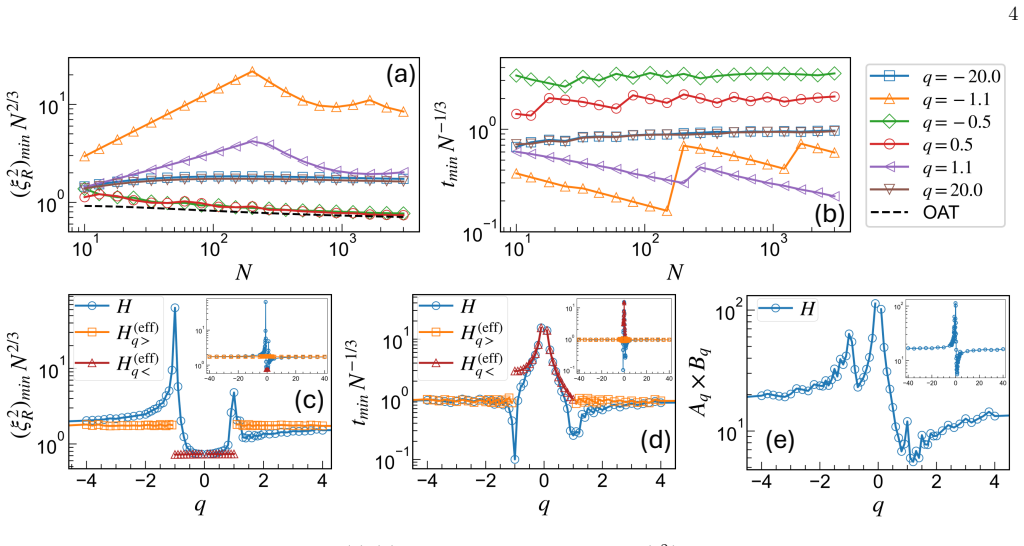
The combination of the native spin-dependent contact interaction and an arbitrary quadratic Zeeman shift generates scalable spin squeezing of the collective spin that obeys the one-axis-twisting scalings ξ_R^{2}_min ∼ N^{-2/3} and t_min ∼ N^{1/3} for every value of the reduced Zeeman parameter q. The same dynamics can be frozen by extinguishing q, leaving the squeezed state available for arbitrary interrogation times.
Load-bearing premise
All atoms occupy exactly the same spatial orbital, so the many-body problem collapses exactly onto a pure collective-spin Hamiltonian.
Signed reviews
Editorial analysis
A structured set of objections, weighed in public.
Referee Report
Summary. The manuscript shows that a spin-1 Bose-Einstein condensate in the single-mode approximation, governed by the Hamiltonian of spin-changing collisions plus a quadratic Zeeman term (Eq. 1), generates scalable collective-spin squeezing from a coherent spin state for essentially any value of the reduced quadratic shift q. For |q| ≪ 1 a Schrieffer-Wolff effective Hamiltonian reduces to one-axis twisting (Eq. 2); for |q| ≫ 1 a rotating-wave approximation yields an effective Hamiltonian (Eq. 4) that produces stroboscopic OAT-like squeezing. Exact diagonalization up to N = 3000 confirms that the optimal Wineland parameter and the optimal time obey the universal OAT scalings (ξ_R^{2})_min ∼ N^{-2/3} and t_min ∼ N^{1/3} across the explored range of q. Quenching q freezes the collective-spin observables because the residual Hamiltonian is SU(2)-invariant, allowing arbitrarily long interrogation times in a subsequent Ramsey sequence. The same framework is argued to apply to larger-spin atoms that can be prepared close to an effective S = 1 coherent state.
Significance. If correct, the result supplies a concrete, experimentally accessible route to scalable spin squeezing in spinor condensates that does not require engineered interactions or Floquet driving. The ability to freeze the squeezed state by simply turning off the quadratic Zeeman field is a practical advantage unique to this platform and directly relevant to entanglement-enhanced magnetometry. The combination of controlled effective Hamiltonians, high-N exact diagonalization, and universal scaling constitutes a solid theoretical foundation that can guide near-term experiments with ^{87}Rb, ^{23}Na and larger-spin species such as Cr, Er or Dy.
minor comments (5)
- End Matter, paragraph after Eq. (10): the statement that higher-order terms produce a polynomial in J_z^{2} is plausible but not demonstrated; a short remark on the radius of convergence of the Schrieffer-Wolff series would strengthen the claim that the OAT form remains dominant for all |q| ≪ 1.
- Fig. 2 and associated text: the exception at q = -1 is noted only in a footnote; a brief physical explanation (or a statement that the scaling is recovered for larger N) would remove any residual ambiguity about universality.
- Fig. 1 caption and panels (b,d): the comparison between exact dynamics and the two effective Hamiltonians is visually clear, yet the quantitative discrepancy (e.g., relative error on ξ_R^{2}) is never stated; a single sentence or inset would help the reader gauge the quality of the approximations.
- End Matter, preparation of S > 1 atoms: the claim of >90 % fidelity is supported by Fig. 5, but the subsequent many-body dynamics under the full spin-dependent Hamiltonian is not simulated; a short caveat that residual population in |m| > 1 may generate additional dephasing would be useful.
- Notation: the reduced quadratic shift q is defined with the sign of the interaction coefficient absorbed; a parenthetical reminder that experimental q_B and c_2 may have independent signs would avoid confusion when comparing with literature values.
Circularity Check
No significant circularity: scalable OAT-like squeezing is obtained from controlled effective Hamiltonians (Schrieffer-Wolff / rotating-wave) plus exact diagonalization of the microscopic single-mode Hamiltonian, with no fitted parameters or self-referential definitions entering the claimed exponents.
full rationale
The derivation chain is self-contained and non-circular. The microscopic Hamiltonian (Eq. 1) is the standard single-mode spinor-BEC model. For |q|≪1 an effective OAT Hamiltonian is obtained by a standard Schrieffer-Wolff projection onto the maximal-spin Dicke manifold (End Matter, Eqs. 5–11); the resulting α₂Jz² term is not assumed but computed order-by-order from the matrix elements of the quadratic Zeeman operator. For |q|≫1 a rotating-wave approximation in the interaction picture yields another effective Hamiltonian (Eq. 4) that again contains an explicit OAT piece. Intermediate-q regimes are treated by exact diagonalization (block-diagonal in magnetization sectors, up to N=3000) that directly measures ξ_R^{2}(t) and extracts the observed scalings (ξ_R^{2})_min∼N^{-2/3}, t_min∼N^{1/3}. Prefactors A_q, B_q are post-hoc numerical summaries of those same simulations; they are never used as inputs to “predict” the exponents. Freezing by quenching q follows immediately from residual SU(2) invariance of the interaction term. Self-citations ([45,46] for the SWT technique, [47] for a contrasting lattice case) supply standard methods or comparisons and do not underwrite the central claim. No quantity is defined in terms of the result it is said to predict, and no uniqueness theorem is imported from prior author work to force the conclusion. The single-mode premise is an explicit modeling assumption, not a circular step.
Assumptions & free parameters
assumptions (4)
- domain assumption All atoms occupy a single spatial mode ϕ(r), so the many-body Hamiltonian reduces exactly to the collective-spin form of Eq. (1).
- standard math Schrieffer-Wolff transformation to second order yields an effective OAT Hamiltonian inside the maximal-J Dicke manifold when |q|≪1.
- standard math Rotating-wave approximation is valid for |q|≫1, discarding terms oscillating at 2|q|.
- domain assumption Unitary evolution from a pure coherent spin state; no decoherence, particle loss or multimode dynamics.
Cite this review
Pith. "Pith review of Universal spin-squeezing dynamics in spinor condensates." pith.science (2026). https://pith.science/paper/SREHRFML
@misc{pith2026260706842,
  author       = {Pith},
  title        = {Pith review of: Universal spin-squeezing dynamics in spinor condensates},
  year         = {2026},
  howpublished = {\url{https://pith.science/paper/SREHRFML}},
  note         = {Machine review of arXiv:2607.06842}
}
read the original abstract
The production of large-scale entangled states is one of the main goals of next-generation quantum technologies, with an immediate potential for applications in the context of entanglement-assisted quantum sensing. A very promising platform to achieve this goal is offered by ultracold spinor gases, made of atoms with a large internal spin sensitive to magnetic fields. Here we show that the native spin-changing collisions in a spinor Bose-Einstein condensate, combined with an arbitrary quadratic Zeeman shift, can generate scalable spin squeezing in the collective spin of the ensemble, following the universal paradigm of the celebrated one-axis-twisting model. Squeezing dynamics is driven by the quadratic Zeeman shift when this shift is small; and by the spin-changing collisions for large shifts, in the form of stroboscopic squeezing. Turning off the Zeeman shift freezes out the collective-spin dynamics, so that the ensuing collective spin dynamics can be uniquely governed by an external field to be sensed. Our theoretical results pave the way for the use of spinor Bose gases with a large spin in fundamental studies of entanglement, as well as in advanced metrological applications.
Figures


Figures from the paper (2 more)


Reference graph
Works this paper leans on
-
[1]
Gilder,The Age of Entanglement: When Quantum Physics Was Reborn(Knopf Doubleday, 2009)
L. Gilder,The Age of Entanglement: When Quantum Physics Was Reborn(Knopf Doubleday, 2009)
work page 2009
-
[2]
M. A. Nielsen and I. L. Chuang,Quantum Computation and Quantum Information(Cambridge University Press, 2010)
work page 2010
-
[3]
I. M. Georgescu, S. Ashhab, and F. Nori, Rev. Mod. Phys.86, 153 (2014), URLhttps://link.aps.org/doi/ 10.1103/RevModPhys.86.153
-
[4]
L. Pezz` e, A. Smerzi, M. K. Oberthaler, R. Schmied, and P. Treutlein, Rev. Mod. Phys.90, 035005 (2018), URL https://link.aps.org/doi/10.1103/RevModPhys.90. 035005
-
[5]
Simon, Ady Stern, Michael Freedman, and Sankar Das Sarma
R. Horodecki, P. Horodecki, M. Horodecki, and K. Horodecki, Rev. Mod. Phys.81, 865 (2009), URLhttp://link.aps.org/doi/10.1103/RevModPhys. 81.865
-
[6]
I. Fr´ erot, M. Fadel, and M. Lewenstein, Reports on Progress in Physics86, 114001 (2023), URLhttps: //doi.org/10.1088/1361-6633/acf8d7
-
[7]
C. Song, K. Xu, H. Li, Y.-R. Zhang, X. Zhang, W. Liu, Q. Guo, Z. Wang, W. Ren, J. Hao, et al., Science365, 574 (2019), URLhttps://doi.org/10.1126/science. aay0600
-
[8]
A. Javadi-Abhari, S. Martiel, A. Seif, M. Takita, and K. X. Wei,Big cats: entanglement in 120 qubits and be- yond(2025), 2510.09520, URLhttps://arxiv.org/abs/ 2510.09520
Show all 57 references
-
[9]
T. Monz, P. Schindler, J. T. Barreiro, M. Chwalla, D. Nigg, W. A. Coish, M. Harlander, W. H¨ ansel, M. Hennrich, and R. Blatt, Phys. Rev. Lett.106, 130506 (2011), URLhttps://link.aps.org/doi/10. 1103/PhysRevLett.106.130506
2011
-
[10]
Franke, S
J. Franke, S. R. Muleady, R. Kaubruegger, F. Kranzl, R. Blatt, A. M. Rey, M. K. Joshi, and C. F. Roos, Nature 621, 740 (2023), ISSN 1476-4687, URLhttps://doi. org/10.1038/s41586-023-06472-z
2023 doi
-
[11]
Est` eve, C
J. Est` eve, C. Gross, A. Weller, S. Giovanazzi, and M. K. Oberthaler, Nature455, 1216 (2008), URLhttps:// doi.org/10.1038/nature07332
2008 doi
-
[12]
M. F. Riedel, P. B¨ ohi, Y. Li, T. W. H¨ ansch, A. Sinatra, and P. Treutlein, Nature464, 1170 (2010), URLhttps: //doi.org/10.1038/nature08988
2010 doi
-
[13]
L¨ ucke, M
B. L¨ ucke, M. Scherer, J. Kruse, L. Pezz´ e, F. Deuret- zbacher, P. Hyllus, O. Topic, J. Peise, W. Ert- mer, J. Arlt, et al., Science334, 773 (2011), https://www.science.org/doi/pdf/10.1126/science.1208798, URLhttps://www.science.org/doi/abs/10.1126/ science.1208798
2011 doi
-
[14]
Gross, Journal of Physics B: Atomic, Molecular and Optical Physics45, 103001 (2012), URLhttps://dx
C. Gross, Journal of Physics B: Atomic, Molecular and Optical Physics45, 103001 (2012), URLhttps://dx. doi.org/10.1088/0953-4075/45/10/103001. 6
2012 doi
-
[15]
L¨ ucke, J
B. L¨ ucke, J. Peise, G. Vitagliano, J. Arlt, L. San- tos, G. T´ oth, and C. Klempt, Phys. Rev. Lett.112, 155304 (2014), URLhttps://link.aps.org/doi/10. 1103/PhysRevLett.112.155304
2014
-
[16]
Luo, Y.-Q
X.-Y. Luo, Y.-Q. Zou, L.-N. Wu, Q. Liu, M.-F. Han, M. K. Tey, and L. You, Science355, 620 (2017), https://www.science.org/doi/pdf/10.1126/science.aag1106, URLhttps://www.science.org/doi/abs/10.1126/ science.aag1106
2017 doi
-
[17]
Zou, L.-N
Y.-Q. Zou, L.-N. Wu, Q. Liu, X.-Y. Luo, S.-F. Guo, J.-H. Cao, M. K. Tey, and L. You, Proceedings of the National Academy of Sciences115, 6381 (2018), https://www.pnas.org/doi/pdf/10.1073/pnas.1715105115, URLhttps://www.pnas.org/doi/abs/10.1073/pnas. 1715105115
2018 doi
-
[18]
Braverman, A
B. Braverman, A. Kawasaki, E. Pedrozo-Pe˜ nafiel, S. Colombo, C. Shu, Z. Li, E. Mendez, M. Yamoah, L. Salvi, D. Akamatsu, et al., Phys. Rev. Lett.122, 223203 (2019), URLhttps://link.aps.org/doi/10. 1103/PhysRevLett.122.223203
2019
-
[19]
Bornet, G
G. Bornet, G. Emperauger, C. Chen, B. Ye, M. Block, M. Bintz, J. A. Boyd, D. Barredo, T. Comparin, F. Mez- zacapo, et al.,Scalable spin squeezing in a dipolar rydberg atom array(2023), URLhttps://arxiv.org/abs/2303. 08053
2023
-
[20]
Finkelstein, R
R. Finkelstein, R. B.-S. Tsai, X. Sun, P. Scholl, S. Di- rekci, T. Gefen, J. Choi, A. L. Shaw, and M. Endres, Nature634, 321 (2024), ISSN 1476-4687, URLhttps: //doi.org/10.1038/s41586-024-08005-8
2024 doi
-
[21]
A. Cao, W. J. Eckner, T. Lukin Yelin, A. W. Young, S. Jandura, L. Yan, K. Kim, G. Pupillo, J. Ye, N. Darkwah Oppong, et al., Nature634, 315 (2024), ISSN 1476-4687, URLhttps://doi.org/10. 1038/s41586-024-07913-z
2024
-
[22]
J. Ma, X. Wang, C. Sun, and F. Nori, Physics Reports509, 89 (2011), ISSN 0370-1573, URL https://www.sciencedirect.com/science/article/ pii/S0370157311002201
2011
-
[23]
Muessel, H
W. Muessel, H. Strobel, D. Linnemann, D. B. Hume, and M. K. Oberthaler, Phys. Rev. Lett.113, 103004 (2014), URLhttps://link.aps.org/doi/10. 1103/PhysRevLett.113.103004
2014
-
[24]
Pedrozo-Pe˜ nafiel, S
E. Pedrozo-Pe˜ nafiel, S. Colombo, C. Shu, A. F. Adiy- atullin, Z. Li, E. Mendez, B. Braverman, A. Kawasaki, D. Akamatsu, Y. Xiao, et al., Nature588, 414 (2020), ISSN 1476-4687, URLhttps://doi.org/10. 1038/s41586-020-3006-1
2020
-
[25]
Schulte, C
M. Schulte, C. Lisdat, P. O. Schmidt, U. Sterr, and K. Hammerer, Nature Communications11, 5955 (2020), ISSN 2041-1723, URLhttps://doi.org/10. 1038/s41467-020-19403-7
2020
-
[26]
G. P. Greve, C. Luo, B. Wu, and J. K. Thompson, Nature 610, 472 (2022), ISSN 1476-4687, URLhttps://doi. org/10.1038/s41586-022-05197-9
2022 doi
-
[27]
W. J. Eckner, N. Darkwah Oppong, A. Cao, A. W. Young, W. R. Milner, J. M. Robinson, J. Ye, and A. M. Kaufman, Nature621, 734 (2023), ISSN 1476-4687, URL https://doi.org/10.1038/s41586-023-06360-6
2023 doi
-
[28]
Moreno-Pineda, C
E. Moreno-Pineda, C. Godfrin, F. Balestro, W. Werns- dorfer, and M. Ruben, Chem. Soc. Rev.47, 501 (2018), URLhttp://dx.doi.org/10.1039/C5CS00933B
2018 doi
-
[29]
Erhard, M
M. Erhard, M. Krenn, and A. Zeilinger, Nature Reviews Physics2, 365 (2020), ISSN 2522-5820, URLhttps:// doi.org/10.1038/s42254-020-0193-5
2020 doi
-
[30]
M. S. Blok, V. V. Ramasesh, T. Schuster, K. O’Brien, J. M. Kreikebaum, D. Dahlen, A. Morvan, B. Yoshida, N. Y. Yao, and I. Siddiqi, Phys. Rev. X11, 021010 (2021), URLhttps://link.aps.org/doi/10. 1103/PhysRevX.11.021010
2021
-
[31]
M. Qiao, G. Emperauger, C. Chen, L. Home- ier, S. Hollerith, G. Bornet, R. Martin, B. G´ ely, L. Klein, D. Barredo, et al., Nature644, 889 (2025), ISSN 1476-4687, URLhttps://doi.org/10. 1038/s41586-025-09377-1
2025
-
[32]
D. M. Stamper-Kurn and M. Ueda, Rev. Mod. Phys. 85, 1191 (2013), URLhttps://link.aps.org/doi/10. 1103/RevModPhys.85.1191
2013
-
[34]
Chomaz, I
L. Chomaz, I. Ferrier-Barbut, F. Ferlaino, B. Laburthe- Tolra, B. L. Lev, and T. Pfau, Reports on Progress in Physics86, 026401 (2022), URLhttps://dx.doi.org/ 10.1088/1361-6633/aca814
2022 doi
-
[35]
C. D. Hamley, C. S. Gerving, T. M. Hoang, E. M. Bookjans, and M. S. Chapman, Nature Physics8, 305 (2012), ISSN 1745-2481, URLhttps://doi.org/10. 1038/nphys2245
2012
-
[36]
T.-W. Mao, Q. Liu, X.-W. Li, J.-H. Cao, F. Chen, W.- X. Xu, M. K. Tey, Y.-X. Huang, and L. You, Nature Physics19, 1585 (2023), ISSN 1745-2481, URLhttps: //doi.org/10.1038/s41567-023-02168-3
2023 doi
-
[37]
Kitagawa and M
M. Kitagawa and M. Ueda, Phys. Rev. A47, 5138 (1993), URLhttps://link.aps.org/doi/10. 1103/PhysRevA.47.5138
1993
-
[38]
Lepoutre, K
S. Lepoutre, K. Kechadi, B. Naylor, B. Zhu, L. Gabar- dos, L. Isaev, P. Pedri, A. M. Rey, L. Vernac, and B. Laburthe-Tolra, Phys. Rev. A97, 023610 (2018), URLhttps://link.aps.org/doi/10.1103/PhysRevA. 97.023610
2018 doi
-
[39]
C. K. Law, H. Pu, and N. P. Bigelow, Phys. Rev. Lett. 81, 5257 (1998), URLhttps://link.aps.org/doi/10. 1103/PhysRevLett.81.5257
1998
-
[40]
J. Jie, Q. Guan, S. Zhong, A. Schwettmann, and D. Blume, Phys. Rev. A102, 023324 (2020), URLhttps: //link.aps.org/doi/10.1103/PhysRevA.102.023324
2020 doi
-
[41]
Kawaguchi and M
Y. Kawaguchi and M. Ueda, Physics Reports520, 253 (2012), ISSN 0370-1573, spinor Bose–Einstein conden- sates, URLhttps://www.sciencedirect.com/science/ article/pii/S0370157312002098
2012
-
[42]
Chalopin, C
T. Chalopin, C. Bouazza, A. Evrard, V. Makhalov, D. Dreon, J. Dalibard, L. A. Sidorenkov, and S. Nascimbene, Nature Communications9, 4955 (2018), ISSN 2041-1723, URLhttps://doi.org/10. 1038/s41467-018-07433-1
2018
-
[43]
Evrard, V
A. Evrard, V. Makhalov, T. Chalopin, L. A. Sidorenkov, J. Dalibard, R. Lopes, and S. Nascimbene, Phys. Rev. Lett.122, 173601 (2019), URLhttps://link.aps.org/ doi/10.1103/PhysRevLett.122.173601
2019 doi
-
[44]
Niezgoda, D
A. Niezgoda, D. Kajtoch, J. Dzieka´ nska, and E. Witkowska, New Journal of Physics21, 093037 (2019), URLhttps://dx.doi.org/10.1088/1367-2630/ ab4099
2019 doi
-
[45]
T. H. Yanes, M. P lodzie´ n, M. M. Sinkeviˇ cien˙ e, G.ˇZlabys, G. Juzeli¯ unas, and E. Witkowska, Physical Review Letters129(2022), URLhttps://doi.org/10.1103% 2Fphysrevlett.129.090403. 7
2022
-
[46]
Hern´ andez Yanes, A
T. Hern´ andez Yanes, A. Niezgoda, and E. Witkowska, Phys. Rev. B109, 214310 (2024), URLhttps://link. aps.org/doi/10.1103/PhysRevB.109.214310
2024 doi
-
[47]
Trifa and T
Y. Trifa and T. Roscilde, Phys. Rev. Lett.133, 083601 (2024), URLhttps://link.aps.org/doi/10. 1103/PhysRevLett.133.083601
2024
-
[48]
At the exception of the caseq=−1, for which we could not directly observe OAT scaling for the system sizes we had access to
-
[49]
M. A. Perlin, C. Qu, and A. M. Rey, Phys. Rev. Lett. 125, 223401 (2020), URLhttps://link.aps.org/doi/ 10.1103/PhysRevLett.125.223401
2020 doi
-
[50]
Roscilde, F
T. Roscilde, F. Mezzacapo, and T. Comparin, Phys. Rev. A104, L040601 (2021), URLhttps://link.aps.org/ doi/10.1103/PhysRevA.104.L040601
2021 doi
-
[51]
Comparin, F
T. Comparin, F. Mezzacapo, M. Robert-de Saint- Vincent, and T. Roscilde, Phys. Rev. Lett.129, 113201 (2022), URLhttps://link.aps.org/doi/10. 1103/PhysRevLett.129.113201
2022
-
[52]
Block, B
M. Block, B. Ye, B. Roberts, S. Chern, W. Wu, Z. Wang, L. Pollet, E. J. Davis, B. I. Halperin, and N. Y. Yao,A universal theory of spin squeezing(2023), URLhttps: //arxiv.org/abs/2301.09636
2023 arXiv
-
[53]
Roscilde, M
T. Roscilde, M. Kumari, A. Cooper, and F. Mezzacapo, Exponential onset of scalable entanglement via twist-and- turn dynamics in xy models(2025), 2507.08206, URL https://arxiv.org/abs/2507.08206
2025 arXiv
-
[54]
Geier, N
S. Geier, N. Thaicharoen, C. Hainaut, T. Franz, A. Salzinger, A. Tebben, D. Grimshandl, G. Z¨ urn, and M. Weidem¨ uller, Science374, 1149 (2021), https://www.science.org/doi/pdf/10.1126/science.abd9547, URLhttps://www.science.org/doi/abs/10.1126/ science.abd9547
2021 doi
-
[55]
Lepoutre, J
S. Lepoutre, J. Schachenmayer, L. Gabardos, B. Zhu, B. Naylor, E. Mar´ echal, O. Gorceix, A. M. Rey, L. Vernac, and B. Laburthe-Tolra, Nature Communi- cations10, 1714 (2019), ISSN 2041-1723, URLhttps: //doi.org/10.1038/s41467-019-09699-5
2019 doi
-
[56]
Aikawa, A
K. Aikawa, A. Frisch, M. Mark, S. Baier, A. Riet- zler, R. Grimm, and F. Ferlaino, Phys. Rev. Lett. 108, 210401 (2012), URLhttps://link.aps.org/doi/ 10.1103/PhysRevLett.108.210401
2012 doi
-
[57]
Claude, L
F. Claude, L. Lafforgue, J. J. A. Houwman, M. J. Mark, and F. Ferlaino, Phys. Rev. Res.6, L042016 (2024), URLhttps://link.aps.org/doi/10.1103/ PhysRevResearch.6.L042016
2024
-
[58]
M. Lu, N. Q. Burdick, S. H. Youn, and B. L. Lev, Phys. Rev. Lett.107, 190401 (2011), URLhttps://link.aps. org/doi/10.1103/PhysRevLett.107.190401. END MATTER Effective Hamiltonian for|q| ≪1.The initial state of the evolution,|CSS x⟩, belongs to the Dicke subspace of states with...
2011 doi
Reviewed July 10, 2026 · model on record in the stance chip above.
Discussion (0). Continue with ORCID to comment.