REVIEW 4 major objections 8 minor 76 references
Gradient-free Riemannian Langevin Sampler
T0 review · 4 major / 8 minor · reviewed 2026-07-09 · glm-5.2
Pith's one-line read Sampling multimodal distributions without gradients
desk verdict Gradient-free Langevin sampler with a clean Poincaré bound, but the discrete-to-continuous bridge is unestablished at finite step size. read the letter →
The pith
A machine-rendered reading of the paper's core claim, the machinery that carries it, and where it could break.
The reading
What carries the argument
The Riemannian metric W(x) = (ν(x)/μ(x))Σ; the gradient-free Langevin dynamics it induces (Eq. 16); the Lamperti time-change τ(t) = ∫₀ᵗ ν(Y_s)/μ(Y_s) ds linking an Ornstein-Uhlenbeck process to the target dynamic; the resulting proposal x† = m + θ_k(x_k − m) + √(1−θ_k²)ξ_k with θ_k = exp(−Δt·ν(x_k)/μ(x_k)); the Poincaré constant bound C(μ, W) ≤ sup(μ/ν); the block-ensemble estimation of mean and covariance from interacting particles.
What would settle it
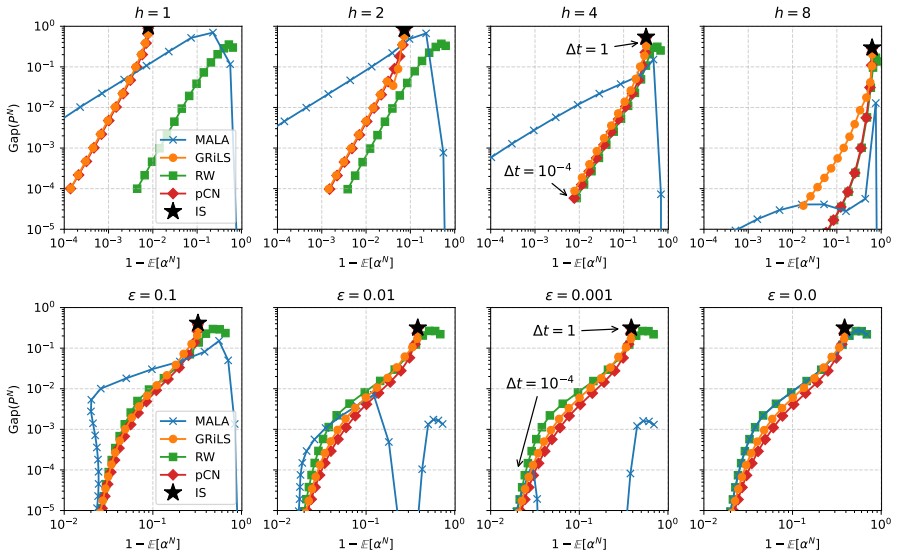
On a Gaussian mixture with mode separation h, measure the spectral gap of the GRiLS transition kernel as h increases. If the spectral gap does not decay at most polynomially (linearly) in h but instead decays exponentially, the central claim that the Poincaré constant grows linearly rather than exponentially is not realized in the discrete algorithm.
Extended reading notes
Core claim
The ratio W(x) = (ν(x)/μ(x))Σ, with ν a moment-matched Gaussian, produces a gradient-free Langevin dynamic that admits μ as its invariant measure and whose Poincaré constant is bounded by sup(μ/ν). For a two-mode Gaussian mixture with mode separation h, this bound grows as O(h) rather than O(exp(h²)), converting the exponential mode-hopping difficulty into a linear one. The Lamperti-transformed discretization yields a stable proposal that avoids the variance explosion of naive Euler-Maruyama and recovers pCN as a special case when the state-dependent step parameter is held constant.
Load-bearing premise
The method requires that a single Gaussian ν matching the target's mean and covariance 'covers' all modes in the sense that the ratio μ(x)/ν(x) is bounded everywhere. If the target has modes or mass in regions where this Gaussian is negligibly small, the convergence-rate guarantee becomes vacuous and the proposal's step size degenerates.
Editorial extensions
If this is right
- Gradient-free sampling for expensive black-box likelihoods (e.g., scientific simulators with no derivative access) becomes more principled when the target's first two moments are available or estimable, since the ratio-bounded Poincaré guarantee provides a convergence-rate contract rather than a heuristic.
- The interpolation between pCN (constant θ) and an independence sampler (θ→0) within a single proposal provides a tuning knob that could be adapted online based on the estimated mode coverage ratio sup(μ/ν).
- The generalization to non-Gaussian reference densities ν (Remark 2.2) opens a route to gradient-free samplers tailored to targets with heavy tails or skewness, where a moment-matched Gaussian would give a vacuous bound.
- Restricting the spatially varying component of the metric to a low-dimensional subspace, as the authors suggest for high dimensions, could make the approach scalable while preserving the mode-bridging benefit.
Reading between the lines
- The method's success is fundamentally tied to the quality of the Gaussian approximation ν: if the target has modes in regions where ν is negligibly small (heavy tails, far outliers, or many well-separated modes in high dimension), the ratio sup(μ/ν) explodes and the Poincaré bound becomes vacuous, so the linear-in-h guarantee is a best-case guarantee, not a universal one.
- The exponential dependence on dimension d and number of modes N in the bound (20) for multi-component mixtures suggests that the practical regime where GRiLS outperforms alternatives may be moderate-dimensional with a manageable number of modes—exactly the regime tested, but not necessarily the regime of interest for very high-dimensional problems.
- Since the proposal reduces to an independence sampler as Δt→∞ with acceptance rate governed by the TV distance between μ⊗ν and ν⊗μ, the method's efficiency ceiling in any given problem is set by how well ν approximates μ—making the choice of reference density the true lever, with the Riemannian dynamics providing a smooth interpolation rather than a fundamentally different sampling mechanism.
Editorial analysis
A structured set of objections, weighed in public.
Referee Report
Summary. The paper introduces GRiLS (Gradient-free Riemannian Langevin Sampler), a Metropolis-Hastings proposal for sampling multimodal distributions without gradient evaluations. The core idea is the Riemannian metric W(x) = (ν(x)/μ(x))Σ, where ν is a Gaussian with the target's mean and covariance. This metric renders the Langevin dynamics (Eq. 16) gradient-free while preserving μ as invariant. A Lamperti transform (Proposition 2) maps the dynamics to an OU process with a path-dependent time change, and a first-order quadrature (Eq. 24) yields the practical proposal (Eq. 25/27). Proposition 1 bounds the Poincaré constant by sup(μ/ν), which grows polynomially rather than exponentially with mode separation for Gaussian mixtures (Eq. 19). A block-ensemble variant (BE-GRiLS) estimates mean and covariance from particles. Numerical experiments in d=1 (spectral gap via Ulam discretization) and d=2,10 (empirical moment errors) compare favorably against pCN, MALA, adaptive Metropolis, and AIES.
Significance. The paper makes a genuine contribution by identifying a parameter-free metric (given the target's first two moments) that simultaneously eliminates gradient computations and yields a Poincaré constant with polynomial (rather than exponential) growth in mode separation. The connection to pCN and the independence sampler via the step-size limits is elegant and clarifying. The Lamperti transform construction is a clean device for obtaining a stable discretization. The reproducible code for both 1D and higher-dimensional experiments is a strength. The Poincaré bound (Proposition 1) is derived from external inequalities (Gaussian Poincaré) and does not assume the conclusion; the construction is not circular.
major comments (4)
- Remark 3.1 states the RMS quadrature error for the Lamperti time-change integral (Eq. 24) is O(Δt^{3/2}). This is correct in conditional expectation over the OU path, but the hidden constant scales with the pathwise supremum of ν(Y_s)/μ(Y_s) over [0, Δt]. When the OU trajectory passes through a low-μ region between modes, the integrand spikes and the point-evaluation quadrature can be off by orders of magnitude relative to the true time change τ(Δt). The paper does not provide an error bound linking the discrete proposal (Eq. 25) to the continuous SDE (Eq. 16) at fixed Δt that accounts for this. The Poincaré analysis (Section 4) applies only to the continuous SDE. Please add a discussion of this pathwise error and its practical implications, or provide a bound that controls the quadrature error uniformly over the OU path.
- Remark 4.1 / Eq. (43): the link between the spectral gap of the discrete MCMC chain and the Poincaré constant is explicitly flagged as not fully derived ('beyond the scope of this paper'). This is a load-bearing step for the central practical claim that the favorable Poincaré constant translates to faster mixing of the GRiLS proposal. The numerical spectral gap computations in Section 5.1 provide empirical support, but the theoretical gap remains open. Please clarify in the main text (not just the remark) that Eq. (43) is conjectural and that the mixing claims rest on the continuous-time analysis plus empirical evidence.
- The coverage assumption sup(μ/ν) < ∞ (stated following Eq. 2 and formalized in Prop. 1) is the central practical condition. For the Gaussian mixture bound (Eq. 20), the constant grows as exp(N/2)(1+h²)^{d/2}, which is exponential in both the number of modes N and the dimension d. The paper acknowledges this is 'likely overly pessimistic' (Remark 2.1), but the practical regime where the bound remains useful is not characterized. Please specify, at least qualitatively, the class of targets for which sup(μ/ν) is moderate, and discuss what happens when the target has heavy tails or modes far from the mean (where ν is negligibly small and the bound becomes vacuous).
- Section 6.2, Figure 9: the d=10 experiment initializes BE-GRiLS from N(μ_MAP, Σ_π) where Σ_π is the true global covariance. This gives BE-GRiLS an oracle advantage that the competing methods (AM, MALA initialized at MAP with identity covariance) do not have. The comparison is therefore not on equal footing. Please either initialize all methods from the same distribution, or explicitly discuss how the initialization affects the fairness of the comparison.
minor comments (8)
- Table 1: the entry for the present paper's metric uses 'Cov_μ' in the last row but the formula in Eq. (15) uses 'Σ'. Please unify notation.
- Eq. (3) and Eq. (25): the proposal is written with θ_k = exp(-Δt ν(x_k)/μ(x_k)) in both places, but Eq. (3) uses the notation x† while Eq. (25) uses x_{k+1}. Consistent notation would improve readability.
- Section 5.1: the Ulam discretization uses N=2000 bins. A brief sensitivity check or justification for this resolution would strengthen the spectral gap estimates.
- Figure 3: the y-axis label 'χ²(μ_N || μ_N^∞)' is cut off in some panels. Please ensure all axis labels are fully visible.
- Section 6.1: the step size Δt=0.3 is stated as chosen 'to minimize the probability of missing modes due to initialization.' Please clarify whether this was tuned by pilot runs or selected a priori.
- Reference [39] (Kutri and Scheichl, 2026) and [9] (Chakraborty et al., 2025) appear relevant to the gradient-free MCMC literature review in the introduction. Please ensure these are discussed in context rather than only cited.
- Remark 3.3, Eq. (30): the TV distance expression for the independence sampler limit is a nice result but is somewhat buried. Consider highlighting it as a proposition.
- Appendix B: 'one simply test' should be 'one simply tests'; 'the function h ↦ Var_μ(f) is monotonically increasing (because f is)' — please clarify that f is monotone, not h.
Simulated Author's Rebuttal
We thank the referee for a careful and constructive report. The referee correctly identifies the main contributions of the paper and raises four substantive points regarding (1) pathwise quadrature error in the Lamperti time-change, (2) the conjectural status of the spectral gap/Poincaré constant link, (3) the practical regime where the coverage assumption sup(μ/ν)<∞ is useful, and (4) the fairness of the initialization in the d=10 experiment. We address each point below. We agree that points (1), (2), and (3) require revisions to the manuscript to clarify the scope and limitations of our theoretical results, and we will incorporate these. On point (4), we acknowledge the referee's concern about the oracle initialization and will revise the experiment and its discussion.
read point-by-point responses
-
Referee: Remark 3.1 states the RMS quadrature error for the Lamperti time-change integral (Eq. 24) is O(Δt^{3/2}). This is correct in conditional expectation over the OU path, but the hidden constant scales with the pathwise supremum of ν(Y_s)/μ(Y_s) over [0, Δt]. When the OU trajectory passes through a low-μ region between modes, the integrand spikes and the point-evaluation quadrature can be off by orders of magnitude relative to the true time change τ(Δt). The paper does not provide an error bound linking the discrete proposal (Eq. 25) to the continuous SDE (Eq. 16) at fixed Δt that accounts for this. The Poincaré analysis (Section 4) applies only to the continuous SDE. Please add a discussion of this pathwise error and its practical implications, or provide a bound that controls the quadrature error uniformly over the OU path.
Authors: The referee is correct that the O(Δt^{3/2}) error stated in Remark 3.1 is a conditional-expectation bound and that the hidden constant depends on the pathwise behavior of ν(Y_s)/μ(Y_s). When the OU trajectory traverses a low-μ region between modes, the integrand indeed spikes, and the left-point quadrature (24) can deviate significantly from the true time change τ(Δt) on individual paths. We do not currently have a uniform (pathwise) error bound for the quadrature that controls this behavior, and we agree that this gap should be made explicit in the manuscript. We will revise Remark 3.1 to: (a) clarify that the O(Δt^{3/2}) bound holds in conditional expectation and that the hidden constant involves the pathwise supremum of ν/μ along the OU trajectory, (b) note that the Poincaré analysis in Section 4 applies to the continuous SDE (16) and not to the discretized proposal, and (c) discuss the practical implications, including the observation that the Lamperti-based proposal (25) is designed to remain stable (unlike the Euler-Maruyama scheme (21)) even when the ratio ν/μ is large, because θ_k→0 in low-μ regions and the proposal collapses to N(m,Σ) rather than exploding. We will also note that higher-order quadrature schemes (mentioned in Remark 3.1) could mitigate the pathwise error at the cost of gradient evaluations, but this is outside the scope of the present gradient-free setting. We are unable to provide a uniform pathwise bound at this time and will state this as a limitation. revision: partial
-
Referee: Remark 4.1 / Eq. (43): the link between the spectral gap of the discrete MCMC chain and the Poincaré constant is explicitly flagged as not fully derived ('beyond the scope of this paper'). This is a load-bearing step for the central practical claim that the favorable Poincaré constant translates to faster mixing of the GRiLS proposal. The numerical spectral gap computations in Section 5.1 provide empirical support, but the theoretical gap remains open. Please clarify in the main text (not just the remark) that Eq. (43) is conjectural and that the mixing claims rest on the continuous-time analysis plus empirical evidence.
Authors: We agree that the link between the Poincaré constant of the continuous SDE and the spectral gap of the discrete MCMC chain is conjectural and that this should be stated more prominently. Equation (43) requires a stronger remainder bound R(f) ≤ C(1 + E_μ[‖∇f‖²_W]) that we have not established; without it, the derivation from (42) to (43) is not rigorous. We will revise the main text (Section 4) to explicitly flag that (43) is conjectural, to clarify that the Poincaré analysis in Section 2 and Proposition 1 applies to the continuous-time dynamics (16) and not to the discrete proposal, and to state that the practical mixing claims rest on (a) the continuous-time Poincaré bound, (b) the conjectural link in (43), and (c) the empirical spectral gap computations in Section 5.1. We will also add a sentence in the abstract or introduction to this effect. We cannot close this theoretical gap in the present revision; it is a natural direction for future work, as noted in Section 7. revision: yes
-
Referee: The coverage assumption sup(μ/ν) < ∞ (stated following Eq. 2 and formalized in Prop. 1) is the central practical condition. For the Gaussian mixture bound (Eq. 20), the constant grows as exp(N/2)(1+h²)^{d/2}, which is exponential in both the number of modes N and the dimension d. The paper acknowledges this is 'likely overly pessimistic' (Remark 2.1), but the practical regime where the bound remains useful is not characterized. Please specify, at least qualitatively, the class of targets for which sup(μ/ν) is moderate, and discuss what happens when the target has heavy tails or modes far from the mean (where ν is negligibly small and the bound becomes vacuous).
Authors: We agree that the practical regime where sup(μ/ν) is moderate deserves more discussion. We will add a paragraph in Section 2 (after Remark 2.1) characterizing, at least qualitatively, the class of targets for which the bound is useful. Specifically: (a) For Gaussian mixtures with N components in dimension d, sup(μ/ν) is moderate when the number of modes N and the dimension d are not too large relative to the separation h, and when the component covariances are not too dissimilar from the global covariance. (b) The bound becomes vacuous when modes are far from the global mean (large h), when N or d are large, or when the target has heavy tails that are poorly covered by the Gaussian ν. In the heavy-tail case, ν(x)→0 faster than μ(x) in the tails, so sup(μ/ν)=∞ and the Poincaré bound (17) is vacuous; the algorithm may still be practically useful (the proposal remains well-defined) but the theoretical guarantee does not apply. (c) For targets where the Gaussian approximation ν is a poor cover, the generalization in Remark 2.2 (using a non-Gaussian reference) suggests a remedy, though we leave the practical construction of such references to future work. We will also note that the exponential dependence on N in (20) is likely an artifact of the proof technique (as already noted in Remark 2.1) and that the d=1 bound (19) grows only polynomially in h, which is the key qualitative advantage over standard Langevin. revision: yes
-
Referee: Section 6.2, Figure 9: the d=10 experiment initializes BE-GRiLS from N(μ_MAP, Σ_π) where Σ_π is the true global covariance. This gives BE-GRiLS an oracle advantage that the competing methods (AM, MALA initialized at MAP with identity covariance) do not have. The comparison is therefore not on equal footing. Please either initialize all methods from the same distribution, or explicitly discuss how the initialization affects the fairness of the comparison.
Authors: The referee is correct that the initialization in Section 6.2 gives BE-GRiLS access to the true global covariance, which is an oracle advantage. We will address this in two ways. First, we will add an explicit discussion in Section 6.2 acknowledging the unequal initialization and explaining the rationale: BE-GRiLS is an ensemble method that requires an initial ensemble spread to estimate the mean and covariance, and initializing from N(μ_MAP, Σ_π) was intended to give all methods the best chance of success. However, we agree this is not a fair comparison. Second, we will rerun the d=10 experiment with a fairer initialization: either (a) initializing the ensemble methods from N(μ_MAP, I_d) (matching the single-chain methods' covariance) or (b) initializing all methods from the same distribution, e.g., a broad Gaussian centered at μ_MAP. We expect BE-GRiLS to still perform well in case (a) because the ensemble will adapt its covariance estimate over iterations, though there may be a longer burn-in. We will report the updated results and discuss the impact of initialization on the relative performance. revision: yes
Circularity Check
No significant circularity; derivation is self-contained with one non-load-bearing self-citation
full rationale
The paper's main theoretical results are derived from standard external tools, not from self-citation. Proposition 1 (Poincaré bound C(μ,W_μ) ≤ sup(μ/ν)) is proved using the Gaussian Poincaré inequality from [4] (Bakry, Gentil, Ledoux) and a standard change-of-measure argument — no result from the authors' own prior work is invoked. The gradient-free property (Eq. 16) follows from the algebraic identity (Eq. 14): div W(x) − W(x)∇V(x) = (1/μ)div(Wμ), which holds for any W = A/μ by direct calculation. The Lamperti transform (Prop. 2) cites Øksendal [51] for the stochastic time-change theorem. The Gaussian mixture bound (Eq. 19) is a direct computation of sup(μ_h/ν_h) in Appendix A. The proposal (Eq. 25) follows from the OU process closed-form solution evaluated at the quadrature-approximated time change. The one self-citation is [16] (Cui, Tong, Zahm), which provides the optimal-metric optimization framework (Eq. 9) and the 1D closed form (Eq. 12). However, the paper explicitly states its metric is suboptimal ('Although it might not be optimal in the sense of [16]') and uses [16] only as motivation for the construction — the ansatz W = (ν/μ)Σ is inspired by qualitative properties of the optimal metric (unimodality, support coverage) shown in Figure 1, not derived from it. The Poincaré bound, the gradient-free property, and the Lamperti-based proposal are all proved independently of [16]. Remark 4.1 is notably honest: the spectral-gap-to-Poincaré-constant link (Eq. 43) is explicitly left as unproven future work. No fitted parameter is renamed as a prediction; the mean and covariance are estimated empirically but the theory assumes exact values. The derivation chain is self-contained against external benchmarks.
Assumptions & free parameters
free parameters (3)
- Step size ∆t =
0.3 (2D experiments), tuned via pilot run (10D)
- Number of particles N =
10 (2D), 40 (10D)
- Block partition P =
2 (equal size)
assumptions (3)
- domain assumption The target density μ is fully supported on R^d (μ(x) > 0 for all x).
- domain assumption The Gaussian approximation ν covers the target: sup(μ/ν) < ∞.
- ad hoc to paper The spectral gap of the MCMC transition kernel relates to the Poincaré constant via Gap(P) = ∆t/C(μ,W) + O(∆t^{3/2}).
Cite this review
Pith. "Pith review of Gradient-free Riemannian Langevin Sampler." pith.science (2026). https://pith.science/paper/BWXA56GY
@misc{pith2026260707519,
  author       = {Pith},
  title        = {Pith review of: Gradient-free Riemannian Langevin Sampler},
  year         = {2026},
  howpublished = {\url{https://pith.science/paper/BWXA56GY}},
  note         = {Machine review of arXiv:2607.07519}
}
read the original abstract
We address the problem of efficiently sampling multimodal probability distributions, where standard Markov Chain Monte Carlo methods often suffer from poor mixing and mode trapping. To mitigate these issues, we propose Gradient-free Riemannian Langevin Sampler (GRiLS), a novel proposal that improves exploration without requiring gradient evaluations of the target density. Our approach introduces a Riemannian metric which reshapes the local geometry in order to facilitate transitions across modes. The resulting gradient-free MCMC algorithm is particularly suitable for complex, computationally expensive targets where derivatives are unavailable or impractical. The GRiLS proposal requires knowing the mean and covariance of the target density, which we estimate using an ensemble of interacting particles. Empirical results on multimodal benchmarks demonstrate that GRiLS achieves improved mixing compared to existing gradient-based and gradient-free MCMC approaches.
Figures


Figures from the paper (6 more)



Reference graph
Works this paper leans on
-
[1]
Sampling with Adaptive Variance for Multimodal Distributions
Sampling with Adaptive Variance for Multimodal Distributions , author=. arXiv preprint arXiv:2411.15220 , year=
-
[2]
Advances in neural information processing systems , volume=
Rapid convergence of the unadjusted langevin algorithm: Isoperimetry suffices , author=. Advances in neural information processing systems , volume=
-
[3]
Communications on Applied Mathematics and Computation , volume=
Adaptive state-dependent diffusion for derivative-free optimization , author=. Communications on Applied Mathematics and Computation , volume=. 2024 , publisher=
work page 2024
-
[4]
Optimizing the diffusion coefficient of overdamped
Leli. Optimizing the diffusion coefficient of overdamped. Mathematics of Computation , year=
-
[5]
Communications in applied mathematics and computational science , volume=
Ensemble samplers with affine invariance , author=. Communications in applied mathematics and computational science , volume=. 2010 , publisher=
work page 2010
-
[6]
Robert, Christian P and Casella, George and Casella, George , volume=. Monte. 1999 , publisher=
work page 1999
-
[7]
Journal of theoretical probability , volume=
When is a stochastic integral a time change of a diffusion? , author=. Journal of theoretical probability , volume=. 1990 , publisher=
work page 1990
-
[8]
Stable generative modelling using Schr
Gottwald, Georg A and Li, Fengyi and Marzouk, Youssef and Reich, Sebastian , journal=. Stable generative modelling using Schr. 2025 , publisher=
work page 2025
Show all 76 references
-
[9]
An Adaptive
Haario, Heikki and Saksman, Eero and Tamminen, Johanna , journal=. An Adaptive. 2001 , publisher=
2001
-
[10]
Book draft available at https://chewisinho
Log-concave sampling , author=. Book draft available at https://chewisinho. github. io , volume=
-
[11]
Nonasymptotic convergence analysis for the unadjusted
Durmus, Alain and Moulines, Eric , journal=. Nonasymptotic convergence analysis for the unadjusted
-
[12]
Advances in Neural Information Processing Systems , volume=
Exponential ergodicity of mirror-Langevin diffusions , author=. Advances in Neural Information Processing Systems , volume=
-
[13]
1995 , publisher=
Bayesian data analysis , author=. 1995 , publisher=
1995
-
[14]
Statistics and computing , volume=
Sampling from multimodal distributions using tempered transitions , author=. Statistics and computing , volume=. 1996 , publisher=
1996
-
[15]
Cui, Tiangang and Tong, Xin and Zahm, Olivier , journal=. Optimal
-
[16]
2013 , publisher=
Analysis and geometry of Markov diffusion operators , author=. 2013 , publisher=
2013
-
[17]
Advances in Applied Probability , volume=
Time-reversible diffusions , author=. Advances in Applied Probability , volume=. 1978 , publisher=
1978
-
[18]
Riemann manifold
Girolami, Mark and Calderhead, Ben , journal=. Riemann manifold. 2011 , publisher=
2011
-
[19]
Lectures from
Chung, Kai Lai , volume=. Lectures from. 2013 , publisher=
2013
-
[20]
Mirrored
Hsieh, Ya-Ping and Kavis, Ali and Rolland, Paul and Cevher, Volkan , journal=. Mirrored
-
[21]
Wasserstein control of mirror
Zhang, Kelvin Shuangjian and Peyr. Wasserstein control of mirror. Conference on learning theory , pages=. 2020 , organization=
2020
-
[22]
Optimal preconditioning and
Titsias, Michalis , journal=. Optimal preconditioning and
-
[23]
Menz, Georg and Schlichting, Andr. Poincar. The Annals of Probability , volume=. 2014 , publisher=
2014
-
[24]
2013 , publisher=
Cotter, Simon L and Roberts, Gareth O and Stuart, Andrew M and White, David , journal=. 2013 , publisher=
2013
-
[25]
Geometric
Beskos, Alexandros and Girolami, Mark and Lan, Shiwei and Farrell, Patrick E and Stuart, Andrew M , journal=. Geometric. 2017 , publisher=
2017
-
[26]
Log-density gradient covariance and automatic metric tensors for
Kleppe, Tore Selland , journal=. Log-density gradient covariance and automatic metric tensors for. 2024 , publisher=
2024
-
[27]
A general metric for
Betancourt, Michael , booktitle=. A general metric for. 2013 , organization=
2013
-
[28]
Derivative-informed neural operator acceleration of geometric
Cao, Lianghao and O'Leary-Roseberry, Thomas and Ghattas, Omar , journal=. Derivative-informed neural operator acceleration of geometric
-
[29]
Journal of Functional Analysis , volume=
Moment measures , author=. Journal of Functional Analysis , volume=. 2015 , publisher=
2015
-
[30]
Weighted
Saumard, Adrien , journal=. Weighted. 2019 , publisher=
2019
-
[31]
2002 , publisher=
Shape Optimization by the Homogenization Method , author=. 2002 , publisher=
2002
-
[32]
A note on one-dimensional
Germain, Gilles and Swan, Yvik , journal=. A note on one-dimensional. 2023 , publisher=
2023
-
[33]
Bernoulli , number =
Marie Ernst and Gesine Reinert and Yvik Swan , title =. Bernoulli , number =. 2020 , doi =
2020
-
[34]
On one dimensional weighted
Heredia, David and Joulin, Ald. On one dimensional weighted. Journal of Mathematical Analysis and Applications , pages=. 2025 , publisher=
2025
-
[35]
Derivative-based new upper bound of
Song, Shufang and Zhou, Tong and Wang, Lu and Kucherenko, Sergei and Lu, Zhenzhou , journal=. Derivative-based new upper bound of. 2019 , publisher=
2019
-
[36]
Journal of Theoretical Probability , volume=
Stochastic calculus for a time-changed semimartingale and the associated stochastic differential equations , author=. Journal of Theoretical Probability , volume=. 2011 , publisher=
2011
-
[37]
Stochastic differential equations: an introduction with applications , pages=
Stochastic differential equations , author=. Stochastic differential equations: an introduction with applications , pages=. 2003 , publisher=
2003
-
[38]
Convergence of Langevin Monte Carlo in chi-squared and R
Erdogdu, Murat A and Hosseinzadeh, Rasa and Zhang, Shunshi , booktitle=. Convergence of Langevin Monte Carlo in chi-squared and R. 2022 , organization=
2022
-
[39]
Asymptotics of the spectral gap with applications to the theory of simulated annealing , author=. J. Funct. Anal , volume=
-
[40]
Schlichting, Andr. Poincar. Entropy , volume=. 2019 , publisher=
2019
-
[41]
Environmental Modelling & Software , volume=
Markov chain Monte Carlo simulation using the DREAM software package: Theory, concepts, and MATLAB implementation , author=. Environmental Modelling & Software , volume=. 2016 , publisher=
2016
-
[42]
A Non-asymptotic Analysis for Learning and Applying a Preconditioner in
Hird, Max and Maire, Florian and Negrea, Jeffrey , journal=. A Non-asymptotic Analysis for Learning and Applying a Preconditioner in
-
[43]
Semi-stable
Lamperti, John , journal=. Semi-stable. 1972 , publisher=
1972
-
[44]
Gradient-enhanced global sensitivity analysis with
Roustant, O and L\"uthen, N and Heredia, D and Sudret, B , journal=. Gradient-enhanced global sensitivity analysis with
-
[45]
2013 , publisher=
Numerical Solution of Stochastic Differential Equations , author=. 2013 , publisher=
2013
-
[46]
Roberts and Jeffrey S
Gareth O. Roberts and Jeffrey S. Rosenthal , journal =. Harris Recurrence of
-
[47]
Statistics and Computing , volume=
Metropolis-adjusted interacting particle sampling , author=. Statistics and Computing , volume=. 2025 , publisher=
2025
-
[48]
Interacting
Garbuno-Inigo, Alfredo and Hoffmann, Franca and Li, Wuchen and Stuart, Andrew M , journal=. Interacting. 2020 , publisher=
2020
-
[49]
A tutorial on adaptive
Andrieu, Christophe and Thoms, Johannes , journal=. A tutorial on adaptive. 2008 , publisher=
2008
-
[50]
Transport map accelerated
Parno, Matthew D and Marzouk, Youssef M , journal=. Transport map accelerated. 2018 , publisher=
2018
-
[51]
Scalable conditional deep inverse
Cui, Tiangang and Dolgov, Sergey and Zahm, Olivier , journal=. Scalable conditional deep inverse. 2023 , publisher=
2023
-
[52]
Log-concave sampling:
Dwivedi, Raaz and Chen, Yuansi and Wainwright, Martin J and Yu, Bin , journal=. Log-concave sampling:
-
[53]
The Journal of Physical Chemistry B , volume=
The adaptive biasing force method: Everything you always wanted to know but were afraid to ask , author=. The Journal of Physical Chemistry B , volume=. 2015 , publisher=
2015
-
[54]
2010 , publisher=
Free energy computations: A mathematical perspective , author=. 2010 , publisher=
2010
-
[55]
Certified dimension reduction in nonlinear
Zahm, Olivier and Cui, Tiangang and Law, Kody and Spantini, Alessio and Marzouk, Youssef , journal=. Certified dimension reduction in nonlinear
-
[56]
Sharp detection of low-dimensional structure in probability measures via dimensional logarithmic
Li, Matthew TC and Cui, Tiangang and Li, Fengyi and Marzouk, Youssef and Zahm, Olivier , journal=. Sharp detection of low-dimensional structure in probability measures via dimensional logarithmic. 2025 , publisher=
2025
-
[57]
Studies in Applied Mathematics , volume=
Consensus-based sampling , author=. Studies in Applied Mathematics , volume=. 2022 , publisher=
2022
-
[58]
Statistica Sinica , pages=
Adaptively scaling the Metropolis algorithm using expected squared jumped distance , author=. Statistica Sinica , pages=. 2010 , publisher=
2010
-
[59]
Ensemble preconditioning for
Leimkuhler, Benedict and Matthews, Charles and Weare, Jonathan , journal=. Ensemble preconditioning for. 2018 , publisher=
2018
-
[60]
Optimal scaling of discrete approximations to
Roberts, Gareth O and Rosenthal, Jeffrey S , journal=. Optimal scaling of discrete approximations to. 1998 , publisher=
1998
-
[61]
2017 , publisher=
Markov chains and mixing times , author=. 2017 , publisher=
2017
-
[62]
A note on
Tierney, Luke , journal=. A note on. 1998 , publisher=
1998
-
[63]
Stochastic Processes and their Applications , volume=
A Dirichlet form approach to MCMC optimal scaling , author=. Stochastic Processes and their Applications , volume=. 2017 , publisher=
2017
-
[64]
Practical
Geyer, Charles J , journal=. Practical. 1992 , publisher=
1992
-
[65]
Journal of Computational and Applied Mathematics , volume=
Finite approximations of Markov operators , author=. Journal of Computational and Applied Mathematics , volume=. 2002 , publisher=
2002
-
[66]
Nonlinear Analysis: Theory, Methods & Applications , volume=
Approximating physical invariant measures of mixing dynamical systems in higher dimensions , author=. Nonlinear Analysis: Theory, Methods & Applications , volume=. 1998 , publisher=
1998
-
[67]
(No Title) , year=
A collection of mathematical problems , author=. (No Title) , year=
-
[68]
Convergence of numerical time-averaging and stationary measures via
Mattingly, Jonathan C and Stuart, Andrew M and Tretyakov, Michael V , journal=. Convergence of numerical time-averaging and stationary measures via. 2010 , publisher=
2010
-
[69]
Langevin diffusions and the
Xifara, Tatiana and Sherlock, Chris and Livingstone, Samuel and Byrne, Simon and Girolami, Mark , journal=. Langevin diffusions and the. 2014 , publisher=
2014
-
[70]
Spectral Gap of
Liu, Shuigen and Tong, Xin T , journal=. Spectral Gap of
-
[71]
Explicit convergence bounds for
Andrieu, Christophe and Lee, Anthony and Power, Sam and Wang, Andi Q , journal=. Explicit convergence bounds for. 2024 , publisher=
2024
-
[72]
arXiv preprint arXiv:2605.30979 , year=
On weighted Poincaré inequalities for multivariate Liouville distributions--Application to Global Sensitivity Analysis , author=. arXiv preprint arXiv:2605.30979 , year=
-
[73]
arXiv preprint arXiv:2606.27564 , year=
Fast-Mixing Markov Chains without Gradients , author=. arXiv preprint arXiv:2606.27564 , year=
-
[74]
SIAM Journal on Applied Dynamical Systems , volume=
Affine invariant interacting Langevin dynamics for Bayesian inference , author=. SIAM Journal on Applied Dynamical Systems , volume=. 2020 , publisher=
2020
-
[75]
2025 , eprint=
Affine Invariant Langevin Dynamics for rare-event sampling , author=. 2025 , eprint=
2025
-
[76]
Journal of Computational Physics , pages=
Improving sampling by modifying the effective diffusion , author=. Journal of Computational Physics , pages=. 2025 , publisher=
2025
Reviewed July 9, 2026 · model on record in the stance chip above.
Discussion (0). Continue with ORCID to comment.