REVIEW 5 minor 1 cited by
Observation of coherent flux-charge interaction in a gate-tunable fluxonium
T0 review · 0 major / 5 minor · reviewed 2026-07-10 · grok-4.5
Pith's one-line read A voltage-tunable Josephson junction mediates coherent flux-charge coupling that can be isolated by parity rules and used for Rabi control while remaining first-order gate-insensitive.
desk verdict Clean first experimental isolation of coherent flux-charge driving, using parity selection and a charge-insensitive sweet spot in a hybrid fluxonium. read the letter →
The pith
A machine-rendered reading of the paper's core claim, the machinery that carries it, and where it could break.
The reading
What carries the argument
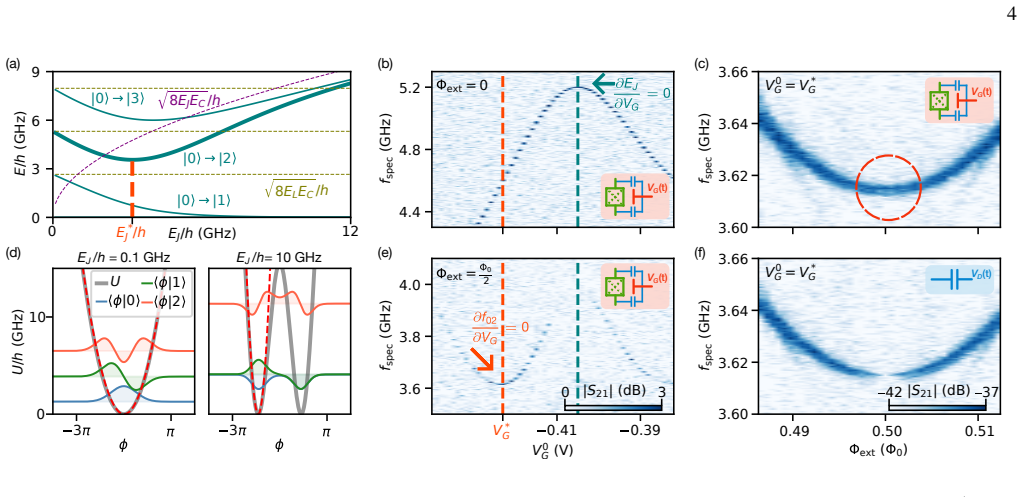
The flux-charge drive Hamiltonian term ∝ (∂EJ/∂VG) cos ϕ · δVG cos(2πft), isolated by the even parity of cos ϕ at Φext = Φ₀/2 (where the charge matrix element vanishes) and operated at the ChIVE sweet spot where ∂f₀₂/∂EJ = 0.
What would settle it
If a pure capacitive drive through the dedicated charge line, or a gate-line drive with ∂EJ/∂VG deliberately set to zero, still produced a finite |0–|2 matrix element or Rabi oscillation exactly at Φext = Φ₀/2, the isolation claim would fail.
Extended reading notes
Core claim
A voltage-tunable Josephson junction with parametrically modulated critical current mediates a coherent flux-charge interaction that can be isolated from residual capacitive coupling by parity selection rules at half-flux quantum and used for cross-quadrature-activated Rabi control of the |0–|2 transition while the transition energy remains first-order insensitive to gate voltage at the ChIVE point.
Load-bearing premise
The residual capacitive coupling of the gate line is small enough and well enough characterized that the signal exactly at half flux arises only from the cos-ϕ term, not from higher-order capacitive processes.
Editorial extensions
If this is right
- The flux-charge term becomes a native circuit element that can couple fixed-frequency modes without requiring frequency matching of same-quadrature drives.
- Symmetry-selective activation of otherwise dark transitions becomes available for protected-mode control and longitudinal readout schemes.
- When the classical gate charge is replaced by quantum charge fluctuations of a neighboring transmon, the same interaction yields a fully quantum conjugate-variable coupling estimated at 100 kHz–1 MHz.
- Parametric non-reciprocal devices and synthetic-gauge circuit elements can be built from the linear-in-drive flux-charge interaction without first-order gate-noise dephasing.
Reading between the lines
- The same parity-isolation technique should apply to other even-parity transitions or multi-junction loops once a voltage-tunable element is present, broadening the set of dark-state control protocols.
- Because the coupling remains linear in drive amplitude at a first-order charge-insensitive point, continuous parametric pumping for squeezing or non-reciprocal amplification may be practical without rapid dephasing.
- Replacing the classical gate drive by a second quantum mode would complete the missing conjugate pair in the superconducting toolbox and enable direct comparison with optical cross-quadrature interactions.
Editorial analysis
A structured set of objections, weighed in public.
Referee Report
Summary. The manuscript reports experimental observation of a coherent flux-charge interaction mediated by a voltage-tunable Josephson junction in a hybrid InAs/Al nanowire fluxonium. By modulating the gate voltage, the authors generate a drive term proportional to cos φ that couples a classical charge oscillation to the quantum flux operator. Parity selection rules at half-flux quantum (Φ_ext = Φ_0/2) forbid the |0 angle–|2 angle transition under pure capacitive drive (n is odd) while allowing it under the even cos φ operator; two-tone spectroscopy and amplitude-Rabi measurements confirm the transition appears only under gate-line drive when ∂E_J/∂V_G is large and vanishes under drive-line excitation or at flat E_J points. They further identify a Charge-Insensitive-with-Variable-E_J (ChIVE) bias where ∂f_02/∂E_J = 0 while ∂E_J/∂V_G eq 0, enabling first-order gate-noise protection together with linear flux-charge coupling, and demonstrate coherent Rabi control of the transition at that point.
Significance. If the result holds, the work supplies a missing circuit primitive: a native cross-quadrature (flux-charge) interaction that is not available from ordinary capacitors or inductors. The combination of parity isolation, independent capacitive-drive nulls, and operation at a first-order charge-insensitive point is a concrete experimental advance over earlier theoretical proposals. The demonstrated coherent control already enables symmetry-selective driving of otherwise dark transitions and, when extended to a fully quantum charge degree of freedom, would open routes to non-reciprocal elements, alternative squeezing, and protected modes. The multi-control experimental design (gate vs. drive lines, high-slope vs. flat working points, continuous-wave and time-domain data) and the supporting eight-level simulations strengthen the claim.
minor comments (5)
- Methods, drive Hamiltonian (Eq. 7) and simulation fits: the relative residual capacitive strength r_n ≈ 1.3 and flux-charge strength ε ≈ 0.087 are obtained from two flux points. A short table or sentence listing the fitted values together with the eta_G estimate from finite-element simulation would make the residual-capacitance bound fully transparent.
- Fig. 4 and Methods: the Rabi simulations omit relaxation and dephasing. Given the measured T_2R ≈ 144 ns and 48 ns pulse length, a brief statement that the qualitative on/off pattern at half flux is robust to the inclusion of decoherence would be useful.
- Supplementary Information, device parameters: the slight theory–experiment deviation noted for the gate-voltage spectrum (higher harmonics or array nonlinearities) could be quantified with a residual plot or χ^{2} value so that readers can judge the quality of the E_J(V_G) extraction used for the ChIVE identification.
- Introduction and Conclusions: the estimated fully-quantum coupling rate (100 kHz–1 MHz) is cited from Ref. [24]; a one-sentence derivation or parameter set used for that estimate would help readers assess the next experimental step.
- Notation consistency: the manuscript alternates between Φ_ext/Φ_0 and Φ_ext (in units of Φ_0). Standardizing the axis labels in Figs. 2–4 would improve readability.
Circularity Check
No significant circularity: experimental isolation of flux-charge drive via parity selection rules stands independently of the theoretical form taken from overlapping-author theory paper.
-
self citation load bearing
[Introduction, Eq. (1) and surrounding text]
"the second term reveals the flux-charge interaction, as shown in Ref. [24], which we can write as Û_FC(t)= abla g_FC[ abla Q/2e·cos(2πΦ̂/Φ_0)]cos(2πft)"
The functional form of the flux-charge drive is imported from a theory paper whose author list overlaps substantially with the present work. The citation is not load-bearing for the experimental claim (the parity-isolated signal is measured directly), but it is the sole source of the claimed interaction Hamiltonian; no independent derivation is supplied here.
full rationale
The paper is an experimental demonstration. The load-bearing claim (parity-allowed |0 angle–|2 angle signal and Rabi oscillations exactly at \Phi_ext=\Phi_0/2 only when driven through the gate line, while remaining first-order gate-insensitive at the ChIVE point) is secured by direct spectroscopy and time-domain data plus null controls (pure capacitive drive line, flat-gate working point). Circuit parameters E_C, E_L, E_J are fitted to spectra in the usual way and then used for numerical Schrödinger evolution; the existence of the half-flux signal is not forced by those fits. The interaction Hamiltonian form U_FC is taken from Ref. [24] (overlapping authors), but that citation supplies the expected operator structure rather than a uniqueness theorem or a fitted prediction that is re-labeled as observation. Residual capacitive leakage is symmetry-forbidden for the single-photon |0 angle–|2 angle matrix element at half flux, so the observed signal cannot be re-interpreted as a re-fit of eta_G. No self-definitional loop, no fitted-input-called-prediction, and no ansatz smuggled as theorem appear in the derivation chain.
Assumptions & free parameters
free parameters (4)
- E_C/h, E_L/h, E_J(V_G) =
E_C/h ≈ 0.88 GHz, E_L/h ≈ 1.00 GHz, E_J/h tunable ~0–few GHz
- r_n (relative residual capacitive strength of gate line) =
1.3
- ε (relative flux-charge strength of gate line) =
0.087
- β_D, β_G (voltage division ratios) =
β_D ≈ −4.2e-3, β_G ≈ −1.1e-3
assumptions (3)
- domain assumption The static fluxonium Hamiltonian is invariant under reflection about ϕ = π at half-integer flux, making n odd and cos ϕ even, so ⟨2|n|0⟩ = 0 while ⟨2|cos ϕ|0⟩ ≠ 0.
- domain assumption For small gate modulation the junction energy expands to a static term plus a term linear in δV that multiplies cos ϕ, yielding the flux-charge drive of Eq. (1).
- standard math Circuit quantization of the multi-node capacitive network yields the effective single-mode Hamiltonian with charging energy E_C and coupling constants β_R, β_D, β_G.
invented entities (1)
-
ChIVE (Charge-Insensitive-with-Variable-E_J) point
independent evidence
Cite this review
Pith. "Pith review of Observation of coherent flux-charge interaction in a gate-tunable fluxonium." pith.science (2026). https://pith.science/paper/I7ZADY76
@misc{pith2026260707798,
  author       = {Pith},
  title        = {Pith review of: Observation of coherent flux-charge interaction in a gate-tunable fluxonium},
  year         = {2026},
  howpublished = {\url{https://pith.science/paper/I7ZADY76}},
  note         = {Machine review of arXiv:2607.07798}
}
read the original abstract
Interactions that mix conjugate variables, such as the flux through a circuit element and the charge across it, lie outside the reach of the elementary couplings of superconducting circuits. Capacitors connect charge to charge, and inductors connect flux to flux, while no two-terminal element couples flux to charge directly. A native flux-charge coupling would thus serve as a circuit primitive in its own right, opening direct routes to non-reciprocity, protected modes, and unconventional readout. In this work, we demonstrate a flux-charge coupling by harnessing a voltage-tunable Josephson junction with parametrically modulated critical current, which mediates the interaction between a classical charge variable and a quantum flux operator. Relying on parity-selection rules in a hybrid superconducting-semiconductor fluxonium, we isolate the flux-charge coupling from other parasitic capacitive contributions and perform cross-quadrature-activated coherent control of states. Critically, we realize a flux-charge coupling that scales linearly with driving amplitude while keeping the transition energy first-order-insensitive to gate voltage. Such unconventional interaction broadens the toolbox of superconducting circuits with a critical missing component that enables the coherent coupling of conjugate variables.
Figures


Figures from the paper (5 more)


Forward citations
Cited by 1 Pith paper
-
Inductively-protected Andreev (IPA) spin qubit
Shunting an Andreev spin qubit with a linear inductor separates its two spin states into distinct phase-space wells, exponentially suppressing wavefunction overlap and enhancing predicted relaxation times by orders of...
Reference graph
Works this paper leans on
-
[1]
Fabrication The device fabrication starts with cleaning a high-resistivity (>20 kΩ·cm) silicon wafer with a thickness of 525±25µm in a piranha solution (2:1 mixture of H 2SO4:H2O2) for 10 minutes. This step is followed by two successive rinses in Milli-Q water for 60 seconds each, 1%HF dip for 30 seconds, and another two rinses in Milli-Q water for 60 sec...
-
[2]
Numerical simulation of the driven fluxonium dynamics The driven response (Fig. 4c and d) was simulated by solv- ing the time-dependent Schr ¨odinger equation for the fluxo- nium circuit. The static Hamiltonian was taken to be ˆH0 = 4EC ˆn2 + 1 2 EL ˆϕ−2π Φext Φ0 2 −E J cos ˆϕ,(5) where ˆϕis the superconducting phase across the junction,ˆn is the conjugat...
-
[3]
A. A. Clerk, Introduction to quantum non-reciprocal interac- tions: from non-Hermitian Hamiltonians to quantum master equations and quantum feedforward schemes, SciPost Phys. Lect. Notes , 44 (2022)
work page 2022
-
[4]
R. J. Potton, Reciprocity in optics, Reports on Progress in Physics67, 717 (2004)
work page 2004
-
[5]
M. Fruchart, R. Hanai, P. B. Littlewood, and V . Vitelli, Non- reciprocal phase transitions, Nature592, 363 (2021)
work page 2021
-
[6]
O. Naaman and J. Aumentado, Synthesis of parametrically cou- pled networks, PRX Quantum3, 020201 (2022)
work page 2022
-
[7]
C. C. Wanjura, J. J. Slim, J. del Pino, M. Brunelli, E. Ver- hagen, and A. Nunnenkamp, Quadrature nonreciprocity in bosonic networks without breaking time-reversal symmetry, Nature Physics19, 1429 (2023)
work page 2023
-
[8]
K. v. Klitzing, G. Dorda, and M. Pepper, New method for high- accuracy determination of the fine-structure constant based on quantized Hall resistance, Phys. Rev. Lett.45, 494 (1980)
work page 1980
Show all 36 references
-
[9]
Roushan, C
P. Roushan, C. Neill, A. Megrant, Y . Chen, R. Babbush, R. Barends, B. Campbell, Z. Chen, B. Chiaro, A. Dunsworth, A. Fowler, E. Jeffrey, J. Kelly, E. Lucero, J. Mutus, P. J. J. O’Malley, M. Neeley, C. Quintana, D. Sank, A. Vainsencher, J. Wenner, T. White, E. Kapit, H. Neven,...
2017
-
[10]
M. C. Rechtsman, J. M. Zeuner, Y . Plotnik, Y . Lumer, D. Podol- sky, F. Dreisow, S. Nolte, M. Segev, and A. Szameit, Photonic Floquet topological insulators, Nature496, 196 (2013)
2013
-
[11]
Carusotto, A
I. Carusotto, A. A. Houck, A. J. Koll´ar, P. Roushan, D. I. Schus- ter, and J. Simon, Photonic materials in circuit quantum electro- dynamics, Nature Physics16, 268 (2020)
2020
-
[12]
Z. Tu, V . Workman, G. Bahl, and A. J. Koll ´ar, Realization of pure gyration coupling in an on-chip superconducting mi- crowave device, Phys. Rev. Res.8, 013049 (2026)
2026
-
[13]
R. E. Slusher, L. W. Hollberg, B. Yurke, J. C. Mertz, and J. F. Valley, Observation of squeezed states generated by four-wave mixing in an optical cavity, Phys. Rev. Lett.55, 2409 (1985)
1985
-
[14]
Grangier, R
P. Grangier, R. E. Slusher, B. Yurke, and A. LaPorta, Squeezed- light–enhanced polarization interferometer, Phys. Rev. Lett.59, 2153 (1987)
1987
-
[15]
Grimm, N
A. Grimm, N. E. Frattini, S. Puri, S. O. Mundhada, S. Touzard, M. Mirrahimi, S. M. Girvin, S. Shankar, and M. H. Devoret, Stabilization and operation of a Kerr-cat qubit, Nature584, 205 (2020)
2020
-
[16]
Gottesman, A
D. Gottesman, A. Kitaev, and J. Preskill, Encoding a qubit in an oscillator, Phys. Rev. A64, 012310 (2001)
2001
-
[17]
V ool and M
U. V ool and M. Devoret, Introduction to quantum electromag- netic circuits, International Journal of Circuit Theory and Ap- plications45, 897 (2017)
2017
-
[18]
J. M. Chow, A. D. C ´orcoles, J. M. Gambetta, C. Rigetti, B. R. Johnson, J. A. Smolin, J. R. Rozen, G. A. Keefe, M. B. Roth- well, M. B. Ketchen, and M. Steffen, Simple all-microwave en- tangling gate for fixed-frequency superconducting qubits, Phys. Rev. Lett.107, 080502 (2011)
2011
-
[19]
Barends, C
R. Barends, C. M. Quintana, A. G. Petukhov, Y . Chen, D. Kafri, K. Kechedzhi, R. Collins, O. Naaman, S. Boixo, F. Arute, K. Arya, D. Buell, B. Burkett, Z. Chen, B. Chiaro, A. Dunsworth, B. Foxen, A. Fowler, C. Gidney, M. Giustina, R. Graff, T. Huang, E. Jeffrey, J. Kelly, P. V...
2019
-
[20]
Ficheux, L
Q. Ficheux, L. B. Nguyen, A. Somoroff, H. Xiong, K. N. Nes- terov, M. G. Vavilov, and V . E. Manucharyan, Fast logic with slow qubits: Microwave-activated controlled-Z gate on low- frequency fluxoniums, Phys. Rev. X11, 021026 (2021)
2021
-
[21]
F. Bao, H. Deng, D. Ding, R. Gao, X. Gao, C. Huang, X. Jiang, H.-S. Ku, Z. Li, X. Ma, X. Ni, J. Qin, Z. Song, H. Sun, C. Tang, T. Wang, F. Wu, T. Xia, W. Yu, F. Zhang, G. Zhang, X. Zhang, J. Zhou, X. Zhu, Y . Shi, J. Chen, H.-H. Zhao, and C. Deng, Fluxonium: An alternative qub...
2022
-
[22]
Y . Chen, C. Neill, P. Roushan, N. Leung, M. Fang, R. Barends, J. Kelly, B. Campbell, Z. Chen, B. Chiaro, A. Dunsworth, E. Jeffrey, A. Megrant, J. Y . Mutus, P. J. J. O’Malley, C. M. Quintana, D. Sank, A. Vainsencher, J. Wenner, T. C. White, M. R. Geller, A. N. Cleland, and J....
2014
-
[23]
Zhang, C
H. Zhang, C. Ding, D. Weiss, Z. Huang, Y . Ma, C. Guinn, S. Sussman, S. P. Chitta, D. Chen, A. A. Houck, J. Koch, and D. I. Schuster, Tunable inductive coupler for high-fidelity gates between fluxonium qubits, PRX Quantum5, 020326 (2024)
2024
-
[24]
X. Ma, G. Zhang, F. Wu, F. Bao, X. Chang, J. Chen, H. Deng, R. Gao, X. Gao, L. Hu, H. Ji, H.-S. Ku, K. Lu, L. Ma, L. Mao, Z. Song, H. Sun, C. Tang, F. Wang, H. Wang, T. Wang, T. Xia, M. Ying, H. Zhan, T. Zhou, M. Zhu, Q. Zhu, Y . Shi, H.-H. Zhao, and C. Deng, Native approach t...
2024
-
[25]
L. B. Nguyen, G. Koolstra, Y . Kim, A. Morvan, T. Chistolini, S. Singh, K. N. Nesterov, C. J ¨unger, L. Chen, Z. Pedramrazi, B. K. Mitchell, J. M. Kreikebaum, S. Puri, D. I. Santiago, and I. Siddiqi, Blueprint for a high-performance fluxonium quantum processor, PRX Quantum3, 0...
2022
-
[26]
Leroux, A
C. Leroux, A. Parra-Rodriguez, R. Shillito, A. Di Paolo, 9 W. D. Oliver, C. M. Marcus, M. Kjaergaard, A. Gyenis, and A. Blais, Nonreciprocal devices based on voltage-tunable junc- tions, arXiv:2209.06194 [quant-ph] (2022)
2022 arXiv
-
[27]
Y .-J. Doh, J. A. van Dam, A. L. Roest, E. P. A. M. Bakkers, L. P. Kouwenhoven, and S. D. Franceschi, Tunable supercurrent through semiconductor nanowires, Science309, 272 (2005)
2005
-
[28]
T. W. Larsen, K. D. Petersson, F. Kuemmeth, T. S. Jespersen, P. Krogstrup, J. Nyg ˚ard, and C. M. Marcus, Semiconductor- nanowire-based superconducting qubit, Phys. Rev. Lett.115, 127001 (2015)
2015
-
[29]
de Lange, B
G. de Lange, B. van Heck, A. Bruno, D. J. van Woerkom, A. Geresdi, S. R. Plissard, E. P. A. M. Bakkers, A. R. Akhmerov, and L. DiCarlo, Realization of microwave quan- tum circuits using hybrid superconducting-semiconducting nanowire Josephson elements, Phys. Rev. Lett.115, 127...
2015
-
[30]
Aguado, A perspective on semiconductor-based supercon- ducting qubits, Applied Physics Letters117, 240501 (2020)
R. Aguado, A perspective on semiconductor-based supercon- ducting qubits, Applied Physics Letters117, 240501 (2020)
2020
-
[31]
Feldstein-Bofill, Z
D. Feldstein-Bofill, Z. Sun, C. Wied, S. Singh, B. D. Isakov, S. Krøjer, J. Hastrup, A. Gyenis, and M. Kjaergaard, Gatemon qubit revisited for improved reliability and stability, Phys. Rev. Appl.24, 044099 (2025)
2025
-
[32]
W. M. Strickland, B. H. Elfeky, L. Baker, A. Maiani, J. Lee, I. Levy, J. Issokson, A. Vrajitoarea, and J. Shabani, Gatemo- nium: A voltage-tunable fluxonium, PRX Quantum6, 010326 (2025)
2025
-
[33]
Pita-Vidal, A
M. Pita-Vidal, A. Bargerbos, C.-K. Yang, D. J. van Wo- erkom, W. Pfaff, N. Haider, P. Krogstrup, L. P. Kouwenhoven, G. de Lange, and A. Kou, Gate-tunable field-compatible fluxo- nium, Phys. Rev. Appl.14, 064038 (2020)
2020
-
[34]
Blais, A
A. Blais, A. L. Grimsmo, S. M. Girvin, and A. Wallraff, Circuit quantum electrodynamics, Rev. Mod. Phys.93, 025005 (2021)
2021
-
[35]
M. F. Goffman, C. Urbina, H. Pothier, J. Nyg ˚ard, C. M. Mar- cus, and P. Krogstrup, Conduction channels of an InAs-Al nanowire Josephson weak link, New Journal of Physics19, 092002 (2017)
2017
-
[36]
Observation of coherent flux-charge interaction in a gate-tunable fluxonium
P. Groszkowski and J. Koch, Scqubits: a Python package for superconducting qubits, Quantum5, 583 (2021). Supplementary Information for “Observation of coherent flux-charge interaction in a gate-tunable fluxonium” Device parameters For this study, we measure a fluxonium qubit w...
2021
Reviewed July 10, 2026 · model on record in the stance chip above.
Discussion (0). Continue with ORCID to comment.