REVIEW 5 minor 1 cited by
Bulk Boundary Condition for Surface Calculations in Density Functional Theory
T0 review · 0 major / 5 minor · reviewed 2026-07-10 · grok-4.5
Pith's one-line read Surface DFT can be restricted to a near-surface patch by imposing bulk density and potential as boundary data and evaluating observables from the density matrix.
desk verdict Solid real-space method that replaces the slab with bulk Dirichlet data and density-matrix energies; head-to-head numbers match slabs within the authors' tolerances. read the letter →
The pith
A machine-rendered reading of the paper's core claim, the machinery that carries it, and where it could break.
The reading
What carries the argument
The truncated density matrix constructed on an extended domain that contains a bulk buffer of thickness Z_cut: bulk density is forced for z ≤ Z_cut, the electrostatic potential is solved subject to bulk Dirichlet data at the artificial interior boundary, and energy and forces for the surface region are obtained from density-matrix integrals.
What would settle it
Increase Z_cut systematically for a metallic surface such as Al(100) and check whether surface energy, work function, and near-surface density continue to approach the thick-slab reference; if they plateau at a value that differs by more than numerical tolerance, the density-matrix approximation has failed.
Extended reading notes
Core claim
A bulk-boundary-condition formulation of real-space Kohn–Sham DFT recovers surface energies, work functions, and adsorption energies of representative metals, semiconductors, and insulators to within numerical tolerance of the conventional slab method by restricting the calculation to a near-surface domain, imposing bulk density and electrostatic potential as interior boundary data, and evaluating all observables from the density matrix.
Load-bearing premise
That the density matrix built from orbitals of the truncated Hamiltonian with zero Dirichlet data at the artificial bulk edge converges to the true semi-infinite density matrix inside the surface region as the buffer thickness grows—most fragile for metals where Friedel oscillations make the decay long-ranged and non-monotonic.
Editorial extensions
If this is right
- Surface energies and work functions can be extracted from domains containing roughly half the layers of a conventional slab while matching slab accuracy.
- Geometry optimization needs to relax only the atoms on one surface, eliminating the need to mirror adsorbates and enforce inversion symmetry.
- For systems with long-ranged electrostatics (large dipoles, polar materials), only the electrostatic domain need be enlarged; the orbital problem remains compact.
- The same boundary-data construction extends directly to interfaces, low-coverage adsorbates, bulk defects, and constant-potential electrochemistry once the electrostatic treatment is generalized.
Reading between the lines
- Because the method already works with ordinary real-space finite-difference infrastructure, production implementations could reuse existing SCF and geometry optimizers with only a change of boundary handling.
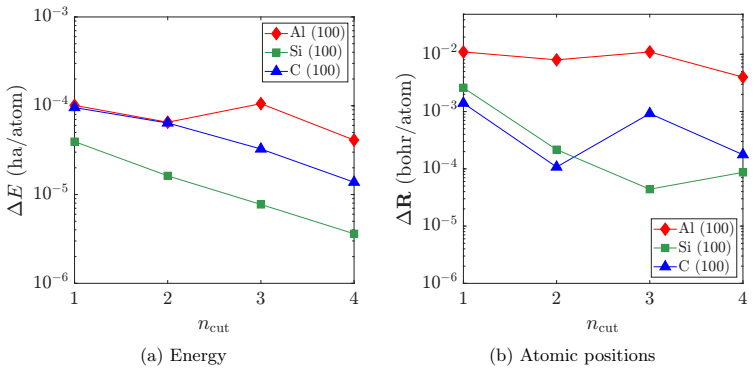
- The slower, oscillatory convergence observed for Al suggests that metals may still require a modest adaptive or screening-aware choice of Z_cut before the method becomes routinely cheaper than thick slabs.
- Pairing the bulk boundary condition with hybrid or RPA functionals would test whether the same locality assumptions survive nonlocal exchange.
Signed reviews
Editorial analysis
A structured set of objections, weighed in public.
Referee Report
Summary. The manuscript introduces a bulk boundary condition formalism for Kohn–Sham DFT surface calculations that exploits density-matrix nearsightedness to confine the problem to a localized surface region. A fundamental domain Ω containing the surface is embedded in an extended domain eΩ that includes a bulk buffer of thickness Z_cut; the density is set to its bulk value for z ≤ Z_cut, the electrostatic potential is solved on eΩ subject to a bulk Dirichlet condition at z = 0, and density, free energy, and Hellmann–Feynman forces are evaluated from density-matrix expressions restricted to Ω (Eqs. 6–11). Accuracy is demonstrated by head-to-head comparison with the conventional slab method under matched grids, XC, pseudopotentials, and k-meshes: (100) surface energies and work functions of Al, Si, and C agree to within 0.02 eV/surface atom and 0.02 eV (Table 1, Fig. 5), and CO adsorption energies on Cu(100) at T/B/H sites agree to ~0.05–0.09 eV with the correct site ordering (Table 2). Convergence with Z_cut and recovery of bulk density/potential with depth are shown in Figs. 3–4.
Significance. If the numerical claims hold, the work supplies a practical, systematically improvable alternative to the slab model that avoids artificial second surfaces, dipole corrections, and adsorbate mirroring while remaining compatible with standard real-space DFT infrastructure. The explicit density-matrix energy and force expressions, the controlled Z_cut convergence study, and the direct matched-parameter validation against both slab results and literature PBE adsorption energies constitute concrete, falsifiable evidence rather than formal novelty alone. The approach is especially useful for systems with long-ranged electrostatics or asymmetric adsorbates, where slab thickness requirements become severe, and it opens a clear path to interfaces, low-coverage limits, and constant-potential electrochemistry once the stated extensions are implemented.
minor comments (5)
- The non-monotonic convergence of energy and atomic positions with Z_cut for Al (Fig. 3) is correctly attributed to Friedel oscillations, but a short quantitative remark on the practical Z_cut needed for metals at the stated 0.025 eV/atom target would help readers set the free parameter without re-running the full study.
- Eq. (10) for the free energy and Eq. (11) for the forces integrate over eΩ for nonlocal and electrostatic contributions; a brief clarifying sentence that the density-matrix approximation remains controlled for these extended integrals (or that the projectors/pseudocharges decay sufficiently) would remove a possible source of confusion.
- The fixed-atom strategy (bulk region plus first unit cell of Ω held at bulk positions) is presented as reducing mismatch and charge leakage; a one-sentence note that full relaxation of all atoms in Ω is in principle allowed, with only a possible increase in required Z_cut, would make the approximation’s status clearer.
- Figure 1 (TOC) and Figure 2 use slightly different schematic conventions; aligning the labeling of Z_cut and the vacuum/bulk boundaries would improve readability.
- The manuscript states that extension to spin polarization is straightforward and that hybrids/charged systems require further methodology; these limitations are already listed, but a single sentence in the abstract or conclusion flagging the present restriction to non-spin-polarized local/semilocal XC would set expectations more cleanly.
Circularity Check
No significant circularity: method is a controlled numerical approximation validated against independent slab runs and external literature, not against quantities defined by its own inputs.
full rationale
The derivation chain is self-contained. The bulk boundary condition formalism (Eqs. 6–11) constructs a truncated Hamiltonian on eΩ with zero-Dirichlet at z=0, imposes bulk ρ (z≤Z_cut) and ϕ (z=0) taken from a separate 3D crystal calculation, and evaluates density/energy/forces via the density matrix on Ω. Convergence with the single free parameter Z_cut is demonstrated numerically (Figs. 3–4); surface energies are extracted by linear fit of total energy versus natoms (Eq. 12) and compared to slab results obtained with identical SPARC/M-SPARC parameters and grids (Table 1); work functions and CO adsorption energies (Eq. 13, Table 2) likewise agree with the same slab protocol and with independent PBE literature values (Favot et al.). Bulk ρ/ϕ enter only as fixed Dirichlet data, not as fitted targets. Density-matrix decay is invoked via standard external citations (Goedecker, Ismail-Beigi et al.), not via a self-proved uniqueness theorem. Self-citations to prior SPARC and spectral-quadrature work supply only the real-space infrastructure and a related (translationally symmetric) technique; they are not load-bearing for the surface results. No step reduces a claimed prediction to a definitional identity or to a fit of the same quantity. Limitations (spin, hybrids, charged systems) are stated explicitly. Score 0 is therefore required.
Assumptions & free parameters
free parameters (3)
- Z_cut (bulk buffer thickness) =
4 alat (Al,C); 3 alat (Si); 2 alat (Cu adsorption)
- Fermi–Dirac smearing σ =
0.1 eV (metals)
- Real-space grid spacing and FD order =
h≈0.24–0.30 bohr; 12th-order FD
assumptions (5)
- domain assumption Real-space density matrix decays exponentially (insulators; metals at finite smearing), so local observables in Ω depend only on a finite neighborhood.
- domain assumption Standard spin-unpolarized KS-DFT with local/semilocal XC, real-space Poisson electrostatics, and nonlocal pseudopotentials correctly describes the electronic ground state of the tested surfaces.
- domain assumption Bulk electron density and electrostatic potential from a separate 3D periodic calculation are the correct Dirichlet data for the semi-infinite interior.
- ad hoc to paper Holding atoms in the bulk region and first unit cell of Ω fixed at bulk positions reduces mismatch and prevents charge leakage without spoiling surface energies.
- standard math High-order finite differences and trapezoidal integration on a uniform grid commensurate with the bulk cell accurately discretize the truncated problem.
invented entities (1)
-
Bulk boundary condition surface formalism (Ω / eΩ partition with bulk Dirichlet data)
independent evidence
Cite this review
Pith. "Pith review of Bulk Boundary Condition for Surface Calculations in Density Functional Theory." pith.science (2026). https://pith.science/paper/WNHBXU2W
@misc{pith2026260707894,
  author       = {Pith},
  title        = {Pith review of: Bulk Boundary Condition for Surface Calculations in Density Functional Theory},
  year         = {2026},
  howpublished = {\url{https://pith.science/paper/WNHBXU2W}},
  note         = {Machine review of arXiv:2607.07894}
}
read the original abstract
We present a bulk boundary condition formalism for surface calculations in Kohn--Sham density functional theory. The approach exploits the nearsightedness of electronic interactions in real space to restrict the calculation to a localized surface region. Within this region, the electron density is evaluated by leveraging the decay of the density matrix, with bulk values imposed on the density and electrostatic potential in the interior, and the electrostatic potential solved subject to bulk boundary conditions. The energy and atomic forces are computed using density-matrix-based expressions. Through representative calculations of surface and adsorption energies, we demonstrate the accuracy and efficiency of the proposed formalism.
Figures


Figures from the paper (2 more)


Forward citations
Cited by 1 Pith paper
-
Unified open-boundary electrostatics in real-space density functional theory
A single variational electrostatic framework, implemented in SPARC, gives exact open-boundary Dirichlet conditions and analytic energy, forces, and stress for isolated, 1D periodic, and 2D periodic systems under a uni...
Reference graph
Works this paper leans on
-
[1]
45; pp 71–129, DOI:https://doi.org/10.1016/S0360-0564(02)45013-4
Hammer, B.; Nørskov, J.Impact of Surface Science on Catalysis; Advances in Catalysis; Academic Press, 2000; Vol. 45; pp 71–129, DOI:https://doi.org/10.1016/S0360-0564(02)45013-4
-
[2]
K.; Bligaard, T.; Rossmeisl, J.; Christensen, C
Nørskov, J. K.; Bligaard, T.; Rossmeisl, J.; Christensen, C. H. Towards the computational design of solid catalysts.Nat. Chem.2009,1, 37–46, DOI:10.1038/nchem.121
-
[3]
Nørskov, J. K.; Studt, F.; Abild-Pedersen, F.; Bligaard, T.Fundamental concepts in heterogeneous catalysis; John Wiley & Sons, 2014
work page 2014
-
[4]
F.; Bonde, J.; Chorkendorff, I.; Nørskov, J
Greeley, J.; Jaramillo, T. F.; Bonde, J.; Chorkendorff, I.; Nørskov, J. K. Computational high-throughput screening of electrocatalytic materials for hydrogen evolution.Nat. Mater.2006,5, 909–913, DOI: 10.1038/nmat1752
-
[5]
Rossmeisl, J.; Nørskov, J. K.; Taylor, C. D.; Janik, M. J.; Neurock, M. Calculated Phase Diagrams for the Electrochemical Oxidation and Reduction of Water over Pt(111).J. Phys. Chem. B2006,110, 21833–21839, DOI:https://doi.org/10.1021/jp0631735. 10
-
[6]
S.; Rossmeisl, J.; Bligaard, T.; Greeley, J.; Jónsson, H.; Nørskov, J
Skúlason, E.; Karlberg, G. S.; Rossmeisl, J.; Bligaard, T.; Greeley, J.; Jónsson, H.; Nørskov, J. K. Density functional theory calculations for the hydrogen evolution reaction in an electrochemi- cal double layer on the Pt(111) electrode.Phys. Chem. Chem. Phys.2007,9, 3241–3250, DOI: https://doi.org/10.1039/B700099E
-
[7]
Greeley, J.; Nørskov, J. Electrochemical dissolution of surface alloys in acids: Thermody- namic trends from first-principles calculations.Electrochimica Acta2007,52, 5829–5836, DOI: https://doi.org/10.1016/j.electacta.2007.02.082
-
[8]
Extending the Concept of Defect Chemistry from Semiconductor Physics to Electrochemistry.Phys
Todorova, M.; Neugebauer, J. Extending the Concept of Defect Chemistry from Semiconductor Physics to Electrochemistry.Phys. Rev. Appl.2014,1, 014001, DOI:10.1103/PhysRevApplied.1.014001
Show all 81 references
-
[9]
G.; Martin, R
Van de Walle, C. G.; Martin, R. M. Theoretical study of band offsets at semiconductor interfaces.Phys. Rev. B1987,35, 8154–8165, DOI:10.1103/PhysRevB.35.8154
-
[10]
Best practices for first-principles simu- lations of epitaxial inorganic interfaces.J
Dardzinski, D.; Yu, M.; Moayedpour, S.; Marom, N. Best practices for first-principles simu- lations of epitaxial inorganic interfaces.J. Phys.: Condens. Matter2022,34, 233002, DOI: 10.1088/1361-648X/ac577b
-
[11]
Chen, B. W. J.; Xu, L.; Mavrikakis, M. Computational Methods in Heterogeneous Catalysis.Chem. Rev.2021,121, 1007–1048, DOI:10.1021/acs.chemrev.0c01060, PMID: 33350813
2021 doi
-
[12]
E.; Marzari, N
Singh-Miller, N. E.; Marzari, N. Surface energies, work functions, and surface relaxations of low-index metallic surfaces from first principles.Phys. Rev. B2009,80, 235407, DOI: 10.1103/PhysRevB.80.235407
-
[13]
J.; Binggeli, N.; Baldereschi, A
Fall, C. J.; Binggeli, N.; Baldereschi, A. Deriving accurate work functions from thin-slab calculations. J. Phys.: Condens. Matter1999,11, 2689, DOI:10.1088/0953-8984/11/13/006
-
[14]
Adsorbate-substrate and adsorbate-adsorbate interactions of Na and K adlayers on Al(111).Phys
Neugebauer, J.; Scheffler, M. Adsorbate-substrate and adsorbate-adsorbate interactions of Na and K adlayers on Al(111).Phys. Rev. B1992,46, 16067–16080, DOI:10.1103/PhysRevB.46.16067
-
[15]
Density functional descriptions of interfacial electronic structure.Chem
Liu, Z.-F. Density functional descriptions of interfacial electronic structure.Chem. Phys. Rev.2023,4, 031307, DOI:10.1063/5.0156437
2023 doi
-
[16]
A.; Li, Y.Introduction to surface chemistry and catalysis; Wiley New York, 1994; Vol
Somorjai, G. A.; Li, Y.Introduction to surface chemistry and catalysis; Wiley New York, 1994; Vol. 2
1994
-
[17]
Physics at Surfaces Cambridge University Press.New York1988,
Zangwill, A. Physics at Surfaces Cambridge University Press.New York1988,
-
[18]
T.; Petersen, L.; Plummer, E
Sprunger, P. T.; Petersen, L.; Plummer, E. W.; Lægsgaard, E.; Besenbacher, F. Gi- ant Friedel Oscillations on the Beryllium(0001) Surface.Science1997,275, 1764–1767, DOI: 10.1126/science.275.5307.1764
-
[19]
Importance of bulk states for the electronic structure of semi- conductor surfaces: implications for finite slabs.J
Sagisaka, K.; Nara, J.; Bowler, D. Importance of bulk states for the electronic structure of semi- conductor surfaces: implications for finite slabs.J. Phys.: Condens. Matter2017,29, 145502, DOI: 10.1088/1361-648X/aa5f91
-
[20]
Schultz, P. A. First-principles calculations of metal surfaces. I. Slab-consistent bulk reference for con- vergent surface properties.Phys. Rev. B2021,103, 195426, DOI:10.1103/PhysRevB.103.195426
-
[21]
Justo, J. a. F.; Bazant, M. Z.; Kaxiras, E.; Bulatov, V. V.; Yip, S. Interatomic potential for silicon defects and disordered phases.Phys. Rev. B1998,58, 2539–2550, DOI:10.1103/PhysRevB.58.2539
-
[22]
R.; Mattsson, A
Mattsson, T. R.; Mattsson, A. E. Calculating the vacancy formation energy in metals: Pt, Pd, and Mo. Phys. Rev. B2002,66, 214110, DOI:10.1103/PhysRevB.66.214110
-
[23]
Inhomogeneous electron gas.Phys
Hohenberg, P.; Kohn, W. Inhomogeneous electron gas.Phys. Rev.1964,136, B864–B871, DOI: 10.1103/PhysRev.136.B864
1964 doi
-
[24]
Kohn, W.; Sham, L. J. Self-consistent equations including exchange and correlation effects.Phys. Rev. 1965,140, A1133–A1138, DOI:10.1103/PhysRev.140.A1133. 11
1965 doi
-
[25]
Perspective on density functional theory.J
Burke, K. Perspective on density functional theory.J. Chem. Phys.2012,136, 150901, DOI: 10.1063/1.4704546
2012 doi
-
[26]
Becke, A. D. Perspective: Fifty years of density-functional theory in chemical physics.J. Chem. Phys. 2014,140, 18A301, DOI:10.1063/1.4869598
2014 doi
-
[27]
Efficient iterative schemes for ab initio total-energy calculations using a plane-wave basis set.Phys
Kresse, G.; Furthmüller, J. Efficient iterative schemes for ab initio total-energy calculations using a plane-wave basis set.Phys. Rev. B1996,54, 11169–11186, DOI:10.1103/PhysRevB.54.11169
-
[28]
Gonze, X. et al. First-principles computation of material properties: the ABINIT software project.Com- put. Mater. Sci.2002,25, 478–492(15), DOI:https://doi.org/10.1016/S0927-0256(02)00325-7
2002 doi
-
[29]
J.; Segall, M
Clark, S. J.; Segall, M. D.; Pickard, C. J.; Hasnip, P. J.; Probert, M. I.; Refson, K.; Payne, M. C. First principles methods using CASTEP.Zeitschrift für Krist. - Cryst. Mater.2005,220, 567–570, DOI: https://doi.org/10.1524/zkri.220.5.567.65075
2005 doi
-
[30]
Giannozzi, P. et al. QUANTUM ESPRESSO: A modular and open-source software project for quantum simulations of materials.J. Phys. Condens. Matter2009,21, 395502
-
[31]
R.; Troullier, N.; Saad, Y
Chelikowsky, J. R.; Troullier, N.; Saad, Y. Finite-difference-pseudopotential method: Elec- tronic structure calculations without a basis.Phys. Rev. Lett.1994,72, 1240–1243, DOI: 10.1103/PhysRevLett.72.1240
1994 doi
-
[32]
SPARC: Accurate and efficient finite-difference formulation and parallel implementation of density functional theory: Isolated clusters.Comput
Ghosh, S.; Suryanarayana, P. SPARC: Accurate and efficient finite-difference formulation and parallel implementation of density functional theory: Isolated clusters.Comput. Phys. Comm.2017,212, 189– 204
2017
-
[33]
SPARC: Accurate and efficient finite-difference formulation and parallel implementation of density functional theory: Extended systems.Comput
Ghosh, S.; Suryanarayana, P. SPARC: Accurate and efficient finite-difference formulation and parallel implementation of density functional theory: Extended systems.Comput. Phys. Comm.2017,216, 109–125
2017
-
[34]
DFT-FE – A massively parallel adaptive finite-element code for large-scale density functional theory calculations.Comput
Motamarri, P.; Das, S.; Rudraraju, S.; Ghosh, K.; Davydov, D.; Gavini, V. DFT-FE – A massively parallel adaptive finite-element code for large-scale density functional theory calculations.Comput. Phys. Commun.2020,246, 106853, DOI:https://doi.org/10.1016/j.cpc.2019.07.016
2020 doi
-
[35]
J.; Pask, J
Xu, Q.; Sharma, A.; Comer, B.; Huang, H.; Chow, E.; Medford, A. J.; Pask, J. E.; Suryanarayana, P. SPARC: Simulation package for ab-initio real-space calculations.SoftwareX2021,15, 100709
-
[36]
J.; Chow, E.; Med- ford, A
Zhang, B.; Jing, X.; Xu, Q.; Kumar, S.; Sharma, A.; Erlandson, L.; Sahoo, S. J.; Chow, E.; Med- ford, A. J.; Pask, J. E.; Suryanarayana, P. SPARC v2. 0.0: Spin-orbit coupling, dispersion interactions, and advanced exchange-correlation functionals.Software Impacts2024,20, 100649
-
[37]
Gavini, V. et al. Roadmap on electronic structure codes in the exascale era.Modelling Simul. Mater. Sci. Eng.2023,31, 063301
2023
-
[38]
K.; Nakano, A.; Vashishta, P
Shimojo, F.; Kalia, R. K.; Nakano, A.; Vashishta, P. Linear-scaling density-functional-theory calculations of electronic structure based on real-space grids: design, analysis, and scala- bility test of parallel algorithms.Comput. Phys. Commun.2001,140, 303 – 314, DOI: https://...
2001 doi
-
[39]
On spectral quadrature for linear-scaling Density Functional Theory.Chem
Suryanarayana, P. On spectral quadrature for linear-scaling Density Functional Theory.Chem. Phys. Lett.2013,584, 182–187, DOI:https://doi.org/10.1016/j.cplett.2013.08.035
2013 doi
-
[40]
Gross, A.Theoretical surface science; Springer, 2009
2009
-
[41]
S.; Steckel, J
Sholl, D. S.; Steckel, J. A.Density functional theory: A practical introduction; John Wiley & Sons, 2022
2022
-
[42]
Makov, G.; Payne, M. C. Periodic boundary conditions in ab initio calculations.Phys. Rev. B1995, 51, 4014–4022, DOI:10.1103/PhysRevB.51.4014. 12
-
[43]
Extracting convergent surface energies from slab calculations.J
Fiorentini, V.; Methfessel, M. Extracting convergent surface energies from slab calculations.J. Phys.: Condens. Matter1996,8, 6525, DOI:10.1088/0953-8984/8/36/005
-
[44]
R.; Troisi, A
Martsinovich, N.; Jones, D. R.; Troisi, A. Electronic Structure of TiO2 Surfaces and Effect of Molecular Adsorbates Using Different DFT Implementations.J. Phys. Chem. C2010,114, 22659–22670, DOI: 10.1021/jp109756g
-
[45]
J.; Sánchez-Portal, D.; Alcamí, M.; Arnau, A.; Vázquez de Parga, A
Stradi, D.; Barja, S.; Díaz, C.; Garnica, M.; Borca, B.; Hinarejos, J. J.; Sánchez-Portal, D.; Alcamí, M.; Arnau, A.; Vázquez de Parga, A. L.; Miranda, R.; Martín, F. Lattice-matched versus lattice-mismatched models to describe epitaxial monolayer graphene on Ru(0001).Phys. Re...
-
[46]
A.; Radny, M
Shah, G. A.; Radny, M. W.; Smith, P. V.; Schofield, S. R. Slab Thickness Effects for the Clean and Adsorbed Ge(001) Surface with Comparison to Si(001).J. Phys. Chem. C2012,116, 6615–6622, DOI: 10.1021/jp208247m
-
[47]
Atoms" in
Cohen, M. H.; Wasserman, A. Revisiting N-continuous density-functional theory: Chem- ical reactivity and "Atoms" in "Molecules".Isr. J. Chem.2003,43, 219–227, DOI: https://doi.org/10.1560/3R9J-FHB5-51UV-C4BJ
2003 doi
-
[48]
E.; Benesh, G
Inglesfield, J. E.; Benesh, G. A. Surface electronic structure: Embedded self-consistent calculations. Phys. Rev. B1988,37, 6682–6700, DOI:10.1103/PhysRevB.37.6682
-
[49]
M.; Crampin, S.; Vvedensky, D
MacLaren, J. M.; Crampin, S.; Vvedensky, D. D.; Pendry, J. B. Layer Korringa-Kohn-Rostoker tech- nique for surface and interface electronic properties.Phys. Rev. B1989,40, 12164–12175, DOI: 10.1103/PhysRevB.40.12164
-
[50]
Self-consistent localized KKR scheme for surfaces and interfaces.Phys
Szunyogh, L.; Újfalussy, B.; Weinberger, P.; Kollár, J. Self-consistent localized KKR scheme for surfaces and interfaces.Phys. Rev. B1994,49, 2721–2729, DOI:10.1103/PhysRevB.49.2721
-
[51]
Inglesfield, J. E. A method of embedding.J. Phys. C: Solid State Phys.1981,14, 3795, DOI: 10.1088/0022-3719/14/26/015
1981 doi
-
[52]
Sancho, M. P. L.; Sancho, J. M. L.; Rubio, J. Quick iterative scheme for the calculation of transfer matrices: application to Mo (100).J. Phys. F1984,14, 1205, DOI:10.1088/0305-4608/14/5/016
-
[53]
Sancho, M. P. L.; Sancho, J. M. L.; Sancho, J. M. L.; Rubio, J. Highly convergent schemes for the calculation of bulk and surface Green functions.J. Phys. F1985,15, 851, DOI: 10.1088/0305-4608/15/4/009
-
[54]
L.; Rosengaard, N
Skriver, H. L.; Rosengaard, N. M. Self-consistent Green’s-function technique for surfaces and interfaces. Phys. Rev. B1991,43, 9538–9549, DOI:10.1103/PhysRevB.43.9538
-
[55]
E.; Bose, S
Kudrnovský, J.; Turek, I.; Drchal, V.; Weinberger, P.; Christensen, N. E.; Bose, S. K. Self- consistent Green’s-function method for random overlayers.Phys. Rev. B1992,46, 4222–4228, DOI: 10.1103/PhysRevB.46.4222
-
[56]
Augmented Lagrangian formulation of orbital-free density functional theory.Journal of Computational Physics2014,275, 524–538
Suryanarayana, P.; Phanish, D. Augmented Lagrangian formulation of orbital-free density functional theory.Journal of Computational Physics2014,275, 524–538
-
[57]
Higher-order finite-difference formulation of periodic orbital-free density functional theory.Journal of Computational Physics2016,307, 634–652
Ghosh, S.; Suryanarayana, P. Higher-order finite-difference formulation of periodic orbital-free density functional theory.Journal of Computational Physics2016,307, 634–652
-
[58]
P.; Sharma, A.; Pask, J
Suryanarayana, P.; Pratapa, P. P.; Sharma, A.; Pask, J. E. SQDFT: Spectral Quadrature method for large-scale parallel O(N) Kohn–Sham calculations at high temperature.Comput. Phys. Commun.2018, 224, 288–298, DOI:https://doi.org/10.1016/j.cpc.2017.12.003
2018 doi
-
[59]
P.; Suryanarayana, P.; Pask, J
Pratapa, P. P.; Suryanarayana, P.; Pask, J. E. Spectral Quadrature method for accurate O(N) electronic structure calculations of metals and insulators.Comput. Phys. Commun.2016,200, 96–107, DOI: https://doi.org/10.1016/j.cpc.2015.11.005. 13
2016 doi
-
[60]
Suryanarayana,P.; Bhattacharya,K.; Ortiz,M.Coarse-grainingKohn–ShamDensityFunctionalTheory. J. Mech. Phys. Solids2013,61, 38–60, DOI:https://doi.org/10.1016/j.jmps.2012.09.002
2012 doi
-
[61]
Decay properties of the finite-temperature density matrix in metals.Phys
Goedecker, S. Decay properties of the finite-temperature density matrix in metals.Phys. Rev. B1998, 58, 3501–3502, DOI:10.1103/PhysRevB.58.3501
-
[62]
Ismail-Beigi, S.; Arias, T. A. Locality of the Density Matrix in Metals, Semiconductors, and Insulators. Phys. Rev. Lett.1999,82, 2127–2130, DOI:10.1103/PhysRevLett.82.2127
1999 doi
-
[63]
Decay Properties of Spectral Projectors with Applications to Electronic Structure.SIAM Review2013,55, 3–64, DOI:10.1137/100814019
Benzi, M.; Boito, P.; Razouk, N. Decay Properties of Spectral Projectors with Applications to Electronic Structure.SIAM Review2013,55, 3–64, DOI:10.1137/100814019
-
[64]
On nearsightedness in metallic systems for O(N) Density Functional The- ory calculations: A case study on aluminum.Chem
Suryanarayana, P. On nearsightedness in metallic systems for O(N) Density Functional The- ory calculations: A case study on aluminum.Chem. Phys. Lett.2017,679, 146–151, DOI: https://doi.org/10.1016/j.cplett.2017.04.095
2017 doi
-
[65]
M-SPARC: Matlab-simulation package for ab-initio real-space calculations.SoftwareX2020,11, 100423
Xu, Q.; Sharma, A.; Suryanarayana, P. M-SPARC: Matlab-simulation package for ab-initio real-space calculations.SoftwareX2020,11, 100423
-
[66]
Version 2.0.0-M-SPARC: Matlab-simulation package for ab-initio real-space calculations.SoftwareX2023,21, 101295
Zhang, B.; Jing, X.; Kumar, S.; Suryanarayana, P. Version 2.0.0-M-SPARC: Matlab-simulation package for ab-initio real-space calculations.SoftwareX2023,21, 101295
-
[67]
P.; Burke, K.; Ernzerhof, M
Perdew, J. P.; Burke, K.; Ernzerhof, M. Generalized gradient approximation made simple.Phys. Rev. Lett.1996,77, 3865–3868, DOI:10.1103/PhysRevLett.77.3865
1996 doi
-
[68]
Hamann, D. R. Optimized norm-conserving Vanderbilt pseudopotentials.Phys. Rev. B2013,88, 085117, DOI:10.1103/PhysRevB.88.085117
-
[69]
F.; Pask, J
Shojaei, M. F.; Pask, J. E.; Medford, A. J.; Suryanarayana, P. Soft and transferable pseudopotentials from multi-objective optimization.Comput. Phys. Comm.2023,283, 108594
2023
-
[70]
E.; Sun, J.; Perdew, J
Patra, A.; Bates, J. E.; Sun, J.; Perdew, J. P. Properties of real metallic surfaces: Effects of density functional semilocality and van der Waals nonlocality.Proc. Natl. Acad. Sci. U.S.A.2017,114, E9188– E9196, DOI:10.1073/pnas.1713320114
2017 doi
-
[71]
CO adsorbed on Cu(001): A comparison between local density approximation and Perdew, Burke, and Ernezerhof generalized gradient approximation.J
Favot, F.; Dal Corso, A.; Baldereschi, A. CO adsorbed on Cu(001): A comparison between local density approximation and Perdew, Burke, and Ernezerhof generalized gradient approximation.J. Chem. Phys. 2001,114, 483–488, DOI:10.1063/1.1328042
2001 doi
-
[72]
Efficient real space formalism for hybrid density functionals.J
Jing, X.; Suryanarayana, P. Efficient real space formalism for hybrid density functionals.J. Chem. Phys. 2024,161, 084115, DOI:10.1063/5.0225396
2024 doi
-
[73]
Zhang,B.; Shah,S.; Pask,J.E.; Chow,E.; Suryanarayana,P.RandomPhaseApproximationCorrelation Energy Using Real-Space Density Functional Perturbation Theory.J. Chem. Theory Comput.2025,21, 6023–6033, DOI:10.1021/acs.jctc.5c00528, PMID: 40503615
2025 doi
-
[74]
J.; Suryanarayana, P.; Sharma, A.; Pask, J
Bhowmik, S.; Medford, A. J.; Suryanarayana, P.; Sharma, A.; Pask, J. E. Ab initio study of strain-driven vacancy clustering in aluminum.Phys. Rev. B2025,112, 174105, DOI:10.1103/97k3-sfyw
-
[75]
Real-space formulation of orbital-free density functional theory using finite- element discretization: The case for Al, Mg, and Al-Mg intermetallics.Phys
Das, S.; Iyer, M.; Gavini, V. Real-space formulation of orbital-free density functional theory using finite- element discretization: The case for Al, Mg, and Al-Mg intermetallics.Phys. Rev. B2015,92, 014104, DOI:10.1103/PhysRevB.92.014104
-
[76]
A.; Gunceler, D.; Ozhabes, Y.; Arias, T
Sundararaman, R.; Letchworth-Weaver, K.; Schwarz, K. A.; Gunceler, D.; Ozhabes, Y.; Arias, T. JDFTx: Software for joint density-functional theory.SoftwareX2017,6, 278–284, DOI: https://doi.org/10.1016/j.softx.2017.10.006
2017 doi
-
[77]
Kastlunger, G.; Lindgren, P.; Peterson, A. A. Controlled-Potential Simulation of Elementary Electro- chemical Reactions: Proton Discharge on Metal Surfaces.J. Phys. Chem. C2018,122, 12771–12781, DOI:10.1021/acs.jpcc.8b02465. 14
-
[78]
G.; Andreussi, O.; Marzari, N
Hormann, N. G.; Andreussi, O.; Marzari, N. Grand canonical simulations of electrochemical interfaces in implicit solvation models.J. Chem. Phys.2019,150, 041730, DOI:10.1063/1.5054580
2019 doi
-
[79]
A.; Dickens, C
Gauthier, J. A.; Dickens, C. F.; Heenen, H. H.; Vijay, S.; Ringe, S.; Chan, K. Unified Approach to Implicit and Explicit Solvent Simulations of Electrochemical Reaction Energetics.J. Chem. Theory Comput.2019,15, 6895–6906, DOI:10.1021/acs.jctc.9b00717, PMID: 31689089
2019 doi
-
[80]
Chan, K.; Nørskov, J. K. Electrochemical Barriers Made Simple.J. Phys. Chem. Lett.2015,6, 2663– 2668, DOI:10.1021/acs.jpclett.5b01043, PMID: 26266844
2015 doi
-
[81]
A.; Bernstein, N
Akhade, S. A.; Bernstein, N. J.; Esopi, M. R.; Regula, M. J.; Janik, M. J. A simple method to approx- imate electrode potential-dependent activation energies using density functional theory.Catal. Today 2017,288, 63–73, DOI:https://doi.org/10.1016/j.cattod.2017.01.050, Electro...
2017 doi
Reviewed July 10, 2026 · model on record in the stance chip above.
Discussion (0). Continue with ORCID to comment.