REVIEW 3 major objections 4 minor 1 cited by
Pretraining with switchable modules gives one model many capability profiles
Reviewed by Pith at T0; open to challenge. T0 means a machine referee read the full paper against a public rubric. the ladder, T0–T4 →
T0 review · glm-5.2
2026-07-10 00:25 UTC pith:3VJ56QKX
load-bearing objection GRAM is a genuinely interesting idea—pretrain auxiliary modules, ablate them at inference to remove capabilities, and get something that approximates data filtering at a fraction of the cost. The scaling analysis is the real contribution. But the fine-tuning resistance claim is doing a lot of load-bearing work and the abstract doesn't give us enough to evaluate it. the 3 major comments →
Modular Pretraining Enables Access Control
The pith
A machine-rendered reading of the paper's core claim, the machinery that carries it, and where it could break.
Core claim
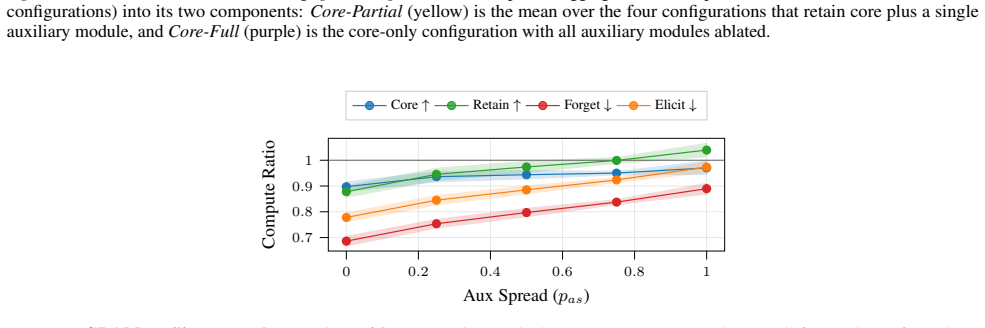
The core discovery is that gradient-routed auxiliary modules, installed during pretraining and ablated at inference, can selectively remove targeted capabilities from a language model while preserving others, and that this approximation to data-filtered models improves with scale. The scaling analysis from 50M to 5B parameters shows the gap between GRAM and data-filtered models widening on removed capabilities (good — removal is effective) and staying small on retained ones (good — other skills survive), suggesting the method becomes more faithful as models grow. The cost structure is also central: because one training run produces a model whose modules can be independently toggled, the cost
What carries the argument
Gradient-Routed Auxiliary Modules (GRAM): auxiliary modules added to a neural network during pretraining, selectively updated via gradient routing to induce specialization, and removable at inference to disable the associated capability.
Load-bearing premise
The claim that GRAM resists recovery of ablated capabilities under fine-tuning is load-bearing for the access-control promise. The abstract does not specify the fine-tuning budget, number of steps, or threat model assumed, so it is unclear whether this resistance would hold against a determined adversary with substantial compute.
What would settle it
If fine-tuning a GRAM model with an ablated module for a modest number of steps recovers the removed capability to a level comparable to the unablated model, the access-control guarantee collapses and GRAM offers no meaningful advantage over post-hoc unlearning methods.
If this is right
- A single pretrained model could be deployed with different capability profiles to different users, reducing the infrastructure cost of access control for dual-use AI by a factor proportional to the number of profiles.
- The scaling trend suggests that larger models may be better candidates for module-based access control, since the fidelity of GRAM relative to data filtering improves with scale.
- If module ablation is genuinely resistant to fine-tuning recovery, this method could serve as a regulatory compliance tool, allowing auditors to verify that a deployed model lacks a specific capability by inspecting which modules are present.
- The cost-independence property means that supporting many capability profiles (e.g., for many organizations with different clearance levels) adds no marginal training cost beyond the initial GRAM pretraining run.
Where Pith is reading between the lines
- The resistance-to-recovery claim is critical for the access-control use case but the abstract does not specify the fine-tuning budget, number of steps, or threat model. An adversary with sufficient fine-tuning compute may recover ablated capabilities, which would collapse the access-control guarantee. The strength of this claim under realistic adversarial conditions remains the key open question.
- If GRAM modules encode capabilities in a sufficiently separable manner, one could potentially compose modules in novel combinations not seen during training (e.g., granting virology but not cybersecurity to a user who needs neither), creating capability profiles that were never explicitly trained. Whether this compositional generalization holds is not addressed in the abstract.
- The method's success at the Chinchilla-optimal scaling frontier (up to 5B) raises the question of whether the favorable scaling trends continue at frontier-model scales (100B+), where training dynamics and module interactions may differ qualitatively.
Editorial analysis
A structured set of objections, weighed in public.
Referee Report
Summary. The manuscript proposes gradient-routed auxiliary modules (GRAM), a pretraining method that adds auxiliary modules to a neural network and selectively updates them to induce capability specialization. At inference time, ablating a module is claimed to remove the corresponding capability, approximating a model trained on filtered data. The paper evaluates GRAM on synthetic stories and four realistic dual-use domains (virology, cybersecurity, nuclear physics, specialized code), with a Chinchilla-optimal scaling analysis from 50M to 5B parameters across five capability profiles. The central claims are: (1) GRAM disables targeted capabilities while preserving others; (2) GRAM resists capability recovery under fine-tuning better than post-hoc unlearning; (3) GRAM closely tracks data filtering across scales, with the gap between data-filtered and full-data models widening on removed capabilities but remaining small on retained ones; and (4) GRAM's training cost is independent of the number of capability profiles, yielding a 5x reduction over data filtering in the 5-profile setting. This review is based on the abstract only, as the full text was not available for evaluation.
Significance. The paper addresses a practically important problem—access control for dual-use AI capabilities—and proposes a pretraining-time solution rather than a post-hoc intervention, which is a meaningful architectural contribution. The experimental scope is substantial: four realistic dual-use domains, five capability profiles, and a scaling analysis from 50M to 5B parameters following Chinchilla-optimal compute. The claim that training cost is independent of the number of profiles is a strong efficiency result if it holds. The fine-tuning resistance comparison against post-hoc unlearning is the right empirical test for the access-control use case. However, this assessment is necessarily limited by the absence of the full manuscript; the methodological details, statistical significance, and quantitative gap sizes cannot be verified.
major comments (3)
- The fine-tuning resistance claim is load-bearing for the paper's central thesis. The abstract states that GRAM 'resists their recovery under finetuning better than post-hoc unlearning' but does not specify the fine-tuning budget, number of steps, learning rate, dataset size, or threat model. Without these details, the reader cannot assess whether the resistance is practically meaningful or an artifact of a weak fine-tuning attack. This matters in two ways: (a) directly, for the access-control use case where adversaries may fine-tune with substantial compute and data; (b) indirectly, as the strongest available test of whether gradient routing actually localizes capability in the auxiliary modules rather than leaving partial knowledge in shared base parameters. If the base network retains latent capability, fine-tuning would recover it, and the 'tracks data filtering' result would be qualt
- The claim that GRAM 'closely tracks data filtering' is central but the abstract provides no quantitative threshold for what constitutes 'closely.' The scaling analysis reportedly shows the gap between data-filtered and full-data models widens on removed capabilities and stays small on retained ones, but without seeing the actual gap magnitudes, confidence intervals, or the metric definitions, it is impossible to judge whether the tracking is practically sufficient for access control. The full manuscript must report per-domain and per-scale gap sizes with error bars.
- The localization assumption—that gradient routing during pretraining confines capability-relevant knowledge to auxiliary modules rather than distributing it across shared base parameters—is the architectural foundation of the method. The abstract does not describe how gradient routing thresholds are set, what architecture the auxiliary modules use, or what happens when localization is imperfect. If the base network retains partial knowledge of an ablated capability, standard benchmarks might show removal while latent capability persists. The full manuscript should include probing experiments or representation analyses that directly test localization, beyond the behavioral fine-tuning test.
minor comments (4)
- The abstract does not specify the model architecture (transformer, MLP, etc.), the auxiliary module design, or how gradient routing is implemented. These details are needed to assess generality.
- The five capability profiles are not enumerated in the abstract. A brief listing would help readers understand the scope of the access-control evaluation.
- The 5x cost reduction claim should specify whether this accounts for inference cost (serving multiple module configurations) or only training cost, since inference-time overhead from auxiliary modules could affect the practical comparison.
- The relationship between GRAM and existing modular/mixture-of-experts architectures is not discussed in the abstract. A brief positioning would clarify novelty.
Circularity Check
No circularity detected in the available text
full rationale
Based on the abstract, GRAM's central claim—that ablating a module at inference approximates a model trained on filtered data—is evaluated against externally trained baselines (data-filtered models, post-hoc unlearning) across multiple domains and scales (50M–5B). No step in the described derivation chain reduces to its own inputs by construction: the method (gradient-routed auxiliary modules) is an architectural/training proposal, not a definition that entails the evaluation outcome. No fitted parameter is renamed as a prediction, no uniqueness theorem is invoked, and no self-citation chain is visible in the abstract. The scaling analysis compares GRAM to independently trained data-filtered and full-data models, which is an external benchmark. While the full text is unavailable and self-citation patterns cannot be fully ruled out, there is no evidence of circularity in what can be assessed. This is a standard empirical-methods paper evaluated against external baselines.
Axiom & Free-Parameter Ledger
free parameters (2)
- Module architecture/hyperparameters =
unknown
- Gradient routing thresholds =
unknown
axioms (2)
- domain assumption Data filtering is the gold standard for capability removal
- domain assumption Fine-tuning resistance is a meaningful security metric
invented entities (1)
-
Gradient-routed auxiliary modules (GRAM)
independent evidence
read the original abstract
AI developers face a dual-use dilemma. An AI capability that helps one user cure a disease can help another synthesize one. This dilemma could be resolved with access control, limiting dual-use AI capabilities to trusted deployments with a legitimate need. A gold standard for access control would be to serve separate models with different capabilities to different users. However, training and deploying multiple models is prohibitively expensive. To address this challenge, we propose gradient-routed auxiliary modules (GRAM), a pre-training method that adds modules to a neural network and selectively updates them to induce specialization. Ablating a module at inference time removes its capability from the network, approximating a model trained on filtered data. We evaluate GRAM on synthetic stories and realistic dual-use data spanning virology, cybersecurity, nuclear physics, and specialized code. These experiments show that GRAM disables targeted capabilities while preserving the rest, and resists their recovery under finetuning better than post-hoc unlearning. Most importantly, a Chinchilla-optimal scaling analysis from 50M to 5B parameters shows that the gap between data-filtered and full-data models widens with scale on removed capabilities but stays small on retained ones, and that GRAM closely tracks data filtering. GRAM's training cost is independent of the number of supported capability profiles, yielding a 5x reduction over data filtering in our 5-profile setting.
Figures




Forward citations
Cited by 1 Pith paper
-
Safeguards Based on Copyable Context Cannot Provide Reliable Safety for LLMs
With copyable pre-release evidence, any dual-use release rule that keeps legitimate utility q must leave worst-case attacker assistance at least Γ(q)>0, so useful capability, reliable safety, and open access cannot coexist.
Reference graph
Works this paper leans on
-
[1]
Biderman, Dan and Portes, Jacob and Ortiz, Jose Javier Gonzalez and Paul, Mansheej and Greengard, Philip and Jennings, Connor and King, Daniel and Havens, Sam and Chiley, Vitaliy and Frankle, Jonathan and others , journal=
-
[2]
Sheng, Ying and Cao, Shiyi and Li, Dacheng and Hooper, Coleman and Lee, Nicholas and Yang, Shuo and Chou, Christopher and Zhu, Banghua and Zheng, Lianmin and Keutzer, Kurt and Gonzalez, Joseph E. and Stoica, Ion , booktitle=
-
[3]
International Conference on Learning Representations (ICLR) , year=
Editing Models with Task Arithmetic , author=. International Conference on Learning Representations (ICLR) , year=
-
[4]
Advances in Neural Information Processing Systems (NeurIPS) , year=
Composing Parameter-Efficient Modules with Arithmetic Operation , author=. Advances in Neural Information Processing Systems (NeurIPS) , year=
-
[5]
Jacobs, Robert A and Jordan, Michael I and Nowlan, Steven J and Hinton, Geoffrey E , journal=. 1991 , publisher=
work page 1991
-
[6]
Zhou, Yanqi and Lei, Tao and Liu, Hanxiao and Du, Nan and Huang, Yanping and Zhao, Vincent and Dai, Andrew M and Le, Quoc V and Laudon, James and others , journal=
-
[7]
Thinking Machines Lab: Connectionism , year =
John Schulman and Thinking Machines Lab , title =. Thinking Machines Lab: Connectionism , year =
-
[8]
Greenblatt, Ryan and Roger, Fabien and Krasheninnikov, Dmitrii and Krueger, David , journal=
-
[9]
Gradient Routing: Masking Gradients to Localize Computation in Neural Networks
Cloud, Alex and Goldman-Wetzler, Jacob and Wybitul, Ev. Gradient. arXiv preprint arXiv:2410.04332 , year=
work page internal anchor Pith review Pith/arXiv arXiv
-
[10]
Science and engineering ethics , volume=
Ethical and philosophical consideration of the dual-use dilemma in the biological sciences , author=. Science and engineering ethics , volume=. 2007 , publisher=
work page 2007
-
[11]
ICML Workshop on Technical AI Governance (TAIG) , year=
Access Controls Will Solve the Dual-Use Dilemma , author=. ICML Workshop on Technical AI Governance (TAIG) , year=
-
[12]
Chen, Yanda and Tucker, Mycal and Panickssery, Nina and Wang, Tony and Mosconi, Francesco and Gopal, Anjali and Denison, Carson and Petrini, Linda and Leike, Jan and Perez, Ethan and others , journal=. 2025 , url=
work page 2025
-
[13]
Stranisci, Marco Antonio and Hardmeier, Christian , journal=
-
[14]
Guo, Yiduo and Fu, Jie and Zhang, Huishuai and Zhao, Dongyan , booktitle=
-
[15]
Lialin, Vladislav and Deshpande, Vijeta and Rumshisky, Anna , journal=. 2023 , url=
work page 2023
-
[16]
Han, Zeyu and Gao, Chao and Liu, Jinyang and Zhang, Jeff and Zhang, Sai Qian , journal=
-
[17]
Xie, Yong and Aggarwal, Karan and Ahmad, Aitzaz , booktitle=
-
[18]
Longpre, Shayne and Yauney, Gregory and Reif, Emily and Lee, Katherine and Roberts, Adam and Zoph, Barret and Zhou, Denny and Wei, Jason and Robinson, Kevin and Mimno, David and others , booktitle=
-
[19]
Birhane, Abeba and Prabhu, Vinay and Han, Sang and Boddeti, Vishnu Naresh , journal=. 2023 , url=
work page 2023
-
[20]
Forty-second International Conference on Machine Learning , year=
Li, Kenneth and Chen, Yida and Vi. Forty-second International Conference on Machine Learning , year=
-
[21]
Reuel, Anka and Bucknall, Ben and Casper, Stephen and Fist, Tim and Soder, Lisa and Aarne, Onni and Hammond, Lewis and Ibrahim, Lujain and Chan, Alan and Wills, Peter and others , journal=
-
[22]
Touvron, Hugo and others , journal =
- [23]
-
[24]
Beyond Data Filtering: Knowledge Localization for Capability Removal in
Shilov, Igor and Cloud, Alex and Gema, Aryo Pradipta and Goldman-Wetzler, Jacob and Panickssery, Nina and Sleight, Henry and Jones, Erik and Anil, Cem , journal =. Beyond Data Filtering: Knowledge Localization for Capability Removal in
-
[25]
Glukhov, David and Han, Ziwen and Shumailov, Ilia and Papyan, Vardan and Papernot, Nicolas , journal=
-
[26]
Russinovich, Mark and Salem, Ahmed and Eldan, Ronen , booktitle=
-
[27]
Jin, Haibo and Zhou, Andy and Menke, Joe and Wang, Haohan , journal=
-
[28]
Glukhov, David and Shumailov, Ilia and Gal, Yarin and Papernot, Nicolas and Papyan, Vardan , booktitle=
-
[29]
Sharma, Mrinank and Tong, Meg and Mu, Jesse and Wei, Jerry and Kruthoff, Jorrit and Goodfriend, Scott and Ong, Euan and Peng, Alwin and Agarwal, Raj and Anil, Cem and others , journal=. 2025 , URL=
work page 2025
-
[30]
Mallya, Arun and Lazebnik, Svetlana , booktitle=
-
[31]
Mallya, Arun and Davis, Dillon and Lazebnik, Svetlana , booktitle=
-
[32]
Serra, Joan and Suris, Didac and Miron, Marius and Karatzoglou, Alexandros , booktitle=. 2018 , organization=
work page 2018
-
[33]
Rusu, Andrei A and Rabinowitz, Neil C and Desjardins, Guillaume and Soyer, Hubert and Kirkpatrick, James and Kavukcuoglu, Koray and Pascanu, Razvan and Hadsell, Raia , journal=. 2016 , url=
work page 2016
-
[34]
Yoon, Jaehong and Yang, Eunho and Lee, Jeongtae and Hwang, Sung Ju , booktitle=
-
[35]
International Conference on Learning Representations , year=
von Oswald, Johannes and Henning, Christian and Grewe, Benjamin F and Sacramento, Jo. International Conference on Learning Representations , year=
-
[36]
Aljundi, Rahaf and Chakravarty, Punarjay and Tuytelaars, Tinne , booktitle=
-
[37]
Razdaibiedina, Anastasia and Mao, Yuning and Hou, Rui and Khabsa, Madian and Lewis, Mike and Almahairi, Amjad , booktitle=
-
[38]
The Thirteenth International Conference on Learning Representations , year=
A Closer Look at Machine Unlearning for Large Language Models , author=. The Thirteenth International Conference on Learning Representations , year=
-
[39]
Bohao, Peng and Tian, Zhuotao and Liu, Shu and Yang, Ming-Chang and Jia, Jiaya , booktitle=
-
[40]
Liu, Sijia and Yao, Yuanshun and Jia, Jinghan and Casper, Stephen and Baracaldo, Nathalie and Hase, Peter and Yao, Yuguang and Liu, Chris Yuhao and Xu, Xiaojun and Li, Hang and others , journal=. 2025 , publisher=
work page 2025
-
[41]
Lee, Bruce W and Foote, Addie and Infanger, Alex and Shor, Leni and Kamath, Harish and Goldman-Wetzler, Jacob and Woodworth, Bryce and Cloud, Alex and Turner, Alexander Matt , booktitle=
-
[42]
The Elicitation Game: Evaluating Capability Elicitation Techniques
Hofst. arXiv preprint arXiv:2502.02180 , year=
work page internal anchor Pith review Pith/arXiv arXiv
-
[43]
Lynch, Aengus and Guo, Phillip and Ewart, Aidan and Casper, Stephen and Hadfield-Menell, Dylan , journal=
- [44]
-
[45]
Transactions on Machine Learning Research , year=
-
[46]
Barez, Fazl and Fu, Tingchen and Prabhu, Ameya and Casper, Stephen and Sanyal, Amartya and Bibi, Adel and O'Gara, Aidan and Kirk, Robert and Bucknall, Ben and Fist, Tim and others , journal=
-
[47]
Gadre, Samir Yitzhak and Smyrnis, Georgios and Shankar, Vaishaal and Gururangan, Suchin and Wortsman, Mitchell and Shao, Rulin and Mercat, Jean and Fang, Alex and Li, Jeffrey and Keh, Sedrick and others , booktitle=
-
[48]
Chen, Yangyi and Huang, Binxuan and Gao, Yifan and Wang, Zhengyang and Yang, Jingfeng and Ji, Heng , journal=
-
[49]
O'Brien, Kyle and Casper, Stephen and Anthony, Quentin Gregory and Korbak, Tomek and Kirk, Robert and Davies, Xander and Mishra, Ishan and Irving, Geoffrey and Gal, Yarin and Biderman, Stella , booktitle=
-
[50]
Li, Nathaniel and Pan, Alexander and Gopal, Anjali and Yue, Summer and Berrios, Daniel and Gatti, Alice and Li, Justin D and Dombrowski, Ann-Kathrin and Goel, Shashwat and Mukobi, Gabriel and others , booktitle=. 2024 , organization=
work page 2024
-
[51]
Yuan, Xiaojian and Pang, Tianyu and Du, Chao and Chen, Kejiang and Zhang, Weiming and Lin, Min , booktitle=
- [52]
-
[53]
Truong, Thanh Cong and Diep, Quoc Bao and Zelinka, Ivan , journal=. 2020 , publisher=
work page 2020
-
[54]
Sandbrink, Jonas B and Koblentz, Gregory D , journal=. 2022 , publisher=
work page 2022
-
[55]
Drew, Trevor W and Mueller-Doblies, Uwe Ulex , journal=. 2017 , publisher=
work page 2017
-
[56]
Maini, Pratyush and Goyal, Sachin and Sam, Dylan and Robey, Alex and Savani, Yash and Jiang, Yiding and Zou, Andy and Fredrikson, Matt and Lipton, Zacharcy C and Kolter, J Zico , journal=. 2025 , url=
work page 2025
-
[57]
Hu, Edward J and Shen, Yelong and Wallis, Phillip and Allen-Zhu, Zeyuan and Li, Yuanzhi and Wang, Shean and Wang, Lu and Chen, Weizhu , booktitle=
-
[58]
Hubinger, Evan and Denison, Carson and Mu, Jesse and Lambert, Mike and Tong, Meg and MacDiarmid, Monte and Lanham, Tamera and Ziegler, Daniel M and Maxwell, Tim and Cheng, Newton and others , journal=
-
[59]
Shazeer, Noam and Mirhoseini, Azalia and Maziarz, Krzysztof and Davis, Andy and Le, Quoc and Hinton, Geoffrey and Dean, Jeff , booktitle=
-
[60]
Gururangan, Suchin and Lewis, Mike and Holtzman, Ari and Smith, Noah A and Zettlemoyer, Luke , booktitle=
-
[61]
Eldan, Ronen and Li, Yuanzhi , journal=
-
[62]
Advances in Neural Information Processing Systems , volume=
Penedo, Guilherme and Kydl. Advances in Neural Information Processing Systems , volume=
-
[63]
Advances in Neural Information Processing Systems , volume=
Vaswani, Ashish and Shazeer, Noam and Parmar, Niki and Uszkoreit, Jakob and Jones, Llion and Gomez, Aidan N and Kaiser,. Advances in Neural Information Processing Systems , volume=
- [64]
-
[65]
Finke, Lennart and Sreedhara, Chandan and Dooms, Thomas and Allen, Mat and Zhang, Emerald and Rodriguez, Juan Diego and Nabeshima, Noa and Marshall, Thomas and Braun, Dan , journal=. 2025 , url=
work page 2025
-
[66]
Hoffmann, Jordan and Borgeaud, Sebastian and Mensch, Arthur and Buchatskaya, Elena and Cai, Trevor and Rutherford, Eliza and Casas, Diego de Las and Hendricks, Lisa Anne and Welbl, Johannes and Clark, Aidan and others , journal=
-
[67]
Zhao, Yanli and Gu, Andrew and Varma, Rohan and Luo, Liang and Huang, Chien-Chin and Xu, Min and Wright, Less and Shojanazeri, Hamid and Ott, Myle and Shleifer, Sam and others , journal=
-
[68]
Geva, Mor and Schuster, Roei and Berant, Jonathan and Levy, Omer , booktitle=
-
[69]
Meng, Kevin and Bau, David and Andonian, Alex and Belinkov, Yonatan , booktitle=
-
[70]
The Malicious Use of Artificial Intelligence: Forecasting, Prevention, and Mitigation
Brundage, Miles and Avin, Shahar and Clark, Jack and Toner, Helen and Eckersley, Peter and Garfinkel, Ben and Dafoe, Allan and Scharre, Paul and Zeitzoff, Thomas and Filar, Bobby and Anderson, Hyrum and Roff, Heather and Allen, Gregory C and Steinhardt, Jacob and Flynn, Carrick and. arXiv preprint arXiv:1802.07228 , year=
work page internal anchor Pith review Pith/arXiv arXiv
-
[71]
Cottier, Ben and Rahman, Robi and Fattorini, Loredana and Maslej, Nestor and Besiroglu, Tamay and Owen, David , journal=. 2024 , url=
work page 2024
-
[72]
Saltzer, Jerome H and Schroeder, Michael D , journal=. 1975 , publisher=
work page 1975
-
[73]
Wei, Alexander and Haghtalab, Nika and Steinhardt, Jacob , booktitle=
-
[74]
Zou, Andy and Wang, Zifan and Carlini, Nicholas and Nasr, Milad and Kolter, J Zico and Fredrikson, Matt , journal=. 2023 , URL=
work page 2023
-
[75]
Wang, Zihan and Chen, Deli and Dai, Damai and Xu, Runxin and Li, Zhuoshu and Wu, Y. , booktitle=
-
[76]
Studying Cross-cluster Modularity in Neural Networks
Golechha, Satvik and Chaudhary, Maheep and Velja, Joan and Abate, Alessandro and Schoots, Nandi , year=. 2502.02470 , archivePrefix=
work page internal anchor Pith review Pith/arXiv arXiv
-
[77]
Golechha, Satvik and Cope, Dylan and Schoots, Nandi , booktitle=
-
[78]
Liu, Aixin and Feng, Bei and Xue, Bing and Wang, Bingxuan and Wu, Bochao and Lu, Chengda and Zhao, Chenggang and Deng, Chengqi and Zhang, Chenyu and Ruan, Chong and others , journal=. 2024 , url=
work page 2024
-
[79]
Transactions on Machine Learning Research , year=
Pfeiffer, Jonas and Ruder, Sebastian and Vuli. Transactions on Machine Learning Research , year=
-
[80]
Pfeiffer, Jonas and Goyal, Naman and Lin, Xi Victoria and Li, Xian and Cross, James and Riedel, Sebastian and Artetxe, Mikel , booktitle=
discussion (0)
Sign in with ORCID, Apple, or X to comment. Anyone can read and Pith papers without signing in.