REVIEW 2 major objections 5 minor 43 references
Efficient Pauli-decomposition and multistage state-refinement for tensor network based differential equation solver
T0 review · 2 major / 5 minor · reviewed 2026-07-10 · grok-4.5
Pith's one-line read An analytical Pauli formula and multistage refinement let tensor networks find the first 32 eigenstates of a million-by-million Laplacian on 20 qubits with fidelity above 0.95.
desk verdict Solid methods paper: closed-form Pauli matrix elements via binary encoding plus a multistage ITE initializer that actually cuts Trotter steps on smooth Sturm–Liouville modes. read the letter →
The pith
A machine-rendered reading of the paper's core claim, the machinery that carries it, and where it could break.
The reading
What carries the argument
The Structure and Value Theorems: every Pauli string’s sole nonzero entry in row j sits at column α ⊕ j and equals (−i)^K(α∧β) (−1)^Π(β∧j), where α and β are the binary structure and value numbers of the string. This identity turns the Pauli decomposition of any matrix with known entries into a direct sum of length 2^n, and for tridiagonal operators collapses further to (n+1)2^n or fewer terms.
What would settle it
Run the same 20-qubit pipeline on a Laplacian plus a random potential whose strength is large enough that the ground-state fidelity falls below 0.95 (or the relative energy error exceeds the paper’s 10^{-4} threshold) while keeping bond dimension fixed; if the multistage refinement still converges in far fewer Trotter steps than direct evolution, the smoothness premise is false.
Extended reading notes
Core claim
For sparse, structured differential operators that become tridiagonal after discretization, an analytic formula for Pauli-string matrix elements (built from two n-bit binary numbers that encode column location and phase) yields every expansion coefficient with O(2n) memory; the resulting compact MPO, together with a coarse-to-fine state-refinement map, makes imaginary-time evolution converge fast enough to extract dozens of accurate low-lying eigenpairs on grids that exceed a million points.
Load-bearing premise
The low-lying eigenfunctions must be smooth enough that linear interpolation of a coarse-grid solution already lies close to the true fine-grid solution; otherwise the multistage speedup and the reported fidelities disappear.
Signed reviews
Editorial analysis
A structured set of objections, weighed in public.
Referee Report
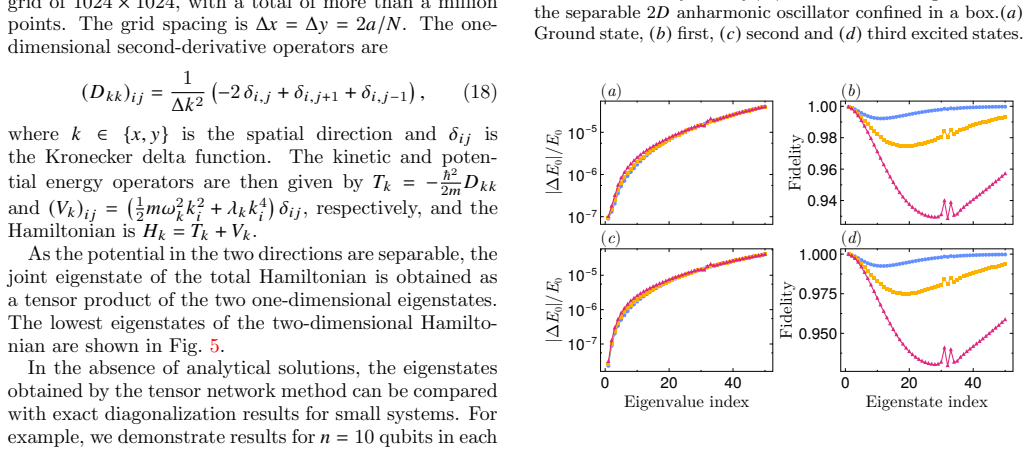
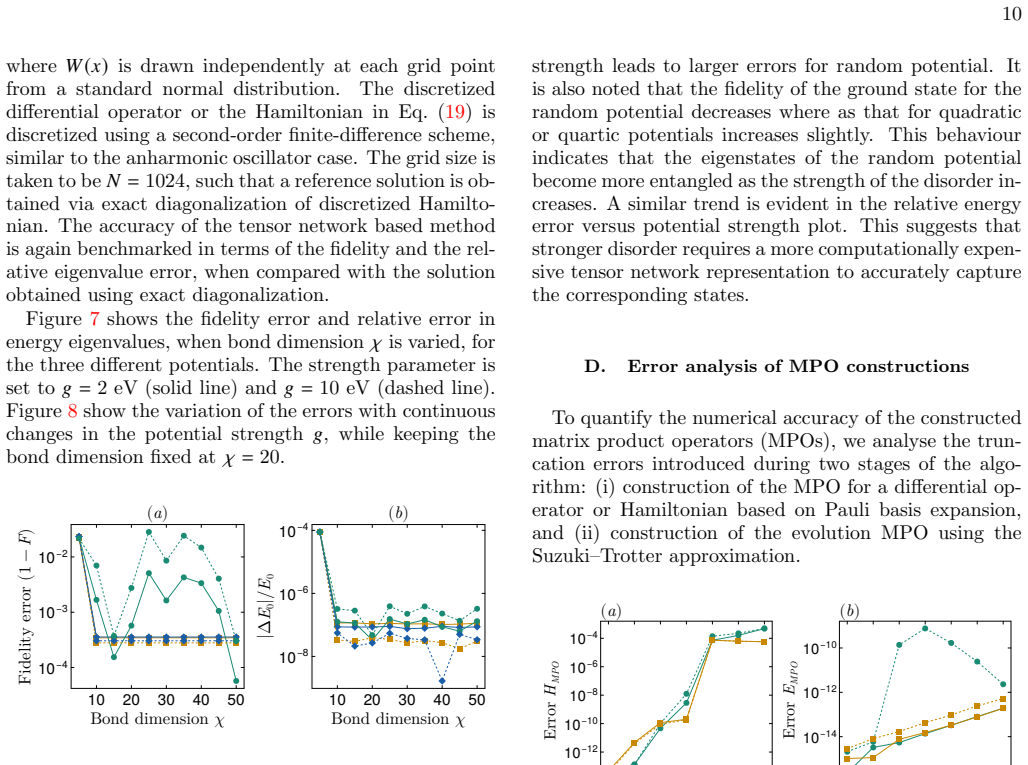
Summary. The paper develops two techniques to improve tensor-network (TN) solvers for Sturm–Liouville problems arising from PDEs. First, it derives closed-form expressions (Theorems 1–2, Eq. (2)) for the matrix elements of arbitrary n-qubit Pauli strings via binary structure number α and value number β; this yields Pauli coefficients (Eq. (3)) by a direct sum, reducing memory from O(2^{n+1}) (explicit Pauli matrices) to O(2n) and enabling efficient MPO construction for sparse structured operators such as tridiagonal discretizations (Props. 4–7, specialized sums in Appendix C). Second, it introduces a multistage state-refinement heuristic (linear interpolation map Û : H_n → H_{n+n′}, Eq. (11)) that seeds fine-grid imaginary-time evolution (ITE) from coarse-grid eigenstates, cutting the number of Trotter steps by up to two orders of magnitude. The framework is demonstrated on the Dirichlet Laplacian (first 32 eigenstates of dimension >10^6 at fidelity ≥0.95 with a 20-qubit MPO), the separable 2-D anharmonic oscillator (fidelity >0.99 vs exact diagonalization), and 1-D systems with quadratic/quartic/random potentials (accuracy degrades with disorder strength).
Significance. If the claims hold, the work supplies two reusable algorithmic primitives of independent interest: an analytical Pauli-string matrix-element formula that removes a memory bottleneck for any n-qubit operator (not only differential ones), and a simple coarse-to-fine MPS refinement that accelerates ITE for smooth low-lying modes. The induction proofs (Theorems 1–2, Props. 1–7) are machine-checkable in principle, the numerical benchmarks are external (closed-form Laplacian eigenfunctions, exact diagonalization), and the paper itself maps the failure mode (strong random potentials increase entanglement, rendering low-χ MPOs inaccurate). These contributions are useful both for classical TN PDE solvers and as classical simulators/preconditioners for quantum algorithms that rely on Pauli decompositions or imaginary-time evolution.
major comments (2)
- [§II.B, Eq. (3) and abstract] §II.B–C and abstract: The memory claim “O(2^{n+1}) → O(2n)” is correct for the evaluation of each Pauli coefficient once the operator matrix elements are known analytically, but for a completely general dense operator the sum in Eq. (3) still requires O(2^n) storage of those elements. The paper should state more sharply that the O(2n) figure applies only when the operator itself admits an O(n)- or O(poly(n))-space description (as the tridiagonal SL operators do via the functions a_i, b_i, c_i). Without that qualification the abstract overstates the generality.
- [§II.E, Eq. (11)] §II.E and Fig. 4: The multistage map Û is asserted to be representable as an MPO so that the whole pipeline stays inside the TN framework for large n. No explicit MPO construction, bond-dimension bound, or numerical verification of the MPO–MPS contraction cost is supplied. For the system sizes shown classical interpolation is used; a short appendix giving the MPO tensors of Û (or a reference to a standard linear-interpolation MPO) would make the scalability claim fully rigorous.
minor comments (5)
- [Fig. 2] Fig. 2 caption and main text: the comparison libraries “qiskit” and “pauli_lcu” are cited only by name; full package versions and the precise API calls used would improve reproducibility.
- [Tables I–II] Table I vs Table II: wall-clock times are reported on the same hardware, yet the two tables measure different stages (Pauli expansion alone vs full MPO+Trotter). A single combined timing table for the end-to-end pipeline would clarify the relative cost of each component.
- [§III.D] §III.D and Fig. 9: truncation-error analysis is performed only up to n=10 because of the exponential growth of Pauli strings. A brief remark on how the observed error scales (or an extrapolation) would help readers judge reliability at the n=20 regime used for the main Laplacian results.
- [§III.A] Notation: the same symbol χ is used both for bond dimension and (in places) for the diffusion constant; a distinct symbol for the latter would avoid momentary confusion.
- [Appendix C] Appendix C pseudocode: the functions C0/C1/C2 return un-normalized sums; the final division by 2^n and the phase factor appear only in the outer procedure. Adding a one-line comment that the returned values must still be scaled would prevent implementation errors.
Circularity Check
No significant circularity: Pauli-coefficient formulas are derived by induction from binary encodings, multistage refinement is an explicit heuristic validated on external exact solutions, and no fitted inputs are renamed as predictions.
full rationale
The load-bearing claims rest on Theorems 1–2 (structure and value numbers for Pauli matrix elements, proved by induction on n) and the resulting closed-form coefficient sum (Eq. 3), which reduce memory for any n-qubit matrix without assuming the target eigenstates or fidelities. Specialization to tridiagonal Sturm–Liouville operators (Props. 4–7) follows directly from the sparsity pattern of the finite-difference stencil and is not defined in terms of the later numerical results. Multistage refinement (§II.E) is presented as a heuristic map Ũ that linearly interpolates coarse-grid MPS amplitudes; its justification is the smoothness of low-lying modes, which the paper itself falsifies for strong random potentials (§III.C) rather than assuming it circularly. All reported fidelities and energy errors are measured against independent external references: closed-form Dirichlet Laplacian eigenfunctions (Fig. 3) and exact diagonalization of coarsened anharmonic/random Hamiltonians (Figs. 6–8). Algorithmic parameters (χ, Δt, truncation thresholds) are free choices whose effect is quantified, not tuned to force agreement with a target formula. Background citations to TN/ITE literature are not load-bearing uniqueness theorems or self-citations that close the derivation. Consequently the derivation chain does not reduce to its own inputs by construction.
Assumptions & free parameters
free parameters (4)
- bond dimension χ (and truncation threshold) =
typically 20–50 in reported runs
- Trotter step size Δt =
0.1
- multistage refinement schedule (n sequence) =
e.g. 4→6→10
- potential strength g (disorder scans) =
2–20 eV in figures
assumptions (5)
- standard math n-qubit Pauli strings form a complete orthogonal basis under the Hilbert–Schmidt product Tr(P†Q)=2^n δ_PQ
- domain assumption Centered finite-difference discretization of a Sturm–Liouville operator yields a real symmetric tridiagonal matrix with the stated a_i, b_i, c_i
- domain assumption Low-lying eigenstates of the considered differential operators are smooth enough that linear interpolation between coarse-grid amplitudes is a good fine-grid initializer
- domain assumption MPO bond truncation with relative-norm threshold keeps operator error small enough for the reported eigenstate fidelities
- standard math First-order Suzuki–Trotter with commuting Pauli groups is an adequate evolution operator for the ITE runs shown
invented entities (2)
-
structure number α(P_n) and value number β(P_n) for Pauli strings
independent evidence
-
multistage refinement map Û : H_n → H_{n+n′}
Cite this review
Pith. "Pith review of Efficient Pauli-decomposition and multistage state-refinement for tensor network based differential equation solver." pith.science (2026). https://pith.science/paper/FMUV2B5Z
@misc{pith2026260708166,
  author       = {Pith},
  title        = {Pith review of: Efficient Pauli-decomposition and multistage state-refinement for tensor network based differential equation solver},
  year         = {2026},
  howpublished = {\url{https://pith.science/paper/FMUV2B5Z}},
  note         = {Machine review of arXiv:2607.08166}
}
abstract
Classical numerical techniques for solving partial differential equations (PDEs) become computationally expensive as the dimension of the discretized differential operator increases. For PDEs giving rise to Sturm--Liouville problems, tensor network (TN) methods can be highly productive: an operator of dimension $N\times N$ can be represented as a matrix product operator (MPO) using only $n=\log_2(N)$ qubits, enabling computation of eigenvalues and eigenvectors via imaginary time evolution (ITE). However, this remains computationally challenging. First, most methods for generating MPOs of large operators without explicit tensor-product structure require prohibitively large memory. Second, the number of Trotterization steps for convergence in conventional ITE increases rapidly with $n$. We present techniques to mitigate both challenges for certain sparse, structured differential operators. To address the first, we construct the MPO by expanding the operator in the Pauli-string basis, enabled by an analytical expression for the Pauli basis coefficients that reduces the memory requirement from $\mathcal{O}(2^{n+1})$ to $\mathcal{O}(2n)$. To address the second, we propose a multistage state-refinement heuristic that accelerates ITE convergence, reducing convergence time by up to two orders of magnitude. Using this TN framework, we compute the first 32 eigenstates of a Laplacian of dimension exceeding $10^6$ with fidelity above $0.95$ using a 20-qubit MPO. We further validate the method on the 2D anharmonic oscillator and investigate disordered systems, where increasing random potential strength degrades accuracy and limits the approach.
Figures


Figures from the paper (5 more)



Reference graph
Works this paper leans on
-
[1]
S. R. White, Density matrix formulation for quantum renormalization groups, Phys. Rev. Lett.69, 2863 (1992)
work page 1992
-
[2]
S. R. White, Density-matrix algorithms for quantum renormalization groups, Phys. Rev. B48, 10345 (1993)
work page 1993
-
[3]
U. Schollw¨ ock, The density-matrix renormalization group in the age of matrix product states, Annals of Physics 326, 96 (2011), january 2011 Special Issue
work page 2011
-
[4]
R. Or´ us, A practical introduction to tensor networks: Matrix product states and projected entangled pair states, Annals of Physics349, 117 (2014)
work page 2014
-
[5]
F. Verstraete, V. Murg, and J. Cirac, Matrix prod- uct states, projected entangled pair states, and vari- ational renormalization group methods for quantum spin systems, Advances in Physics57, 143 (2008), https://doi.org/10.1080/14789940801912366
-
[6]
J. I. Cirac, D. P´ erez-Garc´ ıa, N. Schuch, and F. Ver- straete, Matrix product states and projected entangled pair states: Concepts, symmetries, theorems, Rev. Mod. Phys.93, 045003 (2021)
work page 2021
-
[7]
Or´ us, Tensor networks for complex quantum systems, Nature Reviews Physics1, 538 (2019)
R. Or´ us, Tensor networks for complex quantum systems, Nature Reviews Physics1, 538 (2019)
work page 2019
-
[8]
M. D. Garc´ ıa and A. M´ arquez Romero, Survey on com- putational applications of tensor-network simulations, IEEE Access12, 193212 (2024)
work page 2024
Show all 43 references
-
[9]
Eisert, M
J. Eisert, M. Cramer, and M. B. Plenio, Colloquium: Area laws for the entanglement entropy, Rev. Mod. Phys. 82, 277 (2010)
2010
-
[10]
M. B. Hastings, An area law for one-dimensional quan- tum systems, Journal of Statistical Mechanics: Theory and Experiment2007, P08024 (2007)
2007
-
[11]
Vidal, Efficient classical simulation of slightly entan- gled quantum computations, Phys
G. Vidal, Efficient classical simulation of slightly entan- gled quantum computations, Phys. Rev. Lett.91, 147902 (2003)
2003
-
[12]
Vidal, Efficient simulation of one-dimensional quan- tum many-body systems, Phys
G. Vidal, Efficient simulation of one-dimensional quan- tum many-body systems, Phys. Rev. Lett.93, 040502 (2004)
2004
-
[13]
P. C. S. Costa, S. Jordan, and A. Ostrander, Quantum algorithm for simulating the wave equation, Phys. Rev. A99, 012323 (2019)
2019
-
[14]
S. Jin, N. Liu, and Y. Yu, Quantum simulation of partial differential equations: Applications and detailed analy- sis, Phys. Rev. A108, 032603 (2023)
2023
-
[15]
I. V. Oseledets, Tensor-train decomposition, SIAM Journal on Scientific Computing33, 2295 (2011), https://doi.org/10.1137/090752286
2011 doi
-
[16]
I. V. Oseledets and S. V. Dolgov, Solution of linear systems and matrix inversion in the tt-format, SIAM Journal on Scientific Computing34, A2718 (2012), https://doi.org/10.1137/110833142
2012 doi
-
[17]
B. N. Khoromskij, Tensor numerical methods for high- dimensional pdes: Basic theory and initial applications (2014), arXiv:1408.4053 [math.NA]
2014 arXiv
-
[18]
Kazeev, O
V. Kazeev, O. Reichmann, and C. Schwab, Low-rank ten- sor structure of linear diffusion operators in the tt and qtt formats, Linear Algebra and its Applications438, 4204 (2013)
2013
-
[19]
S. V. Dolgov and D. V. Savostyanov, Alternating minimal energy methods for linear systems in higher dimensions, SIAM Journal on Scientific Computing36, A2248 (2014), https://doi.org/10.1137/140953289
2014 doi
-
[20]
Dolgov, B
S. Dolgov, B. Khoromskij, I. Oseledets, and D. Savostyanov, Computation of extreme eigenval- ues in higher dimensions using block tensor train format, Computer Physics Communications185, 1207 (2014)
2014
-
[21]
Holtz, T
S. Holtz, T. Rohwedder, and R. Schneider, The alternat- ing linear scheme for tensor optimization in the tensor train format, SIAM Journal on Scientific Computing34, A683 (2012), https://doi.org/10.1137/100818893
2012 doi
-
[22]
A. M. Boelens, D. Venturi, and D. M. Tartakovsky, Paral- lel tensor methods for high-dimensional linear pdes, Jour- nal of Computational Physics375, 519 (2018)
2018
-
[23]
A. J. Daley, C. Kollath, U. Schollw¨ ock, and G. Vidal, Time-dependent density-matrix renormalization-group using adaptive effective hilbert spaces, Journal of Statis- tical Mechanics: Theory and Experiment2004, P04005 (2004)
2004
-
[24]
Vidal, Classical simulation of infinite-size quantum lattice systems in one spatial dimension, Phys
G. Vidal, Classical simulation of infinite-size quantum lattice systems in one spatial dimension, Phys. Rev. Lett. 98, 070201 (2007)
2007
-
[25]
Haegeman, J
J. Haegeman, J. I. Cirac, T. J. Osborne, I. Piˇ zorn, H. Ver- schelde, and F. Verstraete, Time-dependent variational principle for quantum lattices, Phys. Rev. Lett.107, 070601 (2011)
2011
-
[26]
Paeckel, T
S. Paeckel, T. K¨ ohler, A. Swoboda, S. R. Manmana, U. Schollw¨ ock, and C. Hubig, Time-evolution methods for matrix-product states, Annals of Physics411, 167998 (2019)
2019
-
[27]
Koska, M
O. Koska, M. Baboulin, and A. Gazda, A tree-approach pauli decomposition algorithm with application to quan- tum computing (2024), arXiv:2403.11644 [quant-ph]
2024 arXiv
-
[28]
Gottesman, Stabilizer codes and quantum error cor- rection (1997), arXiv:quant-ph/9705052 [quant-ph]
D. Gottesman, Stabilizer codes and quantum error cor- rection (1997), arXiv:quant-ph/9705052 [quant-ph]
1997 arXiv
-
[29]
A. W. Harrow, A. Hassidim, and S. Lloyd, Quantum al- gorithm for linear systems of equations, Phys. Rev. Lett. 103, 150502 (2009)
2009
-
[30]
A. M. Childs, R. Kothari, and R. D. Somma, Quantum algorithm for systems of linear equations with exponentially improved dependence on preci- sion, SIAM Journal on Computing46, 1920 (2017), https://doi.org/10.1137/16M1087072
1920 doi
-
[31]
D. W. Berry, High-order quantum algorithm for solving linear differential equations, Journal of Physics A: Math- ematical and Theoretical47, 105301 (2014)
2014
-
[32]
A. M. Childs, J.-P. Liu, and A. Ostrander, High-precision quantum algorithms for partial differential equations, Quantum5, 574 (2021)
2021
-
[33]
Farghadan, M
A. Farghadan, M. M. Masteri Farahani, and M. Akbari, A fast quantum algorithm for solving partial differential equations, Scientific Reports15, 5317 (2025)
2025
-
[34]
Arseniev, D
B. Arseniev, D. Guskov, R. Sengupta, J. Biamonte, and I. Zacharov, Tridiagonal matrix decomposition for hamil- tonian simulation on a quantum computer, Phys. Rev. A 109, 052629 (2024)
2024
-
[35]
Peruzzo, J
A. Peruzzo, J. McClean, P. Shadbolt, M.-H. Yung, X.-Q. Zhou, P. J. Love, A. Aspuru-Guzik, and J. L. O’Brien, A variational eigenvalue solver on a photonic quantum processor, Nature Communications5, 4213 (2014)
2014
-
[36]
J. R. McClean, J. Romero, R. Babbush, and A. Aspuru- Guzik, The theory of variational hybrid quantum- classical algorithms, New Journal of Physics18, 023023 (2016)
2016
-
[37]
Cerezo, A
M. Cerezo, A. Arrasmith, R. Babbush, S. C. Benjamin, 13 S. Endo, K. Fujii, J. R. McClean, K. Mitarai, X. Yuan, L. Cincio, and P. J. Coles, Variational quantum algo- rithms, Nature Reviews Physics3, 625 (2021)
2021
-
[38]
Lubasch, J
M. Lubasch, J. Joo, P. Moinier, M. Kiffner, and D. Jaksch, Variational quantum algorithms for nonlinear problems, Phys. Rev. A101, 010301 (2020)
2020
-
[39]
McArdle, T
S. McArdle, T. Jones, S. Endo, Y. Li, S. C. Benjamin, and X. Yuan, Variational ansatz-based quantum simula- tion of imaginary time evolution, npj Quantum Informa- tion5, 75 (2019)
2019
-
[40]
Motta, C
M. Motta, C. Sun, A. T. K. Tan, M. J. O’Rourke, E. Ye, A. J. Minnich, F. G. S. L. Brand˜ ao, and G. K.-L. Chan, Determining eigenstates and thermal states on a quan- tum computer using quantum imaginary time evolution, Nature Physics16, 205 (2020)
2020
-
[41]
Bachmayr, Low-rank tensor methods for partial dif- ferential equations, Acta Numerica32, 1–121 (2023)
M. Bachmayr, Low-rank tensor methods for partial dif- ferential equations, Acta Numerica32, 1–121 (2023)
2023
-
[42]
T. N. Georges, B. K. Berntson, C. S¨ underhauf, and A. V. Ivanov, Pauli decomposition via the fast walsh-hadamard transform (2025), arXiv:2408.06206 [quant-ph]
2025 arXiv
-
[43]
M. Suzuki, Generalized Trotter’s formula and systematic approximants of exponential operators and inner deriva- tions with applications to many-body problems, Commu- nications in Mathematical Physics51, 183 (1976). 14 Appendix A: Definitions and Notations The single-qubit Paul...
1976
Reviewed July 10, 2026 · model on record in the stance chip above.
Discussion (0). Continue with ORCID to comment.