REVIEW 3 major objections 5 minor 54 references
Which student layers you swap for teacher blocks decides how well intermediate-size models interpolate, and a KL-greedy order often finds a near-optimal path.
Reviewed by Pith at T0; open to challenge. T0 means a machine referee read the full paper against a public rubric. the ladder, T0–T4 →
T0 review · grok-4.5
2026-07-10 11:56 UTC pith:YULMOCWG
load-bearing objection Clean formalization and a practical O(N^{2}) greedy algorithm for the patching-order problem in boomerang distillation; solid extension, not a paradigm shift. the 3 major comments →
Understanding Layer Patching in Model Size Interpolation
The pith
A machine-rendered reading of the paper's core claim, the machinery that carries it, and where it could break.
Core claim
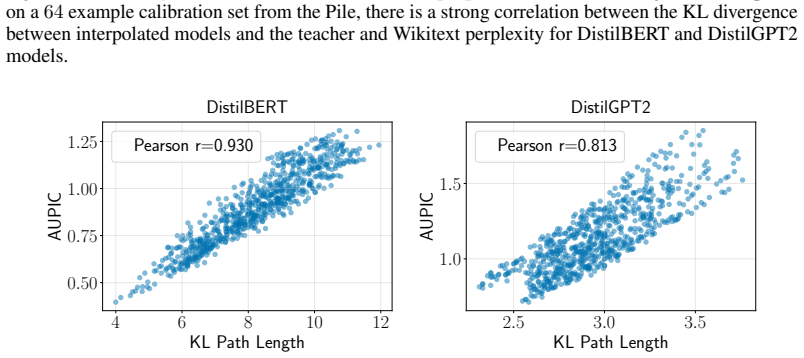
Finding the optimal nested patching order for model-size interpolation is equivalent, under equidistant consecutive sizes, to a shortest path in the Boolean lattice of partially patched models whose edge weights are expected KL divergence from the teacher’s next-token distribution. A greedy algorithm that always patches the layer that most reduces that KL produces near-optimal interpolation trajectories on several language-model families.
What carries the argument
The interpolation graph: the Boolean lattice of student-layer subsets, with an edge from a model to the same model after one more teacher block is patched, weighted by expected KL(p_teacher || p_patched) on a calibration set. Shortest paths in this graph are optimal permutations for teacher-relative log-area-under-perplexity-curve; KLPatch greedily follows the cheapest outgoing edge at each step.
Load-bearing premise
The optimality claim needs consecutive patched models to grow by roughly the same number of parameters, and needs KL distance to the teacher to track real data perplexity and downstream accuracy closely enough.
What would settle it
On a fixed teacher–student pair, compute the true minimum AUPIC (or AUIC) over all nested orders—or a large random sample—and check whether the KLPatch order’s score is near that minimum; a large, systematic gap on a new model family would falsify the claim that the KL path is near-optimal in practice.
Editorial analysis
A structured set of objections, weighed in public.
Referee Report
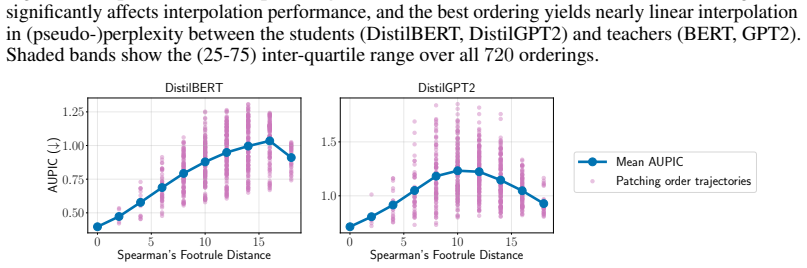
Summary. The paper studies student-layer selection for zero-shot model-size interpolation via boomerang distillation. It formalizes optimal nested patching as a combinatorial problem over subsets/permutations (Problems 1–2), shows that under equidistant consecutive sizes the optimal permutation w.r.t. teacher-relative log-AUPIC is exactly a shortest path in the Boolean lattice whose edge weights are expected KL(p_T || p_M) (Definition 1, Proposition 1), and introduces the greedy O(N^{2}) KLPatch algorithm that selects the cheapest outgoing edge at each step. Exhaustive enumeration on DistilBERT/DistilGPT2 (N=6), 200 random orders on Qwen3-4B/8B and Pythia-6.9B, and ablations (cosine vs KL, iterative vs non-iterative, calibration size) show that last-to-first is often strong, that good orders cluster near the optimum in footrule distance, and that KLPatch recovers best or near-best AUPIC/AUIC trajectories on those families (with a hand-crafted first-layer constraint needed for Llama).
Significance. If the reduction and the empirical near-optimality of KLPatch hold, the work supplies the first principled account of the combinatorial design space of layer patching and a practical O(N^{2}) recipe that improves on the fixed sequential baselines of the prior boomerang-distillation paper. Strengths include a short, correct proof of Proposition 1 under the stated assumptions, exhaustive enumeration on the small models, transparent ablations (Appendix K), and explicit acknowledgment of the Llama exception and the approximate equidistance of real student initializations (Remark 2). The contribution is incremental relative to Kangaslahti et al. (2026) but fills a genuine user-facing gap and is immediately usable for constructing intermediate-size models without retraining.
major comments (3)
- Proposition 1 (and the optimality claim for KLPatch) rests on equidistant consecutive model sizes. Remark 2 notes that the student initializations keep first/last layers, so the assumption is only approximate. The manuscript should quantify the size variation across edges for the actual Qwen/Pythia/Llama students (e.g., max relative deviation of |M_{A∪{i}}|−|M_A|) and either restate the guarantee for non-uniform edge lengths or show that the greedy path remains near-optimal under the observed deviations.
- Appendix J shows that plain KLPatch underperforms first-to-last on Llama-3.2-3B and recovers only after the hand-crafted constraint “always patch layer 1 first.” Because the abstract and §6 claim that KLPatch “often improves over last-to-first \ldots across several language models,” the main text should either (i) present the Llama result as a clear family-specific failure mode tied to student initialization, or (ii) supply a diagnostic (e.g., first-layer KL gap) that predicts when the unconstrained algorithm will fail.
- The proxy chain teacher-log-PPL → data-PPL → downstream AUIC is only partially validated. Propositions 2–3 give additive/multiplicative bounds, and Appendix G shows strong Pearson correlations on DistilBERT/GPT2, yet §5.3 already notes that last-to-first is best on Wikitext AUPIC but leaves a substantial gap on downstream AUIC for the large models. A short table of Spearman rank correlations between KL-path length, data-AUPIC and AUIC on the 200-order samples would make the strength of the proxy transparent rather than leaving it to the reader to infer from the figures.
minor comments (5)
- Figure 1 caption and the surrounding text use both “block” and “layer” for the same student unit; a single consistent term would reduce confusion.
- In §4.2 the AUIC/AUPIC formulas are written with a trapezoidal average; the text never states whether the reported “normalized AUPIC” simply divides by total size span or also by the student–teacher gap. One clarifying sentence would help.
- Table 3 (DistilGPT2) shows that the global shortest KL path coincides with first-to-last, while the minimum-AUPIC path is different; a one-sentence remark on why the KL optimum and the data-AUPIC optimum diverge on this model would be useful.
- The calibration-set ablation (Table 7) is thorough; moving the |D_cal|=64 recommendation into the main-text description of Algorithm 1 would make the practical recipe self-contained.
- A few typos: “boomerang distillation [Kangaslahti et al., 2026]” appears with a future year in the abstract; “AUPIC Percentile” is defined twice (G.3 and I.1) with slightly different wording.
Circularity Check
No significant circularity: shortest-path equivalence is a direct algebraic identity from the KL decomposition and AUPIC definition; self-citation supplies only the experimental setup.
full rationale
Proposition 1 equates argmin of path length E(π) in the KL-weighted Boolean lattice to argmin of AUPIClog_T(π) by the elementary identity Ex KL(pT ∥ pM) = log PPLT(M) - log PPLT(T) together with the equidistant-size assumption that converts the sum into a scaled trapezoidal area. This is a definitional rewriting, not a prediction forced by a fit or by an external uniqueness claim. Propositions 2–3 merely bound the gap to data-referenced and raw-scale AUPIC; they do not close a loop. KLPatch is an explicit greedy heuristic on the same graph and is validated empirically against exhaustive enumeration (DistilBERT/GPT2) and random baselines (Qwen/Pythia), not by construction. The only self-citation is to Kangaslahti et al. 2026 for the boomerang-distillation procedure and the released student checkpoints; those supply the experimental substrate, not a load-bearing uniqueness or ansatz that forces the optimality result. No fitted parameter is later called a prediction, no uniqueness theorem is imported from the same authors, and no known empirical pattern is merely renamed. Score 1 reflects only the ordinary reliance on the authors’ prior models for the empirical sections; the formal claim is self-contained.
Axiom & Free-Parameter Ledger
free parameters (2)
- calibration set size |D_cal| =
64
- number of random patching orders sampled for large models =
200
axioms (3)
- standard math Cross-entropy decomposition H(p_T, p_M) = H(p_T) + KL(p_T || p_M) holds for the next-token distributions of any intermediate model M.
- domain assumption Consecutive interpolated models differ by a constant number of parameters (equidistant sizes).
- domain assumption Teacher-relative KL (or log-perplexity) is a sufficiently faithful proxy for data perplexity and downstream accuracy that greedy minimization of the former yields good values of the latter.
invented entities (2)
-
Interpolation graph G (Boolean lattice with KL edge weights)
no independent evidence
-
KLPatch algorithm
independent evidence
read the original abstract
Zero-shot model size interpolation aims to create new models of intermediate target sizes by combining existing models without additional training. Recent work on boomerang distillation [Kangaslahti et al., 2026] shows that a student language model distilled from a larger teacher can be expanded by iteratively patching its layers, replacing student layers with contiguous blocks of teacher layers to obtain models whose size and performance interpolate between the student and the teacher. In this work, we provide the first systematic study of student-layer selection for model size interpolation. We cast finding the optimal layer subset for each model size as an optimization problem and prove it can be viewed as a shortest-path problem in a certain acyclic graph. In experiments, we show that patching strongly shapes interpolation behavior, with effects that vary substantially across model families. We find that simple sequential strategies--patching either from the first layer to the last or from the last to the first--often achieve surprisingly strong performance in practice. We further introduce KLPatch, a greedy patching algorithm based on KL divergence, which often improves over last-to-first patching and approximately solves the optimization problem. Together, our results provide a principled understanding of how layer patching affects model size interpolation and offer practical guidance for constructing near-optimal interpolated models.
Figures






Reference graph
Works this paper leans on
-
[1]
Ainsworth, Jonathan Hayase, and Siddhartha S
Samuel K. Ainsworth, Jonathan Hayase, and Siddhartha S. Srinivasa. Git re-basin: Merging models modulo permutation symmetries. In The Eleventh International Conference on Learning Representations, ICLR 2023, Kigali, Rwanda, May 1-5, 2023 . OpenReview.net, 2023. URL https://openreview.net/pdf?id=CQsmMYmlP5T
work page 2023
-
[2]
Pythia: A suite for analyzing large language models across training and scaling
Stella Biderman, Hailey Schoelkopf, Quentin Gregory Anthony, Herbie Bradley, Kyle O'Brien, Eric Hallahan, Mohammad Aflah Khan, Shivanshu Purohit, USVSN Sai Prashanth, Edward Raff, Aviya Skowron, Lintang Sutawika, and Oskar van der Wal. Pythia: A suite for analyzing large language models across training and scaling. In Andreas Krause, Emma Brunskill, Kyung...
work page 2023
-
[3]
PIQA: reasoning about physical commonsense in natural language
Yonatan Bisk, Rowan Zellers, Ronan LeBras, Jianfeng Gao, and Yejin Choi. PIQA: reasoning about physical commonsense in natural language. In The Thirty-Fourth AAAI Conference on Artificial Intelligence, AAAI 2020, The Thirty-Second Innovative Applications of Artificial Intelligence Conference, IAAI 2020, The Tenth AAAI Symposium on Educational Advances in ...
work page 2020
-
[4]
LL amaflex: Many-in-one LLM s via generalized pruning and weight sharing
Ruisi Cai, Saurav Muralidharan, Hongxu Yin, Zhangyang Wang, Jan Kautz, and Pavlo Molchanov. LL amaflex: Many-in-one LLM s via generalized pruning and weight sharing. In The Thirteenth International Conference on Learning Representations, 2025. URL https://openreview.net/forum?id=AyC4uxx2HW
work page 2025
-
[5]
B ool Q : Exploring the surprising difficulty of natural yes/no questions
Christopher Clark, Kenton Lee, Ming-Wei Chang, Tom Kwiatkowski, Michael Collins, and Kristina Toutanova. B ool Q : Exploring the surprising difficulty of natural yes/no questions. In Jill Burstein, Christy Doran, and Thamar Solorio, editors, Proceedings of the 2019 Conference of the North A merican Chapter of the Association for Computational Linguistics:...
-
[6]
Think you have Solved Question Answering? Try ARC, the AI2 Reasoning Challenge
Peter Clark, Isaac Cowhey, Oren Etzioni, Tushar Khot, Ashish Sabharwal, Carissa Schoenick, and Oyvind Tafjord. Think you have solved question answering? try arc, the ai2 reasoning challenge, 2018. URL https://arxiv.org/abs/1803.05457
work page internal anchor Pith review Pith/arXiv arXiv 2018
-
[7]
Training Verifiers to Solve Math Word Problems
Karl Cobbe, Vineet Kosaraju, Mohammad Bavarian, Mark Chen, Heewoo Jun, Lukasz Kaiser, Matthias Plappert, Jerry Tworek, Jacob Hilton, Reiichiro Nakano, Christopher Hesse, and John Schulman. Training verifiers to solve math word problems, 2021. URL https://arxiv.org/abs/2110.14168
work page internal anchor Pith review Pith/arXiv arXiv 2021
-
[8]
BERT : Pre-training of Deep Bidirectional Transformers for Language Understanding
Jacob Devlin, Ming-Wei Chang, Kenton Lee, and Kristina Toutanova. BERT : Pre-training of deep bidirectional transformers for language understanding. In Jill Burstein, Christy Doran, and Thamar Solorio, editors, Proceedings of the 2019 Conference of the North A merican Chapter of the Association for Computational Linguistics: Human Language Technologies, V...
-
[9]
The Role of Permutation Invariance in Linear Mode Connectivity of Neural Networks
Rahim Entezari, Hanie Sedghi, Olga Saukh, and Behnam Neyshabur. The role of permutation invariance in linear mode connectivity of neural networks. arXiv preprint arXiv:2110.06296, 2021
work page internal anchor Pith review Pith/arXiv arXiv 2021
-
[10]
Linear mode connectivity and the lottery ticket hypothesis
Jonathan Frankle, Gintare Karolina Dziugaite, Daniel Roy, and Michael Carbin. Linear mode connectivity and the lottery ticket hypothesis. In Proceedings of the 37th International Conference on Machine Learning, ICML 2020, 13-18 July 2020, Virtual Event , volume 119 of Proceedings of Machine Learning Research, pages 3259--3269. PMLR , 2020. URL http://proc...
work page 2020
-
[11]
The Pile: An 800GB Dataset of Diverse Text for Language Modeling
Leo Gao, Stella Biderman, Sid Black, Laurence Golding, Travis Hoppe, Charles Foster, Jason Phang, Horace He, Anish Thite, Noa Nabeshima, Shawn Presser, and Connor Leahy. The pile: An 800gb dataset of diverse text for language modeling, 2021. URL https://arxiv.org/abs/2101.00027
work page internal anchor Pith review Pith/arXiv arXiv 2021
-
[12]
A framework for few-shot language model evaluation, 2023
Leo Gao, Jonathan Tow, Baber Abbasi, Stella Biderman, Sid Black, Anthony DiPofi, Charles Foster, Laurence Golding, Jeffrey Hsu, Alain Le Noac'h, Haonan Li, Kyle McDonell, Niklas Muennighoff, Chris Ociepa, Jason Phang, Laria Reynolds, Hailey Schoelkopf, Aviya Skowron, Lintang Sutawika, Eric Tang, Anish Thite, Ben Wang, Kevin Wang, and Andy Zou. A framework...
-
[13]
Aaron Grattafiori, Abhimanyu Dubey, Abhinav Jauhri, Abhinav Pandey, Abhishek Kadian, Ahmad Al-Dahle, Aiesha Letman, Akhil Mathur, Alan Schelten, Alex Vaughan, et al. The llama 3 herd of models. ArXiv preprint, abs/2407.21783, 2024. URL https://arxiv.org/abs/2407.21783
work page internal anchor Pith review Pith/arXiv arXiv 2024
-
[14]
Song Han, Jeff Pool, John Tran, and William J. Dally. Learning both weights and connections for efficient neural network. In Corinna Cortes, Neil D. Lawrence, Daniel D. Lee, Masashi Sugiyama, and Roman Garnett, editors, Advances in Neural Information Processing Systems 28: Annual Conference on Neural Information Processing Systems 2015, December 7-12, 201...
work page 2015
-
[15]
Amc: Automl for model compression and acceleration on mobile devices
Yihui He, Ji Lin, Zhijian Liu, Hanrui Wang, Li-Jia Li, and Song Han. Amc: Automl for model compression and acceleration on mobile devices. In Proceedings of the European conference on computer vision (ECCV), pages 784--800, 2018
work page 2018
-
[16]
Measuring massive multitask language understanding
Dan Hendrycks, Collin Burns, Steven Basart, Andy Zou, Mantas Mazeika, Dawn Song, and Jacob Steinhardt. Measuring massive multitask language understanding. In 9th International Conference on Learning Representations, ICLR 2021, Virtual Event, Austria, May 3-7, 2021 . OpenReview.net, 2021 a . URL https://openreview.net/forum?id=d7KBjmI3GmQ
work page 2021
-
[17]
Measuring mathematical problem solving with the math dataset
Dan Hendrycks, Collin Burns, Saurav Kadavath, Akul Arora, Steven Basart, Eric Tang, Dawn Song, and Jacob Steinhardt. Measuring mathematical problem solving with the math dataset. NeurIPS, 2021 b
work page 2021
-
[18]
Rethinking layer relevance in large language models beyond cosine similarity
Cristian Hinostroza, Rodrigo Toro Icarte, Christ Devia, Andres Carvallo De Ferari, Eugenio Herrera-Berg, Denis Parra, and Jorge F Silva. Rethinking layer relevance in large language models beyond cosine similarity. In The Fourteenth International Conference on Learning Representations, 2026. URL https://openreview.net/forum?id=mRLnS8jQWt
work page 2026
-
[19]
Distilling the Knowledge in a Neural Network
Geoffrey Hinton, Oriol Vinyals, and Jeff Dean. Distilling the knowledge in a neural network. ArXiv preprint, abs/1503.02531, 2015. URL https://arxiv.org/abs/1503.02531
work page internal anchor Pith review Pith/arXiv arXiv 2015
-
[20]
Training Compute-Optimal Large Language Models
Jordan Hoffmann, Sebastian Borgeaud, Arthur Mensch, Elena Buchatskaya, Trevor Cai, Eliza Rutherford, DDL Casas, Lisa Anne Hendricks, Johannes Welbl, Aidan Clark, et al. Training compute-optimal large language models. arXiv preprint arXiv:2203.15556, 10, 2022
work page internal anchor Pith review Pith/arXiv arXiv 2022
-
[21]
Instruction-Following Pruning for Large Language Models
Bairu Hou, Qibin Chen, Jianyu Wang, Guoli Yin, Chong Wang, Nan Du, Ruoming Pang, Shiyu Chang, and Tao Lei. Instruction-following pruning for large language models. arXiv preprint arXiv:2501.02086, 2025
work page internal anchor Pith review Pith/arXiv arXiv 2025
-
[22]
Chip Huyen. Designing machine learning systems. " O'Reilly Media, Inc.", 2022
work page 2022
-
[23]
Nayak, Jonathan Geuter, Marco Fumero, Francesco Locatello, and David Alvarez-Melis
Sara Kangaslahti, Nihal V. Nayak, Jonathan Geuter, Marco Fumero, Francesco Locatello, and David Alvarez-Melis. Boomerang distillation enables zero-shot model size interpolation. In The Fourteenth International Conference on Learning Representations, 2026. URL https://openreview.net/forum?id=4ZU8v4s3IR
work page 2026
-
[24]
Scaling Laws for Neural Language Models
Jared Kaplan, Sam McCandlish, Tom Henighan, Tom B Brown, Benjamin Chess, Rewon Child, Scott Gray, Alec Radford, Jeffrey Wu, and Dario Amodei. Scaling laws for neural language models. arXiv preprint arXiv:2001.08361, 2020
work page internal anchor Pith review Pith/arXiv arXiv 2001
-
[25]
Nayak, Jack Merullo, Stephen Bach, Chen Sun, and Ellie Pavlick
Apoorv Khandelwal, Tian Yun, Nihal V. Nayak, Jack Merullo, Stephen Bach, Chen Sun, and Ellie Pavlick. \ 100k or 100 days: Trade-offs when pre-training with academic resources. In Second Conference on Language Modeling, 2025. URL https://openreview.net/forum?id=EFxC34XbDh
work page 2025
-
[26]
RACE : Large-scale R e A ding comprehension dataset from examinations
Guokun Lai, Qizhe Xie, Hanxiao Liu, Yiming Yang, and Eduard Hovy. RACE : Large-scale R e A ding comprehension dataset from examinations. In Martha Palmer, Rebecca Hwa, and Sebastian Riedel, editors, Proceedings of the 2017 Conference on Empirical Methods in Natural Language Processing, pages 785--794, Copenhagen, Denmark, 2017. Association for Computation...
-
[27]
Yann LeCun, John Denker, and Sara Solla. Optimal brain damage. Advances in neural information processing systems, 2, 1989
work page 1989
-
[28]
Same Pre-training Loss, Better Downstream: Implicit Bias Matters for Language Models
Hong Liu, Sang Michael Xie, Zhiyuan Li, and Tengyu Ma. Same pre-training loss, better downstream: Implicit bias matters for language models. 2023. doi:10.48550/arXiv.2210.14199
work page internal anchor Pith review Pith/arXiv arXiv doi:10.48550/arxiv.2210.14199 2023
-
[29]
Amir M. Mansourian, Rozhan Ahmadi, Masoud Ghafouri, Amir Mohammad Babaei, Elaheh Badali Golezani, Zeynab yasamani ghamchi, Vida Ramezanian, Alireza Taherian, Kimia Dinashi, Amirali Miri, and Shohreh Kasaei. A comprehensive survey on knowledge distillation. Transactions on Machine Learning Research, 2025. ISSN 2835-8856. URL https://openreview.net/forum?id...
work page 2025
-
[30]
ShortGPT: Layers in Large Language Models are More Redundant Than You Expect
Xin Men, Mingyu Xu, Qingyu Zhang, Bingning Wang, Hongyu Lin, Yaojie Lu, Xianpei Han, and Weipeng Chen. Shortgpt: Layers in large language models are more redundant than you expect. ArXiv preprint, abs/2403.03853, 2024. URL https://arxiv.org/abs/2403.03853
work page internal anchor Pith review Pith/arXiv arXiv 2024
-
[31]
Pointer sentinel mixture models
Stephen Merity, Caiming Xiong, James Bradbury, and Richard Socher. Pointer sentinel mixture models. In 5th International Conference on Learning Representations, ICLR 2017, Toulon, France, April 24-26, 2017, Conference Track Proceedings . OpenReview.net, 2017. URL https://openreview.net/forum?id=Byj72udxe
work page 2017
-
[32]
Can a suit of armor conduct electricity? a new dataset for open book question answering
Todor Mihaylov, Peter Clark, Tushar Khot, and Ashish Sabharwal. Can a suit of armor conduct electricity? a new dataset for open book question answering. In Ellen Riloff, David Chiang, Julia Hockenmaier, and Jun ' ichi Tsujii, editors, Proceedings of the 2018 Conference on Empirical Methods in Natural Language Processing, pages 2381--2391, Brussels, Belgiu...
-
[33]
Compact language models via pruning and knowledge distillation
Saurav Muralidharan, Sharath Turuvekere Sreenivas, Raviraj Joshi, Marcin Chochowski, Mostofa Patwary, Mohammad Shoeybi, Bryan Catanzaro, Jan Kautz, and Pavlo Molchanov. Compact language models via pruning and knowledge distillation. In Amir Globersons, Lester Mackey, Danielle Belgrave, Angela Fan, Ulrich Paquet, Jakub M. Tomczak, and Cheng Zhang, editors,...
-
[34]
Uniform convergence may be unable to explain generalization in deep learning
Vaishnavh Nagarajan and J Zico Kolter. Uniform convergence may be unable to explain generalization in deep learning. Advances in neural information processing systems, 32, 2019
work page 2019
-
[35]
An analysis of approximations for maximizing submodular set functions
G L Nemhauser, L A Wolsey, and M L Fisher. An analysis of approximations for maximizing submodular set functions. 14: 0 265--294, 1978. ISSN 0025-5610,1436-4646. doi:10.1007/bf01588971
-
[36]
Interpreting gpt: The logit lens, 2020
nostalgebraist. Interpreting gpt: The logit lens, 2020. URL https://www. lesswrong.com/posts/AcKRB8wDpdaN6v6ru/ interpreting-gpt-the-logit-lens
work page 2020
-
[37]
Pytorch: An imperative style, high-performance deep learning library
Adam Paszke, Sam Gross, Francisco Massa, Adam Lerer, James Bradbury, Gregory Chanan, Trevor Killeen, Zeming Lin, Natalia Gimelshein, Luca Antiga, Alban Desmaison, Andreas K \" o pf, Edward Yang, Zachary DeVito, Martin Raison, Alykhan Tejani, Sasank Chilamkurthy, Benoit Steiner, Lu Fang, Junjie Bai, and Soumith Chintala. Pytorch: An imperative style, high-...
work page 2019
-
[38]
Language models are unsupervised multitask learners
Alec Radford, Jeff Wu, Rewon Child, David Luan, Dario Amodei, and Ilya Sutskever. Language models are unsupervised multitask learners. OpenAI, 2019. URL https://cdn.openai.com/better-language-models/language_models_are_unsupervised_multitask_learners.pdf
work page 2019
-
[39]
Winogrande: An adversarial winograd schema challenge at scale
Keisuke Sakaguchi, Ronan Le Bras, Chandra Bhagavatula, and Yejin Choi. Winogrande: An adversarial winograd schema challenge at scale. In The Thirty-Fourth AAAI Conference on Artificial Intelligence, AAAI 2020, The Thirty-Second Innovative Applications of Artificial Intelligence Conference, IAAI 2020, The Tenth AAAI Symposium on Educational Advances in Art...
work page 2020
-
[40]
DistilBERT, a distilled version of BERT: smaller, faster, cheaper and lighter
Victor Sanh, Lysandre Debut, Julien Chaumond, and Thomas Wolf. Distilbert, a distilled version of bert: smaller, faster, cheaper and lighter. ArXiv preprint, abs/1910.01108, 2019. URL https://arxiv.org/abs/1910.01108
work page internal anchor Pith review Pith/arXiv arXiv 1910
-
[41]
Model fusion via optimal transport
Sidak Pal Singh and Martin Jaggi. Model fusion via optimal transport. In Hugo Larochelle, Marc'Aurelio Ranzato, Raia Hadsell, Maria - Florina Balcan, and Hsuan - Tien Lin, editors, Advances in Neural Information Processing Systems 33: Annual Conference on Neural Information Processing Systems 2020, NeurIPS 2020, December 6-12, 2020, virtual, 2020. URL htt...
work page 2020
-
[42]
LLM Pruning and Distillation in Practice: The Minitron Approach
Sharath Turuvekere Sreenivas, Saurav Muralidharan, Raviraj Joshi, Marcin Chochowski, Ameya Sunil Mahabaleshwarkar, Gerald Shen, Jiaqi Zeng, Zijia Chen, Yoshi Suhara, Shizhe Diao, et al. Llm pruning and distillation in practice: The minitron approach. ArXiv preprint, abs/2408.11796, 2024. URL https://arxiv.org/abs/2408.11796
work page internal anchor Pith review Pith/arXiv arXiv 2024
-
[43]
Mingjie Sun, Zhuang Liu, Anna Bair, and J. Zico Kolter. A simple and effective pruning approach for large language models. In The Twelfth International Conference on Learning Representations, ICLR 2024, Vienna, Austria, May 7-11, 2024 . OpenReview.net, 2024. URL https://openreview.net/forum?id=PxoFut3dWW
work page 2024
- [44]
-
[45]
Kimi Team, Tongtong Bai, Yifan Bai, Yiping Bao, SH Cai, Yuan Cao, Y Charles, HS Che, Cheng Chen, Guanduo Chen, et al. Kimi k2. 5: Visual agentic intelligence. arXiv preprint arXiv:2602.02276, 2026
work page internal anchor Pith review Pith/arXiv arXiv 2026
-
[46]
Qwen3.5: Accelerating productivity with native multimodal agents, February 2026
Qwen Team. Qwen3.5: Accelerating productivity with native multimodal agents, February 2026. URL https://qwen.ai/blog?id=qwen3.5
work page 2026
-
[47]
Alex Wang, Amanpreet Singh, Julian Michael, Felix Hill, Omer Levy, and Samuel R. Bowman. GLUE: A multi-task benchmark and analysis platform for natural language understanding. In 7th International Conference on Learning Representations, ICLR 2019, New Orleans, LA, USA, May 6-9, 2019 . OpenReview.net, 2019. URL https://openreview.net/forum?id=rJ4km2R5t7
work page 2019
-
[48]
HuggingFace's Transformers: State-of-the-art Natural Language Processing
Thomas Wolf, Lysandre Debut, Victor Sanh, Julien Chaumond, Clement Delangue, Anthony Moi, Pierric Cistac, Tim Rault, R \'e mi Louf, Morgan Funtowicz, and Jamie Brew. Huggingface's transformers: State-of-the-art natural language processing. ArXiv preprint, abs/1910.03771, 2019. URL https://arxiv.org/abs/1910.03771
work page internal anchor Pith review Pith/arXiv arXiv 1910
-
[49]
Sheared llama: Accelerating language model pre-training via structured pruning
Mengzhou Xia, Tianyu Gao, Zhiyuan Zeng, and Danqi Chen. Sheared llama: Accelerating language model pre-training via structured pruning. In The Twelfth International Conference on Learning Representations, ICLR 2024, Vienna, Austria, May 7-11, 2024 . OpenReview.net, 2024. URL https://openreview.net/forum?id=09iOdaeOzp
work page 2024
-
[50]
An Yang, Anfeng Li, Baosong Yang, Beichen Zhang, Binyuan Hui, Bo Zheng, Bowen Yu, Chang Gao, Chengen Huang, Chenxu Lv, et al. Qwen3 technical report. ArXiv preprint, abs/2505.09388, 2025. URL https://arxiv.org/abs/2505.09388
work page internal anchor Pith review Pith/arXiv arXiv 2025
-
[51]
Model merging in llms, mllms, and beyond: Methods, theories, applications, and opportunities
Enneng Yang, Li Shen, Guibing Guo, Xingwei Wang, Xiaochun Cao, Jie Zhang, and Dacheng Tao. Model merging in llms, mllms, and beyond: Methods, theories, applications, and opportunities. ACM Comput. Surv., 58 0 (8), February 2026. ISSN 0360-0300. doi:10.1145/3787849. URL https://doi.org/10.1145/3787849
-
[52]
Rowan Zellers, Ari Holtzman, Yonatan Bisk, Ali Farhadi, and Yejin Choi. H ella S wag: Can a machine really finish your sentence? In Anna Korhonen, David Traum, and Llu \' s M \`a rquez, editors, Proceedings of the 57th Annual Meeting of the Association for Computational Linguistics, pages 4791--4800, Florence, Italy, 2019. Association for Computational Li...
-
[53]
FinerCut: Finer-grained Interpretable Layer Pruning for Large Language Models
Yang Zhang, Yawei Li, Xinpeng Wang, Qianli Shen, Barbara Plank, Bernd Bischl, Mina Rezaei, and Kenji Kawaguchi. Finercut: Finer-grained interpretable layer pruning for large language models. arXiv preprint arXiv:2405.18218, 2024
work page internal anchor Pith review Pith/arXiv arXiv 2024
-
[54]
Instruction-Following Evaluation for Large Language Models
Jeffrey Zhou, Tianjian Lu, Swaroop Mishra, Siddhartha Brahma, Sujoy Basu, Yi Luan, Denny Zhou, and Le Hou. Instruction-following evaluation for large language models, 2023. URL https://arxiv.org/abs/2311.07911
work page internal anchor Pith review Pith/arXiv arXiv 2023
discussion (0)
Sign in with ORCID, Apple, or X to comment. Anyone can read and Pith papers without signing in.