REVIEW 3 major objections 5 minor 103 references
Tens of MeV, collimated, bright fluxes of protons from ordered nano-structured targets in ultra-relativistic laser-matter interaction
T0 review · 3 major / 5 minor · reviewed 2026-07-13 · grok-4.5
Pith's one-line read Ordered nickel nanowires keep raising proton cutoff energy and beam collimation even under ordinary petawatt contrast.
desk verdict Solid ELI-NP comparison showing nanowire TNSA gains and collimation hold at realistic ~10^{-10} contrast; residual cutoff attribution after Zimmer scaling is imperfect but not fatal. read the letter →
The pith
A machine-rendered reading of the paper's core claim, the machinery that carries it, and where it could break.
The reading
What carries the argument
Target-normal sheath acceleration (TNSA) strengthened by nanowire-enhanced hot-electron generation, which both raises the sheath field and amplifies the rear-side toroidal magnetic field that collimates the proton beam.
What would settle it
A side-by-side campaign that holds substrate thickness, rear-surface contamination layer, and measured pre-plasma scale length fixed while only the presence or absence of the nanowires is varied; if the cutoff and collimation advantages then disappear, the central claim fails.
Extended reading notes
Core claim
At intensities of ~3 imes10^{21} W cm^{-2}, ordered Ni nanowire targets produce a measurable rise in proton cutoff energy (roughly 29–32 MeV flat → 36–38 MeV nanowire) and a several-fold increase in high-energy flux that survives both ~10^{-10} and ~10^{-13} contrast; the same wires also reduce the angular divergence of protons above 12 MeV relative to flat foils.
Load-bearing premise
The leftover cutoff-energy gain after ordinary thickness scaling is credited mainly to the nanowires rather than to uncontrolled differences in substrate thickness, surface contamination, or pre-plasma shape among the nine targets.
Signed reviews
Editorial analysis
A structured set of objections, weighed in public.
Referee Report
Summary. The manuscript reports proton acceleration experiments at ELI-NP (~3×10^21 W cm^-2, ~23 fs) comparing ordered Ni nanowire/nanotube targets to flat Ni foils under two temporal-contrast regimes (~10^-10 without plasma mirror; ~10^-13 with a single plasma mirror). Using Thomson-parabola spectra along target normal and energy-resolved RCF angular maps, the authors find higher cutoff energies and high-energy proton flux for several nanowire configurations at both contrasts, together with narrower angular divergence of >12 MeV protons relative to flat foils. Coupled 3D radiation-hydrodynamics and PIC simulations reproduce the qualitative spectral and angular trends and attribute improved collimation to an enhanced rear-side toroidal magnetic field that preferentially deflects off-axis protons.
Significance. If the residual enhancement after thickness and pre-plasma effects is cleanly attributable to the ordered nanostructures, the result is practically important: it indicates that nanowire targets remain useful under contrast levels typical of multi-PW facilities, without requiring extreme plasma-mirror cleaning. The dual-contrast comparison, multi-geometry survey (Table I), and energy-resolved angular diagnostics are genuine strengths, as is the 3D RHD+PIC chain that links collimation to enhanced B_θ. These elements provide actionable guidance for detector placement and beam transport at ELI-NP and similar facilities, and a useful baseline for scaling toward 10 PW.
major comments (3)
- §III.A and Table I: The load-bearing claim that nanostructure-induced residual cutoff gain persists at ~10^-10 rests on the A-vs-B comparison (flat 2.0 µm → 29 MeV; NW 1.2 µm → 36 MeV) after applying Zimmer et al. empirical TNSA thickness scaling (predicted 31.5 MeV). Substrate thickness, wire length/diameter/gap, and (for NT) wall thickness all co-vary across the nine geometries; the thickest substrate (E, 3.5 µm) gives the lowest cutoff (26 MeV), while several high performers sit at 0.5–1.4 µm. Without a thickness-matched flat control fabricated by the same electrodeposition route, or a systematic thickness series at fixed nanostructure parameters, the residual cannot be cleanly isolated from substrate mass, rear-surface contamination, or pre-plasma morphology differences (Supp. Fig. 3). Please either add such a control/analysis or substantially qualify the attribution of the residual
- Supp. §IV (PIC setup): Hydrocarbon contamination is fixed at 50 nm with n_H = 27 n_cr and n_C = 159 n_cr and is never measured shot-to-shot. The authors note that contamination profile and density affect the proton spectrum, yet the reported cutoff/flux enhancement and conversion-efficiency ratio (0.8 % flat vs 2.1 % NW) are presented without a sensitivity scan over contamination thickness/density. Because the experimental residual cutoff claim is already thickness-sensitive, a brief contamination-parameter scan (or explicit statement that absolute cutoffs are not claimed to match experiment) is needed before the simulation can be used to reinforce the nanostructure-origin interpretation.
- §III.A (nanotube targets H vs I) and Fig. 3: The contrasting NT performance at the two contrasts is explained by lower material density and pre-plasma coupling, but no quantitative pre-plasma scale lengths or density profiles from the RHD stage are shown for the NT geometries, and the two NT targets differ in outer/inner diameter as well as contrast. The explanation remains qualitative; either support it with RHD lineouts for H/I or mark it as speculative so that it does not dilute the stronger NW results.
minor comments (5)
- Fig. 3 and Table I: State explicitly how many shots enter each multi-shot-averaged spectrum and whether the horizontal error bars (pinhole width) fully capture shot-to-shot energy uncertainty; vertical error bars or shot-to-shot scatter would strengthen the cutoff comparisons.
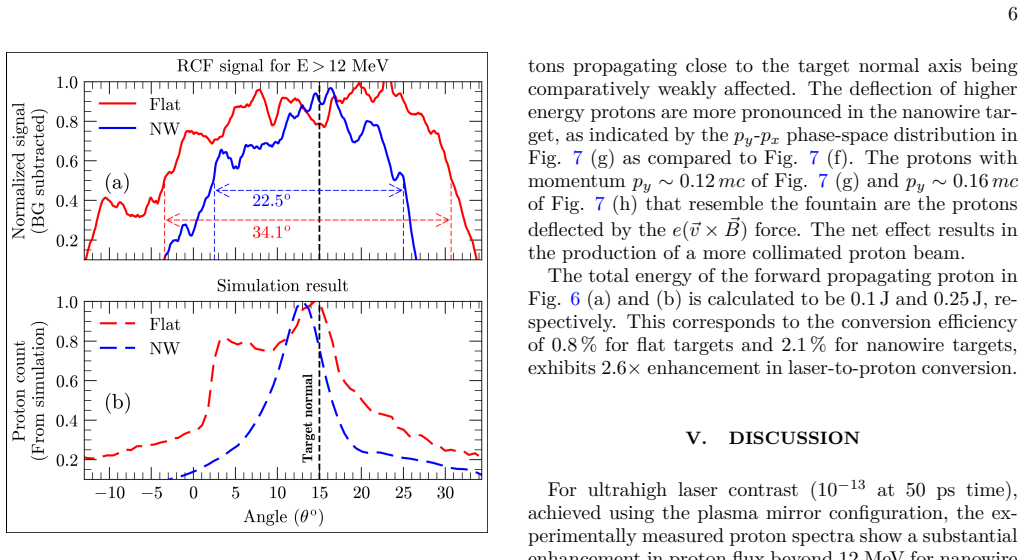
- Fig. 5(a): Clarify whether the angular distributions are single-shot or averaged, and how the FWHM values (34.1° flat, 22.5° NW) were extracted from the RCF optical-density maps (lineout direction, background subtraction).
- §IV / Fig. 7: The toroidal-field lineouts are shown at three x positions; a short statement of the time at which B_z is evaluated relative to the laser peak would help the reader connect the field enhancement to the py–px fountain structures.
- Throughout: Normalize notation for contrast (10^{-10} vs ∼10^{-10}), and fix minor typos (e.g., “EXPERIMENT AL RESUL TS”, “SIMULA TION RESUL TS”, “nanowired target”).
- References: The related electron-emission preprint (Parab et al., arXiv:2605.18668) is cited for hot-electron generation; ensure the proton-focused claims of the present manuscript stand independently of that work.
Circularity Check
No significant circularity; measured proton cutoffs, fluxes and angular distributions stand on independent TP/RCF diagnostics, with PIC used only for post-hoc mechanistic support.
full rationale
The load-bearing claims (cutoff enhancement persisting at both ~10^{-10} and ~10^{-13} contrast, higher high-energy flux, and narrower angular emission for nanowires vs flat foils) are obtained directly from Thomson-parabola spectra and energy-resolved RCF stacks under the two experimental contrast settings; no free parameter is fitted to those data and then re-presented as a prediction. The residual gain after applying the external Zimmer et al. empirical thickness scaling is an interpretive attribution, not a self-fit that forces the result by construction. 3D RHD+PIC simulations import experimental-like laser parameters and pre-plasma profiles and reproduce qualitative trends (higher cutoff/flux, enhanced rear-side B_theta collimation), but the experimental observables are not redefined by the simulations. The single self-citation to the overlapping-author electron-emission preprint is used only to note a related hot-electron observation and is not required for the proton measurements or the B-field argument already present in the present PIC runs. No self-definitional loop, uniqueness import, or ansatz smuggled via citation appears in the derivation chain.
Assumptions & free parameters
free parameters (4)
- Hydrocarbon contamination layer (n_H, n_C, thickness)
- RHD flux limiter
- Ablation-onset fluence threshold model
- Zimmer et al. empirical TNSA thickness scaling applied to A vs B
assumptions (4)
- domain assumption Rear-side proton acceleration is dominated by TNSA along target normal under the stated intensity and target thicknesses.
- domain assumption 3D RHD (FLASH) with inverse-bremsstrahlung ray tracing plus 3D PIC (PIConGPU) adequately captures prepulse expansion and main-pulse ion acceleration for comparative flat vs NW trends.
- domain assumption IP response and fading corrections from Martin et al. and related calibrations convert TP traces to absolute proton spectra.
- domain assumption Plasma-mirror contrast improvement to ~10^-13 at 50 ps is as estimated; native contrast ~10^-10.
Cite this review
Pith. "Pith review of Tens of MeV, collimated, bright fluxes of protons from ordered nano-structured targets in ultra-relativistic laser-matter interaction." pith.science (2026). https://pith.science/paper/WOKX43Y5
@misc{pith2026260709229,
  author       = {Pith},
  title        = {Pith review of: Tens of MeV, collimated, bright fluxes of protons from ordered nano-structured targets in ultra-relativistic laser-matter interaction},
  year         = {2026},
  howpublished = {\url{https://pith.science/paper/WOKX43Y5}},
  note         = {Machine review of arXiv:2607.09229}
}
abstract
Laser-driven proton acceleration from nanostructured solid targets has been extensively studied, yet its performance under realistic temporal contrast conditions at petawatt-class facilities remains an open question. We present an experimental investigation of proton generation from nanostructured and flat solid targets performed at the ELI-NP facility using femtosecond laser pulses at peak intensities of $\sim 3\times10^{21}$ \wcm. Proton spectra are compared for two contrast regimes: $\sim 10^{-10}$ without plasma mirror and $\sim 10^{-13}$ with single plasma mirror. Importantly, measurable enhancement in the cutoff energy persists for the nanowire targets at both contrast levels, indicating robustness of nanowire targets against moderate pre-pulse intensities. Alongside, study of energy resolved angular distribution reveals that nanowires promote more directional emission with higher flux of high-energy protons along the target normal, while flat targets produce broader angular distributions. The results are well supported and explained by 3D particle-in-cell simulations.
Figures


Figures from the paper (7 more)



Reference graph
Works this paper leans on
-
[1]
at sharp features. Second, by comparing energy de- pendent angular distributions, the work shows how the nanostructures guide the higher energy protons and give a much more enhanced and directional emission of parti- cle beams. Third, the study compares the results of nine different kinds of structured and non-structured targets and gives an overview of t...
-
[2]
Physics and Astronomy (Project Identification No. RTI4002), Tata Institute of Fundamental Research
section§3. More details on experimental methods in supplementary material.[77] B. Nanostructure growth Metallic nanowires and nanotubes were grown by elec- trochemical methods [see Fig. 2(a)-(d)], using a porous alumina template, which was obtained by aluminum an- odization in acidic electrolytes (oxalic, phosphoric and citric acid) [90]. By changing the ...
2021
-
[3]
V. E. Fortov,Extreme states of matter: high energy density physics, Vol. 216 (Springer, Berlin, Heidelberg, 2015)
2015
-
[4]
Gibbon,Short pulse laser interactions with matter: an introduction(World Scientific, 57 Shelton Street, Covent Garden, London., 2005)
P. Gibbon,Short pulse laser interactions with matter: an introduction(World Scientific, 57 Shelton Street, Covent Garden, London., 2005)
2005
-
[5]
W.L.Kruer,The physics of laser plasma interaction (Westview Press, Boulder, Colorado, 2003)
2003
-
[6]
Eliezer,The interaction of high-power lasers with plas- mas(CRC press, Boca Raton, FL, 2002)
S. Eliezer,The interaction of high-power lasers with plas- mas(CRC press, Boca Raton, FL, 2002)
2002
-
[7]
Snavely, M
R. Snavely, M. Key, S. Hatchett, T. Cowan, M. Roth, T. Phillips, M. Stoyer, E. Henry, T. Sangster, M. Singh, et al., Intense high-energy proton beams from petawatt- laserirradiationofsolids, Physicalreviewletters85,2945 (2000)
2000
-
[8]
Robson, P
L. Robson, P. Simpson, R. J. Clarke, K. W. Leding- ham, F. Lindau, O. Lundh, T. McCanny, P. Mora, D. Neely, C.-G. Wahlström,et al., Scaling of proton ac- celeration driven by petawatt-laser–plasma interactions, Nature physics3, 58 (2007)
2007
Show all 103 references
-
[9]
T. Kurz, T. Heinemann, M. Gilljohann, Y. Chang, J. Couperus Cabadağ, A. Debus, O. Kononenko, R. Pausch, S. Schöbel, R. Assmann,et al., Demonstra- tion of a compact plasma accelerator powered by laser- accelerated electron beams, Nature communications12, 2895 (2021)
2021
-
[10]
M. J. Hogan, C. Barnes, C. E. Clayton, F. Decker, S. Deng, P. Emma, C. Huang, R. Iverson, D. John- son, C. Joshi,et al., Multi-gev energy gain in a plasma- wakefield accelerator, Physical review letters95, 054802 (2005)
2005
-
[11]
Litos, E
M. Litos, E. Adli, W. An, C. Clarke, C. E. Clayton, 9 S. Corde, J. Delahaye, R. England, A. Fisher, J. Fred- erico,et al., High-efficiency acceleration of an electron beam in a plasma wakefield accelerator, Nature515, 92 (2014)
2014
-
[12]
Choudhary, L
A. Choudhary, L. P. Goswami, C. Aparajit, A. D. Lad, A. Parab, Y. M. Ved, T. Dhalia, A. Das, and G. R. Ku- mar, Generation of mega-gauss axial and azimuthal mag- netic fields in a solid plasma by ultrahigh intensity, cir- cularly polarized femtosecond laser pulses, Fundamental...
2025
-
[13]
Betti and O
R. Betti and O. Hurricane, Inertial-confinement fusion with lasers, Nature Physics12, 435 (2016)
2016
-
[14]
Mulser and D
P. Mulser and D. Bauer,High power laser-matter in- teraction, Vol. 238 (Springer Science & Business Media, Berlin, Heidelberg, 2010)
2010
-
[15]
C.Liu, V.K.Tripathi,andB.Eliasson,High-power laser- plasma interaction(Cambridge university press, Univer- sity Printing House, Cambridge cb2 8bs, United King- dom, 2019)
2019
-
[16]
Myatt, J
J. Myatt, J. Zhang, R. Short, A. Maximov, W. Seka, D. Froula, D. Edgell, D. Michel, I. Igumenshchev, D. Hinkel,et al., Multiple-beam laser–plasma interac- tions in inertial confinement fusion, Physics of Plasmas 21, https://doi.org/10.1063/1.4878623 (2014)
2014 doi
-
[17]
Chatterjee, P
G. Chatterjee, P. K. Singh, A. Robinson, D. Black- man, N. Booth, O. Culfa, R. Dance, L. Gizzi, R. Gray, J.Green,et al.,Micron-scalemappingofmegagaussmag- netic fields using optical polarimetry to probe hot elec- tron transport in petawatt-class laser-solid interactions, Scien...
2017
-
[18]
Dulat, C
A. Dulat, C. Aparajit, A. Choudhary, A. D. Lad, Y. M. Ved, B. Paradkar, and G. Ravindra Kumar, Subpicosec- ond pre-plasma dynamics of a high contrast, ultraintense laser–solid target interaction, Optics Letters47, 5684 (2022)
2022
-
[19]
J. J. Rocca, M. G. Capeluto, R. C. Hollinger, S. Wang, Y. Wang, G. R. Kumar, A. D. Lad, A. Pukhov, and V. N. Shlyaptsev, Ultra-intense femtosecond laser interactions with aligned nanostructures, Optica11, 437 (2024)
2024
-
[20]
S. Dam, J. F. Ong, S. Rakeeb, A. Parab, A. C, Anandam, A. D. Lad, Y. M. Ved, M. Krishnamurthy, K. A. Tanaka, and G. R. Kumar, Impulsive excitation of a solid by ex- treme contrast, high-intensity femtosecond laser pulses, Phys. Rev. Res.8, 023017 (2026)
2026
-
[21]
Schreiber, F
J. Schreiber, F. Bell, F. Grüner, U. Schramm, M. Geissler, M. Schnürer, S. Ter-Avetisyan, B. M. Hegelich, J. Cobble, E. Brambrink,et al., Analytical model for ion acceleration by high-intensity laser pulses, Physical review letters97, 045005 (2006)
2006
-
[22]
Borghesi, A
M. Borghesi, A. Bigongiari, S. Kar, A. Macchi, L. Romagnani, P. Audebert, J. Fuchs, T. Toncian, O. Willi, S. Bulanov,et al., Laser-driven proton accel- eration: source optimization and radiographic applica- tions, Plasma Physics and Controlled Fusion50, 124040 (2008)
2008
-
[23]
Gitomer, R
S. Gitomer, R. Jones, F. Begay, A. Ehler, J. Kephart, and R. Kristal, Fast ions and hot electrons in the laser– plasma interaction, The Physics of fluids29, 2679 (1986)
1986
-
[24]
A. Fews, P. Norreys, F. Beg, A. Bell, A. Dangor, C. Dan- son, P. Lee, and S. Rose, Plasma ion emission from high intensity picosecond laser pulse interactions with solid targets, Physical review letters73, 1801 (1994)
1994
-
[25]
Maksimchuk, S
A. Maksimchuk, S. Gu, K. Flippo, D. Umstadter, and V. Y. Bychenkov, Forward ion acceleration in thin films driven by a high-intensity laser, Physical Review Letters 84, 4108 (2000)
2000
-
[26]
F. Beg, A. Bell, A. Dangor, C. Danson, A. Fews, M. Glin- sky, B. Hammel, P. Lee, P. Norreys, and M. Tatarakis, A study of picosecond laser–solid interactions up to 1019 w cm- 2, Physics of plasmas4, 447 (1997)
1997
-
[27]
Clark, K
E. Clark, K. Krushelnick, M. Zepf, F. Beg, M. Tatarakis, A. Machacek, M. Santala, I. Watts, P. Norreys, and A. Dangor, Energetic heavy-ion and proton generation from ultraintense laser-plasma interactions with solids, Physical Review Letters85, 1654 (2000)
2000
-
[28]
Clark, K
E. Clark, K. Krushelnick, J. Davies, M. Zepf, M. Tatarakis, F. Beg, A. Machacek, P. Norreys, M. San- tala, I. Watts,et al., Measurements of energetic proton transport through magnetized plasma from intense laser interactions with solids, Physical Review Letters84, 670 (2000)
2000
-
[29]
Macchi, M
A. Macchi, M. Borghesi, and M. Passoni, Ion accelera- tion by superintense laser-plasma interaction, Reviews of Modern Physics85, 751 (2013)
2013
-
[30]
Badziak, Laser-driven ion acceleration: methods, chal- lenges and prospects, inJournal of Physics: Conference Series, Vol
J. Badziak, Laser-driven ion acceleration: methods, chal- lenges and prospects, inJournal of Physics: Conference Series, Vol. 959 (IOP Publishing, 2018) p. 012001
2018
-
[31]
Kluge, S
T. Kluge, S. Gaillard, K. A. Flippo, T. Burris-Mog, W. Enghardt, B. Gall, M. Geissel, A. Helm, S. Kraft, T. Lockard,et al., High proton energies from cone tar- gets: electron acceleration mechanisms, New Journal of Physics14, 023038 (2012)
2012
-
[32]
Daido, M
H. Daido, M. Nishiuchi, and A. S. Pirozhkov, Review of laser-driven ion sources and their applications, Reports on progress in physics75, 056401 (2012)
2012
-
[33]
Willingale,Ion acceleration from high intensity laser plasma interactions: measurements and applications, Ph.D
L. Willingale,Ion acceleration from high intensity laser plasma interactions: measurements and applications, Ph.D. thesis, Department of Physics, Imperial College London (2007)
2007
-
[34]
Romagnani, J
L. Romagnani, J. Fuchs, M. Borghesi, P. Antici, P. Au- debert, F. Ceccherini, T. Cowan, T. Grismayer, S. Kar, A. Macchi,et al., Dynamics of electric fields driving the laser acceleration of multi-MeV protons, Physical review letters95, 195001 (2005)
2005
-
[35]
Ziegler, I
T. Ziegler, I. Göthel, S. Assenbaum, C. Bernert, F.-E. Brack, T. Cowan, N. Dover, L. Gaus, T. Kluge, S. Kraft, F. Kroll, J. Metzkes-Ng, M. Nishiuchi, I. Prencipe, T. Püschel, M. Rehwald, M. Reimold, H.-P. Schlenvoigt, M. Umlandt, and K. Zeil, Laser-driven high-energy pro- ton ...
2024
-
[36]
Cowan, J
T. Cowan, J. Fuchs, H. Ruhl, A. Kemp, P. Audebert, M. Roth, R. Stephens, I. Barton, A. Blazevic, E. Bram- brink,et al., Ultralow emittance, multi-MeV proton beams from a laser virtual-cathode plasma accelerator, Physical review letters92, 204801 (2004)
2004
-
[37]
Passoni, A
M. Passoni, A. Sgattoni, I. Prencipe, L. Fedeli, D. Del- lasega, L. Cialfi, I. W. Choi, I. J. Kim, K. A. Janulewicz, H. W. Lee,et al., Toward high-energy laser-driven ion beams: Nanostructured double-layer targets, Physical Review Accelerators and Beams19, 061301 (2016)
2016
-
[38]
Margarone, I
D. Margarone, I. J. Kim, J. Psikal, J. Kaufman, T. Mo- cek, I. W. Choi, L. Stolcova, J. Proska, A. Chouk- ourov, I. Melnichuk,et al., Laser-driven high-energy proton beam with homogeneous spatial profile from a nanosphere target, Physical Review Special Top- ics—Accelerators a...
2015
-
[39]
Floquet, O
V. Floquet, O. Klimo, J. Psikal, A. Velyhan, 10 J. Limpouch, J. Proska, F. Novotny, L. Stolcova, A. Mac- chi, A. Sgattoni,et al., Micro-sphere layered targets ef- ficiency in laser driven proton acceleration, Journal of Applied Physics114, https://doi.org/10.1063/1.4819239 (2013)
2013 doi
-
[40]
Margarone, O
D. Margarone, O. Klimo, I. J. Kim, J. Prokůpek, J. Limpouch, T.-M. Jeong, T. Mocek, J. Pšikal, H. T. Kim, J. Proška,et al., Laser-driven proton acceleration enhancement by nanostructured foils, Phys. Rev. Lett. 109, 234801 (2012)
2012
-
[41]
Fedeli, A
L. Fedeli, A. Formenti, L. Cialfi, A. Pazzaglia, and M. Passoni, Ultra-intense laser interaction with nanos- tructured near-critical plasmas, Scientific reports8, 3834 (2018)
2018
-
[42]
Andreev, N
A. Andreev, N. Kumar, K. Platonov, and A. Pukhov, Efficient generation of fast ions from surface mod- ulated nanostructure targets irradiated by high in- tensity short-pulse lasers, Physics of Plasmas18, https://doi.org/10.1063/1.3641965 (2011)
2011 doi
-
[43]
Klimo, J
O. Klimo, J. Psikal, J. Limpouch, J. Proska, F. Novotny, T. Ceccotti, V. Floquet, and S. Kawata, Short pulse laser interaction with micro-structured targets: simulations of laser absorption and ion acceleration, New journal of physics13, 053028 (2011)
2011
-
[44]
J. Yu, Z. Zhao, X. Jin, F. Wu, Y. Yan, W. Zhou, L. Cao, B. Li, and Y. Gu, Laser-driven proton acceleration us- ing a conical nanobrush target, Physics of Plasmas19, https://doi.org/10.1063/1.4714809 (2012)
2012 doi
-
[45]
Lübcke, A
A. Lübcke, A. A. Andreev, S. Höhm, R. Grunwald, L. Ehrentraut, and M. Schnürer, Prospects of target nanostructuring for laser proton acceleration, Scientific reports7, 44030 (2017)
2017
-
[46]
L. Ji, S. Jiang, A. Pukhov, R. Freeman, and K. Akli, Exploring novel target structures for manipulating rela- tivisticlaser–plasmainteraction,Highpowerlaserscience and engineering5, e14 (2017)
2017
-
[47]
Passoni, F
M. Passoni, F. Arioli, L. Cialfi, D. Dellasega, L. Fedeli, A. Formenti, A. C. Giovannelli, A. Maffini, F. Mirani, A. Pazzaglia,et al., Advanced laser-driven ion sources and their applications in materials and nuclear science, PlasmaPhysicsandControlledFusion62,014022(2019)
2019
-
[48]
Bagchi, P
S. Bagchi, P. Prem Kiran, M. Bhuyan, S. Bose, P. Ayyub, M. Krishnamurthy, and G. Kumar, Fast ion beams from intense, femtosecond laser irradiated nanostructured sur- faces, Applied Physics B88, 167 (2007)
2007
-
[49]
Giuffrida, K
L. Giuffrida, K. Svensson, J. Psikal, M. Dalui, H. Ek- erfelt, I. Gallardo Gonzalez, O. Lundh, A. Persson, P. Lutoslawski, V. Scuderi,et al., Manipulation of laser- accelerated proton beam profiles by nanostructured and microstructured targets, Physical Review Accelerators and...
2017
-
[50]
Torrisi, L
L. Torrisi, L. Calcagno, M. Cutroneo, J. Badziak, M.Rosinski, A.Zaras-Szydlowska,andA.Torrisi,Nanos- tructured targets for TNSA laser ion acceleration, Nuk- leonika61, 103 (2016)
2016
-
[51]
Bagchi, P
S. Bagchi, P. Prem Kiran, W.-M. Wang, Z. Sheng, M. Bhuyan, M. Krishnamurthy, and G. Ravindra Kumar, Surface-plasmon-enhanced MeV ions from femtosecond laser irradiated, periodically modulated surfaces, Physics of Plasmas19, https://doi.org/10.1063/1.3693388 (2012)
2012 doi
-
[52]
Cristoforetti, P
G. Cristoforetti, P. Londrillo, P. Singh, F. Baffigi, G. D’Arrigo, A. D. Lad, R. Milazzo, A. Adak, M. Shaikh, D. Sarkar,et al., Transition from coherent to stochastic electron heating in ultrashort relativistic laser interaction with structured targets, Scientific reports7, 14...
2017
-
[53]
Dalui, W.-M
M. Dalui, W.-M. Wang, T. M. Trivikram, S. Sarkar, S. Tata, J. Jha, P. Ayyub, Z. Sheng, and M. Krishna- murthy, Preferential enhancement of laser-driven carbon ion acceleration from optimized nanostructured surfaces, Scientific reports5, 11930 (2015)
2015
-
[54]
Vallières, M
S. Vallières, M. Barberio, M. Scisciò, E. d’Humières, and P. Antici, Enhanced laser-driven proton acceleration us- ing ultrasmall nanoparticles, Physical Review Accelera- tors and Beams22, 091303 (2019)
2019
-
[55]
Ebert, N
T. Ebert, N. W. Neumann, T. Abel, G. Schaumann, and M. Roth, Laser-induced microstructures on silicon for laser-driven acceleration experiments, High Power Laser Science and Engineering5, e13 (2017)
2017
-
[56]
Vallières, M
S. Vallières, M. Salvadori, A. Permogorov, G. Cantono, K. Svendsen, Z. Chen, S. Sun, F. Consoli, E. d’Humières, C.-G. Wahlström,et al., Enhanced laser-driven proton acceleration using nanowire targets, Scientific Reports 11, 2226 (2021)
2021
-
[57]
Blanco, M
M. Blanco, M. T. Flores-Arias, C. Ruiz, and M. Vranic, Table-top laser-based proton acceleration in nanostruc- tured targets, New Journal of Physics19, 033004 (2017)
2017
-
[58]
Dozières, G
M. Dozières, G. Petrov, P. Forestier-Colleoni, P. Camp- bell, K. Krushelnick, A. Maksimchuk, C. McGuffey, V. Kaymak, A. Pukhov, M. Capeluto,et al., Optimiza- tion of laser-nanowire target interaction to increase the proton acceleration efficiency, Plasma Physics and Con- troll...
2019
-
[59]
G. A. Mourou, T. Tajima, and S. V. Bulanov, Optics in the relativistic regime, Reviews of modern physics78, 309 (2006)
2006
-
[60]
Kiriyama, T
H. Kiriyama, T. Shimomura, H. Sasao, Y. Nakai, M. Tanoue, S. Kondo, S. Kanazawa, A. S. Pirozhkov, M. Mori, Y. Fukuda,et al., Temporal contrast enhance- ment of petawatt-class laser pulses, Optics Letters37, 3363 (2012)
2012
-
[61]
I. W. Choi, C. Jeon, S. G. Lee, S. Y. Kim, T. Y. Kim, I. J. Kim, H. W. Lee, J. Woo Yoon, J. H. Sung, S. K. Lee,et al., Highly efficient double plasma mirror produc- ingultrahigh-contrastmulti-petawattlaserpulses,Optics Letters45, 6342 (2020)
2020
-
[62]
Tanaka, K
K. Tanaka, K. Spohr, D. Balabanski, S. Balascuta, L. Capponi, M. Cernaianu, M. Cuciuc, A. Cucoanes, I. Dancus, A. Dhal,et al., Current status and highlights of the eli-np research program, Matter and Radiation at Extremes5, https://doi.org/10.1063/1.5093535 (2020)
2020 doi
-
[63]
Wilks, A
S. Wilks, A. Langdon, T. Cowan, M. Roth, M. Singh, S. Hatchett, M. Key, D. Pennington, A. MacKinnon, and R. Snavely, Energetic proton generation in ultra-intense laser–solid interactions, Physics of plasmas8, 542 (2001)
2001
-
[64]
Inoue, K
S. Inoue, K. Maeda, S. Tokita, K. Mori, K. Teramoto, M. Hashida, and S. Sakabe, Single plasma mirror pro- viding 104 contrast enhancement and 70% reflectivity for intense femtosecond lasers, Applied Optics55, 5647 (2016)
2016
-
[65]
Itatani, J
J. Itatani, J. Faure, M. Nantel, G. Mourou, and S. Watanabe, Suppression of the amplified spontaneous emission in chirped-pulse-amplification lasers by clean high-energyseed-pulseinjection,OpticsCommunications 148, 70 (1998)
1998
-
[66]
Wittmann, J.-P
T. Wittmann, J.-P. Geindre, P. Audebert, R. Mar- joribanks, J.-P. Rousseau, F. Burgy, D. Douil- let, T. Lefrou, K. T. Phuoc, and J.-P. Cham- 11 baret, Towards ultrahigh-contrast ultraintense laser pulses—complete characterization of a double plasma- mirror pulse cleaner, Revie...
2006 doi
-
[67]
I. B. Földes, B. Gilicze, Z. Kovács, and S. Szatmári, Plasma mirrors for cleaning laser pulses from the infrared to the ultraviolet, inEPJ Web of Conferences, Vol. 167 (EDP Sciences, 2018) p. 04001
2018
-
[68]
P.Rajeev, P.Ayyub, S.Bagchi,andG.R.Kumar,Nanos- tructures, localfields, andenhancedabsorptioninintense light–matter interaction, Optics letters29, 2662 (2004)
2004
-
[69]
Cernaianu, P
M. Cernaianu, P. Ghenuche, F. Rotaru, L. Tudor, O. Chalus, C. Gheorghiu, D. Popescu, M. Gugiu, S. Bal- ascuta, A. Magureanu,et al., Commissioning of the 1 pw experimental area at eli-np using a short focal parabolic mirror for proton acceleration, Matter and Radiation at Extre...
2025 doi
-
[70]
Lureau, G
F. Lureau, G. Matras, O. Chalus, C. Derycke, T. Mor- bieu, C. Radier, O. Casagrande, S. Laux, S. Ricaud, G. Rey,et al., High-energy hybrid femtosecond laser system demonstrating 2×10 pw capability, High Power Laser Science and Engineering8, e43 (2020)
2020
-
[71]
Trebino and D
R. Trebino and D. J. Kane, Using phase retrieval to measure the intensity and phase of ultrashort pulses: frequency-resolved optical gating, Journal of the Optical society of America A10, 1101 (1993)
1993
-
[72]
Trebino, K
R. Trebino, K. W. DeLong, D. N. Fittinghoff, J. N. Sweetser, M. A. Krumbügel, B. A. Richman, and D. J. Kane, Measuring ultrashort laser pulses in the time- frequency domain using frequency-resolved optical gat- ing, Review of Scientific Instruments68, 3277 (1997)
1997
-
[73]
J. J. Thomson, Xxvi. rays of positive electricity, The Lon- don, Edinburgh, and Dublin Philosophical Magazine and Journal of Science21, 225 (1911)
1911
-
[74]
Slater, Thomson parabola ion analyzer for laser- plasma studies., The Review of Scientific Instruments49, 1493 (1978)
D. Slater, Thomson parabola ion analyzer for laser- plasma studies., The Review of Scientific Instruments49, 1493 (1978)
1978
-
[75]
Sakabe, T
S. Sakabe, T. Mochizuki, T. Yamanaka, and C. Ya- manaka, Modified thomson parabola ion spectrometer of wide dynamic range, Review of Scientific Instruments51, 1314 (1980)
1980
-
[76]
Treffert, Q
F. Treffert, Q. Ji, P. Seidl, A. Persaud, B. Ludewigt, J. Barnard, A. Friedman, D. Grote, E. Gilson, I. Kaganovich,et al., Design and implementation of a thomson parabola for fluence dependent energy- loss measurements at the neutralized drift compres- sion experiment, Review ...
2018 doi
-
[77]
D. Jung, R. Hörlein, D. Gautier, S. Letzring, D. Kiefer, K. Allinger, B. Albright, R. Shah, S. Palaniyappan, L. Yin,et al., A novel high resolution ion wide an- gle spectrometer, Review of Scientific Instruments82, https://doi.org/10.1063/1.3575581 (2011)
2011 doi
-
[78]
S. Tata, A. Mondal, S. Sarkar, A. D. Lad, and M. Krish- namurthy, A gated thomson parabola spectrometer for improved ion and neutral atom measurements in intense laser produced plasmas, Review of Scientific Instruments 88, https://doi.org/10.1063/1.4998685 (2017)
2017 doi
-
[79]
See Supplemental Material at [URL will be inserted by publisher] for details on experimental method, RCF cal- ibration, simulation parameters and calculation of neu- tron flux
-
[80]
Cialfi,Advances in Target Normal Sheath Accelera- tion with Traditional and Nanostructured Targets, Ph.D
L. Cialfi,Advances in Target Normal Sheath Accelera- tion with Traditional and Nanostructured Targets, Ph.D. thesis, Politecnico di Milano (2017), doctoral Program in Energy and Nuclear Science and Technology, Diparti- mento di Energia
2017
-
[81]
Hegelich, S
M. Hegelich, S. Karsch, G. Pretzler, D. Habs, K. Witte, W. Guenther, M. Allen, A. Blazevic, J. Fuchs, J. Gau- thier,et al., MeV ion jets from short-pulse-laser interac- tion with thin foils, Physical review letters89, 085002 (2002)
2002
-
[82]
Borghesi, J
M. Borghesi, J. Fuchs, S. Bulanov, A. Mackinnon, P. Pa- tel, and M. Roth, Fast ion generation by high-intensity laser irradiation of solid targets and applications, Fusion science and technology49, 412 (2006)
2006
-
[83]
B. M. Hegelich, B. Albright, J. Cobble, K. Flippo, S. Let- zring, M. Paffett, H. Ruhl, J. Schreiber, R. Schulze, and J. Fernández, Laser acceleration of quasi-monoenergetic MeV ion beams, Nature439, 441 (2006)
2006
-
[84]
Roth and M
M. Roth and M. Schollmeier, Ion acceleration: TNSA, inLaser-Plasma Interactions and Applications(Springer,
-
[85]
Passoni, C
M. Passoni, C. Perego, A. Sgattoni, and D. Batani, Advances in target normal sheath acceleration theory, Physics of Plasmas20, https://doi.org/10.1063/1.4812708 (2013)
2013 doi
-
[86]
K. Zeil, S. Kraft, S. Bock, M. Bussmann, T. Cowan, T. Kluge, J. Metzkes, T. Richter, R. Sauerbrey, and U. Schramm, The scaling of proton energies in ultrashort pulse laser plasma acceleration, New Journal of Physics 12, 045015 (2010)
2010
-
[87]
Vanderloo, M
N. Vanderloo, M. Cufari, L. Russell, T. Johnson, J. Var- gas, B. Foo, B. Buschmann, S. Dannhoff, A. DeVault, T. Evans,et al., Image plate multi-scan response to fu- sion protons in the range of 1–14 mev, Review of Scien- tific Instruments95, https://doi.org/10.1063/5.0219547 (2024)
2024 doi
-
[90]
García-Garduño, M
O. García-Garduño, M. Mirón-Lozada, and J. Lárraga- Gutiérrez, Radiochromic film as a reference detector for field output factor determination in small photon field dosimetry, Radiation Measurements183, 107413 (2025)
2025
-
[91]
V. D. Diaz-Martinez, M. Cyr, S. Devic, N. Tomic, D. F. Lewis, and S. A. Enger, Investigation of dosimetric char- acteristics of radiochromic film in response to alpha par- ticles emitted from americium-241, Medical Physics51, 6305 (2024)
2024
-
[92]
C. C. Gheorghiu, S. C. Ionescu, P. Ghenuche, M. O. Cer- naianu, D. Doria, D. Popa, and V. Leca, Structuring free- standing foils for laser-driven particle acceleration exper- iments, Frontiers in Physics9, 515 (2021)
2021
-
[93]
Masuda and K
H. Masuda and K. Fukuda, Ordered metal nanohole ar- rays made by a two-step replication of honeycomb struc- tures of anodic alumina, Science268, 1466 (1995)
1995
-
[94]
S. C. Ionescu, C. C. Gheorghiu, V. Lupu, M.-I. Zai, A. Magureanu, D. B. Dreghici, A. McCay, D. Molloy, H. Ahmed, M. Borghesi,et al., Highly ordered vertical 12 nickelnanotubesandnanowiresonthinsubstrateforhigh power lasers experiments, Discover Nano20, 219 (2025)
2025
-
[95]
Zimmer, S
M. Zimmer, S. Scheuren, T. Ebert, G. Schaumann, B. Schmitz, J. Hornung, V. Bagnoud, C. Rödel, and M. Roth, Analysis of laser-proton acceleration experi- ments for development of empirical scaling laws, Phys. Rev. E104, 045210 (2021)
2021
-
[96]
Parab, J
A. Parab, J. F. Ong, S. Ionescu, S. Dam, S. Ra- keeb, H. Habara, Y. Keita, R. Palit, D. Popa, D. Sangwan,et al., Bright, directional electron emis- sion from nanowire coated targets under petawatt, fem- tosecond irradiation, arXiv preprint arXiv:2605.18668 https://doi.org/10.4...
-
[97]
Tens of MeV, collimated, bright fluxes of protons from ordered nano-structured targets in ultra-relativistic laser-matter interaction
A. Mančić, J. Robiche, P. Antici, P. Audebert, C. Blan- card, P. Combis, F. Dorchies, G. Faussurier, S. Four- maux, M. Harmand,et al., Isochoric heating of solids by laser-accelerated protons: Experimental characterization and self-consistent hydrodynamic modeling, High Energy...
2010
-
[98]
K. A. Tanaka, T. Yabuuchi, T. Sato, R. Kodama, Y. Kitagawa, T. Takahashi, T. Ikeda, Y. Honda, and S. Okuda, Calibration of imaging plate for high energy electron spectrometer, Review of scientific instruments76, https://doi.org/10.1063/1.1824371 (2005)
2005 doi
-
[99]
Martin, H
P. Martin, H. Ahmed, D. Doria, A. Alejo, R. Clarke, S. Ferguson, J. Fernández-Tobias, R. Freeman, J. Fuchs, A. Green,et al., Absolute calibration of Fujifilm BAS-TR image plate response to laser driven protons up to 40 MeV, Review of Scientific Instruments93, https://doi.org/1...
2022 doi
-
[100]
Alejo, S
A. Alejo, S. Kar, H. Ahmed, A. Krygier, D. Do- ria, R. Clarke, J. Fernandez, R. Freeman, J. Fuchs, A. Green,et al., Characterisation of deuterium spec- tra from laser driven multi-species sources by employ- ing differentially filtered image plate detectors in thom- son spectro...
2014 doi
-
[101]
Fryxell, K
B. Fryxell, K. Olson, P. Ricker, F. Timmes, M. Zingale, D. Lamb, P. MacNeice, R. Rosner, J. Truran, and H. Tufo, Flash: An adaptive mesh hydrodynamics code for model- ing astrophysical thermonuclear flashes, The Astrophysi- cal Journal Supplement Series131, 273 (2000)
2000
-
[102]
E. G. Gamaly, A. V. Rode, B. Luther-Davies, and V. T. Tikhonchuk, Ablation of solids by femtosec- ond lasers: Ablation mechanism and ablation thresh- olds for metals and dielectrics, Physics of Plas- mas9, 949 (2002), https://pubs.aip.org/aip/pop/article- pdf/9/3/949/19278465/...
2002
-
[103]
E. G. Gamaly, A. V. Rode, O. Uteza, V. Kolev, B. Luther-Davies, T. Bauer, J. Koch, F. Korte, and B. N. Chichkov, Control over a phase state of the laser plume ablated by femtosecond laser: Spatial pulse shaping, Journal of Applied Physics 95, 2250 (2004), https://pubs.aip.org/...
2004
-
[104]
J. F. Ong, flash2openpmd, https://github.com/ELI- NP/flash2openPMD.git (2022)
2022
-
[105]
Burau, R
H. Burau, R. Widera, W. Hönig, G. Juckeland, A. Debus, T. Kluge, U. Schramm, T. E. Cowan, R. Sauerbrey, and 5 M. Bussmann, PIConGPU: A fully relativistic particle-in- cell code for a GPU cluster, IEEE Transactions on Plasma Science38, 2831 (2010)
2010
Reviewed July 13, 2026 · model on record in the stance chip above.
Discussion (0). Continue with ORCID to comment.