REVIEW 2 major objections 4 minor
A power-law non-minimal coupling deforms the inflaton potential while preserving the Einstein consistency relation and reheating dynamics.
Reviewed by Pith at T0; open to challenge. T0 means a machine referee read the full paper against a public rubric. the ladder, T0–T4 →
T0 review · grok-4.5
2026-07-14 10:01 UTC pith:L3SRZZIK
load-bearing objection Clean one-parameter dial for tensor amplitude that keeps n_T = -r/8 and GR-like reheating, useful for ACT-era model sorting but built on a forced-dynamics ansatz. the 2 major comments →
Corrections to inflationary models induced by non-minimal coupling between scalar field and curvature
The pith
A machine-rendered reading of the paper's core claim, the machinery that carries it, and where it could break.
Core claim
A power-law coupling F=(H/λ)^{2n} with the same background H=H_E and ϕ=ϕ_E deforms the potential according to V≃(1−n)^{−1}[V_E]^{1+n} while exactly preserving the consistency relation n_T=−r/8 and rendering the field equation (and therefore reheating) identical to the minimally coupled case; the deformation parameter n then induces the controlled shifts Δn_S=n r_E/8 and r=(1−n)r_E that reorganize the first- and second-order expansions of r=r(1−n_S).
What carries the argument
The power-law parametrization F=(H/λ)^{2n} (−1<n<1), together with the matching conditions that force the kinetic function ω into the form that keeps the field equation unchanged; n simultaneously measures potential deformation and the fractional shift of tensor observables.
Load-bearing premise
The assumption that the non-minimal coupling can be tuned so the expansion history and the scalar-field trajectory remain exactly the same as in Einstein gravity; if the coupling changes that history, both the clean potential deformation and the identical reheating dynamics disappear.
What would settle it
A precision measurement of the tensor-to-scalar ratio together with n_S and α_S that cannot be fit by any n∈(−1,1) inside the first- or second-order expansions for any allowed e-fold range would rule out the claimed universal corrections.
If this is right
- First-order models (linear δ–ϵ relation) stay inside both Planck and ACT windows for the standard 50–60 e-folds once the n-induced tensor suppression is included.
- Second-order models (δ∼−√ϵ) can suppress r by the factor (1−n) while leaving n_S essentially unchanged, allowing them to survive tighter future tensor bounds if reheating is non-instantaneous or dark-matter production lengthens the e-fold count.
- Well-known potentials (power-law Hybrid Natural Inflation, α-attractors, Starobinsky) reappear as special cases of the same r=r(1−n_S) classification, so existing forecasts can be re-used after a simple n-rescaling.
- The running α_S remains negative (∼−10^{-4}) for all orders, so any confirmed positive running at the ACT level would require going beyond this power-law coupling.
Where Pith is reading between the lines
- If future CMB-S4 or LiteBIRD data push r below ∼0.001 while n_S stays near 0.965, the second-order branch with n∼0.9 becomes the only surviving class inside this framework.
- The same F∝H^{2n} construction could be ported to multi-field or warm-inflation models; the preservation of the single-field consistency relation would then serve as a clean diagnostic of whether the extra fields are coupled only through the background.
- Because reheating is identical to the Einstein case, any observational constraint that depends only on the post-inflationary equation of state (e.g., gravitational-wave spectra from LIGO/LISA) can be imported unchanged once the inflationary n-correction is fixed.
Editorial analysis
A structured set of objections, weighed in public.
Referee Report
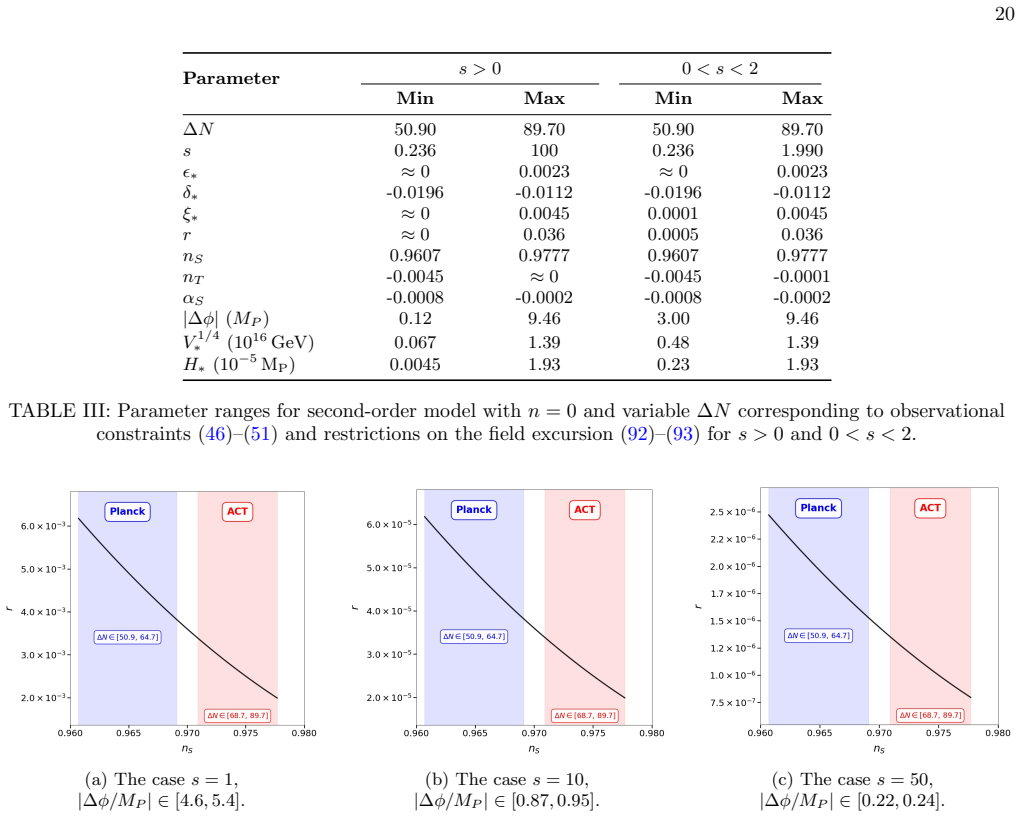
Summary. The paper studies corrections to single-field inflationary predictions arising from a power-law non-minimal coupling F=(H/λ)^{2n} (−1<n<1) in generalized scalar-tensor gravity. Under the ansatz of identical background evolution (H=H_E, ϕ=ϕ_E, ˙ϕ^{2}=−2˙H) the kinetic function is fixed so that the field equation remains identical to Einstein gravity; the potential is deformed as V≃[V_E]^{1+n}/(1−n), the scalar amplitude is matched by fixing λ, and the perturbation parameters shift by Δn_S=n r_E/8 and r=(1−n)r_E while the consistency relation n_T=−r/8 is preserved exactly. Reheating is argued to be dynamically equivalent. A model-independent classification via the series expansion of r=r(1−n_S) is introduced; first-order (linear δ(ε)) models fit both Planck and ACT constraints for standard 50–60 e-folds, while second-order models require 51–90 e-folds. Known scenarios (generalized Hybrid Natural Inflation, α-attractors) appear as special cases.
Significance. If the results hold under the stated ansatz, the work supplies a controlled, algebraically transparent framework for quantifying non-minimal-coupling corrections without spoiling the GR consistency relation or the standard reheating description. The dual reading of n (potential deformation parameter and relative shift in r, n_T) together with the order-by-order r(1−n_S) classification gives a practical diagnostic for assessing phenomenological robustness against tightening CMB bounds (Planck+ACT). The exact preservation of n_T=−r/8 distinguishes the class from generic scalar-tensor models and is a clean, falsifiable prediction. The recovery of well-known potentials as special cases further enhances utility for model-building.
major comments (2)
- [Section III.A, Eqs. (33)–(36)] The central claims (potential deformation V∼[V_E]^{1+n}, exact n_T=−r/8, identical reheating) rest on the simultaneous imposition of H=H_E, ϕ=ϕ_E and ˙ϕ^{2}=−2˙H. This forces ω into the specific form (35) and thereby guarantees field-equation equivalence (36). While the ansatz enables a clean comparison, it excludes any back-reaction of the non-minimal coupling on the expansion history itself. The manuscript should state more explicitly the domain of validity (near-de Sitter, small |n|, etc.) and, if possible, give a rough estimate of the size of corrections when the assumption is relaxed.
- [Section IV.C and VII] The assertion that reheating dynamics are completely analogous relies on formal invariance of the field equation. After the end of inflation ϵ∼O(1), the slow-roll expressions used to reconstruct F and ω no longer hold, yet F=(H/λ)^{2n} continues to evolve. A short analysis (or at least a clear statement of the residual freedom) of the post-inflationary evolution of F and ω would make the claim more robust.
minor comments (4)
- [Section III.A] Heading of III.A contains the typo “non-miminal”; several other minor spelling inconsistencies (parametrization/parametrisation) appear throughout.
- [Section VI] Figures 1 and 2 would benefit from explicit indication of the Planck and ACT 1σ/2σ contours on the r–n_S plane so that the visual comparison with the tabulated ranges is immediate.
- [Section III] The range −1<n<1 is stated repeatedly; a single sentence early in Sec. III explaining why the lower bound is required for a non-flat potential would improve readability.
- [Appendix A] Appendix A is useful but could cross-reference the main-text equation numbers more systematically for the reader who jumps between sections.
Circularity Check
No significant circularity: λ is a calibration constant fixed by matching A_S, n is a free deformation parameter, and the r=r(1-n_S) expansions follow algebraically from the imposed dynamics ansatz without self-referential reduction.
full rationale
The derivation chain is self-contained once the phenomenological power-law ansatz F=(H/λ)^{2n} and the simultaneous conditions H=H_E, φ=φ_E, φ̇^{2}=-2Ḣ (Eqs. 33-34) are granted. These force ω into form (35) and make the field equation identical to the Einstein-gravity case (Eq. 36), after which potential deformation V∼[V_E]^{1+n}, the shifts Δn_S=n r_E/8 and r=(1-n)r_E, exact preservation of n_T=-r/8, and identical reheating dynamics all follow by direct substitution. λ is fixed solely by equating the observed scalar amplitude A_S between the two frameworks (Eq. 99), which is ordinary observational calibration, not a prediction of a fitted quantity. The series expansion of r=r(1-n_S) is an independent model-independent classification tool whose coefficients are computed from the slow-roll relations; known models (power-law, Hybrid Natural, α-attractors) appear as special cases of those relations rather than as renamed empirical patterns. Self-citations to the authors’ earlier n=1 papers supply only the special case and are not load-bearing for the general-n results. No step reduces a claimed prediction to its own input by construction.
Axiom & Free-Parameter Ledger
free parameters (4)
- n (potential deformation / coupling index)
- λ (normalisation scale) =
fixed by A_S matching
- s, b (coefficients in δ(ε) relation)
- ΔN (e-folds between horizon exit and end of inflation) =
50–90 scanned
axioms (5)
- domain assumption Spatially flat FRW metric and single canonical scalar field
- domain assumption Slow-roll conditions ε≪1, |δ|≪1 throughout the observable window
- ad hoc to paper Power-law form F=(H/λ)^{2n} with constant n, λ
- ad hoc to paper Identical background evolution H=H_E, ϕ=ϕ_E and ˙ϕ^{2}=-2˙H for minimal and non-minimal theories
- domain assumption Exit from inflation when ε=1 and ε'_N>0
invented entities (1)
-
potential deformation parameter n
no independent evidence
read the original abstract
In this paper, we consider possible corrections to the characteristics of inflationary models based on a specific parametrization of the non-minimal coupling between the scalar field and curvature. At the inflationary stage, these corrections lead to a deformation of the scalar field potential and a corresponding deviation in the determination of the cosmological perturbation parameters. At the same time, it is shown that the proposed parametrization yields a description of the reheating stage dynamics completely analogous to the case of Einstein gravity with minimal coupling between the scalar field and curvature. For a model-independent analysis of inflationary corrections induced by a non-minimal coupling, a classification of inflationary scenarios based on the expansion in series of the dependence of the tensor-to-scalar ratio on the spectral index of scalar perturbations is considered. It is also shown that this approach allows for the inclusion of well-known inflationary models as special cases.
Figures

discussion (0)
Sign in with ORCID, Apple, or X to comment. Anyone can read and Pith papers without signing in.