REVIEW 2 major objections 4 minor
Black holes with Minkowski cores look almost identical to Kerr from the outside, so shadow images cannot tell their interiors apart.
Reviewed by Pith at T0; open to challenge. T0 means a machine referee read the full paper against a public rubric. the ladder, T0–T4 →
T0 review · grok-4.5
2026-07-14 09:48 UTC pith:6WQAZ6DI
load-bearing objection Clean GD construction of Minkowski-core regular BHs whose shadows and thin-disk images sit almost on top of Kerr; useful incremental result, not a paradigm shift. the 2 major comments →
Regular black holes with Minkowskian cores: causal structure and observational degeneracy
The pith
A machine-rendered reading of the paper's core claim, the machinery that carries it, and where it could break.
Core claim
A new, analytically tractable family of regular black holes with Minkowskian cores yields shadows and full thin-disk ray-traced images that remain nearly indistinguishable from Schwarzschild and Kerr geometries carrying the same asymptotic mass and spin, even though the interior causal structure is generated by an entirely different geometric mechanism.
What carries the argument
Gravitational decoupling applied to a Schwarzschild seed: an extra anisotropic source whose energy density is chosen as κE = α r²/ℓ⁴ exp(−r/ℓ) deforms the metric so that the center becomes Minkowski while the weak energy condition is preserved; the same mass function is then promoted to a Gürses–Gürsey rotating geometry whose optical appearance is compared with Kerr.
Load-bearing premise
The extra energy density is postulated by hand in a specific exponentially decaying form that makes the weak-energy inequalities close and removes the central singularity; a different regular density would produce a different family whose observational near-degeneracy is not guaranteed.
What would settle it
A higher-resolution shadow or photon-ring measurement that resolves a statistically significant deviation in critical impact parameter or Doppler-boosted ring asymmetry between the Minkowski-core model and Kerr at fixed mass and spin, or a dynamical calculation showing that the inner horizon is violently unstable under realistic perturbations while Kerr is not.
Editorial analysis
A structured set of objections, weighed in public.
Referee Report
Summary. The paper constructs an analytically tractable family of asymptotically flat regular black holes (static and rotating) with Minkowskian cores via gravitational decoupling of the Schwarzschild vacuum by a postulated exponentially localized source. After imposing the Kerr–Schild condition and regularity (fixing the integration constant so that the metric approaches Minkowski as r→0), the solutions admit a finite two-horizon structure for a range of the deformation parameter α, satisfy the weak energy condition, and reduce to Schwarzschild/Kerr in appropriate limits. The authors then compute photon-sphere/shadow observables and perform ray-tracing of geometrically thin, optically thin accretion disks (GLM emission profiles) for both the static and Gürses–Gürsey rotating geometries, concluding that the optical appearance remains remarkably close to that of Schwarzschild/Kerr with the same asymptotic mass and spin, thereby illustrating observational degeneracy between markedly different interiors.
Significance. If the reported near-degeneracy holds, the work supplies a concrete, energy-condition-respecting counter-example to the expectation that a non-de Sitter regular core must leave a clear imprint on horizon-scale images. This is directly relevant to the interpretation of EHT shadow and photon-ring data and to the broader program of testing the Kerr hypothesis. Strengths that raise the paper above a pure existence proof include the closed-form static metric (Eq. 46), the explicit verification of regularity of curvature invariants and of the weak energy condition, the transparent bifurcation analysis of the extremal locus, and the use of a publicly available ray-tracer (Gradus.jl) for the full synthetic images. The construction therefore offers a useful, falsifiable benchmark for future multi-messenger or higher-resolution imaging studies.
major comments (2)
- [III.B–C] Section III.B–C, Eqs. (39)–(43): the exponentially localized density κE=α r²/ℓ⁴ exp(−r/ℓ) is introduced by hand to close the WEC inequalities and to produce a Minkowskian core after fixing c1. While the subsequent derivation is correct for this ansatz, the central claim of observational degeneracy is stated for “these solutions.” A short robustness check (or at least a clear statement of the domain of the claim) is needed: does a different regular, compactly supported density that still yields a Minkowski core produce a comparably close shadow, or is the near-degeneracy special to the exponential tail?
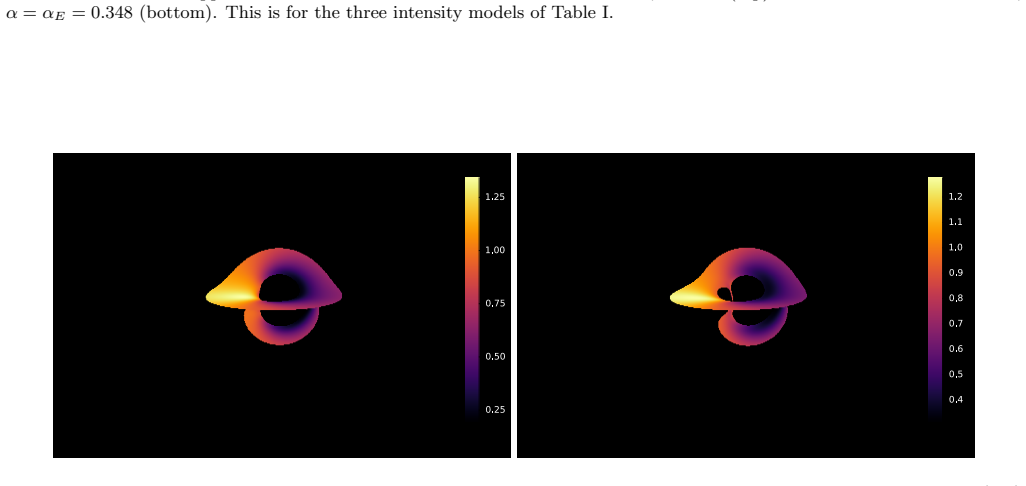
- [V] Section V and Figs. 6–9: the intensity profiles and synthetic images are shown only for the regular metrics. The text asserts that they are “qualitatively similar” or “practically indistinguishable” from Schwarzschild/Kerr, yet no side-by-side panels or quantitative measures (Δbc/bc, fractional difference in photon-ring flux, etc.) under identical emission profiles, inclination and mass are provided. Adding such a direct comparison would make the degeneracy claim falsifiable rather than visual.
minor comments (4)
- Throughout the manuscript (section titles, figure captions) there are systematic spacing artifacts (“GRA VIT A TIONAL”, “W eak energy condition”, “AXIALL Y SYMMETRIC”, “OBSER V A TIONAL”, “red lune”). These should be cleaned for the final version.
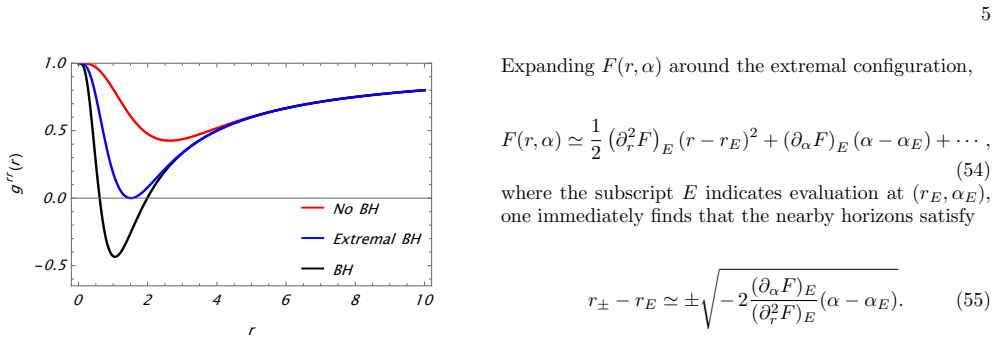
- [III] Fig. 1 caption and surrounding text: the extremal value is quoted as αE≈0.348 for M=1; it would help the reader if the same numerical value were used consistently in the later image captions (bottom rows of Figs. 6–8).
- [III.C] Eq. (47) and the paragraph that follows: the statement that the Schwarzschild limit is recovered only as α→+∞ (while α→0 yields Minkowski) is correct but counter-intuitive at first reading; a one-sentence remark on the non-commutativity of the two limits would clarify the parameter space.
- [III.D] References: several recent works on Minkowski-core regular black holes and on the stability of Cauchy horizons in non-de Sitter regular geometries are already cited; a brief pointer in Sec. III.D to the surface-gravity estimates available for those models would help the reader gauge how different the present blueshift problem might be.
Circularity Check
No significant circularity: metric derived from Einstein equations plus explicit ansatz, optical degeneracy is independent numerical evaluation.
full rationale
The construction begins from the Schwarzschild seed under gravitational decoupling, imposes the Kerr–Schild condition e^ν = e^{-λ}, and postulates the energy-density profile κE = α r²/ℓ⁴ e^{-r/ℓ} (Eq. 39) solely to close the WEC inequalities and remove the central singularity after fixing the integration constant. The resulting static metric (46) and its Gürses–Gürsey rotating extension (61) with mass function (47) are therefore model solutions, not tautologies. Shadow contours (Fig. 5) and full ray-traced thin-disk images (Figs. 6–9) are then obtained by independent geodesic integration and transfer-function evaluation; their near-coincidence with Kerr/Schwarzschild of the same ADM mass and spin is a computed numerical outcome, not an identity forced by the input ansatz. No parameter is fitted to optical data and later re-presented as a prediction, no load-bearing uniqueness theorem is imported from the authors’ prior work, and the cited GD framework is used only as a technical tool. The derivation chain is therefore self-contained against external benchmarks.
Axiom & Free-Parameter Ledger
free parameters (3)
- α (deformation coupling)
- ℓ (length scale in energy density)
- GLM emission-profile parameters (μ,σ,γ)
axioms (4)
- domain assumption Einstein equations with two independent matter Lagrangians (seed + θμν) and the gravitational-decoupling metric deformations ν = ξ + αg, e^−λ = e^−μ + αf
- ad hoc to paper Kerr–Schild condition e^ν = e^−λ, which forces Pr = −E
- domain assumption Weak energy condition on the extra source θμν
- domain assumption Geometrically thin, optically thin, monochromatic accretion disk with Johnson-SU emissivity
invented entities (1)
-
Exponentially localized effective density κE = α r²/ℓ⁴ exp(−r/ℓ)
no independent evidence
read the original abstract
We construct a new family of asymptotically flat static and rotating regular black holes characterized by a Minkowskian core and a finite two-horizon structure. The solutions are obtained within the framework of gravitational decoupling and provide an analytically tractable realization of non-singular black hole geometries with a regular interior and well-defined asymptotic properties. We investigate the optical appearance of the rotating spacetime through shadow observables and ray-traced images of geometrically thin, optically thin accretion disks. Despite the substantial differences between the interior geometry of these solutions and that of singular black holes, their optical signatures are found to remain remarkably close to those of Schwarzschild and Kerr spacetimes with the same asymptotic parameters. Our results show that markedly different black hole interiors may lead to nearly indistinguishable optical appearances, highlighting the challenges of probing the internal structure of compact objects using current shadow and imaging observations.
Figures


discussion (0)
Sign in with ORCID, Apple, or X to comment. Anyone can read and Pith papers without signing in.