REVIEW 3 major objections 5 minor 41 references
An extra coupling between the trapping field and the heat bath makes a charged magneto-oscillator lose quantum coherence faster.
Reviewed by Pith at T0; open to challenge. T0 means a machine referee read the full paper against a public rubric. the ladder, T0–T4 →
Field-bath coupling (parameter λ) renormalizes the memory kernel and spring constant of a charged magneto-oscillator, enhancing its decoherence rate relative to the λ=0 case.
T0 review reviewed 2026-07-14 challenge →
load-bearing objection Solid incremental extension of CMO decoherence that cleanly adds a classical field-bath term and shows λ-enhanced decay under controlled approximations; useful for reservoir engineering, not a foundational rewrite. the 3 major comments →
Decoherence of a quantum magneto-oscillator: Effect of field-bath interaction
The pith
A machine-rendered reading of the paper's core claim, the machinery that carries it, and where it could break.
The reading
Core claim
When an external harmonic trap is allowed to interact with the bath oscillators through a tunable coupling λ, the resulting modification of the noise kernel and of the effective oscillator frequency increases the decoherence rate of a charged magneto-oscillator; the off-diagonal elements of the reduced density matrix therefore decay more rapidly with larger λ.
What carries the argument
The generalized quantum Langevin equation whose memory kernel, random-force correlator and effective spring constant Ω₀ are all renormalized by the field–bath parameter λ; the associated non-Markovian master equation then yields an explicit decoherence factor Γ(t) that grows with λ.
Load-bearing premise
The analytic expressions and plots rely on taking the field–bath coupling large while still treating the system–bath interaction as weak and the bath spectrum as Ohmic with a sharp frequency cutoff.
What would settle it
In a Penning-trap ion cloud cooled by optical molasses, measure the Ramsey-visibility decay of off-diagonal coherences while systematically varying the feedback strength that implements λ; if the decoherence rate does not increase with that strength at fixed temperature and trap frequency, the central claim fails.
If this is right
- Decoherence of a magneto-oscillator can be accelerated or slowed by engineering how strongly the confining potential couples to the bath.
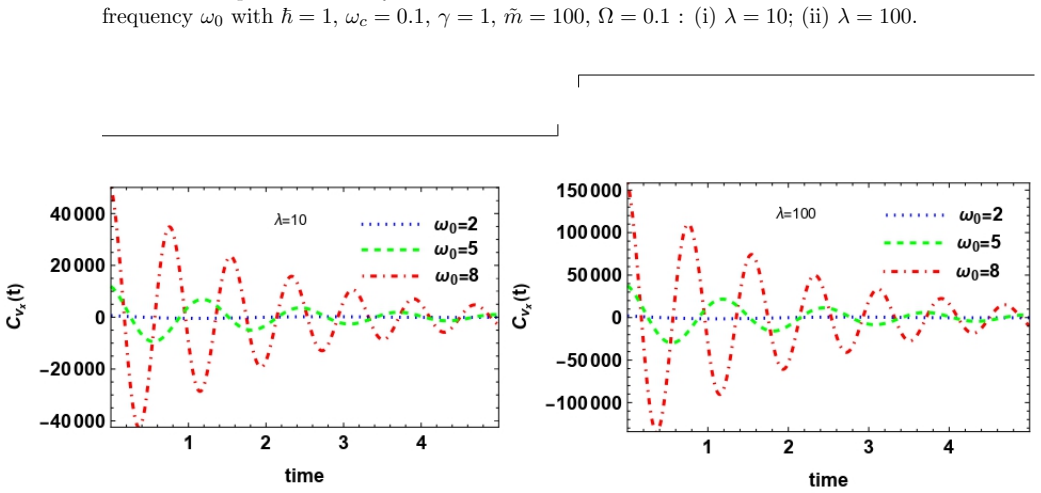
- Position, position–velocity and velocity autocorrelation functions become experimentally tunable signatures of the field–bath interaction strength.
- Reservoir engineering via external control fields becomes a practical route for shaping irreversible quantum dynamics in hybrid ion–atom platforms.
- The quantum-to-classical transition of a charged particle in a magnetic field is no longer fixed solely by temperature and cyclotron frequency; it also depends on the field–bath coupling.
Where Pith is reading between the lines
- The same λ-renormalization mechanism should alter heating rates and information back-flow measures in non-Markovian magneto-oscillators.
- If the large-λ restriction can be relaxed, intermediate coupling strengths may reveal non-monotonic decoherence windows useful for coherence protection.
- Feedback-controlled optical molasses already used in ion traps could implement the proposed λ tuning without new hardware.
Editorial analysis
A structured set of objections, weighed in public.
Referee Report
Summary. The paper studies the quantum dissipative dynamics of a charged magneto-oscillator (CMO) linearly coupled to a harmonic-oscillator bath, augmented by an additional field-bath interaction Hamiltonian HP = ∑j (λ/2) M ω0^{2} qj^{2}. Starting from the microscopic Hamiltonian, the authors derive a generalized quantum Langevin equation in which the memory kernel, random-force correlator and effective spring constant Ωo are all renormalized by λ (Eqs. 17–20). They obtain the corresponding fluctuation-dissipation relation (Eqs. 22–23), explicit position, position-velocity and velocity autocorrelation functions, and a non-Markovian Born master equation whose decoherence rate Γ(t) depends on λ through both the noise kernel ν(τ) and the free-evolution functions F1(τ) that contain Ωo(λ). Numerical plots for large λ show faster damping of the correlators and faster decay of the off-diagonal elements of the reduced density matrix with increasing λ or ω0. An experimental proposal based on a Penning-trap ion cloud cooled by optical molasses is sketched.
Significance. If the claimed enhancement of decoherence by field-bath coupling survives beyond the large-λ continuum limit, the work supplies a concrete microscopic mechanism for reservoir engineering of a magneto-oscillator—an experimentally relevant platform for quantum technologies. The derivations of the modified QLE, FDT and correlators are explicit and falsifiable; the experimental outline (trap frequencies, laser cooling, Ramsey interferometry) gives a clear route to test the λ-dependence. The paper therefore extends the authors’ earlier CMO studies and the classical field-bath literature in a direction that is of genuine interest to open-quantum-system and quantum-control communities.
major comments (3)
- After Eq. (20) and throughout Appendix A the authors explicitly restrict the analytic treatment (noise kernel Eq. (23), Γ(t), and all subsequent plots) to the large-λ and M ≫ mj continuum Ohmic limit with a sharp cutoff Λ. In that regime both the prefactor of ν(τ) and the renormalized frequency Ωo that enters F1(τ) grow with λ, producing the monotonic enhancement of decoherence shown in Fig. 4. No calculation or argument is given that the same monotonicity persists for moderate λ (where the discrete sum over bath modes must be retained) or for a smooth spectral density. Because the central claim of the abstract and §6 rests on this enhancement, the restriction must either be lifted or its necessity for the claimed effect must be demonstrated.
- The non-Markovian master equation (Eqs. 34–48) is derived under the Born weak-coupling approximation, yet the analytic expressions and the plots that support the central claim are obtained only after taking λ large. The two limits are not shown to be simultaneously consistent; if large λ drives the system out of the weak-coupling regime, the master-equation description of Γ(t) ceases to be controlled. A quantitative estimate of the range of λ for which the Born approximation remains valid is required.
- Section 7 proposes that the field-bath interaction can be realized by a “suitable feedback mechanism” between the harmonic trap and the optical molasses, but supplies no concrete protocol, Hamiltonian, or control sequence that would generate the term HP. Without such a mapping the experimental proposal cannot test the specific λ-dependence predicted by the theory.
minor comments (5)
- The date on the title page is “July 14, 2026”; this is presumably a typographical error.
- Notation for the cyclotron frequency is introduced as ωc = eB/Mc only in Appendix B; it should be defined at first appearance in the main text (Eq. 17).
- Figs. 1–3 caption the same set of parameters twice (once for each panel); a single caption with panel labels would improve readability.
- In Eq. (23) the factor coth(√λ m̃ ω0 / Ω) is pulled outside the frequency integral; a brief remark that this is valid only after the large-λ approximation would help the reader.
- Several self-citations to the authors’ prior CMO papers are listed as [8–14]; a short sentence clarifying which technical ingredients are new versus recycled would aid the reader.
Circularity Check
No significant circularity: λ-dependence of decoherence follows from the extended Hamiltonian and stated large-λ continuum limit; self-citations supply background CMO techniques only.
full rationale
The derivation begins from the microscopic Hamiltonian (1)–(5) that explicitly adds the field-bath term HP = ∑ (λ/2) M ω0^{2} qj^{2}. The QLE (17), memory kernel (18), effective frequency Ωo(λ) (20), force correlator (22)–(23), and decoherence rate Γ(t) (48) are obtained by direct elimination of bath degrees of freedom and continuum/Ohmic approximations that are stated after Eq. (20) and in Appendix A. λ remains a free input parameter; no data fit is performed and no quantity is redefined in terms of the claimed enhancement. Self-citations to the authors’ earlier CMO papers supply the position-coupling and master-equation machinery used for the λ = 0 baseline, but the new λ-dependence is generated by the added HP term and is not forced by those citations. The conventional identification of an Ohmic spectral density with constant γ is a modeling choice, not a definitional loop. The large-λ restriction is an explicit tractability assumption, not a circular reduction of the central claim to its inputs. Consequently the paper’s derivation chain is self-contained against its own premises.
Axiom & Free-Parameter Ledger
free parameters (3)
- λ (field-bath coupling strength)
- γ (Ohmic dissipation constant) =
1 (in natural units)
- Λ (bath cutoff frequency)
axioms (4)
- domain assumption Born weak-coupling approximation remains valid for the non-Markovian master equation (ρSE(t)≈ρS(t)⊗ρE).
- domain assumption Bath spectral density is Ohmic with sharp cutoff: μ(ω)=Mγ for 0<ω≤Λ.
- ad hoc to paper Large-λ and M≫mj limits permit the simplified noise correlator and analytic progress.
- domain assumption Position-position bilinear coupling plus the additional harmonic field-bath term fully capture the relevant system-environment interaction.
invented entities (1)
-
Field-bath interaction Hamiltonian HP = ∑j (λ/2) M ω0^{2} qj^{2}
no independent evidence
Cite this review
Pith. "Pith review of Decoherence of a quantum magneto-oscillator: Effect of field-bath interaction." pith.science (2026). https://pith.science/paper/3SHJCI7N
@misc{pith2026260711137,
  author       = {Pith},
  title        = {Pith review of: Decoherence of a quantum magneto-oscillator: Effect of field-bath interaction},
  year         = {2026},
  howpublished = {\url{https://pith.science/paper/3SHJCI7N}},
  note         = {Machine review of arXiv:2607.11137}
}
read the original abstract
We investigate the quantum dissipative dynamics of a charged magneto-oscillator(CMO) coupled to a heat bath of harmonic oscillators in the presence of an additional field-bath interaction. The problem is formulated within the framework of the generalized quantum Langevin equation, where the external confining potential modifies the random force correlations and the memory kernel of the environment, and the effective spring constant. Using the corresponding non-Markovian master equation, we examine the influence of the field-bath coupling on the temporal decay of the reduced density matrix of the system. We show that the additional interaction leads to an enhancement of the decoherence rate by altering the dissipative response of the bath. Thus our results shed light on the role of field-bath coupling in the quantum to classical transition of a CMO. The resulting fluctuation-dissipation relation is analyzed, and the position autocorrelation, position-velocity correlation and velocity autocorrelation are obtained explicitly. The dependence of these experimentally accessible quantities on the field-bath coupling parameter is discussed. We outline an experimental proposal for testing our theoretical predictions. The study sheds light on reservoir engineering which is central to quantum technologies.
Figures




Reference graph
Works this paper leans on
-
[1]
INTRODUCTION The study of quantum Brownian motion (QBM) is central to modern quantum statis- tical physics, providing a fundamental frame- work for understanding how microscopic quan- tum systems interact with their environments [1–7]. While classical Brownian motion describes the dynamics of particles coupled to a ther- mal bath, its quantum analogue cap...
Pith/arXiv arXiv 2026
-
[2]
This system is subjected to an external magnetic field ⃗Balong thez-axis
QUANTUM LANGEVIN EQUA TION We consider a charged quantum Brownian particle of massMand chargeecoupled to a bath ofN-harmonic oscillators at an arbitrary temperatureT. This system is subjected to an external magnetic field ⃗Balong thez-axis. Thus the motion of the charged particle is confined to the two-dimensionalx−yplane. In addition, the Brownian partic...
-
[3]
As the heat bath is at a fixed temperatureTand is coupled to the CMO, we use a statistical average of the bath operators [26]
FLUCTUA TION DISSIP A TION THEOREM Here we derive the FDT for the CMO which establishes a direct connection between the equi- librium fluctuations of the noise and the dissipa- tive properties of the bath. As the heat bath is at a fixed temperatureTand is coupled to the CMO, we use a statistical average of the bath operators [26]. Thus we have ⟨qjα(0)⟩= 0...
-
[4]
CORRELA TION FUNCTIONS The motion of the CMO is confined to the x−yplane as the applied magnetic field is di- rected along thez-axis. Now using the prop- erties of the random force, one can find the position auto-correlation function (forxandy coordinates), velocity auto-correlation and the position-velocity correlation along the lines out- lined in ref. ...
-
[5]
−2Ω 2 o −ω 2 c −ω c p 4Ω2o +ω 2c # 1 2 (41) B= 1 2
NON-MARKOVIAN MASTER EQUA TION: DYNAMICS OF THE REDUCED DENSITY MA TRIX We set up the Born-Markov master equa- tion for a CMO linearly coupled to a heat-bath via position coordinates and in the presence of a field-bath interaction to study the dissipative and decohering dynamics of the system. Using the Born-Markov approximation, the Liouville- von Neuman...
-
[6]
RESUL TS In this section we analyze the behaviour of various experimentally observable quantities like the time evolution of the position and velocity autocorrelation functions, the position-velocity correlation functions and the off-diagonal ele- ments of the reduced density matrix. FIG. 1: The position auto-correlation function versus time for different...
-
[7]
Hybrid ion–atom trapping techniques provide a suitable route for confining the CMO
EXPERIMENT AL PROPOSAL An experimental platform can be engineered to test the predictions of our theoretical model. Hybrid ion–atom trapping techniques provide a suitable route for confining the CMO. In partic- ular, we consider a Penning trap, where stable confinement is achieved via the superposition of static quadrupolar electric fields (generated by r...
-
[8]
Our work follows on similar research works in the context of Brownian dy- namics [15, 16] where the authors confine to a classical situation
DISCUSSION In this work, we have investigated the dissi- pative quantum dynamics of a charged magneto- oscillator interacting with a thermal reservoir in the presence of an additional coupling between the external confining field and the bath de- grees of freedom. Our work follows on similar research works in the context of Brownian dy- namics [15, 16] wh...
-
[9]
M. P. A. Fisher and W. Zwerger, Quantum brownian motion in a periodic potential, Phys. Rev. B32, 6190 (1985)
1985
-
[10]
Eisert and M
J. Eisert and M. B. Plenio, Quantum and clas- sical correlations in quantum brownian motion, Phys. Rev. Lett.89, 137902 (2002)
2002
-
[11]
Blume-Kohout and W
R. Blume-Kohout and W. H. Zurek, Quantum darwinism in quantum brownian motion, Phys. Rev. Lett.101, 240405 (2008)
2008
-
[12]
B. L. Hu, J. P. Paz, and Y. Zhang, Quantum brownian motion in a general environment. ii. nonlinear coupling and perturbative approach, Phys. Rev. D47, 1576 (1993)
1993
-
[13]
Bauer, D
M. Bauer, D. Bernard, and A. Tilloy, The open quantum brownian motions, Journal of Statisti- cal Mechanics: Theory and Experiment2014, P09001 (2014)
2014
-
[14]
Pucci, M
L. Pucci, M. Esposito, and L. Peliti, Entropy production in quantum brownian motion, Jour- nal of Statistical Mechanics: Theory and Exper- iment2013, P04005 (2013)
2013
-
[15]
Cobanera, P
E. Cobanera, P. Kristel, and C. Morais Smith, Quantum brownian motion in a landau level, Phys. Rev. B93, 245422 (2016)
2016
-
[16]
Bhattacharjee, U
S. Bhattacharjee, U. Satpathi, and S. Sinha, Quantum langevin dynamics of a charged par- ticle in a magnetic field: Response function, position–velocity and velocity autocorrelation functions, Pramana96, 53 (2022)
2022
-
[17]
Bhattacharjee, K
S. Bhattacharjee, K. Mandal, and S. Sinha, Decoherence and the ultraviolet cutoff: non- markovian dissipative dynamics of a charged particle in a magnetic field, Journal of Physics A: Mathematical and Theoretical56, 245301 (2023)
2023
-
[18]
Rajesh and M
A. Rajesh and M. Bandyopadhyay, Quantum brownian magneto-oscillator: Role of environ- mental spectrum and external magnetic field in decoherence and decay processes, Phys. Rev. A 92, 012105 (2015)
2015
-
[19]
Bhattacharjee, U
S. Bhattacharjee, U. Satpathi, and S. Sinha, Quantum brownian motion of a charged os- cillator in a magnetic field coupled to a heat bath through momentum variables, Physica A: Statistical Mechanics and its Applications605, 128010 (2022)
2022
-
[20]
Gupta and M
S. Gupta and M. Bandyopadhyay, Quantum langevin equation of a charged oscillator in a magnetic field and coupled to a heat bath through momentum variables, Phys. Rev. E84, 041133 (2011)
2011
-
[21]
Bhattacharjee, K
S. Bhattacharjee, K. Mandal, and S. Sinha, Decoherence of a charged brownian particle in a magnetic field: an analysis of the roles of coupling via position and momentum variables, Journal of Physics A: Mathematical and Theo- retical57, 375304 (2024)
2024
-
[22]
Bhattacharjee, K
S. Bhattacharjee, K. Mandal, and S. Sinha, Decoherence of a dissipative brownian charged magneto-anharmonic oscillator: an information theoretic approach, Journal of Physics A: Math- ematical and Theoretical58, 505301 (2025)
2025
-
[23]
P. J. Colmenares, Generalized dynamics and fluctuation-dissipation theorem for a parabolic potential, Phys. Rev. E108, 014115 (2023)
2023
-
[24]
P. J. Colmenares, Behavior of the generalized brownian motion in a parabolic potential: Ef- fect of the field on the bath, Phys. Rev. E110, 064125 (2024)
2024
-
[25]
J. O. Daldrop, B. G. Kowalik, and R. R. Netz, External potential modifies friction of molecular solutes in water, Phys. Rev. X7, 041065 (2017)
2017
-
[26]
H. Vroylandt and P. Monmarch´ e, Position- dependent memory kernel in generalized langevin equations: Theory and numerical estimation, The Journal of Chemical Physics 156, 10.1063/5.0094566 (2022)
-
[27]
Fukui and T
Y. Fukui and T. Morita, Derivation of the sta- tionary generalized langevin equation, Journal of Physics A: General Physics4, 477 (1971)
1971
-
[28]
Grabert, Nonlinear transport and dynamics of fluctuations, Journal of Statistical Physics19, 479 (1978)
H. Grabert, Nonlinear transport and dynamics of fluctuations, Journal of Statistical Physics19, 479 (1978)
1978
-
[29]
Widder, J
C. Widder, J. Zimmer, and T. Schilling, On the generalized langevin equation and the mori pro- jection operator technique, Journal of Physics A: Mathematical and Theoretical58, 405001 (2025)
2025
-
[30]
J. E. Straub, B. J. Berne, and B. Roux, Spatial dependence of time-dependent friction for pair diffusion in a simple fluid, The Journal of chem- ical physics93, 6804 (1990)
1990
-
[31]
Cohen-Tannoudji, B
C. Cohen-Tannoudji, B. Diu, and F. Lalo¨ e, Quantum mechanics, volume 3: fermions, bosons, photons, correlations, and entanglement (John Wiley & Sons, 2019)
2019
-
[32]
X. L. Li, G. W. Ford, and R. F. O’Connell, Charged oscillator in a heat bath in the pres- ence of a magnetic field, Phys. Rev. A42, 4519 (1990)
1990
-
[33]
Bhattacharjee, U
S. Bhattacharjee, U. Satpathi, and S. Sinha, Long-time tails in quantum brownian motion of 15 a charged particle in a magnetic field, Physica A: Statistical Mechanics and its Applications608, 128266 (2022)
2022
-
[34]
Shankar,Principles of quantum mechanics (Springer Science & Business Media, 2012)
R. Shankar,Principles of quantum mechanics (Springer Science & Business Media, 2012)
2012
-
[35]
Huang,Statistical mechanics(John Wiley & Sons, 2008)
K. Huang,Statistical mechanics(John Wiley & Sons, 2008)
2008
-
[36]
P. H¨ anggi and G.-L. Ingold, Fundamental as- pects of quantum brownian motion, Chaos: An Interdisciplinary Journal of Nonlinear Science 15, 10.1063/1.1853631 (2005)
-
[37]
Schlosshauer, Decoherence, the measure- ment problem, and interpretations of quantum mechanics, Rev
M. Schlosshauer, Decoherence, the measure- ment problem, and interpretations of quantum mechanics, Rev. Mod. Phys.76, 1267 (2005)
2005
-
[38]
Schlosshauer,The quantum-to-classical tran- sition(Springer, 2007)
M. Schlosshauer,The quantum-to-classical tran- sition(Springer, 2007)
2007
-
[39]
Schlosshauer, Quantum decoherence, Physics Reports831, 1 (2019), quantum decoherence
M. Schlosshauer, Quantum decoherence, Physics Reports831, 1 (2019), quantum decoherence
2019
-
[40]
De Vega and D
I. De Vega and D. Alonso, Dynamics of non- markovian open quantum systems, Reviews of Modern Physics89, 015001 (2017)
2017
-
[41]
S. Bhar, M. Swar, U. Satpathi, S. Sinha, R. Sorkin, S. Chaudhuri, and S. Roy, Measure- ments and analysis of response function of cold atoms in optical molasses, Optics Continuum1, 171 (2022)
2022
This paper was first reviewed by grok-4.5 on July 14, 2026.
discussion (0)
Sign in with ORCID, Apple, or X to comment. Anyone can read and Pith papers without signing in.