REVIEW 2 major objections 4 minor 38 references
Fully-connected transverse-interaction catalysts for quantum annealing can be emulated by a self-consistent transverse field, fixed by repeated measurements of the x-magnetization, with errors that shrink as the system grows.
Reviewed by Pith at T0; open to challenge. T0 means a machine referee read the full paper against a public rubric. the ladder, T0–T4 →
T0 review · deepseek-v4-flash
2026-08-02 06:01 UTC pith:7NBCEPZS
load-bearing objection A practical measurement-feedback protocol for emulating XX catalysts in quantum annealing, with honest numerics but a load-bearing non-rigorous saddle-point step that the authors themselves flag. the 2 major comments →
Emulating XX catalysts for quantum annealing via self-consistent transverse fields
The pith
A machine-rendered reading of the paper's core claim, the machinery that carries it, and where it could break.
Core claim
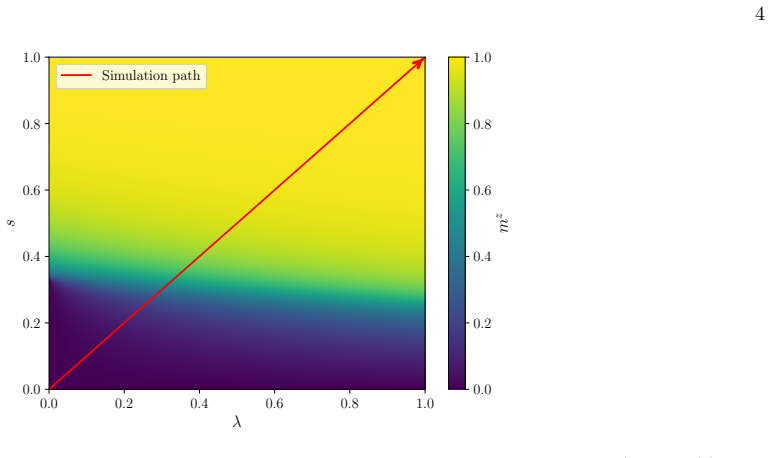
The central claim is that the Hamiltonian with fully-connected transverse interactions, H = sλH0 + (s(1−λ)/N)Σ_{ij}σ^x_iσ^x_j − (1−s)Σ_iσ^x_i, generates the same expectation values as a purely transverse-field Hamiltonian in which the field Γ(t) is set to 2s(1−λ) times the instantaneous average x-magnetization. The equivalence is derived from a Keldysh path-integral representation: after decoupling the transverse interaction with a mean-field-like auxiliary field, the generating functional is evaluated by saddle point, which is claimed to become exact as N→∞. The authors call the idealized version SCE; practical versions update Γ at discrete times (SCD) and estimate it from a finite number o
What carries the argument
The central object is the self-consistent transverse field Γ(t): at each update one measures the average σ^x magnetization and sets Γ equal to 2s(t)(1−λ(t)) times that average. This replacement becomes exact in the large-N limit because the fully-connected transverse interaction (1/N)Σ_{ij}σ^x_iσ^x_j factorizes, and the Keldysh generating functional is evaluated by saddle point in the auxiliary fields m^± and Γ^±. The workhorse identity is the mean-field decoupling: (1/N)(Σ_iσ^x_i)^2 ≈ m_x Σ_iσ^x_i, which becomes an equality of dynamics only as N→∞. The hierarchy SCE→SCD→SCM then turns this exact-in-limit construction into a procedure implementable with transverse-basis measurements and a ti
Load-bearing premise
The proof that the self-consistent field exactly reproduces the transverse-interaction catalyst assumes that the Keldysh generating functional Z_SCE is extensive—log Z_SCE ~ N—so that the saddle-point evaluation is justified; the authors note this is 'somewhat subtle and admittedly not rigorous.'
What would settle it
Compute log Z_SCE for the p-spin model at finite N and check whether it is proportional to N; if it is subextensive, the saddle-point argument fails and SCE will not converge to ED. Alternatively, fix T and measure the error ∆_ED/SCE at N=10^4 for a range of T; if it does not tend to zero (or does not follow roughly 1/N scaling) for some T, the claimed large-N equivalence is empirically false.
If this is right
- If the protocol works on hardware, quantum annealers can explore the effects of XX-type catalysts without building the interactions, using only transverse-field control and σ^x-basis measurements.
- The protocol reproduces the catalyst dynamics in the large-N limit, so the known benefits of XX catalysts—such as converting first-order transitions to second-order—become accessible at large problem sizes.
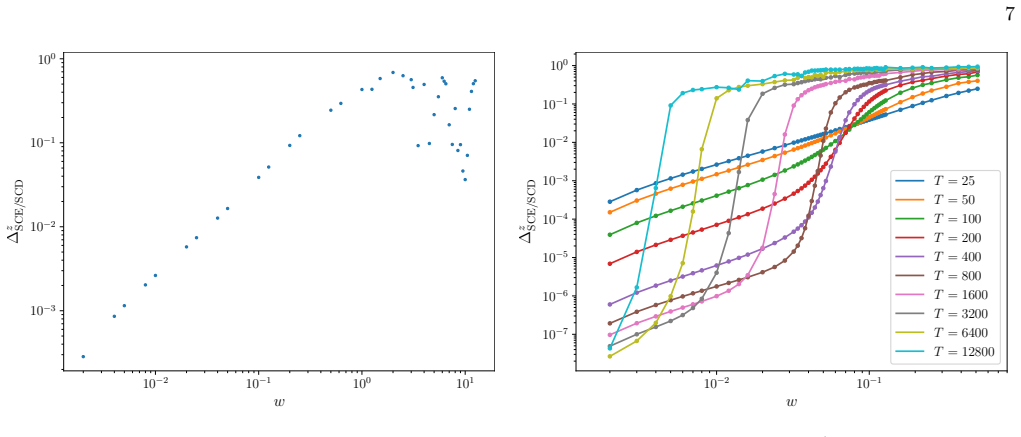
- Errors at each approximation stage can be made small: roughly 1/N from finite size, ~w from discrete updates (with an instability timescale that diverges as w→0), and ~1/√(Nk) from finite measurement statistics.
- The protocol can be mapped onto single-parameter annealing hardware by solving the schedule equations dτ/dt = A(u(t))/(s(τ)λ(τ)) and B(u)/A(u) = [1−s−2s(1−λ)Γ]/sλ.
- The self-consistent protocol cannot reach the exact ground state with probability 1 by taking T→∞; there is a limit to how closely it can follow the adiabatic path, though this error can be made small at large N.
Where Pith is reading between the lines
- An unstated corollary is that the 1/√(Nk) measurement-shot scaling implies a single measurement per update may suffice in large problems—the authors even show reasonable agreement with k=1 at N=100—making the quadratic runtime overhead from re-initialization the dominant practical cost rather than the number of shots.
- The instability in SCD at long runtimes suggests the protocol's useful parameter window is bounded by the instability timescale T_inst ~ w^{−1/α}; one might conjecture that a continuous-feedback variant, rather than piecewise-constant updates, could extend this window substantially for a given w.
- Because the saddle-point proof is admittedly non-rigorous, a rigorous large-N treatment (for instance, a concentration bound on the empirical x-magnetization) would be a natural next step; the numerical 1/N scaling can be read as partial evidence for the claim.
Editorial analysis
A structured set of objections, weighed in public.
Referee Report
Summary. The paper proposes a protocol to emulate fully-connected transverse (XX) catalyst interactions in quantum annealing by replacing them with a self-consistently adjusted transverse field. The protocol is developed in three stages: SCE (continuous feedback based on the average x-magnetization), SCD (piecewise-constant updates at intervals w), and SCM (updates based on k projective measurements). The authors argue, via a Keldysh path-integral saddle-point calculation in Appendix A, that SCE reproduces the exact dynamics of the transverse-interaction Hamiltonian in the large-N limit. Numerical simulations on the p-spin model show that the error between stages scales as Δ_ED/SCE ∼ 1/N, Δ_SCE/SCD ∼ w (in the small-w regime), and Δ_SCD/SCM ∼ 1/√(Nk); they also identify an instability of SCD at large runtime T. Finally, the protocol is mapped onto single-parameter annealing platforms. The paper is careful to quantify errors at each approximation stage and is unusually transparent about the formal gaps in the derivation.
Significance. If the central large-N equivalence holds, the paper provides a practical route to implementing XX catalysts on existing quantum annealers, requiring only transverse-basis measurements, a capability recently demonstrated on D-Wave hardware. The staged error analysis is a valuable contribution: it gives concrete, falsifiable scalings for each approximation and identifies the SCD instability timescale. The single-parameter mapping in Sec. IV addresses an important experimental constraint. The manuscript is honest about the non-rigorous nature of the saddle-point argument, and the numerical evidence is consistent with the claimed 1/N correction. The strength of the work lies in its clear error budget and the explicit statement of what is and is not rigorous.
major comments (2)
- [Appendix A, Eq. (A9)–(A14), footnote 1] The central large-N equivalence between ED and SCE is established by a saddle-point evaluation of the integrals over m± and Γ±, which requires log Z_SCE to be extensive. Footnote 1 explicitly admits this is not rigorous. Moreover, the saddle-point prefactor can, in principle, depend on the sources ξ; its contribution to connected correlation functions is O(1) relative to the O(N) terms, so the equality Z[ξ] ∼ Z_SCE[ξ] holds only up to O(1/N) corrections in intensive observables. The numerical support in Figs. 3–4 and 12–13 checks only m_z(t), not the full generating functional or other observables. The abstract's 'identical dynamics in the large-system limit' is therefore stronger than what has been demonstrated. Please either provide a rigorous argument for extensivity (e.g., via known mean-field bounds for fully-connected models) or soften the claim to 'intensive observables agree up t
- [Sec. III B, Fig. 5] The SCD instability is characterized by a crossover waiting time w_c ∼ T^{-α} with α ≈ 0.85. This exponent is inferred from a scaling collapse, but no collapse plot, fit range, or uncertainty is provided. Since the conclusion that SCD fails for any nonzero w as T → ∞ depends on this scaling, please quantify the confidence in α, or at least show the collapsed data. A similar issue applies to the linear-interpolation variant in Appendix B (Fig. 10), where no exponent is quoted.
minor comments (4)
- [Sec. III C] The argument that the O(1/√N) scaling extends to short-range models with finite correlation length is plausible but speculative. The manuscript should clearly mark this as a conjecture, since the rigorous WKB-like statement (Eq. (10)) is proved only for fully-connected models.
- [Eq. (7)] The total runtime expression T_tot ∼ kT^2/(2w) is asymptotic; for finite T/w the floor function matters. Please state this explicitly to avoid confusion about the discrete sum.
- [Fig. 8 caption] The legend symbol '□SCM' is not explained, and the caption says 'Dashed orange' for the SCM field while the legend also contains dashed and solid lines. Please make the line styles and symbols unambiguous.
- [Sec. IV] The statement that Eq. (15) 'always has a unique solution' assumes that B(u)/A(u) spans the required ratio. The limitation that B(u) may need to be negative, and therefore may be impossible on some platforms, should be stated more prominently.
Circularity Check
No circular reduction found; the SCE-ED equivalence is a saddle-point derivation, with an explicitly non-rigorous extensivity assumption.
full rationale
I walked the derivation chain from the exact dynamics (ED) of Eq. (2) to the self-consistent exact (SCE) protocol of Eqs. (3)-(4). The connection is made in Appendix A through a Keldysh path integral: the auxiliary fields m± and Γ± are introduced in the exact representation Eq. (A9), the saddle-point conditions are derived as Eq. (A11), and the self-consistent solution is identified with the SCE Hamiltonian in Eqs. (A13)-(A14). The claimed equality Z ~ Z_SCE is therefore a derived large-N saddle-point result, not an identity by construction. The SCE field is not fitted to ED data; it is the self-consistent expectation value of the SCE dynamics itself, and the equivalence is a substantive mathematical claim. The numerical comparisons are direct simulations of ED versus SCE/SCD/SCM, with error scalings measured after the fact rather than imposed. The paper's self-citations (Refs. [9,13,14] for the Keldysh approach, Ref. [35] for the large-N Gaussian wavefunction form) are methodological and non-load-bearing; the key proof in Appendix A is self-contained. The main flagged limitation is footnote 1, which states that 'Arguing that Z_SCE scales exponentially with N is somewhat subtle and admittedly not rigorous,' and Sec. II similarly notes the proof 'is not quite rigorous.' This is an unproven assumption on which the large-N equivalence rests, but it is a correctness gap rather than a circular step: if extensivity fails, the equivalence would be false, not true by definition. No fitted parameter is relabeled as a prediction, and no uniqueness or ansatz is imported solely from the authors' prior work. The score of 2 reflects only the presence of minor non-load-bearing self-citation; no circular step was identified.
Axiom & Free-Parameter Ledger
free parameters (1)
- crossover exponent alpha for SCD instability =
~0.85
axioms (3)
- ad hoc to paper The Keldysh generating functional Z_SCE scales exponentially with N, so saddle-point integration over m± and Gamma± is valid.
- domain assumption For fully-connected transverse interactions, mean-field decoupling is exact in the N -> infinity limit.
- domain assumption The p-spin dynamics stays in the total-spin N/2 subspace with initial state |right-arrow>^{x N}.
read the original abstract
Fully-connected transverse interactions have been considered as catalysts for quantum annealing that could mitigate exponentially small gaps and circumvent first-order phase transitions, but their experimental implementation remains challenging. In this work, we introduce a procedure for emulating their effects via a self-consistent transverse field. All that is required beyond conventional transverse-field annealing is the ability to make measurements in the transverse ($\hat{\sigma}^x$) basis. We show that this protocol yields identical dynamics in the large-system limit, and study the approach to that limit in numerical simulations of the (uniform) $p$-spin model. However, realizing the protocol in practice requires us to consider a series of approximate variants, each of whose errors we quantify and demonstrate can be made sufficiently small. Lastly, we show how to map the protocol onto annealing platforms that vary only a single control parameter. Even after the multiple stages of approximation, our procedure can generate dynamics that agree well with the original transverse-interaction catalyst, establishing self-consistent transverse fields as a viable alternative on near-term quantum annealers.
Figures





Reference graph
Works this paper leans on
-
[1]
Albash and D
T. Albash and D. A. Lidar, Adiabatic quantum computation, Rev. Mod. Phys.90, 015002 (2018)
2018
-
[2]
Hauke, H
P. Hauke, H. G. Katzgraber, W. Lechner, H. Nishimori, and W. D. Oliver, Perspectives of quantum annealing: Methods and implementations, Rep. Prog. Phys.83, 054401 (2020)
2020
-
[3]
Rajak, S
A. Rajak, S. Suzuki, A. Dutta, and B. K. Chakrabarti, Quantum annealing: An overview, Phil. Trans. R. Soc. A381, 20210417 (2023)
2023
-
[4]
Kadowaki and H
T. Kadowaki and H. Nishimori, Quantum annealing in the transverse Ising model, Phys. Rev. E58, 5355 (1998)
1998
-
[5]
Farhi, J
E. Farhi, J. Goldstone, S. Gutmann, J. Lapan, A. Lundgren, and D. Preda, A quantum adiabatic evolution algorithm applied to random instances of an NP-complete problem, Science292, 472 (2001)
2001
-
[6]
G. E. Santoro, R. Martoˇ n´ ak, E. Tosatti, and R. Car, Theory of quantum annealing of an Ising spin glass, Science295, 2427 (2002)
2002
-
[7]
Y. Susa, Y. Yamashiro, M. Yamamoto, and H. Nishimori, Exponential speedup of quantum annealing by inhomogeneous driving of the transverse field, J. Phys. Soc. Jpn.87, 023002 (2018)
2018
-
[8]
J. I. Adame and P. L. McMahon, Inhomogeneous driving in quantum annealers can result in orders-of-magnitude improve- ments in performance, Quantum Sci. Technol.5, 035011 (2020)
2020
-
[9]
Dadgar and C
M. Dadgar and C. L. Baldwin, Anomalously slow dynamics of inhomogeneous quantum annealing, Phys. Rev. A111, 062601 (2025)
2025
-
[10]
Ohkuwa, H
M. Ohkuwa, H. Nishimori, and D. A. Lidar, Reverse annealing for the fully connected p-spin model, Phys. Rev. A98, 022314 (2018)
2018
-
[11]
Marshall, D
J. Marshall, D. Venturelli, I. Hen, and E. G. Rieffel, Power of pausing: Advancing understanding of thermalization in experimental quantum annealers, Phys. Rev. Appl.11, 044083 (2019)
2019
-
[12]
Mehta, H
V. Mehta, H. De Raedt, K. Michielsen, and F. Jin, Unraveling reverse annealing: A study of D-Wave quantum annealers, Phys. Rev. A112, 012414 (2025)
2025
-
[13]
C. L. Baldwin, Simulated outperforms quantum reverse annealing in mean-field models, arXiv:2511.00150 (2025)
arXiv 2025
- [14]
-
[15]
Passarelli, V
G. Passarelli, V. Cataudella, R. Fazio, and P. Lucignano, Counterdiabatic driving in the quantum annealing of the p-spin model: A variational approach, Phys. Rev. Res.2, 013283 (2020)
2020
-
[16]
Passarelli and P
G. Passarelli and P. Lucignano, Counterdiabatic reverse annealing, Phys. Rev. A107, 022607 (2023)
2023
-
[17]
Seki and H
Y. Seki and H. Nishimori, Quantum annealing with antiferromagnetic fluctuations, Phys. Rev. E85, 051112 (2012)
2012
-
[18]
Seoane and H
B. Seoane and H. Nishimori, Many-body transverse interactions in the quantum annealing of the p-spin ferromagnet, J. Phys. A: Math. Theor.45, 435301 (2012)
2012
-
[19]
Seki and H
Y. Seki and H. Nishimori, Quantum annealing with antiferromagnetic transverse interactions for the Hopfield model, J. Phys. A: Math. Theor.48, 335301 (2015)
2015
-
[20]
Hormozi, E
L. Hormozi, E. W. Brown, G. Carleo, and M. Troyer, Nonstoquastic Hamiltonians and quantum annealing of an Ising spin glass, Phys. Rev. B95, 184416 (2017)
2017
-
[21]
Y. Susa, J. F. Jadebeck, and H. Nishimori, Relation between quantum fluctuations and the performance enhancement of quantum annealing in a nonstoquastic Hamiltonian, Phys. Rev. A95, 042321 (2017)
2017
-
[22]
Albash, Role of nonstoquastic catalysts in quantum adiabatic optimization, Phys
T. Albash, Role of nonstoquastic catalysts in quantum adiabatic optimization, Phys. Rev. A99, 042334 (2019)
2019
-
[23]
Takada, Y
K. Takada, Y. Yamashiro, and H. Nishimori, Mean-field solution of the weak-strong cluster problem for quantum annealing with stoquastic and non-stoquastic catalysts, J. Phys. Soc. Jpn.89, 044001 (2020)
2020
-
[24]
Takada, S
K. Takada, S. Sota, S. Yunoki, B. Pokharel, H. Nishimori, and D. A. Lidar, Phase transitions in the frustrated Ising ladder with stoquastic and nonstoquastic catalysts, Phys. Rev. Res.3, 043013 (2021)
2021
-
[25]
Feinstein, L
N. Feinstein, L. Fry-Bouriaux, S. Bose, and P. A. Warburton, Effects of XX catalysts on quantum annealing spectra with perturbative crossings, Phys. Rev. A110, 042609 (2024)
2024
-
[26]
L. A. Nutricati, R. Ghosh, N. Feinstein, S. Bose, and P. A. Warburton, Enhancing the energy gap of random graph problems via XX-catalysts in quantum annealing, Quantum Sci. Technol.10, 045010 (2025)
2025
-
[27]
Ghosh, L
R. Ghosh, L. A. Nutricati, N. Feinstein, P. A. Warburton, and S. Bose, Enhancement of quantum annealing via n-local catalysts, Phys. Rev. Res.8, 013301 (2026)
2026
-
[28]
Ozfidan, C
I. Ozfidan, C. Deng, A. Smirnov, T. Lanting, R. Harris, L. Swenson, J. Whittaker, F. Altomare, M. Babcock, C. Baron, A. Berkley, K. Boothby, H. Christiani, P. Bunyk, C. Enderud, B. Evert, M. Hager, A. Hajda, J. Hilton, S. Huang, E. Hoskinson, M. Johnson, K. Jooya, E. Ladizinsky, N. Ladizinsky, R. Li, A. MacDonald, D. Marsden, G. Marsden, T. Medina, R. Mol...
2020
-
[29]
R. Deshpande, M. Kheirkhah, C. Rich, R. Harris, J. Raymond, E. Hoskinson, P. Sathe, A. J. Berkley, S. Paul, B. Barch, D. A. Lidar, M. M¨ uller, G. Aeppli, A. D. King, and M. H. Amin, Analog-digital quantum computing with quantum annealing processors, arXiv:2603.15534 (2026)
Pith/arXiv arXiv 2026
-
[30]
J¨ org, F
T. J¨ org, F. Krzakala, J. Kurchan, A. C. Maggs, and J. Pujos, Energy gaps in quantum first-order mean-field-like transitions: The problems that quantum annealing cannot solve, EPL (Europhysics Letters)89, 40004 (2010)
2010
-
[31]
Bapst and G
V. Bapst and G. Semerjian, On quantum mean-field models and their quantum annealing, J. Stat. Mech.: Theory Exp. 2012(06), P06007
2012
-
[32]
Ohzeki, Quantum Monte Carlo simulation of a particular class of non-stoquastic Hamiltonians in quantum annealing, Sci
M. Ohzeki, Quantum Monte Carlo simulation of a particular class of non-stoquastic Hamiltonians in quantum annealing, Sci. Rep.7, 41186 (2017)
2017
-
[33]
R. J. Banks, N. Feinstein, R. Ghosh, S. Bose, and P. A. Warburton, Gadgets for simulating a non-native XX interaction in quantum annealing, arXiv:2503.16663 (2025)
Pith/arXiv arXiv 2025
-
[34]
Garg, Application of the discrete Wentzel–Kramers–Brillouin method to spin tunneling, J
A. Garg, Application of the discrete Wentzel–Kramers–Brillouin method to spin tunneling, J. Math. Phys.39, 5166 (1998)
1998
-
[35]
C. L. Baldwin, S. Shivam, S. L. Sondhi, and M. Kardar, Distinct critical behaviors from the same state in quantum spin and population dynamics perspectives, Phys. Rev. E103, 012106 (2021)
2021
-
[36]
Rammer,Quantum Field Theory of Non-Equilibrium States(Cambridge University Press, 2007)
J. Rammer,Quantum Field Theory of Non-Equilibrium States(Cambridge University Press, 2007)
2007
-
[37]
Kamenev,Field Theory of Non-Equilibrium Systems(Cambridge University Press, 2011)
A. Kamenev,Field Theory of Non-Equilibrium Systems(Cambridge University Press, 2011)
2011
-
[38]
conventional annealing
L. M. Sieberer, M. Buchhold, and S. Diehl, Keldysh field theory for driven open quantum systems, Rep. Prog. Phys.79, 096001 (2016). Appendix A: Derivation of the self-consistent exact protocol Here we give a formal proof that the SCE protocol produces exactly the same dynamics as the original Hamiltonian in the large-Nlimit (while holding all other parame...
2016
discussion (0)
Sign in with ORCID, Apple, or X to comment. Anyone can read and Pith papers without signing in.