REVIEW 3 major objections 4 minor 28 references
A two-layer quantum circuit encodes any matrix chain product in depth independent of chain length.
Reviewed by Pith at T0; open to challenge. T0 means a machine referee read the full paper against a public rubric. the ladder, T0–T4 →
T0 review · deepseek-v4-flash
2026-08-02 05:56 UTC pith:QJEYRFOI
load-bearing objection The K-independent depth claim is real but only for the raw state-encoding unitary; the paper discloses the signal-weight caveat in Section 4.3, yet the abstract and Table 1 still overstate it. the 3 major comments →
Two-Tower Quantum Matrix Chain Multiplication: Trading Qubits for Depth
The pith
A machine-rendered reading of the paper's core claim, the machinery that carries it, and where it could break.
Core claim
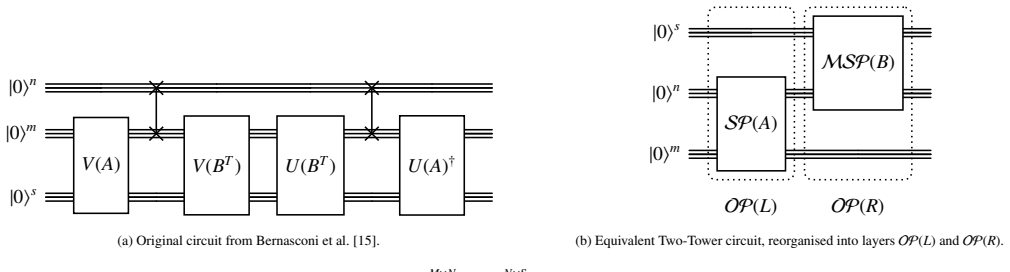
Theorem 5 states that for any chain M^(0)...M^(K-1), there is a unitary U_W = OP(R) OP(L) that maps |0...0> to the Frobenius-normalized chain product on the outer registers, with every shared index contracted to |0>, plus an orthogonal residual. The construction interleaves state-preparation operators: the even-indexed matrices are loaded in parallel in one layer, the odd-indexed ones are contracted in parallel in the second, using the adjoint state-preparation operator to convert shared-register basis states into matrix-entry amplitudes. For even chains, the last matrix is loaded with a modified operator that keeps the output column register alive. The depth is O(max_k polylog(P_k P_{k+1}))
What carries the argument
The contraction mechanism: for a matrix M, the adjoint state-preparation operator SP(M)^dagger acts on a basis state |i,j> as SP(M)^dagger |i,j> = (m_ij/||M||_F) |0,0> + |perp>, projecting onto the contracted state with amplitude proportional to the matrix entry. This single identity turns a superposition over shared indices into the inner-product sums that define the chain product, and it is what lets all K matrices be handled in two parallel layers. A second operator, MSP, is the even-chain variant that contracts only the shared register while preserving the output column register.
Load-bearing premise
The headline constant-depth result holds for the raw quantum state; if the goal is to read out the product or feed it to an algorithm that needs the contracted subspace with constant probability, the exponentially small signal weight for well-conditioned chains forces amplitude amplification, reintroducing dependence on K.
What would settle it
Simulate the K=3 or K=4 circuit for random well-conditioned matrices and compare the amplitudes on the subspace |p,0,...,0,q> with W_pq/(prod ||M^(k)||_F): a mismatch at machine precision would falsify correctness; measuring the two-qubit-gate depth as K grows would falsify the constant-depth claim.
If this is right
- Setting the last matrix to a column vector gives a matrix-chain-vector routine that encodes M^(0)...M^(K-2) v in polylog depth with no output column register.
- The raw output can feed amplitude-estimation-based routines for norms, traces, variances, graph-matrix powers, linear-system solvers, and kernel evaluations without tomography.
- Total gate count remains Theta(K polylog(N)); the gain is depth, not total work.
- The signal weight Omega_W = ||W||_F^2 / prod ||M^(k)||_F^2 controls how much of the state is useful; amplitude amplification boosts it at cost O(1/sqrt Omega_W).
- For normal matrices, Omega_W for A^K approaches (sigma_1^2 / ||A||_F^2)^{K-1}, so peaked spectra keep the signal strong while flat spectra dilute it.
Where Pith is reading between the lines
- If a downstream algorithm can consume the raw state without post-selecting the contracted subspace, the K-independent depth is a genuine end-to-end advantage; otherwise the amplification overhead restores a K dependence that should be counted in comparisons with classical depth.
- A statevector-to-block-encoding conversion, which the paper leaves open, would let intermediate Two-Tower outputs be multiplied further by QSVT-based methods, potentially giving a hybrid that controls both depth and signal decay.
- The same two-layer contraction idea could be applied to products of unitaries or to tensor-network contractions, where contractions over multiple bond indices might be parallelized in the same way.
- The classical preprocessing to build the quantum-accessible tree costs O(PR) per matrix, so the asymptotic depth saving assumes the data tree is already built; a fair end-to-end comparison should include that one-time cost.
Editorial analysis
A structured set of objections, weighed in public.
Referee Report
Summary. The paper presents Two-Tower Matrix Multiplication, a quantum subroutine that prepares a quantum state whose amplitudes encode the product W = M^(0)...M^(K-1) of K distinct matrices. The construction is a generalization of the authors' earlier two-matrix subroutine [15]: even-indexed matrices are loaded with state-preparation operators SP(M^(2i)) in one parallel layer, odd-indexed matrices are contracted with adjoint operators SP(M^(2j+1))^† in a second parallel layer, and for even K the last matrix is handled by an MSP operator. The authors prove correctness for odd and even K (Theorem 5), derive depth O(max_k polylog(P_k P_{k+1})) independent of K, qubit count O(sum_k log P_k), total gate count Theta(K polylog), and give a chain-vector corollary plus Qiskit/QCLAB implementations. They also explicitly define a signal weight Omega_W = ||W||_F^2 / prod ||M^(k)||_F^2 and note that amplitude amplification costs O(1/sqrt(Omega_W)).
Significance. The contraction mechanism (Eq. 3) and the odd/even correctness proofs are clean, and the depth/qubit counts follow directly from the two-layer parallel structure. If the result is understood as a raw state-preparation primitive in the QRAM model, it is a genuine and nontrivial improvement over block-encoding-based chain multiplication, whose depth typically grows with K. The availability of open-source implementations and the explicit proof for arbitrary K are strengths. However, the advertised 'constant-depth' claim does not automatically extend to any end-to-end computation: the useful component of the output has squared weight Omega_W, and for well-conditioned N x N factors Omega_W ~ N^{-(K-1)}, so post-selection or amplitude amplification introduces a substantial K-dependent overhead. The resource comparison in Table 1 also omits the classical QRAM storage needed for the input matrices. The significance is therefore conditional: the formal state-preparation result is sound, but its practical reach is narrower than the abstract suggests.
major comments (3)
- [Abstract; Table 1; Section 4.3] The headline 'depth independent of K' is stated for the raw output state of U_W, but the paper itself shows in Section 4.3 that the useful subspace has squared weight Omega_W = ||W||_F^2 / prod ||M^(k)||_F^2, and that boosting Omega_W to a constant costs O(1/sqrt(Omega_W)) amplitude-amplification rounds. For well-conditioned N x N factors Omega_W ~ N^{-(K-1)}, so that overhead grows as Omega(N^{(K-1)/2}). Thus any end-to-end procedure that needs the chain product W, or that uses the product encoding in a downstream algorithm, has a K-dependent cost that is omitted from the abstract and from Table 1's 'O(polylog(N))' execution depth. The claim should be explicitly qualified as applying to raw state preparation, and the amplification cost should be included in the resource accounting or clearly stated as a separate stage.
- [Algorithm 1; Figures 2-3 with Definitions 2 and 4] There is a systematic reversal of register order. Definition 2 fixes SP(M) to map |0>^p|0>^r to sum m_{i,j}|i>^p|j>^r, i.e. first register = row index, second = column. Definition 4 accordingly places SP(M^(2i)) on (l_i,r_i) and SP(M^(2j+1))^† on (r_j,l_{j+1}). However Algorithm 1 line 2 says 'apply SP(M^(k)) on registers (q_{k+1}, q_k)' for even k, and the Figure 3 caption describes OP(L) acting on pairs (r_i,l_i) and OP(R) on (l_{j+1},r_j). Read literally, these reversed pairs load M^T rather than M; tracking the K=3 case gives W^T (or a reversed product order), not W as claimed in Theorem 5. Please standardize the register ordering in the pseudocode and circuit captions to match Definitions 2-4, or explicitly explain a different convention and prove the output state under that convention.
- [Table 1; Section 2.2] The memory comparison is incomplete. The 'Memory/qubits' row lists classical O(K N^2) words versus Theta(K log N) qubits, but the proposed algorithm operates in the QRAM model, where all K N^2 matrix entries are stored in a classical quantum-accessible data structure; the QRAM also requires O(K N^2) classical preprocessing. The qubit count includes only circuit registers, as a footnote says, but the table does not state the accompanying QRAM storage size. As presented, the row overstates the memory compression of the full quantum system. Please report circuit-register qubits and QRAM storage separately, or clearly state that the classical data structure is excluded from the resource comparison.
minor comments (4)
- [Section 3.1, Figure 2] The caption says MSP(B) acts on registers (s,n) and SP(A) on (n,m). For A in R^{M x N} and B in R^{N x S}, Definition 2/3 imply SP(A) should act on (m,n) and MSP(B) on (n,s). The caption appears to swap the roles of n and s, which is confusing given the register-order issue noted above.
- [Section 1] The statement that classical unbounded-parallelism matrix chain multiplication has depth O(log K log N) is plausible under the arithmetic-circuit model with constant-time scalar operations, but it should be accompanied by a citation or a short justification; matrix multiplication itself is commonly quoted as O(log^2 N) depth in NC.
- [Section 4.3] The transition 'for large K is dominated by the largest singular value: Omega_W ~ (sigma_1^2/||A||_F^2)^{K-1}' is only accurate in the limit where the second singular value is small; for a generic normal matrix with sigma_1>sigma_2, Omega_W tends to 1, not to a decaying exponential. Please state the precise asymptotic regime or replace the displayed formula with the more careful ratio.
- [Throughout] The paper uses both 'P_k' and 'p_k = log P_k' and at times writes O(polylog(P_k P_{k+1})) and at other times O(polylog(N)) for square chains. This is fine, but a short notation reminder near Table 1 would help.
Circularity Check
No significant circularity: Theorem 5 is proved directly from the contraction identity Eq. (3); the main self-citation [15] supplies the base-case circuit but is not load-bearing.
full rationale
The central derivation is self-contained. Theorem 5's correctness is proven by direct calculation: OP(L) prepares all even-indexed matrices and OP(R) contracts each shared register via SP(M)^†|i,j> = (m_ij/||M||_F)|0,0> + |⊥> (Eq. 3), which follows immediately from Definition 2 and unitarity. The chain-product sums emerge by linearity from this identity, not from any fitted parameter or prior result assumed as equivalent to the target. The MSP operator used for even K is not postulated as an independent oracle; it is defined as V(M)^†U(M) and its action is derived from SP. The only substantive self-citation is [15], which supplies the original two-matrix circuit that the paper rearranges into OP(L)/OP(R); for K=2 the paper states the rearrangement explicitly, and for general K the proof in Section 4.1 does not cite [15] as a theorem. Thus the self-citation is not load-bearing. Section 4.3's signal-weight analysis is an honest limitation: Ω_W = ||W||_F^2 / ∏||M^(k)||_F^2 may decay as N^{-(K-1)}, and boosting it costs O(1/√Ω_W), reintroducing K-dependence for end-to-end use; this qualifies the raw-state depth claim but is not circular. Section 6 likewise flags the missing statevector-to-block-encoding conversion as an open problem rather than silently assuming it. Within the stated QRAM model, the polylog depth per SP is an external assumption, not a consequence of the target result.
Axiom & Free-Parameter Ledger
axioms (4)
- domain assumption QRAM-based state preparation can load a P x R matrix into a (p+r)-qubit state in depth O(polylog(PR)) using Theta(log(PR)) qubits.
- domain assumption All matrix dimensions are powers of two and all entries are real.
- standard math For any real matrix M, there exists a unitary SP(M) with first column equal to the Frobenius-normalized vectorized entries, and a unitary MSP(M) = V(M)^dagger U(M) with the stated action on |i>|0>.
- standard math The vectorization identity vec(AXB) = (B^T tensor A) vec(X) (Horn and Johnson, Lemma 4.3.1).
read the original abstract
Matrix chain multiplication -- computing $\mathcal{W} = M^{(0)}\cdots M^{(K-1)}$ where $M^{(k)} \in \mathbb{R}^{P_k \times P_{k+1}}$ -- arises in scientific computing, machine learning, and graph analysis. Despite the importance of this problem, for chains of distinct matrices, the classical number of operations grows linearly with the chain length $K$ and polynomially in the matrix dimensions. We present \emph{Two-Tower Matrix Multiplication}, a quantum subroutine that encodes the product $\mathcal{W}$ of the $K$ matrices into a quantum state in circuit depth $\mathcal{O}(\max_{k} \mathrm{polylog} (P_k P_{k+1}))$, which is independent of~$K$ within the QRAM-based state-preparation model, whereas the qubit count is $\mathcal{O}\bigl(\sum_{k} \log P_k \bigr)$; the total gate count remains linear in $K$, so the gain is in the circuit depth. The construction interleaves state-preparation operators across two layers; within each layer, all operators act on disjoint registers and execute in parallel. This subroutine can be specialized for the chain-vector case, which computes the product of $K-1$ matrices applied to a vector. We prove the correctness of the subroutine for all $K$ and provide two implementations using the Qiskit and QCLAB frameworks. The subroutine is applicable to any downstream quantum algorithm that operates on a matrix encoded in the statevector, including norm estimation, graph-matrix powers, linear system solving, and quantum machine learning kernels.
Figures



Reference graph
Works this paper leans on
-
[1]
G. H. Golub, C. F. Van Loan, Matrix computations, 3rd Edition, Johns Hopkins University Press, Baltimore, MD, 1996
1996
-
[2]
Biamonte, P
J. Biamonte, P. Wittek, N. Pancotti, P. Rebentrost, N. Wiebe, S. Lloyd, Quantum machine learning, Nature 549 (7671) (2017) 195–202
2017
-
[3]
D. Janzing, P. Wocjan, BQP-complete problems concern- ing mixing properties of classical random walks on sparse graphs, arXiv preprint quant-ph/0610235 (2006)
Pith/arXiv arXiv 2006
-
[4]
N. A. Nghiem, T.-C. Wei, Quantum algorithm for esti- mating largest eigenvalues, Physics Letters A 488 (2023) 129138
2023
-
[5]
D. Bini, M. Capovani, F. Romani, G. Lotti, o(n2.7799) complexity for n×n approximate matrix multiplication, Information Processing Letters 8 (1979) 234–235. doi: 10.1016/0020-0190(79)90113-3
-
[6]
Alman, V
J. Alman, V . V . Williams, A refined laser method and faster matrix multiplication, in: Proceedings of the 2021 ACM-SIAM Symposium on Discrete Algorithms (SODA), SIAM, 2021, pp. 522–539
2021
-
[7]
R. Duan, H. Wu, R. Zhou, Faster matrix multiplication via asymmetric hashing, in: Proceedings of the 64th Annual IEEE Symposium on Foundations of Computer Science (FOCS), IEEE, 2023, pp. 2129–2138
2023
-
[8]
A. W. Harrow, A. Hassidim, S. Lloyd, Quantum algorithm for linear systems of equations, Physical Review Letters 103 (15) (2009) 150502
2009
-
[9]
L. Wossnig, Z. Zhao, A. Prakash, Quantum linear sys- tem algorithm for dense matrices, Physical Review Letters 120 (5) (2018) 050502. doi:10.1103/PhysRevLett. 120.050502
-
[10]
S. Chakraborty, A. Gilyén, S. Jeffery, The Power of Block- Encoded Matrix Powers: Improved Regression Tech- niques via Faster Hamiltonian Simulation, in: 46th In- ternational Colloquium on Automata, Languages, and Pro- gramming (ICALP 2019), V ol. 132 of Leibniz International Proceedings in Informatics (LIPIcs), Schloss Dagstuhl – Leibniz-Zentrum für Info...
-
[11]
D. Fang, L. Lin, Y . Tong, Time-marching based quantum solvers for time-dependent linear dif- ferential equations, Quantum 7 (2023) 955. doi:10.22331/q-2023-03-20-955. URL http://dx.doi.org/10.22331/ q-2023-03-20-955
-
[12]
Li, P.-L
X. Li, P.-L. Zheng, C. Pan, F. Wang, C. Cui, X. Lu, Faster quantum subroutine for matrix chain multiplication via Chebyshev approximation, Scientific Reports 15 (1) (2025) 28559
2025
-
[13]
A. Gilyén, Y . Su, G. H. Low, N. Wiebe, Quantum singular value transformation and beyond: Exponential improve- ments for quantum matrix arithmetics, in: Proceedings of the 51st Annual ACM SIGACT Symposium on Theory of Computing (STOC 2019), ACM, 2019, pp. 193–204. doi:10.1145/3313276.3316366
arXiv 2019
-
[14]
Montanaro, C
A. Montanaro, C. Shao, Quantum and classical query com- plexities of functions of matrices, in: Proceedings of the 56th Annual ACM Symposium on Theory of Computing, 2024, pp. 573–584
2024
-
[15]
A. Bernasconi, A. Berti, G. M. Del Corso, A. Poggiali, Quantum subroutine for efficient matrix multiplication, IEEE Access 12 (2024) 116274–116284. doi:10.1109/ ACCESS.2024.3446176
arXiv 2024
-
[16]
Giovannetti, S
V . Giovannetti, S. Lloyd, L. Maccone, Quantum random access memory, Physical Review Letters 100 (16) (2008) 160501
2008
-
[17]
R. A. Horn, C. R. Johnson, Matrix analysis, Cambridge university press, 2012
2012
-
[18]
Antonioli, A
G. Antonioli, A. Berti, A. Poggiali, A. Bernasconi, G. M. Del Corso, Outlier detection and other applications of quan- tum matrix multiplication, in: 2025 IEEE International Par- allel and Distributed Processing Symposium Workshops (IPDPSW), IEEE, 2025, pp. 509–518
2025
-
[19]
Bernasconi, A
A. Bernasconi, A. Berti, G. M. Del Corso, R. Guidotti, A. Poggiali, Quantum subroutine for variance estimation: algorithmic design and applications, Quantum Machine Intelligence 6 (2) (2024) 78
2024
-
[20]
Poggiali, A
A. Poggiali, A. Bernasconi, A. Berti, G. M. Del Corso, R. Guidotti, et al., Quantum feature selection with variance estimation, in: ESANN, 2023
2023
-
[21]
Poggiali, J
A. Poggiali, J. Ju, A more efficient quantum circuit for estimating the variance, Quantum Machine Intelligence 8 (1) (2026) 34
2026
-
[22]
M. A. Nielsen, I. L. Chuang, Quantum Computation and Quantum Information, Cambridge University Press, 2010
2010
-
[23]
A. Javadi-Abhari, M. Treinish, K. Krsulich, C. J. Wood, J. Lishman, J. Gacon, S. Martiel, P. D. Nation, L. S. Bishop, A. W. Cross, B. R. Johnson, J. M. Gambetta, Quantum 10 computing with Qiskit (2024). arXiv:2405.08810, doi: 10.48550/arXiv.2405.08810
-
[24]
S. Keip, D. Camps, R. Van Beeumen, QCLAB: A mat- lab toolbox for quantum computing, in: 2025 IEEE Inter- national Parallel and Distributed Processing Symposium Workshops (IPDPSW), IEEE, 2025, pp. 1175–1181
2025
-
[25]
A. Berti, F. Ghisoni, Efficient quantum state prepa- ration with bucket brigade QRAM, arXiv preprint arXiv:2510.16149 (2025)
Pith/arXiv arXiv 2025
-
[26]
I. Kerenidis, A. Prakash, Quantum Recommendation Sys- tems, in: 8th Innovations in Theoretical Computer Science Conference (ITCS 2017), V ol. 67 of Leibniz International Proceedings in Informatics (LIPIcs), Schloss Dagstuhl – Leibniz-Zentrum für Informatik, 2017, pp. 49:1–49:21. doi:10.4230/LIPIcs.ITCS.2017.49
-
[27]
G. Brassard, P. Høyer, M. Mosca, A. Tapp, Quantum am- plitude amplification and estimation, Contemporary Math- ematics 305 (2002) 53–74, arXiv:quant-ph/0005055
Pith/arXiv arXiv 2002
-
[28]
C. Cade, A. Montanaro, The quantum complexity of com- puting Schatten p-norms, arXiv preprint arXiv:1706.09279 (2017). 11
Pith/arXiv arXiv 2017
discussion (0)
Sign in with ORCID, Apple, or X to comment. Anyone can read and Pith papers without signing in.