REVIEW 4 major objections 4 minor 53 references
A trivalent planar qubit layout enables lattice surgery between surface-code patches with zero additional data qubits while preserving modular operation, cutting resource overhead and improving logical teleportation fidelity.
Reviewed by Pith at T0; open to challenge. T0 means a machine referee read the full paper against a public rubric. the ladder, T0–T4 →
T0 review · deepseek-v4-flash
2026-08-02 00:19 UTC pith:Q6AB73OY
load-bearing objection A careful, honest simulation study: the trivalent resource saving for lattice surgery is real, but the headline fidelity gains ride on an unmeasured gate-speed model and the abstract's scaling claim needs a fix. the 4 major comments →
Towards logical entanglement creation in trivalent planar architectures
The pith
A machine-rendered reading of the paper's core claim, the machinery that carries it, and where it could break.
Core claim
The central claim is that lattice surgery—measuring the joint logical parity of two surface-code patches to create a Bell state or teleport a logical state—can be implemented in the trivalent architecture with strictly fewer auxiliary resources than in the conventional four-valent layout, without sacrificing modular operability of the two patches. Because the trivalent readout schedule places boundary ancillas on only two sides of each patch, the merging region between two patches is a single column of plaquette stabilizers, independent of code distance. Merging is done by running the two patches' QEC cycles in parallel, with one patch executing the adjoint of the other's circuit, and measur
What carries the argument
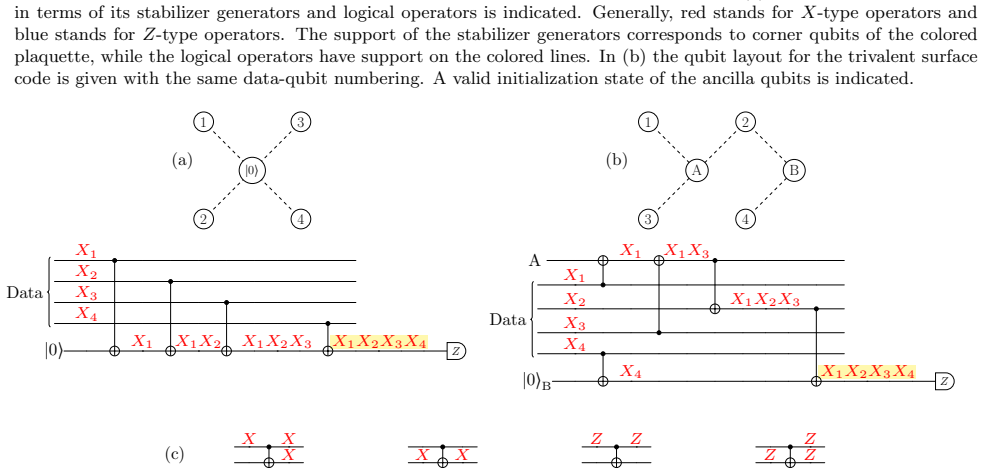
The load-bearing mechanism is the trivalent stabilizer-measurement schedule, a degree-three readout scheme for the surface code in which each weight-four plaquette is measured via ancilla qubits that couple to at most three neighbors, using bridge ancillas to relay error information and alternating each QEC round with its adjoint circuit. The paper's contribution is the observation that this arrangement leaves the boundary of each patch with ancillas on only two sides, so two patches can be merged by simply interleaving their alternating QEC cycles—one running the original circuit, the other the adjoint—and measuring the resulting extended boundary stabilizers. No data-qubit stripe is needed
Load-bearing premise
The predicted fidelity improvements hinge on the assumption that reducing valency from four to three lets two-qubit gates run about 25% faster with an error-rate decomposition p2=(1−α)0.4%+η·α·0.4%, which the authors state is hard to pin down experimentally; if no speed-up occurs, trivalent surgery is actually worse than four-valent at distances 5 and 7 under realistic idling noise.
What would settle it
Measure the two-qubit gate time and error rate for a fluxonium qubit coupled to three versus four neighbors under a fixed total capacitance budget. If the gate time does not drop by roughly a factor 3/4, or if the error rate does not follow the model's dependence on gate time, the predicted up-to-50% logical teleportation fidelity improvement will not materialize, and the trivalent scheme would be expected to underperform four-valent at d≥5 in realistic noise.
If this is right
- A trivalent planar processor can run surface-code lattice surgery with fewer physical qubits, reducing the qubit footprint of multi-logical-qubit algorithms by O(d) per merge.
- The reduction in two-qubit gates lowers the leading-order prefactor of the logical error rate, so the advantage over four-valent surgery grows as code distance increases.
- The trivalent surgery protocol is compatible with modular operation: each patch can be initialized, measured, and error-corrected independently before and after the merge.
- Under the modeled hardware speed-up (gate time about 3/4 of the four-valent value), the trivalent scheme's realistic-noise disadvantage in memory operation is compensated, and surgery fidelity improves by up to about 50%.
- For fluxonium-based architectures, where capacitance budget limits connectivity, the trivalent layout is a natural fit that can turn the structural surgery advantage into an experimental one.
Where Pith is reading between the lines
- If the 4/3 coupling-strength speed-up is even partially realized, the trivalent architecture's slightly higher idling penalty in repeated memory cycles becomes a secondary consideration, making the whole processor, not just surgery, competitive.
- The reverse interleaving requirement (one patch runs the adjoint of the other's QEC cycle) implies a global synchronization constraint for multi-patch algorithms; future compilation strategies may need to schedule which patches are 'phase-aligned' to minimize waiting times.
- The resource counting covers only the merging region; in a large processor where patches are packed, the savings in data qubits may also reduce routing and measurement constraints, an effect not quantified in the paper.
- A natural extension is to test the trivalent surgery protocol on existing four-valent hardware by using a subset of couplings, as was done for the trivalent memory scheme; the predicted ~2% low-p improvement at d=3 is directly measurable.
Editorial analysis
A structured set of objections, weighed in public.
Referee Report
Summary. The paper studies the trivalent (degree-3) measurement scheme for the rotated surface code, originally introduced in Ref. [21], and extends it to lattice-surgery operations between logical patches. The authors present explicit circuit constructions, reproduce the memory-experiment comparison under a standard circuit-level noise model, and then introduce a trivalent lattice-surgery layout that avoids the additional stripe of data qubits required in the minimal four-valent modular layout. They report resource-count savings (Table 2) and simulate logical teleportation protocols under standard and experimentally motivated noise models, claiming a potential improvement in logical fidelity of up to ~25% in memory and ~50% in surgery when a reduced two-qubit gate time is assumed. The paper is notable for honestly reporting that, without this assumed gate-time improvement, the trivalent surgery protocol is worse than the four-valent one at d=5 and d=7 under the realistic noise model (Fig. 12).
Significance. The structural insight is valuable: the trivalent arrangement of boundary ancilla qubits allows lattice surgery without additional merging data qubits while preserving modularity, and the gate-count savings in Table 2 are concrete and checkable. The paper also contributes explicit circuits and a fair comparison with the four-valent scheme, including a transparent sensitivity analysis over the parameters η and α rather than a fit dressed as a prediction. The main weakness is that the headline fidelity improvement is conditional on an idealized and unmeasured hardware model for fluxonium qubits: the 4/3 coupling-strength argument is a capacitance-based estimate, and the error decomposition p2=(1−α)0.4%+η·α·0.4% is explicitly acknowledged as hard to determine experimentally. Since the paper's own Fig. 12 shows trivalent surgery performing worse at d=5,7 under realistic noise without the gate-time assumption, the performance claim is not yet established in an unconditional sense. The resource-saving claim is more robust and should be the primary stated contribution.
major comments (4)
- [Abstract and Table 2] The abstract states that the trivalent protocol reduces two-qubit gates by O(d) out of a total O(d^3), but Table 2 lists 2d^2 versus 6d^2−2 additional two-qubit gates, which is a difference of 4d^2−2 = O(d^2), not O(d). This is a load-bearing scaling claim. Either correct the abstract to 'by O(d^2) two-qubit gates out of a total O(d^3)' (which would be a relative saving O(1/d)), or clarify exactly which gate count is meant. As written, the stated asymptotic saving is inconsistent with the table.
- [Section III, Figs. 12 and 13] The central performance claim — improved logical teleportation fidelity — is not established under the experimentally motivated noise model without the additional gate-time assumption. Fig. 12 shows the trivalent protocol is worse than the four-valent protocol at d=5 and d=7 for λ around 1, and the improvement in Fig. 13 (up to ~50%) relies on η∈[0.75,1] and α∈[0,1] with p2=(1−α)0.4%+η·α·0.4%. The authors themselves state that this decomposition is 'hard to determine for a concrete experiment.' The 4/3 coupling-strength argument is an idealized capacitance model, not a measured hardware relation. The abstract and conclusion should therefore present the fidelity improvement as conditional on this assumed hardware benefit, not as a direct benchmark result.
- [Section II, Fig. 8] A similar issue affects the memory-experiment improvement of up to ~25%. At η=1, the trivalent memory scheme performs slightly worse than the four-valent scheme for the realistic noise model (Fig. 7). The improvement only appears when the gate time is reduced to η<1 and when α is sufficiently large. The text should more clearly separate the unconditional result (trivalent has a small structural disadvantage under realistic idle-dominated noise) from the conditional scenario (this disadvantage can be overcome if reduced valency improves gate speed as assumed).
- [Section III, gate-time comparison] The comparison between trivalent and four-valent surgery is asymmetric: the gate-time improvement η is applied only to the trivalent scheme, while the four-valent scheme is kept at η=1. If future four-valent hardware also benefits from faster gates or improved coupling, the comparison would change. The paper should state explicitly why the gate-time reduction is specific to the trivalent architecture, or should include a symmetric sensitivity analysis.
minor comments (4)
- [Section III, noise-model discussion] The text refers to 'Section B' when describing the noise model; this should be 'Section II B' or 'Appendix B' to be consistent with the section numbering.
- [Appendix B] Typo: 'controled' should be 'controlled'.
- [Fig. 7 caption] 'T 1,2 →T 1/2/λ' appears garbled; it should read T1,2 → T1,2/λ.
- [General] The abstract's 'potential improvement of up to ≈25% for distance-three' is ambiguous because the paper reports both memory and surgery improvements with different conditional assumptions. The abstract should identify which protocol and which noise model the 25% refers to.
Circularity Check
No significant circularity: the η/α scans are explicit sensitivity analyses, resource savings are direct circuit counts benchmarked externally, and self-citations are not load-bearing.
full rationale
No circular step is present in the paper's derivation chain. The trivalent surgery protocol is given as an explicit circuit construction, and the resource savings in Table 2 (0 vs d additional data qubits, 1 vs d+1 ancillas, 2d^2 vs 6d^2−2 two-qubit gates) are direct counts from the circuits, not fitted quantities. The authors externally benchmark the underlying trivalent stabilizer-measurement scheme by reproducing Ref. [21] memory results, and they credit the independent discovery of the resource savings to Ref. [28]: 'These savings were found independently by Ref. [28].' The headline fidelity improvements are conditional on an explicitly swept hardware model, not on a parameter fitted to a target result: the paper states 'This decomposition is hard to determine for a concrete experiment. Hence, we tune the decoherence-rooted part of the gate infidelity by a factor α∈[0,1]' and 'we therefore explore the whole range of α∈[0,1]'. This is a sensitivity analysis, not a fitted prediction renamed as a result. Moreover, the paper honestly reports the opposite of a forced conclusion: under the realistic unscaled noise model, Fig. 12 shows trivalent surgery performs worse than four-valent for d=5 and d=7, so the advantage is not built in by construction. The self-citations [51] and [53] appear only as context for modular operability and noisy links, respectively, and are not load-bearing for the trivalent surgery construction or its resource counts. No self-definitional reduction, imported uniqueness theorem, or ansatz smuggling via self-citation occurs. The realistic-noise disadvantages and the unmeasured gate-speedup premise are genuine limitations and correctness risks, but they are not circularity.
Axiom & Free-Parameter Ledger
free parameters (2)
- eta (η) =
0.75–1.0 (swept, not fitted)
- alpha (α) =
0–1 (swept, not fitted)
axioms (5)
- domain assumption The trivalent measurement scheme of Ref. [21] is fault tolerant and has essentially the same threshold as the four-valent scheme under a standard circuit-level noise model.
- domain assumption Depolarizing two-qubit gates, measurement flips, and twirled amplitude-damping/dephasing idling channels adequately capture the relevant hardware noise.
- ad hoc to paper Reducing valency increases coupling strength by a factor of 4/3 and reduces gate time to 3/4 without degrading intrinsic gate quality.
- domain assumption Merging two patches by running O(d) rounds of the merged code's stabilizer measurements yields the joint logical parity fault-tolerantly, with the detection-region deformation shown in Fig. 10 being valid.
- standard math Minimum-weight perfect matching decoding with PyMatching, using weights determined by the error model, correctly decodes the surgery circuits.
read the original abstract
Low-overhead quantum error-correction schemes are essential for enabling quantum computation on registers containing multiple logical qubits. For planar architectures with limited nearest-neighbor qubit connectivity, the surface code has emerged as the leading paradigm. Recent theoretical and experimental work has shown that a physical-qubit connectivity of degree three is sufficient to implement fault-tolerant quantum error correction. In this work, we study lattice surgery in the context of such trivalent architectures and introduce scalable circuit constructions to implement it. Compared with the four-valent measurement scheme, the trivalent lattice-surgery protocol reduces the required resources by $\mathcal{O}(d)$ qubits out of a total qubit count of $\mathcal{O}(d^2)$ and by $\mathcal{O}(d)$ two-qubit gates out of a total two-qubit gate count of $\mathcal{O}(d^3)$. We benchmark the logical fidelity of both lattice-surgery schemes in terms of experimentally realistic simulations targeting an implementation with a fluxonium qubit based architecture and find a potential improvement of up to $\approx25\%$ for distance-three. These results open a way for scalable planar trivalent qubit architectures to host a surface-code-based logical quantum processor.
Figures



Reference graph
Works this paper leans on
-
[1]
M., McArdle, S., Berta, M., et al., Quantum Algorithms: A Survey of Applications and End-to-end Complexities, Cambridge Uni- versity Press (2025)
Dalzell, A. M., McArdle, S., Berta, M., et al., Quantum Algorithms: A Survey of Applications and End-to-end Complexities, Cambridge Uni- versity Press (2025)
2025
-
[2]
J., Kim, Y., et al., Demonstrating multi-round subsystem quantum error correction using matching and maximum likelihood decoders,Nature Communications14, 2852 (2023)
Sundaresan, N., Yoder, T. J., Kim, Y., et al., Demonstrating multi-round subsystem quantum error correction using matching and maximum likelihood decoders,Nature Communications14, 2852 (2023)
2023
-
[3]
C., Baldwin, C
Ryan-Anderson, C., Brown, N. C., Baldwin, C. H., et al., High-fidelity teleportation of a logical qubit using transversal gates and lattice surgery,Science385, 1327–1331 (2024)
2024
-
[4]
Zhang, C., Li, C., Tian, Z., et al., Quantum error detection in a silicon quantum processor,Nature Electronics9, 295–303 (2026)
2026
-
[5]
and Wootton, J
Het´ enyi, B. and Wootton, J. R., Creating En- tangled Logical Qubits in the Heavy-Hex Lat- tice with Topological Codes,PRX Quantum5, 040334 (2024)
2024
-
[6]
J., Geim, A
Bluvstein, D., Evered, S. J., Geim, A. A., et al., Logical quantum processor based on recon- figurable atom arrays,Nature626, 58–65 (2024)
2024
-
[7]
A., Aghababaie-Beni, L., et al., Quantum error correction below the surface code threshold,Nature638, 920–926 (2025)
Acharya, R., Abanin, D. A., Aghababaie-Beni, L., et al., Quantum error correction below the surface code threshold,Nature638, 920–926 (2025)
2025
-
[8]
Wang, Y., Shen, F., Xie, H., et al., A superconducting surface-code processor with lattice-surgery logical operations,arXiv preprint arXiv:2606.06598(2026)
Pith/arXiv arXiv 2026
-
[9]
Besedin, I., Kerschbaum, M., Knoll, J., et al., Lattice surgery realized on two distance-three repetition codes with superconducting qubits, Nature Physics22, 189–194 (2026)
2026
-
[10]
Dennis, E., Kitaev, A., Landahl, A., et al., Topo- logical quantum memory,Journal of Mathemat- ical Physics43, 4452–4505 (2002)
2002
-
[11]
and Knill, E., Restrictions on Transversal Encoded Quantum Gate Sets,Phys
Eastin, B. and Knill, E., Restrictions on Transversal Encoded Quantum Gate Sets,Phys. Rev. Lett.102, 110502 (2009)
2009
-
[12]
Eickbusch, A., McEwen, M., Sivak, V., et al., Demonstration of dynamic surface codes,Nature Physics21, 1994–2001 (2025)
1994
-
[13]
Google Quantum AI and Collaborators, Scaling and logic in the colour code on a superconducting quantum processor,Nature645, 614–619 (2025)
2025
-
[14]
Lin, W., Guo, S., Ma, Y., et al., Surface code logical operations on a superconducting quantum processor,arXiv:2607.01473(2026)
Pith/arXiv arXiv 2026
-
[15]
Rosenfeld, E., Gidney, C., Roberts, G., et al., Magic state cultivation on a superconducting quantum processor,arXiv:2512.13908(2025)
arXiv 2025
-
[16]
and Chuang, I
Gottesman, D. and Chuang, I. L., Demonstrating the viability of universal quantum computation using teleportation and single-qubit operations, Nature402, 390–393 (1999)
1999
-
[17]
Y., Quantum computations: algo- rithms and error correction,Russian Mathemat- ical Surveys52, 1191 (1997)
Kitaev, A. Y., Quantum computations: algo- rithms and error correction,Russian Mathemat- ical Surveys52, 1191 (1997)
1997
-
[18]
G., Mariantoni, M., Martinis, J
Fowler, A. G., Mariantoni, M., Martinis, J. M., et al., Surface codes: Towards practical large-scale quantum computation,Phys. Rev. A86, 032324 (2012)
2012
-
[19]
G., Devitt, S., et al., Surface code quantum computing by lat- tice surgery,New Journal of Physics14, 123011 (2012)
Horsman, D., Fowler, A. G., Devitt, S., et al., Surface code quantum computing by lat- tice surgery,New Journal of Physics14, 123011 (2012)
2012
-
[20]
Litinski, D., A game of surface codes: Large-scale quantum computing with lattice surgery,Quan- tum3, 128 (2019). 17
2019
-
[21]
McEwen, M., Bacon, D., and Gidney, C., Re- laxing hardware requirements for surface code circuits using time-dynamics,Quantum7, 1172 (2023)
2023
-
[22]
Higgott, O., Anker, B., McEwen, M., et al., Handling fabrication defects in hex-grid surface codes,arXiv:2508.08116(2025)
Pith/arXiv arXiv 2025
-
[23]
Benito, C., L´ opez, E., Peropadre, B., et al., Comparative study of quantum error correction strategies for the heavy-hexagonal lattice,Quan- tum9, 1623 (2025)
2025
-
[24]
Vezvaee, A., Benito, C., Morford-Oberst, M., et al., Surface code scaling on heavy-hex super- conducting quantum processors,arXiv preprint arXiv:2510.18847(2025)
arXiv 2025
-
[25]
and Jones, C., New circuits and an open source decoder for the color code, arXiv:2312.08813(2023)
Gidney, C. and Jones, C., New circuits and an open source decoder for the color code, arXiv:2312.08813(2023)
Pith/arXiv arXiv 2023
-
[26]
Shaw, M. H. and Terhal, B. M., Lowering Connectivity Requirements for Bivariate Bicycle Codes Using Morphing Circuits,Phys. Rev. Lett. 134, 090602 (2025)
2025
-
[27]
Shaw, M. H. and Terhal, B. M., Optimising Quantum Error Correction Using Morphing Cir- cuits,arXiv:2604.09797(2026)
Pith/arXiv arXiv 2026
-
[28]
Low, G. H., Huggins, W. J., Berry, D. W., et al., A Denser Planar Surface Code, arXiv:2605.30455(2026)
Pith/arXiv arXiv 2026
-
[29]
Hirai, Y., Ikari, S., Ueno, Y., et al., No more hooks in the surface code: Distance-preserving syndrome extraction for arbitrary layouts at min- imum depth,arXiv:2603.01628(2026)
Pith/arXiv arXiv 2026
-
[30]
and Martin-Delgado, M
Bombin, H. and Martin-Delgado, M. A., Optimal resources for topological two-dimensional stabi- lizer codes: Comparative study,Phys. Rev. A76, 012305 (2007)
2007
-
[31]
Gidney, C., Inplace access to the surface code y basis,Quantum8, 1310 (2024)
2024
-
[32]
Gidney, C., Shutty, N., and Jones, C., Magic state cultivation: growing T states as cheap as CNOT gates,arXiv:2409.17595(2024)
Pith/arXiv arXiv 2024
-
[33]
Litinski, D., Magic state distillation: Not as costly as you think,Quantum3, 205 (2019)
2019
-
[34]
M., Jepsen, P
Sales Rodriguez, P., Robinson, J. M., Jepsen, P. N., et al., Experimental demonstration of logi- cal magic state distillation,Nature645, 620–625 (2025)
2025
-
[35]
Quantum Information Processing-From Theory to Experi- ment199, 137–158 (2006)
Jozsa, R., An introduction to measurement based quantum computation,NATO Science Series, III: Computer and Systems Sciences. Quantum Information Processing-From Theory to Experi- ment199, 137–158 (2006)
2006
-
[36]
Kim, Y., Sevior, M., and Usman, M., Magic state injection on IBM quantum processors above the distillation threshold,Scientific Reports16, 11189 (2026)
2026
-
[37]
and Svore, K
Tomita, Y. and Svore, K. M., Low-distance sur- face codes under realistic quantum noise,Phys. Rev. A90, 062320 (2014)
2014
-
[38]
Gidney, C., Stim: a fast stabilizer circuit simula- tor,Quantum5, 497 (2021)
2021
-
[39]
E., Tarasinski, B., and DiCarlo, L., Density-matrix simulation of small surface codes under current and projected experimental noise, npj Quantum Information3, 39 (2017)
O’Brien, T. E., Tarasinski, B., and DiCarlo, L., Density-matrix simulation of small surface codes under current and projected experimental noise, npj Quantum Information3, 39 (2017)
2017
-
[40]
Higgott, O., PyMatching: A Python package for decoding quantum codes with minimum-weight perfect matching,arXiv:2105.13082(2021)
Pith/arXiv arXiv 2021
-
[41]
A., Baldwin, C
Moses, S. A., Baldwin, C. H., Allman, M. S., et al., A Race-Track Trapped-Ion Quantum Proces- sor,Phys. Rev. X13, 041052 (2023)
2023
-
[42]
M., Phuttitarn, L., Chinnarasu, R., et al., Midcircuit Measurements on a Single- Species Neutral Alkali Atom Quantum Proces- sor,Phys
Graham, T. M., Phuttitarn, L., Chinnarasu, R., et al., Midcircuit Measurements on a Single- Species Neutral Alkali Atom Quantum Proces- sor,Phys. Rev. X13, 041051 (2023)
2023
-
[43]
Krinner, S., Lacroix, N., Remm, A., et al., Re- alizing repeated quantum error correction in a distance-three surface code,Nature605, 669–674 (2022)
2022
-
[44]
and Lloyd, S., Dynamical suppression of decoherence in two-state quantum systems,Phys
Viola, L. and Lloyd, S., Dynamical suppression of decoherence in two-state quantum systems,Phys. Rev. A58, 2733–2744 (1998)
1998
-
[45]
Viola, L., Knill, E., and Lloyd, S., Dynamical De- coupling of Open Quantum Systems,Phys. Rev. Lett.82, 2417–2421 (1999)
1999
-
[46]
Tong, C., Zhang, H., and Pokharel, B., Empirical Learning of Dynamical Decoupling on Quantum Processors,PRX Quantum6, 030319 (2025)
2025
-
[47]
E., Koch, J., Glazman, L
Manucharyan, V. E., Koch, J., Glazman, L. I., et al., Fluxonium: Single Cooper-Pair Circuit Free of Charge Offsets,Science326, 113–116 (2009)
2009
-
[48]
L., Hann, C
Rosenfeld, E. L., Hann, C. T., Schuster, D. I., et al., High-Fidelity Two-Qubit Gates between Fluxonium Qubits with a Resonator Coupler, PRX Quantum5, 040317 (2024)
2024
-
[49]
Ding, L., Hays, M., Sung, Y., et al., High- Fidelity, Frequency-Flexible Two-Qubit Fluxo- nium Gates with a Transmon Coupler,Phys. Rev. X13, 031035 (2023)
2023
-
[50]
L., Girvin, S
Blais, A., Grimsmo, A. L., Girvin, S. M., et al., Circuit quantum electrodynamics,Rev. Mod. Phys.93, 025005 (2021)
2021
-
[51]
B¨ odeker, L., M´ arton, ´A., Colmenarez, L., et al., Lattice surgery for near term experimental entanglement creation in planar architectures, arXiv:2606.15190(2026)
arXiv 2026
-
[52]
P., et al., Fault-tolerant connection of error-corrected qubits with noisy links,npj Quantum Informa- tion10, 58 (2024)
Ramette, J., Sinclair, J., Breuckmann, N. P., et al., Fault-tolerant connection of error-corrected qubits with noisy links,npj Quantum Informa- tion10, 58 (2024). 18
2024
-
[53]
M´ arton, ´A., Colmenarez, L., B¨ odeker, L., et al., Lattice surgery-based logical state teleportation via noisy links,Phys. Rev. Res.7, 033238 (2025). 19
2025
discussion (0)
Sign in with ORCID, Apple, or X to comment. Anyone can read and Pith papers without signing in.