REVIEW 3 major objections 3 minor 28 references
This paper derives first-order noncommutative corrections to the Einstein-crystal partition function, internal energy, and specific heat, and turns the requirement that these stay physical into bounds on the deformation parameter.
Reviewed by Pith at T0; open to challenge. T0 means a machine referee read the full paper against a public rubric. the ladder, T0–T4 →
T0 review · deepseek-v4-flash
2026-08-01 22:27 UTC pith:FCGCF43Y
load-bearing objection Reproducible thermodynamics for Snyder/Einstein crystals, but a false convergence condition and an uncontrolled low-T expansion gut the headline bounds on zeta. the 3 major comments →
Einstein crystals in Snyder and Snyder-de Sitter noncommutative backgrounds
The pith
A machine-rendered reading of the paper's core claim, the machinery that carries it, and where it could break.
Core claim
The paper claims that a deformed commutation relation [x,p]=iℏ(1+θ p²) (Snyder/GUP) and its (anti-)Snyder-de Sitter generalization [x,p]=iℏ(1+αx²+ζp²+√(αζ)(xp+px)) (GEUP) change the energy spectrum of a harmonic oscillator from En = ℏω(n+1/2) to En = ℏω[(n+1/2)(1+A)+(n²+n+1/2)A], with A = (1/2)μℏωθ in the Snyder case and B = (1/2)ℏμ(ζω+α/ω) in the SdS case. From this spectrum the paper derives the partition function to first order in A or B and, for a 3D Einstein crystal, obtains the internal energy U = (3Nℏω/2)coth(ℏω/2kBT) + corrections and specific heat C_V with an analogous correction term. Requiring Z>0 and 0<C_V/(3Nk_B)<1 gives allowed ranges for ζ (and for ζ+α/ω² in the SdS case), eva
What carries the argument
The central object is the deformed harmonic-oscillator partition function Z = Σ exp(-βE_n) with E_n = ℏω[(n+1/2)(1+A)+(n²+n+1/2)A], expanded to first order in the deformation parameter A (or B) after approximating sqrt(1+A²)≈1. The partition function becomes Z = e^{-βℏω/2} [ e^{βℏω}/(e^{βℏω}-1) - A βℏω e^{βℏω}(e^{βℏω}+1)²/(2(e^{βℏω}-1)³) ]. Its logarithm and temperature derivatives yield the internal energy and specific heat corrections; the requirement that Z and C_V stay positive turns into inequalities that bound the deformation parameter. The parameter A = (1/2)μℏωζ(3ξ-1/2) encodes the realization of the Snyder model; B = (1/2)ℏμ(ζω+α/ω) does the same for SdS.
Load-bearing premise
The entire calculation expands the Boltzmann factor to first order in the deformation parameter and assumes that first-order truncation stays valid at all temperatures, including the low-temperature regime where the correction term Aℏω/(kBT) becomes large; if that expansion breaks down, the derived bounds on ζ do not follow.
What would settle it
Compute the exact partition function Σ exp[-βℏω((n+1/2)(1+A)+(n²+n+1/2)A)] numerically for a fixed A and compare with the first-order expression (11); wherever the difference exceeds the first-order term, the paper's bounds and the C_V corrections lose their quantitative meaning. Alternatively, a high-precision measurement of diamond's specific heat at T ~ 20-300 K showing no deviation from the standard Einstein curve at the level of the predicted A-correction would falsify the claimed bounds for the corresponding deformation scale.
If this is right
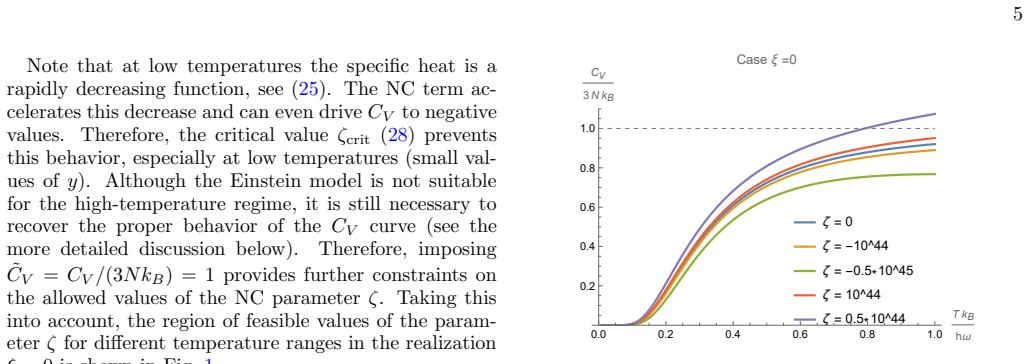
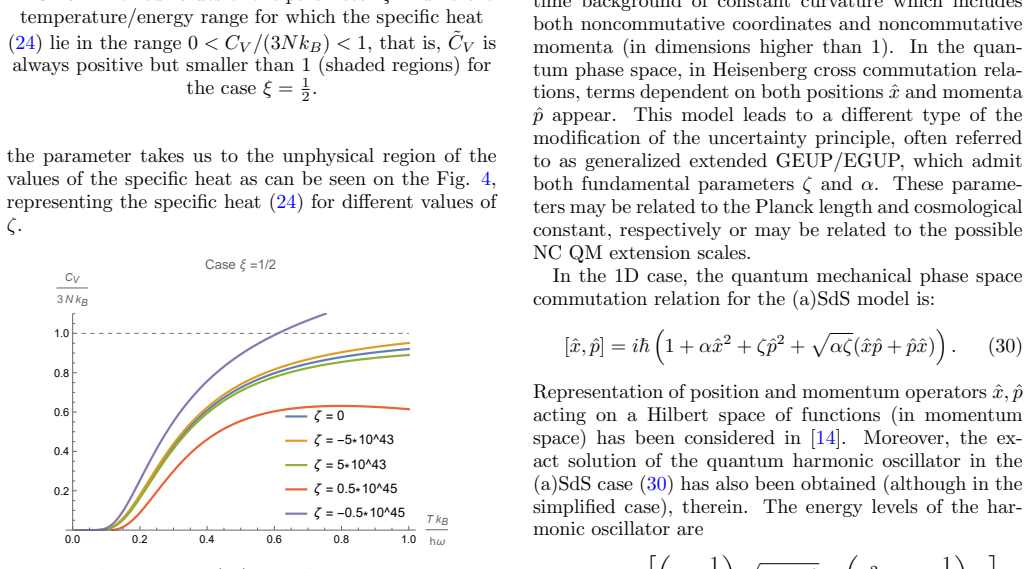
- The specific heat of a crystal acquires a calculable, temperature-dependent correction proportional to A; at high T it suppresses C_V below the Dulong-Petit value, at low T it accelerates the exponential falloff.
- Positivity of the partition function places constraints on ζ; for diamond and the Maggiore realization ζ must be > -1.2×10^43 T (low T) and ζ < 6.6×10^45 (from convergence).
- In the SdS/GEUP case the bound applies to the combination ζ + α/ω² and is frequency-dependent, so one could vary the oscillator frequency to separate the two parameters.
- If the bound is violated, the model predicts a negative specific heat or an unphysical C_V exceeding the classical limit, marking the breakdown of the thermodynamic description.
- The undeformed limit (ζ→0, α→0) recovers the standard Einstein-crystal results, so the corrections are a well-defined extension.
Where Pith is reading between the lines
- The strongest low-temperature bounds (13)-(14) come from the regime where the expansion parameter Aℏω/(kBT) diverges; a resummation of the full series would likely soften or shift those bounds, so the numerical constraints should be read as indicative rather than final.
- The paper's stated convergence condition A > -1/2 conflicts with the fact that for A<0 the spectrum (4) is unbounded below, making the partition sum diverge; requiring genuine convergence would restrict to A≥0 and reverse the sign of the allowed ζ in the low-T bounds.
- The same formalism extends to any harmonic lattice (e.g., graphene or trapped-ion arrays) and to other thermodynamic observables such as entropy and free energy, which could sharpen the bounds with combined measurements.
- A direct test: measure the low-temperature specific heat of diamond with high precision; any deviation from the Einstein curve with the predicted A-linear sign and temperature dependence would be a signature, while a null result would push the deformation scale beyond roughly 10^44 (in the stated units).
Editorial analysis
A structured set of objections, weighed in public.
Referee Report
Summary. The paper analyzes Einstein-crystal thermodynamics in Snyder and Snyder-de Sitter noncommutative backgrounds. Starting from the energy spectrum (3)-(4) taken from earlier work, it derives a first-order-in-A partition function (11), imposes positivity to obtain constraints on the noncommutativity parameter ζ for diamond (Eqs. (13)-(14)), and then computes internal energy (17)-(19) and specific heat (24)-(25). Critical values of ζ from C_V=0 are given in Eqs. (27)-(29), and the analysis is extended to the Snyder-de Sitter/GEUP case with parameter B. The authors claim that noncommutativity produces calculable temperature-dependent corrections to crystal thermodynamics and that positivity and specific-heat requirements yield bounds on the deformation parameters.
Significance. The manuscript has clear strengths: the formal algebra from the partition function through U and C_V is internally consistent, the undeformed limits are correctly recovered, and the numerical application to diamond makes the proposed constraints concrete. If valid, the work would connect GUP/GEUP parameters with table-top condensed-matter observables, which is a timely and interesting direction. However, two load-bearing technical issues—an incorrect convergence condition and an uncontrolled low-temperature expansion—invalidate the headline parameter bounds. The paper therefore does not currently establish its central quantitative claims, although a corrected analysis restricted to the convergent sector could yield meaningful results.
major comments (3)
- [§2, after Eq. (7)] The statement that the series in (7) is convergent for A > -1/2 is incorrect under the paper's own spectrum. Substituting (4), E_n = (ℏω/2)(1+A) + ℏω[n(1+A)+n^2 A]. For any A<0, the n^2 term dominates and E_n → -∞ as n→∞, so e^{-βE_n} diverges and Z does not exist. The exact series is finite only for A≥0. Therefore the negative-A portions of the bounds (13)-(14) and of Figs. 1 and 3 are invalid. In particular, for ξ=0, A=-(μℏω/4)ζ, so ζ≤0 is required; the stated upper bound ζ<6.6×10^45 is spurious. For ξ=1/2, A=(μℏω/2)ζ, so ζ≥0 is required; the lower bound ζ>-3.3×10^45 is spurious.
- [§2, Eqs. (9)-(11)] The first-order expansion in A of exp[-βℏω(n+n^2)A] is not uniform in n. The effective expansion parameter is βℏω A (n+n^2); for n ≳ 1/(βℏω A) the correction is O(1) even for infinitesimal A. In the low-T regime x=ℏω/(k_B T)≫1 used in (13)-(14) and in the critical-ζ analysis of Sec. 3, βℏω A is not small, so the truncated Z (11) and all constraints derived from it are truncation artifacts. A valid low-T treatment requires summing the exact series or controlling the expansion; this directly affects the paper's advertised 'stronger constraints' in the low-temperature regime.
- [§3, Eq. (27) and Figs. 1, 3] The critical values ζ_crit from C_V=0 are evaluated in regions affected by the two preceding issues: for ξ=0, Eq. (28) is negative and therefore lies in the divergent region A<0; for ξ=1/2, Eq. (29) is positive, but the low-T asymptotics used to discuss it require A x ≪ 1, which fails as T→0. Consequently the shaded allowed regions in Figs. 1 and 3 and the concluding statement that ζ ≈ ±10^44 is allowed are not established. The paper should re-derive the allowed parameter set using the exact partition function for A≥0 and state which bounds survive after a controlled expansion.
minor comments (3)
- [Footnote 2 and Appendix A] The phonon energy is quoted as 0.19 eV ~ 0.30441356046×10^{-19} J in the footnote but as 3.04×10^{-20} J in Appendix A. The latter is the correct conversion; the main-text value appears to be a decimal-point typo.
- [§2 and §4, Eqs. (7) and (33)] The same convergence assertion 'convergent for A > -1/2' (and B > -1/2) appears in both sections. Both statements should be corrected to reflect the actual condition A≥0 (B≥0) required by the spectrum.
- [Notation, §2] The variable x is used both for βℏω in (A1) and for ℏω/(k_B T) in (20) and (22). These are the same dimensionless ratio, but the notation should be defined once and used consistently.
Circularity Check
No significant circularity: the thermodynamic corrections are derived from an externally imported exact oscillator spectrum; self-citations are contextual and non-load-bearing.
full rationale
The derivation chain starts from the assumed Snyder/SdS commutation relations (1)/(30) and imports the exact harmonic-oscillator spectrum (3)/(31) from the external papers [3] (Chang et al.) and [14] (Mignemi), neither of which is a self-citation. The paper then expands the spectrum to first order in A (Eq. 4), constructs the partition function (7), expands it (9–11), and obtains internal energy and heat capacity by standard statistical mechanics (17, 19, 24). The constraints on zeta follow from requiring Z > 0 (12, A1–A3) and C_V > 0 (26–29), i.e. self-consistency conditions of the model on its own parameter, not predictions matched to or fitted against data. No fitted parameter is relabeled as a prediction. Self-citations [6] and [9] are used only for context (classification of GUP/GEUP limits and prior motivational indications from the authors' earlier work); they are not load-bearing for the partition-function algebra, which rests on external, parameter-free exact solutions with stated assumptions. Therefore no circular step is present. Separate correctness risks exist but are not circular: the assertion after Eq. (7) that the series converges for A > -1/2 is false under the paper's own spectrum (4), because for A < 0, E_n ~ hbar*omega*A*n^2 -> -infinity, making Z divergent; the correct convergence condition is A >= 0. This invalidates the negative-A bounds in (13)–(14) and Figs. 1/3. In addition, the first-order-in-A expansion used in (9)–(11), (19), (24) is not uniformly valid at low temperatures, where A*hbar*omega/(k_B*T) diverges. These are mathematical/validity defects, not circular reasoning.
Axiom & Free-Parameter Ledger
free parameters (3)
- zeta (Snyder noncommutativity/deformation parameter) =
No fit; bounded by self-consistency: for xi=0, -1.2*10^43 T < zeta < 6.6*10^45; for xi=1/2, -3.3*10^45 < zeta < 5.9*10^4
- xi (Snyder realization parameter) =
Hand-chosen values 0, 1/2 (and 1/6 for Weyl)
- alpha (SdS curvature parameter)
axioms (5)
- domain assumption Exact 1D oscillator spectrum in Snyder background, Eq. (3), imported from Chang-Minic-Okamura-Takeuchi [3].
- domain assumption Exact oscillator spectrum in (a)SdS background, Eq. (31), imported from Mignemi [14].
- domain assumption Einstein model of a 3D crystal: N independent oscillators with a common frequency; E_tot = 3N E_n.
- ad hoc to paper First-order-in-A expansion of the Boltzmann factor and partition function is valid at all temperatures, including T -> 0.
- ad hoc to paper The partition-function series is 'convergent for A > -1/2' (asserted after Eq. (7)).
read the original abstract
We investigate the behavior of Einstein crystals in noncommutative backgrounds described by the Snyder and Snyder-de Sitter models. Possible novel effects, which may arise in realistic systems such as diamond crystals, are analyzed within a thermodynamical framework. We show that noncommutativity influences the key thermodynamic quantities, including internal energy and specific heat. These corrections can be directly related to modifications of the underlying uncertainty relations, of the generalized uncertainty principle (GUP) and generalized extended uncertainty principle (GEUP) types.
Figures



Reference graph
Works this paper leans on
-
[1]
Con- sequently, direct experimental access to such effects has been considered unattainable
INTRODUCTION The conventional quantum gravity research focused for a long time on the search of quantum gravitational ef- fects at the Planck-scale (very high energies 10 19 GeV or correspondingly very small length scales 10 −35 m). Con- sequently, direct experimental access to such effects has been considered unattainable. Recently, however, sub- stantia...
Pith/arXiv arXiv 2026
-
[2]
Our derivation bases on the solution to the Schr¨ odinger equation obtained in the presence of the modified quantum mechanical phase space relations found in [3]
P AR TITION FUNCTION OF A 1D OSCILLA TOR IN SNYDER (GUP) BACKGROUND Starting with the Hamiltonian of a 1D harmonic oscil- lator ˆH= 1 2 µω2 ˆx2 + 1 2µ ˆp2 we want to incorporate the modifications arising from noncommutativity (1) (or a generalized uncertainty prin- ciple (GUP) corresponding to (1)). Our derivation bases on the solution to the Schr¨ odinge...
-
[3]
We have taken the energy of a quantum as ℏω= 0.19eV∼0.30441356046×10 −19J while the effective mass of the oscillator is 9.96×10 −27kg
INTERNAL ENERGY AND HEA T CAP ACITY OF 3-DIM SOLIDS Since we want to consider a 3 dimensional (3D) solid at low temperatures modeled by the Einstein crystal, let us assume that each oscillator has the same frequencyω, so the total energy of the 3D crystal withNoscillators can be expressed as 3 Etot = 3NX i=0 (En)i = 3N En,(15) 2 A diamond crystal is well ...
-
[4]
(ANTI-)SNYDER-DE SITTER AND THE GENERALIZED EXTENDED (GEUP) CASE As another possible extension of quantum mechan- ics one can consider a different type of noncommutative background, for example Snyder-de Sitter (SdS) model. SdS is a generalization of the Snyder model to a space- time background of constant curvature which includes both noncommutative coor...
-
[5]
Such models are often linked to phenomenolog- ical effects of quantum theories of gravity via e.g
CONCLUSIONS The aim of this paper was to propose an investigation into how low-energy consequences of modified quantum phase space models could be identified in table-top exper- iments. Such models are often linked to phenomenolog- ical effects of quantum theories of gravity via e.g. GUP or GEUP models. 6 in the same shortcut notationy= 1 x = kB T ℏω andx...
2022
-
[6]
A. Pacho l. Generalized Extended Uncertainty Principles, Liouville theorem and density of states: Snyder-de Sitter and Yang models. Nucl. Phys. B, 1010:116771, 2025, arXiv:2409.05110
Pith/arXiv arXiv 2025
-
[7]
H. S. Snyder. Quantized space-time. Physical Review, 71(1):38, 1947
1947
-
[8]
M. V. Battisti and S. Meljanac. Scalar Field Theory on Non-commutative Snyder Space-Time. Phys. Rev. D, 82:024028, 2010, arXiv:1003.2108
Pith/arXiv arXiv 2010
-
[9]
Here we focus on the GUP (and later GEUP)-induced modifications to the energy spectrum of a one-dimensional harmonic oscillator, following [16] (and
and in [15]. Here we focus on the GUP (and later GEUP)-induced modifications to the energy spectrum of a one-dimensional harmonic oscillator, following [16] (and
-
[10]
for a recent overview of various approaches. In this context, the first type of realization (ξ= 1/2), leads to the standard quadratic GUP (QGUP) relations, while the second one (ξ= 0) is related to the so-called higher order type GUP, see e.g. [11, 12]. One can also consider the case of modified quantum phase space (1) with the negative coupling parameter...
-
[11]
Pedalino, B
S. Pedalino, B. E. Ram ´ ırez-Galindo, R. Ferstl, K. Horn- berger, M. Arndt, and S. Gerlich. Probing quantum mechanics with nanoparticle matter-wave interferometry. Nature, 649(8098):866–870, 2026
2026
-
[12]
S. Bose, I. Fuentes, A. A. Geraci, S. M. Khan, S. Qvar- fort, M. Rademacher, M. Rashid, M. Toroˇ s, H. Ulbricht, and C. C. Wanjura. Massive quantum systems as in- terfaces of quantum mechanics and gravity. Rev. Mod. Phys., 97(1):015003, 2025, arXiv:2311.09218
Pith/arXiv arXiv 2025
-
[13]
L. N. Chang, D. Minic, N. Okamura, and T. Takeuchi. Exact solution of the harmonic oscillator in arbitrary dimensions with minimal length uncertainty relations. Phys. Rev. D, 65:125027, 2002, arXiv:hep-th/0111181
Pith/arXiv arXiv 2002
-
[14]
This allows us, in particu- lar, to obtain indicative constraints on the NC parameter from the requirement of positivity of the partition func- tion
respectively), and derive the corresponding partition function, including NC corrections up to the first order in the deformation parameter. This allows us, in particu- lar, to obtain indicative constraints on the NC parameter from the requirement of positivity of the partition func- tion. We then compute the internal energy and specific heat, and discuss...
-
[15]
Bawaj, C
M. Bawaj, C. Biancofiore, M. Bonaldi, F. Bonfigli, A. Borrielli, G. Di Giuseppe, L. Marconi, F. Marino, R. Natali, A. Pontin, et al. Probing deformed commu- tators with macroscopic harmonic oscillators. Nature communications, 6(1):7503, 2015
2015
-
[16]
W. M. Campbell, M. E. Tobar, M. Goryachev, and S. Galliou. Improved constraints on minimum length models with a macroscopic low loss phonon cavity. Phys- ical Review D, 108(10):102006, 2023
2023
-
[17]
A. Pacho l and A. Wojnar. Fermi equation of state with finite temperature corrections in quantum space-times approach: Snyder model vs GUP case. Class. Quant. Grav., 40(19):195021, 2023, arXiv:2304.08215
Pith/arXiv arXiv 2023
-
[18]
P. Bosso, G. G. Luciano, L. Petruzziello, and F. Wag- ner. 30 years in: Quo vadis generalized uncertainty principle? Class. Quant. Grav., 40(19):195014, 2023, arXiv:2305.16193
Pith/arXiv arXiv 2023
-
[19]
M. Maggiore. Quantum groups, gravity and the general- ized uncertainty principle. Phys. Rev. D, 49:5182–5187, 1994, arXiv:hep-th/9305163
Pith/arXiv arXiv 1994
-
[20]
S. Segreto and G. Montani. Extended GUP formulation and the role of momentum cut-off. Eur. Phys. J. C, 83(5):385, 2023, arXiv:2208.03101
Pith/arXiv arXiv 2023
-
[21]
S. Mignemi. Classical and quantum mechanics of the nonrelativistic Snyder model. Phys. Rev. D, 84:025021, 2011, arXiv:1104.0490
Pith/arXiv arXiv 2011
-
[22]
S. Mignemi. Classical and quantum mechanics of the nonrelativistic Snyder model in curved space. Class. Quant. Grav., 29:215019, 2012, arXiv:1110.0201
Pith/arXiv arXiv 2012
-
[23]
Riasat and B
S. Riasat and B. P. Mandal. Effect of quantum gravity on specific heat of solid. The European Physical Journal Plus, 138(10):1–10, 2023. 10
2023
-
[24]
L. N. Chang, D. Minic, N. Okamura, and T. Takeuchi. The Effect of the minimal length uncertainty relation on the density of states and the cosmological constant problem. Phys. Rev. D, 65:125028, 2002, arXiv:hep- th/0201017
arXiv 2002
-
[25]
A. Kozak and A. Wojnar. Invariant quantities of scalar–tensor theories for stellar structure. Eur. Phys. J. C, 81(6):492, 2021, arXiv:2103.06601
Pith/arXiv arXiv 2021
-
[26]
A. Wojnar. Bose-Einstein condensate and liquid He4: Implications of the GUP and modified gravity cor- respondence. Phys. Rev. D, 109(12):124031, 2024, arXiv:2401.01159
Pith/arXiv arXiv 2024
-
[27]
Lope-Oter and A
E. Lope-Oter and A. Wojnar. Constraining Palatini grav- ity with GR-independent equations of state for neutron stars. JCAP, 02:017, 2024
2024
-
[28]
A. Wojnar. When waves meet rays: Seismic vibrations and cosmic showers to test gravity. arXiv:2604.07333
discussion (0)
Sign in with ORCID, Apple, or X to comment. Anyone can read and Pith papers without signing in.